


 |
市場調查報告書
商品編碼
2062142
歐洲冷藏運輸:市場佔有率分析、產業趨勢與統計及成長預測(2026-2031 年)Europe Refrigerated Transport - Market Share Analysis, Industry Trends & Statistics, Growth Forecasts (2026 - 2031) |
||||||

※ 本網頁內容可能與最新版本有所差異。詳細情況請與我們聯繫。
根據 Mordor Intelligence 預測,歐洲冷藏運輸市場規模預計將在 2025 年達到 784.4 億美元,2026 年達到 815.8 億美元,2031 年達到 995.2 億美元,2026 年至 2031 年的複合年成長率為 4.0%。
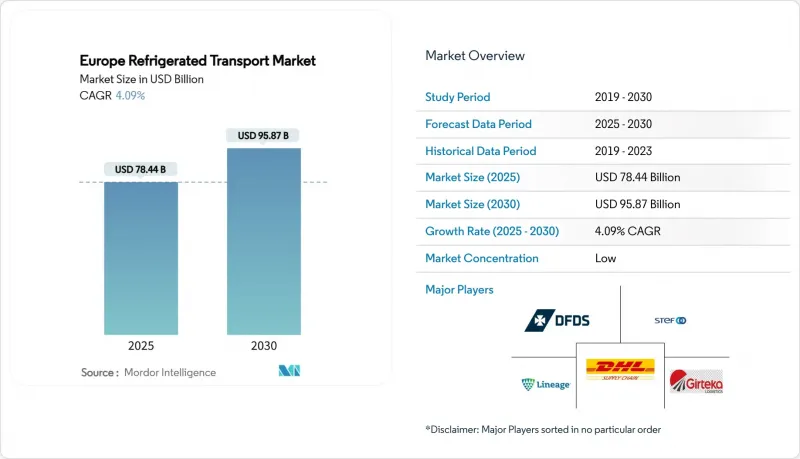
醫藥和食材自煮包物流對精準溫控的需求日益成長,加之零售商致力於實現淨零排放運輸,促使人們重新評估車輛規格和路線規劃。本報告按運輸方式(公路、鐵路、海運、空運)、溫度範圍(冷藏 0–5 度C、冷凍 -18–0 度C C 、常溫、超低溫/極低溫 20 度C及以上)、應用領域(食品飲料、醫藥及生命科學、化工及特種材料、花卉園藝及其他)以及地區(德國、法國及其他)進行園藝地區(德國和其他地區)進行園藝地區(德國及其他)。市場預測以美元計價。
歐洲冷藏運輸市場的趨勢與洞察
利用物聯網實現端對端低溫運輸可視化
5G連接的感測器如今能夠即時傳輸公路、鐵路、海運和空運過程中的溫度、濕度和位置信息,在使用開利Lynx Fleet等平台的車隊中,溫度偏差事件的發生率降低了高達35%。保險公司在驗證了可視性後,會提供10-15%的保費折扣,提高了技術投資的盈利。歐洲藥品良好分銷規範(GDP)標準要求持續監測,這推動了物聯網技術的應用,使其不再局限於早期採用者。拖車製造商正在工廠內整合遠端資訊處理技術,例如Schmitz Cargoble公司實施的“Atlantis全球系統”,該系統將追蹤硬體整合到新型冷藏拖車中。基於感測器數據的預測分析可以在貨物風險增加之前檢測到壓縮機故障,從而將意外停機時間減少約四分之一。
加強疫苗宣傳活動推動藥品物流
除了持續進行新冠肺炎和流感加強疫苗接種計畫外,對溫度敏感的生物製藥需求激增,使得2-8°C的運輸路線幾乎滿載運轉。 DHL已在歐洲各地擴建了其GDP認證的樞紐,並增設了檢驗的儲存區域,以支援運輸過程中的多溫區處理。用於治療糖尿病和肥胖症的高價值GLP-1藥物正在強化控制系統下運輸,因此其高昂的運費也物有所值。運輸方式正在多元化發展,穩定性較強的產品正逐漸轉向海運和鐵路運輸以減少排放,而細胞和基因療法則出於速度考慮,繼續採用空運。內建數據記錄器的可重複使用包裝正日益普及,透過多次使用減少了廢棄物,並將包裝總成本降低了近一半。
歐盟減少氟碳化合物配額,導致低全球暖化潛勢冷媒的價格上漲。
2024/573號法規將使氫氟碳化合物(HFCs)的供應量在2027年減少約88%,在2030年減少約95%,預計R452A的價格將上漲至每公斤49美元(45歐元)。相比之下,天然二氧化碳和丙烷的價格為每公斤6至17美元。營運商將不得不承擔每輛卡車1.6萬至3.7萬美元的維修費用,以安裝符合法規要求的系統。運輸公司已引入附加費來抵銷飆升的原料成本,但承諾使用新一代冷媒將使其對氣候的影響減少89%。對於營運老舊車輛的小規模運輸公司而言,資金負擔最為沉重。
細分市場分析
至2025年,陸路運輸將佔歐洲冷藏運輸市場佔有率的65.97%。這主要得益於為食品和藥品托運人提供的靈活的門到門服務。儘管預計到2025年初,歐洲將出現42.6萬個卡車司機崗位的缺口,加上通行費大幅上漲,導致卡車運輸的成本效益降低,但由於嵌入式資訊系統和直達門市路線的普及,卡車運輸仍然至關重要。在碳排放目標嚴格的地區,鐵路和海運的市場佔有率正在不斷成長。布倫納基線隧道全面開通後,預計將使走廊的日列車運力提高50%以上(每天最多可容納400列火車),從而促進冷凍蛋白從北部港口向義大利零售商的配送。航空貨運以7.66%的複合年成長率成長,運輸高價值生物製藥產品,尤其是來自法蘭克福和巴塞爾等製藥產業叢集,這些產品運費較高。此外,沿海航運路線上氣調冷藏貨櫃的興起,減輕了擁擠道路的負擔,並將柑橘類水果和漿果的保存期限延長了一周。
隨著電動和柴油運輸的發展趨勢趨於分化,陸路運輸的相對利潤率正在下降。電池卡車在250公里以下的短途配送中表現出色,但在長途運輸中卻面臨負載容量的限制,而氫燃料卡車原型則瞄準了漢堡-慕尼黑這條主要幹線。車隊營運商正透過雙燃料策略來規避風險,將電池驅動的最後一公里配送貨車與液化氣幹線牽引車相結合,在滿足排放法規要求的同時,又不犧牲續航里程。多式聯運業者宣稱,與僅使用卡車運輸相比,二氧化碳排放量最多可減少75%,這一數字對報告範圍3進展的零售商來說極具吸引力。隨著可視性價值的不斷提升,將物聯網遙測技術整合到卡車、鐵路和海運環節的承運商正吸引生命科學領域托運人的新競標。
其他好處:
- Excel格式的市場預測(ME)表
- 3個月的分析師支持
目錄
第1章:引言
- 研究假設和市場定義
- 調查範圍
第2章:調查方法
第3章執行摘要
第4章 市場狀況
- 市場概覽
- 市場促進因素
- 利用物聯網實現端對端低溫運輸可視化
- 加強疫苗接種宣傳活動推動冷藏藥品的分發
- 食材自煮包和烹飪食材訂閱服務的蓬勃發展。
- 零售商的淨零排放目標正在加速車輛電氣化。
- 用於拖車製冷系統的氫燃料電池動力包
- 放寬跨境鐵路運輸溫控多式聯運路線限制
- 市場限制因素
- 尖峰時段電費推高了電動冷藏貨櫃的營運成本。
- 歐盟減少氟碳化合物配額,導致低全球暖化潛勢冷媒的價格上漲。
- 鋰離子電池驅動冷藏貨櫃卡車ADR認證技術人員短缺
- 由於托盤規格不匹配,導致逆向物流運輸浪費。
- 價值供應鏈分析
- 監理情勢
- 技術展望
- 波特五力模型
第5章 市場規模與成長預測
- 透過交通工具
- 路
- 鐵路
- 海
- 航空
- 溫度
- 冷藏(0-5 度C)
- 冰點(-18 至 0°C)
- 環境的
- 冰凍/超低溫(-20 度C或更低)
- 透過使用
- 食品/飲料
- 製藥和生命科學
- 化學品和特殊材料
- 花卉和園藝
- 其他生鮮食品
- 國家
- 德國
- 法國
- 英國
- 義大利
- 西班牙
- 荷蘭
- 比利時
- 波蘭
- 其他歐洲國家
第6章 競爭情勢
- 市場集中度
- 策略趨勢
- 市佔率分析
- 公司簡介
- DHL Group
- DFDS Logistics
- STEF Group
- Lineage Logistics
- Girteka Logistics
- Waberer's International
- DSV
- Dachser
- Frigoscandia
- Kuehne+Nagel
- Hellmann Worldwide Logistics
- Noatum Logistics
- Rhenus Logistics
- Geodis
- XPO Logistics
- Frigotrans
- Transports Octavio
- Constellation Cold Logistics
- Culina Group
- AGI Global Logistics Ltd*
第7章 市場機會與未來展望
According to Mordor Intelligence, the europe refrigerated transport market size is projected to be USD 78.44 billion in 2025, USD 81.58 billion in 2026, and reach USD 99.52 billion by 2031, growing at a CAGR of 4.0% from 2026 to 2031.
Heightened demand for precise temperature control in pharmaceutical and meal-kit logistics, coupled with retailer net-zero commitments, is reshaping fleet specifications and route planning. This report is Segmented by Mode of Transport (Road, Rail, Sea, Air), by Temperature (Chilled 0-5°C, Frozen -18-0°C, Ambient, Deep-Frozen/Ultra-Low More Than 20°C), by Application (Food & Beverages, Pharmaceuticals & Life-Sciences, Chemicals & Specialty Materials, Floral & Nursery, and More), and by Geography (Germany, France, and More). The Market Forecasts are Provided in Terms of Value (USD).
Europe Refrigerated Transport Market Trends and Insights
IoT-Enabled End-to-End Cold-Chain Visibility
5G-linked sensors now stream temperature, humidity, and location data across road, rail, sea, and air legs, cutting excursion incidents by up to 35% for fleets deploying platforms such as Carrier's Lynx Fleet. Insurance firms are rewarding documented visibility with 10-15% premium discounts, improving return on technology spend. European Good Distribution Practice rules for medicines mandate continuous monitoring, pushing IoT uptake beyond early adopters. Trailer builders are integrating telematics at the factory, evidenced by Schmitz Cargobull's Atlantis Global System purchase, which embeds tracking hardware into new reefers. Predictive analytics built on sensor streams now flag compressor faults before cargo risk escalates, trimming unplanned downtime by roughly a quarter.
Booster Immunization Campaigns Driving Pharma Flows
Continued COVID-19 and influenza booster programs, plus a surge of temperature-sensitive biologics, keep 2-8 °C lanes running near capacity. DHL has expanded GDP-certified hubs across Europe, adding validated storage zones to support multi-temperature breaks in transit. High-value GLP-1 drugs for diabetes and obesity therapy move under reinforced chain-of-custody protocols, justifying premium freight rates. Modal diversification is growing; stable products shift to ocean or rail to cut emissions, while cell and gene therapies stay in air corridors for speed. Reusable packaging with embedded data-loggers is gaining traction, cutting waste and slicing total packaging spend by nearly half over multi-cycle use.
EU F-Gas Quota Cuts Raising Low-GWP Refrigerant Prices
Regulation 2024/573 slashes hydrofluorocarbon availability by nearly 88% in 2027 and 95% in 2030, driving R452A prices toward USD 49 per kg (EUR 45) versus USD 6-17 for natural CO2 or propane. Operators face retrofit bills of USD 16,000-37,000 per truck to adopt compliant systems. Carrier has introduced surcharges to offset steep input costs, yet promises 89% lower climate impact with next-gen refrigerants. Capital strain is harshest on small haulers that run older fleets.
Other drivers and restraints analyzed in the detailed report include:
- Meal-Kit and Ready-to-Cook Subscription Boom
- Retailer Net-Zero Targets Accelerating Fleet Electrification
- High Fuel & Energy Prices
For complete list of drivers and restraints, kindly check the Table Of Contents.
Segment Analysis
Road transport captured 65.97% of the Europe refrigerated transport market share in 2025, anchored by flexible door-to-door service for grocery and pharma shippers. Driver shortages, such as 426,000 vacancies in early 2025 and steep toll hikes, are eroding cost advantages, but embedded telematics and expanded direct-store routes keep trucks indispensable. Rail and sea gain share where carbon targets are stringent; the Brenner Base Tunnel is forecast to increase the corridor's daily train capacity by over 50% (accommodating up to 400 trains per day) once fully opened, drawing frozen protein flows from Northern ports to Italian retailers. Air freight, paced by 7.66% CAGR, channels high-value biologics that justify premium lift prices, especially out of pharma clusters in Frankfurt and Basel. The ascent of controlled-atmosphere reefers on short-sea lanes also eases pressure on congested roads, extending shelf life by an extra week for citrus and berries.
Road's relative margin narrows as electricity and diesel dynamics diverge. Battery trucks excel on sub-250 km milk runs but struggle with long-haul payload penalties, while hydrogen prototypes target the Hamburg-Munich spine. Fleet operators hedge through dual-fuel strategies, pairing battery last-mile vans with liquid gas line-haul tractors to meet emission caps without sacrificing range. Intermodal players market CO2 savings of up to 75% versus truck-only delivery, a compelling figure for retailers reporting Scope 3 progress. As the value of visibility rises, carriers that integrate IoT telemetry across truck, rail, and vessel legs are winning new tenders from life-science shippers.
List of Companies Covered in this Report:
- DHL Group
- DFDS Logistics
- STEF Group
- Lineage Logistics
- Girteka Logistics
- Waberer's International
- DSV
- Dachser
- Frigoscandia
- Kuehne + Nagel
- Hellmann Worldwide Logistics
- Noatum Logistics
- Rhenus Logistics
- Geodis
- XPO Logistics
- Frigotrans
- Transports Octavio
- Constellation Cold Logistics
- Culina Group
- AGI Global Logistics Ltd*
Additional Benefits:
- The market estimate (ME) sheet in Excel format
- 3 months of analyst support
TABLE OF CONTENTS
1 Introduction
- 1.1 Study Assumptions and Market Definition
- 1.2 Scope of the Study
2 Research Methodology
3 Executive Summary
4 Market Landscape
- 4.1 Market Overview
- 4.2 Market Drivers
- 4.2.1 IoT-Enabled End-To-End Cold-Chain Visibility
- 4.2.2 Booster Immunization Campaigns Driving Refrigerated Pharma Flows
- 4.2.3 Meal-Kit and Ready-To-Cook Subscription Boom
- 4.2.4 Retailer Net-Zero Targets Accelerating Fleet Electrification
- 4.2.5 Hydrogen Fuel-Cell Power Packs for Trailer Refrigeration
- 4.2.6 Liberalized Cross-Border Rail Paths for Temperature-Controlled Intermodal
- 4.3 Market Restraints
- 4.3.1 Peak-Hour Electricity Tariffs Inflating E-Reefer OPEX
- 4.3.2 EU F-Gas Quota Cuts Raising Low-GWP Refrigerant Prices
- 4.3.3 ADR-Qualified Technician Shortage for Lithium Battery Reefers
- 4.3.4 Pallet Standard Mismatches Causing Reverse-Logistics Dead-Runs
- 4.4 Value / Supply-Chain Analysis
- 4.5 Regulatory Landscape
- 4.6 Technological Outlook
- 4.7 Porter's Five Forces
- 4.7.1 Threat of New Entrants
- 4.7.2 Bargaining Power of Suppliers
- 4.7.3 Bargaining Power of Buyers
- 4.7.4 Threat of Substitutes
- 4.7.5 Industry Rivalry
5 Market Size and Growth Forecasts (Value)
- 5.1 By Mode of Transport
- 5.1.1 Road
- 5.1.2 Rail
- 5.1.3 Sea
- 5.1.4 Air
- 5.2 By Temperature
- 5.2.1 Chilled (0-5 °C)
- 5.2.2 Frozen (-18-0 °C)
- 5.2.3 Ambient
- 5.2.4 Deep-Frozen / Ultra-Low (more than -20 °C)
- 5.3 By Application
- 5.3.1 Food and Beverages
- 5.3.2 Pharmaceuticals and Life-sciences
- 5.3.3 Chemicals and Specialty Materials
- 5.3.4 Floral & Nursery
- 5.3.5 Other Perishables
- 5.4 By Country
- 5.4.1 Germany
- 5.4.2 France
- 5.4.3 United Kingdom
- 5.4.4 Italy
- 5.4.5 Spain
- 5.4.6 Netherlands
- 5.4.7 Belgium
- 5.4.8 Poland
- 5.4.9 Rest of Europe
6 Competitive Landscape
- 6.1 Market Concentration
- 6.2 Strategic Moves
- 6.3 Market Share Analysis
- 6.4 Company Profiles (includes Global level Overview, Market level overview, Core Segments, Financials as available, Strategic Information, Market Rank/Share for key companies, Products & Services, and Recent Developments)
- 6.4.1 DHL Group
- 6.4.2 DFDS Logistics
- 6.4.3 STEF Group
- 6.4.4 Lineage Logistics
- 6.4.5 Girteka Logistics
- 6.4.6 Waberer's International
- 6.4.7 DSV
- 6.4.8 Dachser
- 6.4.9 Frigoscandia
- 6.4.10 Kuehne + Nagel
- 6.4.11 Hellmann Worldwide Logistics
- 6.4.12 Noatum Logistics
- 6.4.13 Rhenus Logistics
- 6.4.14 Geodis
- 6.4.15 XPO Logistics
- 6.4.16 Frigotrans
- 6.4.17 Transports Octavio
- 6.4.18 Constellation Cold Logistics
- 6.4.19 Culina Group
- 6.4.20 AGI Global Logistics Ltd*
7 Market Opportunities and Future Outlook

 冷藏運輸市場:2026-2032年全球市場預測(依運輸方式、冷媒類型、技術類型及應用分類)
 冷藏道路運輸市場:依運輸方式、冷卻方式、技術及地區分類
 冷藏運輸市場規模、佔有率、趨勢和預測:按運輸方式、技術、溫度、應用和地區分類,2026-2034年冷藏運輸市場:依運輸方式、技術、溫度及應用分類。
 2026年全球冷藏運輸市場報告
 全球冷藏運輸市場規模、佔有率、趨勢和成長分析報告(2026-2034)
 冷藏運輸市場-全球產業規模、佔有率、趨勢、機會及預測(依運輸方式、產品類型、技術、溫度、地區及競爭格局分類,2021-2031年)日本冷藏運輸市場報告(按運輸方式、技術、溫度、應用和地區分類,2026-2034年)
 冷藏運輸市場規模、佔有率及成長分析(按技術、模式、溫度範圍、應用和地區分類)-產業預測,2026-2033年
 2025-2029年全球冷藏運輸市場