


 |
市場調查報告書
商品編碼
2062127
職業訓練:市場佔有率分析、產業趨勢與統計、成長預測(2026-2031)Vocational Training - Market Share Analysis, Industry Trends & Statistics, Growth Forecasts (2026 - 2031) |
||||||

※ 本網頁內容可能與最新版本有所差異。詳細情況請與我們聯繫。
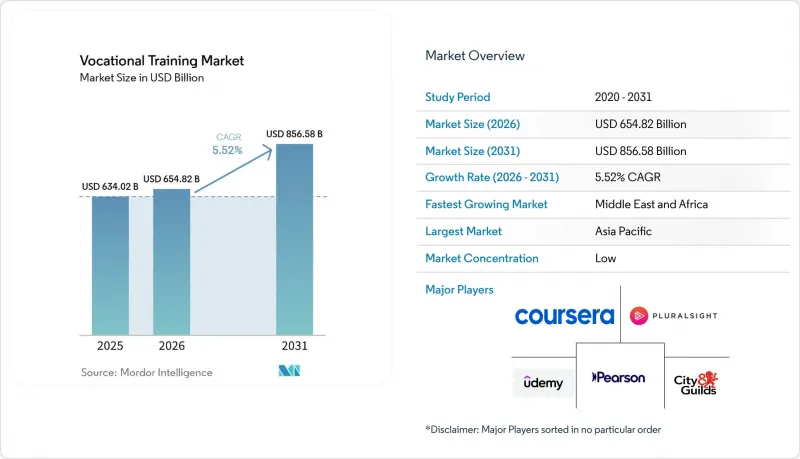
根據 Mordor Intelligence 預測,職業訓練市場規模將從 2025 年的 6,340.2 億美元成長到 2026 年的 6,548.2 億美元,然後在 2031 年達到 8,565.8 億美元,2026 年至 2031 年的複合年成長率為 5.52%。
本報告按交付方式(面授/離線培訓、線上/虛擬培訓等)、培訓類型(技術技能、非技術技能)、最終用戶(學生和初次求職者等)、提供者類型(公共/政府機構、私營機構等)以及地區(北美、南美等)進行分類。市場預測以美元計價。
全球職業培訓市場趨勢與洞察
現在,基於技能的招募方式已經超過了基於學歷的招募方式。
雇主越來越重視可證明的技能和實務經驗,這導致職業培訓市場對檢驗資格和實踐評估的需求日益成長。各州放寬執照核准門檻的改革措施提高了技能型和護理型從業人員的流動性,促進了跨地區的快速就業和職業發展。這一趨勢獎勵培訓機構引入與職位要求和安全標準緊密相關的微資格認證。同時,它也促使選拔方式轉向客觀的技能考核,這與職業訓練市場基於能力的課程體系高度契合。培訓機構與雇主聯盟合作設計專案、評估和評估標準,能夠更清楚地向招募團隊展現學員的就業準備程度。這些措施加強了職業訓練市場中教育與勞動市場需求之間的回饋機制。
雇主檢驗的微證書採用
檢驗的數位徽章在正規和非正規教育領域都越來越受歡迎,頒發機構優先考慮防篡改設計、包含豐富元資料的技能說明以及安全的錢包存儲,以增強其在職業培訓市場的便攜性。透過開放的徽章標準實現互通性,正在推動高校和培訓機構採用數位徽章,其在資訊科技、先進製造業和醫療保健等行業的認可度也在不斷提高。技能定義和評估證據的透明度使雇主無需查閱冗長的成績單即可分析學習成果。這種透明度也支持職業培訓市場中可疊加的學習路徑,將短期資格證書組合起來,最終獲得更高級別的認證。隨著品質框架的不斷發展,某些地區的徽章與受監管認證之間的一致性正在提高。這些進步減輕了學習者的負擔,並增強了短期資格證書在職業培訓市場中的認可。
學歷資格跨境轉移性低
職業資格認證因國家而異,導致許多勞工在搬遷後必須接受重複培訓,從而降低了職業培訓市場的盈利。越南的農村技能發展計劃等國家級項目,透過協調各部會和地方政府部門,展示了集中管治如何透過統一標準和實施方案來提高培訓完成率和就業成果。肯亞的雙元學徒模式由國家工業培訓局認證,是可移植認證的典範,符合雇主需求和正式的合約結構。雖然數位徽章平台提高了技能數據的互通性,但受監管的職業仍依賴傳統的認證途徑,而這些流程較為緩慢,限制了職業培訓市場的跨境轉移。在多個國家運作的培訓機構面臨各國不同的檢驗要求,增加了行政成本。與區域框架的銜接仍然不均衡,阻礙了人才流動,並提高了進入職業培訓市場的門檻。
細分市場分析
至2025年,課堂和線下培訓將佔職業培訓市場規模的50.7%。這是因為在工程、醫療保健和技術工種領域,實踐安全培訓、實驗室操作和實踐指導仍然至關重要。混合式學習預計到2031年將以14.4%的複合年成長率成長,因為培訓機構將自定進度模組、虛擬課堂和麵對面實踐培訓相結合,以提高職業培訓市場的柔軟性和技能掌握程度。高等教育案例研究表明,混合式教學模式與模擬和企劃為基礎學習相結合,可以增強學習者的參與度和問題解決能力。培訓機構正透過教師技能發展和對平台的逐步投資來應對基礎設施和教學方法的挑戰。包括虛擬實境(VR)和擴增實境(AR)在內的身臨其境型技術在錯誤成本高的領域越來越受到關注,有助於提升職業培訓市場的實踐能力。在安全至關重要的領域的合規框架中,符合國家和ISO標準的基於模擬的評估正逐漸被接受。
為了平衡工作和照顧家庭的責任,職場人士正利用線上和虛擬學習管道,這一趨勢推動了職業培訓市場對可融入日常工作流程的短期模組的需求。個人化至關重要,因為如果學習內容與學習者的角色和技能水平不符,他們的興趣就會減弱。為了應對這一趨勢,供應商正擴大採用建議引擎和自適應測驗。在職業培訓市場,企業透過將理論學習轉移到數位化形式,並將面對面時間分配給實踐培訓和輔導,從而降低了差旅、場地和材料成本。英國的學院正在將身臨其境型實驗室和演算法指導融入混合式課程,以增強學生的實際問題應對力。隨著混合工作模式的日益普及,混合式設計仍然是整個職業培訓產業優先考慮技能快速習得策略的核心。在職業培訓市場中,平衡數位擴充性和麵對面教學將提升學習者和雇主雙方的成果。
到2025年,技術技能將佔職業培訓市場佔有率的63.6%,這主要得益於雇主對與生產和服務交付直接相關的工程、工業、IT和醫療保健能力的需求。預計到2031年,資訊科技(IT)產業將以9.7%的複合年成長率成長,因為各組織將人工智慧、網路安全、資料和雲端運算相關職位列為優先事項,這將導致職業培訓市場對基於崗位的學習路徑的需求集中。政府主導的先進製造業和清潔能源領域的學徒計畫正在擴大關鍵市場接受大規模實踐培訓的能力。由於護理人員和技術人員長期短缺,以及對最新合規和安全認證的需求,醫療保健及相關項目正在擴張。飯店管理、商業和藝術等非技術課程對於服務型經濟和創新職業仍然至關重要,但它們在職業培訓市場的成長速度落後於技術領域。除了技術專長之外,雇主也更加重視軟性技能,以使管理人員和現場團隊能夠適應不斷變化的工具和工作流程。
美國和英國優先考慮製造業回流和基礎設施建設,這擴大了造船、建築和國防相關行業的就業能力,從而為職業培訓市場輸送了更多可立即上崗的畢業生。在IT產業,模組化認證和與供應商生態系統相銜接的實務訓練環境提高了企業負責人的選拔準確性。教育機構正在擴展畢業設計、情境式評估和指導性實習,以確認學生的實際應用能力。職業培訓產業也將商務英語和溝通技巧納入其課程,以提升遠距團隊的技能。這些趨勢正在促進職業培訓市場的人才安置和就業融合,從小型企業到大型公司都受益。因此,一個更強大的人才儲備庫正在形成,尤其是在招募阻力最大的技術領域。
區域分析
預計到2025年,亞太地區將以34.3%的市場佔有率引領市場;而到2031年,中東和非洲以及亞太地區的職業培訓市場規模預計將以9.1%的複合年成長率成長。越南的國家計畫正與地方政府部門合作,力爭在2030年前完成農村勞動力培訓,重點關注非農業部門,並對資金籌措和實施進行系統性監督。在澳大利亞,改革提高了註冊培訓機構的標準,並調整了課程以滿足勞動力市場需求;同時,公立技術與繼續教育學院(TAFE)優先發展高需求職業的職業培訓。這些措施提高了培訓的相關性和完成率,並加強了製造業、物流業和數位領域的人才供應管道。面臨人口結構挑戰的國家正依賴自動化和終身學習來維持生產力。那些能夠實現內容本地化並與雇主合作的培訓機構正在職業培訓市場中獲得區域支援。
預計到2031年,中東和非洲地區將與亞太地區一起成為成長最快的地區之一,各國政府正積極推動職業訓練市場的多元化,並拓展青年就業管道。在南非,跨國公司正在為技術工人和技師開展長期學徒計劃,將課堂學習與監督式在職培訓和實地實習相結合。肯亞的雙元學徒模式基於認證培訓模式和兩年期契約,能夠實現高度靈活的認證和雇主共同投資。海灣國家的國家技能平台和公共獎勵正在擴大資訊科技、飯店服務和可再生能源產業的就業接受度。這些措施正在提高職業培訓市場的完成率和就業速度。隨著基礎設施建設項目的持續推進,對安全、合規和工廠運營方面的培訓需求日益成長。
北美仍然是重要的收入來源,這得益於不斷擴大的註冊學徒計劃以及美國在職業培訓市場重點領域提供的基於績效的資金支持。簡化成人教育和勞動力津貼的政策津貼正在改善協調性並減少課程重複。在歐洲,公共部門對技能和流動性的投資正透過國家中心和專業院校推進,這些機構正在提高標準,並將職業培訓市場的提供者和雇主聯繫起來。早期和中期職業再培訓計畫正轉向更廣泛地關注模組化資格、語言技能和數位基礎技能。隨著北美近岸外包的擴張,雙語培訓和跨國認證變得越來越重要。在兩個地區的職業培訓市場中,擁有透明結果和強大雇主網路的提供者都佔據最佳地位。
其他好處:
- Excel格式的市場預測(ME)表
- 3個月的分析師支持
目錄
第1章:引言
- 研究假設和市場定義
- 調查範圍
第2章:調查方法
第3章執行摘要
第4章 市場狀況
- 市場概覽
- 市場促進因素
- 如今,技能型招募比學歷型招募更為重要。
- 已實施由雇主檢驗的微證書制度。
- 在全球範圍內,津貼的學徒計畫正在不斷擴展。
- 基於績效的培訓合約正在擴大。
- 人工智慧驅動的自動化刺激了對再培訓技能的需求。
- 提高合約中與採購相關的技能
- 市場限制因素
- 跨境轉移學歷的困難
- 變動品質保證標準
- 雇主與教育計畫之間協調不足。
- 資金分配是根據服務年資而不是績效來決定的。
- 價值供應鏈分析
- 監理情勢
- 技術展望
- 波特五力模型
- 培訓就業轉換率指標
- 學徒生態系與資金籌措模式
第5章 市場規模與成長預測
- 透過串流媒體模式
- 課堂式/面授培訓
- 線上/虛擬培訓
- 混合式學習
- 按培訓類型
- 技術技能
- 工程與工業
- 資訊科技
- 醫學及相關領域
- 非技術技能
- 飯店和旅遊業
- 企業管理
- 藝術與設計
- 技術技能
- 最終用戶
- 學生和初次求職者
- 致所有職場人士
- 企業/公司
- 政府/公共部門
- 提供者類型
- 一般/政府機構
- 私立教育機構
- 企業培訓中心
- 線上教育科技平台
- 按地區
- 北美洲
- 美國
- 加拿大
- 墨西哥
- 南美洲
- 巴西
- 秘魯
- 智利
- 阿根廷
- 其他南美國家
- 歐洲
- 英國
- 德國
- 法國
- 西班牙
- 義大利
- 比荷盧經濟聯盟
- 北歐的
- 其他歐洲國家
- 亞太地區
- 印度
- 中國
- 日本
- 澳洲
- 韓國
- 東南亞
- 其他亞太國家
- 中東和非洲
- 阿拉伯聯合大公國
- 沙烏地阿拉伯
- 南非
- 奈及利亞
- 其他中東和非洲國家
- 北美洲
第6章 競爭情勢
- 市場集中度
- 策略趨勢
- 市佔率分析
- 公司簡介
- Pearson plc
- City & Guilds Group
- Skillsoft Corporation
- Coursera Inc.
- Udemy Inc.
- LinkedIn Learning
- Pluralsight LLC
- NIIT Ltd.
- Simplilearn
- Kaplan, Inc.(Kaplan Professional)
- General Assembly(Adecco Group)
- GP Strategies(LTG)
- Learning Tree International
- New Horizons Computer Learning Centers
- CompTIA
- TAFE NSW
- SENAI(Brazil)
- TVTC(Saudi Arabia)
- ITE Education Services(Singapore)
- CEGOS Group
- Lincoln Educational Services
- Aptech Ltd.
第7章 市場機會與未來展望
According to Mordor Intelligence, the vocational training market size is expected to grow from USD 634.02 billion in 2025 to USD 654.82 billion in 2026 and is forecast to reach USD 856.58 billion by 2031 at 5.52% CAGR over 2026-2031.
This report is Segmented by Delivery Mode (Classroom/Offline Training, Online/Virtual Training, and More), Training Type (Technical Skills, Non-Technical Skills), End User (Students & First-Time Job Seekers, and More), Provider Type (Public/Government Institutes, Private Institutes, and More), and Geography (North America, South America, and More). The Market Forecasts are Provided in Terms of Value (USD).
Global Vocational Training Market Trends and Insights
Skills-Based Hiring Overtakes Degrees
Employers are placing more weight on demonstrable competencies and performance tasks, which strengthens demand for verified credentials and practical assessments across the vocational training market. State-level reforms that relax licensing barriers are improving mobility for trained workers in trades and care professions, supporting faster placement and career progression across regions. This direction incentivizes providers to embed micro-credentials that map clearly to role requirements and safety standards. It also shifts selection toward objective skill checks, which align well with competency-based curricula in the vocational training market. Providers that co-design projects, assessments, and rubrics with employer consortia can signal job readiness more clearly to hiring teams. These steps tighten the feedback loop between instruction and labor-market demand in the vocational training market.
Employer-Verified Micro-Credentials Adopted
Verified digital badges are scaling across formal and non-formal education, with issuers emphasizing tamper-proof design, metadata-rich skill descriptions, and secure wallet storage to improve portability in the vocational training market. Interoperability through open badge standards supports adoption by colleges and training providers, while sector recognition continues to expand within IT, advanced manufacturing, and healthcare. The transparency of skill definitions and assessment evidence helps employers parse learning outcomes without reviewing long transcripts. This visibility also supports stackable pathways that bundle short-format credentials toward higher qualifications in the vocational training market. As quality frameworks evolve, alignment between badges and regulated certifications is improving in select jurisdictions. These developments reduce friction for learners and boost the signaling power of short-cycle credentials in the vocational training market.
Low Credential Portability Cross-Borders
Recognition of vocational credentials varies widely across borders, which leads many workers to repeat training when relocating and reduces returns on learning investment in the vocational training market. National programs that coordinate ministries and provincial departments, such as Vietnam's rural upskilling efforts, show how centralized governance can lift completion and employment outcomes by unifying standards and execution. Kenya's dual apprenticeship model, accredited by the National Industrial Training Authority, demonstrates portable certification aligned to employer demand and formal contract structures. Digital badge platforms improve interoperability of skills data, but regulated trades still depend on traditional accreditation pathways that move more slowly, limiting cross-border transfer in the vocational training market. Providers scaling across multiple countries face varying validation requirements that increase administrative costs. Alignment with regional frameworks remains uneven, which slows mobility and reduces barriers to entry in the vocational training market.
Other drivers and restraints analyzed in the detailed report include:
- Subsidized Apprenticeships Scale Globally
- AI Automation Triggers Reskilling Demand
- Fragmented Quality Assurance Standards
For complete list of drivers and restraints, kindly check the Table Of Contents.
Segment Analysis
Classroom and offline training accounted for 50.7% share of the vocational training market size in 2025, as hands-on safety, lab work, and close supervision remain essential in engineering, healthcare, and trades. Blended learning is set to grow at 14.4% CAGR through 2031 as providers combine self-paced modules, virtual classrooms, and in-person practicums to improve flexibility and mastery in the vocational training market. Evidence from higher education shows blended formats enhance engagement and problem-solving when linked to simulations and project-based work. Providers are addressing infrastructure and pedagogy gaps through upskilling for instructors and incremental platform investments. Immersive technologies, including VR and AR, are gaining traction where error costs are high, which reinforces practical competencies in the vocational training market. Compliance frameworks in safety-critical fields are beginning to acknowledge simulation-based assessments where national or ISO standards are met.
Working professionals use online and virtual paths to balance learning with jobs and caregiving, and this behavior encourages short modules that fit into daily workflows in the vocational training market. Personalization matters as learners disengage when content does not match role and skill level, a signal that is pushing vendors to deploy recommendation engines and adaptive quizzes. Companies report lower travel, facility, and materials costs when shifting theory to digital formats while reserving in-person time for practice and coaching in the vocational training market. Colleges in the United Kingdom are embedding immersive labs and algorithmic guidance into blended curricula to improve readiness for applied tasks. As hybrid work patterns persist, blended designs will remain central to speed-to-skill strategies across the vocational training industry. This balance between digital scalability and live instruction strengthens outcomes for both learners and employers in the vocational training market.
Technical skills held 63.6% of the vocational training market share in 2025, anchored by employer demand for engineering, industrial, IT, and healthcare competencies that are directly tied to production and service delivery. Information Technology is projected to expand at 9.7% CAGR to 2031 as organizations prioritize AI, cybersecurity, data, and cloud roles, which concentrates demand for role-based learning paths in the vocational training market. Government-backed apprenticeship initiatives in advanced manufacturing and clean energy are adding capacity for practical training at scale in major markets. Healthcare and allied programs are expanding due to persistent nurse and technician shortages and the need for up-to-date compliance and safety credentials. Non-technical tracks in hospitality, business, and arts maintain relevance for service economies and creative roles, though growth remains slower than in technical areas in the vocational training market. Employers emphasize soft skills alongside technical depth to ensure managers and frontline teams can adapt to evolving tools and workflows.
Reshoring and infrastructure priorities in the United States and the United Kingdom are widening capacity in shipbuilding, construction, and defense-related trades, which raises the throughput of job-ready graduates in the vocational training market. For IT, modular credentials and labs tied to vendor ecosystems improve signal strength for enterprise recruiters. Providers are expanding capstone projects, scenario-based assessments, and supervised practicums to verify readiness. The vocational training industry is also integrating professional English and communication skills for distributed teams. These patterns support faster placement and ramp-up in both small firms and large enterprises in the vocational training market. The net effect is a deeper pipeline for technical roles that face the highest hiring friction.
Geography Analysis
Asia-Pacific led with 34.3% revenue share in 2025, while Middle East & Africa and Asia-Pacific are each projected to post a 9.1% CAGR through 2031 within the vocational training market size. Vietnam's national program coordinates provincial departments to train rural workers through 2030, with targeted emphasis on non-agricultural sectors and structured oversight for funding and delivery. Australian reforms tighten standards for registered providers and align programs with labor-market needs as public TAFEs prioritize high-demand occupations in the vocational training market. These approaches improve relevance and completion, enhancing pipelines for manufacturing, logistics, and digital roles. Countries with demographic headwinds are leaning on automation and lifelong learning to preserve productivity. Providers that localize content and employer partnerships are gaining regional traction in the vocational training market.
The Middle East & Africa is expected to match Asia-Pacific as the fastest growing region through 2031, as governments push diversification and scale youth employment pathways in the vocational training market. In South Africa, multinationals run long-form apprenticeships for artisans and technicians that merge classroom work with supervised practice and placement. Kenya's dual apprenticeship model demonstrates portable certification and employer co-investment with accredited training models and two-year contracts. National skills platforms and public incentives in Gulf economies are expanding capacity in IT, hospitality, and renewable energy. These measures increase completion rates and speed-to-hire in the vocational training market. As infrastructure programs continue, demand rises for safety, compliance, and plant operations training.
North America remains a large revenue base, supported by United States grants that expand Registered Apprenticeships and align funds to performance outcomes across priority sectors in the vocational training market. Policy steps that streamline adult education and workforce grants are improving coordination and reducing duplication in delivery. In Europe, public investment in skills and mobility is advancing through national hubs and specialized colleges that raise standards and connect providers to employers in the vocational training market. Early career and mid-career retraining programs are converging on modular credentials, language proficiency, and digital foundations to reach wider cohorts. As nearshoring expands in North America, bilingual training and cross-border recognition gain importance. Providers with transparent outcomes and strong employer networks are best positioned across both regions in the vocational training market.
- Pearson plc
- City & Guilds Group
- Skillsoft Corporation
- Coursera Inc.
- Udemy Inc.
- LinkedIn Learning
- Pluralsight LLC
- NIIT Ltd.
- Simplilearn
- Kaplan, Inc. (Kaplan Professional)
- General Assembly (Adecco Group)
- GP Strategies (LTG)
- Learning Tree International
- New Horizons Computer Learning Centers
- CompTIA
- TAFE NSW
- SENAI (Brazil)
- TVTC (Saudi Arabia)
- ITE Education Services (Singapore)
- CEGOS Group
- Lincoln Educational Services
- Aptech Ltd.
Additional Benefits:
- The market estimate (ME) sheet in Excel format
- 3 months of analyst support
TABLE OF CONTENTS
1 Introduction
- 1.1 Study Assumptions & Market Definition
- 1.2 Scope of the Study
2 Research Methodology
3 Executive Summary
4 Market Landscape
- 4.1 Market Overview
- 4.2 Market Drivers
- 4.2.1 Skills-based hiring overtakes degrees
- 4.2.2 Employer-verified micro-credentials adopted
- 4.2.3 Subsidized apprenticeships scale globally
- 4.2.4 Outcome-based training contracts expand
- 4.2.5 AI automation triggers reskilling demand
- 4.2.6 Procurement-linked skilling in contracts
- 4.3 Market Restraints
- 4.3.1 Low credential portability cross-borders
- 4.3.2 Fragmented quality assurance standards
- 4.3.3 Weak employer-curriculum co-design
- 4.3.4 Funding tied to seat-time, not outcomes
- 4.4 Value / Supply-Chain Analysis
- 4.5 Regulatory Landscape
- 4.6 Technological Outlook
- 4.7 Porter's Five Forces
- 4.7.1 Threat of New Entrants
- 4.7.2 Bargaining Power of Suppliers
- 4.7.3 Bargaining Power of Buyers
- 4.7.4 Threat of Substitutes
- 4.7.5 Competitive Rivalry
- 4.8 Training-to-employment conversion benchmarks
- 4.9 Apprenticeship ecosystem and funding models
5 Market Size & Growth Forecasts (Value)
- 5.1 By Delivery Mode
- 5.1.1 Classroom / Offline Training
- 5.1.2 Online / Virtual Training
- 5.1.3 Blended Learning
- 5.2 By Training Type
- 5.2.1 Technical Skills
- 5.2.1.1 Engineering & Industrial
- 5.2.1.2 Information Technology
- 5.2.1.3 Healthcare & Allied
- 5.2.2 Non-Technical Skills
- 5.2.2.1 Hospitality & Tourism
- 5.2.2.2 Business & Management
- 5.2.2.3 Arts & Design
- 5.2.1 Technical Skills
- 5.3 By End User
- 5.3.1 Students & First-time Job Seekers
- 5.3.2 Working Professionals
- 5.3.3 Corporates / Enterprises
- 5.3.4 Government & Public Sector
- 5.4 By Provider Type
- 5.4.1 Public / Government Institutes
- 5.4.2 Private Institutes
- 5.4.3 Corporate Training Centers
- 5.4.4 Online EdTech Platforms
- 5.5 By Geography
- 5.5.1 North America
- 5.5.1.1 United States
- 5.5.1.2 Canada
- 5.5.1.3 Mexico
- 5.5.2 South America
- 5.5.2.1 Brazil
- 5.5.2.2 Peru
- 5.5.2.3 Chile
- 5.5.2.4 Argentina
- 5.5.2.5 Rest of South America
- 5.5.3 Europe
- 5.5.3.1 United Kingdom
- 5.5.3.2 Germany
- 5.5.3.3 France
- 5.5.3.4 Spain
- 5.5.3.5 Italy
- 5.5.3.6 BENELUX
- 5.5.3.7 NORDICS
- 5.5.3.8 Rest of Europe
- 5.5.4 Asia-Pacific
- 5.5.4.1 India
- 5.5.4.2 China
- 5.5.4.3 Japan
- 5.5.4.4 Australia
- 5.5.4.5 South Korea
- 5.5.4.6 South-East Asia
- 5.5.4.7 Rest of Asia-Pacific
- 5.5.5 Middle East & Africa
- 5.5.5.1 United Arab Emirates
- 5.5.5.2 Saudi Arabia
- 5.5.5.3 South Africa
- 5.5.5.4 Nigeria
- 5.5.5.5 Rest of Middle East & Africa
- 5.5.1 North America
6 Competitive Landscape
- 6.1 Market Concentration
- 6.2 Strategic Moves
- 6.3 Market Share Analysis
- 6.4 Company Profiles {(includes Global level Overview, Market level overview, Core Segments, Financials as available, Strategic Information, Market Rank/Share for key companies, Products & Services, and Recent Developments)}
- 6.4.1 Pearson plc
- 6.4.2 City & Guilds Group
- 6.4.3 Skillsoft Corporation
- 6.4.4 Coursera Inc.
- 6.4.5 Udemy Inc.
- 6.4.6 LinkedIn Learning
- 6.4.7 Pluralsight LLC
- 6.4.8 NIIT Ltd.
- 6.4.9 Simplilearn
- 6.4.10 Kaplan, Inc. (Kaplan Professional)
- 6.4.11 General Assembly (Adecco Group)
- 6.4.12 GP Strategies (LTG)
- 6.4.13 Learning Tree International
- 6.4.14 New Horizons Computer Learning Centers
- 6.4.15 CompTIA
- 6.4.16 TAFE NSW
- 6.4.17 SENAI (Brazil)
- 6.4.18 TVTC (Saudi Arabia)
- 6.4.19 ITE Education Services (Singapore)
- 6.4.20 CEGOS Group
- 6.4.21 Lincoln Educational Services
- 6.4.22 Aptech Ltd.
7 Market Opportunities & Future Outlook
- 7.1 White-space & unmet-need assessment

 2026年全球同步電子學習市場報告
 全球數位學習市場規模、佔有率、趨勢和成長分析報告(2026-2034)數位學習服務市場規模、佔有率、成長、全球產業分析、區域趨勢及2026-2034年預測。
 技術、職業教育與培訓市場:2034 年預測-按培訓類型、交付模式、專案類型、提供者類型、資金來源、最終用戶和地區分類的全球分析
 數位學習法規遵從培訓市場:按組成部分、培訓類型、組織規模、部署模式和產業分類-2026-2032年全球市場預測2034年幼兒數位化學習市場預測-全球分析(按組成部分、學習形式、部署方法、應用、最終用戶和地區分類)產業專用的培訓平台市場預測——按組件、行業、培訓類型、交付方式和最終用戶分類的全球分析——2034 年遠距學習平台市場預測-全球分析(按組件、交付方式、技術、應用、最終用戶和地區分類)——2034年
 技術和職業教育市場規模、佔有率和成長分析:按專案類型、應用領域、交付模式和地區分類-2026-2033年產業預測
 虛擬特許學校市場:按課程、年級、最終用戶、所有權類型、組成部分和地區分類