


 |
市場調查報告書
商品編碼
2062115
銀膠:市場佔有率分析、產業趨勢與統計、成長預測(2026-2031)Silver Paste - Market Share Analysis, Industry Trends & Statistics, Growth Forecasts (2026 - 2031) |
||||||

※ 本網頁內容可能與最新版本有所差異。詳細情況請與我們聯繫。
據 Mordor Intelligence 稱,2025 年銀膠市場價值為 27.2 億美元,預計到 2031 年將從 2026 年的 28.5 億美元成長至 36.1 億美元,預測期(2026-2031 年)複合年成長率為 4.82%。
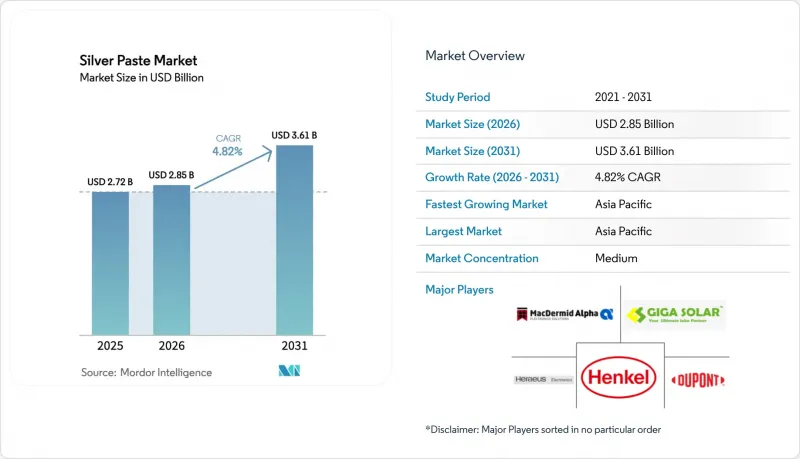
本報告按基板(陶瓷、玻璃、金屬、聚合物)、成分(銀片、銀奈米顆粒、銀粉及其他成分)、應用(太陽能、汽車電子和電動汽車動力模組、家用電子電器、整合電路及其他應用)和地區(亞太地區等)進行細分。市場預測以美元計價。
全球銀膠市場趨勢與洞察
汽車和電動車中電力電子技術的日益融合。
到2025年,電池式電動車(BEV)的銀消耗量將超過內燃機汽車(ICE)。目前,符合IATF 16949可靠性標準的燒結銀接頭可承受-40 度C至175 度C範圍內數千次的熱循環。 2025年6月,LG化學和Noritake宣布推出一種室溫穩定的奈米銀膠。這項突破性技術將銀漿的保存期限從幾週延長至幾個月,無需低溫運輸物流。因此,一級供應商擴大選擇與金屬期貨價格掛鉤的多年期契約,這在銀膠行業是一種新的策略。此外,即使經過嚴格的循環測試,仍能保持剪切強度,促使驅動逆變器中碳化矽(SiC)的應用顯著增加。這些進步正在推動汽車銀膠的需求,並為合格供應商帶來穩定的利潤成長。
印刷和軟性電子產品製造業的快速成長
目前,穿戴式醫療貼片、曲面顯示器和聚合物基板均依賴在低於 150 度C 的溫度下固化的導電線路進行保護。透明銀膠在 140 度C下固化 20 分鐘即可實現低薄片電阻,從而便於整合式 OLED內嵌式驅動電路。同時,銅銀核殼油墨在顯著減少銀用量的同時,實現了幾乎相同的導電性能。這種轉變促使配方設計人員將純銀基體系的使用限制在對性能要求極高的設計中。儘管高性能細分應用推動了銀膠市場的發展,但由於材料效率的提高,其銷售成長並未跟上裝置產量成長的步伐。儘管智慧包裝、結構感測器和折疊式智慧型手機的產量激增,但以噸位計算的成長仍然較為溫和。然而,在平均售價上漲的推動下,營收成長速度超過了噸位成長速度。
與低成本銅(Cu)/鋁(Al)導電材料的競爭。
中國太陽能電池製造商已成功將鍍銀銅的試點生產從實驗室轉移到生產線,在不影響效率的前提下減少了每片拓普康(TOPCon)晶片的銀用量。隆基(LONGi)採用全銅鍍指狀結構,顯示每個組件的銀用量還有進一步降低的潛力。同樣,在無線射頻識別(RFID)技術、觸控螢幕和一次性感測器領域,銅基混合油墨的應用也日益增多,這種油墨能夠在滿足電氣標準的同時顯著降低成本。儘管太陽能產業的銷售額正在直接下滑,但更廣泛的銀膠市場也受到了影響,銀漿生產商現在面臨著一個關鍵的選擇:要麼追求創新,要麼面臨產品同質化的風險。
細分市場分析
2025年,陶瓷材料佔銷售額的45.11%,這主要得益於對直接接合銅功率模組的強勁需求,這些模組需要鍵合線電導率超過200 W/m*K。該細分市場在2025年佔據了銀膠市場佔有率的領先地位。同時,由於聚合物基板在軟性感測器、智慧紡織品和折疊式顯示器等領域的廣泛應用,其在2026年至2031年的預測期內,在基板市場中實現了最高的複合年成長率,達到5.33%。
能夠承受超過 250 度C高溫並提供高達 10 kV 電絕緣的陶瓷材料已在電動車 (EV) 逆變器和工業驅動領域佔據穩固地位。然而,聚醯亞胺和聚對苯二甲酸乙二醇酯 (PET) 成型技術的創新,已在傳統厚膜混合電路領域之外開闢了新的市場。化合物製造商採用低溫固化化學技術,在保持良好利潤率的同時,顯著提高了聚合物的應用量。這種成長為銀膠市場帶來了顯著的益處,尤其是在軟性電子產品領域。
區域分析
預計到2025年,亞太地區將主導銀膠市場,佔全球銷售額的64.11%,並以6.33%的速度成長。 2025年,受拓普康(TOPCon)新一代生產線建設的推動,中國國內銀膠銷量將顯著成長。到2029年,隨著銀粉產能預計將達到相當規模,該地區將增強其供應韌性,但同時也將面臨日益加劇的地緣政治風險。
在技術創新方面,日本處於主導地位。利用其獨特霧化技術的主要公司主導市場,供應全球超過50%的光伏顯示器(PV)用銀粉。同時,京瓷、田中和旭化成等行業領導者也處於領先地位,提供導電率超過240 W/m*K的特種漿料。在韓國,LG化學和Noritake的合作旨在進軍汽車碳化矽(SiC)附件領域,這得益於韓國不斷成長的電動車電池市場。同時,印度和東南亞國協是通用太陽能漿料的經濟型組裝基地,但它們對高純度奈米粉末進口的高度依賴表明,目前上游工程多元化的空間有限。
北美正透過創新技術不斷擴大其市場佔有率。銦泰公司(Indium Corporation)和麥克德米德阿爾法公司(MacDermid Alpha)已擴展其產品組合,並採用了無壓燒結技術。同時,漢高公司推出了符合範圍3永續性標準的再生銀油墨。歐洲則採取了更謹慎的態度,禁止在化妝品中使用奈米銀,並重視歐洲食品安全局(EFSA)關於E 174的警告。這項監管措施旨在遏制職場中奈米銀的廣泛暴露,並敦促歐盟供應商採用「安全設計」策略。在博世和採埃孚等逆變器產品線的支持下,德國正崛起為歐洲主要的銀漿大規模生產商。相比之下,南美和中東的太陽能專案嚴重依賴進口銀漿。儘管預計這些地區未來將有所成長,但目前它們對銀膠市場的收入影響並不顯著。
其他好處:
- Excel格式的市場預測(ME)表
- 3個月的分析師支持
目錄
第1章:引言
- 研究假設和市場定義
- 調查範圍
第2章:調查方法
第3章執行摘要
第4章 市場狀況
- 市場概覽
- 市場促進因素
- 汽車和電動車中電力電子技術的日益融合。
- 印刷和軟性電子產品製造業的快速成長
- SiC/GaN功率元件中燒結銀附件的過渡
- 低溫Ag2O漿料在穿戴式裝置和微型LED的應用。
- 透過循環經濟促進銀膠的收集和回收。
- 市場限制因素
- 與低成本銅(Cu)/鋁(Al)導電材料的競爭。
- 由於銀膠回收能力有限,供應鏈面臨風險。
- 嚴格的環境法規限制奈米銀的排放
- 價值鏈分析
- 波特五力模型
第5章 市場規模與成長預測
- 按基礎材料
- 陶瓷製品
- 玻璃
- 金屬
- 聚合物
- 成分
- 銀箔
- 銀奈米粒子
- 銀粉
- 其他配置
- 透過使用
- 太陽能發電(太陽能電池)
- 電動汽車用汽車電子產品和電源模組
- 家用電子電器(顯示器、穿戴式裝置)
- 積體電路和半導體
- 其他應用(RFID、LED、醫療設備)
- 按地區
- 亞太地區
- 中國
- 印度
- 日本
- 韓國
- 東南亞國協
- 其他亞太國家
- 北美洲
- 美國
- 加拿大
- 墨西哥
- 歐洲
- 德國
- 英國
- 法國
- 義大利
- 西班牙
- 俄羅斯
- 其他歐洲國家
- 南美洲
- 巴西
- 阿根廷
- 其他南美國家
- 中東和非洲
- 沙烏地阿拉伯
- 南非
- 其他中東和非洲國家
- 亞太地區
第6章 競爭情勢
- 市場集中度
- 策略趨勢
- 市佔率和排名分析
- 公司簡介
- ANP CORPORATION
- artience Co., Ltd
- Bando Chemical Industries Ltd.
- CAPLINQ Corporation
- DAIKEN CHEMICAL
- DuPont
- Dycotec Materials Ltd.
- Giga Solar Materials Corp.
- Henkel AG & Co. KGaA
- Heraeus Electronics
- Indium Corporation
- Jiangsu Hoyi Technology Co. Ltd.
- Kyocera Corporation
- LEED-INK
- LG Chem
- MacDermid Alpha Electronics Solutions
- NORITAKE CO., LIMITED
- Shanghai EqualOcean Technology Co., Ltd
第7章 市場機會與未來展望
According to Mordor Intelligence, the silver paste market size was valued at USD 2.72 billion in 2025 and is estimated to grow from USD 2.85 billion in 2026 to reach USD 3.61 billion by 2031, at a CAGR of 4.82% during the forecast period (2026-2031).
This report is Segmented by Substrate (Ceramic, Glass, Metal, and Polymer), Composition (Silver Flakes, Silver Nanoparticles, Silver Powders, and Other Compositions), Application (Photovoltaics, Automotive Electronics and EV Power Modules, Consumer Electronics, Integrated Circuits, and Other Applications), and Geography (Asia-Pacific, and More). Market Forecasts are Provided in Terms of Value (USD).
Global Silver Paste Market Trends and Insights
Expansion of Automotive and Electric Vehicle Power-Electronics Integration
By 2025, battery-electric vehicles (BEVs) outpaced their internal-combustion engine (ICE) counterparts in silver consumption. Sintered-silver joints, now meeting IATF 16949 reliability standards, endure thousands of thermal cycles, spanning from -40 °C to 175 °C. In June 2025, LG Chem and Noritake introduced a room-temperature-stable nano-silver paste. This breakthrough extends the paste's shelf life from mere weeks to several months, negating the necessity for cold-chain logistics. Consequently, Tier 1 suppliers are increasingly opting for multi-year offtake agreements tied to metal futures - a fresh strategy in the silver paste arena. Moreover, with shear-strength retention proving resilient post-rigorous cycling, there is a marked surge in SiC adoption for traction inverters. These advancements are propelling the demand for automotive silver paste and bolstering consistent margin growth for adept suppliers.
Boom in Printed and Flexible Electronics Manufacturing
Wearable medical patches, curved displays, and polymer substrates now depend on conductive traces that cure at temperatures below 150 °C for their protection. Transparent silver pastes, after a 20-minute cure at 140 °C, achieve low sheet resistance, facilitating in-cell OLED driver integration. Meanwhile, copper-silver core-shell inks reach nearly identical conductivity levels but with a marked reduction in silver usage. This shift encourages formulators to reserve pure-silver systems for designs prioritizing performance. Although the silver paste market has seen a value boost from high-performance niches, its volume growth has not kept pace with device output, thanks to strides in material efficiency. Even as unit counts have surged in smart packaging, structural sensors, and foldable smartphones, leading to only modest tonnage increases, revenue growth has outstripped tonnage, fueled by rising average selling prices.
Competition from Lower-Cost Cu/Al Conductive Materials
Chinese cell manufacturers have transitioned silver-coated copper pilots from laboratories to production lines, successfully reducing silver usage per TOPCon wafer without compromising efficiency. LONGi's adoption of fully copper-electroplated fingers indicates a potential reduction in silver usage per module. Similarly, RFID technology, touch screens, and disposable sensors are shifting toward copper-hybrid inks, meeting electrical standards while significantly reducing costs. While photovoltaics experience a direct revenue dip, the broader silver paste market is also impacted - formulators now face a critical choice between pursuing innovation and confronting the risk of commoditization.
Other drivers and restraints analyzed in the detailed report include:
- Shift to Sintered-Silver Attach in SiC/GaN Power Devices
- Emergence of Low-Temperature Ag2O Pastes for Wearables and µLEDs
- Supply-Chain Risk from Limited Silver-Paste Recycling Capacity
For complete list of drivers and restraints, kindly check the Table Of Contents.
Segment Analysis
In 2025, ceramics, driven by robust demand for direct-bonded-copper power modules requiring bondline conductivity exceeding 200 W/m*K, accounted for 45.11% of the revenue. This segment led the silver paste market share in 2025. Meanwhile, polymer substrates, due to their roles in flexible sensors, smart textiles, and foldable displays, recorded a 5.33% compound annual growth rate (CAGR) - the highest among substrates during the forecast period of 2026-2031.
Withstanding temperatures exceeding 250 °C and offering electrical isolation up to 10 kV, ceramics have cemented their position in electric vehicle (EV) inverters and industrial drives. However, innovations in form factors for polyimide and polyethylene terephthalate (PET) have tapped into a new market, surpassing the conventional thick-film hybrid-circuit sector. As formulators introduced low-temperature curing chemistries, polymer adoption increased significantly, all while maintaining healthy profit margins. This growth has notably benefited the silver paste market, particularly in the flexible electronics segment.
Geography Analysis
In 2025, the Asia-Pacific region dominated the silver paste market, accounting for 64.11% of the revenue and projecting a growth rate of 6.33%. In 2025, driven by advancements to next-generation TOPCon lines, China's domestic sales of silver paste saw a notable surge. By 2029, as silver-powder production capacity is set to reach significant levels, the region not only solidifies its supply resilience but also faces heightened geopolitical risks.
Japan leads in technological innovations. A prominent company, utilizing proprietary atomization, dominates the market, supplying over 50% of the global PV-grade silver powder. Simultaneously, industry leaders like Kyocera, TANAKA, and Asahi Kagaku are at the forefront, offering specialty pastes with conductivity levels surpassing 240 W/m*K. In South Korea, LG Chem and Noritake's partnership is eyeing the automotive SiC attachment, leveraging the country's expanding EV battery landscape. While India and ASEAN nations act as economic assembly centers for commodity solar pastes, their dependence on imports for high-purity nanopowders highlights a limited scope for upstream diversification in the foreseeable future.
North America is establishing its presence through innovative strides. Indium Corporation and MacDermid Alpha have expanded their portfolios to include pressureless sintering. Meanwhile, Henkel has introduced inks with recycled silver, aligning with Scope 3 sustainability benchmarks. Europe adopts a more cautious stance, implementing bans on nano-silver in cosmetics and heeding the European Food Safety Authority's warnings about E 174. This regulatory push aims to curtail broader workplace exposures, prompting EU suppliers to adopt 'safe-by-design' strategies. Germany, fortified by Bosch and ZF's inverter lines, emerges as Europe's dominant volume player. Conversely, South America and the Middle-East predominantly depend on imported pastes for their photovoltaic initiatives. Although these regions hold promise for future growth, they currently lack significant revenue impact on the silver paste market.a
- ANP CORPORATION
- artience Co., Ltd
- Bando Chemical Industries Ltd.
- CAPLINQ Corporation
- DAIKEN CHEMICAL
- DuPont
- Dycotec Materials Ltd.
- Giga Solar Materials Corp.
- Henkel AG & Co. KGaA
- Heraeus Electronics
- Indium Corporation
- Jiangsu Hoyi Technology Co. Ltd.
- Kyocera Corporation
- LEED-INK
- LG Chem
- MacDermid Alpha Electronics Solutions
- NORITAKE CO., LIMITED
- Shanghai EqualOcean Technology Co., Ltd
Additional Benefits:
- The market estimate (ME) sheet in Excel format
- 3 months of analyst support
TABLE OF CONTENTS
1 Introduction
- 1.1 Study Assumptions and Market Definition
- 1.2 Scope of the Study
2 Research Methodology
3 Executive Summary
4 Market Landscape
- 4.1 Market Overview
- 4.2 Market Drivers
- 4.2.1 Expansion of automotive and Electric Vehicle power-electronics integration
- 4.2.2 Boom in printed and flexible electronics manufacturing
- 4.2.3 Shift to sintered-silver attach in SiC/GaN power devices
- 4.2.4 Emergence of low-temperature Ag2O pastes for wearables and µLEDs
- 4.2.5 Circular-economy push for silver-paste recovery and recycling
- 4.3 Market Restraints
- 4.3.1 Competition from lower-cost Cu/Al conductive materials
- 4.3.2 Supply-chain risk from limited silver-paste recycling capacity
- 4.3.3 Stringent environmental regulations on nano-silver emissions
- 4.4 Value Chain Analysis
- 4.5 Porter's Five Forces
- 4.5.1 Bargaining Power of Suppliers
- 4.5.2 Bargaining Power of Buyers
- 4.5.3 Threat of New Entrants
- 4.5.4 Threat of Substitutes
- 4.5.5 Competitive Rivalry
5 Market Size and Growth Forecasts (Value)
- 5.1 By Substrate
- 5.1.1 Ceramic
- 5.1.2 Glass
- 5.1.3 Metal
- 5.1.4 Polymer
- 5.2 By Composition
- 5.2.1 Silver Flakes
- 5.2.2 Silver Nano Particles
- 5.2.3 Silver Powders
- 5.2.4 Other Composition
- 5.3 By Application
- 5.3.1 Photovoltaics (Solar Cells)
- 5.3.2 Automotive Electronics and EV Power Modules
- 5.3.3 Consumer Electronics (displays, wearables)
- 5.3.4 Integrated Circuits and Semiconductors
- 5.3.5 Other Applications (RFID, LEDs, medical devices)
- 5.4 By Geography
- 5.4.1 Asia-Pacific
- 5.4.1.1 China
- 5.4.1.2 India
- 5.4.1.3 Japan
- 5.4.1.4 South Korea
- 5.4.1.5 ASEAN Countries
- 5.4.1.6 Rest of Asia-Pacific
- 5.4.2 North America
- 5.4.2.1 United States
- 5.4.2.2 Canada
- 5.4.2.3 Mexico
- 5.4.3 Europe
- 5.4.3.1 Germany
- 5.4.3.2 United Kingdom
- 5.4.3.3 France
- 5.4.3.4 Italy
- 5.4.3.5 Spain
- 5.4.3.6 Russia
- 5.4.3.7 Rest of Europe
- 5.4.4 South America
- 5.4.4.1 Brazil
- 5.4.4.2 Argentina
- 5.4.4.3 Rest of South America
- 5.4.5 Middle-East and Africa
- 5.4.5.1 Saudi Arabia
- 5.4.5.2 South Africa
- 5.4.5.3 Rest of Middle-East and Africa
- 5.4.1 Asia-Pacific
6 Competitive Landscape
- 6.1 Market Concentration
- 6.2 Strategic Moves
- 6.3 Market Share (%)/Ranking Analysis
- 6.4 Company Profiles (includes Global Overview, Market Overview, Core Segments, Financials, Strategic Information, Products and Services, and Recent Developments)
- 6.4.1 ANP CORPORATION
- 6.4.2 artience Co., Ltd
- 6.4.3 Bando Chemical Industries Ltd.
- 6.4.4 CAPLINQ Corporation
- 6.4.5 DAIKEN CHEMICAL
- 6.4.6 DuPont
- 6.4.7 Dycotec Materials Ltd.
- 6.4.8 Giga Solar Materials Corp.
- 6.4.9 Henkel AG & Co. KGaA
- 6.4.10 Heraeus Electronics
- 6.4.11 Indium Corporation
- 6.4.12 Jiangsu Hoyi Technology Co. Ltd.
- 6.4.13 Kyocera Corporation
- 6.4.14 LEED-INK
- 6.4.15 LG Chem
- 6.4.16 MacDermid Alpha Electronics Solutions
- 6.4.17 NORITAKE CO., LIMITED
- 6.4.18 Shanghai EqualOcean Technology Co., Ltd
7 Market Opportunities and Future Outlook
- 7.1 White-space and Unmet-need Assessment

 導熱低溫導熱銀膠市場:全球市場預測,2026-2032年高性能太陽能電池金屬化漿料市場:全球市場預測,2026-2032年
 全球燒結漿料市場研究報告(2026版)銀漿市場-2026-2032年全球市場預測
 銀燒結漿料市場規模、佔有率和成長分析:按類型、銀顆粒類型、燒結溫度、應用、終端用戶產業和地區分類-2026-2033年產業預測
 銀膠市場規模、佔有率和趨勢分析報告:按基板、應用、地區和細分市場預測(2026-2033 年)
 2026年全球銀燒結漿市場報告按技術類型、成分、粒度和應用分類的壓制銅燒結漿市場—全球預測,2026-2032年按產品類型、包裝、燒結方法、應用和最終用途行業分類的壓力燒結銀膠市場—2026-2032年全球預測
 2032年銀膠市場預測:按基材、配置、應用、最終用戶和地區分類的全球分析