


 |
市場調查報告書
商品編碼
2062112
氯酸鉀:市場佔有率分析、產業趨勢與統計、成長預測(2026-2031)Potassium Chlorate - Market Share Analysis, Industry Trends & Statistics, Growth Forecasts (2026 - 2031) |
||||||

※ 本網頁內容可能與最新版本有所差異。詳細情況請與我們聯繫。
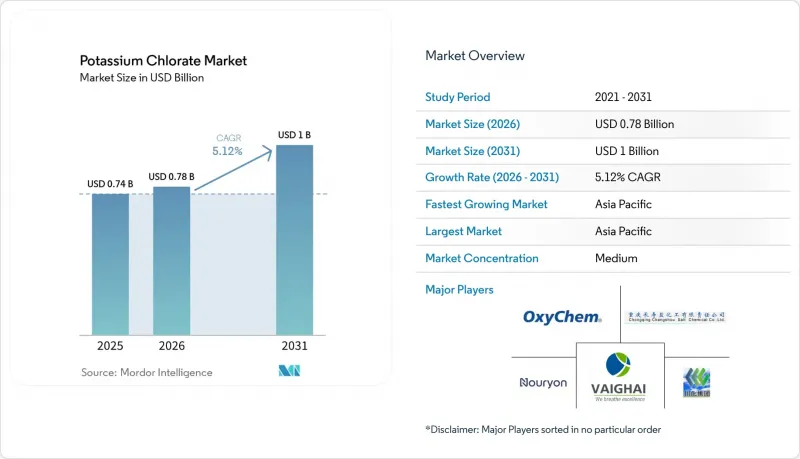
據 Mordor Intelligence 稱,氯酸鉀市場預計將從 2025 年的 7.4 億美元成長到 2026 年的 7.8 億美元,到 2031 年達到 10 億美元,2026 年至 2031 年的複合年成長率為 5.12%。
本報告按形態(粉末、晶體、片狀)、純度等級(工業級:≤99%,實驗室級:≥99%)、技術級(≤99%)、實驗室級(≥99%)、應用(安全火柴、其他)、終端用戶行業(化學、農業、其他)以及地區(亞太、北美、歐洲、南美、中東和非洲)進行細分。市場預測以美元計價。
全球氯酸鉀市場趨勢及洞察
擴大去葉劑配方在農業領域的應用
在巴西塞拉多地區和印度古吉拉突邦,棉花種植機械化進程不斷推進,對速效且不留鈉殘留的乾燥劑的需求日益成長。製劑生產商正將氯酸鉀添加到輔助包裝中,以促進即使在高濕度收穫條件下也能落葉。 2023年至2024年間,印度出口了27,726噸氯酸鹽,顯示其產能過剩,足以滿足肯亞和泰國等市場不斷擴大的棉花種植面積。在美國,環保署(EPA)的規定禁止在收穫前使用氯酸鹽,因此來自亞洲的過剩產量正流入監管相對寬鬆的市場。儘管南亞的機械化率仍低於15%,但旁遮普邦和信德省的試驗計畫已證明其具有節省成本的優勢,這增加了未來推廣應用的可能性。整體而言,氯酸鹽在歐美市場的農業應用正在下降,但在新興棉花產區仍保持穩定。
再生纖維向無氯氧化漂白過渡
隨著全球服裝品牌對低氯排放的需求日益成長,亞洲的紡織廠正擴大採用能夠維持纖維強度的電化學氧化劑。氯酸鉀可在室溫下現場生成次氯酸或過氧化氫,從而減少漂白週期所需的時間和能源消耗。 Nouriyon 的「Eka HP Puroxide」產品線將氯酸電解與綠色氫氣相結合,可將範圍 3 的排放減少高達 90%。孟加拉和越南的紡織廠每年加工超過 800 萬噸紡織品,它們迅速採用這項技術以滿足歐盟 REACH 法規的合規要求。此現場系統無需運輸不穩定的氧化劑,可在三個生產週期內回收投資。因此,漂白化學品供應商在對高純度氯酸鹽的需求中發現了新的成長機會。
對除草劑和火柴的使用實施監管禁令及顆粒物限制。
美國環保署 (EPA) 對棉花採後燻蒸的豁免期至 2026 年,但不包括美國棉花採前計畫中氯酸鹽的使用。在歐盟,事先同意 (PIC) 法規要求出口商獲得買家的批准,而布魯塞爾正在製定的新顆粒物排放標準預計將增加火柴生產企業的合規成本。在日本,姬路市生產了國內 80% 的火柴,當局正在考慮類似的粉塵標準,這可能會減少氯酸鹽的消耗。儘管新興經濟體正在調整其法規,但這些監管趨勢總體上將減少經合組織 (OECD) 市場中氯酸鹽的使用。
細分市場分析
截至2025年,粉末狀氯酸鉀將佔氯酸鉀市佔率的57.12%,這主要得益於其在火柴頭、農業混合物和實驗室試劑中的應用。位於努利翁的Alby工廠通過了ISO認證,可根據歐洲火柴製造商的需求客製化研磨曲線。結晶級氯酸鉀用於藥物合成,但面臨中國學名藥的競爭。片狀氯酸鉀的產量預計將以5.51%的複合年成長率成長。這主要是由於煙火製造商偏好高密度顆粒,以減少空隙並提高燃燒均勻性。日本煙火製造商擴大指定使用片狀氯酸鉀,以最佳化多級、絢麗的爆炸效果。因此,預計到2031年,片狀氯酸鉀市場的成長速度將超過整體市場。
預計到2025年,技術級氯酸鉀(≤99%)將佔市場規模的73.25%,主要供應給對成本敏感的農業化學品和火柴行業。分析容差定義為溴酸鹽含量低於100 ppm,氯化物含量低於2000 ppm,這些含量足以滿足大多數氧化劑應用的需求。實驗室級氯酸鉀(≥99%)預計將以5.78%的複合年成長率成長,主要受醫藥中間體和需要更嚴格重金屬控制的特種分析領域的需求驅動。根據歐盟REACH法規註冊文件,該化合物在20°C下的水溶性為69.9 g/L,這是實驗室設計結晶製程的關鍵參數。
受歐美市場除草劑使用禁令的限制,技術級氯酸鉀市場成長受限,但新興棉花產區以及採礦用氧燭對氯酸鉀的需求依然強勁。實驗室級氯酸鉀則受益於印度契約製造的擴張以及中國特種染料合成技術的進步。隨著對兩用產品的出口限制日益嚴格,能夠提供經審核的監管鏈文件的供應商可以設定溢價,從而在高純度氯酸鉀市場中佔據更高的價值佔有率。
區域分析
預計到2025年,亞太地區將佔全球銷售額的47.12%,複合年成長率為5.98%,主要得益於印度出口擴張和中國原料管控措施。 2024年,中國國內氯化鉀(KCl)產量下降0.56%至305萬噸,而消費量增加15.51%,導致進口依賴度超過50%。在美國對中國氯化物技術有限公司實施制裁後,對出口的監管力度加大,促使該地區轉向內部儲備。
在北美,農業應用正在減少,但國防和氧氣設備領域的需求仍然強勁。 NewMarket-AMPAC的擴建計畫預計將在2026年底前滿足美國國家航空暨太空總署(NASA)和美國國防部(DoD)的計畫要求。在歐洲,位於阿爾比的唯一一家專門生產氯酸鹽的工廠利用瑞典水力發電以提高成本效益。
南美洲正崛起為主要參與企業,諾力昂公司位於南馬托格羅索州的計畫使該地區產量提高了20%,並利用生質能蒸氣降低了電力成本。在中東和非洲,成長主要集中在肯亞和南非,這主要得益於印度對棉花和採礦用途的出口。總體而言,擁有可再生能源的地區正在吸引氯酸鹽領域的新投資,而依賴石化燃料電網的地區的利潤率正在下降。
其他好處
- Excel格式的市場預測(ME)表
- 3個月的分析師支持
目錄
第1章:引言
- 研究假設和市場定義
- 調查範圍
第2章:調查方法
第3章執行摘要
第4章 市場狀況
- 市場概覽
- 市場促進因素
- 擴大去葉劑配方在農業領域的應用
- 再生纖維向無氯氧化漂白過渡
- 擴大在低溫化學製氧機的應用
- 利用可再生能源實現電解設施的成本競爭力擴張
- 用於小型火箭和無人機推進系統的微粒設計氧化劑
- 市場限制因素
- 監管機構禁止使用氯酸鹽類除草劑
- 用高氯酸鉀和氯酸鈉替代
- 為因應歐盟更嚴格的粒狀物排放法規,調整配方。
- 價值鏈分析
- 波特五力模型
第5章 市場規模與成長預測
- 按形式
- 粉末
- 水晶
- 薄片
- 按純度等級
- 僅供技術用途(99% 或以下)
- 用於實驗用途(超過 99%)
- 透過使用
- 安全火柴
- 煙火和爆炸物
- 殺蟲劑(除草劑/落葉劑)
- 紡織品漂白和印花
- 實驗試劑和氧氣發生器
- 其他用途(消毒劑等)
- 按最終用戶行業分類
- 化學
- 農業
- 紙張和紡織品
- 國防和煙火
- 採礦和安全設備
- 其他終端用戶產業(實驗室、水處理等)
- 按地區
- 亞太地區
- 中國
- 日本
- 印度
- 韓國
- ASEAN
- 其他亞太國家
- 北美洲
- 美國
- 加拿大
- 墨西哥
- 歐洲
- 德國
- 英國
- 法國
- 義大利
- 西班牙
- 俄羅斯
- 北歐國家
- 其他歐洲國家
- 南美洲
- 巴西
- 阿根廷
- 其他南美國家
- 中東和非洲
- 沙烏地阿拉伯
- 南非
- 其他中東和非洲國家
- 亞太地區
第6章 競爭情勢
- 市場集中度
- 策略趨勢
- 市佔率和排名分析
- 公司簡介
- American Elements
- Barium & Chemicals, Inc.
- Chenzhou Chenxi Metals Co., Ltd
- Chongqing Changshou Salt Chemical Co., Ltd.
- GFS Chemicals Inc.
- Hebei Fiza Technology Co., Ltd
- Merck KGaA
- Nouryon
- Occidental Chemical Corporation
- Pandian Chemicals
- Santa Cruz BIoTechnology Inc.
- Sichuan Chemical Works
- Thermo Fisher Scientific Inc.
- Vaighai Agro.
第7章 市場機會與未來展望
According to Mordor Intelligence, the potassium chlorate market size is expected to increase from USD 0.74 billion in 2025 to USD 0.78 billion in 2026 and reach USD 1 billion by 2031, growing at a CAGR of 5.12% over 2026-2031.
This report is Segmented by Form (Powder, Crystals, Flakes), Purity Grade (Technical Less Than or Equal To 99%, Laboratory Greater Than or Equal To 99%), Application (Safety Matches, and More), End-User Industry (Chemicals, Agriculture, and More), and Geography (Asia-Pacific, North America, Europe, South America, and Middle-East and Africa). The Market Forecasts are Provided in Terms of Value (USD).
Global Potassium Chlorate Market Trends and Insights
Expansion of Agro-Chemical Defoliant Formulations
Cotton mechanization is expanding in Brazil's Cerrado region and India's Gujarat belt, increasing demand for fast-acting desiccants that do not leave sodium residues. Formulators are incorporating potassium chlorate into adjuvant packages to promote faster leaf drop under humid harvest conditions. In 2023-24, India exported 27,726 tons of chlorate, indicating surplus production capacity that can cater to growing cotton acreage in markets such as Kenya and Thailand. In the United States, EPA regulations prohibit the use of pre-harvest chlorate, leading to the redirection of surplus Asian production to less-regulated markets. While mechanization rates in South Asia remain below 15%, pilot programs in Punjab and Sindh have demonstrated cost savings, encouraging potential future adoption. Overall, chlorate's agronomic role is declining in Western markets but stabilizing in emerging cotton-producing regions.
Shift Toward Chlorine-Free Oxidative Bleaching in Recycled Textiles
Global apparel brands are requesting low-chlorine discharge scores, leading Asian textile mills to adopt electrochemical oxidants that maintain fiber strength. Potassium chlorate enables the in-situ generation of hypochlorite or hydrogen peroxide at room temperature, reducing bleaching cycle durations and energy consumption. Nouryon's Eka HP Puroxide product line integrates chlorate electrolysis with green hydrogen, achieving up to a 90% reduction in Scope 3 emissions. Textile mills in Bangladesh and Vietnam, which process over 8 million tons of textiles annually, are early adopters to meet EU REACH compliance requirements. On-site systems eliminate the need for transporting unstable oxidants and provide a return on investment within three production cycles. Consequently, suppliers of bleaching chemicals are identifying a new growth opportunity in the demand for high-purity chlorate.
Regulatory Bans and Micro-Particle Limits on Herbicide and Match Uses
The EPA's 2026 tolerance exemption is limited to post-harvest fumigation, excluding chlorate from U.S. pre-harvest cotton programs. In the European Union, Prior Informed Consent regulations mandate exporters to obtain buyer approval, while new micro-particle discharge limits being drafted in Brussels are expected to increase compliance costs for match production facilities. In Japan, which produces 80% of its domestic match supply in Himeji, authorities are considering similar dust standards that may reduce chlorate consumption. These regulatory developments collectively reduce chlorate tons in OECD markets, even as emerging economies adjust restrictions.
Other drivers and restraints analyzed in the detailed report include:
- Growing Use in Low-Temperature Chemical Oxygen Generators
- Cost-Advantaged Renewable-Powered Electrolysis Capacity Additions
- Substitution by Potassium Perchlorate and Sodium Chlorate in Defense and Bleaching
For complete list of drivers and restraints, kindly check the Table Of Contents.
Segment Analysis
Powder accounted for 57.12% of the potassium chlorate market share in 2025, driven by its use in match heads, agricultural blends, and laboratory reagents. Nouryon's ISO-certified Alby mill customizes grind curves to meet the requirements of European match manufacturers. Crystal grades are used in pharmaceutical synthesis but face competition from Chinese commodities. Flake volumes are expected to grow at a CAGR of 5.51%, as aerial-shell manufacturers prefer dense particles that reduce void space and enhance burn consistency. Japanese fireworks manufacturers are increasingly specifying flake morphology to optimize multi-stage color bursts. As a result, the market size for potassium chlorate flakes is projected to grow faster than the overall market through 2031.
Technical-grade potassium chlorate (less than or equal to 99%) accounted for 73.25% of the projected 2025 market size, primarily serving cost-sensitive agrochemical and match industries. Assay tolerances permit bromate levels below 100 ppm and chloride levels below 2,000 ppm, which are sufficient for most oxidizer applications. Laboratory-grade potassium chlorate (greater than or equal to 99%) is expected to grow at a CAGR of 5.78%, driven by demand in pharmaceutical intermediates and specialty analytics requiring stricter heavy-metal controls. According to EU REACH dossiers, the compound has a water solubility of 69.9 g/L at 20°C, a critical parameter for laboratories designing crystallization processes.
Growth in the technical-grade segment is limited by herbicide bans in Western markets; however, emerging cotton-growing regions and the use of potassium chlorate in mining oxygen candles maintain baseline demand. Laboratory-grade potassium chlorate benefits from India's expanding contract manufacturing sector and China's advancements in specialty dye synthesis. As dual-use export regulations become increasingly stringent, suppliers providing audited chain-of-custody documentation are able to command premium pricing, enhancing value capture in the high-purity segment of the potassium chlorate market.
Geography Analysis
Asia-Pacific is projected to account for 47.12% of the revenue in 2025, with a compound annual growth rate (CAGR) of 5.98%, supported by India's export growth and China's feedstock control policies. In 2024, China's domestic potassium chloride (KCl) production decreased by 0.56% to 3.05 million tons, while consumption increased by 15.51%, raising import dependency to over 50%. Increased scrutiny on exports, following U.S. sanctions on China Chlorate Tech Co., has led to regional stockpiling efforts.
In North America, agricultural usage is declining, but demand from the defense and oxygen-device sectors remains steady. The NewMarket-AMPAC expansion is expected to meet the requirements of NASA and Department of Defense (DoD) programs by late 2026. In Europe, the only dedicated chlorate plant, located in Alby, benefits from Swedish hydropower for cost efficiency.
South America is emerging as a key player, with Nouryon's Mato Grosso do Sul project increasing regional output by 20% and utilizing biomass steam to reduce power costs. In the Middle East and Africa, growth is concentrated in Kenya and South Africa, primarily supported by Indian exports for cotton and mining applications. Overall, regions with renewable energy resources are attracting new chlorate investments, while areas reliant on fossil fuel grids face reduced margins.
- American Elements
- Barium & Chemicals, Inc.
- Chenzhou Chenxi Metals Co., Ltd
- Chongqing Changshou Salt Chemical Co., Ltd.
- GFS Chemicals Inc.
- Hebei Fiza Technology Co., Ltd
- Merck KGaA
- Nouryon
- Occidental Chemical Corporation
- Pandian Chemicals
- Santa Cruz Biotechnology Inc.
- Sichuan Chemical Works
- Thermo Fisher Scientific Inc.
- Vaighai Agro.
Additional Benefits:
- The market estimate (ME) sheet in Excel format
- 3 months of analyst support
TABLE OF CONTENTS
1 Introduction
- 1.1 Study Assumptions and Market Definition
- 1.2 Scope of the Study
2 Research Methodology
3 Executive Summary
4 Market Landscape
- 4.1 Market Overview
- 4.2 Market Drivers
- 4.2.1 Expansion of agro-chemical defoliant formulations
- 4.2.2 Shift toward chlorine-free oxidative bleaching in recycled textiles
- 4.2.3 Growing use in low-temperature chemical oxygen generators
- 4.2.4 Cost-advantaged renewable-powered electrolysis capacity additions
- 4.2.5 Micro-particle engineered oxidizers for mini-rocket & drone propulsion
- 4.3 Market Restraints
- 4.3.1 Regulatory bans on chlorate-based herbicides
- 4.3.2 Substitution by potassium perchlorate & sodium chlorate
- 4.3.3 EU micro-particle discharge limits tightening match formulations
- 4.4 Value Chain Analysis
- 4.5 Porter's Five Forces
- 4.5.1 Threat of New Entrants
- 4.5.2 Bargaining Power of Buyers
- 4.5.3 Bargaining Power of Suppliers
- 4.5.4 Threat of Substitutes
- 4.5.5 Competitive Rivalry
5 Market Size and Growth Forecasts (Value)
- 5.1 By Form
- 5.1.1 Powder
- 5.1.2 Crystals
- 5.1.3 Flakes
- 5.2 By Purity Grade
- 5.2.1 Technical (Less than equal to 99 %)
- 5.2.2 Laboratory (Greater than equal to 99 %)
- 5.3 By Application
- 5.3.1 Safety Matches
- 5.3.2 Fireworks and Explosives
- 5.3.3 Agrochemicals (Herbicides/Defoliants)
- 5.3.4 Textile Bleaching and Printing
- 5.3.5 Laboratory Reagents and Oxygen Generators
- 5.3.6 Other Applications (Disinfectants, etc.)
- 5.4 By End-User Industry
- 5.4.1 Chemicals
- 5.4.2 Agriculture
- 5.4.3 Paper and Textiles
- 5.4.4 Defense and Pyrotechnics
- 5.4.5 Mining and Safety Equipment
- 5.4.6 Other End-user Industries (Lab, Water Treatment, etc.)
- 5.5 By Geography
- 5.5.1 Asia-Pacific
- 5.5.1.1 China
- 5.5.1.2 Japan
- 5.5.1.3 India
- 5.5.1.4 South Korea
- 5.5.1.5 ASEAN Countries
- 5.5.1.6 Rest of Asia-Pacific
- 5.5.2 North America
- 5.5.2.1 United States
- 5.5.2.2 Canada
- 5.5.2.3 Mexico
- 5.5.3 Europe
- 5.5.3.1 Germany
- 5.5.3.2 United Kingdom
- 5.5.3.3 France
- 5.5.3.4 Italy
- 5.5.3.5 Spain
- 5.5.3.6 Russia
- 5.5.3.7 NORDIC Countries
- 5.5.3.8 Rest of Europe
- 5.5.4 South America
- 5.5.4.1 Brazil
- 5.5.4.2 Argentina
- 5.5.4.3 Rest of South America
- 5.5.5 Middle-East and Africa
- 5.5.5.1 Saudi Arabia
- 5.5.5.2 South Africa
- 5.5.5.3 Rest of Middle-East and Africa
- 5.5.1 Asia-Pacific
6 Competitive Landscape
- 6.1 Market Concentration
- 6.2 Strategic Moves
- 6.3 Market Share(%)/Ranking Analysis
- 6.4 Company Profiles (includes Global Overview, Market Overview, Core Segments, Financials, Strategic Information, Products and Services, Recent Developments)
- 6.4.1 American Elements
- 6.4.2 Barium & Chemicals, Inc.
- 6.4.3 Chenzhou Chenxi Metals Co., Ltd
- 6.4.4 Chongqing Changshou Salt Chemical Co., Ltd.
- 6.4.5 GFS Chemicals Inc.
- 6.4.6 Hebei Fiza Technology Co., Ltd
- 6.4.7 Merck KGaA
- 6.4.8 Nouryon
- 6.4.9 Occidental Chemical Corporation
- 6.4.10 Pandian Chemicals
- 6.4.11 Santa Cruz Biotechnology Inc.
- 6.4.12 Sichuan Chemical Works
- 6.4.13 Thermo Fisher Scientific Inc.
- 6.4.14 Vaighai Agro.
7 Market Opportunities and Future Outlook
- 7.1 White-space and Unmet-need Assessment


