


 |
市場調查報告書
商品編碼
2062104
四氯化矽:市場佔有率分析、產業趨勢與統計、成長預測(2026-2031)Silicon Tetrachloride - Market Share Analysis, Industry Trends & Statistics, Growth Forecasts (2026 - 2031) |
||||||

※ 本網頁內容可能與最新版本有所差異。詳細情況請與我們聯繫。
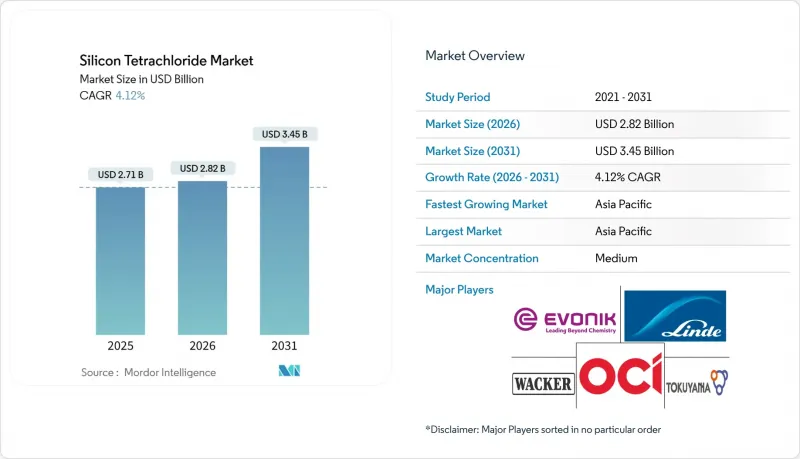
根據 Mordor Intelligence 預測,四氯化矽市場規模將在 2025 年達到 27.1 億美元,2026 年達到 28.2 億美元,2031 年達到 34.5 億美元,2026 年至 2031 年的複合年成長率為 4.12%。
本報告按等級(電子級、技術級、試劑級)、應用(電子和半導體、光纖預型體、其他)、終端用戶產業(電子、通訊、能源(太陽能)、其他)以及地區(亞太、北美、歐洲、南美、中東和非洲)進行細分。市場預測以美元計價。
全球四氯化矽市場趨勢與洞察
通訊領域對光纖的需求不斷成長
全球通訊網路的發展推動了對高純度四氯化矽 (SiCl4) 的需求成長。這是因為諸如 MCVD(先進化學氣相沉積)、PCVD(等離子體化學氣相沉積)、OVD(外部氣相沉積)和 VAD(軸向氣相沉積)等預製棒製造製程都依賴 SiCl4 與氧氣的反應生成二氧化矽煙灰,然後將其固化成玻璃。 VAD 和 OVD 製程的產能最高,每根預製棒可生產長達 250 公里的光纖。而 PCVD 製程雖然前驅體轉化率達 100%,但純度要求更高,可達 6N 至 7N。中國 5G大型基地台和小型基地台的積極密集化部署,以及印度 FTTH(光纖到戶)部署的加速,都支撐了亞太地區四氯化矽市場的需求。北美和歐洲資料中心營運商向400G/800G連貫光纖通訊的轉型,推動了對超低損耗光纖的需求成長,而這類光纖需要7N或更高純度的原料。此外,專家對中空光纖和超材料光纖的研究進一步提高了對光纖純度的要求,導致電子級光纖價格居高不下。
多晶矽在太陽能發電領域的應用拓展。
多晶矽仍是四氯化矽最大的單一消費領域,但供應過剩和價格壓力正迫使中國進行廣泛的產業結構調整。 2025年,前六大生產商將總合籌集500億元人民幣(約69.6億美元),用於收購或關閉約100萬噸過時產能。此舉收緊了技術級多晶矽的供應,並有助於價格穩定。同時,流體化床反應器技術正在獲得市場佔有率。此技術可降低約25%的能耗,並降低每公斤多晶矽產生的四氯化矽量,但也略微抑制了絕對產量的成長。到2023年,N型太陽能電池將佔據全球市場佔有率的一半,需要純度為9N至11N的多晶矽,這將間接推動四氯化矽提純技術達到新的極限。中東地區新興的生產基地,例如阿曼蘇哈爾年產 10 萬噸的工廠,預計將保持長期需求勢頭,同時也將為四氯化矽市場帶來地域多元化。
日益嚴格的氯排放法規
中國T/CCSAS 052-2025標準要求氯矽烷回收率達到98.5%或更高,這迫使老舊的多晶矽生產線要麼投資數千萬美元升級蒸餾和洗滌設備,要麼退出市場。印度和歐盟正在同步製定的ESG(環境、社會和管治)框架進一步收緊了排放上限和碳核算,實際上提高了小規模和技術落後生產商的成本門檻。大型垂直整合企業已實現99%以上的回收率,在合規方面享有成本優勢,這進一步加速了四氯化矽市場的整合趨勢。
細分市場分析
預計到2025年,電子級四氯化矽將佔據47.13%的市場佔有率,並將在2031年之前以4.61%的複合年成長率成長。受3nm邏輯半導體、3D DRAM和純度高達99.9999999999%的超高純度多晶矽需求不斷成長的推動,對多級蒸餾設備、微量硼去除製程和封閉回路型回收系統的投資正在加速。因此,電子級和技術級四氯化矽之間的傳統價格差距正在縮小,尤其是在中國強制回收政策的影響下,這迫使即使是太陽能級四氯化矽生產商也採用高純度製程。德山化學、瓦克化學和海姆洛克半導體目前提供整合封裝的四氯化矽、矽烷和超高純度多晶矽,增加了下游晶圓廠的轉換成本。
技術級四氯化矽仍是光伏發電的關鍵材料,但由於供應過剩,其利潤率面臨壓力。預計到2025年初,運轉率將下降至33-40%,多晶矽現貨價格預計將同比暴跌50%以上,這將對整個行業的現金成本帶來壓力。試劑級四氯化矽是實驗室和特殊合成應用領域的利基市場,其產量和價格基本上不受光電市場波動的影響。在所有等級中,電子級四氯化矽的市場規模預計將超過整體成長率,這表明按純度進行差異化生產仍然具有優勢。
區域分析
預計到2025年,亞太地區將維持其在全球市場57.45%的佔有率,並在預測期(2026-2031年)內以4.66%的複合年成長率成長。這主要得益於中國在多晶矽、光纖預型體和特殊二氧化矽領域的領先地位。由於中國產能的合理化調整,供應曲線向上移動,老舊設施被關閉,而資金雄厚的大公司則擴大了市場佔有率。日本和韓國正在加強超高純度產品的生產,而馬來西亞的半導體級業務(依托水力發電)使東協成為四氯化矽市場的重要樞紐。
北美正重新崛起為戰略生產基地。 《晶片法案》(CHIPS Act)為運作Hemlock Semiconductor和REC Silicon位於摩西湖的工廠提供的資金,凸顯了政策主導超高純度材料重返國內市場的趨勢。大型特種氣體公司正逐步在各地增設現場生產工廠,以降低與ISO儲槽相關的物流成本。在歐洲,高電價給多晶矽的獲利能力帶來了壓力,但這並未影響高附加價值電子級四氯化矽(SiCl4)的生產,投資主要集中在德國和愛爾蘭的晶圓廠叢集。
在中東,一座利用低成本太陽能和風能的年產10萬噸多晶矽的生產設施已在阿曼運作。一旦穩定運作,該設施每年將產生30萬至40萬噸四氯化矽的核心需求。非洲和南美洲目前仍嚴重依賴進口,市場佔有率較小,但對於尋求在四氯化矽市場實現地理多元化的供應商而言,預計未來需求將會增加。
其他好處
- Excel格式的市場預測(ME)表
- 3個月的分析師支持
目錄
第1章:引言
- 研究假設和市場定義
- 調查範圍
第2章:調查方法
第3章執行摘要
第4章 市場狀況
- 市場概覽
- 市場促進因素
- 通訊領域對光纖的需求不斷成長
- 多晶矽在太陽能發電領域的應用拓展。
- 增加對半導體製造業的投資
- 氣相二氧化矽和矽烷細分市場的應用日益廣泛
- 研究和開發需要 7N 級或更高等級 SiCl4 的超低損耗中空光纖和超材料。
- 市場限制因素
- 日益嚴格的氯排放法規(例如,中國規定氯回收率必須超過 98.5%)
- 運輸6N至9N級ISO儲槽的物流成本高昂
- 矽金屬價格波動導致供應鏈風險
- 價值鏈分析
- 波特五力模型
第5章 市場規模與成長預測
- 按年級
- 電子級
- 技術級
- 試劑級
- 透過使用
- 電子和半導體
- 光纖預型體
- 化學中間體
- 其他用途(矽橡膠等)
- 按最終用途行業分類
- 電子的
- 溝通
- 能源(太陽能)
- 其他終端用戶產業(航太、製藥等)
- 按地區
- 亞太地區
- 中國
- 日本
- 印度
- 韓國
- ASEAN
- 其他亞太國家
- 北美洲
- 美國
- 加拿大
- 墨西哥
- 歐洲
- 德國
- 英國
- 法國
- 義大利
- 西班牙
- 俄羅斯
- 北歐國家
- 其他歐洲國家
- 南美洲
- 巴西
- 阿根廷
- 其他南美國家
- 中東和非洲
- 沙烏地阿拉伯
- 南非
- 其他中東和非洲國家
- 亞太地區
第6章 競爭情勢
- 市場集中度
- 策略趨勢
- 市佔率和排名分析
- 公司簡介
- Air Liquide
- American Elements
- Evonik Industries AG
- GCL TECH
- Hemlock Semiconductor Operations LLC
- Linde plc
- Merck KGaA
- OCI Company Ltd.
- ProChem, Inc.
- REC Silicon ASA
- Thermo Fisher Scientific Inc.
- Tokuyama Corporation
- Valmet
- Wacker Chemie AG
第7章 市場機會與未來展望
According to Mordor Intelligence, the silicon tetrachloride market size is projected to be USD 2.71 billion in 2025, USD 2.82 billion in 2026, and reach USD 3.45 billion by 2031, growing at a CAGR of 4.12% from 2026 to 2031.
This report is Segmented by Grade (Electronic Grade, Technical Grade, and Reagent Grade), Application (Electronics and Semiconductors, Optical Fibre Preforms, and More), End-Use Industry (Electronics, Telecommunications, Energy (Solar), and More), and Geography (Asia-Pacific, North America, Europe, South America, and Middle East and Africa). The Market Forecasts are Provided in Terms of Value (USD).
Global Silicon Tetrachloride Market Trends and Insights
Growing Demand for Optical Fibres in Telecommunications
Global telecom build-outs are tightening demand for high-purity SiCl4 because MCVD (Modified Chemical Vapor Deposition), PCVD (Plasma Chemical Vapor Deposition), OVD (Outside Vapor Deposition), and VAD (Vapor Axial Deposition) preform routes all rely on the reaction of SiCl4 and oxygen to form silica soot that is later consolidated into glass. VAD and OVD deliver the highest throughput, producing preforms that yield up to 250 km of fiber each, while PCVD offers 100% precursor conversion but drives purity specifications to 6N-7N. Active 5G macro- and small-cell densification in China and accelerating FTTH (Fiber to the Home) roll-outs in India underpin the Asia-Pacific pull on the silicon tetrachloride market. North American and European data-center operators moving to 400G/800G coherent optics are also contributing, especially for ultra-low-loss fibers that require 7N-plus feedstock. Specialized research into hollow-core and metamaterial fibers further elevates purity requirements and sustains premium pricing on electronic-grade supplies.
Expanding Use in Polysilicon for Solar Photovoltaics
Polysilicon remains the largest single consumer of SiCl4, yet oversupply and price pressure have forced widespread consolidation inside China. The top six producers collectively raised more than CNY 50 billion (USD 6.96 billion) in 2025 to acquire and idle roughly 1 million tons of obsolete capacity, a move that tightened technical-grade availability and helped stabilize prices. At the same time, fluidized bed reactor technology is gaining share because it cuts energy consumption by about 25% and generates less SiCl4 per kilogram of polysilicon, slightly tempering absolute volume growth. N-type solar cells captured half of the global market share in 2023 and demand polysilicon purity of 9N-11N, indirectly pushing SiCl4 purification technology to new limits. Emerging Middle-Eastern production, such as the 100 kilotons-per-year Sohar plant in Oman, will diversify the silicon tetrachloride market geographically while preserving long-term demand momentum.
Increasingly Stringent Chlorine-Emission Regulations
China's T/CCSAS 052-2025 standard requires more than or equal to 98.5% chlorosilane recycling, forcing legacy polysilicon lines to invest tens of millions of dollars in distillation and scrubbing upgrades or exit the market. Parallel ESG (Environmental, Social, and Governance) frameworks emerging in India and the European Union further tighten emission ceilings and carbon accounting, effectively raising the cost floor for small or technologically outdated producers. Vertically integrated majors already operating more than 99% recycling enjoy a compliance cost advantage, reinforcing consolidation trends in the silicon tetrachloride market.
Other drivers and restraints analyzed in the detailed report include:
- Rising Investments in Semiconductor Manufacturing
- Expanding Adoption in Fumed Silica and Silane Chains
- High Logistics Costs for ISO-Tank Transport of 6N-9N Grades
For complete list of drivers and restraints, kindly check the Table Of Contents.
Segment Analysis
Electronic Grade held a commanding 47.13% of the silicon tetrachloride market share in 2025 and is projected to grow at a 4.61% CAGR through 2031. The quest for 3 nm logic, 3D DRAM, and 11-nines polysilicon is propelling investment in multi-stage distillation columns, trace-boron removal, and closed-loop recovery systems. Consequently, the historical price gap between electronic and technical grades is narrowing, especially as China's recycle mandates press even solar-grade producers to adopt higher-purity processes. Tokuyama, Wacker, and Hemlock Semiconductor now bundle SiCl4, silane, and hyper-pure polysilicon in integrated offerings, reinforcing switching costs for downstream fabs.
Technical Grade, while still indispensable to solar PV, faces margin pressure from overcapacity; utilization rates dipped to 33-40% in early 2025, and spot polysilicon prices crashed more than 50% year-over-year, squeezing cash costs industry-wide. Reagent Grade remains a niche for laboratories and specialty synthesis, with volumes and pricing largely insulated from solar market swings. Across all grades, the silicon tetrachloride market size for electronic-grade material is expected to outpace aggregate growth, illustrating the enduring benefit of purity-driven differentiation.
Geography Analysis
Asia-Pacific retained 57.45% of global share in 2025 and is forecast to expand at a 4.66% CAGR during the forecast period (2026-2031), driven by China's dominance in polysilicon, optical-fiber preforms, and specialty silica. Capacity rationalization in China shifted the supply curve upward, allowing well-capitalized leaders to capture spread while older assets shuttered. Japan and South Korea are bolstering extreme-purity output, and Malaysia's hydropower-backed semiconductor-grade venture positions ASEAN as an important redundancy node for the silicon tetrachloride market.
North America is re-emerging as a strategic production base. The CHIPS Act funding for Hemlock Semiconductor and REC Silicon's Moses Lake restart underscores policy-driven reshoring of hyper-pure materials. Specialty-gas majors are layering on regional on-site generation plants to slash ISO-tank logistics costs. Europe's high electricity tariffs curb the economics of polysilicon but not of value-added electronic-grade SiCl4, prompting investments concentrated around fab clusters in Germany and Ireland.
The Middle East debuts with Oman's 100 kiloton polysilicon facility using low-cost solar and wind power, creating anchor demand for 300-400 kilotons of SiCl4 annually once steady-state operations begin. Africa and South America remain import-dependent, accounting for a minimal share but offering incremental volume for suppliers seeking geographic diversification in the silicon tetrachloride market.
- Air Liquide
- American Elements
- Evonik Industries AG
- GCL TECH
- Hemlock Semiconductor Operations LLC
- Linde plc
- Merck KGaA
- OCI Company Ltd.
- ProChem, Inc.
- REC Silicon ASA
- Thermo Fisher Scientific Inc.
- Tokuyama Corporation
- Valmet
- Wacker Chemie AG
Additional Benefits:
- The market estimate (ME) sheet in Excel format
- 3 months of analyst support
TABLE OF CONTENTS
1 Introduction
- 1.1 Study Assumptions and Market Definition
- 1.2 Scope of the Study
2 Research Methodology
3 Executive Summary
4 Market Landscape
- 4.1 Market Overview
- 4.2 Market Drivers
- 4.2.1 Growing Demand for Optical Fibres in Telecommunications
- 4.2.2 Expanding Use in Polysilicon for Solar Photovoltaics
- 4.2.3 Rising Investments in Semiconductor Manufacturing
- 4.2.4 Expanding Adoption in Fumed Silica and Silane Chains
- 4.2.5 Ultra-low-loss hollow-core fibre and metamaterial RandD needing 7N-plus SiCl4
- 4.3 Market Restraints
- 4.3.1 Increasingly stringent chlorine-emission regulations (e.g., PRC greater than or equal to 98.5 % recycle rule)
- 4.3.2 High logistics costs for ISO-tank transport of 6N-9N grades
- 4.3.3 Supply-chain exposure to silicon-metal price volatility
- 4.4 Value Chain Analysis
- 4.5 Porter's Five Forces
- 4.5.1 Threat of New Entrants
- 4.5.2 Bargaining Power of Buyers
- 4.5.3 Bargaining Power of Suppliers
- 4.5.4 Threat of Substitutes
- 4.5.5 Competitive Rivalry
5 Market Size and Growth Forecasts (Value)
- 5.1 By Grade
- 5.1.1 Electronic Grade
- 5.1.2 Technical Grade
- 5.1.3 Reagent Grade
- 5.2 By Application
- 5.2.1 Electronics and Semiconductors
- 5.2.2 Optical Fibre Preforms
- 5.2.3 Chemical Intermediates
- 5.2.4 Other Applications (Silicon Rubber, etc.)
- 5.3 By End-Use Industry
- 5.3.1 Electronics
- 5.3.2 Telecommunications
- 5.3.3 Energy (Solar)
- 5.3.4 Other End-user Industries (Aerospace, Pharmaceuticals, etc.)
- 5.4 By Geography
- 5.4.1 Asia-Pacific
- 5.4.1.1 China
- 5.4.1.2 Japan
- 5.4.1.3 India
- 5.4.1.4 South Korea
- 5.4.1.5 ASEAN Countries
- 5.4.1.6 Rest of Asia-Pacific
- 5.4.2 North America
- 5.4.2.1 United States
- 5.4.2.2 Canada
- 5.4.2.3 Mexico
- 5.4.3 Europe
- 5.4.3.1 Germany
- 5.4.3.2 United Kingdom
- 5.4.3.3 France
- 5.4.3.4 Italy
- 5.4.3.5 Spain
- 5.4.3.6 Russia
- 5.4.3.7 NORDIC Countries
- 5.4.3.8 Rest of Europe
- 5.4.4 South America
- 5.4.4.1 Brazil
- 5.4.4.2 Argentina
- 5.4.4.3 Rest of South America
- 5.4.5 Middle-East and Africa
- 5.4.5.1 Saudi Arabia
- 5.4.5.2 South Africa
- 5.4.5.3 Rest of Middle-East and Africa
- 5.4.1 Asia-Pacific
6 Competitive Landscape
- 6.1 Market Concentration
- 6.2 Strategic Moves
- 6.3 Market Share(%)/Ranking Analysis
- 6.4 Company Profiles (includes Global Overview, Market Overview, Core Segments, Financials, Strategic Information, Products and Services, Recent Developments)
- 6.4.1 Air Liquide
- 6.4.2 American Elements
- 6.4.3 Evonik Industries AG
- 6.4.4 GCL TECH
- 6.4.5 Hemlock Semiconductor Operations LLC
- 6.4.6 Linde plc
- 6.4.7 Merck KGaA
- 6.4.8 OCI Company Ltd.
- 6.4.9 ProChem, Inc.
- 6.4.10 REC Silicon ASA
- 6.4.11 Thermo Fisher Scientific Inc.
- 6.4.12 Tokuyama Corporation
- 6.4.13 Valmet
- 6.4.14 Wacker Chemie AG
7 Market Opportunities and Future Outlook
- 7.1 White-space and Unmet Needs

 全球二氧化矽市場規模、佔有率、趨勢和成長分析報告(2026-2034年)
 綠坡縷石市場:全球市場預測,2026-2032年二氧化矽市場-2026-2032年全球市場預測
 綠坡縷石市場規模、佔有率和成長分析:按產品等級、加工形式、最終用途產業、分銷通路和地區分類-2026-2033年產業預測
 聚矽酸乙酯市場規模、佔有率和成長分析:按等級、應用、最終用途、通路和地區分類-2026-2033年產業預測矽酸鉀市場規模、佔有率、成長、全球產業分析、區域洞察及2026-2034年預測。
 四氯化矽市場-全球產業規模、佔有率、趨勢、機會、預測:按等級、應用、地區和競爭格局分類,2021-2031年
 一氧化矽市場機會、成長要素、產業趨勢分析及2026-2035年預測。
 四氯化矽市場:依等級、應用及地區分類全球一氧化矽市場規模、佔有率、趨勢和成長分析報告(2026-2034年)