


 |
市場調查報告書
商品編碼
2062094
建築塑膠:市場佔有率分析、產業趨勢與統計及成長預測(2026-2031 年)Building And Construction Plastics - Market Share Analysis, Industry Trends & Statistics, Growth Forecasts (2026 - 2031) |
||||||

※ 本網頁內容可能與最新版本有所差異。詳細情況請與我們聯繫。
根據 Mordor Intelligence 預測,建築塑膠市場規模預計將在 2025 年達到 1,132.2 億美元,2026 年達到 1,202.5 億美元,2031 年達到 1,625.2 億美元,2026 年至 2031 年的複合年成長率為 6.21%。
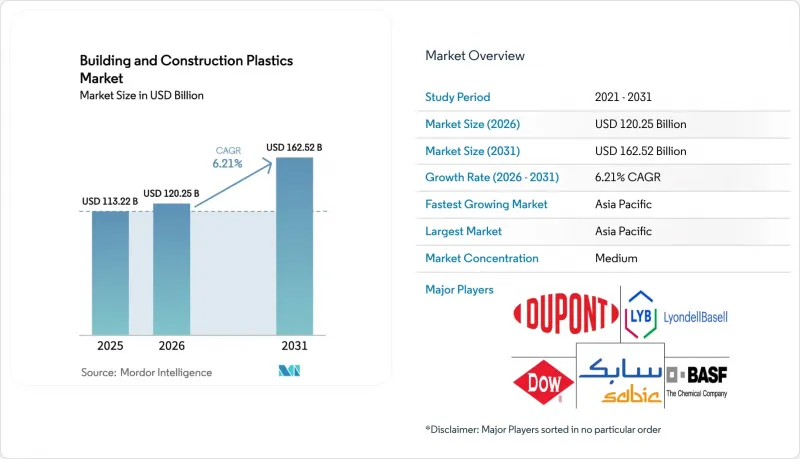
本報告按產品類型(聚氯乙烯(PVC)、聚乙烯 (PE) 及其他)、應用領域(管道系統及配件、隔熱材料及其他)、終端用戶行業(住宅建築、商業建築及其他)和地區(亞太地區、北美地區、歐洲及其他)進行細分。市場預測以美元 (USD) 為單位。
全球建築塑膠市場趨勢及洞察。
亞太地區城市基礎建設投資快速成長
印度、中國和東南亞的地方政府持續面臨預算短缺,因此,安裝時間可縮短高達40%的聚合物系統成為熱門選擇。 2024年,印度塑膠管道的銷售額達到5,410億印度盧比(約65億美元),預計到2027年,在「飲用水生命線計畫」(Jal Jeevan Mission)積極的農村供水計畫的推動下,這一數字將達到8,050億印度盧比(約97億美元)。隨著易腐蝕的鑄鐵管道網路被洩漏率低於10%的高密度聚乙烯(HDPE)和聚氯乙烯(PVC)管道所取代,預計到2030年,中國建築管道市場將以9.2%的複合年成長率成長。BASF在馬來西亞擴建的混煉廠將縮短前置作業時間,並將運往印尼的運輸成本降低高達15%,從而在2025年之前提升其在亞太地區的銷售佔有率。因此,建築塑膠市場直接受益於該地區的永續基礎設施發展計劃,即使住宅開工速度放緩,也能支撐基本需求。
嚴格的全球建築能源效率標準
在主要經濟體中,未能達到2030年碳強度基準值的開發商將面臨相當於專案價值15%至20%的罰款,或入住許可延期。中國的GB 55015-2021標準、歐盟2024/1275能源性能指令以及加州2025年修訂的第24號法規均提高了最低R值,鼓勵使用導熱係數為0.035 W/(m*K)或更低的聚氨酯和聚苯乙烯板材作為新建和維修的外牆材料。 2024年國際節能規範(IECC)新增了建議連續外牆保溫的性能標準,將使礦棉無法滿足厚度要求的地區對硬質發泡體的需求量翻倍。隨著法規的強制執行,聚合物隔熱材料供應商正在獲得長期訂單,這成為支撐建築塑膠市場強勁成長的支柱。
乙烯和丙烯原料價格波動
2025年至2026年間,季度價格波動幅度高達40%,擠壓了加工商的毛利率,迫使他們啟用成本轉嫁條款,並導致合約簽署受阻。 2026年3月霍爾木茲海峽的動盪導致亞洲裂解裝置的石腦油出貨量減少,使得多元醇價格在短短一周內上漲了450美元/噸。由於中國嚴重依賴丙烷脫氫裝置,地緣政治緊張局勢直接影響了國內丙烯供應,導致2026年1月離岸價飆升至868美元/噸。加工商的營業利潤率低於8%,部分企業推遲了產能擴張計劃,抑制了建築塑膠市場的短期成長。
細分市場分析
聚氯乙烯(PVC)預計在2025年將佔銷售額的42.21%,反映出其在管道、窗框和牆板等領域符合相關標準。然而,聚氨酯的成長勢頭最為強勁,預計到2031年將達到6.82%的複合年成長率,這主要得益於噴塗泡沫維修的普及,其每英寸的隔熱性能可達R-6,並符合歐盟2030年的能源目標。科思創的生物基板材「LINITHERM」和BASF的「WALLTITE RSB」泡沫材料表明,可再生原料的認證如今已成為成功競標的關鍵。
中密度聚乙烯憑藉其在壓力管道中的應用,保持著15%左右的市場佔有率;而聚丙烯在耐鹼性混凝土排水複合複合材料領域的佔有率正在擴大。發泡聚苯乙烯的市場佔有率仍維持在個位數,但受益於2024年建築規範的修訂,該修訂允許連續保溫層高度達到75英尺,從而帶動了中高層多用戶住宅的需求成長。總體而言,專注於低碳材料的產品創新正在增強建築塑膠市場供應商之間的差異化優勢。
區域分析
亞太地區預計到2025年將佔全球銷售額的45.16%,並將繼續保持主要需求中心地位,預計到2031年將維持7.12%的複合年成長率。隨著都市區進程的加速,地方政府被迫採用預製聚合物系統,該系統可將漏水率降低至10%以下,並減少三分之一的勞動投入。在積極的農村供水政策的推動下,預計到2027年,印度建築塑膠市場(僅管道領域)的規模將達到97億美元。
在北美,不斷上漲的房屋抵押貸款利率構成阻礙,但對隔熱材料的需求卻推動了資料中心的擴張。 2024版國際建築規範(IBC)允許在18層建築中使用大塊木材,這引發了激烈的競爭,但聚合物供應商正以生物基PVC和再生聚丙烯產品予以應對。
在歐洲,建築能源性能指令 (EPBD) 將在 2030 年前逐步淘汰新建築中的石化燃料供暖,這將間接推動對聚氨酯和 EPS 的需求。德國的維修促進政策和英國的消防安全法規同時對不同類型的聚合物產生了有利和不利的影響,這表明由於這些政策,建築塑膠市場的區域趨勢變得日益複雜。
其他好處
- Excel格式的市場預測(ME)表
- 3個月的分析師支持
目錄
第1章:引言
- 研究假設和市場定義
- 調查範圍
第2章:調查方法
第3章執行摘要
第4章 市場狀況
- 市場概覽
- 市場促進因素
- 亞太地區城市基礎建設快速投資
- 嚴格的全球建築能源效率標準
- 過渡到輕型管道和導線管
- 預製和3D列印塑膠零件
- 再生PVC/生物基PVC共混物的商業性化應用
- 市場限制因素
- 乙烯和丙烯原料價格波動
- 保險公司主導禁止在高層建築。
- 加工木材排碳權的優勢
- 價值鏈分析
- 波特五力模型
第5章 市場規模與成長預測
- 依產品類型
- 聚氯乙烯(PVC)
- 聚乙烯(PE)
- 聚丙烯(PP)
- 聚氨酯(PU)
- 發泡聚苯乙烯(EPS)
- 聚碳酸酯(PC)
- 其他
- 透過使用
- 管道系統和配件
- 隔熱材料
- 門窗
- 地板材料
- 屋頂材料
- 牆板和覆材
- 其他
- 按最終用戶行業分類
- 住宅
- 商業建築
- 工業建築
- 基礎設施項目
- 按地區
- 亞太地區
- 中國
- 印度
- 日本
- 韓國
- 其他亞太國家
- 北美洲
- 美國
- 加拿大
- 墨西哥
- 歐洲
- 德國
- 英國
- 法國
- 義大利
- 其他歐洲國家
- 南美洲
- 巴西
- 阿根廷
- 其他南美國家
- 中東和非洲
- 沙烏地阿拉伯
- 南非
- 其他中東和非洲國家
- 亞太地區
第6章 競爭情勢
- 市場集中度
- 策略趨勢
- 市佔率和排名分析
- 公司簡介
- Arkema
- BASF
- Celanese Corporation
- Covestro AG
- Dow
- DuPont
- ExxonMobil
- Formosa Group
- Huntsman Corporation
- INEOS
- LG Chem
- LyondellBasell Industries Holdings BV
- SABIC
- Shin-Etsu Chemical Co., Ltd.
- Toray Industries, Inc.
- Westlake Corporation
第7章 市場機會與未來展望
According to Mordor Intelligence, the building and construction plastics market size is projected to be USD 113.22 billion in 2025, USD 120.25 billion in 2026, and reach USD 162.52 billion by 2031, growing at a CAGR of 6.21% from 2026 to 2031.
This report is Segmented by Product Type (Polyvinyl Chloride (PVC), Polyethylene (PE), and More), Application (Piping Systems and Fittings, Insulation Materials, and More), End-User Industry (Residential Construction, Commercial Construction, and More), and Geography (Asia-Pacific, North America, Europe, and More). The Market Forecasts are Provided in Terms of Value (USD).
Global Building And Construction Plastics Market Trends and Insights
Rapid Urban Infrastructure Investment in Asia-Pacific
Tier-2 municipalities across India, China, and Southeast Asia continue to face budget gaps that favor polymer systems able to cut installation labor by up to 40%. India's plastic-pipes turnover reached INR 54,100 crore (USD 6.5 billion) in fiscal 2024 and is headed for INR 80,500 crore (USD 9.7 billion) by fiscal 2027 under the Jal Jeevan Mission's aggressive rural-water timetable. China's building-pipe segment is tracking a 9.2% CAGR to 2030 as corrosion-prone cast-iron networks give way to HDPE and PVC lines delivering leakage rates below 10%. BASF's expanded compounding hub in Malaysia shortens lead times and trims delivered costs into Indonesia by up to 15%, reinforcing Asia-Pacific's outsized 2025 revenue share. The building and construction plastics market therefore benefits directly from the region's sustained infrastructure pipeline, lifting baseline demand even when residential starts soften.
Strict Global Energy-Efficiency Building Codes
Across major economies, developers who miss 2030 carbon-intensity thresholds now face fines or delayed occupancy permits worth 15-20% of project value. China's GB 55015-2021 standard, the European Union's 2024/1275 Energy Performance Directive, and California's 2025 Title 24 update all raise minimum R-values, pushing polyurethane and polystyrene boards that achieve thermal conductivities below 0.035 W/(m*K) into both new-build and retrofit envelopes. The 2024 International Energy Conservation Code adds a performance path that rewards continuous exterior insulation, effectively doubling demand for rigid foams in climates where mineral wool cannot meet thickness targets. Because compliance is now non-negotiable, polymer-insulation suppliers secure long-dated order books, anchoring a resilient growth column for the building and construction plastics market.
Volatile Ethylene and Propylene Feedstock Pricing
Quarter-over-quarter swings of up to 40% in 2025-2026 eroded converters' gross margins and forced pass-through clauses that stalled contract awards. The March 2026 Strait of Hormuz disruption trimmed naphtha shipments to Asian crackers, lifting polyol quotes by USD 450 per tonne in a single week. China's heavy reliance on propane dehydrogenation units links geopolitical flashpoints directly to domestic propylene supply, pushing FOB prices to USD 868 per tonne in January 2026. Fabricators faced sub-8% operating margins, leading some to defer capacity builds, a scenario that tempers near-term expansion in the building and construction plastics market.
Other drivers and restraints analyzed in the detailed report include:
- Shift Toward Lightweight Plumbing and Conduits
- Prefabricated and 3-D-Printed Plastic Components
- Insurance-Driven Bans on PVC in High-Rise Facades
For complete list of drivers and restraints, kindly check the Table Of Contents.
Segment Analysis
Polyvinyl chloride delivered 42.21% of 2025 revenue, reflecting code familiarity in pipes, window profiles, and siding. Yet polyurethane exhibits the quickest trajectory, posting a 6.82% CAGR to 2031 on the back of spray-foam retrofits that achieve R-6 per inch and satisfy EU 2030 energy targets. Covestro's LINITHERM bio-attributed boards and BASF's WALLTITE RSB foams underscore how renewable-feedstock certifications are now pivotal to bid success.
Medium-density polyethylene holds a mid-teen slice thanks to pressure-pipe adoption, while polypropylene gains ground in drainage composites that resist alkaline concrete. Expanded polystyrene, though single-digit in share, benefits from 2024 code revisions permitting continuous insulation up to 75 feet, unlocking mid-rise multifamily demand. Collectively, product innovation focused on lower-carbon footprints strengthens supplier differentiation within the building and construction plastics market.
Geography Analysis
Asia-Pacific remained the primary demand center with 45.16% of global revenue in 2025, and is projected to clock a 7.12% CAGR through 2031. Surging urban migration forces municipalities to choose prefabricated polymer systems that deliver leakage rates under 10% and cut labor inputs by a third. India's building and construction plastics market size for pipes alone will crest USD 9.7 billion by fiscal 2027 thanks to aggressive rural-water mandates.
North America is constrained by elevated mortgage rates yet bolstered by insulation demand in data-center expansions. The International Building Code's 2024 allowance for mass timber in 18-story structures creates head-to-head competition, but polymer suppliers are countering with bio-attributed PVC and circular-polypropylene grades.
In Europe, Energy Performance of Buildings Directive phases out fossil-fuel heating in new builds by 2030, indirectly boosting polyurethane and EPS demand. Germany's retrofit drive and the UK's fire-safety legislation simultaneously aid and restrict different polymer categories, illustrating the policy-driven complexity of regional trends in the building and construction plastics market.
- Arkema
- BASF
- Celanese Corporation
- Covestro AG
- Dow
- DuPont
- ExxonMobil
- Formosa Group
- Huntsman Corporation
- INEOS
- LG Chem
- LyondellBasell Industries Holdings B.V.
- SABIC
- Shin-Etsu Chemical Co., Ltd.
- Toray Industries, Inc.
- Westlake Corporation
Additional Benefits:
- The market estimate (ME) sheet in Excel format
- 3 months of analyst support
TABLE OF CONTENTS
1 Introduction
- 1.1 Study Assumptions and Market Definition
- 1.2 Scope of the Study
2 Research Methodology
3 Executive Summary
4 Market Landscape
- 4.1 Market Overview
- 4.2 Market Drivers
- 4.2.1 Rapid urban infrastructure investment in Asia-Pacific
- 4.2.2 Strict global energy-efficiency building codes
- 4.2.3 Shift toward lightweight plumbing and conduits
- 4.2.4 Prefabricated and 3-D-printed plastic components
- 4.2.5 Commercial adoption of recycled/Bio-PVC blends
- 4.3 Market Restraints
- 4.3.1 Volatile ethylene and propylene feedstock pricing
- 4.3.2 Insurance-driven bans on PVC in high-rise facades
- 4.3.3 Engineered timber carbon-credit advantage
- 4.4 Value Chain Analysis
- 4.5 Porter's Five Forces
- 4.5.1 Bargaining Power of Suppliers
- 4.5.2 Bargaining Power of Buyers
- 4.5.3 Threat of New Entrants
- 4.5.4 Threat of Substitutes
- 4.5.5 Degree of Competition
5 Market Size and Growth Forecasts (Value)
- 5.1 By Product Type
- 5.1.1 Polyvinyl Chloride (PVC)
- 5.1.2 Polyethylene (PE)
- 5.1.3 Polypropylene (PP)
- 5.1.4 Polyurethane (PU)
- 5.1.5 Expanded Polystyrene (EPS)
- 5.1.6 Polycarbonate (PC)
- 5.1.7 Other Product Types
- 5.2 By Application
- 5.2.1 Piping Systems and Fittings
- 5.2.2 Insulation Materials
- 5.2.3 Doors and Windows
- 5.2.4 Flooring
- 5.2.5 Roofing
- 5.2.6 Wall Panels and Cladding
- 5.2.7 Other Applications
- 5.3 By End-user Industry
- 5.3.1 Residential Construction
- 5.3.2 Commercial Construction
- 5.3.3 Industrial Construction
- 5.3.4 Infrastructure Projects
- 5.4 By Geography
- 5.4.1 Asia-Pacific
- 5.4.1.1 China
- 5.4.1.2 India
- 5.4.1.3 Japan
- 5.4.1.4 South Korea
- 5.4.1.5 Rest of Asia-Pacific
- 5.4.2 North America
- 5.4.2.1 United States
- 5.4.2.2 Canada
- 5.4.2.3 Mexico
- 5.4.3 Europe
- 5.4.3.1 Germany
- 5.4.3.2 United Kingdom
- 5.4.3.3 France
- 5.4.3.4 Italy
- 5.4.3.5 Rest of Europe
- 5.4.4 South America
- 5.4.4.1 Brazil
- 5.4.4.2 Argentina
- 5.4.4.3 Rest of South America
- 5.4.5 Middle-East and Africa
- 5.4.5.1 Saudi Arabia
- 5.4.5.2 South Africa
- 5.4.5.3 Rest of Middle-East and Africa
- 5.4.1 Asia-Pacific
6 Competitive Landscape
- 6.1 Market Concentration
- 6.2 Strategic Moves
- 6.3 Market Share (%)/Ranking Analysis
- 6.4 Company Profiles (includes Global level Overview, Market level overview, Core Segments, Financials as available, Strategic Information, Products and Services, and Recent Developments)
- 6.4.1 Arkema
- 6.4.2 BASF
- 6.4.3 Celanese Corporation
- 6.4.4 Covestro AG
- 6.4.5 Dow
- 6.4.6 DuPont
- 6.4.7 ExxonMobil
- 6.4.8 Formosa Group
- 6.4.9 Huntsman Corporation
- 6.4.10 INEOS
- 6.4.11 LG Chem
- 6.4.12 LyondellBasell Industries Holdings B.V.
- 6.4.13 SABIC
- 6.4.14 Shin-Etsu Chemical Co., Ltd.
- 6.4.15 Toray Industries, Inc.
- 6.4.16 Westlake Corporation
7 Market Opportunities and Future Outlook
- 7.1 White-space and Unmet-need Assessment
- 7.2 Technological Advances in High-performance Recyclable Polymers
- 7.3 Opportunities in Emerging Urban Infrastructure Megaprojects

 PB加熱管市場分析及預測(至2035年):類型、產品、技術、組件、應用、材料類型、製程、最終用戶、功能、安裝方式
 建築塑膠市場:產品類型、形態、通路、應用、最終用途-2026-2032年全球市場預測
 全球建築塑膠市場規模、佔有率、趨勢和成長分析報告(2026-2034)
 2026年全球建築塑膠市場報告
 建築塑膠市場-全球產業規模、佔有率、趨勢、機會、預測:按類型、應用、地區和競爭格局分類,2021-2031年工業用硼化聚乙烯材料市場:依形態、製造流程、等級、應用和最終用戶分類,全球預測(2026-2032年)硼化聚乙烯材料市場:依產品形式、等級、填充範圍、最終用途產業和分銷管道分類,全球預測(2026-2032年)
 建築塑膠市場規模、佔有率和成長分析(按產品類型、應用、最終用途和地區分類)-2026-2033年產業預測
 全球建築塑膠市場(按塑膠類型、應用、最終用途產業和地區分類)-預測至2030年
 全球建築和建築塑膠市場需求分析、按地區、按應用和預測(至 2034 年)