


 |
市場調查報告書
商品編碼
2062091
腰果殼液:市場佔有率分析、產業趨勢與統計、成長預測(2026-2031)Cashew Nut Shell Liquid - Market Share Analysis, Industry Trends & Statistics, Growth Forecasts (2026 - 2031) |
||||||

※ 本網頁內容可能與最新版本有所差異。詳細情況請與我們聯繫。
據 Mordor Intelligence 稱,2025 年腰果殼油 (CNSL) 市場價值為 106 萬噸,預計到 2031 年將從 2026 年的 111 萬噸成長至 141 萬噸,預測期 (2026-2031 年) 的複合年成長率為 4.90%。
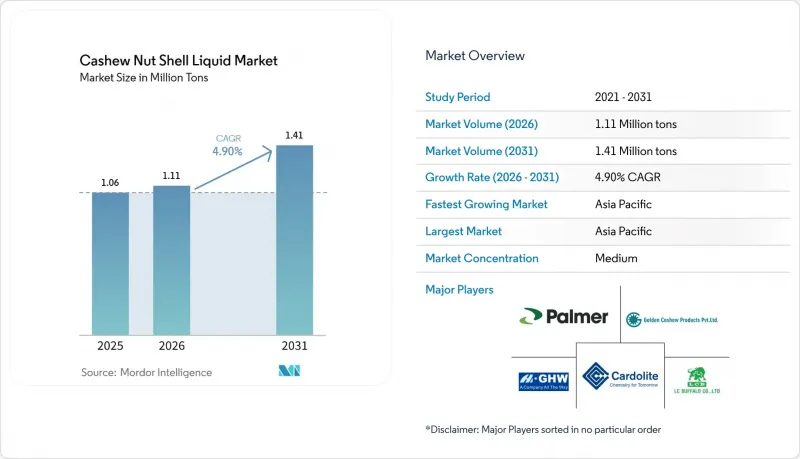
本報告按產品類型(卡爾多及其他)、等級(技術級及其他)、提取方法(機械壓榨及其他)、應用(摩擦材料及其他應用)、終端用戶行業(石油天然氣及其他)和地區(亞太、北美、歐洲、南美、中東和非洲)進行細分。市場預測以銷售量(噸)為單位。
全球腰果殼油(CNSL)市場趨勢與洞察
OEM廠商對高性能摩擦襯片的需求日益成長
為了滿足更嚴格的顆粒物排放和銅含量法規,汽車和商用車製造商正在用腰果酚基酚醛樹脂取代煞車皮傳統的酚醛樹脂。這項轉變主要受歐盟2019/631號法規和中國國家VI標準的推動。此外,電動車平台需要能夠應對頻率較低但能量較高的煞車事件的摩擦材料。為了因應這一日益成長的需求,帕默國際公司(Palmer International)在收到北美卡車原始設備製造商(OEM)對生物基襯片訂單大幅成長的報告後,已擴大其位於德克薩斯州的產能,計劃於2025年投產。同行評審的研究表明,腰果殼油(CNSL)和酚醛樹脂的複合材料具有更高的耐磨性和更低的噪音、振動和粗糙度(NVH),進一步促進了其應用。位於清奈和浦那的印度供應商利用國內原料和國際標準化組織(ISO)9001認證來履行全球契約,從而進一步鞏固了其在亞太地區市場的地位。
促進生物基、低VOC工業塗料相關法規的製定
國際海事組織 (IMO) 對揮發性有機化合物 (VOC) 的限制以及各國生態標籤均建議使用酚醛胺固化環氧樹脂,因為它們可在低溫下高效固化,且可再生碳含量高。 Cardolite 公司於 2025 年 5 月推出的 LITE 514HP 樹脂,在 ASTM B117 鹽霧試驗中表現出色,基準值超過 3000 小時,適用於離岸風力發電渦輪機和船舶船體等應用。歐盟的化學品註冊、評估、授權和限制 (EU REACH) 法規以及美國環保署 (US EPA) 的「更安全選擇」計畫等監管項目限制了壬基酚聚氧乙烯醚的使用,導致儘管腰果酚基稀釋劑成本較高,但市場對其需求卻有所增加。歐洲買家通常願意為具有可追溯文件的蒸餾腰果殼油 (CNSL) 支付 15-20% 的溢價,這為高純度 CNSL 的供應設定了結構性的價格下限。
腰果收成和原殼價格的波動
難以預測的季風和蟲害爆發導致原料短缺,推高了堅果殼價格,並降低了加工商的利潤率。 2026年第一季,由於西非物流的挑戰,印度的生堅果進口量大幅下降。這種情況導致小規模加工商停止運營,精製堅果的價格上漲至每噸975至1025美元。西非國家仍然嚴重依賴堅果殼作為能源來源,不僅犧牲了潛在的加工收入,也加劇了全球供應的波動。雖然與人工林有聯繫的綜合性公司已簽訂了長期契約,但在收成不佳的時期,現貨買家的利潤率面臨壓力。
細分市場分析
預計到2025年,工業用腰果殼油(CNSL)將佔總銷售量的46.5%,這反映了其在摩擦材料和通用工業塗料領域的成本效益。腰果酚預計將以5.12%的複合年成長率成長,這主要得益於環氧樹脂和酚胺化合物生產商的需求,他們需要符合特定規格的產品,例如加德納色度為1或更低、鉀含量低於10 ppm以及胺值穩定。
蒸餾過程可將腰果酚的純度提高至78%,使混煉商能夠滿足電動車煞車系統和低溫固化船舶塗料等原始設備製造商 (OEM) 的要求。原物料殼價格的波動對利潤率帶來壓力,促使印度和越南的加工商擴大其精煉生產線,採用擦拭巾膜法和離子交換法從特種衍生物中提取更高價值的產品。此外,酚醛樹脂仍是一個盈利的細分市場,其在海上塗料應用領域的價格最高可達每噸3,500美元。
預計到2031年,蒸餾和提純級腰果殼油的年複合成長率將達到5.23%,主要得益於下游對高階複合材料中化學性質穩定、微量金屬含量低的腰果殼油的需求。 2025年,技術級腰果殼油佔腰果殼油市場規模的42.1%,但隨著全球目的地設備製造商(OEM)對其供應商的品質審核進行標準化,預計其市場佔有率將會下降。
歐洲進口商為符合化學品註冊、評估、授權和限制(REACH)法規的精製材料支付的價格高出20%,這種價格差異正推動亞太地區生產設施進行技術升級。酸性級產品繼續供應一些特定的木材黏合劑應用,但許多膠合板製造商正轉向使用低甲醛含量的腰果酚基產品,這些產品與傳統的酚醛樹脂黏合劑相比性能更優。
區域分析
至2025年,亞太地區將佔腰果殼油(CNSL)市場39.1%的佔有率,預計2026年至2031年將以5.25%的複合年成長率成長。印度憑藉接近性腰果種植園的優勢,加工了全球約45%的腰果殼油供應。越南則專注於出口精製腰果殼油,這些產品在歐洲和北美市場價格較高。同時,中國樹脂生產商正致力於研發腰果酚環氧樹脂,旨在實現供應鏈本地化並降低對進口的依賴。 2025年,多篇關於石墨烯增強腰果酚基體的同行評審論文發表,也印證了這個趨勢。
儘管北美大部分腰果殼油(CNSL)原料來自亞洲,但對摩擦黏合劑和酚醛胺類塗料等高性能應用的需求仍然強勁。帕默國際公司2025年的產能擴張計畫反映了強勁的訂單,尤其是在電動車平台下游製程中,這些製程需要生物基材料。此外,加拿大風電產業在葉片修復樹脂中擴大採用腰果酚環氧樹脂,進一步擴大了市場潛力。
歐洲仍然是精煉和蒸餾級腰果殼油 (CNSL) 化學品的最大進口地區,通常需要支付可追溯性溢價,以滿足化學品註冊、評估、授權和限制 (REACH) 法規以及生態標籤認證的要求。北歐國家優先考慮將可回收環氧樹脂體系應用於離岸風力發電項目,並大力推動相關研發工作。這些努力得到了循環經濟津貼的支持,這些補助金與腰果殼油化學領域的進步相契合。
儘管南美洲腰果產量豐富,但腰果殼油(CNSL)的萃取卻十分有限。巴西的研究人員正在探索腰果殼油的新用途,但該地區的產業化過程因資金短缺而受阻。中東和非洲對腰果殼油的需求量不大。然而,西非腰果產量過剩,為當地提取腰果殼油提供了機遇,有望使該地區在價值鏈中獲得更高的附加價值。
其他好處:
- Excel格式的市場預測(ME)表
- 3個月的分析師支持
目錄
第1章:引言
- 研究假設和市場定義
- 調查範圍
第2章:調查方法
第3章執行摘要
第4章 市場狀況
- 市場概覽
- 市場促進因素
- 原始設備製造商對高性能摩擦襯片的需求不斷成長
- 促進生物基、低VOC工業塗料相關法規的製定
- 用於風力渦輪機葉片製造的複合材料的擴展
- 海洋環氧體係向酚醛胺基固化劑的過渡
- 以腰果殼油為基礎的生物農藥在農業化學品領域的快速普及*
- 市場限制因素
- 腰果收成與去殼生豆價格的波動
- 低成本合成烷基酚的可用性
- 超臨界二氧化碳萃取規模化所面臨的挑戰
- 價值鏈分析
- 監理情勢
- 波特五力模型
第5章 市場規模與成長預測
- 依產品類型
- 技術 CNSL (TCNSL)
- Cardanol
- Cardol
- 酚醛樹脂
- 腰果酸及其衍生物
- 按年級
- 技術級
- 酸級
- 蒸餾和純化等級
- 透過萃取法
- 機械壓力機
- 溶劑萃取
- 蒸餾和真空蒸餾
- 超臨界二氧化碳萃取
- 熱解
- 透過使用
- 摩擦材料
- 油漆和塗料
- 黏合劑和層壓板
- 表面活性劑和塑化劑
- 聚合物和複合材料
- 化學中間體
- 其他小眾應用(生物潤滑劑、碳材料)
- 按最終用戶行業分類
- 汽車和運輸業
- 建築/施工
- 工業化學品
- 個人護理化妝品
- 石油和天然氣
- 農業
- 其他
- 按地區
- 亞太地區
- 中國
- 日本
- 印度
- 韓國
- 東南亞國協
- 其他亞太國家
- 北美洲
- 美國
- 加拿大
- 墨西哥
- 歐洲
- 德國
- 英國
- 法國
- 義大利
- 西班牙
- 俄羅斯
- 北歐國家
- 其他歐洲國家
- 南美洲
- 巴西
- 阿根廷
- 其他南美國家
- 中東和非洲
- 沙烏地阿拉伯
- 南非
- 其他中東和非洲國家
- 亞太地區
第6章 競爭情勢
- 市場集中度
- 策略趨勢
- 市佔率和排名分析
- 公司簡介
- Adarsh Industrial Chemicals
- Blueline Foods(India)Pvt Ltd
- C. Ramakrishna Padayatchi
- Cardolite Corporation
- Cashew Chem India
- Cat Loi Cashew Oil Production & Export JSC
- Elementis Plc
- GHW(VIETNAM)CO., LTD
- Golden Cashew Products Pvt. Ltd.
- K2P Chemicals
- Kumaraswamy Industries
- LC BUFFALO CO., LTD
- Muskaan Group
- Olam International
- Palmer International, Inc.
- Senesel
- Shivam Cashew Industry
- Shree Ganesh Agro
- SI Group
- Sri Devi Group
- Vavimex Co., Ltd
- Zhejiang Wansheng Co., Ltd
第7章 市場機會與未來展望
According to Mordor Intelligence, the cashew nut shell liquid market size was valued at 1.06 million tons in 2025 and is estimated to grow from 1.11 million tons in 2026 to reach 1.41 million tons by 2031, at a CAGR of 4.90% during the forecast period (2026-2031).
This report is Segmented by Product Type (Cardol and Others), Grade (Technical Grade and Others), Extraction Method (Mechanical Press and Others), Application (Friction Materials and Other Applications), End-User Industry(Oil and Gas and Others), and Geography (Asia-Pacific, North America, Europe, South America, and Middle East and Africa). The Market Forecasts are Provided in Terms of Volume (tons).
Global Cashew Nut Shell Liquid Market Trends and Insights
Growing OEM Demand for High-Performance Friction Linings
Automotive and commercial vehicle manufacturers are replacing conventional phenol-formaldehyde with cardanol-based phenolic resins in brake pads to comply with stricter particulate emission and copper content regulations. This shift is driven by European Union (EU) Regulation 2019/631 and China's National VI standards. Additionally, electric vehicle platforms require friction materials capable of handling infrequent but high-energy braking events. In response to rising demand, Palmer International expanded its Texas production capacity in 2025, following reports of significant growth in orders for bio-based linings from North American truck original equipment manufacturers (OEMs). Peer-reviewed studies indicate that cashew nutshell liquid (CNSL)-phenolic composites offer improved wear resistance and reduced noise, vibration, and harshness, supporting their increased usage. Indian suppliers based in Chennai and Pune are utilizing domestic feedstock and International Organization for Standardization (ISO) 9001 certification to fulfill global contracts, further strengthening the Asia-Pacific region's position in this market.
Regulatory Push for Bio-Based, Low-VOC Industrial Coatings
The International Maritime Organization's Volatile Organic Compound (VOC) caps and national ecolabels support phenalkamine-cured epoxies due to their ability to cure efficiently at low temperatures and their high renewable-carbon content. Cardolite's LITE 514HP, introduced in May 2025, exceeds ASTM B117 salt-spray thresholds of 3,000 hours, making it suitable for applications such as offshore wind towers and marine hulls. Regulatory programs like the European Union Registration, Evaluation, Authorization, and Restriction of Chemicals (EU REACH) and the United States Environmental Protection Agency (U.S. EPA) Safer Choice discourage the use of nonylphenol ethoxylates, increasing demand for cardanol-based diluents despite their higher cost. European buyers consistently pay a 15-20% premium for distilled Cashew Nut Shell Liquid (CNSL) accompanied by traceability documentation, establishing a structural price floor for high-purity supply.
Volatile Cashew Crop Yields and Raw-Shell Pricing
Unpredictable monsoons and pest outbreaks have resulted in feedstock shortages, increasing shell prices, and reducing processor margins. In the first quarter (Q1) of 2026, India experienced a notable decline in raw-nut imports due to logistical challenges in West Africa. This situation led to smaller extractors halting operations and raised refined-grade prices to USD 975-1,025 per ton. West African countries continue to utilize most shells for energy, foregoing potential extraction revenue and contributing to global supply fluctuations. Integrated players with plantation connections secure long-term contracts, while spot buyers face margin pressures during periods of crop shortages.
Other drivers and restraints analyzed in the detailed report include:
- Expansion of Wind-Energy Blade Manufacturing Composites
- Shift to Phenalkamine Curing Agents in Marine Epoxy Systems
- Availability of Low-Cost Synthetic Alkyl-Phenols
For complete list of drivers and restraints, kindly check the Table Of Contents.
Segment Analysis
Technical Cashew Nut Shell Liquid (CNSL) is expected to account for 46.5% of the volume in 2025, reflecting its cost efficiency in friction materials and generic industrial coatings. Cardanol is projected to grow at a Compound Annual Growth Rate (CAGR) of 5.12%, driven by demand from epoxy and phenalkamine formulators requiring specifications such as Gardner color less than or equal to 1, potassium content below 10 parts per million (ppm), and a consistent amine value.
Distillation processes concentrate cardanol to 78% purity, enabling formulators to meet Original Equipment Manufacturer (OEM) requirements for electric vehicle brake systems and marine coatings that cure at sub-zero temperatures. Margin pressures caused by raw-shell price volatility are encouraging Indian and Vietnamese processors to expand wiped-film and ion-exchange purification lines to capture higher value from specialty derivatives. Additionally, phenalkamine resins remain a profitable sub-segment, with prices reaching up to USD 3,500 per ton for offshore coating applications.
Distilled and refined grades are projected to grow at a Compound Annual Growth Rate (CAGR) of 5.23% through 2031, driven by downstream demand for consistent chemical profiles and low trace metal content in high-end composites. In 2025, technical grade accounted for 42.1% of the Cashew Nut Shell Liquid market size; however, its market share is expected to decline as global Original Equipment Manufacturers (OEMs) standardize supplier quality audits.
European importers pay up to 20% more for Registration, Evaluation, Authorization, and Restriction of Chemicals (REACH)-compliant refined materials, creating a price differential that supports technology upgrades in Asia-Pacific production facilities. Acid-grade output continues to cater to niche wood-adhesive applications, although many plywood manufacturers are transitioning to low-formaldehyde cardanol options, which offer improved performance compared to traditional phenol-formaldehyde binders.
Geography Analysis
In 2025, the Asia-Pacific region accounted for 39.1% of the Cashew Nut Shell Liquid (CNSL) market and is projected to grow at a compound annual growth rate (CAGR) of 5.25% from 2026 to 2031. India processes approximately 45% of the global CNSL supply, benefiting from its proximity to cashew farms. Vietnam focuses on exporting refined CNSL grades, which are priced higher in European and North American markets. Meanwhile, China's resin producers are advancing research on cardanol-epoxy systems to localize supply chains and reduce import dependency. This is supported by multiple peer-reviewed studies in 2025 on graphene-reinforced cardanol matrices.
North America sources the majority of its CNSL feedstock from Asia but maintains strong demand for high-performance applications, such as friction binders and phenalkamine coatings. Palmer International's capacity expansion in 2025 reflects robust downstream orders, particularly from electric vehicle platforms that require bio-based materials. Additionally, Canada's wind energy sector is incorporating cardanol epoxies in blade repair resins, further expanding the market's addressable volume.
Europe remains the largest importer of refined and distilled CNSL grades, often paying traceability premiums to meet the requirements of Registration, Evaluation, Authorization, and Restriction of Chemicals (REACH) and Ecolabel certifications. Nordic countries are prioritizing recyclable epoxy systems for offshore wind projects, driving research and development efforts. These initiatives are supported by circular-economy grants that align with CNSL chemistry advancements.
South America, despite its abundance of raw cashew nuts, extracts limited volumes of CNSL. Brazilian researchers are pioneering new applications for CNSL, but industrialization in the region is hindered by capital shortages. The Middle East and Africa exhibit modest CNSL offtake. However, West Africa's surplus of raw cashew nuts presents an opportunity for localized extraction, which could enable the region to capture more value within the supply chain.
- Adarsh Industrial Chemicals
- Blueline Foods (India) Pvt Ltd
- C. Ramakrishna Padayatchi
- Cardolite Corporation
- Cashew Chem India
- Cat Loi Cashew Oil Production & Export JSC
- Elementis Plc
- GHW (VIETNAM) CO., LTD
- Golden Cashew Products Pvt. Ltd.
- K2P Chemicals
- Kumaraswamy Industries
- LC BUFFALO CO., LTD
- Muskaan Group
- Olam International
- Palmer International, Inc.
- Senesel
- Shivam Cashew Industry
- Shree Ganesh Agro
- SI Group
- Sri Devi Group
- Vavimex Co., Ltd
- Zhejiang Wansheng Co., Ltd
Additional Benefits:
- The market estimate (ME) sheet in Excel format
- 3 months of analyst support
TABLE OF CONTENTS
1 Introduction
- 1.1 Study Assumptions and Market Definition
- 1.2 Scope of the Study
2 Research Methodology
3 Executive Summary
4 Market Landscape
- 4.1 Market Overview
- 4.2 Market Drivers
- 4.2.1 Growing OEM demand for high-performance friction linings
- 4.2.2 Regulatory push for bio-based, low-VOC industrial coatings
- 4.2.3 Expansion of wind-energy blade manufacturing composites
- 4.2.4 Shift to phenalkamine curing agents in marine epoxy systems
- 4.2.5 Rapid adoption of CNSL-based bio-pesticides in agro-chemicals*
- 4.3 Market Restraints
- 4.3.1 Volatile cashew crop yields and raw-shell pricing
- 4.3.2 Availability of low-cost synthetic alkyl-phenols
- 4.3.3 Scale-up challenges for super-critical CO2 extraction
- 4.4 Value Chain Analysis
- 4.5 Regulatory Landscape
- 4.6 Porter's Five Forces
- 4.6.1 Bargaining Power of Suppliers
- 4.6.2 Bargaining Power of Buyers
- 4.6.3 Threat of New Entrants
- 4.6.4 Threat of Substitutes
- 4.6.5 Degree of Competition
5 Market Size and Growth Forecasts (Volume)
- 5.1 By Product Type
- 5.1.1 Technical CNSL (TCNSL)
- 5.1.2 Cardanol
- 5.1.3 Cardol
- 5.1.4 Phenalkamine Resins
- 5.1.5 Anacardic Acid and Other Derivatives
- 5.2 By Grade
- 5.2.1 Technical Grade
- 5.2.2 Acid Grade
- 5.2.3 Distilled / Refined Grade
- 5.3 By Extraction Method
- 5.3.1 Mechanical Press
- 5.3.2 Solvent Extraction
- 5.3.3 Distillation and Vacuum Distillation
- 5.3.4 Super-critical CO2 Extraction
- 5.3.5 Thermal Cracking
- 5.4 By Application
- 5.4.1 Friction Materials
- 5.4.2 Paints and Coatings
- 5.4.3 Adhesives and Laminates
- 5.4.4 Surfactants and Plasticizers
- 5.4.5 Polymer and Composites
- 5.4.6 Chemical Intermediates
- 5.4.7 Other Niche Uses (Bio-lubricants, Carbon Materials)
- 5.5 By End-User Industry
- 5.5.1 Automotive and Transportation
- 5.5.2 Building and Construction
- 5.5.3 Industrial Chemicals
- 5.5.4 Personal Care and Cosmetics
- 5.5.5 Oil and Gas
- 5.5.6 Agriculture
- 5.5.7 Others
- 5.6 By Geography
- 5.6.1 Asia-Pacific
- 5.6.1.1 China
- 5.6.1.2 Japan
- 5.6.1.3 India
- 5.6.1.4 South Korea
- 5.6.1.5 ASEAN Countries
- 5.6.1.6 Rest of Asia-Pacific
- 5.6.2 North America
- 5.6.2.1 United States
- 5.6.2.2 Canada
- 5.6.2.3 Mexico
- 5.6.3 Europe
- 5.6.3.1 Germany
- 5.6.3.2 United Kingdom
- 5.6.3.3 France
- 5.6.3.4 Italy
- 5.6.3.5 Spain
- 5.6.3.6 Russia
- 5.6.3.7 NORDIC Countries
- 5.6.3.8 Rest of Europe
- 5.6.4 South America
- 5.6.4.1 Brazil
- 5.6.4.2 Argentina
- 5.6.4.3 Rest of South America
- 5.6.5 Middle-East and Africa
- 5.6.5.1 Saudi Arabia
- 5.6.5.2 South Africa
- 5.6.5.3 Rest of Middle-East and Africa
- 5.6.1 Asia-Pacific
6 Competitive Landscape
- 6.1 Market Concentration
- 6.2 Strategic Moves
- 6.3 Market Share (%)/Ranking Analysis
- 6.4 Company Profiles (includes Global level Overview, Market level overview, Core Segments, Financials as available, Strategic Information, Products and Services, and Recent Developments)
- 6.4.1 Adarsh Industrial Chemicals
- 6.4.2 Blueline Foods (India) Pvt Ltd
- 6.4.3 C. Ramakrishna Padayatchi
- 6.4.4 Cardolite Corporation
- 6.4.5 Cashew Chem India
- 6.4.6 Cat Loi Cashew Oil Production & Export JSC
- 6.4.7 Elementis Plc
- 6.4.8 GHW (VIETNAM) CO., LTD
- 6.4.9 Golden Cashew Products Pvt. Ltd.
- 6.4.10 K2P Chemicals
- 6.4.11 Kumaraswamy Industries
- 6.4.12 LC BUFFALO CO., LTD
- 6.4.13 Muskaan Group
- 6.4.14 Olam International
- 6.4.15 Palmer International, Inc.
- 6.4.16 Senesel
- 6.4.17 Shivam Cashew Industry
- 6.4.18 Shree Ganesh Agro
- 6.4.19 SI Group
- 6.4.20 Sri Devi Group
- 6.4.21 Vavimex Co., Ltd
- 6.4.22 Zhejiang Wansheng Co., Ltd
7 Market Opportunities and Future Outlook
- 7.1 White-space and Unmet-Need Assessment
- 7.2 Increasing Demand for Sustainable, Bio-based Solutions

 腰果殼液市場-2026-2032年全球市場預測
 全球腰果殼液市場規模調查及預測:按產品類型、等級、萃取製程、應用領域、最終用戶和地區分類的預測(2026-2035 年)
 全球腰果殼油市場(依應用、產品類型、萃取製程、等級及地區)預測至2030年
 腰果殼液的全球市場