


 |
市場調查報告書
商品編碼
2062090
鋁酸鈣水泥:市場佔有率分析、產業趨勢與統計、成長預測(2026-2031)Calcium Aluminate Cement - Market Share Analysis, Industry Trends & Statistics, Growth Forecasts (2026 - 2031) |
||||||

※ 本網頁內容可能與最新版本有所差異。詳細情況請與我們聯繫。
據 Mordor Intelligence 稱,鋁酸鈣水泥市場預計將從 2025 年的 396 萬噸成長到 2026 年的 416 萬噸,到 2031 年達到 539 萬噸,2026 年至 2031 年的複合年成長率為 5.32%。
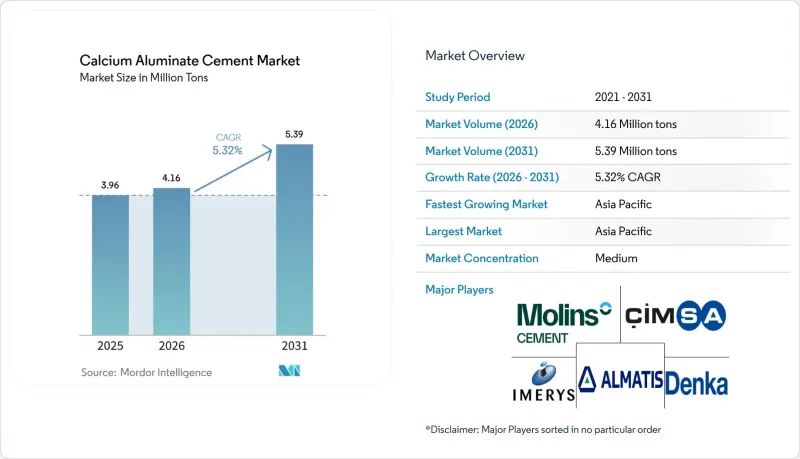
本報告按類型(礬土水泥、預混合料鋁酸鈣水泥等)、形態(粉末、預混合料袋裝等)、應用(耐火材料等)、終端用戶產業(鋼鐵冶金、石油天然氣等)及地區(亞太、北美、歐洲、南美、中東和非洲)進行細分。市場預測以噸為單位。
全球鋁酸鈣水泥市場趨勢及洞察
耐火材料應用需求不斷成長
印度向電弧爐的轉型預計將在2023-2024年使耐火澆注料的需求成長22%,這將刺激鋁酸鈣水泥(CAC)消費量的成長,因為即使在波特蘭接合材料失效的情況下,CAC仍能保持強度。這項轉型也使每噸鋼材的能耗降低了60-70%,而印度強制性的「績效、成就與交易(PAT)」脫碳計畫的實施也支撐了需求的持續成長。同樣,在中東和中國,將CAC與活性氧化鋁結合的超低水泥澆注料正被用於石化裂解裝置的維修。這種澆注料在1400度C下可實現超過12兆帕(MPa)的高溫斷裂模量,從而將爐襯壽命延長15-20%。
採用快凝高性能混凝土
利用海水,硫鋁酸鈣混凝土可在72小時內達到35-40兆帕的強度。這使得沿海預製構件廠無需使用淡水,且與普通矽酸鹽水泥(OPC)相比,可減少高達48%的二氧化碳(CO2)排放。在美國,根據《基礎設施投資與就業法案》,橋樑橋面加鋪工程必須使用此類快速凝固材料。同樣,東協的《互聯互通總體規劃》也允許使用鋁酸鈣水泥(CAC)黏合劑,以期在2030年前彌補2,100億美元的基礎設施缺口。
與波特蘭水泥相比,高昂的製造成本
由於鋁酸鈣水泥(CAC)的燒結溫度比矽酸鹽水泥高100-150 度C,因此其能耗高出15-20%,價格也高出25-30%。因此,在普通矽酸鹽水泥(OPC)添加速凝劑即可滿足需求的場合,鋁酸鈣水泥的應用受到限制。到2025年,印度買家將面臨中國進口產品價格比印度低10-15%的局面,這將影響國內利潤率,並減緩產能擴張。
細分市場分析
預計到2025年,其他特種鈣礬土水泥(CAC)的銷售將佔總銷售量的28.00%。同時,受能夠承受1600 度C以上熱衝擊的整體式耐火材料需求的推動,礬土水泥預計將以6.12%的年成長率成長,尤其是在電弧爐維修。該領域的企業正利用其市場規模優勢提供設計支持,隨著鋼鐵製造商致力於延長宣傳活動壽命,礬土水泥的市場佔有率預計將會擴大。由於來自中國製造商的競爭,氧化鋁含量為40-50%的通用型耐火材料正面臨利潤率壓力。然而,像EcoCaltrix這樣注重永續性的產品在歐洲公共採購管道中卻能獲得15-20%的溢價。
預計到2025年,粉狀耐火材料仍將佔據主導地位,佔市場需求的46.00%,因為耐火材料生產商需要柔軟性調整其水分含量、流動性和高溫強度。同時,預混合料耐火材料預計將以6.23%的複合年成長率成長,主要得益於承包商對勞動效率和批次品質穩定性的需求,尤其是在緊急路面維修方面。膏狀和漿狀耐火材料仍屬於小眾產品,但由於其良好的泵送性和對高溫基材的強黏結性,毛利率預計將達到25-30%。這些特性對於鋼包和窯殼修復等應用至關重要。
預計到2025年,粉狀產品將佔總銷售量的46.00%,這顯示其在散裝耐火澆注料混合中的重要性。製造商使用粉狀產品混合氧化鋁骨材、矽灰、分散劑和氧化鋁鈣,以滿足特定的流變性能和固化時間要求。預混合料袋預計將以6.23%的複合年成長率成長,這主要得益於承包商對穩定、單一來源配方的需求,尤其是在快速維修和緊急應變應用中。膏狀/漿狀產品通常是觸變性配方,設計用於噴塗或抹塗,適用於維護和維修應用。這些產品因其良好的泵送性和對高溫基材(高達800°C)的優異黏附性而備受青睞,使其適用於窯殼維修和鋼包修補等應用。依產品形態分類體現了客製化與便利性之間的平衡。雖然粉末可以進行精確的配方設計,以適應耐火材料的應用,但預混合料袋優先考慮經驗不足的工人的易用性和操作性,因此在性能方面略有不足。
區域分析
預計到2031年,亞太地區將維持46.50%的市場佔有率,年複合成長率達6.15%。這項成長主要得益於印度電弧爐普及率提升18個百分點,從而提振了耐火材料的需求;此外,中國生產商儘管面臨價格競爭壓力,仍在擴大產能。日本和韓國注重品質而非數量,而東協國家則依賴進口袋裝鋁酸鈣水泥(CAC)來支持基礎設施項目,特別是橋樑建設。
在北美,RHI Magnesita 於 2025 年收購 Resco 預計將帶來顯著成長。聯邦基礎設施建設資金預計將推動對快速維修解決方案的需求,而 Calderis 在密蘇裡州的新工廠預計將為中西部地區的買家縮短 30% 至 40% 的前置作業時間。
儘管歐洲在永續性創新方面仍處於主導,但預計到2025年,工業水泥產量將下降12%。然而,基於DWA-A 143標準和碳邊境調節機制(CBAM)碳定價框架的污水管道維修表明,低二氧化碳(CO2)水泥等級具有長期成長潛力。北歐國家較高的人均支出支撐了對優質碳酸鹽水泥(CAC)的利基需求,儘管其產量相對較低。
南美市場的前景取決於巴西反傾銷稅的最終結果,該稅項有可能保護當地生產商。此外,阿根廷的採礦業小規模,但為耐火材料需求提供了穩定的基礎。
中東和非洲的成長主要集中在沙烏地阿拉伯和南非。在伊朗,主要本地供應商滿足了90%以上的國內需求,並出口到鄰近的石化中心,有助於區域市場的穩定。
其他好處:
- Excel格式的市場預測(ME)表
- 3個月的分析師支持
目錄
第1章:引言
- 研究假設和市場定義
- 調查範圍
第2章:調查方法
第3章執行摘要
第4章 市場狀況
- 市場概覽
- 市場促進因素
- 耐火材料應用需求不斷成長
- 採用快凝高性能混凝土
- 在污水和污水基礎設施的應用擴展
- 3D列印耐火模塑件為新型CAC黏合劑的出現提供了可能。
- 低二氧化碳、高效的CAC製造程序
- 市場限制因素
- 高昂的製造成本和波特蘭水泥
- 高能耗、高二氧化碳排放的生產過程
- 高純度礬土原料供應風險
- 價值鏈分析
- 監理情勢
- 波特五力模型
第5章 市場規模與成長預測
- 按類型
- 礬土水泥(CA-50/60)
- 低水泥澆注料
- 預混合料/預混合料CAC
- 超低水泥和隔熱等級
- 其他特殊 CAC(FCA 40-90)
- 按形式
- 粉末
- 糊狀物/漿狀物
- 預混合料袋
- 透過使用
- 耐火材料
- 建築施工及緊急維修
- 化工/石油化工
- 用水和污水處理
- 採礦和發電
- 按最終用戶行業分類
- 鋼鐵冶金
- 石油和天然氣
- 基礎設施和公共工程
- 製造和加工廠
- 其他(船舶、儲能)
- 按地區
- 亞太地區
- 中國
- 日本
- 印度
- 韓國
- 東南亞國協
- 其他亞太國家
- 北美洲
- 美國
- 加拿大
- 墨西哥
- 歐洲
- 德國
- 英國
- 法國
- 義大利
- 西班牙
- 俄羅斯
- 北歐國家
- 其他歐洲國家
- 南美洲
- 巴西
- 阿根廷
- 其他南美國家
- 中東和非洲
- 沙烏地阿拉伯
- 南非
- 其他中東和非洲國家
- 亞太地區
第6章 競爭情勢
- 市場集中度
- 策略趨勢
- 市佔率和排名分析
- 公司簡介
- Almatis
- Caltra Nederland BV
- Carborundum Universal Ltd.(CUMI)
- Cimsa
- Denka Company Limited
- Elfusa S/A
- Etex(Ex-Kerneos Latin America)
- Fengrun Metallurgy Material
- Gorka Cement
- Imerys
- Molins
- Refratechnik Group
- RHI Magnesita
- Royal White Cement
- Taiheiyo Cement Corp.
- Target Products Ltd.
- Union Cement Company
- Vicat Group
- Zhengzhou Dengfeng Smelting Materials
第7章 市場機會與未來展望
According to Mordor Intelligence, the calcium aluminate cement market size is expected to increase from 3.96 million tons in 2025 to 4.16 million tons in 2026 and reach 5.39 million tons by 2031, growing at a CAGR of 5.32% over 2026-2031.
This report is Segmented by Type (High-Alumina Cement, Pre-Mixed Calcium Aluminate Cement, and More), Form (Powder, Premixed Bags, and More), Application (Refractories and More), End-User Industry(Steel and Metallurgy, Oil and Gas, and More), and Geography (Asia-Pacific, North America, Europe, South America, and Middle East and Africa). The Market Forecasts are Provided in Terms of Volume (Tons).
Global Calcium Aluminate Cement Market Trends and Insights
Growing Demand in Refractory Applications
India's transition to electric-arc furnaces increased the demand for refractory castables by 22% in 2023-24, driving higher consumption of calcium aluminate cement (CAC) due to its ability to maintain strength where Portland binders fail. This shift also results in energy savings of 60-70% per ton of steel, while compliance with India's Perform, Achieve, and Trade (PAT) scheme for mandated decarbonization supports sustained demand growth. Similarly, petrochemical cracker upgrades in the Middle East and China are adopting ultra-low cement castables, which combine CAC with reactive alumina to achieve a hot modulus of rupture exceeding 12 megapascals (MPa) at 1,400 degrees Celsius (°C), extending lining lifespans by 15-20%.
Rapid-Setting/High-Performance Concrete Adoption
Calcium sulfoaluminate variants achieve a strength of 35-40 MPa within 72 hours when using seawater, eliminating the need for freshwater in coastal precast yards and reducing carbon dioxide (CO2) emissions by up to 48% compared to Ordinary Portland Cement (OPC). In the United States, bridge-deck overlays funded under the Infrastructure Investment and Jobs Act require such fast-setting materials. Similarly, the Association of Southeast Asian Nations (ASEAN) Connectivity Master Plan permits the use of Calcium Aluminate Cement (CAC) binders to address a USD 210 billion infrastructure gap by 2030.
High Production Costs vs Portland Cement
Sintering at temperatures 100-150°C higher than Portland variants increases Calcium Aluminate Cement (CAC) energy consumption by 15-20% and results in a 25-30% price premium, limiting its adoption in applications where Ordinary Portland Cement (OPC) with accelerators is sufficient. In 2025, Indian buyers faced Chinese imports priced 10-15% lower, which impacted domestic margins and delayed capacity expansions.
Other drivers and restraints analyzed in the detailed report include:
- Expanding Use in Sewerage and Waste-Water Infrastructure
- 3-D Printed Refractory Shapes Enable New CAC Binders
- Energy-Intensive, CO2-Heavy Manufacturing Process
For complete list of drivers and restraints, kindly check the Table Of Contents.
Segment Analysis
Other Specialty Calcium Aluminate Cement (CAC) is projected to account for 28.00% of the 2025 volume, while High-Alumina Cement is expected to grow at an annual rate of 6.12%, driven by the demand for monolithic refractories capable of withstanding thermal shocks of greater than or equal to 1,600 °C, particularly in electric-arc furnace retrofits. Companies in the segment utilize their market size advantage by offering design support, with High-Alumina Cement's market share anticipated to increase as steel producers focus on achieving longer campaign lifespans. Commodity grades with 40-50% alumina content face margin pressures due to competition from Chinese manufacturers. However, sustainability-focused products, such as EcoCaltrix, command a 15-20% price premium in Europe's public procurement channels.
Powder forms are expected to remain dominant, accounting for 46.00% of 2025 demand, as refractory formulators require flexibility to adjust water demand, flow characteristics, and hot strength. Premixed bags, on the other hand, are forecasted to grow at a compound annual growth rate (CAGR) of 6.23%, driven by contractors seeking labor efficiency and consistent batch quality, particularly for emergency pavement repairs. Paste and slurry forms will remain niche products but achieve 25-30% gross margins due to their pumpability and strong adhesion to hot substrates, which are essential for applications such as ladle and kiln-shell patching.
Powder accounted for 46.00% of the projected 2025 volume, indicating its significance in bulk refractory castable mixing. Producers use powder to blend calcium aluminate with alumina aggregates, silica fume, and dispersants to achieve specific rheology and setting time requirements. Premixed bags are expected to grow at a CAGR of 6.23%, driven by contractor demand for consistent, single-source formulations, particularly in rapid-repair and emergency-response applications. Paste/Slurry forms, which are typically thixotropic formulations designed for gunning or troweling, cater to maintenance and repair segments. These forms are valued for their pumpability and ability to adhere to hot substrates (up to 800 degrees Celsius), making them suitable for applications such as kiln-shell repairs and ladle patching. The segmentation by form reflects a balance between customization and convenience: powder allows for precise mix designs tailored to refractory applications, while premixed bags focus on ease of use and reduced labor skill requirements, with some trade-offs in performance potential.
Geography Analysis
Asia-Pacific is projected to retain its 46.50% market share through 2031, with an annual growth rate of 6.15%. This growth is driven by India's 18-percentage-point increase in electric-arc furnace penetration, boosting refractory demand, and capacity expansions by Chinese producers despite competitive pricing pressures. Japan and South Korea prioritize quality over volume, while ASEAN (Association of Southeast Asian Nations) countries depend on imported bagged calcium aluminate cement (CAC) to support infrastructure projects, particularly bridge construction programs.
North America is expected to benefit from RHI Magnesita's acquisition of Resco in 2025. Federal infrastructure funding is anticipated to drive demand for rapid-repair solutions, while Calderys' new plant in Missouri is projected to reduce lead times by 30-40% for buyers in the Midwest region.
Europe continues to lead in sustainability innovations, but experienced a 12% contraction in industrial cement production in 2025. Despite this, sewer upgrades under DWA-A 143 standards and the Carbon Border Adjustment Mechanism's (CBAM) carbon pricing framework indicate long-term growth potential for low-carbon dioxide (CO2) cement grades. High per-capita spending in Nordic countries supports niche demand for premium CAC, despite relatively low production volumes.
South America's market outlook hinges on Brazil's pending antidumping duties, which could protect local producers. Additionally, Argentina's mining sector provides a stable, though modest, baseline for refractory demand.
Growth in the Middle East and Africa is concentrated in Saudi Arabia and South Africa. In Iran, a dominant local supplier meets over 90% of domestic demand and exports to neighboring petrochemical hubs, contributing to regional market stability.
- Almatis
- Caltra Nederland B.V.
- Carborundum Universal Ltd. (CUMI)
- Cimsa
- Denka Company Limited
- Elfusa S/A
- Etex (Ex-Kerneos Latin America)
- Fengrun Metallurgy Material
- Gorka Cement
- Imerys
- Molins
- Refratechnik Group
- RHI Magnesita
- Royal White Cement
- Taiheiyo Cement Corp.
- Target Products Ltd.
- Union Cement Company
- Vicat Group
- Zhengzhou Dengfeng Smelting Materials
Additional Benefits:
- The market estimate (ME) sheet in Excel format
- 3 months of analyst support
TABLE OF CONTENTS
1 Introduction
- 1.1 Study Assumptions and Market Definition
- 1.2 Scope of the Study
2 Research Methodology
3 Executive Summary
4 Market Landscape
- 4.1 Market Overview
- 4.2 Market Drivers
- 4.2.1 Growing demand in refractory applications
- 4.2.2 Rapid-setting/high-performance concrete adoption
- 4.2.3 Expanding use in sewerage and waste-water infrastructure
- 4.2.4 3-D printed refractory shapes enable new CAC binders
- 4.2.5 Low-CO2, energy-efficient CAC production processes
- 4.3 Market Restraints
- 4.3.1 High production costs vs Portland cement
- 4.3.2 Energy-intensive, CO2-heavy manufacturing process
- 4.3.3 Supply risk of high-purity bauxite feedstock
- 4.4 Value Chain Analysis
- 4.5 Regulatory Landscape
- 4.6 Porter's Five Forces
- 4.6.1 Threat of New Entrants
- 4.6.2 Bargaining Power of Buyers
- 4.6.3 Bargaining Power of Suppliers
- 4.6.4 Threat of Substitutes
- 4.6.5 Competitive Rivalry
5 Market Size and Growth Forecasts (Volume)
- 5.1 By Type
- 5.1.1 High-Alumina Cement (CA-50/60)
- 5.1.2 Low-Cement Castables
- 5.1.3 Pre-Mixed/Premixed CAC
- 5.1.4 Ultra-Low Cement and Insulating Grades
- 5.1.5 Other Specialty CAC (FCA 40-90)
- 5.2 By Form
- 5.2.1 Powder
- 5.2.2 Paste / Slurry
- 5.2.3 Premixed Bags
- 5.3 By Application
- 5.3.1 Refractories
- 5.3.2 Construction and Rapid-Repair
- 5.3.3 Chemicals and Petrochemicals
- 5.3.4 Water and Waste-Water Treatment
- 5.3.5 Mining and Power Generation
- 5.4 By End-user Industry
- 5.4.1 Steel and Metallurgy
- 5.4.2 Oil and Gas
- 5.4.3 Infrastructure and Public Works
- 5.4.4 Manufacturing and Process Plants
- 5.4.5 Others (Marine, Energy Storage)
- 5.5 By Geography
- 5.5.1 Asia-Pacific
- 5.5.1.1 China
- 5.5.1.2 Japan
- 5.5.1.3 India
- 5.5.1.4 South Korea
- 5.5.1.5 ASEAN Countries
- 5.5.1.6 Rest of Asia-Pacific
- 5.5.2 North America
- 5.5.2.1 United States
- 5.5.2.2 Canada
- 5.5.2.3 Mexico
- 5.5.3 Europe
- 5.5.3.1 Germany
- 5.5.3.2 United Kingdom
- 5.5.3.3 France
- 5.5.3.4 Italy
- 5.5.3.5 Spain
- 5.5.3.6 Russia
- 5.5.3.7 NORDIC Countries
- 5.5.3.8 Rest of Europe
- 5.5.4 South America
- 5.5.4.1 Brazil
- 5.5.4.2 Argentina
- 5.5.4.3 Rest of South America
- 5.5.5 Middle-East and Africa
- 5.5.5.1 Saudi Arabia
- 5.5.5.2 South Africa
- 5.5.5.3 Rest of Middle-East and Africa
- 5.5.1 Asia-Pacific
6 Competitive Landscape
- 6.1 Market Concentration
- 6.2 Strategic Moves
- 6.3 Market Share (%)/Ranking Analysis
- 6.4 Company Profiles (includes Global Level Overview, Market Level Overview, Core Segments, Financials as available, Strategic Information, Products and Services, and Recent Developments)
- 6.4.1 Almatis
- 6.4.2 Caltra Nederland B.V.
- 6.4.3 Carborundum Universal Ltd. (CUMI)
- 6.4.4 Cimsa
- 6.4.5 Denka Company Limited
- 6.4.6 Elfusa S/A
- 6.4.7 Etex (Ex-Kerneos Latin America)
- 6.4.8 Fengrun Metallurgy Material
- 6.4.9 Gorka Cement
- 6.4.10 Imerys
- 6.4.11 Molins
- 6.4.12 Refratechnik Group
- 6.4.13 RHI Magnesita
- 6.4.14 Royal White Cement
- 6.4.15 Taiheiyo Cement Corp.
- 6.4.16 Target Products Ltd.
- 6.4.17 Union Cement Company
- 6.4.18 Vicat Group
- 6.4.19 Zhengzhou Dengfeng Smelting Materials
7 Market Opportunities and Future Outlook
- 7.1 White-space and Unmet-Need Assessment
- 7.2 Demand for corrosion-resistant, high-performance binders in circular infrastructure
- 7.3 Green-cement technology integration and sustainable construction pathways

 鑄造用碳化矽水泥市場:全球市場預測,2026-2032年
 2026年全球硫鋁酸鈣水泥市場報告2026年全球耐高溫水泥市場報告2026年全球鋁酸鈣水泥市場報告
 全球鋁酸鈣水泥市場規模、佔有率、趨勢和成長分析報告(2026-2034年)熔融鋁酸鹽水泥市場按類型、包裝類型、應用、最終用途產業和分銷管道分類,全球預測(2026-2032年)
 鋁酸鈣水泥市場規模、佔有率和成長分析(按類型、產品類型、功能、最終用途、通路和地區分類)-2026-2033年產業預測
 全球硫鋁酸鈣(CSA)水泥市場:預測至2032年-依產品類型、等級/性能、生產/加工、分銷通路、應用及地區進行分析
 鋁酸鈣水泥市場機會、成長動力、產業趨勢分析及 2025 - 2034 年預測