


 |
市場調查報告書
商品編碼
2062063
防火測試:市場佔有率分析、產業趨勢與統計、成長預測(2026-2031)Fire Testing - Market Share Analysis, Industry Trends & Statistics, Growth Forecasts (2026 - 2031) |
||||||

※ 本網頁內容可能與最新版本有所差異。詳細情況請與我們聯繫。
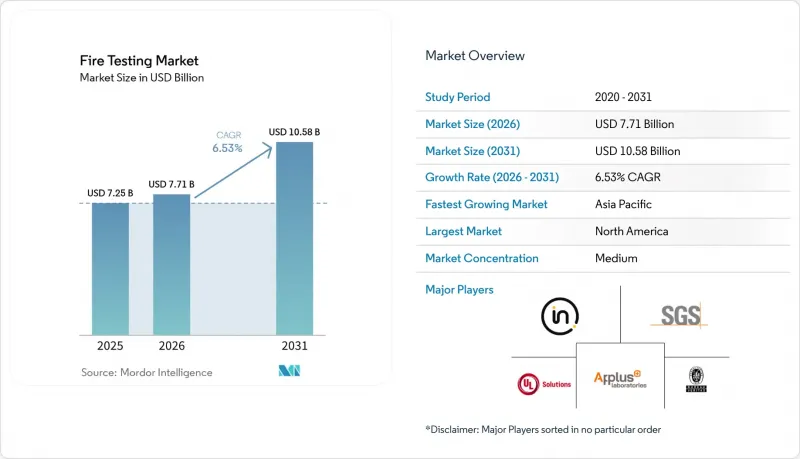
根據 Mordor Intelligence 預測,火災測試市場規模將從 2025 年的 72.5 億美元成長到 2026 年的 77.1 億美元,然後在 2031 年達到 105.8 億美元,2026 年至 2031 年的複合年成長率為 6.53%。
本報告按服務類型(耐火性測試、可燃性測試等)、測試方法(全尺寸爐試驗、小規模和台架試驗等)、最終用途行業(建築施工、交通運輸等)、材料類型(結構構件、防火塗料等)和地區進行細分。市場預測以美元(USD)計價。
全球火災測試市場趨勢及洞察
更嚴格的消防安全法規與執法力度
北美、歐洲和亞太地區日益嚴格的消防法規仍然是支撐防火測試市場的最大結構性因素。 2026版NFPA 855強制要求電池能源儲存系統進行基於ANSI/CAN/UL 9540A標準的大規模防火測試,這要求買家要求進行安裝等級的檢驗,而非僅限於產品等級的測試。在歐洲,建築產品防火等級和耐火性能的法規也透過對《建築產品法規》(CPR)框架內相關授權法規的修訂而得到加強。 ISO 834-1:2025於2025年5月修訂了耐火性能測試的一般要求,要求實驗室和製造商遵守修訂後的程序、儀器檢查和報告規範。 ISO/IEC 17025仍然是重要的認證標準,這意味著在許多應用中,未獲得認可認證的實驗室無法出具具有監管效力的測試結果。這些因素共同促成了強勁的需求和穩定的價格。這是因為防火測試市場越來越依賴有據可查的性能證據,而不是僅基於檢查清單的聲明。
建築和基礎設施維修活動增加
雖然建築和維修工程的增加支撐了整個防火測試市場的需求,但維修項目的工作量與新建項目有所不同。現有塔樓、住宅大樓和商業建築在更換外牆系統、隔間牆、門、塗料或保溫材料時,通常需要進行大量的重新測試。 2024年9月發布的格倫費爾大廈火災調查第二階段報告揭示了外牆防火測試的系統性缺陷,導致英國各地的維修活動活性化。這種轉變增加了對大規模帷幕牆系統評估的需求,尤其是在業主和監管機構尋求能夠反映實際安裝條件(而非單一材料的性能聲明)的系統性能證明時。歐盟修訂後的建築產品框架也推動了對定期測試的需求,因為製造商正努力確保帶有CE標誌的產品持續符合相關標準。 Intertek於2025年5月收購巴西TESIS公司,顯示這家領先的測試、檢測和通訊(TIC)集團認為,南美洲由建築業主導的測試需求並非暫時的復甦,而是永續的長期成長機會。
全面適用性測試高成本且複雜
在防火測試市場中,全面符合性測試仍然是最明顯的營運瓶頸。這是因為服務提供者和客戶都面臨著巨大的資金和準備成本。將於2026年3月發布的ANSI/CAN/UL 9540A第六版,在附件C中強制要求對電池儲能場景進行大規模燃燒測試,尤其是在機殼設計和氣體成分存在爆炸風險的情況下。 SGS在2026年5月指出,新版本實際上將初始CFD分析作為某些專案的先決條件,甚至在安排實際測試之前就需要更多的規劃時間。如果製造商需要大型爐體、先進的儀器設備、多個模型以及重複的設定檢驗,成本負擔會更加沉重。在一些關鍵市場,認證等待時間已經長達數年,這意味著延遲成本幾乎與直接測試成本相當。這種壓力往往有利於那些財務基礎雄厚、產品規劃週期較長的成熟大型企業,同時增加了中小型新參與企業商業化進程延誤的風險。
細分市場分析
截至2025年,耐火測試將佔耐火測試市場(按服務類型分類)的37.32%,這表明耐火測試是許多建築產品和被動防火系統的基本要求。耐火測試仍然至關重要,因為牆體、樓板、門、隔間、柱子和其他結構構件通常未經認證爐的檢驗,不得用於受監管的項目。 ISO 834-1:2025於2025年5月修訂了建築結構構件的全球測試程序,進一步強化了耐火測試的核心地位。阻燃性測試仍然是第二大服務領域,因為紡織品、聚合物、電纜和建築材料無論用於民用或工業用途,仍需要進行反應篩檢。此外,對火災偵測系統測試的需求也在不斷成長,尤其是在資料中心。在設備密集的資料中心,必須證明探測和滅火系統在特定的熱力和空間條件下能夠如預期運作。
預計從2026年到2031年,菸霧和毒性測試的複合年成長率將達到7.27%,成為消防測試市場中成長最快的服務領域。 2025年9月,英國建築安全監管機構發布了一份重要審查報告,指出當前監管實踐與現代建築中使用的合成聚合物燃燒產生的氣體危害之間存在差距。在鐵路和公共交通領域,這個問題尤其突出,因為早在國家建築規範明確之前,營運商就已將煙霧毒性視為一個實際的安全問題。因此,對新材料進行兩種類型測試的趨勢日益明顯,因為客戶在批准產品之前,越來越需要結構耐火性和燃燒氣體評估的雙重證明。然而,專門針對煙霧和毒性的測試能力發展速度並未與之同步,因此,未來幾年,該細分領域將在消防測試市場中佔據更重要的戰略地位。
即使到了2025年,全尺寸爐試驗仍將佔據測試方法領域40.51%的佔有率,這表明物理檢驗仍然是防火測試市場的核心方法。許多主要的建築規範和認證途徑仍然要求對用於居住建築的組裝和部件提供直接的爐試驗證據。這項要求提高了准入門檻,因為獲得認證的大型爐需要大量的資金投入、專業人員以及多種測試方向以適應不同的產品類型。沃靈頓消防公司位於伯奇伍德公園的實驗室耗資3,000萬美元,於2025年1月啟用,計畫配備大規模爐。該實驗室旨在將歐洲的耐火測試處理能力比先前的霍姆斯菲爾德路基地提高80%。小規模試驗和桌上型試驗仍然非常重要,因為錐形量熱儀、本生燈和相關方法可以幫助製造商在進行更昂貴的全尺寸測試之前篩選材料。
在測試方法領域,電腦模擬和建模預計將在2026年至2031年間以7.41%的複合年成長率(CAGR)實現最高成長。西南研究院的研究表明,CFD火災建模可以透過在全面物理檢驗開始前識別危險模式來減少成本高的測試迭代次數。隨著UL 9540A第六版的發布,早期建模已成為某些電池儲能專案中大規模燃燒風險緩解的實用環節,因此其在認證流程中的作用也日益規範化。就銷售額而言,火災反應測試仍然是最小的測試方法類別,但隨著自願性分類擴大被用作市場准入的指標,它在電纜和家具應用領域正受到越來越多的關注。在火災測試產業,測試方法的構成正從單純的實體測試檢驗轉向利用模擬來改善進度安排、設計方案和一次性通過率的混合方案。
區域分析
到2025年,北美將佔據全球消防測試市場32.95%的佔有率,成為最大的區域貢獻者。美國憑藉一套完善的框架支撐著這一地位,該框架由NFPA規範、UL標準和國際建築標準(IBC)組成,這些標準對建築、工業和交通運輸領域規定了常規的測試義務。加拿大透過CSA相關標準和認證途徑創造了穩定的需求,而墨西哥則受益於製造業擴張以及近岸外包帶來的相關合規要求。 DEKRA認證公司已獲得OSHA對32項新增測試標準的認可,這些標準將於2025年12月31日生效,這表明認證機構正在積極競爭,以擴大該地區的認證範圍。此外,隨著NFPA 855將大規模消防測試納入2026年安裝規範框架,北美在電池儲能(BESS)測試需求方面也處於領先地位。
雖然所提供的數據並未揭露區域市場佔有率,但歐洲仍然是防火測試市場中測試實驗室最發達的叢集之一。德國、英國和法國構成了核心國內市場,這得益於CE相關產品認證途徑和基於EN(歐洲標準)的測試方法所形成的密集測試環境。格雷內爾大樓二期工程報告加速了英國對外牆和帷幕牆系統測試的需求,其影響波及BS 8414和EN相關活動。歐洲也受益於相對較高的認證測試實驗室密度,使其能夠同時滿足國內合規性和跨境產品認證的需求。南美洲仍是小規模的區域市場,但巴西憑藉Intertek於2025年5月收購位於聖保羅的TESIS公司,成為重要的成長驅動力。
亞太地區預計將成為消防測試市場成長最快的地區,2026年至2031年的複合年成長率將達到7.35%。中國、印度、日本、韓國和東南亞國家正在收緊建築法規,同時擴大對製造業相關認證的需求,這推動了所有服務業的成長。在澳大利亞,儘管CSIRO Northride的整合面臨短期產能限制,但Jensen Hughes在2024年底完成其原Warrington Fire Australia業務的品牌重塑後,已做好充分準備,把握市場需求的變化。中東和非洲地區繼續依賴海灣合作理事會(GCC)的建設項目,沙烏地阿拉伯的「2030願景」項目和阿拉伯聯合大公國的智慧城市發展項目都持續需要符合國際標準和海灣國家標準。
其他好處:
- Excel格式的市場預測(ME)表
- 3個月的分析師支持
目錄
第1章:引言
- 研究假設和市場定義
- 調查範圍
第2章:調查方法
第3章執行摘要
第4章 市場狀況
- 市場概覽
- 市場促進因素
- 更嚴格的消防安全法規與執法力度
- 建築和基礎設施維修活動活性化
- 汽車和交通運輸系統中對消防安全檢驗的需求日益成長。
- 擴大將防火測試外包給經認可的第三方機構
- UL 9540A 第 5 版:電池能源儲存系統。
- 英國外牆組件系統測試向基於EN標準的過渡
- 市場限制因素
- 全面合規性測試高成本且複雜。
- 各檢查室的標準並不統一。
- 由於CSIRO北萊德基地關閉,澳洲失去了火災測試能力。
- 在防火、防水、結構木材和煙霧毒性等方面的標準有缺陷。
- 產業價值鏈分析
- 監理情勢
- 技術展望
- 波特五力分析
- 市場宏觀經濟趨勢分析
第5章 市場規模與成長預測
- 按服務類型
- 耐火性測試
- 可燃性測試
- 煙霧和毒性測試
- 火災偵測系統測試
- 其他服務類型
- 透過測試方法
- 全尺寸反應器試驗
- 小規模試驗和台架試驗
- 電腦模擬和建模
- 耐火性測試
- 產業最終用途
- 建築/施工
- 運輸
- 車
- 航太
- 鐵路
- 海上
- 電氣和電子設備
- 工業製造
- 消費品和家具
- 石油、天然氣和採礦業
- 其他終端用戶產業
- 依材料/依樣品類型
- 結構部件
- 防火塗層
- 電纜和電線
- 織物和紡織品
- 聚合物和塑膠
- 其他材料/樣品類型
- 按地區
- 北美洲
- 美國
- 加拿大
- 墨西哥
- 南美洲
- 巴西
- 阿根廷
- 其他南美國家
- 歐洲
- 德國
- 英國
- 法國
- 義大利
- 西班牙
- 其他歐洲國家
- 亞太地區
- 中國
- 日本
- 印度
- 韓國
- ASEAN
- 其他亞太國家
- 中東和非洲
- 中東
- 沙烏地阿拉伯
- 阿拉伯聯合大公國
- 土耳其
- 其他中東國家
- 非洲
- 南非
- 奈及利亞
- 其他非洲國家
- 中東
- 北美洲
第6章 競爭情勢
- 市場集中度
- 策略趨勢
- 市佔率分析
- 公司簡介
- Intertek Group plc
- SGS SA
- UL LLC
- Applus+Laboratories
- Bureau Veritas
- TAceV SAceD
- TAceV Rheinland
- DEKRA SE
- Eurofins Scientific
- Element Materials Technology
- Vetrotech Saint-Gobain International AG
- FM Global
- NGC Testing Services
- Underwriters Laboratories of Canada
- Kiwa NV
- CSA Group
- ALS Limited
- Thomas Bell-Wright International
- Trox SE
- System Laboratories UK
- Ignito Labs
- BRE Global
- Labtest Certification Inc.
- QAI Laboratories
- Govmark Fire Testing
第7章 市場機會與未來展望
According to Mordor Intelligence, the fire testing market size is expected to grow from USD 7.25 billion in 2025 to USD 7.71 billion in 2026 and is forecast to reach USD 10.58 billion by 2031 at 6.53% CAGR over 2026-2031.
This report is Segmented by Service Type (Fire Resistance Testing, Flammability Testing, and More), Testing Method (Full-Scale Furnace Testing, Small-Scale and Bench Testing, and More), End-Use Industry (Building and Construction, Transportation, and More), Material Type (Structural Components, Fire-Protective Coatings, and More), and Geography. The Market Forecasts are Provided in Terms of Value (USD).
Global Fire Testing Market Trends and Insights
Stricter Fire Safety Regulations and Code Enforcement
Stricter fire rules across North America, Europe, and Asia-Pacific remain the strongest structural force supporting the fire testing market. The 2026 edition of NFPA 855 now mandates large-scale fire testing under ANSI/CAN/UL 9540A for battery energy storage systems, which pushes buyers toward installation-level validation instead of narrower product-level checks. Europe has also tightened fire classification and fire resistance rules for construction products through updated delegated regulations tied to the Construction Products Regulation framework. ISO 834-1:2025 updated the general requirements for fire resistance testing in May 2025, which means laboratories and manufacturers must align with revised procedures, instrumentation checks, and reporting practices. ISO/IEC 17025 remains the gatekeeping accreditation standard, so laboratories without recognized accreditation cannot issue test results with regulatory standing in many applications. This combination supports steady demand and firmer pricing because the fire testing market increasingly depends on documented performance evidence rather than checklist-based declarations alone.
Rising Construction and Infrastructure Retrofit Activity
Rising construction and retrofit work are sustaining demand across the fire testing market, but retrofit projects are creating a different workload than new buildings. Existing towers, residential blocks, and commercial properties often need broad retesting when cladding systems, partitions, doors, coatings, or insulation packages are changed. The Grenfell Tower Inquiry Phase 2 report, published in September 2024, exposed systemic failures in external wall fire testing and intensified remediation activity across the United Kingdom. That shift has increased demand for large-scale facade system evaluation, especially where owners and regulators now want proof that system performance reflects real installation conditions rather than isolated material claims. The revised EU framework for construction products is also sustaining recurring test demand as manufacturers seek continued compliance for CE-marked products. Intertek's May 2025 acquisition of TESIS in Brazil showed that leading TIC groups see construction-led testing demand in South America as a durable, long-cycle growth opportunity rather than a short-lived rebound.
High Cost and Complexity of Full-Scale Compliance Testing
Full-scale compliance work remains the clearest operational brake on the fire testing market because both providers and customers face high capital and preparation costs. ANSI/CAN/UL 9540A 6th Edition, published in March 2026, introduced mandatory large-scale deflagration testing under Annex C for battery energy storage scenarios where enclosure design and gas composition create explosion risk. SGS noted in May 2026 that the new Edition also makes early-stage CFD work a practical prerequisite for some programs, which adds planning time before a physical test can even be booked. The cost burden is even heavier where manufacturers need large furnaces, advanced instrumentation, multiple mockups, and repeated setup verification. Certification queues in several major markets already stretch into multi-year windows, which means delay costs can become nearly as damaging as the direct testing bill. That pressure tends to favor large incumbents with stronger balance sheets and longer product planning horizons, while smaller challengers face a higher risk of commercialization delays.
Other drivers and restraints analyzed in the detailed report include:
- Higher Fire-Safety Validation Needs in Automotive and Transportation Systems
- Growing Outsourcing of Accredited Third-Party Fire Testing
- Lack of Cross-Laboratory Standard Harmonization
For complete list of drivers and restraints, kindly check the Table Of Contents.
Segment Analysis
Fire resistance testing held a 37.32% share of the fire testing market by service type in 2025, which confirms its role as the baseline requirement for many building products and passive protection systems. Fire resistance work remains central because walls, floors, doors, partitions, columns, and other structural elements often cannot move into regulated projects without recognized furnace-based validation. ISO 834-1:2025 reinforced that central role by updating the global testing procedure for elements of building construction in May 2025. Flammability testing remained the second-largest service area because textiles, polymers, cables, and construction materials still need reaction screening across consumer and industrial uses. Fire detection system testing is also seeing stronger demand from data centers, where dense equipment layouts require proof that detection and suppression systems perform as intended under specific thermal and spatial conditions.
Smoke and toxicity testing is forecast to grow at a 7.27% CAGR from 2026 to 2031, which makes it the fastest-expanding service line in the fire testing market. The UK Building Safety Regulator published a major review in September 2025 that highlighted the gap between current regulatory practice and the combustion gas hazards created by synthetic polymers used in modern buildings. That issue is even more visible in rail and transit, where operators have long treated smoke toxicity as a practical safety issue even when national building rules were less explicit. The result is a growing two-test pattern for newer materials, because clients increasingly need both structural fire resistance evidence and combustion gas assessment before approving a product. Specialized capacity for smoke and toxicity work is not scaling at the same pace, which gives this sub-segment a stronger strategic position within the fire testing market over the next several years.
Full-scale furnace testing retained a 40.51% share of the testing method segment in 2025, which shows that physical validation remains the core method in the fire testing market. Most major building codes and certification pathways still require direct furnace evidence for assemblies and components that are used in occupied structures. That requirement creates a high barrier to entry because accredited large furnaces need large capital budgets, specialized staff, and multiple orientations for different product categories. Warringtonfire's Birchwood Park laboratory opened in January 2025 as a USD 30 million facility with major planned furnace capacity, and the site was designed to raise European fire resistance throughput by 80% versus its prior Holmesfield Road operation. Small-scale and bench testing remain important because cone calorimeter, Bunsen burner, and related methods help manufacturers screen materials before moving into more expensive full-scale programs.
Computer simulation and modeling are forecast to record the fastest CAGR at 7.41% from 2026 to 2031 within the testing method segment. Southwest Research Institute has shown how CFD fire modeling can reduce costly test iterations by identifying hazard patterns before full physical validation begins. That role is becoming more formal inside certification workflows because the 6th Edition of UL 9540A makes early-stage modeling a practical part of large-scale deflagration risk preparation for some battery energy storage programs. Reaction-to-fire testing remains the smallest method category by revenue, yet it is gaining traction in cable and furniture applications as voluntary classification is used more often as a market entry signal. Within the fire testing industry, the method mix is shifting from physical-only validation toward hybrid programs that use simulation to improve scheduling, design choices, and first-time pass rates.
Geography Analysis
North America held 32.95% of the global fire testing market in 2025, which made it the largest regional contributor. The United States supports that position through a dense framework of NFPA codes, UL standards, and the International Building Code that creates recurring test obligations across buildings, industry, and transport. Canada adds steady demand through CSA-linked standards and certification pathways, while Mexico is benefiting from manufacturing expansion tied to nearshoring and related compliance needs. DEKRA Certification Inc. received OSHA recognition for 32 additional test standards effective December 31, 2025, which shows how aggressively accredited bodies are competing to widen recognized scope in the region. North America is also at the forefront of battery energy storage testing demand after NFPA 855 moved large-scale fire testing into the installation code pathway for 2026.
Europe remained one of the most developed laboratory clusters within the fire testing market, even though a regional share was not disclosed in the input. Germany, the United Kingdom, and France form the core national markets because CE-related product pathways and EN-based methods create a dense testing environment. The Grenfell Tower Inquiry Phase 2 report accelerated external wall and facade system testing demand in the United Kingdom, and that effect has flowed into both BS 8414 and EN-linked activity. Europe also benefits from a relatively high concentration of accredited laboratories, which helps it serve both domestic compliance and cross-border product qualification. South America is still a smaller regional base, but Brazil stands out as the main growth anchor after Intertek entered the market through its May 2025 acquisition of TESIS in Sao Paulo.
Asia-Pacific is forecast to be the fastest-growing region in the fire testing market at a 7.35% CAGR from 2026 to 2031. China, India, Japan, South Korea, and Southeast Asian economies are all tightening building rules while also expanding manufacturing-linked certification demand, which supports growth across service types. Australia faces a near-term capacity constraint as the CSIRO North Ryde consolidation progresses, and Jensen Hughes is well placed to capture redirected demand after rebranding the former Warringtonfire Australia business in late 2024. The Middle East and Africa region remains tied to GCC construction programs, where Saudi Arabia's Vision 2030 projects and UAE smart-city developments continue to require compliance under international and Gulf-referenced standards.
- Intertek Group plc
- SGS SA
- UL LLC
- Applus+ Laboratories
- Bureau Veritas
- TAceV SAceD
- TAceV Rheinland
- DEKRA SE
- Eurofins Scientific
- Element Materials Technology
- Vetrotech Saint-Gobain International AG
- FM Global
- NGC Testing Services
- Underwriters Laboratories of Canada
- Kiwa NV
- CSA Group
- ALS Limited
- Thomas Bell-Wright International
- Trox SE
- System Laboratories UK
- Ignito Labs
- BRE Global
- Labtest Certification Inc.
- QAI Laboratories
- Govmark Fire Testing
Additional Benefits:
- The market estimate (ME) sheet in Excel format
- 3 months of analyst support
TABLE OF CONTENTS
1 INTRODUCTION
- 1.1 Study Assumptions and Market Definition
- 1.2 Scope of the Study
2 RESEARCH METHODOLOGY
3 EXECUTIVE SUMMARY
4 MARKET LANDSCAPE
- 4.1 Market Overview
- 4.2 Market Drivers
- 4.2.1 Stricter Fire Safety Regulations and Code Enforcement
- 4.2.2 Rising Construction and Infrastructure Retrofit Activity
- 4.2.3 Higher Fire-Safety Validation Needs in Automotive and Transportation Systems
- 4.2.4 Growing Outsourcing of Accredited Third-Party Fire Testing
- 4.2.5 UL 9540A Edition 5 Expanding Battery Energy Storage System Fire Testing Scope
- 4.2.6 UK Shift Toward EN-Based System Testing for External Wall Assemblies
- 4.3 Market Restraints
- 4.3.1 High Cost and Complexity of Full-Scale Compliance Testing
- 4.3.2 Lack of Cross-Laboratory Standard Harmonization
- 4.3.3 Australia Fire Testing Capacity Loss From the CSIRO North Ryde Closure
- 4.3.4 Standards Gaps in Fire Stopping, Structural Timber, and Smoke Toxicity
- 4.4 Industry Value Chain Analysis
- 4.5 Regulatory Landscape
- 4.6 Technological Outlook
- 4.7 Porter's Five Forces Analysis
- 4.7.1 Bargaining Power of Suppliers
- 4.7.2 Bargaining Power of Buyers
- 4.7.3 Threat of New Entrants
- 4.7.4 Threat of Substitutes
- 4.7.5 Intensity of Competitive Rivalry
- 4.8 Assessment of Macroeconomic Trends on the Market
5 MARKET SIZE AND GROWTH FORECASTS (VALUE)
- 5.1 By Service Type
- 5.1.1 Fire Resistance Testing
- 5.1.2 Flammability Testing
- 5.1.3 Smoke and Toxicity Testing
- 5.1.4 Fire Detection System Testing
- 5.1.5 Other Service Types
- 5.2 By Testing Method
- 5.2.1 Full-Scale Furnace Testing
- 5.2.2 Small-Scale and Bench Testing
- 5.2.3 Computer Simulation and Modelling
- 5.2.4 Reaction-to-Fire Testing
- 5.3 By End-Use Industry
- 5.3.1 Building and Construction
- 5.3.2 Transportation
- 5.3.2.1 Automotive
- 5.3.2.2 Aerospace
- 5.3.2.3 Rail
- 5.3.2.4 Marine
- 5.3.3 Electrical and Electronics
- 5.3.4 Industrial Manufacturing
- 5.3.5 Consumer Goods and Furniture
- 5.3.6 Oil and Gas and Mining
- 5.3.7 Other End-Use Industries
- 5.4 By Material / Sample Type
- 5.4.1 Structural Components
- 5.4.2 Fire-Protective Coatings
- 5.4.3 Cables and Wires
- 5.4.4 Fabrics and Textiles
- 5.4.5 Polymers and Plastics
- 5.4.6 Other Materials / Sample Types
- 5.5 By Geography
- 5.5.1 North America
- 5.5.1.1 United States
- 5.5.1.2 Canada
- 5.5.1.3 Mexico
- 5.5.2 South America
- 5.5.2.1 Brazil
- 5.5.2.2 Argentina
- 5.5.2.3 Rest of South America
- 5.5.3 Europe
- 5.5.3.1 Germany
- 5.5.3.2 United Kingdom
- 5.5.3.3 France
- 5.5.3.4 Italy
- 5.5.3.5 Spain
- 5.5.3.6 Rest of Europe
- 5.5.4 Asia-Pacific
- 5.5.4.1 China
- 5.5.4.2 Japan
- 5.5.4.3 India
- 5.5.4.4 South Korea
- 5.5.4.5 ASEAN
- 5.5.4.6 Rest of Asia-Pacific
- 5.5.5 Middle East and Africa
- 5.5.5.1 Middle East
- 5.5.5.1.1 Saudi Arabia
- 5.5.5.1.2 United Arab Emirates
- 5.5.5.1.3 Turkey
- 5.5.5.1.4 Rest of the Middle East
- 5.5.5.2 Africa
- 5.5.5.2.1 South Africa
- 5.5.5.2.2 Nigeria
- 5.5.5.2.3 Rest of Africa
- 5.5.5.1 Middle East
- 5.5.1 North America
6 COMPETITIVE LANDSCAPE
- 6.1 Market Concentration
- 6.2 Strategic Moves
- 6.3 Market Share Analysis
- 6.4 Company Profiles (includes Global level Overview, Market level overview, Core Segments, Financials as available, Strategic Information, Market Rank/Share for key companies, Products and Services, and Recent Developments)
- 6.4.1 Intertek Group plc
- 6.4.2 SGS SA
- 6.4.3 UL LLC
- 6.4.4 Applus+ Laboratories
- 6.4.5 Bureau Veritas
- 6.4.6 TAceV SAceD
- 6.4.7 TAceV Rheinland
- 6.4.8 DEKRA SE
- 6.4.9 Eurofins Scientific
- 6.4.10 Element Materials Technology
- 6.4.11 Vetrotech Saint-Gobain International AG
- 6.4.12 FM Global
- 6.4.13 NGC Testing Services
- 6.4.14 Underwriters Laboratories of Canada
- 6.4.15 Kiwa NV
- 6.4.16 CSA Group
- 6.4.17 ALS Limited
- 6.4.18 Thomas Bell-Wright International
- 6.4.19 Trox SE
- 6.4.20 System Laboratories UK
- 6.4.21 Ignito Labs
- 6.4.22 BRE Global
- 6.4.23 Labtest Certification Inc.
- 6.4.24 QAI Laboratories
- 6.4.25 Govmark Fire Testing
7 MARKET OPPORTUNITIES AND FUTURE OUTLOOK
- 7.1 White-space and Unmet-Need Assessment


