


 |
市場調查報告書
商品編碼
2062046
工業攪拌機:市佔率分析、產業趨勢與統計、成長預測(2026-2031)Industrial Agitators - Market Share Analysis, Industry Trends & Statistics, Growth Forecasts (2026 - 2031) |
||||||

※ 本網頁內容可能與最新版本有所差異。詳細情況請與我們聯繫。
根據 Mordor Intelligence 預測,工業攪拌器市場規模將從 2025 年的 28 億美元成長到 2026 年的 29.2 億美元,到 2031 年將達到 36.1 億美元,2026 年至 2031 年的複合年成長率為 4.33%。
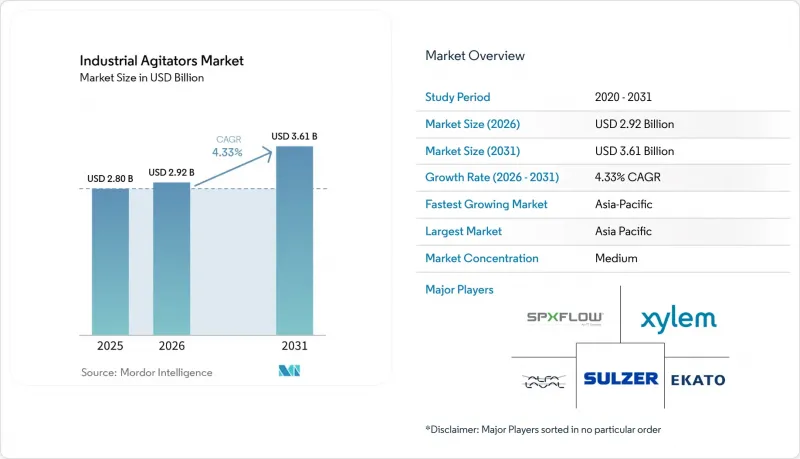
本報告按產品類型(大型罐式攪拌器、可攜式攪拌器及其他)、安裝方式(頂部安裝及其他)、組件(葉輪及其他)、混合流型(軸流及其他)、額定功率(5kW及以下及其他)、終端用戶行業(化學/石化、食品飲料及其他)和地區進行細分。市場預測以美元計價。
全球工業攪拌器市場趨勢與洞察
化工和石化領域產能的提高推動了攪拌器的採購。
化工和石化領域產能的擴張仍然是工業攪拌器市場需求的最強驅動力。這是因為新建的反應器、聚合反應罐和排放罐都需要特定的攪拌解決方案。這些項目通常需要大型罐體、高扭矩或側入式攪拌系統,這些系統需要根據容器尺寸、流體特性和製程負荷進行客製化設計,而不是從標準產品目錄中選擇。這不僅增加了設備成本,而且與簡單的攪拌器相比,也延長了設計和交付週期。因此,採購活動在專案週期的早期階段就開始了,參與FEED(基礎設計效應)或詳細設計階段的供應商可以在最終設備訂單之前確定規格。這種趨勢使得擁有現場工程支援和深厚製程應用知識的OEM廠商在工業攪拌器市場中擁有明顯的優勢。
污水處理系統的維修和節能投資正在擴大其應用範圍。
隨著市政當局和工業企業翻新老舊攪拌機以降低能耗並提高製程穩定性,污水處理方面的支出正在推動工業攪拌機市場的發展。這並非源自於新建工廠的激增,而是由於現有設施需要在滿足嚴格性能要求的同時降低維修成本。根據賽萊默公司(Xylem)的報告顯示,科羅拉多州克利夫頓衛生區在將其氧化溝設施升級為自適應攪拌機後,能耗降低了50%以上,沉澱問題減少了99%。厭氧消化和沼氣發電工程也面臨維修的成長,因為需要持續攪拌來維持污泥和漿液的均勻流動。當供應商能夠證明投資回報迅速並帶來成本節約時,企業越來越願意支付前期費用,這正是推動工業攪拌機市場成長的因素。
大型工業攪拌器的高昂生命週期成本限制了其應用。
生命週期成本仍然是工業攪拌器市場的主要限制因素,因為在較長的運作內,維護、密封更換、變速箱維修、磨損和停機成本可能超過初始購買價格。在價格敏感型市場,這個問題特別突出,業者往往即使設備已超過其建議的設計壽命,也會延後更換。在採礦等高磨蝕性和固態含量應用中,由於密封件和葉輪磨損更快,以及相關的維護成本,負擔更加沉重。即使在已開發市場,由於總擁有成本比簡單的旋轉設備更難追蹤,因此獲得認證也可能很困難。雖然供應商正在透過數位化監控和預測性維護工具來解決這個問題,但如果最終用戶尚未擁有必要的數據系統來證明降低生命週期成本的益處,工業攪拌器市場在推廣應用方面仍然面臨限制。
細分市場分析
截至2025年,大型罐式攪拌器將佔據工業攪拌器市場42.89%的佔有率,這反映了它們在化工、石油化工和水處理等需要連續運行和高扭矩攪拌的儲罐中的核心作用。這些系統通常根據儲罐的特定規格進行設計,因此與標準目錄產品相比,單位成本更高,交貨週期更長。可攜式攪拌器則滿足不同的需求領域,在這些領域,易於訂單和更換頻率比客製化更為重要,例如小批量混合、工業維護和現場混合作業。滾筒式攪拌器在化妝品、塗料和特殊化學品領域仍然十分重要,這些領域的使用者優先考慮的是快速處理和在重複性、短週期操作中易於操作。
磁力攪拌器是工業攪拌器市場中成長最快的產品類型,預計到2031年將以5.12%的複合年成長率成長,這主要得益於製藥和特種化學品製造商轉型為零洩漏設計。磁力攪拌器的優勢在於其卓越的密封性能、更低的密封故障風險以及更高的清潔性,儘管與傳統攪拌器相比,其初始購置成本更高。阿法拉伐於2026年3月推出的EnSaLine B和EnSaLine S平台,以衛生操作、易於清潔的設計和便利的維護為核心。其他產品類型,包括用於連續流特種製程的混合解決方案,雖然銷售量仍然有限,但它們填補了標準葉輪系統無法滿足的應用空白,從而為工業攪拌器市場提供了支援。
在2025年的工業攪拌器市場中,頂部安裝式配置佔據了72.32%的市場。這主要得益於化學、水處理和採礦等行業的大規模應用。在這些行業的工廠中,頂部入口式配置往往更受歡迎,因為它便於從上方進入儲罐,並且可以使用現有的架空起重機設備進行維護。側裝式系統在原油調和以及大型儲存槽仍然發揮著重要作用,因為在這些場所,由於罐體直徑和高度的限制,頂部入口式配置並不實用。因此,即使新型衛生設施採用了不同的佈局,散裝物料處理行業傳統設備的配置仍然保持穩定。
由於生物製藥和食品加工企業傾向於採用閉迴路製程、完全排空和更清潔的罐頂,預計到2031年,底部安裝式攪拌器在工業攪拌器市場將以4.91%的複合年成長率成長。這種轉變是結構性的,因為許多新建的無菌和衛生工廠現在在製程設計的早期階段就指定採用這種佈局,而不是後期添加。蘇爾壽於2025年7月推出的Scaba STA表明,主要供應商仍在努力提高頂部安裝式攪拌器的效率和水力性能,以維持其成熟的市場佔有率。因此,工業攪拌器市場正在經歷一種根據最終用途和合規性要求而變化的安裝配置模式,而不是完全放棄頂部安裝式設備。
區域分析
預計到2025年,亞太地區將佔據工業攪拌器市場規模的38.54%,並在2031年之前以4.89%的複合年成長率持續成長。該地區在化工、製藥和水基礎設施領域擁有最豐富的設備安裝項目儲備,這推動了對標準和客製化規格產品的旺盛需求。中國和印度繼續在這一趨勢中發揮核心作用,大規模的工藝投資和不斷擴大的國內製造業生態系統支撐著廣泛的採購基礎。韓國透過生物製藥的擴張,為市場增添了另一個高價值環節,不銹鋼和混合製程系統在高價值生產的應用也持續推進。 2026年4月,藥明生物宣布其成都微生物商業製造地的建設工作竣工,關鍵設備已運抵現場,進一步鞏固了其在中國生物程序相關設備市場的地位。
北美和歐洲共同構成了工業攪拌器市場的另一個主要收入來源,這得益於製藥企業回流、污水處理廠維修以及食品級設備的升級。在美國,艾伯維、強生和安進相繼宣布了大規模生產計劃,以滿足上游製程、製劑製程以及整個公用系統對符合GMP規範的攪拌器的需求。在歐洲,隨著加工商更加重視在連續運轉中實現更精確的控制和更低的能耗,變頻驅動裝置的更換週期正在加快。德國憑藉在特種化學品、製藥和食品加工領域的集中優勢,繼續保持其作為歐洲主要市場的地位。
南美洲、中東和非洲是工業攪拌器市場中規模較小但成長顯著的細分市場。沙烏地阿拉伯和阿拉伯聯合大公國的主導下游石化和海水淡化產業,而非洲則高度依賴廢水處理基礎設施和採礦相關的攪拌作業。在巴西和阿根廷,食品加工和工業化學品行業支撐著市場需求,但匯率波動可能會延誤專案決策並延長設備更換週期。隨著這些地區設備的老化,維護、維修和升級工作,加上新增需求,如今已佔據工業攪拌器市場相當大的佔有率。
其他好處
- Excel格式的市場預測(ME)表
- 3個月的分析師支持
目錄
第1章:引言
- 研究假設和市場定義
- 調查範圍
第2章:調查方法
第3章執行摘要
第4章 市場狀況
- 市場概覽
- 市場促進因素
- 提高化工和石化產品的產能
- 用於污水處理設施維修和節能改善的支出
- 擴大藥品和生物製程的生產能力
- 食品和飲料的衛生和批次間一致性要求
- 投資電動車電池漿料混合生產線
- 向磁力驅動攪拌器過渡,以實現零洩漏應用
- 市場限制因素
- 大型工業攪拌器的生命週期成本高
- 不銹鋼及合金的價格波動
- 在小批量生物製程中引進一次性混合技術
- ATEX、噪音以及機械密封合規性的複雜性
- 產業價值鏈分析
- 監理情勢
- 技術展望
- 波特五力分析
- 市場宏觀經濟趨勢分析
第5章 市場規模與成長預測
- 依產品類型
- 大型罐式攪拌器
- 可攜式攪拌器
- 滾筒攪拌器
- 磁力攪拌器
- 其他
- 安裝配置
- 頂部安裝式
- 側裝式
- 底部安裝型
- 按組件
- 葉輪
- 軸
- 引擎
- 密封件和軸承
- 混合流模式
- 軸流式
- 徑向流
- 切向流
- 按類型分類的額定輸出
- 5千瓦或以下
- 5~15kW
- 15~50kW
- 超過50千瓦
- 按最終用途行業分類
- 化工/石油化工
- 用水和污水處理
- 食品/飲料
- 製藥和生物技術
- 礦產和採礦
- 紙漿和紙漿
- 能源和發電
- 其他
- 按地區
- 北美洲
- 美國
- 加拿大
- 墨西哥
- 南美洲
- 巴西
- 阿根廷
- 其他南美國家
- 歐洲
- 德國
- 英國
- 法國
- 義大利
- 西班牙
- 其他歐洲國家
- 亞太地區
- 中國
- 日本
- 印度
- 韓國
- ASEAN
- 其他亞太國家
- 中東和非洲
- 中東
- 沙烏地阿拉伯
- 阿拉伯聯合大公國
- 土耳其
- 其他中東國家
- 非洲
- 南非
- 奈及利亞
- 其他非洲地區
- 中東
- 北美洲
第6章 競爭情勢
- 市場集中度
- 策略趨勢
- 市佔率分析
- 公司簡介
- SPX FLOW Inc.
- Xylem Inc.
- Alfa Laval AB
- Sulzer Ltd.
- EKATO Holding GmbH
- Philadelphia Mixing Solutions, Ltd.
- NOV Inc.(Chemineer & Kenics)
- Dynamix Agitators Inc.
- Shenyin Side-Entry Mixer Co., Ltd.
- Silverson Machines Inc.
- Sumitomo Heavy Industries Environment Co., Ltd.
- Pfaudler Group
- Sharpe Mixers
- United Technologies Fluidmix SL
- JiangSu JianShe Group
- CS UNITEC Inc.
- Milton Roy Mixing
- Plenty Mixers
- Landia A/S
- Mixer Direct Inc.
第7章 市場機會與未來展望
According to Mordor Intelligence, the industrial agitators market size is expected to grow from USD 2.80 billion in 2025 to USD 2.92 billion in 2026 and is forecast to reach USD 3.61 billion by 2031 at 4.33% CAGR over 2026-2031.
This report is Segmented by Product Type (Large Tank Agitators, Portable Agitators, and More), Mounting Configuration (Top-Mounted, and More), Component (Impeller, and More), Mixing Flow Pattern (Axial Flow, and More), Power Rating (Up To 5 KW, and More), End-Use Industry (Chemicals and Petrochemicals, Food and Beverage, and More), and Geography. The Market Forecasts are Provided in Terms of Value (USD).
Global Industrial Agitators Market Trends and Insights
Chemical and Petrochemical Capacity Additions Drive Agitator Procurement
Chemical and petrochemical capacity additions remain the strongest demand driver for the industrial agitators market because every new reactor train, polymerization vessel, and effluent tank needs a defined agitation solution. These projects often require large-tank, high-torque, or side-entry systems that are engineered around vessel size, fluid behavior, and process duty rather than drawn from a standard catalog. That raises equipment value and also extends engineering and delivery timelines compared with simpler mixing equipment. Procurement, therefore, moves early in the project cycle, and suppliers that enter during FEED or detailed design can secure specifications before final equipment awards. This pattern gives OEMs with local engineering support and process application depth a clear advantage in the industrial agitators market.
Wastewater Treatment Retrofit and Energy-Efficiency Spending Broaden the Installed Base
Wastewater treatment spending is expanding the industrial agitators market through retrofit activity as municipalities and industrial operators replace aging mixers to cut energy use and improve process stability. The driver is less about a wave of new plants and more about lowering operating costs while meeting tighter performance expectations in existing facilities. Xylem reported that the Clifton Sanitation District in Colorado cut energy consumption by more than 50% and eliminated 99% of settling issues after upgrading to adaptive mixers in oxidation ditch service. Retrofit demand is also widening through anaerobic digestion and biogas-to-power projects, where continuous-duty mixing is needed to keep sludge and slurry streams uniform. Operators are increasingly willing to pay more upfront when a supplier can document savings over a short payback period, which supports value growth in the industrial agitators market.
High Lifecycle Cost of Large Industrial Agitators Constrains Capacity Adoption
Lifecycle cost remains a meaningful restraint on the industrial agitators market because maintenance, seal replacement, gearbox work, erosion, and downtime can exceed the initial purchase price over a long service period. This issue is most visible in price-sensitive markets where operators delay replacement even after equipment moves beyond its preferred engineering life. The burden is heavier in abrasive and high-solids duties such as mining, where wear on seals and impellers is faster and more expensive to manage. Even in developed markets, approvals can be harder to secure because total ownership cost is less visible than it is for simpler rotating equipment. Suppliers are responding with digital monitoring and predictive maintenance tools, but the industrial agitators market still faces adoption limits where end users do not yet have the data systems needed to prove lifecycle savings.
Other drivers and restraints analyzed in the detailed report include:
- Pharmaceutical and Bioprocess Capacity Expansion Drives Specification Complexity
- Food and Beverage Hygiene and Batch Consistency Requirements Elevate Engineering Standards
- Stainless Steel and Alloy Price Volatility Pressures Margins and Project Timelines
For complete list of drivers and restraints, kindly check the Table Of Contents.
Segment Analysis
Large tank agitators held 42.89% of the industrial agitators market share in 2025, reflecting their central role in chemical, petrochemical, and water-treatment vessels that need continuous-duty, high-torque mixing. These systems are usually engineered to vessel specification, which raises unit value and creates longer order-to-delivery cycles than standard catalog products. Portable agitators serve a different layer of demand in small-batch blending, industrial maintenance, and field-mixing work where ease of deployment and replacement frequency matter more than customization. Drum agitators also remain relevant in cosmetics, coatings, and specialty chemicals because users value fast turnover and simple handling across repeated short-cycle duties.
Magnetic agitators are the fastest-growing product type in the industrial agitators market, with a 5.12% CAGR projected through 2031 as pharmaceutical and specialty chemical operators move toward zero-leakage designs. Their appeal comes from better containment, lower seal-related failure risk, and stronger fit with cleanability requirements, even when the initial purchase cost is higher than for conventional units. Alfa Laval's EnSaLine B and EnSaLine S platforms, introduced in March 2026, were built around hygienic service, flushable design, and faster maintenance access. Other product types, including hybrid solutions used in continuous-flow specialty processes, remain narrower in volume but support the industrial agitators market by filling application gaps that standard impeller systems do not always address.
Top-mounted configurations accounted for 72.32% share of the industrial agitators market size in 2025, supported by their very large installed base in chemicals, water treatment, and mining. Plants in these sectors often prefer top entry because tank access from above is straightforward, and maintenance can be managed with existing overhead lifting arrangements. Side-mounted systems remain important in crude oil blending and large storage tanks where vessel diameter and headroom make top entry less practical. This keeps the traditional mounting mix stable across bulk-process industries even as new hygienic facilities adopt different layouts.
Bottom-mounted agitators are forecast to grow at a 4.91% CAGR through 2031 in the industrial agitators market as biopharmaceutical and food processors favor closed-vessel processing, full drainability, and cleaner vessel tops. The change is structural because many new sterile and hygienic plants now specify these layouts early in process design rather than adding them later. Sulzer's Scaba STA launch in July 2025 showed that major suppliers are still improving the efficiency and hydraulic performance of top-entry units to defend mature share positions. The industrial agitators market is therefore seeing a mounting mix that changes by end use and compliance need rather than through a full shift away from top-mounted equipment.
Geography Analysis
Asia-Pacific held 38.54% of the industrial agitators market size in 2025 and is expected to expand at a 4.89% CAGR through 2031. The region combines the deepest pipeline of chemical, pharmaceutical, and water infrastructure additions, which keeps both standard-duty and engineered demand active. China and India remain central to this pattern because large process investments and expanding domestic manufacturing ecosystems support a broader procurement base. South Korea adds another premium layer through biologics expansion, where stainless and hybrid processing systems continue to be commissioned for higher-value output. WuXi Biologics announced structural completion and key equipment arrival at its Chengdu microbial commercial manufacturing site in April 2026, reinforcing China's position in bioprocess-related equipment demand.
North America and Europe together form the other major revenue center for the industrial agitators market, supported by pharmaceutical reshoring, wastewater retrofits, and food-grade equipment upgrades. In the United States, AbbVie, Johnson and Johnson, and Amgen all announced major manufacturing commitments that support GMP-compliant agitation demand across upstream, formulation, and utility systems. Europe is seeing a stronger replacement cycle in variable-frequency-driven units as processors focus on tighter control and lower energy draw in continuous-duty service. Germany remains the leading European value market because it brings together specialty chemicals, pharmaceuticals, and food processing in one concentrated industrial base.
South America, the Middle East, and Africa represent smaller but important growth pockets in the industrial agitators market. Saudi Arabia and the UAE are led by downstream petrochemicals and desalination, while Africa depends more on wastewater infrastructure and mining-related agitation duties. Brazil and Argentina support food processing and industrial chemicals, although currency pressure can delay project commitments and extend replacement cycles. As installed bases age across these regions, service, retrofits, and upgrade work are becoming a larger part of the industrial agitators market than greenfield demand alone.
- SPX FLOW Inc.
- Xylem Inc.
- Alfa Laval AB
- Sulzer Ltd.
- EKATO Holding GmbH
- Philadelphia Mixing Solutions, Ltd.
- NOV Inc. (Chemineer & Kenics)
- Dynamix Agitators Inc.
- Shenyin Side-Entry Mixer Co., Ltd.
- Silverson Machines Inc.
- Sumitomo Heavy Industries Environment Co., Ltd.
- Pfaudler Group
- Sharpe Mixers
- United Technologies Fluidmix S.L.
- JiangSu JianShe Group
- CS UNITEC Inc.
- Milton Roy Mixing
- Plenty Mixers
- Landia A/S
- Mixer Direct Inc.
Additional Benefits:
- The market estimate (ME) sheet in Excel format
- 3 months of analyst support
TABLE OF CONTENTS
1 INTRODUCTION
- 1.1 Study Assumptions and Market Definition
- 1.2 Scope of the Study
2 RESEARCH METHODOLOGY
3 EXECUTIVE SUMMARY
4 MARKET LANDSCAPE
- 4.1 Market Overview
- 4.2 Market Drivers
- 4.2.1 Chemical and Petrochemical Capacity Additions
- 4.2.2 Wastewater Treatment Retrofit and Energy-Efficiency Spending
- 4.2.3 Pharmaceutical and Bioprocess Capacity Expansion
- 4.2.4 Food and Beverage Hygiene and Batch Consistency Requirements
- 4.2.5 EV Battery Slurry Mixing Line Investments
- 4.2.6 Shift Toward Magnetic-Drive Agitators in Zero-Leakage Duty
- 4.3 Market Restraints
- 4.3.1 High Lifecycle Cost of Large Industrial Agitators
- 4.3.2 Stainless Steel and Alloy Price Volatility
- 4.3.3 Single-Use Mixing Adoption in Small-Batch Bioprocessing
- 4.3.4 ATEX, Noise, and Mechanical Seal Compliance Complexity
- 4.4 Industry Value Chain Analysis
- 4.5 Regulatory Landscape
- 4.6 Technological Outlook
- 4.7 Porter's Five Forces Analysis
- 4.7.1 Bargaining Power of Suppliers
- 4.7.2 Bargaining Power of Buyers
- 4.7.3 Threat of New Entrants
- 4.7.4 Threat of Substitutes
- 4.7.5 Intensity of Competitive Rivalry
- 4.8 Assessment of Macroeconomic Trends on the Market
5 MARKET SIZE AND GROWTH FORECASTS (VALUE)
- 5.1 By Product Type
- 5.1.1 Large Tank Agitators
- 5.1.2 Portable Agitators
- 5.1.3 Drum Agitators
- 5.1.4 Magnetic Agitators
- 5.1.5 Other Product Types
- 5.2 By Mounting Configuration
- 5.2.1 Top-Mounted
- 5.2.2 Side-Mounted
- 5.2.3 Bottom-Mounted
- 5.3 By Component
- 5.3.1 Impeller
- 5.3.2 Shaft
- 5.3.3 Motor
- 5.3.4 Seals and Bearings
- 5.4 By Mixing Flow Pattern
- 5.4.1 Axial Flow
- 5.4.2 Radial Flow
- 5.4.3 Tangential Flow
- 5.5 By Power Rating
- 5.5.1 Up to 5 kW
- 5.5.2 5-15 kW
- 5.5.3 15-50 kW
- 5.5.4 Above 50 kW
- 5.6 By End-User Industry
- 5.6.1 Chemicals and Petrochemicals
- 5.6.2 Water and Wastewater Treatment
- 5.6.3 Food and Beverage
- 5.6.4 Pharmaceuticals and Biotechnology
- 5.6.5 Minerals and Mining
- 5.6.6 Paper and Pulp
- 5.6.7 Energy and Power
- 5.6.8 Other End-User Industries
- 5.7 By Geography
- 5.7.1 North America
- 5.7.1.1 United States
- 5.7.1.2 Canada
- 5.7.1.3 Mexico
- 5.7.2 South America
- 5.7.2.1 Brazil
- 5.7.2.2 Argentina
- 5.7.2.3 Rest of South America
- 5.7.3 Europe
- 5.7.3.1 Germany
- 5.7.3.2 United Kingdom
- 5.7.3.3 France
- 5.7.3.4 Italy
- 5.7.3.5 Spain
- 5.7.3.6 Rest of Europe
- 5.7.4 Asia-Pacific
- 5.7.4.1 China
- 5.7.4.2 Japan
- 5.7.4.3 India
- 5.7.4.4 South Korea
- 5.7.4.5 ASEAN
- 5.7.4.6 Rest of Asia-Pacific
- 5.7.5 Middle East and Africa
- 5.7.5.1 Middle East
- 5.7.5.1.1 Saudi Arabia
- 5.7.5.1.2 United Arab Emirates
- 5.7.5.1.3 Turkey
- 5.7.5.1.4 Rest of the Middle East
- 5.7.5.2 Africa
- 5.7.5.2.1 South Africa
- 5.7.5.2.2 Nigeria
- 5.7.5.2.3 Rest of Africa
- 5.7.5.1 Middle East
- 5.7.1 North America
6 COMPETITIVE LANDSCAPE
- 6.1 Market Concentration
- 6.2 Strategic Moves
- 6.3 Market Share Analysis
- 6.4 Company Profiles (includes Global level Overview, Market level overview, Core Segments, Financials as available, Strategic Information, Market Rank/Share for key companies, Products and Services, and Recent Developments)
- 6.4.1 SPX FLOW Inc.
- 6.4.2 Xylem Inc.
- 6.4.3 Alfa Laval AB
- 6.4.4 Sulzer Ltd.
- 6.4.5 EKATO Holding GmbH
- 6.4.6 Philadelphia Mixing Solutions, Ltd.
- 6.4.7 NOV Inc. (Chemineer & Kenics)
- 6.4.8 Dynamix Agitators Inc.
- 6.4.9 Shenyin Side-Entry Mixer Co., Ltd.
- 6.4.10 Silverson Machines Inc.
- 6.4.11 Sumitomo Heavy Industries Environment Co., Ltd.
- 6.4.12 Pfaudler Group
- 6.4.13 Sharpe Mixers
- 6.4.14 United Technologies Fluidmix S.L.
- 6.4.15 JiangSu JianShe Group
- 6.4.16 CS UNITEC Inc.
- 6.4.17 Milton Roy Mixing
- 6.4.18 Plenty Mixers
- 6.4.19 Landia A/S
- 6.4.20 Mixer Direct Inc.
7 MARKET OPPORTUNITIES AND FUTURE OUTLOOK
- 7.1 White-space and Unmet-Need Assessment

 工業攪拌器市場:全球預測,2026-2032年
 工業攪拌器市場報告:按類型、安裝配置、銷售管道、行業和地區分類(2026-2034 年)
 全球工業攪拌器市場:額定功率、型號類型、組件、安裝方式、形狀、產業和地區分類-預測至2032年皮帶驅動攪拌器市場:按類型、馬達功率、材料、應用和最終用戶分類-全球預測,2026-2032年
 全球工業攪拌器市場規模、佔有率、趨勢和成長分析報告(2026-2034年)日本工業攪拌機和攪拌器市場規模、佔有率、趨勢和預測(按類型、應用和地區分類,2026-2034 年)
 工業攪拌器市場-全球產業規模、佔有率、趨勢、機會和預測(按型號、安裝方式、最終用戶、地區和競爭格局分類,2020-2030 年)
 同軸混合器:全球市場佔有率和排名、總收入和需求預測(2025-2031 年)
 2025-2029年全球熱板攪拌器市場
 2030 年全球工業攪拌器市場預測:按類型、安裝類型、組件、結構材料、應用、最終用戶和地區進行分析