


 |
市場調查報告書
商品編碼
2062037
生物療法:市場佔有率分析、產業趨勢與統計、成長預測(2026-2031)Biorationals - Market Share Analysis, Industry Trends & Statistics, Growth Forecasts (2026 - 2031) |
||||||

※ 本網頁內容可能與最新版本有所差異。詳細情況請與我們聯繫。
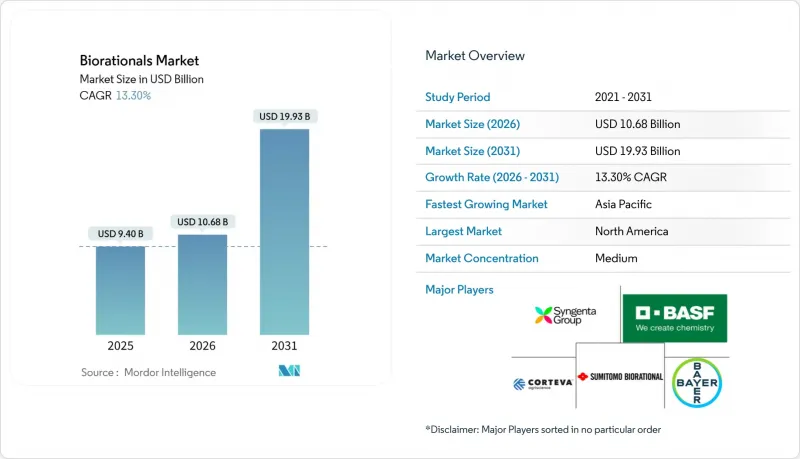
據 Mordor Intelligence 稱,2025 年生物理性市場價值為 94 億美元,預計到 2031 年將達到 199.3 億美元,而 2026 年為 106.8 億美元,預測期(2026-2031 年)的複合年成長率為 13.3%。
本報告按產品類型(微生物、植物來源、訊息化合物及其他)、原料(細菌、真菌及其他)、作物類型(穀類、水果、蔬菜及其他)、製劑形式(液體和固體)、施用方法(葉面噴布及其他)和地區(北美、歐洲及其他)進行分類。市場預測以美元計價。
全球生物合理市場趨勢與洞察
監管機構禁止使用高殘留量的合成農藥。
嚴格執行最大殘留基準值(MRL)縮小了化學農藥的選擇範圍,並將資金重新分配到作物保護領域。美國環保署(EPA)2025年的藥品淘汰清單剔除了在美國玉米和大豆種植項目中佔據主導地位的新菸鹼類和有機磷類農藥,這立即為蘇雲金芽孢蘇力菌和綠殭菌產品創造了市場機會。歐盟農藥法規為多種食品和飼料產品設定了最大殘留基準值(MRL)。對於未明確規定農藥殘留基準值的情況,預設閾值0.01毫克/公斤,透過最大限度地降低農產品貿易中可接受的殘留水平,促進了向生物合理產品的轉變。
食品零售商對零殘留農產品的需求
大型食品零售商正將第三方殘留物檢測納入供應商合約。 2025年10月,沃爾瑪美國公司宣布計畫在2027年前在自有品牌食品中消除色素和其他添加劑。此舉反映了消費者對更清潔、更透明的配料標準的期望以及零售商策略的轉變。好市多和樂購等公司類似的標準正在影響下游的區域批發商。這種壓力對漿果、綠葉蔬菜和果樹尤其顯著,因為這些產品從採摘到商店僅需幾天時間,因此更容易出現不合規的情況。提前達到標準的生產商可以獲得批發溢價,而日本進口標準的收緊進一步刺激了亞太地區出口中心的獎勵。
與化學農藥相比,土壤殘留量較低。
許多微生物和植物來源的活性成分會在幾天內分解,需要多次重複施用,從而增加營運成本。蘇雲金桿菌在強光照射下72小時內藥效會降低一半,而新菸鹼類殺蟲劑的藥效永續2-3週[4]。包埋金屬蘇力菌可以延長存活時間,但這項技術尚未普及。在製劑技術更廣泛應用之前,紫外線輻射強度高的地區的生產者可能仍會繼續依賴合成農藥,只要每公頃成本是首要考慮因素。
細分市場分析
微生物解決方案將佔據最大的市場佔有率,到2025年將佔銷售額的52%,憑藉豐富的田間數據和完善的監管管道,繼續保持其主導地位。訊息化合物產品雖然市場規模較小,但預計將實現最快成長,2026年至2031年的複合年成長率將達到19.8%,主要得益於無人機在果園和葡萄園部署信息素噴灑裝置。植物來源配方將繼續為那些需要零採收前間隔期的專業細分市場做出貢獻,而包括微生物代謝物和生長調節劑在內的「其他」類別,隨著發酵產量的提高,其市場佔有率也在逐步擴大。
多菌株產品的興起正在重塑競爭格局。以芽孢桿菌、木黴和鏈黴菌為核心的菌叢可提供功能冗餘,確保在酸性和鹼性土壤中均能維持穩定的藥效。訊息化合物利用精準噴灑設備降低人事費用,並在多年生作物中實現規模經濟。同時,植物來源製劑易受供應衝擊,且提取成本高昂,限制了其在大面積糧食田中的應用。菌群的定位以及對無人機兼容型信息素製劑的戰略投資,預計將決定生物合理化市場的未來贏家。
到2025年,細菌類藥物將佔銷售額的39%,佔據最大的市場佔有率,這主要得益於叢集規模發酵的經濟可行性及其對昆蟲、真菌和線蟲的廣泛療效。病毒類藥物目前雖然仍處於小眾市場,但預計將以最快的速度成長,2026年至2031年間的複合年成長率將達到22.3%,這主要得益於CRISPR增強型桿狀病毒能夠克服害蟲的抗藥性。昆蟲病原真菌和植物萃取物類藥物仍保持較大的市場佔有率,但在某些地區面臨配方和監管方面的挑戰。
細胞培養技術的進步降低了病毒的生產成本,使得在不影響生態系統的前提下,能夠精確控制宿主特異性。包埋技術延長了真菌孢子的壽命,使其能夠滿足標準的傳播週期。儘管有機認證市場對植物萃取物有需求,但歐盟嚴格的毒理學審查會延長產品上市時間。包含細菌、真菌和病毒的均衡產品組合能夠有效應對抗藥性週期和監管不確定性,從而增強生物合理市場的產品組合的韌性。
區域分析
預計到2025年,北美將保持44%的市場佔有率,並在永續農業領域展現出強勁的發展勢頭,這得益於對化學農藥更嚴格的法律規範以及對環保農業實踐的公共資金投入增加。同時,美國環保署(EPA)繼續推廣和監管生物農藥等更安全的替代方案,而美國農業部(USDA)也大力投資於旨在減少化學投入的保護性農業和再生農業舉措。
在歐洲,隨著歐盟嚴格的農藥法規和永續性政策逐步建立作物保護框架,市場正在不斷擴張。德國和法國透過強制推行有機農業和零售商更嚴格的農藥殘留限制,主導這一領域的發展。雜草仍然是作物產量的主要限制因素,並可能對生態系統和人類健康造成不利影響,而人們對合成除草劑的環境和監管影響的擔憂也日益加劇。因此,基於生態學原則減少化學品使用的生態學雜草管理(AWM)正逐漸成為一種永續的替代方案。植物萃取物的申請通常需要一段時間才能獲得歐洲食品安全局(EFSA)的批准,但領先提交毒性測試資料的公司則能獲得先發優勢。
亞太地區預計將成為成長最快的地區,2026年至2031年的複合年成長率將達到15.4%。中國已宣布多項重大農業舉措,作為其「十五」規劃(2026-2030年)的一部分。同時,印度的有機農地面積已達420萬公頃。中國計劃在未來幾年內將蔬果農藥使用量減少10%。由於各邦核准制度不盡相同,印度在減緩產品上市速度方面面臨挑戰,但其零殘留出口的國家目標正在推動豆類和香辛料領域的應用。在東南亞,低溫運輸的缺乏仍然限制了微生物的保存期限,這為當地發酵產品和可常溫儲存的植物性產品創造了市場機會。
其他好處
- Excel格式的市場預測(ME)表
- 3個月的分析師支持
目錄
第1章:引言
- 研究假設和市場定義
- 調查範圍
第2章:調查方法
第3章執行摘要
第4章 市場狀況
- 市場概覽
- 市場促進因素
- 對高持久性合成農藥的監管禁令
- 食品零售商對無農藥農產品的需求
- 政府對永續農業工具的補貼
- 微生物聯合產品迅速取得商業性成功
- 引入無人機超微量生物農藥噴灑技術
- 基於CRISPR技術的生物防治菌株標靶入侵害蟲
- 市場限制因素
- 與化學物質相比,持久性較低
- 分段式全球核准流程
- 新興市場缺乏低溫運輸基礎設施
- 稀有植物源活性成分的供應風險
- 監理情勢
- 技術展望
- 波特五力分析
第5章 市場規模與成長預測
- 依產品類型
- 微生物來源
- 植物來源
- 訊息化合物起源
- 其他
- 按原料
- 細菌
- 真菌
- 病毒
- 植物萃取物
- 生化訊息化合物
- 按作物類型
- 穀類和穀類食品
- 水果和蔬菜
- 油籽/豆類
- 其他
- 配方
- 液體
- 乾燥
- 透過應用方法
- 葉面噴布
- 種子處理
- 土壤處理
- 收穫後
- 按地區
- 北美洲
- 美國
- 加拿大
- 墨西哥
- 其他北美國家
- 南美洲
- 巴西
- 阿根廷
- 其他南美國家
- 歐洲
- 德國
- 法國
- 俄羅斯
- 其他歐洲國家
- 亞太地區
- 中國
- 印度
- 日本
- 其他亞太國家
- 中東
- 沙烏地阿拉伯
- 土耳其
- 其他中東國家
- 非洲
- 南非
- 肯亞
- 其他非洲地區
- 北美洲
第6章 競爭情勢
- 市場集中度
- 策略趨勢
- 市佔率分析
- 公司簡介
- Sumitomo Biorational Company LLC(Valent BioSciences)
- Bayer AG
- Syngenta Crop Protection AG
- BASF
- Corteva Agriscience
- FMC Corporation
- UPL
- Koppert
- Rovensa Next
- Certis Biologicals
- Novozymes A/S, part of Novonesis Group
- Pro Farm Group Inc.
- Vestaron Corporation
- Biobest
第7章 市場機會與未來展望
According to Mordor Intelligence, the biorationals market size was valued at USD 9.4 billion in 2025 and estimated to grow from USD 10.68 billion in 2026 to reach USD 19.93 billion by 2031, registering a CAGR of 13.3% during the forecast period (2026-2031).
This report is Segmented by Product Type (Microbial-Based, Botanical-Based, Semiochemical-Based, and More), by Source (Bacteria, Fungi, and More), by Crop Type (Cereals and Grains, Fruits and Vegetables, and More), by Formulation (Liquid and Dry), by Mode of Application (Foliar Spray and More), and by Geography (North America, Europe, and More). The Market Forecasts are Provided in Terms of Value (USD).
Global Biorationals Market Trends and Insights
Regulatory Bans on High-Residue Synthetic Pesticides
Heightened maximum-residue-level enforcement is shrinking the chemical toolkit and redirecting crop-protection spending. The Environmental Protection Agency (EPA) 2025 cancellation list removed neonicotinoids and organophosphates that dominated United States corn and soybean programs, creating immediate openings for Bacillus thuringiensis and Metarhizium anisopliae products. The European Union's pesticide regulation establishes Maximum Residue Levels (MRLs) for a broad range of food and feed products. When no specific pesticide limit is defined, a default threshold of 0.01 mg/kg is applied, ensuring minimal allowable residue levels in traded agricultural goods, driving a transition toward biorationals.
Demand for Residue-Free Produce from Food Retailers
Large grocers have embedded third-party residue testing into supplier contracts. In October 2025, Walmart U.S. revealed plans to eliminate synthetic dyes and several other additives from its private-label food products by 2027. This move reflects a broader shift in both consumer expectations and retailer strategies toward cleaner, more transparent ingredient standards. Comparable standards at Costco and Tesco are cascading downstream to regional distributors. The pressure is acute in berries, leafy greens, and tree fruits that move from harvest to shelf in days, increasing the risk of failure. Early-adopter growers secure wholesale price premiums, and Japan's tighter import tolerances amplify incentives in Asia-Pacific export hubs.
Lower Field Persistence Relative to Chemicals
Many microbial and botanical actives degrade within days, requiring multiple reapplications and raising operational costs. Bacillus thuringiensis loses half its potency within 72 hours under high solar radiation, compared with two to three weeks of protection from neonicotinoids[4]. Encapsulated Metarhizium spores extended viability, but such technologies are not yet mainstream. Until formulation advances scale, growers in high-ultraviolet geographies will continue to rely on synthetic standards when cost per hectare dictates.
Other drivers and restraints analyzed in the detailed report include:
- Government Subsidies for Sustainable Agriculture Tools
- Rapid Commercial Success of Microbial Consortia Products
- Fragmented Global Registration Pathways
For complete list of drivers and restraints, kindly check the Table Of Contents.
Segment Analysis
Microbial-based solutions generated the largest market share of 52% of 2025 revenue, protecting their dominant position through extensive field data and well-known regulatory pathways. Semiochemical products, although representing a smaller base, are anticipated to register the fastest growth at 19.8% CAGR 2026-2031, as autonomous drones deploy pheromone dispensers across orchards and vineyards. Botanical formulations continue to serve specialty niches that demand zero-day pre-harvest intervals, whereas the "others" category of microbial metabolites and growth regulators captures incremental share as fermentation yields improve.
The shift toward multi-strain products is reshaping competitive benchmarks. Consortia built around Bacillus, Trichoderma, and Streptomyces deliver functional redundancy, ensuring consistent efficacy across acidic and alkaline soils. Semiochemicals leverage precision-application hardware to lower labor cost, unlocking scale in perennial crops. Botanicals remain exposed to supply shocks, and high extraction costs limit penetration in broad-acre cereals. Strategic investment in consortia positioning and drone-compatible pheromone formats will define future winners in the biorationals market.
Bacteria contributed the largest market share, 39% of 2025 revenue, underpinned by industrial-scale fermentation economics and versatility against insects, fungi, and nematodes. Virus-derived agents hold niche status today, yet are anticipated to expand at a fastest rate of 22.3% CAGR during 2026-2031, propelled by clustered regularly interspaced short palindromic repeats (CRISPR) enhanced baculoviruses that overcome pest resistance. Fungal entomopathogens and plant-extract categories retain significant shares but face formulation and regulatory headwinds in certain jurisdictions.
Cell-culture advances are lowering viral production costs, enabling precise control of host-specificity without collateral ecosystem effects. Encapsulation technologies extend fungal spore viability to match standard spray intervals. Plant extracts appeal to certified-organic markets but undergo rigorous toxicology scrutiny in the European Union, inflating time to market. Balanced portfolios spanning bacteria, fungi, and viruses hedge against resistance cycles and regulatory uncertainty, reinforcing portfolio resilience in the biorationals market.
Geography Analysis
North America remains the largest revenue share at 44% in 2025 and has shown strong momentum toward sustainable agriculture, driven by tightening regulatory oversight on chemical pesticides and increased public funding for environmentally friendly farming practices. In parallel, the U.S. Environmental Protection Agency continues to promote and regulate safer alternatives, such as biopesticides, while the United States Department of Agriculture has committed significant funding to conservation and regenerative agriculture initiatives that encourage reduced chemical inputs.
Europe is growing due to its crop protection landscape, which is increasingly shaped by stringent pesticide regulations and sustainability policies within the European Union. Germany and France spearhead adoption through organic-farming mandates and retailer residue clamps. Weeds remain a major constraint on crop yields and can negatively affect ecosystems and human health, while concerns over the environmental and regulatory impacts of synthetic herbicides continue to rise. Consequently, Agroecological Weed Management (AWM) is emerging as a sustainable alternative that relies on ecological principles and reduced chemical use. While botanical-extract dossiers face longer European Food Safety Authority reviews, companies that front-load toxicology data secure first-mover advantages.
Asia-Pacific is the fastest-growing region at 15.4% CAGR from 2026 to 2031, as China has announced major agricultural initiatives as part of its 15th Five-Year Plan for 2026-2030, while India's organic acreage reached 4.2 million hectares. China aims to reduce pesticide use on fruits and vegetables by 10% in the coming years. India wrestles with fragmented state approvals that slow launches, yet national residue-free export ambitions drive adoption in pulses and spices. Cold-chain shortages still constrain microbial shelf life in Southeast Asia, creating space for locally fermented products and room-temperature stable botanicals.
- Sumitomo Biorational Company LLC (Valent BioSciences)
- Bayer AG
- Syngenta Crop Protection AG
- BASF
- Corteva Agriscience
- FMC Corporation
- UPL
- Koppert
- Rovensa Next
- Certis Biologicals
- Novozymes A/S, part of Novonesis Group
- Pro Farm Group Inc.
- Vestaron Corporation
- Biobest
Additional Benefits:
- The market estimate (ME) sheet in Excel format
- 3 months of analyst support
TABLE OF CONTENTS
1 Introduction
- 1.1 Study Assumptions and Market Definition
- 1.2 Scope of the Study
2 Research Methodology
3 Executive Summary
4 Market Landscape
- 4.1 Market Overview
- 4.2 Market Drivers
- 4.2.1 Regulatory bans on high-residue synthetic pesticides
- 4.2.2 Demand for residue-free produce from food retailers
- 4.2.3 Government subsidies for sustainable agriculture tools
- 4.2.4 Rapid commercial success of microbial consortia products
- 4.2.5 Adoption of drone-enabled ultra-low-volume biological spraying
- 4.2.6 CRISPR-tailored biocontrol strains targeting invasive pests
- 4.3 Market Restraints
- 4.3.1 Lower field persistence relative to chemicals
- 4.3.2 Fragmented global registration pathways
- 4.3.3 Shortage of cold-chain infrastructure in emerging markets
- 4.3.4 Supply risk for rare botanical actives
- 4.4 Regulatory Landscape
- 4.5 Technological Outlook
- 4.6 Porter's Five Forces Analysis
- 4.6.1 Threat of New Entrants
- 4.6.2 Bargaining Power of Suppliers
- 4.6.3 Bargaining Power of Buyers
- 4.6.4 Threat of Substitutes
- 4.6.5 Intensity of Competitive Rivalry
5 Market Size and Growth Forecasts (Value)
- 5.1 By Product Type
- 5.1.1 Microbial-based
- 5.1.2 Botanical-based
- 5.1.3 Semiochemical-based
- 5.1.4 Other Product Types
- 5.2 By Source
- 5.2.1 Bacteria
- 5.2.2 Fungi
- 5.2.3 Viruses
- 5.2.4 Plant Extracts
- 5.2.5 Biochemical Semiochemicals
- 5.3 By Crop Type
- 5.3.1 Cereals and Grains
- 5.3.2 Fruits and Vegetables
- 5.3.3 Oilseeds and Pulses
- 5.3.4 Other Crop Types
- 5.4 By Formulation
- 5.4.1 Liquid
- 5.4.2 Dry
- 5.5 By Mode of Application
- 5.5.1 Foliar Spray
- 5.5.2 Seed Treatment
- 5.5.3 Soil Treatment
- 5.5.4 Post-harvest
- 5.6 By Geography
- 5.6.1 North America
- 5.6.1.1 United States
- 5.6.1.2 Canada
- 5.6.1.3 Mexico
- 5.6.1.4 Rest of North America
- 5.6.2 South America
- 5.6.2.1 Brazil
- 5.6.2.2 Argentina
- 5.6.2.3 Rest of South America
- 5.6.3 Europe
- 5.6.3.1 Germany
- 5.6.3.2 France
- 5.6.3.3 Russia
- 5.6.3.4 Rest of Europe
- 5.6.4 Asia-Pacific
- 5.6.4.1 China
- 5.6.4.2 India
- 5.6.4.3 Japan
- 5.6.4.4 Rest of Asia-Pacific
- 5.6.5 Middle East
- 5.6.5.1 Saudi Arabia
- 5.6.5.2 Turkey
- 5.6.5.3 Rest of Middle East
- 5.6.6 Africa
- 5.6.6.1 South Africa
- 5.6.6.2 Kenya
- 5.6.6.3 Rest of Africa
- 5.6.1 North America
6 Competitive Landscape
- 6.1 Market Concentration
- 6.2 Strategic Moves
- 6.3 Market Share Analysis
- 6.4 Company Profiles (Includes Global level Overview, Market level overview, Core Segments, Financials as available, Strategic Information, Market Rank/Share for key companies, Products and Services, and Recent Developments)
- 6.4.1 Sumitomo Biorational Company LLC (Valent BioSciences)
- 6.4.2 Bayer AG
- 6.4.3 Syngenta Crop Protection AG
- 6.4.4 BASF
- 6.4.5 Corteva Agriscience
- 6.4.6 FMC Corporation
- 6.4.7 UPL
- 6.4.8 Koppert
- 6.4.9 Rovensa Next
- 6.4.10 Certis Biologicals
- 6.4.11 Novozymes A/S, part of Novonesis Group
- 6.4.12 Pro Farm Group Inc.
- 6.4.13 Vestaron Corporation
- 6.4.14 Biobest
7 Market Opportunities and Future Outlook

 生物合理化市場規模、佔有率和成長分析:按產品類型、原料、應用、作物、最終用戶、配方和地區分類-2026-2033年產業預測
 生物合理市場規模、佔有率、趨勢和預測:按原料、類型、作物種類、配方、應用、最終用戶和地區分類,2026-2034 年
 2026年全球生物關係市場報告
 生物合理市場:2026-2032年全球市場預測(依產品類型、作物類型、製劑、作用機制及應用方法分類)
 生物製劑市場 - 全球產業規模、佔有率、趨勢、機會和預測,按產品(植物、微生物、其他)、按應用(水果和蔬菜、穀物和穀類、其他)、按地區和競爭細分,2020-2030 年預測
 生物合理市場:2025 年至 2030 年預測
 生物合理性農藥的全球市場:市場規模·佔有率·趨勢,產業分析 (各產品種類·原料類別·作物類別·各終端用戶·各地區),未來預測 (2025年~2034年)