


 |
市場調查報告書
商品編碼
2062036
沉澱碳酸鈣:市場佔有率分析、產業趨勢與統計、成長預測(2026-2031)Precipitated Calcium Carbonate - Market Share Analysis, Industry Trends & Statistics, Growth Forecasts (2026 - 2031) |
||||||

※ 本網頁內容可能與最新版本有所差異。詳細情況請與我們聯繫。
根據 Mordor Intelligence 預測,沉澱碳酸鈣的市場規模預計到 2025 年將達到 5,112 萬噸,到 2026 年將達到 5,346 萬噸,到 2031 年將達到 6,688 萬噸。
預計從 2026 年到 2031 年,其複合年成長率將達到 4.58%。
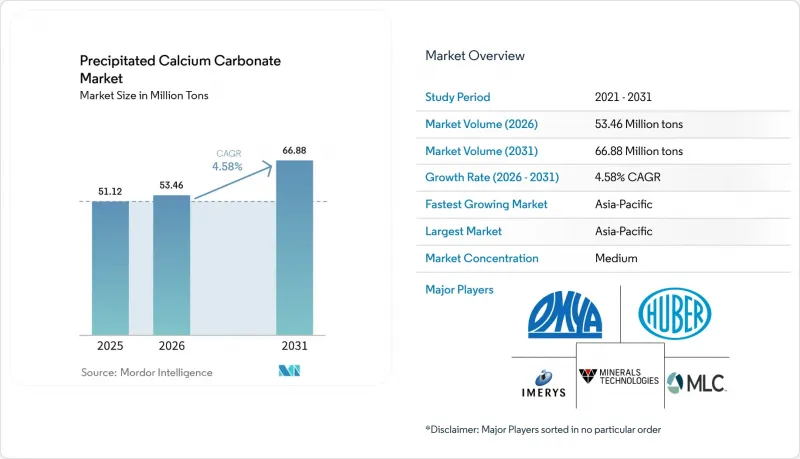
本報告按應用領域(紙張和紙板、油漆和塗料、黏合劑和密封劑等)、終端用戶產業(包裝、建築和基礎設施、汽車和運輸等)以及地區(亞太地區、北美、歐洲、南美、中東和非洲)對市場進行細分。市場預測以噸為單位。
全球碳酸鈣沉澱物市場趨勢及洞察
優質紙張需求激增
品牌所有者正轉向使用高度不透明的包裝和塗佈紙,這些包裝和塗佈紙依靠正交晶系聚氯乙烯(PCC)來最大限度地散射光線,從而使填料含量超過25%而不影響強度。含有木聚醣改質PCC的實驗室手抄紙除了亮度和不透明度提高外,還表現出更高的耐破強度和撕裂強度,這使得造紙商能夠在保持印刷品質的同時降低纖維等級。在再生纖維回收盛行的亞洲,奈米PCC正取代易褪色的螢光增白劑,從而實現經濟高效的白度控制。使用大理石廢棄物製成的PCC進行的初步試驗獲得了103.3°的接觸角,提高了食品包裝材料的防水性。這些結果支持了這樣一種觀點:新一代PCC具有純纖維無法提供的美觀性和永續性優勢。
高填充塑膠可減輕重量
汽車和包裝加工商正在使用高達 40% 的 PCC母粒來控制樹脂成本並減輕零件重量,直接提高燃油效率。添加 40% 碎 PCC 的聚丙烯複合材料的楊氏模數提高了 69%,同時,設計人員透過控制顆粒尺寸來平衡剛度和延展性。 Omiya 的 Smartfill 改性 PCC 在 PET 中保持了 0.74 dL/g 的特性黏度(相較之下,通用 PCC 的特性黏度為 0.61 dL/g)。這使得瓶子在 5% 的填充率下承載能力提高了 40%,從而減少了二氧化鈦的使用量。填充 6%(重量比)PCC 的玻璃纖維環氧樹脂部件的拉伸強度達到了 130.58 MPa,為電動車的輕量化車身面板鋪平了道路。預計到 2024 年,北美汽車產量將達到 1,550 萬輛(每輛車使用 429 磅塑膠),凸顯了對塑膠填充材日益成長的潛在需求。
石灰石價格波動及供應情況
美國地質調查局(USGS)預計,2024年石灰產量將達到4.2億噸,其中72%來自中國,增加了進口商面臨的市場集中風險。採石許可證發放更加嚴格以及燃油額外費用上漲,已將生石灰價格推高至2024年的每噸190美元。適用於生產醫藥等級PCC的高純度礦床稀少,迫使專業生產者投資礦石加工設備,延長了投資回收期。
細分市場分析
由於PCC填料能夠提高紙張白度並減少纖維用量(這對造紙廠而言是一項關鍵的成本節約因素),預計到2025年,全球紙張和紙板市場仍將佔總產量的35.12%。然而,醫藥和食品應用預計將以6.77%的複合年成長率成長,利用USP級填料的高純度實現更高的利潤率。從硬質包裝到軟質薄膜和工程樹脂,塑膠應用領域也在不斷擴展,由於對更輕材料的需求和樹脂成本的上漲,填料的使用量也在增加。表面改質填料能夠在不影響機械強度的前提下,達到20-40%的聚合物替代。
美國FDA 21 CFR 184.1191中明確的GRAS(公認安全)認證以及著色劑豁免條款簡化了全球應用流程,從而形成了准入壁壘,推動了特種輔料的需求成長。緩釋微球、造影劑和藻酸鹽-PCC混合載體表明,顆粒工程正在拓展PCC的應用範圍,使其超越傳統的制酸劑用途。雖然造紙應用仍佔據總量的大部分,但定價權正向微量元素控制的亞微米級產品轉移,這些產品的性能是通用填料無法比擬的。
區域分析
預計到2025年,亞太地區將佔全球產量的40.25%,並在2031年之前以5.05%的複合年成長率成長。 Minerals Technologies公司於2026年在中國和印度的造紙廠開設了三家新的PCC衛星工廠,在減少運輸排放的同時,確保了準時供應的優勢。日本和韓國正致力於為電子和製藥業開發奈米級PCC,並利用精確的製程控制。同時,越南和印尼歡迎外商直接投資塑膠複合材料領域,這正在促進區域消費。在電子商務和食品安全法規的推動下,印度包裝產業對符合印度標準局(BIS)純度標準的塗層PCC的需求不斷成長。
在北美,Domtar 和 Omya 位於威斯康辛州的工廠將於 2024 年運作,這些工廠將回收造紙廠石灰窯排放的二氧化碳,每年生產 27,500 幹噸 PCC,從而減少每年 15,000 短噸(二氧化碳當量)的運輸排放。美國和墨西哥汽車輕量化趨勢的持續推動了對改性 PCC 的需求,這些 PCC 用於生產聚丙烯、聚乙烯和聚醯胺零件。 CarbonFree 的 SkyCycle 計畫(位於 United Stair Gary 工廠)將提供北美首個大規模PCC 供應,這不僅符合企業的氣候目標,而且有望從具有永續發展意識的買家那裡獲得溢價。
在歐洲,嚴格的環境政策,加上油漆、塗料和藥品領域成熟的市場需求,以及歐盟的揮發性有機化合物(VOC)排放上限、REACH法規和即將淘汰的全氟烷基和多氟烷基物質(PFAS),正在加速配方重新評估,混料商正轉向低吸油、非氟化聚碳酸酯(PCC)等級。德國在汽車複合材料的應用方面處於領先地位,英國在營養補充劑領域取得了進展,法國和義大利則為建築塗料的需求提供了支持。除這三大主要地區外,巴西、沙烏地阿拉伯和南非雖然基數小規模,但正實現兩位數的成長,然而由於原料和物流方面的限制,短期規模擴張較為緩慢。
其他好處:
- Excel格式的市場預測(ME)表
- 3個月的分析師支持
目錄
第1章:引言
- 研究假設和市場定義
- 調查範圍
第2章:調查方法
第3章執行摘要
第4章 市場狀況
- 市場概覽
- 市場促進因素
- 優質紙張和包裝紙需求激增
- 高填充塑膠可減輕重量
- 推動制定無揮發性有機化合物(VOC)塗料和塗層的相關法規
- 透過碳捕獲利用途徑實現碳負排放的PCC
- 奈米PCC可提高再生紙的不透明度。
- 市場限制因素
- 石灰石價格波動及供應情況
- 高耗能燃燒和二氧化碳排放
- 氟基表面改質劑中 PFAS 的監測
- 價值鏈分析
- 波特五力模型
第5章 市場規模與成長預測
- 透過使用
- 紙張和紙板
- 塑膠
- 硬包裝
- 軟性薄膜
- 油漆和塗料
- 黏合劑和密封劑
- 橡皮
- 藥品和食品
- 個人護理化妝品
- 其他用途
- 按最終用戶行業分類
- 包裝
- 建築和基礎設施
- 汽車和運輸業
- 醫療保健和生命科學
- 消費品/電子設備
- 其他終端用戶產業
- 按地區
- 亞太地區
- 中國
- 印度
- 日本
- 韓國
- 其他亞太國家
- 北美洲
- 美國
- 加拿大
- 墨西哥
- 歐洲
- 德國
- 英國
- 法國
- 義大利
- 俄羅斯
- 其他歐洲國家
- 南美洲
- 巴西
- 阿根廷
- 其他南美國家
- 中東和非洲
- 沙烏地阿拉伯
- 土耳其
- 南非
- 其他中東和非洲國家
- 亞太地區
第6章 競爭情勢
- 市場集中度
- 策略趨勢
- 市佔率和排名分析
- 公司簡介
- Cales de Llierca
- Carmeuse
- Changzhou Calcium Carbonate Co.
- Fimatec Ltd
- Gulshan Polyols Ltd
- HiTech Minerals and Chemicals Group
- Imerys
- JM Huber Corporation
- Lhoist
- Maruo Calcium Co. Ltd
- Minerals Technologies Inc.
- Mississippi Lime Company d/b/a MLC
- Nordkalk Corporation
- Omya
- SHIRAISHI CHEMICAL KAISHA, LTD
第7章 市場機會與未來展望
According to Mordor Intelligence, the precipitated calcium carbonate market size is projected to be 51.12 million tons in 2025, 53.46 Million tons in 2026, and reach 66.88 million tons by 2031, growing at a CAGR of 4.58% from 2026 to 2031.
This report Segments the Industry by Application (Paper and Paperboard, Paints and Coatings, Adhesives and Sealants, and More), End-User Industry (Packaging, Construction and Infrastructure, Automotive and Transportation, and More), and Geography (Asia-Pacific, North America, Europe, South America, and the Middle East and Africa). The Market Forecasts are Provided in Terms of Volume (Tons).
Global Precipitated Calcium Carbonate Market Trends and Insights
Surging Demand From Premium Paper Grades
Brand owners are shifting toward high-opacity packaging and coated paper that rely on scalenohedral PCC to maximize light scattering, enabling filler loadings above 25% without sacrificing strength. Laboratory handsheets containing xylan-modified PCC showed brightness and opacity gains alongside improved burst and tear strength, letting mills downgrade fiber while protecting print quality. In Asia, where recycled-fiber loops dominate, nano-PCC replaces optical brightening agents that fade under UV, supporting cost-effective brightness control. Pilot trials using marble-waste-derived PCC achieved water contact angles of 103.3°, enhancing hydrophobicity for food wrappers. These results confirm that next-generation PCC provides aesthetic and sustainability benefits that pure fiber cannot match.
High-Fill Plastics for Lightweighting
Automotive and packaging converters incorporate up to 40% PCC masterbatch to curb resin costs and lower part weight, directly improving fuel economy. Polypropylene composites with 40% ground PCC posted a 69% rise in Young's modulus, though designers balance stiffness with ductility through particle-size control. Omya's Smartfill modified PCC sustained intrinsic viscosity in PET at 0.74 dL/g versus 0.61 dL/g for commodity PCC, boosting bottle top-load 40% at 5% filler, and enabling titanium dioxide cuts. Glass-fiber-epoxy parts filled with 6 wt% PCC reached 130.58 MPa tensile strength, opening pathways for lighter body panels in electric vehicles. Rising North American vehicle output of 15.5 million units in 2024, with 429 lb of plastics per car, underlines the latent plastics filler pull.
Limestone Price Volatility and Availability
The United States Geological Survey pegged lime output at 420 million tons in 2024, 72% of it from China, heightening concentration risk for importers. Quicklime prices rose to USD 190 per ton in 2024 as quarry permits tightened and fuel surcharges widened. High-purity deposits suitable for pharma-grade PCC are geographically scarce, forcing specialty producers to invest in beneficiation that stretches payback periods.
Other drivers and restraints analyzed in the detailed report include:
- Regulatory Push for VOC-Free Paints and Coatings
- Carbon-Negative PCC via CCU Routes
- Energy-Intensive Calcination and CO2 Footprint
For complete list of drivers and restraints, kindly check the Table Of Contents.
Segment Analysis
Global paper and paperboard retained 35.12% of 2025 volume as PCC fillers improved brightness and reduced fiber, a critical cost lever for mills. Nonetheless, pharmaceuticals and food applications are projected to grow at 6.77% CAGR, leveraging USP-grade purity to tap higher margins. Plastics applications, spanning Rigid Packaging, Flexible Films, and engineering resins, are expanding as lightweighting mandates and resin-cost inflation drive higher filler loadings, with surface-modified grades enabling 20-40% polymer substitution without sacrificing mechanical integrity.
Specialty excipient demand rests on clear United States FDA GRAS status under 21 CFR 184.1191 and color-additive exemptions that simplify global filings, creating barriers to entry. Controlled-release microspheres, imaging agents, and alginate, PCC hybrid carriers illustrate how particle engineering extends PCC beyond traditional antacid roles. Paper applications still anchor bulk tonnage, yet pricing power tilts toward trace-element-controlled, sub-micron grades that offer performance impossible for commodity fillers.
Geography Analysis
Asia-Pacific held 40.25% of global volume in 2025 and is forecast to expand at 5.05% CAGR through 2031. Minerals Technologies Inc. opened three new on-site PCC satellites in 2026 to serve Chinese and Indian paper mills, shrinking freight emissions and capturing just-in-time supply advantages. Japan and South Korea target nano-scale PCC for electronics and pharma, leveraging precise process control, while Vietnam and Indonesia welcome foreign direct investment in plastics compounding that lifts regional consumption. India's packaging sector, propelled by e-commerce and food safety mandates, escalates demand for coated PCC that meets Bureau of Indian Standards purity benchmarks.
In North America, Domtar and Omya's Wisconsin on-site plant, commissioned in 2024, recycles CO2 from the mill's lime kiln to make 27,500 dry tons per year of PCC, lowering annual transport emissions by 15,000 short tons CO2-equivalent. Automotive lightweighting in the United States and Mexico maintains demand for modified PCC in polypropylene, polyethylene, and polyamide parts. CarbonFree's SkyCycle project at United States Steel Gary brings the first large-scale Carbon Capture and Utilisation (CCU)-based PCC supply to North America, aligning with corporate climate targets and potentially capturing premium pricing from sustainability-focused buyers.
Europe, mixes strict environmental policy with mature demand in paints, coatings, and pharmaceuticals. European Union (EU) VOC (Volatile Organic Compound) ceilings, REACH (Registration, Evaluation, Authorisation and Restriction of Chemicals) regulations, and the looming PFAS (per- and polyfluoroalkyl substances) phase-out accelerate reformulation, steering formulators toward low-oil-absorption, non-fluorinated PCC grades. Germany leads automotive composites uptake, the United Kingdom advances in dietary supplements, and France and Italy anchor architectural-coating volumes. Outside the Big-Three regions, Brazil, Saudi Arabia, and South Africa post double-digit growth off small bases, though feedstock and logistics constraints moderate near-term scale-up.
- Cales de Llierca
- Carmeuse
- Changzhou Calcium Carbonate Co.
- Fimatec Ltd
- Gulshan Polyols Ltd
- HiTech Minerals and Chemicals Group
- Imerys
- J.M. Huber Corporation
- Lhoist
- Maruo Calcium Co. Ltd
- Minerals Technologies Inc.
- Mississippi Lime Company d/b/a MLC
- Nordkalk Corporation
- Omya
- SHIRAISHI CHEMICAL KAISHA, LTD
Additional Benefits:
- The market estimate (ME) sheet in Excel format
- 3 months of analyst support
TABLE OF CONTENTS
1 Introduction
- 1.1 Study Assumptions and Market Definition
- 1.2 Scope of the Study
2 Research Methodology
3 Executive Summary
4 Market Landscape
- 4.1 Market Overview
- 4.2 Market Drivers
- 4.2.1 Surging demand from premium paper and packaging grades
- 4.2.2 High-fill plastics for lightweighting
- 4.2.3 Regulatory push for VOC-free paints and coatings
- 4.2.4 Carbon-negative PCC via CCU routes
- 4.2.5 Nano-PCC improving opacity in recycled paper loops
- 4.3 Market Restraints
- 4.3.1 Limestone price volatility and availability
- 4.3.2 Energy-intensive calcination and CO2 footprint
- 4.3.3 PFAS scrutiny on fluorinated surface modifiers
- 4.4 Value Chain Analysis
- 4.5 Porter's Five Forces
- 4.5.1 Bargaining Power of Suppliers
- 4.5.2 Bargaining Power of Buyers
- 4.5.3 Threat of New Entrants
- 4.5.4 Threat of Substitutes
- 4.5.5 Degree of Competition
5 Market Size and Growth Forecasts (Volume)
- 5.1 By Application
- 5.1.1 Paper and Paperboard
- 5.1.2 Plastics
- 5.1.2.1 Rigid Packaging
- 5.1.2.2 Flexible Films
- 5.1.3 Paints and Coatings
- 5.1.4 Adhesives and Sealants
- 5.1.5 Rubber
- 5.1.6 Pharmaceuticals and Food
- 5.1.7 Personal Care and Cosmetics
- 5.1.8 Other Applications
- 5.2 By End-user Industry
- 5.2.1 Packaging
- 5.2.2 Construction and Infrastructure
- 5.2.3 Automotive and Transportation
- 5.2.4 Healthcare and Life Sciences
- 5.2.5 Consumer Goods and Electronics
- 5.2.6 Other End-user Industries
- 5.3 By Geography
- 5.3.1 Asia-Pacific
- 5.3.1.1 China
- 5.3.1.2 India
- 5.3.1.3 Japan
- 5.3.1.4 South Korea
- 5.3.1.5 Rest of Asia-Pacific
- 5.3.2 North America
- 5.3.2.1 United States
- 5.3.2.2 Canada
- 5.3.2.3 Mexico
- 5.3.3 Europe
- 5.3.3.1 Germany
- 5.3.3.2 United Kingdom
- 5.3.3.3 France
- 5.3.3.4 Italy
- 5.3.3.5 Russia
- 5.3.3.6 Rest of Europe
- 5.3.4 South America
- 5.3.4.1 Brazil
- 5.3.4.2 Argentina
- 5.3.4.3 Rest of South America
- 5.3.5 Middle East and Africa
- 5.3.5.1 Saudi Arabia
- 5.3.5.2 Turkey
- 5.3.5.3 South Africa
- 5.3.5.4 Rest of Middle East and Africa
- 5.3.1 Asia-Pacific
6 Competitive Landscape
- 6.1 Market Concentration
- 6.2 Strategic Moves
- 6.3 Market Share(%)/Ranking Analysis
- 6.4 Company Profiles (includes Global Overview, Market Overview, Core Segments, Financials, Strategic Information, Products and Services, Recent Developments)
- 6.4.1 Cales de Llierca
- 6.4.2 Carmeuse
- 6.4.3 Changzhou Calcium Carbonate Co.
- 6.4.4 Fimatec Ltd
- 6.4.5 Gulshan Polyols Ltd
- 6.4.6 HiTech Minerals and Chemicals Group
- 6.4.7 Imerys
- 6.4.8 J.M. Huber Corporation
- 6.4.9 Lhoist
- 6.4.10 Maruo Calcium Co. Ltd
- 6.4.11 Minerals Technologies Inc.
- 6.4.12 Mississippi Lime Company d/b/a MLC
- 6.4.13 Nordkalk Corporation
- 6.4.14 Omya
- 6.4.15 SHIRAISHI CHEMICAL KAISHA, LTD
7 Market Opportunities and Future Outlook
- 7.1 White-space and Unmet-need Assessment

 PCC - 2026-2032年全球市佔率和排名、總收入和需求預測
 沉澱碳酸鈣市場預測至2034年-按應用和區域分類的全球分析
 2026年全球沉澱碳酸鈣市場報告
 2026-2030年全球沉澱碳酸鈣市場
 按類型、形態、等級、純度、粒徑、應用和分銷管道分類的研磨和沈澱碳酸鈣市場—2026-2032年全球預測
 全球沉澱碳酸鈣市場:市場規模、佔有率、成長率、產業分析、按類型、應用和地區劃分的考量因素以及未來預測(2026-2034)
 沉澱碳酸鈣市場規模、佔有率和成長分析(按等級、形狀、粒徑、應用和地區分類)-2026-2033年產業預測
 全球沉澱碳酸鈣市場
 全球沉澱碳酸鈣市場趨勢、競爭格局及預測(2019-2031):依等級、應用及地區分類