


 |
市場調查報告書
商品編碼
2062030
微型射出成型塑膠:市場佔有率分析、行業趨勢和統計數據、成長預測(2026-2031 年)Micro Injection Molded Plastic - Market Share Analysis, Industry Trends & Statistics, Growth Forecasts (2026 - 2031) |
||||||

※ 本網頁內容可能與最新版本有所差異。詳細情況請與我們聯繫。
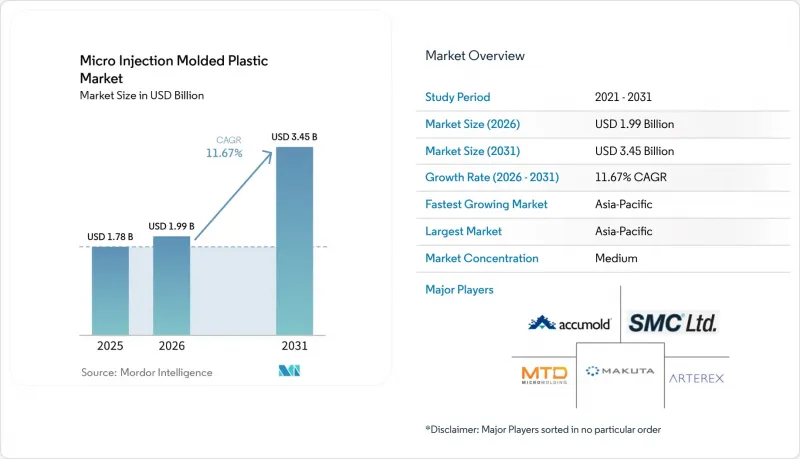
根據 Mordor Intelligence 預測,微型射出成型塑膠市場預計將從 2025 年的 17.8 億美元成長到 2026 年的 19.9 億美元,到 2031 年達到 34.5 億美元,2026 年至 2031 年的複合年預計成長率為 11.67%。
本報告按材料(聚醚醚酮、液晶聚合物、聚碳酸酯、聚乙烯及其他)、終端應用產業(醫療診斷、汽車及交通運輸、電氣及電子及其他)及地區(亞太、北美、歐洲、南美、中東及非洲)進行細分。市場預測以美元計價。
全球微型射出成型塑膠市場趨勢與洞察
汽車感測器對精密塑膠的需求
配備高級駕駛輔助系統 (ADAS) 的車輛最多可容納 30 個獨立感測器,每個感測器都封裝在可承受 -40 度C至 150 度C溫度循環且尺寸變化不超過 0.05 毫米的聚合物機殼中。這避免了使用會衰減 77 GHz 雷達訊號的鋁壓鑄件。與機械加工金屬相比,PEEK 和 LCP 雷達罩可將單位成本降低 60%。 2024 年推出的聚碳酸酯車頂感測器模組,透過在 18 秒的單次射出成型中整合密封件和凸台,可將因進水造成的保固索賠減少 40%。汽車製造商正致力於重新設計集中式區域控制器,目標是在 2028 年前將感測器面積縮小 30%。這要求壁厚為 0.5 毫米或更薄,而這種厚度的壁厚只能壓平機進行重複成型。
從MEMS矽到耐熱聚合物的過渡
雖然矽微機電晶片單價為 2-4 美元,且在 1500G 以上的應力下容易失效,但成型聚合物卻能以 0.80-1.20 美元的單價提供與之相當的性能,並且在 125 度C下經受 2000 小時的老化測試,漂移小於 2%。經台積電和三星認證的 LCP基板將於 2025 年上市,支援封裝內天線 (AIP) 模組,無需使用獨立的射頻連接器,並在 28 GHz 頻率下將插入損耗降低 0.8 dB。預計到 2028 年,聚合物晶片將在先進製程節點的晶片組中佔比達到 20%,儘管在航太領域,抗輻射能力超過 100 千弧度的矽晶片仍然是首選。
超精密模具製造商短缺
全球僅有不到50家模具製造商能夠實現128腔模具±1微米的精度,預計到2025年,前置作業時間將延長至22週。裕和株式會社的生產網路僅能滿足亞太地區0.1克以下射出成型需求的12%,而其耗資8億美元將生產遷回北美的計劃,由於其熟練技工每年15%的退休率,面臨著延期的風險。與等向性材料相比,液晶相控陣(LCP)模具的加工時間增加了40%,進一步加劇了產能的壓力。
細分市場分析
聚醚醚酮 (PEEK) 預計到 2025 年將佔銷售額的 35.11%,這反映了其在脊椎移植和工作溫度為 150°C 的汽車感測器領域的成熟應用。用於高頻封裝的微射出成型塑膠市場規模預計將在 2026 年至 2031 年間進行重組,其中液晶聚合物的複合年成長率 (CAGR) 預計將達到 12.10%。這是因為液晶聚合物的損耗角正切值僅 0.002,與聚醯亞胺相比,其毫米波插入損耗僅有一半。聚碳酸酯憑藉其 89% 的透明度,在眼科器材市場保持著主導地位,但其 147°C 的玻璃化轉變溫度 (Tg) 限制了其在引擎室中的應用。環烯烴共聚物是照護現場PCR 板的基礎材料,即使在 100 度C 的溫度循環下也不會發生翹曲。同時,聚乙烯和聚丙烯仍然是實驗室器皿中注重成本效益的選擇,每件價格低於 0.10 美元。
目前,資本投資正轉向封閉回路型模具溫度控制器和線上CT掃描儀,以確保PEEK和LCP注塑產品的CpK值達到1.67或更高。預計資本投資的增加將提高中型代工注塑企業的進入門檻,並進一步將微型射出成型塑膠產業集中在一個材料密集的細分市場中。能夠確保熔化溫度控制在±5 度C以內的供應商,將有機會從通用注塑企業手中奪取更多微型射出成型塑膠市場佔有率。
區域分析
到2025年,亞太地區將佔中國精密模具銷售額的41.12%,預計2026年至2031年將以12.51%的複合年成長率成長。同時,中國精密模具產業的目標是到2030年實現1兆元的產值。日本模具製造商的精度可達±0.01毫米,雖然溢價15-20%,但在植入領域仍至關重要。韓國的半導體封裝產業正在推動當地液晶聚合物(LCP)的消費。 2024年,東協在電子領域吸引了310億美元的外國直接投資(FDI)。越南和馬來西亞已將自身定位為「中國+1」戰略下的生產基地。
北美和歐洲的成長率比亞太地區低3-4個百分點。全球15家最大的微型模具製造商中有8家位於美國,其中包括預計到2025年銷售額將達到4.6億美元的Tessy Plastics。然而,超精密模具製造商的短缺前置作業時間超過22週。德國巴登-符騰堡州和巴伐利亞州的叢集正在利用弗勞恩霍夫IPT測量技術,將缺陷率控制在0.15%,並實現5,000件起步的經濟型生產。歐盟醫療設備法規的可追溯性要求將於2024年全面實施,這將使醫療設備的初始申請週期增加8-12週,使已獲得ISO 13485認證的現有企業更具優勢。
南美洲、中東和非洲市場正呈現顯著成長。在巴西,2027年生效的感測器60%國產化率規定,要求一級供應商預先認證三家本地註塑企業。在沙烏地阿拉伯,薩勒曼國王醫療城競標指定使用ISO 13485認證的國產供應商,這將創造每年1.2億美元的需求,儘管目前90%的供應依賴進口。在阿根廷,由於匯率波動,合約結算方式正轉向歐元。埃及和摩洛哥的目標是到2028年實現預填充式注射器40%的在地採購。
其他好處
- Excel格式的市場預測(ME)表
- 3個月的分析師支持
目錄
第1章:引言
- 研究假設和市場定義
- 調查範圍
第2章:調查方法
第3章執行摘要
第4章 市場狀況
- 市場概覽
- 市場促進因素
- 汽車感測器對精密塑膠的需求
- 從MEMS矽到耐熱聚合物的過渡
- 微創藥物傳遞系統的廣泛應用
- 利用人工智慧驅動的線上測量,廢品率降低到 0.2% 以下。
- 用於 5G/6G 天線陣列的毫米波 LCP 連接器
- 市場限制因素
- 超精密刀具製造商短缺
- 全球植入用生物可吸收聚合物供不應求
- 由於樹脂批次間的差異,需要對設備進行重新檢驗。
- 價值鏈分析
- 波特五力模型
第5章 市場規模與成長預測
- 材料
- 聚醚醚酮(PEEK)
- 液晶聚合物(LCP)
- 聚碳酸酯(PC)
- 聚乙烯(PE)
- 聚氯乙烯(PVC)
- 聚丙烯(PP)
- 環烯烴共聚物(COC)
- 其他
- 按最終用途行業分類
- 醫學診斷
- 汽車和交通運輸
- 電氣和電子
- 航太/國防
- 工業能源
- 其他
- 按地區
- 亞太地區
- 中國
- 日本
- 印度
- 韓國
- ASEAN
- 其他亞太國家
- 北美洲
- 美國
- 加拿大
- 墨西哥
- 歐洲
- 德國
- 英國
- 法國
- 義大利
- 西班牙
- 俄羅斯
- 北歐國家
- 其他歐洲國家
- 南美洲
- 巴西
- 阿根廷
- 其他南美國家
- 中東和非洲
- 沙烏地阿拉伯
- 南非
- 其他中東和非洲國家
- 亞太地區
第6章 競爭情勢
- 市場集中度
- 策略趨勢
- 市佔率和排名分析
- 公司簡介
- Accu-Mold
- ARTEREX
- Ingersoll Rand
- Makuta, Inc.
- Medbio Inc.
- Microdyne Plastics
- Microsystems UK
- MTD Micro Molding
- Nissha Medical Technologies
- PreciKam
- Rapidwerks, Inc.
- SMC Ltd.
- Tessy Plastics
第7章 市場機會與未來展望
According to Mordor Intelligence, the micro injection molded plastic market size is expected to increase from USD 1.78 billion in 2025 to USD 1.99 billion in 2026 and reach USD 3.45 billion by 2031, growing at a CAGR of 11.67% over 2026-2031.
This report is Segmented by Material (Polyether Ether Ketone, Liquid Crystal Polymers, Polycarbonate, Polyethylene, and More), End-Use Industry (Healthcare and Diagnostics, Automotive and Transportation, Electrical and Electronics, and More), and Geography (Asia-Pacific, North America, Europe, South America, Middle East and Africa). The Market Forecasts are Provided in Terms of Value (USD).
Global Micro Injection Molded Plastic Market Trends and Insights
Precision-Plastic Needs in Automotive Sensors
Advanced driver-assistance vehicles contain up to 30 discrete sensors, each housed in polymer enclosures that tolerate -40°C to 150°C cycles without dimensional creep beyond 0.05 mm, eliminating aluminum die-castings that attenuate 77 GHz radar signals. PEEK and LCP radomes cut per-part costs 60% versus machined metal, and a 2024 polycarbonate roof-sensor module integrated seals and bosses in one 18-second shot, reducing warranty water-ingress claims by 40%. Automakers are redesigning toward centralized zone controllers, shrinking sensor footprints 30% by 2028, which requires wall thicknesses below 0.5 mm that only presses under 50 tons can repeatably mold.
Migration from MEMS Silicon to High-Temperature Polymers
Silicon micro-electromechanical dies cost USD 2-4 each and fracture above 1,500G, whereas molded polymers deliver similar performance for USD 0.80-1.20 per part and survive 2,000-hour 125 °C aging with less than 2% drift. LCP substrates, qualified by TSMC and Samsung in 2025, support antenna-in-package modules that remove discrete RF connectors and cut 28 GHz insertion loss by 0.8 dB. By 2028, polymers are expected to carry 20% of advanced-node chiplets, though aerospace still favors radiation-hard silicon above 100 kilorads.
Scarcity of Ultra-Precision Toolmakers
Fewer than 50 tool shops worldwide hold +-1 µm capability across 128-cavity molds, and 2025 lead times stretched to 22 weeks. Yuwa Corporation's network covers only 12% of Asia-Pacific sub-0.1 g shot demand, while North American reshoring plans worth USD 800 million risk delays because 15% of senior machinists retire annually. LCP molds exacerbate capacity strain by needing 40% more machining hours than isotropic materials.
Other drivers and restraints analyzed in the detailed report include:
- Rising Adoption of Minimally-Invasive Drug-Delivery Systems
- AI-Enabled In-Line Metrology Cutting Scrap Below 0.2%
- Limited Global Supply of Implant-Grade Bio-Absorbable Polymers
For complete list of drivers and restraints, kindly check the Table Of Contents.
Segment Analysis
Polyether ether ketone (PEEK) accounted for 35.11% of 2025 revenue, reflecting entrenched use in spinal implants and 150°C automotive sensors. Liquid crystal polymers' 12.10% CAGR during 2026-2031 will reshape the micro injection molded plastic market size for high-frequency packages because their 0.002 loss tangent halves mmWave insertion loss versus polyimide. Polycarbonate holds ophthalmic devices owing to 89% transparency, although its 147°C Tg limits under-hood deployment. Cyclic olefin copolymer underpins point-of-care PCR plates that endure 100°C cycling without warpage, whereas polyethylene and polypropylene remain cost-driven choices for labware priced under USD 0.10 per part.
Equipment investments now pivot around closed-loop mold-temperature controllers and inline CT scanners that secure CpK greater than or equal to1.67 for PEEK and LCP geometries. That uptick in capital elevates barriers for mid-tier contract molders and will keep the micro injection molded plastic industry concentrated in fewer hands within material-intensive niches. Suppliers able to guarantee melt-temperature control within +-5°C are positioned to capture additional micro injection molded plastic market share from commodity molders.
Geography Analysis
Asia-Pacific owned 41.12% of 2025 revenue and is forecast to expand at 12.51% CAGR during 2026-2031 as China's precision-mold industry heads toward CNY 1 trillion output by 2030. Japanese toolmakers' +-0.01 mm capability commands 15-20% premiums but remains essential for implants, while South Korea's semiconductor packaging drives local LCP consumption. ASEAN nations attracted USD 31 billion in 2024 electronics FDI, positioning Vietnam and Malaysia as overflow hubs within China-plus-one strategies.
North America and Europe trail Asia-Pacific growth by 3-4 points. The United States hosts eight of the fifteen largest micro-molders, including Tessy Plastics with USD 460 million in 2025 sales, but a shortage of ultra-precision toolmakers has pushed new-mold lead times past 22 weeks. Germany's Baden-Wurttemberg and Bavaria clusters leverage Fraunhofer IPT metrology to sustain scrap at 0.15% and enable economical 5,000-part runs. EU Medical Device Regulation traceability rules, fully enforced in 2024, tack on 8-12 weeks to first-time device filings, favoring incumbents with ISO 13485 pedigrees.
South America and Middle East-Africa are witnessing considerable market growth. Brazil's 60% domestic-content rule for sensors, effective 2027, is forcing Tier-1s to pre-qualify three local molders. Saudi Arabia's King Salman Medical City tenders specify domestic ISO 13485 suppliers, creating USD 120 million annual demand currently met 90% by imports. Currency volatility in Argentina pushes contracts toward euro denomination, while Egypt and Morocco pursue 40% local content in pre-filled syringes by 2028.
- Accu-Mold
- ARTEREX
- Ingersoll Rand
- Makuta, Inc.
- Medbio Inc.
- Microdyne Plastics
- Microsystems UK
- MTD Micro Molding
- Nissha Medical Technologies
- PreciKam
- Rapidwerks, Inc.
- SMC Ltd.
- Tessy Plastics
Additional Benefits:
- The market estimate (ME) sheet in Excel format
- 3 months of analyst support
TABLE OF CONTENTS
1 Introduction
- 1.1 Study Assumptions and Market Definition
- 1.2 Scope of the Study
2 Research Methodology
3 Executive Summary
4 Market Landscape
- 4.1 Market Overview
- 4.2 Market Drivers
- 4.2.1 Precision-plastic needs in automotive sensors
- 4.2.2 Migration from MEMS silicon to high-temperature polymers
- 4.2.3 Rising adoption of minimally-invasive drug-delivery systems
- 4.2.4 AI-enabled in-line metrology cutting scrap below 0.2%
- 4.2.5 mmWave LCP connectors for 5G/6G antenna arrays
- 4.3 Market Restraints
- 4.3.1 Scarcity of ultra-precision toolmakers
- 4.3.2 Limited global supply of implant-grade bio-absorbable polymers
- 4.3.3 Resin lot-to-lot variability triggering device re-validation
- 4.4 Value Chain Analysis
- 4.5 Porter's Five Forces
- 4.5.1 Threat of New Entrants
- 4.5.2 Bargaining Power of Buyers
- 4.5.3 Bargaining Power of Suppliers
- 4.5.4 Threat of Substitutes
- 4.5.5 Degree of Competition
5 Market Size and Growth Forecasts (Value)
- 5.1 By Material
- 5.1.1 Polyether Ether Ketone (PEEK)
- 5.1.2 Liquid Crystal Polymers (LCP)
- 5.1.3 Polycarbonate (PC)
- 5.1.4 Polyethylene (PE)
- 5.1.5 Polyvinyl Chloride (PVC)
- 5.1.6 Polypropylene (PP)
- 5.1.7 Cyclic Olefin Copolymer (COC)
- 5.1.8 Other Materials
- 5.2 By End-user Industry
- 5.2.1 Healthcare and Diagnostics
- 5.2.2 Automotive and Transportation
- 5.2.3 Electrical and Electronics
- 5.2.4 Aerospace and Defence
- 5.2.5 Industrial and Energy
- 5.2.6 Other End-user Industries
- 5.3 By Geography
- 5.3.1 Asia-Pacific
- 5.3.1.1 China
- 5.3.1.2 Japan
- 5.3.1.3 India
- 5.3.1.4 South Korea
- 5.3.1.5 ASEAN Countries
- 5.3.1.6 Rest of Asia-Pacific
- 5.3.2 North America
- 5.3.2.1 United States
- 5.3.2.2 Canada
- 5.3.2.3 Mexico
- 5.3.3 Europe
- 5.3.3.1 Germany
- 5.3.3.2 United Kingdom
- 5.3.3.3 France
- 5.3.3.4 Italy
- 5.3.3.5 Spain
- 5.3.3.6 Russia
- 5.3.3.7 NORDIC Countries
- 5.3.3.8 Rest of Europe
- 5.3.4 South America
- 5.3.4.1 Brazil
- 5.3.4.2 Argentina
- 5.3.4.3 Rest of South America
- 5.3.5 Middle-East and Africa
- 5.3.5.1 Saudi Arabia
- 5.3.5.2 South Africa
- 5.3.5.3 Rest of Middle-East and Africa
- 5.3.1 Asia-Pacific
6 Competitive Landscape
- 6.1 Market Concentration
- 6.2 Strategic Moves
- 6.3 Market Share(%)/Ranking Analysis
- 6.4 Company Profiles (includes Global Overview, Market Overview, Core Segments, Financials, Strategic Information, Products and Services, Recent Developments)
- 6.4.1 Accu-Mold
- 6.4.2 ARTEREX
- 6.4.3 Ingersoll Rand
- 6.4.4 Makuta, Inc.
- 6.4.5 Medbio Inc.
- 6.4.6 Microdyne Plastics
- 6.4.7 Microsystems UK
- 6.4.8 MTD Micro Molding
- 6.4.9 Nissha Medical Technologies
- 6.4.10 PreciKam
- 6.4.11 Rapidwerks, Inc.
- 6.4.12 SMC Ltd.
- 6.4.13 Tessy Plastics
7 Market Opportunities and Future Outlook
- 7.1 White-space and Unmet-need Assessment


