


 |
市場調查報告書
商品編碼
2062003
磺酸鹽磺酸:市場佔有率分析、產業趨勢與統計、成長預測(2026-2031)Methane Sulfonic Acid - Market Share Analysis, Industry Trends & Statistics, Growth Forecasts (2026 - 2031) |
||||||

※ 本網頁內容可能與最新版本有所差異。詳細情況請與我們聯繫。
根據 Mordor Intelligence 預測,磺酸鹽市場規模將從 2025 年的 8.4 億美元成長到 2026 年的 8.8 億美元,到 2031 年將達到 11.5 億美元,2026 年至 2031 年的複合年成長率為 5.5%。
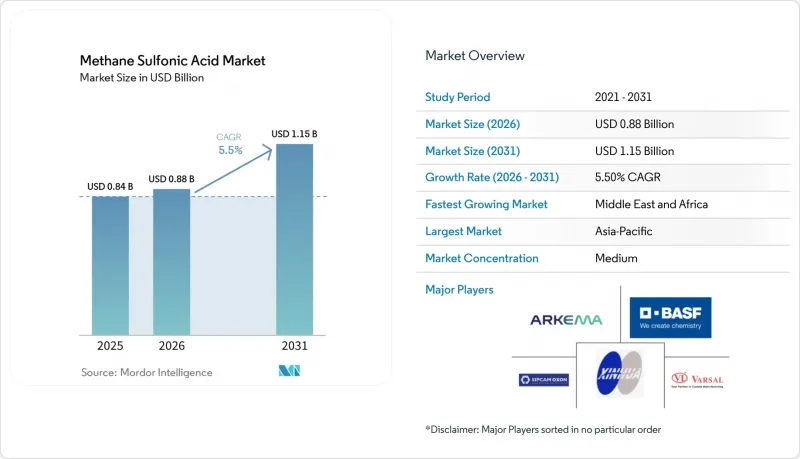
本報告按等級/純度(技術級、電子級等)、形態(液體、固體/片狀)、終端應用行業(金屬表面處理/電鍍、製藥/生化加工等)和地區(亞太地區、北美、歐洲、南美、中東和非洲)進行細分。市場預測以美元計價。
全球磺酸鹽磺酸市場趨勢及洞察
電鍍和金屬表面處理需求不斷成長
汽車輕量化和電子設備小型化推動了對錫和貴金屬電鍍需求的成長。與硫酸基電鍍液相比,磺酸鹽電鍍液產生的氫氣較少,覆蓋率較高。廣東省和台灣地區的印刷基板製造商採用細間距電鍍,因為磺酸鹽即使在高濃度錫環境中也能保持溶解性,從而延長電鍍液的使用壽命。汽車產業的一級供應商正在鋁製電池機殼上應用磺酸鹽塗層,以滿足 ISO 9227 鹽霧試驗的耐久性標準,而無需使用鉻酸鹽層。此外,磺酸鹽(MSA) 的非氧化性最大限度地減少了對基材的腐蝕。這些優異的性能降低了批量生產的缺陷率,並推動了磺酸鹽在裝飾性和功能性塗層市場的擴張。
在製藥和特種合成領域不斷拓展應用。
胜肽類原料藥生產商已檢驗了一種不含 PFAS 的全局去保護混合液,該混合液含有 2% 的磺酸鹽和甲酸。與三氟乙酸相比,此混合液可減少 98% 的強酸用量,並在模型序列中實現了 99% 的裂解率。全長替澤肽的純度可與三氟乙酸製程相媲美。隨著全球產量的成長,甲磺酸在噸級 GLP-1促效劑生產中的重要性日益凸顯。溫和的氫氧化銨洗滌可去除可逆的甲醯化副作用,並且可透過真空蒸餾回收 88% 的甲磺酸,從而進一步提升環境和經濟效益。
腐蝕性和處理風險
MSA被歸類為H314危險物質,因此必須使用耐酸手套、護目鏡和密封運輸系統。由於標準不銹鋼在80 度C以上會發生腐蝕,用戶被迫改用雙相鋼或特殊合金,增加了資本投入負擔。缺乏針對該材料的OSHA基準值使得合規文件的編制變得複雜,對於沒有專門工業負責人的小規模電鍍和代工製造商而言,這尤其具有挑戰性。
細分市場分析
到2025年,技術級產品將佔銷售額的45.55%,傳統電鍍和清洗應用仍將佔據生產主導地位。電子級和醫藥級產品合計將佔約35%的市場佔有率,用於PCB電鍍和胜肽類原料藥,這些應用對氯化物和過渡金屬含量要求較低。隨著下一代半導體節點中鐵和銅污染物的標準收緊至低於1 ppm,預計超高純度產品將以6.56%的複合年成長率實現最快成長。由於供應商對蒸餾和離子交換純化技術的投資,供應量正在擴大,晶圓廠營運商對磺酸鹽的需求也在成長。
人工智慧加速器和汽車電源模組對晶片的需求不斷成長,推動了錫和錫銀沉積量的增加,進而提振了電子級甲磺酸鹽(MSA)的需求。對於醫藥級甲磺酸鹽,對全氟烷基物質(PFAS)更嚴格的監管限制促使製造商從三氟乙酸轉向使用甲磺酸鹽,預計這將進一步推高其需求。對於工業級甲磺酸鹽,在硫酸足以滿足需求的領域,利潤空間受到擠壓,但金屬磺酸鹽的高溶解度在濕式冶金和稀土元素回收領域仍然至關重要。
區域分析
預計到2025年,亞太地區將佔全球銷售額的54.25%,主要得益於中國廣東和江蘇兩省的電鍍產業中心、印度海得拉巴和艾哈默德巴德周邊的胜肽產業走廊以及韓國的半導體投資。中國「碳排放達峰和碳中和」藍圖正在推動可生物分解特種酸和閉合迴路電池電解的發展,增強了結構性需求。
預計到2025年,北美將佔據顯著的市場佔有率,這主要得益於波士頓地區的胜肽類CDMO企業、中西部地區的汽車電鍍公司以及加州和德克薩斯州液流電池的初步部署。 Hydrite Chemical公司宣布將於2026年在南卡羅來納州投資6,300萬美元建造一座工廠,該工廠預計將為美國東南部的汽車和電子產業叢集提供本地供應。歐洲約佔18%的市場佔有率,其核心是德國路德維希港的化工綜合體和斯堪的斯堪地那維亞的綠氫能計畫。同時,法國和比利時的製藥公司正在採用MSA(多系統評估)來逐步淘汰PFAS(全氟烷基和多氟烷基物質)。
預計中東和非洲地區將以6.66%的複合年成長率成為該地區成長最快的地區,這主要得益於沙烏地阿拉伯和阿拉伯聯合大公國下游產業的擴張,使得特種酸得以融入多元化的石化產業鏈。在朱拜勒和阿布達比的投資確保了原料的穩定供應,並吸引了電鍍和電池製造商沿岸地區。南美洲的市佔率維持穩定,為8%。在巴西,甲磺酸被用於甘蔗精煉廠的木質纖維素預處理;阿根廷正在進行一項利用磺酸鹽提取鋰的試點計畫。
其他好處:
- Excel格式的市場預測(ME)表
- 3個月的分析師支持
目錄
第1章:引言
- 研究假設和市場定義
- 調查範圍
第2章:調查方法
第3章執行摘要
第4章 市場狀況
- 市場概覽
- 市場促進因素
- 電鍍和金屬表面處理需求不斷成長
- 在製藥和特種合成領域中得到更廣泛的應用
- 在液流電池和氫燃料電池電解的應用
- 催化劑在生質能衍生燃料精煉中的作用
- 透過循環經濟促進電解回收利用
- 市場限制因素
- 腐蝕性和操作處理風險
- 硫酸和對磺酸鹽的競爭
- 電池級MSA監管分類存在不一致之處。
- 價值鏈分析
- 波特五力模型
第5章 市場規模與成長預測
- 按等級和純度
- 技術級(70-99%)
- 電子級(99.9%或更高)
- 醫藥級(99.5%或更高)
- 超高純度(99.99%或以上)
- 按形式
- 液體
- 固態/片狀
- 產業最終用途
- 金屬表面處理和電鍍
- 貴金屬電鍍
- 印刷基板電鍍
- 汽車零件
- 製藥和生化加工
- 儲能和氫氣生產
- 釩氧化還原流動電池
- PEM燃料電池
- 用於工業和精細化工領域的催化劑
- 電子元件清洗和蝕刻
- 其他特殊用途
- 金屬表面處理和電鍍
- 按地區
- 北美洲
- 美國
- 加拿大
- 墨西哥
- 南美洲
- 巴西
- 阿根廷
- 其他南美國家
- 歐洲
- 德國
- 英國
- 法國
- 義大利
- 俄羅斯
- 其他歐洲國家
- 亞太地區
- 中國
- 印度
- 日本
- 韓國
- 其他亞太國家
- 中東和非洲
- 阿拉伯聯合大公國
- 沙烏地阿拉伯
- 其他中東和非洲國家
- 北美洲
第6章 競爭情勢
- 市場集中度
- 關鍵策略趨勢
- 市佔率和排名分析
- 公司簡介
- Arkema
- BASF
- Central Drug House
- Chemos
- Haihang Industry
- Helsa-Chemie
- Hydrite Chemical
- Kanto Chemical
- Kao Corporation
- Nanjing Chemical Material Corp.
- Shandong Xinhua Pharma
- SHINYA CHEM
- Sipcam Oxon Spa
- Solvay Fluor & Derivatives
- Varsal
- Tokyo Chemical Industry
- Xingrui Industry
- Yingrui Industry Development
- Zibo DeHong Chemical
第7章 市場機會與未來展望
According to Mordor Intelligence, the methane sulfonic acid market size is expected to grow from USD 0.84 billion in 2025 to USD 0.88 billion in 2026 and is forecast to reach USD 1.15 billion by 2031 at 5.5% CAGR over 2026-2031.
This report is Segmented by Grade/Purity (Technical Grade, Electronic Grade, and More), Form (Liquid, and Solid/Flakes), End-Use Industry (Metal Finishing and Electro-Plating, Pharmaceuticals and Biochemical Processing, and More), and Geography (Asia-Pacific, North America, Europe, South America, and Middle East and Africa). The Market Forecasts are Provided in Terms of Value (USD).
Global Methane Sulfonic Acid Market Trends and Insights
Growing Demand in Electroplating and Metal Finishing
Automotive lightweighting and electronics miniaturization lift tin and precious-metal plating volumes, and methanesulfonic acid baths deliver higher throwing power alongside lower hydrogen evolution than sulfuric systems. Printed-circuit board fabricators in Guangdong and Taiwan maintain fine-pitch deposits because methanesulfonate salts stay soluble at elevated tin concentrations, extending bath life. Tier-1 automotive suppliers coat aluminum battery enclosures to reach ISO 9227 salt-spray durability without chromate layers, and MSA's non-oxidizing nature minimizes substrate attack. These performance gains reduce reject rates in volume production, broadening the methane sulfonic acid market across both decorative and functional coatings.
Expanding Use in Pharmaceutical and Specialty Synthesis
Peptide API producers have validated a PFAS-free global deprotection cocktail containing 2% methanesulfonic acid in formic acid, cutting strong-acid use 98% versus trifluoroacetic acid and yielding 99% cleavage for model sequences. Full-length tirzepatide achieved comparable purity to TFA workflows, positioning MSA for ton-scale GLP-1 agonist manufacture as global output climbs. Reversible formylation side reactions are cleared by mild ammonium hydroxide washes, and vacuum distillation recovers 88% of MSA for circular reuse, strengthening environmental and economic cases.
Corrosiveness and Occupational Handling Risks
MSA carries H314 hazard classification and requires acid-resistant gloves, goggles, and enclosed transfer systems. Standard stainless grades corrode above 80 °C, pushing users toward duplex steels or exotic alloys that raise capital outlays. Absence of substance-specific OSHA limits complicates compliance documentation, particularly for small platers and job shops that lack dedicated industrial hygiene staff.
Other drivers and restraints analyzed in the detailed report include:
- Adoption in Flow-Battery and Hydrogen Fuel-Cell Electrolytes
- Catalyst Role in Biomass-Derived Fuel Refining
- Price Competition from Sulfuric and P-Toluenesulfonic Acids
For complete list of drivers and restraints, kindly check the Table Of Contents.
Segment Analysis
Technical grade commanded 45.55% revenue in 2025 as legacy electroplating and cleaning continued to dominate volumes. Electronic and pharma grades together held around 35% share, serving PCB plating and peptide APIs that demand low chloride and transition-metal levels. Ultra-high-purity is projected to record the fastest advance at 6.56% CAGR because next-generation semiconductor nodes tighten contaminant limits to below 1 ppm for iron and copper. Supplier investments in distillation and ion-exchange polishing raise availability, enlarging the methane sulfonic acid market among fab operators.
Rising chip demand for artificial intelligence accelerators and automotive power modules boosts tin and tin-silver deposition, reinforcing pull for electronic-grade MSA. Pharma Grade receives additional lift as regulators tighten PFAS limits, encouraging manufacturers to switch from trifluoroacetic acid. Technical Grade faces margin pressure where sulfuric acid remains adequate, but hydrometallurgy and rare-earth recycling still value high metal-methanesulfonate solubility.
Geography Analysis
Asia-Pacific controlled 54.25% of 2025 revenue, led by Chinese electroplating hubs in Guangdong and Jiangsu, India's peptide corridors around Hyderabad and Ahmedabad, and Korean semiconductor investments. China's dual-carbon roadmap favors biodegradable specialty acids and closed-loop battery electrolytes, reinforcing structural demand.
North America accounted for significant market share in 2025, underpinned by Boston-area peptide CDMOs, Midwestern automotive platers and early flow-battery deployments in California and Texas. Hydrite Chemical's USD 63 million plant in South Carolina, announced in 2026, promises local supply for Southeast vehicle and electronics clusters. Europe held roughly 18%, anchored by Germany's chemical complex at Ludwigshafen and Scandinavia's green hydrogen projects, while pharmaceutical hubs in France and Belgium adopt MSA to exit PFAS.
The Middle East and Africa is projected to clock the fastest regional CAGR at 6.66% as Saudi and Emirati downstream expansions integrate specialty acids into diversified petrochemical chains. Al-Jubail and Abu Dhabi investments improve feedstock security and draw plating and battery makers to the Gulf. South America's 8% slice is stable, with Brazil's sugarcane refineries using MSA in lignocellulosic pretreatment and Argentina piloting methanesulfonate-based lithium extraction.
- Arkema
- BASF
- Central Drug House
- Chemos
- Haihang Industry
- Helsa-Chemie
- Hydrite Chemical
- Kanto Chemical
- Kao Corporation
- Nanjing Chemical Material Corp.
- Shandong Xinhua Pharma
- SHINYA CHEM
- Sipcam Oxon Spa
- Solvay Fluor & Derivatives
- Varsal
- Tokyo Chemical Industry
- Xingrui Industry
- Yingrui Industry Development
- Zibo DeHong Chemical
Additional Benefits:
- The market estimate (ME) sheet in Excel format
- 3 months of analyst support
TABLE OF CONTENTS
1 Introduction
- 1.1 Study Assumptions and Market Definition
- 1.2 Scope of the Study
2 Research Methodology
3 Executive Summary
4 Market Landscape
- 4.1 Market Overview
- 4.2 Market Drivers
- 4.2.1 Growing demand in electroplating and metal finishing
- 4.2.2 Expanding use in pharmaceutical and specialty synthesis
- 4.2.3 Adoption in flow-battery and hydrogen fuel-cell electrolytes
- 4.2.4 Catalyst role in biomass-derived fuel refining
- 4.2.5 Circular economy push for electrolyte recycling
- 4.3 Market Restraints
- 4.3.1 Corrosiveness and occupational handling risks
- 4.3.2 Price competition from sulfuric and p-toluenesulfonic acids
- 4.3.3 Regulatory classification gaps for battery-grade MSA
- 4.4 Value Chain Analysis
- 4.5 Porter's Five Forces
- 4.5.1 Bargaining Power of Suppliers
- 4.5.2 Bargaining Power of Buyers
- 4.5.3 Threat of New Entrants
- 4.5.4 Threat of Substitutes
- 4.5.5 Competitive Rivalry
5 Market Size and Growth Forecasts (Value)
- 5.1 By Grade/Purity
- 5.1.1 Technical Grade (70-99%)
- 5.1.2 Electronic Grade (>= 99.9%)
- 5.1.3 Pharma Grade (>= 99.5%)
- 5.1.4 Ultra-High-Purity (>= 99.99%)
- 5.2 By Form
- 5.2.1 Liquid
- 5.2.2 Solid/Flakes
- 5.3 By End-use Industry
- 5.3.1 Metal Finishing and Electro-plating
- 5.3.1.1 Precious-metal plating
- 5.3.1.2 Printed-circuit-board plating
- 5.3.1.3 Automotive components
- 5.3.2 Pharmaceuticals and Biochemical Processing
- 5.3.3 Energy Storage and Hydrogen Production
- 5.3.3.1 Vanadium-redox flow batteries
- 5.3.3.2 PEM fuel cells
- 5.3.4 Industrial and Fine-Chemical Catalysis
- 5.3.5 Electronics Cleaning and Etching
- 5.3.6 Other Specialty Applications
- 5.3.1 Metal Finishing and Electro-plating
- 5.4 By Geography
- 5.4.1 North America
- 5.4.1.1 United States
- 5.4.1.2 Canada
- 5.4.1.3 Mexico
- 5.4.2 South America
- 5.4.2.1 Brazil
- 5.4.2.2 Argentina
- 5.4.2.3 Rest of South America
- 5.4.3 Europe
- 5.4.3.1 Germany
- 5.4.3.2 United Kingdom
- 5.4.3.3 France
- 5.4.3.4 Italy
- 5.4.3.5 Russia
- 5.4.3.6 Rest of Europe
- 5.4.4 Asia-Pacific
- 5.4.4.1 China
- 5.4.4.2 India
- 5.4.4.3 Japan
- 5.4.4.4 South Korea
- 5.4.4.5 Rest of Asia-Pacific
- 5.4.5 Middle-East and Africa
- 5.4.5.1 United Arab Emirates
- 5.4.5.2 Saudi Arabia
- 5.4.5.3 Rest of Middle-East and Africa
- 5.4.1 North America
6 Competitive Landscape
- 6.1 Market Concentration
- 6.2 Key Strategic Moves
- 6.3 Market Share(%)/Ranking Analysis
- 6.4 Company Profiles (includes Global level Overview, Market level overview, Core Segments, Financials as available, Strategic Information, Products and Services, and Recent Developments)
- 6.4.1 Arkema
- 6.4.2 BASF
- 6.4.3 Central Drug House
- 6.4.4 Chemos
- 6.4.5 Haihang Industry
- 6.4.6 Helsa-Chemie
- 6.4.7 Hydrite Chemical
- 6.4.8 Kanto Chemical
- 6.4.9 Kao Corporation
- 6.4.10 Nanjing Chemical Material Corp.
- 6.4.11 Shandong Xinhua Pharma
- 6.4.12 SHINYA CHEM
- 6.4.13 Sipcam Oxon Spa
- 6.4.14 Solvay Fluor & Derivatives
- 6.4.15 Varsal
- 6.4.16 Tokyo Chemical Industry
- 6.4.17 Xingrui Industry
- 6.4.18 Yingrui Industry Development
- 6.4.19 Zibo DeHong Chemical
7 Market Opportunities and Future Outlook
- 7.1 White-space and Unmet-need Assessment

 石油磺酸鋇市場規模、佔有率和成長分析:按產品類型、應用、最終用途產業和地區分類-2026-2033年產業預測
 仲磺酸鹽市場規模、佔有率和成長分析:按形態、應用、分銷管道和地區分類-2026-2033年產業預測
 2026-2034年全球磺酸鹽市場規模、佔有率、趨勢和成長分析報告
 磺酸鹽市場:2026-2032年全球市場預測(依產品類型、等級、通路、應用及最終用途產業分類)高鹼值合成磺酸鹽市場:依形態、產品等級、製造流程、終端用戶產業及應用分類-2026-2032年全球預測
 2026年全球烷基芳基磺酸鹽市場報告2026年全球磺酸鹽磺酸鹽市場報告全球石油磺酸鹽市場(按形態、產品等級、應用、終端用戶產業和銷售管道分類)預測(2026-2032)磺酸鹽市場依形態、純度、生產技術、應用、終端用戶產業及通路分類,全球預測(2026-2032年)
 仲磺酸鹽市場機會、成長要素、產業趨勢分析及預測(2026年至2035年)