


 |
市場調查報告書
商品編碼
2061975
辣木成分:市佔率分析、產業趨勢及統計、成長預測(2026-2031)Moringa Ingredients - Market Share Analysis, Industry Trends & Statistics, Growth Forecasts (2026 - 2031) |
||||||

※ 本網頁內容可能與最新版本有所差異。詳細情況請與我們聯繫。
據 Mordor Intelligence 稱,2025 年辣木萃取物市值為 68.7 億美元,預計到 2031 年將達到 118.3 億美元,而 2026 年為 75.2 億美元,預測期(2026-2031 年)的複合年成長率為 9.47%。
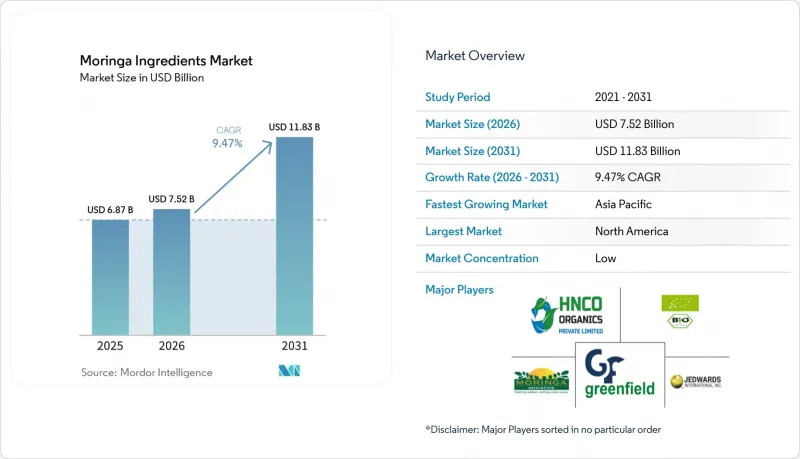
本報告按原料(葉、花、種子、莢果及其他)、應用領域(食品飲料、膳食補充劑、藥品、個人護理及化妝品、動物飼料及其他)及地區(北美、歐洲、亞太、南美、中東和非洲)進行細分。市場預測以價值(美元)和數量(噸)表示。
全球辣木萃取物市場趨勢與洞察
天然、營養豐富的超級食物越來越受到消費者的歡迎。
消費者對植物來源和潔淨標示營養食品的需求日益成長,推動了對辣木成分的需求。這是因為隨著人們對合成添加劑和超加工食品的質疑日益加深,需求也不斷擴大。辣木營養豐富,其維生素C含量是橘子的7倍,鈣含量是牛奶的17倍,鐵含量是菠菜的25倍(按重量計),因此它不僅是一種單一的營養提取物,更是一種功能性的全食物成分。然而,辣木的負責人在風味方面仍面臨挑戰。當濃度超過3-4%時,會產生明顯的苦味,因此建議採用包埋技術,並與其他相容的植物成分(如螺旋藻和猴麵包樹萃取物)混合使用。此外,永續發展措施也提升了辣木的市場吸引力。例如,True Moringa宣布將於2025年8月在加納300英畝的土地上種植其第1000萬棵樹。這將固存超過35,000噸二氧化碳,凸顯再生農業故事在高階零售通路中日益重要的角色。
市場對草藥和阿育吠陀養生方案的需求強勁
在南亞和海外主導市場,傳統養生體系(例如阿育吠陀)正日益被重新定義,並納入機能性食品營養保健品的框架之下。印度的「NutriBharat@2047」舉措已將辣木、薑黃和睡茄列為優先發展作物,以實現該國在營養保健品領域的雄心壯志。該計劃旨在利用政府支持的作物生產走廊和生物活性成分加工中心,實現萃取物品質的標準化。這項策略也體現在諸如北方邦「辣木使命」(Moringa Mission)等地方計畫中,該計畫於2025年啟動,透過「Gal Bhagiya」計畫免費發放幼苗,並將辣木納入學校供餐計畫。這是為對抗貧血而採取的措施之一。根據第五次全國家庭健康調查(NFHS-5)的數據,該邦6個月至5歲兒童的貧血盛行率高達67%,15至49歲女性的貧血盛行率也達到50%。在商業方面,一些成熟的阿育吠陀公司正在拓展業務,進軍數位化和潔淨標示銷售管道。例如,2026年2月,Vaidhyanath Ayurveda公司透過亞馬遜、Flipkart和JioMart等電商平台推出了售價215盧比(200克)的「有機認證辣木粉」。同時,監管力道也不斷加強。印度阿育吠陀、瑜伽、自然療法、尤那尼醫學、悉達醫學和順勢療法部(AYUSH部)要求所有與健康相關的功效聲明都必須經過隨機對照試驗,這提高了對生產商合規性的要求。
辣木種植的生產和加工成本很高
辣木是一種低投入、耐候性強的作物,但要達到出口品質標準仍然成本高昂,這對小規模種植者來說是一個障礙。歐洲和北美高階市場要求的有機認證,每年每個農場需要花費1200至3500美元,而有限的病蟲害控制手段導致其產量比傳統種植方式低約15%至20%。收穫後的基礎建設也需要大量投資;為一家中型企業安裝一套溫控乾燥系統大約需要180萬至190萬美元(約2.2萬美元),這迫使許多農民只能依賴品質較低的日曬乾燥方法。雖然像印度國家園藝使命和PM-Kisan這樣的計畫可以補貼30%至40%的資本成本,但這些補貼的分配並不均衡。 IndexBox估計,印度只有30%至40%的辣木葉產量符合國際出口標準。價格差異進一步加劇了市場的複雜性。出口用有機辣木粉在國際市場的售價為每公斤700至1200盧比,國內市場僅為每公斤180至250盧比。對於像Ancient GreenFields這樣的綜合性營運商而言,財務壓力尤其顯著。該公司報告稱,認證和品管成本的增加,以及來自非洲低成本供應商的競爭,導致其2025會計年度的銷售額下降了22%,至9,860萬盧比。
細分市場分析
葉片衍生產品仍是該品類的主導力量,主要體現在膠囊、冰沙混合物以及能量棒和飲料添加劑系統等。預計到2025年,葉片粉末將佔辣木原料市場佔有率的42.47%。專注於有機認證、第三方檢測和透明採購的企業正獲得零售合作夥伴的支持,其日常綠色混合物和便捷的條狀包裝產品不斷湧入美國和歐洲的家庭市場。在辣木原料產業,各品牌透過強化蛋白質和控制顆粒大小來改善補水飲料和穀物零食中的風味和分散性,從而在不使用掩味劑的情況下,打造一致的用戶體驗。由於各通路和各季節的需求穩定,葉片形式的銷售量仍佔據主導地位,這得益於其從冰沙到調味品等多種用途。在辣木原料產業,能夠掌控收穫時間、乾燥曲線和最終研磨過程的一體化供應商可以提供水分含量、色澤和生物活性成分特性可靠的粉末,從而助力各品牌實現全球產品系列的規模化生產。
預計到2031年,種子衍生成分的複合年成長率將達到10.47%。這主要得益於臨床應用和永續性的良好口碑,促使消費者願意為含有辣木活性成分的精華液、術後護理產品和屏障功能支援產品買單。在種子衍生產品領域,其價值提案主要集中在高階化妝品。高純度種子油和源自升級再造種子餅粕的活性成分,因其穩定性、質地和清潔的永續性,正吸引著配方研發人員的目光。種子衍生活性成分之所以在化妝品領域享有高階地位,源於其在穩定性測試中表現穩定可靠,以及其從小規模農戶採購的良好記錄,這些都符合歐洲零售市場的需求。因此,升級再造萃取物正成為新產品開發的核心。在此背景下,種子衍生產品正在推動辣木成分市場的擴張。這是因為2026年至2031年的成長前景與高價產品以及在多個國家拓展皮膚護理產品線密切相關。隨著品牌追求完全可追溯性和可記錄的永續性,整合農藝、採後管理和檢驗的提取工藝的供應商,在成長和盈利方面將繼續超越單純的商品交易模式。
區域分析
預計到2025年,北美將佔全球銷售額的37.87%,反映出該地區零售生態系統的成熟,消費者和品類採購人員對有機和潔淨標示的概念已有充分的了解。在美國,市場正透過遍布全國的雜貨店、天然食品連鎖店和專賣店不斷擴張,這些零售商銷售辣木膠囊、混合和烹飪產品。這種廣泛的零售網路有助於提高家庭滲透率和一般消費者的重複購買率。辣木原料市場也受惠於該地區對預防性醫療保健的重視,這與膠囊劑型(易於服用且檢測可靠)成為陳列規劃中不可或缺的要素相吻合。 2025年和2026年的召回事件加劇了採購人員對供應商檢驗、環境監測和檢驗的滅菌流程的關注,這直接影響進口商的實質審查和優先採購關係。將cGMP、HACCP文件記錄和批次級檢定作為核心差異化優勢的品牌,在補貨週期中與零售商的談判中獲得了更大的議價能力,這一趨勢將持續影響產品處理決策直至2026年。北美辣木原料市場佔有率由值得信賴的品牌和一體化供應商支撐,這些品牌和供應商在規模、文件記錄和快速品管之間保持平衡。
在歐洲,優質化趨勢日益明顯,更加重視嚴格的監管要求、標準化的活性成分、有機認證以及來自小規模生產商的可追溯性。雖然辣木葉粉和籽油對配方研發人員和專業零售商來說並不陌生,但新型成分和品種仍需經過嚴格的食品安全審查,這會影響產品上市時間和合規成本的計算。追求純淨美容的品牌正在透過強調其屏障功能支持和抗發炎功效的故事,來展示辣木衍生油和升級再造萃取物的有效性。在這種模式下,高階產品因其來源可查、體外測試結果可重複以及經證實的功效而備受青睞。整體食品類別都必須嚴格遵守有關污染物和農藥殘留的法規,這使得投資於上游工程控制和檢驗的出口商在歐洲市場獲得競爭優勢。因此,歐洲辣木成分市場向高價值產品傾斜,這些產品能夠引起零售商和消費者的共鳴,他們期望看到嚴謹的產品故事,並強調可追溯性和永續性。雖然這種結構導致銷售額成長速度比北美慢,但卻使得美國能夠提供更高的價格,尤其是在化妝品和高階健康領域。
亞太地區是成長最快的地區,預計到2031年將以12.85%的複合年成長率成長。這主要歸功於印度致力於將辣木納入公共工程和國內零售市場,推動種植、收穫和營養的措施。各邦的種植舉措和營養支持措施正在擴大供應,並鼓勵農民參與。同時,出口機構正在建立文件和品管程序,以確保生產商符合歐盟和美國的要求。辣木原料市場也受惠於國內對機能性食品和膳食補充劑日益成長的需求,這促使加工商提高其乾燥、研磨和檢測能力,以生產出口粉末和標準化萃取物。除亞太地區外,中東和非洲也在擴大面向出口市場的綜合項目,這些項目以大規模種植和加工設施為特色,旨在滿足北美和歐洲的合規性和永續性要求。這些項目構成了辣木原料市場的基礎,其氣候適應能力、創造就業機會和再生農業目標與高階買家對可追溯性和社會影響的期望相契合。隨著區域能力的成熟,來自亞太地區 (APAC) 和中東及非洲 (MEA) 的大量產品將符合優質進口標準,從而加速該類別從商品粉末向認證和標準化原料的轉變。
其他好處:
- Excel格式的市場預測(ME)表
- 3個月的分析師支持
目錄
第1章:引言
- 市場分析與定義的前提條件
- 分析範圍
第2章 分析方法
第3章執行摘要
第4章 市場狀況
- 市場概覽
- 市場促進因素
- 消費者對天然來源、營養豐富的超級食物越來越感興趣。
- 市場對草藥和阿育吠陀養生方案的需求強勁
- 擴大辣木萃取物在化妝品和個人保健產品。
- 人們越來越意識到辣木的抗氧化和增強免疫力的功效。
- 對植物來源蛋白質和潔淨標示成分的需求日益成長
- 辣木加工和成分萃取的技術進步
- 市場限制因素
- 辣木種植的生產和加工成本很高
- 成分核准和標籤標準的監管挑戰
- 劣質辣木產品有詐欺和污染風險
- 產品品質和活性成分含量缺乏標準化
- 供應鏈分析
- 監理情勢
- 技術展望
- 波特五力分析
第5章:預測市場規模與成長率
- 按原料
- 葉子
- 花
- 種子
- 鞘
- 其他
- 透過使用
- 食品/飲料
- 營養補充品
- 製藥
- 個人護理和化妝品
- 動物飼料
- 其他
- 按地區
- 北美洲
- 美國
- 加拿大
- 墨西哥
- 其他北美國家
- 歐洲
- 德國
- 英國
- 義大利
- 法國
- 西班牙
- 荷蘭
- 其他歐洲國家
- 亞太地區
- 中國
- 印度
- 日本
- 澳洲
- 其他亞太國家
- 南美洲
- 巴西
- 阿根廷
- 其他南美國家
- 中東和非洲
- 南非
- 沙烏地阿拉伯
- 阿拉伯聯合大公國
- 其他中東和非洲國家
- 北美洲
第6章 競爭情勢
- 市場集中度
- 策略趨勢
- 市場排名分析
- 公司簡介
- Ancient GreenFields(Grenera)Pvt Ltd
- HNCO Organics Pvt Ltd
- Bio Moringa Oleifera GmbH
- Jedwards International Inc.
- Moringa Initiative Ltd.
- Holistic Solutions Ltd
- Earth Expo Company
- Grenera Nutrients PVT
- PT Moringa Indonesia Fangardana(MORIFA)
- Green Virgin Products LLC
- Moringa Malawi
- Mevive International
- Moringa Farms
- NaturaleBio
- Now Foods
- Sunfood Superfoods
- Aduna Superfoods
- Dominate Industries
- Bio Nutrients India Pvt. Ltd.
- Only Natural Inc.
第7章 市場機會與未來趨勢
According to Mordor Intelligence, the moringa ingredients market size was valued at USD 6.87 billion in 2025 and estimated to grow from USD 7.52 billion in 2026 to reach USD 11.83 billion by 2031, at a CAGR of 9.47% during the forecast period (2026-2031).
This report is Segmented by Source (Leaf, Flowers, Seeds, Pods, Others), Application (Food and Beverages, Dietary Supplements, Pharmaceuticals, Personal Care and Cosmetics, Animal Feed, Others), and Geography (North America, Europe, Asia-Pacific, South America, Middle East and Africa). The Market Forecasts are Provided in Terms of Value (USD) and Volume (Tons).
Global Moringa Ingredients Market Trends and Insights
Rising consumer preference for natural and nutrient-rich superfoods
Growing consumer preference for plant-based and clean-label nutrition is driving demand for moringa ingredients, as increasing skepticism toward synthetic additives and ultra-processed foods fuels demand. Moringa's high nutritional density, containing 7 times more vitamin C than oranges, 17 times more calcium than milk, and 25 times more iron than spinach on a gram-for-gram basis, positions it as a functional whole-food ingredient rather than a standalone nutrient extract. However, formulators continue to face flavor challenges, as inclusion levels above 3-4% can introduce noticeable bitterness, encouraging the use of encapsulation technologies and blending with complementary botanicals such as spirulina and baobab. Sustainability positioning is also strengthening market appeal; for example, True Moringa announced in August 2025 that it had planted its 10 millionth tree across 300 acres in Ghana, reportedly sequestering more than 35,000 metric tons of CO2, highlighting the growing role of regenerative agriculture narratives in premium retail channels.
Strong demand for herbal and ayurvedic wellness solutions
Traditional wellness systems such as Ayurveda are increasingly being repositioned within evidence-based nutraceutical frameworks, particularly across South Asia and diaspora-driven markets. India's NutriBharat@2047 initiative identifies moringa, turmeric, and ashwagandha as priority botanicals for the country's nutraceutical ambitions, supported by government-backed crop corridors and bioactive processing hubs to ensure standardized extract quality. This strategy is reflected in regional programs such as Uttar Pradesh's "Moringa Mission," launched in 2025, which distributed free saplings under the Ghar-Bagiya scheme and incorporated moringa into school meal programs to address anemia, affecting 67% of children aged 6 months to 5 years and 50% of women aged 15-49 in the state, according to NFHS-5 data. Commercially, established Ayurvedic companies are expanding into digital and clean-label channels; for instance, Baidyanath Ayurved launched Certified Organic Moringa Powder in February 2026 at INR 215 for 200 grams through Amazon, Flipkart, and JioMart. At the same time, regulatory scrutiny is increasing, with India's Ministry of AYUSH requiring randomized controlled trials for health-related claims, raising compliance expectations for manufacturers.
High production and processing costs associated with moringa cultivation
Despite moringa's reputation as a low-input and climate-resilient crop, achieving export-grade quality remains cost-intensive, creating barriers for smallholder producers. Organic certification required for premium Western markets can cost between USD 1,200 and USD 3,500 annually per farm, while organic yields are estimated to be 15-20% lower than conventional output due to limited pest-control options. Post-harvest infrastructure also requires significant investment, with controlled-temperature drying systems costing approximately INR 18-19 lakh (~USD 22,000) for mid-scale operations, leading many farmers to rely on lower-quality sun-drying methods. Although schemes such as India's National Horticulture Mission and PM-Kisan can subsidize 30-40% of capital costs, access remains uneven, and IndexBox estimates that only 30-40% of Indian moringa leaf production meets international export standards. Price disparities further complicate the market, with export-grade organic moringa powder selling for INR 700-1,200 per kg internationally compared to INR 180-250 domestically. Financial pressure is particularly visible among integrated players such as Ancient GreenFields, which reported a 22% revenue decline in FY25 to INR 9.86 crore due to rising certification and quality-control expenses combined with competition from lower-cost African suppliers.
Other drivers and restraints analyzed in the detailed report include:
- Increasing adoption of moringa extracts in cosmetic and personal care products
- Rising awareness of moringa's antioxidant and immunity-boosting benefits
- Risk of adulteration and contamination in low-quality moringa products
For complete list of drivers and restraints, kindly check the Table Of Contents.
Segment Analysis
Leaf-derived formats remain the workhorse of the category, led by capsules, smoothie blends, and fortification systems in bars and beverages, and leaf powder held 42.47% of the moringa ingredients market share in 2025. Companies that lean into organic certifications, third-party testing, and transparent sourcing have found receptive retail partners for everyday green blends and on-the-go stick packs, which sustain household-level penetration in the United States and Europe. In the moringa ingredients industry, protein enrichment and particle-size control help brands manage taste and dispersibility for hydration beverages and cereal-based snacks, creating consistent user experiences without masking agents. Volume still clusters in leaf formats because multi-category use cases, from smoothies to savory seasonings, keep demand consistent across channels and seasons. In the moringa ingredients industry, integrated suppliers who control harvest maturity, drying curves, and final milling can deliver powders with reliable moisture, color, and bioactive fingerprints that scale across brands' global portfolios.
Seed-derived ingredients are projected to grow at 10.47% CAGR to 2031 as clinical and sustainability narratives reinforce willingness to pay for serums, post-procedure care, and barrier-support products that incorporate moringa-based actives. For seed-derived formats, the value proposition tilts toward premium cosmetics, where high-purity seed oil and upcycled seed-cake actives appeal to formulators who need stability, texture, and clean sustainability stories. Cosmetics-facing seed actives draw their premium from reproducible performance in stability testing and from verified smallholder sourcing that aligns with European retail demands, which places upcycled extracts at the center of new product briefs. Within this context, seed-derived formats help expand the moringa ingredients market size because their 2026-2031 growth outlook is linked to higher ticket prices and multi-country launches in dermocosmetic lines. As brands push for complete traceability and documented sustainability, suppliers that integrate agronomy, post-harvest controls, and validated extraction will keep outpacing commodity-only models in both growth and profitability.
Geography Analysis
North America accounted for 37.87% of revenue in 2025, underscoring a mature retail ecosystem in which organic and clean-label claims are well understood by shoppers and category buyers. The United States drives scale through national grocers, natural food chains, and specialty retailers that list moringa-forward capsules, blends, and culinary-use formats, and this retail reach supports household penetration and repeat usage among mainstream audiences. The moringa ingredients market also benefits from regional emphasis on preventive health, which aligns with capsule formats that promise simple dosing and credible testing as table stakes in planograms. The recalls of 2025 and 2026 intensified buyers' focus on supplier verification, environmental monitoring, and validated kill steps, which have immediate implications for importer diligence and favored sourcing relationships. Brands that treat cGMP, HACCP documentation, and lot-level testing as core differentiators gained leverage with retailers during restocking cycles, and that dynamic should continue to shape listing decisions through 2026. The moringa ingredients market share in North America remains anchored by trusted brands and integrated suppliers who can balance scale with documentation and responsive quality management.
Europe advances under stricter regulatory expectations and premiumization trends that reward standardized actives, certified-organic status, and smallholder traceability. While moringa leaf powder and seed oil are familiar to formulators and specialty retailers, new ingredient forms and species still pass through rigorous novel-food and safety reviews, which influence launch timing and cost-of-compliance calculations. Brands pursuing clean beauty have validated moringa-derived oils and upcycled extracts in barrier-support and anti-inflammatory storylines, a path that rewards documented origin and repeatable in-vitro or in-use signals for premium SKUs. Across food categories, contaminant and pesticide-residue rules are non-negotiable, so exporters that invest in upstream controls and testing have an edge in winning European distribution. The moringa ingredients market in Europe therefore skews toward higher-value formats where traceability and sustainability resonate with retailers and shoppers who expect rigorous product stories. That configuration translates to slower unit growth than North America but stronger price realization, particularly in cosmetics and premium wellness.
Asia-Pacific is the fastest-growing region, with a projected 12.85% CAGR through 2031 as India advances cultivation, aggregation, and nutrition missions that normalize moringa in public programs and domestic retail. State-level planting initiatives and nutrition schemes are expanding supply and building farmer participation, while export bodies define procedures for documentation and quality that prepare producers for EU and U.S. requirements. The moringa ingredients market also benefits from growing domestic interest in functional foods and supplements, which encourages processors to upgrade drying, milling, and testing capacity for export-grade powder and standardized extracts. Beyond APAC, the Middle East and Africa have begun to scale integrated projects that target export markets, with large-scale plantings and processing footprints designed around North American and European compliance and sustainability mandates. These projects anchor the moringa ingredients market where climate resilience, job creation, and regenerative agriculture targets align with premium buyer expectations on traceability and social impact. As regional capabilities mature, more lots from APAC and MEA should clear premium import thresholds, accelerating the category's shift from commodity powder to certified, standardized ingredients.
- Ancient GreenFields (Grenera) Pvt Ltd
- HNCO Organics Pvt Ltd
- Bio Moringa Oleifera GmbH
- Jedwards International Inc.
- Moringa Initiative Ltd.
- Holistic Solutions Ltd
- Earth Expo Company
- Grenera Nutrients PVT
- PT Moringa Indonesia Fangardana (MORIFA)
- Green Virgin Products LLC
- Moringa Malawi
- Mevive International
- Moringa Farms
- NaturaleBio
- Now Foods
- Sunfood Superfoods
- Aduna Superfoods
- Dominate Industries
- Bio Nutrients India Pvt. Ltd.
- Only Natural Inc.
Additional Benefits:
- The market estimate (ME) sheet in Excel format
- 3 months of analyst support
TABLE OF CONTENTS
1 INTRODUCTION
- 1.1 Study Assumptions and Market Definition
- 1.2 Scope of the Study
2 RESEARCH METHODOLOGY
3 EXECUTIVE SUMMARY
4 MARKET DYNAMICS
- 4.1 Market Overview
- 4.2 Market Drivers
- 4.2.1 Rising Consumer Preference for Natural and Nutrient-Rich Superfoods
- 4.2.2 Strong Demand for Herbal and Ayurvedic Wellness Solutions
- 4.2.3 Increasing Adoption of Moringa Extracts in Cosmetic and Personal Care Products
- 4.2.4 Rising Awareness of Moringa's Antioxidant and Immunity-Boosting Benefits
- 4.2.5 Growing Demand for Plant-Based Proteins and Clean-Label Ingredients
- 4.2.6 Technological Advancements in Moringa Processing and Ingredient Extraction
- 4.3 Market Restraints
- 4.3.1 High Production and Processing Costs Associated with Moringa Cultivation
- 4.3.2 Regulatory Challenges Related to Ingredient Approval and Labeling Standards
- 4.3.3 Risk of Adulteration and Contamination in Low-Quality Moringa Products
- 4.3.4 Lack of Standardization in Product Quality and Active Ingredient Content
- 4.4 Supply Chain Analysis
- 4.5 Regulatory Landscape
- 4.6 Technological Outlook
- 4.7 Porter's Five Forces
- 4.7.1 Threat of New Entrants
- 4.7.2 Bargaining Power of Buyers/Consumers
- 4.7.3 Bargaining Power of Suppliers
- 4.7.4 Threat of Substitute Products
- 4.7.5 Intensity of Competitive Rivalry
5 MARKET SIZE AND GROWTH FORECASTS (VALUE AND VOLUME)
- 5.1 By Source
- 5.1.1 Leaf
- 5.1.2 Flowers
- 5.1.3 Seeds
- 5.1.4 Pods
- 5.1.5 Others
- 5.2 By Application
- 5.2.1 Food and Beverages
- 5.2.2 Dietary Supplements
- 5.2.3 Pharmaceuticals
- 5.2.4 Personal Care and Cosmetics
- 5.2.5 Animal Feed
- 5.2.6 Others
- 5.3 By Geography
- 5.3.1 North America
- 5.3.1.1 United States
- 5.3.1.2 Canada
- 5.3.1.3 Mexico
- 5.3.1.4 Rest of North America
- 5.3.2 Europe
- 5.3.2.1 Germany
- 5.3.2.2 United Kingdom
- 5.3.2.3 Italy
- 5.3.2.4 France
- 5.3.2.5 Spain
- 5.3.2.6 Netherlands
- 5.3.2.7 Rest of Europe
- 5.3.3 Asia-Pacific
- 5.3.3.1 China
- 5.3.3.2 India
- 5.3.3.3 Japan
- 5.3.3.4 Australia
- 5.3.3.5 Rest of Asia-Pacific
- 5.3.4 South America
- 5.3.4.1 Brazil
- 5.3.4.2 Argentina
- 5.3.4.3 Rest of South America
- 5.3.5 Middle East and Africa
- 5.3.5.1 South Africa
- 5.3.5.2 Saudi Arabia
- 5.3.5.3 United Arab Emirates
- 5.3.5.4 Rest of Middle East and Africa
- 5.3.1 North America
6 COMPETITIVE LANDSCAPE
- 6.1 Market Concentration
- 6.2 Strategic Moves
- 6.3 Market Ranking Analysis
- 6.4 Company Profiles (includes Global level Overview, Market level overview, Core Segments, Financials, Strategic Information, Market Rank/Share, Products and Services, Recent Developments)
- 6.4.1 Ancient GreenFields (Grenera) Pvt Ltd
- 6.4.2 HNCO Organics Pvt Ltd
- 6.4.3 Bio Moringa Oleifera GmbH
- 6.4.4 Jedwards International Inc.
- 6.4.5 Moringa Initiative Ltd.
- 6.4.6 Holistic Solutions Ltd
- 6.4.7 Earth Expo Company
- 6.4.8 Grenera Nutrients PVT
- 6.4.9 PT Moringa Indonesia Fangardana (MORIFA)
- 6.4.10 Green Virgin Products LLC
- 6.4.11 Moringa Malawi
- 6.4.12 Mevive International
- 6.4.13 Moringa Farms
- 6.4.14 NaturaleBio
- 6.4.15 Now Foods
- 6.4.16 Sunfood Superfoods
- 6.4.17 Aduna Superfoods
- 6.4.18 Dominate Industries
- 6.4.19 Bio Nutrients India Pvt. Ltd.
- 6.4.20 Only Natural Inc.
7 MARKET OPPORTUNITIES AND FUTURE TRENDS

 辣木原料市場-全球市場預測(2026-2032年)
 2026年辣木原料全球市場報告
 辣木原料市場規模、佔有率和趨勢分析報告:按供應來源、應用、原料、地區和細分市場預測(2026-2033 年)
 辣木原料市場規模、佔有率及成長分析(按來源、類型、應用及地區分類)-2026-2033年產業預測
 辣木成分的全球市場
 辣木成分市場-全球產業規模、佔有率、趨勢、機會和預測,按來源、產地、應用、地區和競爭細分,2020-2030 年
 辣木原料市場規模(依來源、應用、產地、區域範圍、預測)
 辣木成分市場機會、成長動力、產業趨勢分析及 2024 年至 2032 年預測