


 |
市場調查報告書
商品編碼
2061926
超過濾:市場佔有率分析、產業趨勢和統計數據、成長預測(2026-2031)Ultrafiltration - Market Share Analysis, Industry Trends & Statistics, Growth Forecasts (2026 - 2031) |
||||||

※ 本網頁內容可能與最新版本有所差異。詳細情況請與我們聯繫。
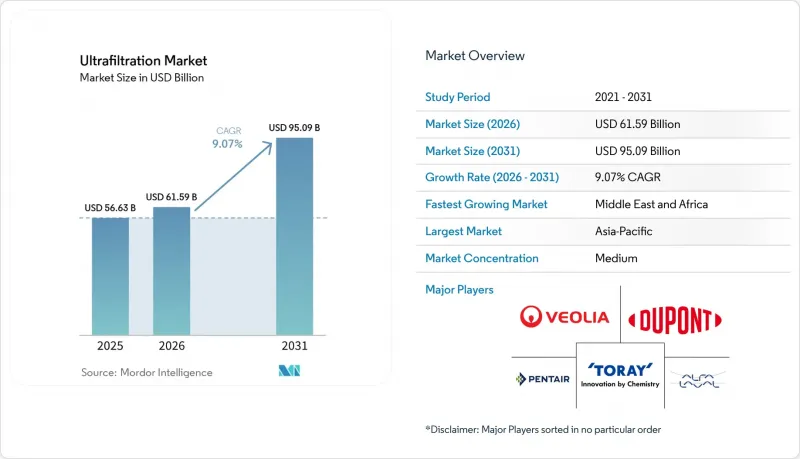
根據 Mordor Intelligence 預測,超過濾市場規模將從 2025 年的 566.3 億美元成長到 2026 年的 615.9 億美元,然後在 2031 年達到 950.9 億美元,2026 年至 2031 年的複合年成長率為 9.07%。
本報告按膜類型(聚合物膜、陶瓷膜等)、組件類型(中空纖維膜、螺旋纏繞膜等)、應用領域(水和廢水處理、微電子等)、終端用戶產業(市政、工業等)以及地區(亞太地區、北美地區、歐洲地區、南美地區、中東和非洲地區)進行細分。市場預測以美元計價。
全球超過濾市場趨勢及洞察
對用水和污水處理的需求日益成長
面對水資源短缺的挑戰,供水事業正逐步拋棄傳統的砂過濾方法,轉而採用先進的薄膜淨化技術。這種轉變不僅能夠滿足嚴格的濁度標準,還能避免與水庫相關的龐大成本。在中國,義烏市第三水質淨化廠是該領域的先驅,採用陶瓷膜組件進行大規模水處理。對該廠的研究表明,即使考慮到因薄膜污染造成的停機時間,陶瓷系統的經濟效益與聚合物系統相當。同時,在青島董家口,另一家水廠正在將超過濾和逆滲透結合,以減少維護需求並提高營運成本效益。中東地區也取得了進展,計劃在未來幾年擴大海水淡化產能。值得注意的是,許多競標都強調使用超過濾預處理。這種超過濾趨勢不僅限於海水淡化,在工業用水回用領域也日益普及。例如,威立雅位於巴西維多利亞的工廠就向一家大型鋼鐵製造商供應製程用水。這項成就不僅展現了該電廠的高效運行,也標誌著在已經面臨乾旱挑戰的地區,淡水消耗量大幅減少。
將超過濾作為逆滲透和海水淡化的預處理方法
雙膜組件現已成為海水淡化廠的標準配備。這是因為過濾水的超過濾是逆滲透膜的強制性要求。東麗2025高效中空纖維膜可將下游製程的污染減少三分之一,並將化學清洗產生的二氧化碳排放減少30%。杜邦2026超高壓元件旨在最大限度地減少廢水排放量,並依靠超過濾來防止不可逆堵塞。在巴林錫特拉和希德價值20億美元的擴建項目中,濁度被限制在0.1濁度單位以下,淤泥密度指數被限制在3.0以下,從而確保在主要運行開始前實施超過濾。能源模型顯示,在0.5-2巴的壓力下實施超過濾可將逆滲透通量提高10-15%。這種性能提升可將元件的使用壽命延長至多兩年,從而實現基於正淨現值(NPV)的投資回報。為了進一步證明其有效性,行業協會已將這些設計納入最佳實踐手冊,為在全球範圍內的快速推廣鋪平了道路。
膜污染和清洗成本
地表水處理設施飽受高濁度和高濃度溶解性有機物之苦,污垢堆積造成了巨大的經濟負擔。定期使用漂白劑、酸和界面活性劑處理會氧化聚合物纖維,縮短其有效使用壽命。陶瓷濾芯雖然能夠承受高強度清洗,但其高昂的成本使其僅限於高階市場。頗爾公司推出的「梯度滲透率整合濾芯」設計,以其漸進式滲透性而著稱,顯著降低了乳製品檢測中的清洗頻率,但目前才剛開始進入更廣泛的市場。氧化石墨烯塗層的研究表明,其在實驗室規模的供水系統中具有抑制滲透率下降的潛力,但缺乏足夠的試驗數據阻礙了實用化。在中東,人們正在進行紫外線預氧化和溶解空氣浮選法試驗以降低有機負荷,但這些方法需要大量的資本投入。
細分市場分析
到2025年,憑藉成本優勢,聚合物薄膜將佔67.20%的銷售額。然而,陶瓷膜的成長速度超過了競爭對手,預計2026年至2031年超過濾市場的複合年成長率將達到10.56%。中空纖維聚合物薄膜的定價經過精心設計,以符合地方政府的標準折舊免稅額計劃。同時,食品和製藥加工商則傾向於選擇價格較高的陶瓷膜。這種選擇源自於陶瓷優異的耐熱性和耐化學性,顯著延長了其使用壽命。頗爾公司新推出的GP-IC陶瓷產品解決了先前人們對產量降低的擔憂,並實現了更高的乳蛋白質回收率。此外,正如中國義烏工廠的案例所示,考慮到因薄膜污染造成的長期停機成本,陶瓷膜在經濟性方面可以與聚合物薄膜相媲美。
金屬膜和其他無機膜雖然市佔率有限,但主要用於半導體產業的超純水循環系統。在這個特殊領域,去除細小顆粒的能力可以顯著提高晶片良率。旭化成(Asahi Kasei)的OAT系列產品雖然僅限於特定的製造程序節點,但其設計旨在滿足這些嚴格的標準。同時,歐洲對全氟烷基化合物(PFAS)和多氟烷基化合物的審查日益嚴格,正促使業界將注意力轉向不含這些化合物的陶瓷材料。 Nanostone的「陶瓷超濾流」正是這一轉變的象徵,其每個模組的表面積更大,正日益推動採購轉向陶瓷材料,尤其是在那些對合規性要求嚴格的公共產業中。
預計2025年,中空纖維組件將主導市場,佔51.45%的裝置佔有率。這些組件每立方米可填充高達1200平方公尺的膜面積,並透過外進內出的方式有效處理固態。同時,螺旋纏繞結構從逆滲透到超過濾,以滿足食品和製藥業的衛生要求。尤其值得一提的是阿法拉伐的「DuroLac」螺旋組件,該組件改進了其創新的外殼形狀,使滲透液量提高了15%。管式組件利用剪切力去除沉積物,因此在啤酒廠和高固態含量都市污水處理廠的維修備受青睞,預計2026年至2031年將以10.24%的複合年成長率成長。例如,中國義烏的一個案例研究展示了這項技術的優越性:陶瓷管式組件實現了3米/秒的交叉流流速,有效控制了藻類生長。在一次性生物技術領域,板框式膠囊正迅速普及。例如,默克公司的焦化廠生產的「Pellicon」裝置不僅無需清洗驗證,還能加快批次週轉速度。
區域分析
到2025年,亞太地區將佔全球整體銷售額的38.31%。這主要得益於中國海水淡化業務的擴張、新加坡新生水(再生水)業務的蓬勃發展以及印度疫苗生產的蓬勃發展。尤其值得一提的是,青島董家口的超過濾預處理技術樹立了能源效率新標竿。新加坡的預測性清洗技術也實現了顯著的節能效果,充分展現了數據驅動營運的優勢。此外,海德拉巴和班加羅爾等製藥廠也擴大採用進口一次性濾芯,也為國內供應商帶來了市場機會。
預計2026年至2031年,中東和非洲地區將以10.74%的強勁複合年成長率推動市場成長。沙烏地阿拉伯國家水務公司正在卡西姆省主導大規模舉措,巴林也在錫特拉和希德等地進行大量投資。尤其值得一提的是,該地區近期許多海水淡化競標都採用了超過濾,凸顯了其在保障水資源安全方面的重要作用。在南非,地方政府正在考慮引進貨櫃式撬裝設備,將其作為應對乾旱挑戰的一種經濟有效的解決方案。
歐洲和北美在全球整體銷售額中佔據較大佔有率,但由於專注於現有設施的維修和升級,其成長受到限制。歐盟的《市政污水指令》強調去除營養物質和微塑膠。此外,隨著新的全氟烷基和多氟烷基物質(PFAS)監管限值計畫於2026年訂定,薄膜技術的進步正在迅速加快。阿法拉伐位於薩爾普斯堡的工廠預計將於2027年達到這些監管標準。在北美,儘管資本投資週期放緩,但生物製程的擴張推動了穩定的市場需求。邁斯納在喬治亞的新工廠就是一個很好的例子,該工廠不僅生產一次性系統,還創造了大量就業機會。同時,在南美,儘管市佔率較小,但威立雅位於巴西維多利亞的工廠凸顯了該地區工業水回用的潛力。
其他好處:
- Excel格式的市場預測(ME)表
- 3個月的分析師支持
目錄
第1章:引言
- 研究假設和市場定義
- 調查範圍
第2章:調查方法
第3章執行摘要
第4章 市場狀況
- 市場概覽
- 市場促進因素
- 對用水和污水處理的需求日益成長
- 將逆滲透和超濾結合作為海水淡化的預處理方法。
- 擴大食品和飲料產品召回流程的實施範圍
- 適用於智慧城市和遠端安裝的分散式超濾撬裝設備
- 推動制定法規,去除飲用水中的微塑膠
- 市場限制因素
- 膜污染和清洗成本
- 來自 MBR 和下一代低壓膜的競爭。
- 關於廢棄聚合物薄膜的處理不確定性
- 價值鏈分析
- 監理情勢
- 技術展望
- 波特五力模型
第5章 市場規模與成長預測
- 依膜類型
- 聚合物薄膜
- 陶瓷膜
- 金屬和其他無機薄膜
- 按模組類型
- 中空纖維
- 螺旋纏繞
- 管狀
- 板框
- 透過使用
- 用水和污水處理
- 食品/飲料加工
- 製藥和生物技術
- 化工/石油化工
- 微電子學
- 按最終用戶行業分類
- 地方政府
- 產業
- 衛生保健
- 農業
- 按地區
- 亞太地區
- 中國
- 印度
- 日本
- 韓國
- 東南亞
- 其他亞太國家
- 北美洲
- 美國
- 加拿大
- 墨西哥
- 歐洲
- 德國
- 英國
- 法國
- 義大利
- 西班牙
- 俄羅斯
- 其他歐洲國家
- 南美洲
- 巴西
- 阿根廷
- 其他南美國家
- 中東和非洲
- 阿拉伯聯合大公國
- 沙烏地阿拉伯
- 南非
- 其他中東和非洲國家
- 亞太地區
第6章 競爭情勢
- 市場集中度
- 關鍵策略趨勢
- 市佔率和排名分析
- 公司簡介
- 3M
- Alfa Laval
- Aquatech
- Asahi Kasei Corporation
- DuPont
- GEA Group Aktiengesellschaft
- Hydranautics(Nitto Group)
- Kovalus Separation Solutions
- Kubota Corporation
- LG Chem Ltd.
- MANN+HUMMEL
- Membranium
- Mitsubishi Chemical Aqua Solutions
- Nanostone
- Ovivo Inc.
- Pall Corporation(Danaher)
- Pentair
- Sartorius AG
- Toray Industries, Inc.
- Toyobo Co., Ltd.
- Veolia
- Xylem
第7章 市場機會與未來展望
According to Mordor Intelligence, the ultrafiltration market size is expected to grow from USD 56.63 billion in 2025 to USD 61.59 billion in 2026 and is forecast to reach USD 95.09 billion by 2031 at 9.07% CAGR over 2026-2031.
This report is Segmented by Membrane Type (Polymeric, Ceramic, and More), Module Type (Hollow Fiber, Spiral Wound, and More), Application (Water and Wastewater Treatment, Micro-Electronics and More), End-User Industry (Municipal, Industrial, and More), and Geography (Asia-Pacific, North America, Europe, South America, and Middle-East and Africa). The Market Forecasts are Provided in Terms of Value (USD).
Global Ultrafiltration Market Trends and Insights
Growing Demand for Water and Wastewater Treatment
Utilities, facing challenges of water scarcity, are moving away from traditional sand filtration methods, opting instead for advanced membrane clarification. This transition not only enables them to adhere to strict turbidity standards but also sidesteps the significant expenses tied to reservoirs. In China, the Yiwu Third Water Plant is at the forefront, utilizing ceramic modules for extensive water processing. Their research indicates that, even accounting for fouling downtimes, ceramic systems are economically comparable to polymeric systems. Meanwhile, in Qingdao Dongjiakou, another facility is combining ultrafiltration with reverse osmosis, resulting in reduced maintenance needs and improved operational cost efficiency. The Middle-East is also advancing, with plans to expand desalination capacities in the coming years. Interestingly, a large portion of these tenders is leaning toward ultrafiltration pretreatment. This trend of ultrafiltration isn't confined to desalination; it's gaining traction in industrial reuse too. For example, Veolia's Vitoria station in Brazil is supplying process water to major steel manufacturers. This achievement not only emphasizes the station's operational efficiency but also signifies a marked decrease in freshwater consumption for a region already grappling with drought challenges.
Integration of Ultrafiltration as Pretreatment for Reverse Osmosis and Desalination
Seawater plants now standardize dual-membrane trains, as reverse-osmosis warranties mandate ultrafiltration feedwater. Toray's 2025 high-removal hollow fiber cuts downstream fouling by a third and reduces carbon output from chemical cleaning by 30%. DuPont's 2026 ultra-high-pressure element, aiming for minimal liquid discharge, depends on ultrafiltration to avert irreversible compaction. Bahrain's USD 2 billion expansions at Sitra and Hidd set turbidity limits under 0.1 nephelometric turbidity units and a silt density index below 3.0, ensuring ultrafiltration is in place before major operations commence. Energy modeling reveals that implementing 0.5-2 bar ultrafiltration boosts reverse-osmosis flux by 10%-15%. This enhancement can prolong the lifespan of the elements by as much as two years, leading to a favorable net-present-value payback. As a testament to its efficacy, industry associations have incorporated these designs into their best-practice manuals, paving the way for a swift global adoption.
Membrane Fouling and Cleaning Costs
Surface-water plants grappling with high turbidity and elevated dissolved organics face a significant financial drain due to fouling. Regular treatments using bleach, acid, and surface-active agents oxidize polymeric fibers, consequently shortening their effective lifespan. While ceramic modules can withstand rigorous cleaning, their elevated price confines them to upscale markets. Pall's Gradient Permeability Integrated Cartridge design, boasting graduated permeability, has notably cut down cleaning frequency in dairy trials, yet it is just now entering wider markets. Research on graphene-oxide coatings indicates potential in curbing flux decline in laboratory feeds; however, the absence of timely pilot data hampers field adoption. In the Middle East, operators are experimenting with ultraviolet pre-oxidation and dissolved-air flotation to lessen organic loads, though this comes with increased capital complexity.
Other drivers and restraints analyzed in the detailed report include:
- Rising Adoption in Food and Beverage Product-Recovery Loops
- Decentralized Ultrafiltration Skids for Smart-City and Remote Installations
- Competition From Membrane Bioreactor and Next-Generation Low-Pressure Membranes
For complete list of drivers and restraints, kindly check the Table Of Contents.
Segment Analysis
In 2025, polymeric membranes secured 67.20% of the revenue, capitalizing on their cost advantages. However, ceramic alternatives are set to outpace the competition, boasting a projected CAGR of 10.56% in the ultrafiltration market from 2026 to 2031. Hollow fiber polymeric units are strategically priced to align with standard municipal budget depreciation schedules. On the other hand, food and pharmaceutical processors opt for the pricier ceramic units. This choice stems from ceramics' enhanced heat and chemical tolerance, which markedly prolongs their service life. Pall's new GP-IC ceramic has addressed previous yield loss concerns, now boasting a high recovery rate for dairy proteins. Furthermore, China's Yiwu plant illustrates that when factoring in long-term pricing for fouling downtime, ceramics can rival the economic viability of polymeric options.
Metallic and other inorganic membranes command a modest market share, predominantly catering to semiconductor ultrapure water loops. In this specialized arena, the capability to eliminate minuscule particles can markedly boost chip yield. Asahi Kasei's OAT series rises to meet these exacting standards, albeit for a select fabrication node. Concurrently, heightened scrutiny on per- and polyfluoroalkyl substances in Europe has pivoted the industry's attention towards ceramics devoid of these compounds. Emphasizing this shift, Nanostone's Ceramic Ultrafiltration Flow, boasting an augmented surface area per module, is swaying procurement choices towards ceramics, especially among utilities with rigorous compliance mandates.
In 2025, hollow fiber modules dominated the landscape, accounting for 51.45% of deployments. These modules boasted the capability to pack up to 1,200 square meters of membrane per cubic meter and effectively managed solids through an outside-in flow. Meanwhile, spiral-wound designs transitioned from reverse osmosis to ultrafiltration, catering to sanitary needs in the food and pharmaceutical sectors. Notably, Alfa Laval's DuroLac spiral, with its innovative envelope geometry tweaks, achieved a 15% boost in permeate. Tubular modules, favored for breweries and high-solids municipal retrofits due to their ability to scour foulants with shear, are projected to grow at a 10.24% CAGR from 2026 to 2031. A testament to this technology's prowess, Yiwu in China showcased a ceramic tubular installation achieving crossflow velocities of 3 meters per second, effectively warding off algae. In the realm of single-use biotech, plate-and-frame capsules are flourishing. Merck's Cork plant, for instance, produces Pellicon devices that not only sidestep cleaning validation but also expedite batch turnover.
Geography Analysis
In 2025, the Asia-Pacific region accounted for 38.31% of global revenue, fueled by China's desalination initiatives, Singapore's NEWater expansion, and India's vaccine manufacturing. Notably, an ultrafiltration pretreatment in Qingdao Dongjiakou has set a new standard for energy efficiency. Singapore's predictive cleaning techniques have yielded impressive energy savings, underscoring the power of data-driven operations. Additionally, pharmaceutical centers in Hyderabad and Bangalore are increasingly opting for imported single-use cassettes, signaling a market opportunity for domestic suppliers.
From 2026 to 2031, the Middle-East and Africa are poised to lead with a robust 10.74% CAGR. The Saudi National Water Company is spearheading a major initiative in Qassim, and Bahrain is heavily investing in its Sitra and Hidd projects. Notably, many recent desalination tenders in the region are now featuring ultrafiltration, highlighting its crucial role in water security. In South Africa, municipalities are exploring containerized skids as a budget-friendly solution to drought challenges.
While Europe and North America command a significant share of global revenue, their growth is tempered by a focus on retrofits and replacements. The European Union's Urban Wastewater Directive emphasizes the removal of nutrients and microplastics. Furthermore, with new per- and polyfluoroalkyl substance limits set to kick in by 2026, there is a surge in membrane technology advancements. Alfa Laval's Sarpsborg plant is on track to meet these regulatory standards by 2027. In North America, even as the capital cycle slows, there is a steady demand driven by bioprocessing expansions. A case in point is Meissner's new plant in Georgia, which not only produces single-use systems but also generates significant employment. Meanwhile, in South America, despite a smaller market presence, Veolia's Vitoria station in Brazil underscores the region's potential for industrial water reuse.
- 3M
- Alfa Laval
- Aquatech
- Asahi Kasei Corporation
- DuPont
- GEA Group Aktiengesellschaft
- Hydranautics (Nitto Group)
- Kovalus Separation Solutions
- Kubota Corporation
- LG Chem Ltd.
- MANN+HUMMEL
- Membranium
- Mitsubishi Chemical Aqua Solutions
- Nanostone
- Ovivo Inc.
- Pall Corporation (Danaher)
- Pentair
- Sartorius AG
- Toray Industries, Inc.
- Toyobo Co., Ltd.
- Veolia
- Xylem
Additional Benefits:
- The market estimate (ME) sheet in Excel format
- 3 months of analyst support
TABLE OF CONTENTS
1 Introduction
- 1.1 Study Assumptions and Market Definition
- 1.2 Scope of the Study
2 Research Methodology
3 Executive Summary
4 Market Landscape
- 4.1 Market Overview
- 4.2 Market Drivers
- 4.2.1 Growing demand for water and wastewater treatment
- 4.2.2 Integration of UF as pretreatment for RO and desalination
- 4.2.3 Rising adoption in food and beverage product-recovery loops
- 4.2.4 Decentralised UF skids for smart-city and remote installations
- 4.2.5 Regulatory push for micro-plastics removal in drinking water
- 4.3 Market Restraints
- 4.3.1 Membrane fouling and cleaning costs
- 4.3.2 Competition from MBR and next-gen low-pressure membranes
- 4.3.3 End-of-life polymer-membrane disposal uncertainty
- 4.4 Value Chain Analysis
- 4.5 Regulatory Landscape
- 4.6 Technological Outlook
- 4.7 Porter's Five Forces
- 4.7.1 Bargaining Power of Suppliers
- 4.7.2 Bargaining Power of Buyers
- 4.7.3 Threat of New Entrants
- 4.7.4 Threat of Substitutes
- 4.7.5 Competitive Rivalry
5 Market Size and Growth Forecasts (Value)
- 5.1 By Membrane Type
- 5.1.1 Polymeric Membranes
- 5.1.2 Ceramic Membranes
- 5.1.3 Metallic and Other Inorganic Membranes
- 5.2 By Module Type
- 5.2.1 Hollow Fiber
- 5.2.2 Spiral Wound
- 5.2.3 Tubular
- 5.2.4 Plate and Frame
- 5.3 By Application
- 5.3.1 Water and Wastewater Treatment
- 5.3.2 Food and Beverage Processing
- 5.3.3 Pharmaceuticals and Biotechnology
- 5.3.4 Chemicals and Petrochemicals
- 5.3.5 Micro-electronics
- 5.4 By End-user Industry
- 5.4.1 Municipal
- 5.4.2 Industrial
- 5.4.3 Healthcare
- 5.4.4 Agriculture
- 5.5 By Geography
- 5.5.1 Asia-Pacific
- 5.5.1.1 China
- 5.5.1.2 India
- 5.5.1.3 Japan
- 5.5.1.4 South Korea
- 5.5.1.5 Southeast Asia
- 5.5.1.6 Rest of Asia-Pacific
- 5.5.2 North America
- 5.5.2.1 United States
- 5.5.2.2 Canada
- 5.5.2.3 Mexico
- 5.5.3 Europe
- 5.5.3.1 Germany
- 5.5.3.2 United Kingdom
- 5.5.3.3 France
- 5.5.3.4 Italy
- 5.5.3.5 Spain
- 5.5.3.6 Russia
- 5.5.3.7 Rest of Europe
- 5.5.4 South America
- 5.5.4.1 Brazil
- 5.5.4.2 Argentina
- 5.5.4.3 Rest of South America
- 5.5.5 Middle-East and Africa
- 5.5.5.1 United Arab Emirates
- 5.5.5.2 Saudi Arabia
- 5.5.5.3 South Africa
- 5.5.5.4 Rest of Middle-East and Africa
- 5.5.1 Asia-Pacific
6 Competitive Landscape
- 6.1 Market Concentration
- 6.2 Key Strategic Moves
- 6.3 Market Share(%)/Ranking Analysis
- 6.4 Company Profiles (includes Global level Overview, Market level overview, Core Segments, Financials as available, Strategic Information, Products and Services, and Recent Developments)
- 6.4.1 3M
- 6.4.2 Alfa Laval
- 6.4.3 Aquatech
- 6.4.4 Asahi Kasei Corporation
- 6.4.5 DuPont
- 6.4.6 GEA Group Aktiengesellschaft
- 6.4.7 Hydranautics (Nitto Group)
- 6.4.8 Kovalus Separation Solutions
- 6.4.9 Kubota Corporation
- 6.4.10 LG Chem Ltd.
- 6.4.11 MANN+HUMMEL
- 6.4.12 Membranium
- 6.4.13 Mitsubishi Chemical Aqua Solutions
- 6.4.14 Nanostone
- 6.4.15 Ovivo Inc.
- 6.4.16 Pall Corporation (Danaher)
- 6.4.17 Pentair
- 6.4.18 Sartorius AG
- 6.4.19 Toray Industries, Inc.
- 6.4.20 Toyobo Co., Ltd.
- 6.4.21 Veolia
- 6.4.22 Xylem
7 Market Opportunities and Future Outlook
- 7.1 White-space and Unmet-need Assessment
- 7.2 Technological Advancements in Membrane Performance
- 7.3 Opportunities in Emerging Water-scarce Markets


