


 |
市場調查報告書
商品編碼
2061924
線傳驅動:市場佔有率分析、產業趨勢與統計、成長預測(2026-2031 年)Drive-by-Wire - Market Share Analysis, Industry Trends & Statistics, Growth Forecasts (2026 - 2031) |
||||||

※ 本網頁內容可能與最新版本有所差異。詳細情況請與我們聯繫。
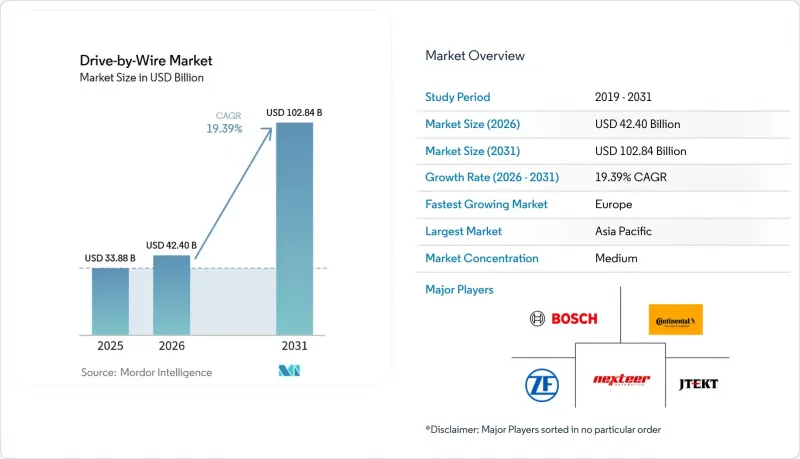
預計到 2025 年,線傳市場規模將達到 338.8 億美元,到 2026 年將達到 424 億美元,到 2031 年將達到 1028.4 億美元,2026 年至 2031 年的複合年成長率為 19.39%。
本報告按應用(線傳、線控刹車等)、車輛類型(乘用車、輕型商用車等)、動力系統(內燃機車輛、混合動力車輛等)、組件(執行器、感測器等)、運行技術和地區進行細分。市場預測以美元計價。
全球線傳市場趨勢與洞察
ADAS和自動駕駛技術的廣泛應用
3級以上自動駕駛需要小於10毫秒的確定性控制迴路,而機械連動機構無法實現這一點,因此線傳驅動成為未來無人駕駛能力的基礎。賓士在2026年推出的EQS車型中採用了線傳系統,顯著降低了城市道路的轉向操作難度。中國的GB 17675-2025標準強制要求冗餘設計並取消了轉向柱,樹立了全球先例。蔚來ET9和XPENG GX結合了以雷射雷達為基礎的路徑規劃和自動變換車道功能,無需駕駛員干預即可完成這些任務。聯合國歐洲經濟委員會(UNECE)正在製定無後視鏡法規,要求採用線傳轉向冗餘設計,預計將使純電動車的單次充電續航里程增加多達12公里。
電動汽車平台的廣泛應用
純電動車(BEV)架構透過取消液壓和氣壓元件來減輕車輛重量,從而可以引入線控刹車、線控線傳和整合式電力電子設備。比亞迪展示了一款電子機械線控刹車系統,該系統提高了能量回收效率並顯著降低了煞車粉塵排放。豐田2026款RAV4將線傳換檔技術與電子控制煞車結合,以增強城市駕駛時的能量回收。採埃孚(ZF)在2025年獲得了一份涵蓋數百萬輛汽車的整合剎車控制系統契約,這凸顯了整車製造商(OEM)對現成純電動汽車底盤模組日益成長的需求。中國第四階段燃油經濟法規鼓勵使用能量回收煞車系統,而美國和歐盟預計也將推出類似的獎勵,這促使本土整車製造商面臨著向線控刹車系統轉型的壓力。
系統成本高且檢驗過程複雜
線控線傳系統和線控刹車系統都會顯著增加單車成本。這些成本對於佔全球汽車產量絕大部分的A級和B級車而言,意味著價格上的巨大上漲。符合ISO 26262 ASIL-D標準需要進行大量的測試,包括故障注入測試和數百萬公里的評估,這導致每個汽車平臺的工程成本都非常高。 IPG Automotive透過虛擬化執行器的動態特性縮短了測試時間,但這種方法的應用仍然僅限於頂級供應商。英飛凌的單晶片感測器成功降低了零件成本,而採埃孚的模組化平台由於其零件在不同車型類別間的高度通用,也預示著中期內成本降低的潛力。
細分市場分析
2025年,線控線傳將主導線傳市場,佔39.25%的佔有率。線傳也不斷擴大其線傳市場的佔有率,預計到2031年將以21.33%的複合年成長率成長,因為汽車製造商(OEM)需要為L3級自動駕駛打造無轉向柱的座艙。值得注意的是,梅賽德斯-奔馳已將這項技術整合到其計劃於2026年上市的EQS車型中。同時,多家中國汽車製造商計劃在2026年至2027年間大規模投產。隨著線控刹車技術的應用日益普及,採埃孚(ZF)已獲得大量訂單,顯示供應商對該技術的長期需求充滿信心。
線傳換檔和線傳等技術已應用於主流車型。例如,計劃於2026年上市的豐田RAV4,透過降低中央通道高度,增加了車內乘客的腿部空間。線控線傳目前仍屬於小眾技術,但比亞迪展示的性能優勢表明,隨著成本的降低,這項技術可能會得到更廣泛的應用。未來,整合式底盤控制系統(將轉向和煞車系統合而為一)有望徹底改變整個產業。這項創新不僅能減少所需的硬體數量,還能為中階轎車在2020年代末期實現L3級自動駕駛鋪路。
截至2025年,乘用車將佔線傳市佔率的69.11%。然而,隨著電動卡車透過能量回收煞車技術提升續航里程,中重型商用車市場預計將以20.15%的複合年成長率成長。沃爾沃和戴姆勒的原型車取消了轉向柱,以減少最小轉彎半徑並為額外的電池騰出空間。
輕型商用車的行駛速度相對較低,因為車隊營運商優先考慮的是降低購置成本。然而,福特的E-Transit和梅賽德斯-奔馳的e-Sprinter都配備了線控刹車,可在走走停停的駕駛過程中能源回收。線傳目前正在非公路用車輛上進行測試,以輔助長時間輪班期間的遠端控制,並將於2027年歐洲機械指令生效後,受到強制性功能安全法規的約束。
區域分析
亞太地區預計到2025年將佔全球銷售量的38.06%,其中中國市場將發揮關鍵作用。在中國,GB 17675-2025標準將於2026年7月起取消轉向柱,加速線傳系統在中國的普及。日本正透過其「移動出行DX策略」投入大量資金,引導國內品牌朝向基於線傳技術的軟體定義汽車轉型。 2024年,韓國現代摩比斯(Hyundai Mobis)的整合式底盤控制器獲得ASIL-D認證,為其拓展出口和國內市場鋪平了道路。印度目前仍處於起步階段,但AIS-189網路安全法規正促使汽車製造商考慮在2027年推出的新車型中引入線控刹車系統。
在歐洲,《關鍵材料法》強制要求使用不含稀土的執行器,並鼓勵對鐵氧體和開關式磁阻電動機進行投資,預計到2031年,其年複合成長率(CAGR)將達到20.81%,是所有地區中最快的。梅賽德斯-奔馳已在EQS車型中引入線傳,而大眾汽車的E3 2.0架構透過整合ECU簡化了未來的安裝。生態設計法規增加了可追溯性成本,促使原始設備製造商(OEM)更早擴大生產規模,以分攤間接成本。
儘管北美市場佔有率落後,但它正受益於美國國家公路交通安全管理局 (NHTSA) 的 CAFE 法規,該法規要求透過電子控制實現最有效的減重方式。通用汽車的 Ultifi 區域控制器程式和福特在 E-Transit 車型上對線控刹車的標準化應用表明,電子控制技術正被廣泛採用。加拿大正在使其 MVSS 能源效率法規與美國政策接軌,而巴西的 PROCONVE L8排放氣體標準和阿拉伯聯合大公國的自動駕駛計程車計劃正在催生出規模雖小但成長迅速的需求中心。
其他好處:
- Excel格式的市場預測(ME)表
- 3個月的分析師支持
目錄
第1章:引言
- 研究的先決條件
- 市場的定義
- 調查範圍
第2章:調查方法
第3章執行摘要
第4章 市場狀況
- 市場概覽
- 市場促進因素
- ADAS和自動駕駛技術的廣泛應用
- 電動汽車平台的廣泛應用
- 有關減輕重量和提高燃油效率的法規
- 具備網路安全措施的故障運行電子電氣架構
- 透過區域架構縮短線束長度
- 歐盟的無稀土汽車指令正在推動 SBW(同時使用輕土)計劃。
- 市場限制因素
- 系統成本高且檢驗過程複雜
- 功能安全認證的障礙
- ISO-26262工程師短缺
- 售後服務體係不完善。
- 價值供應鏈分析
- 監理情勢
- 技術展望
- 波特五力分析
第5章 市場規模與成長預測
- 透過使用
- 線傳
- 線控刹車
- 線傳樓梯
- 線傳換檔
- 線傳泊車
- 線傳
- 車輛類型
- 搭乘用車
- 輕型商用車
- 中型和大型商用車輛
- 非公路用車輛
- 依推進類型
- 內燃機車
- 油電混合車
- 電池式電動車
- 按組件
- 執行器
- 感應器
- 電控系統(ECU)
- 軟體和中介軟體
- 線束和連接器
- 其他
- 透過操作技術
- 電子機械
- 電液式
- 電動氣動
- 按地區
- 北美洲
- 美國
- 加拿大
- 其他北美國家
- 南美洲
- 巴西
- 阿根廷
- 其他南美國家
- 歐洲
- 德國
- 英國
- 法國
- 義大利
- 西班牙
- 俄羅斯
- 其他歐洲國家
- 亞太地區
- 中國
- 日本
- 印度
- 韓國
- 其他亞太國家
- 中東和非洲
- GCC
- 土耳其
- 南非
- 其他中東和非洲國家
- 北美洲
第6章 競爭情勢
- 市場集中度
- 策略趨勢
- 市佔率分析
- 公司簡介
- Robert Bosch GmbH
- Continental AG
- ZF Friedrichshafen AG
- Nexteer Automotive
- JTEKT Corporation
- Curtiss-Wright Corporation
- Astemo, Ltd.
- DENSO Corporation
- NSK Ltd.
- Nissan Motor Co., Ltd.
- SKF Group
- Mobil Elektronik GmbH
- Schaeffler AG
- Hyundai Mobis
- Ficosa International
- Infineon Technologies AG
- Kongsberg Automotive
第7章 市場機會與未來展望
According to Mordor Intelligence, the drive-by-wire market size is projected to be USD 33.88 billion in 2025, USD 42.40 billion in 2026, and reach USD 102.84 billion by 2031, growing at a CAGR of 19.39% from 2026 to 2031.
This report is Segmented by Application (Throttle-By-Wire, Brake-By-Wire, and More), Vehicle Type (Passenger Cars, Light Commercial Vehicles, and More), Propulsion Type (Internal-Combustion Engine Vehicles, Hybrid Electric Vehicles, and More), Component (Actuators, Sensors, and More), Actuation Technology, and Geography. The Market Forecasts are Provided in Terms of Value (USD).
Global Drive-by-Wire Market Trends and Insights
Growing Adoption of ADAS and Autonomous Driving
Level 3+ automation needs deterministic sub-10-millisecond control loops that mechanical linkages cannot meet, making drive-by-wire foundational for future driverless capability. Mercedes-Benz embedded steer-by-wire in the EQS in 2026 and cut urban steering effort significantly. China's GB 17675-2025 mandates redundancy and deletes the steering column, creating a global precedent . NIO ET9 and XPENG GX marry LiDAR-based path planning with autonomous lane changes, executing them without driver input. UNECE is drafting mirrorless regulations contingent on steer-by-wire redundancy, which would extend BEV driving range by up to 12 kilometers per charge.
Rising EV Platform Penetration
BEV architectures eliminate hydraulic and pneumatic components, making way for brake-by-wire, throttle-by-wire, and integrated power electronics, thereby reducing curb weight. BYD showcased an electro-mechanical brake-by-wire system that improves energy recuperation and significantly reduces brake dust emissions. Toyota's 2026 RAV4 integrates shift-by-wire technology with electronically controlled brakes, enhancing energy recovery during city driving . ZF secured a contract in 2025 for integrated brake control spanning millions of vehicles, underscoring OEM demand for prefabricated BEV chassis modules. China's Phase IV fuel-consumption regulations incentivize regenerative braking, steering local OEMs towards brake-by-wire systems, especially ahead of similar incentives set to roll out in the United States and EU.
High System Cost and Validation Complexity
Steer-by-wire systems add a significant premium per vehicle, while brake-by-wire systems also increase costs. These expenses represent a notable markup on A- and B-class cars, which account for a substantial share of global automotive output. Compliance with ISO 26262 ASIL-D standards requires extensive testing, including fault injection and multi-million-kilometer evaluations, resulting in considerable engineering costs per vehicle platform. While IPG Automotive has reduced testing time by virtualizing actuator dynamics, adoption of this approach remains limited to top-tier suppliers. Infineon's one-chip sensors have successfully reduced the bill of materials, and ZF's modular platform shares a high percentage of parts across different vehicle classes, indicating a potential cost reduction in the medium term.
Other drivers and restraints analyzed in the detailed report include:
- Weight-Reduction and Fuel-Efficiency Mandates
- Cyber-Secure Fail-Operational E/E Architectures
- Functional-Safety Certification Barriers
For complete list of drivers and restraints, kindly check the Table Of Contents.
Segment Analysis
Throttle-by-wire dominated the drive-by-wire market with 39.25% share in 2025. Steer-by-wire accounted for a rising share of the drive-by-wire market and is projected to post a 21.33% CAGR through 2031, as OEMs need column-free cabins for Level 3 automation. In a significant move, Mercedes-Benz integrated the technology into its EQS model set for release in 2026. Meanwhile, several Chinese automakers have planned substantial production capacity for the years 2026-2027. As the adoption of brake-by-wire technology gains momentum, ZF has secured a major order, signaling strong supplier confidence in sustained long-term volumes.
Technologies like shift-by-wire and park-by-wire have already found their way into mainstream vehicles. For instance, Toyota's RAV4, scheduled for 2026, features a reduced tunnel height, enhancing legroom for passengers. While suspension-by-wire remains a niche offering, BYD's demonstration of its performance advantages suggests a potential for wider adoption as costs decrease. Looking ahead, integrated chassis control is set to revolutionize the industry by merging steering and braking systems. This innovation not only reduces the hardware count but also paves the way for mid-priced sedans to achieve Level 3 autonomy by the end of the decade.
Passenger cars accounted for 69.11% of the drive-by-wire market share in 2025. Yet, medium- and heavy-duty commercial vehicles will expand at a 20.15% CAGR as electric trucks pursue regenerative braking range boosts. Volvo and Daimler prototypes cut turning circles and clear room for extra batteries once columns vanish.
Light commercial vehicles operate at slower speeds because fleets prize low acquisition costs. However, the Ford E-Transit and Mercedes eSprinter now include brake-by-wire to recover energy during stop-and-go duty. Off-highway vehicles are testing steer-by-wire to support remote control during long shifts and will face mandatory functional-safety rules after Europe enacts its Machinery Regulation in 2027.
Geography Analysis
Asia-Pacific held 38.06% of 2025 revenue, led by China, where GB 17675-2025 removes the steering column from July 2026 and accelerates local steer-by-wire adoption. Japan allocates significant funding under its Mobility DX Strategy, steering domestic brands towards software-defined vehicles reliant on drive-by-wire technology. In 2024, South Korea's Hyundai Mobis secured ASIL-D certification for its integrated chassis controller, paving the way for both export and domestic expansion. While India is still in the nascent stages, the AIS-189 cybersecurity regulations are prompting OEMs to consider brake-by-wire systems for their 2027 launches.
Europe is projected to record a 20.81% CAGR through 2031, the fastest regional pace, as the Critical Raw Materials Act demands rare-earth-free actuators and sparks investment in ferrite and switched-reluctance motors. Mercedes-Benz debuted steer-by-wire in the EQS, and Volkswagen's E3 2.0 architecture consolidates ECUs to simplify future installations. The Ecodesign regulation adds traceability costs, nudging OEMs to scale volumes sooner to spread overhead.
North America trails in share yet gains from NHTSA CAFE rules that compel weight reductions best delivered by electronic actuation. GM's Ultifi zone-controller plan and Ford's E-Transit brake-by-wire standardization illustrate mainstream uptake. Canada aligns its MVSS efficiency rules with U.S. policy, while Brazil's PROCONVE L8 emission standard and the UAE autonomous taxi initiative create smaller but growing demand pockets.
- Robert Bosch GmbH
- Continental AG
- ZF Friedrichshafen AG
- Nexteer Automotive
- JTEKT Corporation
- Curtiss-Wright Corporation
- Astemo, Ltd.
- DENSO Corporation
- NSK Ltd.
- Nissan Motor Co., Ltd.
- SKF Group
- Mobil Elektronik GmbH
- Schaeffler AG
- Hyundai Mobis
- Ficosa International
- Infineon Technologies AG
- Kongsberg Automotive
Additional Benefits:
- The market estimate (ME) sheet in Excel format
- 3 months of analyst support
TABLE OF CONTENTS
1 Introduction
- 1.1 Study Assumptions
- 1.2 Market Definition
- 1.3 Scope of the Study
2 Research Methodology
3 Executive Summary
4 Market Landscape
- 4.1 Market Overview
- 4.2 Market Drivers
- 4.2.1 Growing Adoption of ADAS and Autonomous Driving
- 4.2.2 Rising EV Platform Penetration
- 4.2.3 Weight-Reduction and Fuel-Efficiency Mandates
- 4.2.4 Cyber-Secure Fail-Operational E/E Architectures
- 4.2.5 Zonal Architectures Reducing Wiring Harness Length
- 4.2.6 EU Rare-Earth-Free Motor Directives Spurring SBW
- 4.3 Market Restraints
- 4.3.1 High System Cost and Validation Complexity
- 4.3.2 Functional-Safety Certification Barriers
- 4.3.3 Scarcity of ISO-26262 Engineers
- 4.3.4 Limited Aftermarket Service Readiness
- 4.4 Value / Supply-Chain Analysis
- 4.5 Regulatory Landscape
- 4.6 Technological Outlook
- 4.7 Porter's Five Forces Analysis
- 4.7.1 Threat of New Entrants
- 4.7.2 Bargaining Power of Buyers
- 4.7.3 Bargaining Power of Suppliers
- 4.7.4 Threat of Substitutes
- 4.7.5 Competitive Rivalry
5 Market Size & Growth Forecasts (Value (USD))
- 5.1 By Application
- 5.1.1 Throttle-by-Wire
- 5.1.2 Brake-by-Wire
- 5.1.3 Steer-by-Wire
- 5.1.4 Shift-by-Wire
- 5.1.5 Park-by-Wire
- 5.1.6 Suspension-by-Wire
- 5.2 By Vehicle Type
- 5.2.1 Passenger Cars
- 5.2.2 Light Commercial Vehicles
- 5.2.3 Medium and Heavy Commercial Vehicles
- 5.2.4 Off-highway Vehicles
- 5.3 By Propulsion Type
- 5.3.1 Internal-Combustion Engine Vehicles
- 5.3.2 Hybrid Electric Vehicles
- 5.3.3 Battery Electric Vehicles
- 5.4 By Component
- 5.4.1 Actuators
- 5.4.2 Sensors
- 5.4.3 Electronic Control Units (ECU)
- 5.4.4 Software and Middleware
- 5.4.5 Wiring-Harness and Connectors
- 5.4.6 Others
- 5.5 By Actuation Technology
- 5.5.1 Electro-Mechanical
- 5.5.2 Electro-Hydraulic
- 5.5.3 Electro-Pneumatic
- 5.6 By Geography
- 5.6.1 North America
- 5.6.1.1 United States
- 5.6.1.2 Canada
- 5.6.1.3 Rest of North America
- 5.6.2 South America
- 5.6.2.1 Brazil
- 5.6.2.2 Argentina
- 5.6.2.3 Rest of South America
- 5.6.3 Europe
- 5.6.3.1 Germany
- 5.6.3.2 United Kingdom
- 5.6.3.3 France
- 5.6.3.4 Italy
- 5.6.3.5 Spain
- 5.6.3.6 Russia
- 5.6.3.7 Rest of Europe
- 5.6.4 Asia-Pacific
- 5.6.4.1 China
- 5.6.4.2 Japan
- 5.6.4.3 India
- 5.6.4.4 South Korea
- 5.6.4.5 Rest of Asia-Pacific
- 5.6.5 Middle East and Africa
- 5.6.5.1 GCC
- 5.6.5.2 Turkey
- 5.6.5.3 South Africa
- 5.6.5.4 Rest of Middle East and Africa
- 5.6.1 North America
6 Competitive Landscape
- 6.1 Market Concentration
- 6.2 Strategic Moves
- 6.3 Market Share Analysis
- 6.4 Company Profiles (includes Global Level Overview, Market Level Overview, Core Segments, Financials as Available, Strategic Information, Market Rank/Share for Key Companies, Products and Services, SWOT Analysis, and Recent Developments)
- 6.4.1 Robert Bosch GmbH
- 6.4.2 Continental AG
- 6.4.3 ZF Friedrichshafen AG
- 6.4.4 Nexteer Automotive
- 6.4.5 JTEKT Corporation
- 6.4.6 Curtiss-Wright Corporation
- 6.4.7 Astemo, Ltd.
- 6.4.8 DENSO Corporation
- 6.4.9 NSK Ltd.
- 6.4.10 Nissan Motor Co., Ltd.
- 6.4.11 SKF Group
- 6.4.12 Mobil Elektronik GmbH
- 6.4.13 Schaeffler AG
- 6.4.14 Hyundai Mobis
- 6.4.15 Ficosa International
- 6.4.16 Infineon Technologies AG
- 6.4.17 Kongsberg Automotive
7 Market Opportunities & Future Outlook
- 7.1 White-space & Unmet-Need Assessment

 線傳市場:按組件、變速箱、車輛推進系統、車輛類型和應用分類-2026-2032年全球市場預測
 線傳市場分析及至2035年預測:類型、產品類型、技術、組件、應用、最終用戶、功能、安裝配置、設備
 線傳市場 - 全球產業規模、佔有率、趨勢、機會、預測:按車輛類型、應用、組件、地區和競爭格局分類,2021-2031年
 2026年全球線傳市場報告
 線控驅動市場:按應用、車輛類型、組件和地區分類
 全球線控駕駛市場(至2032年):依類型(線控轉向、線傳煞車、線傳換檔、線控泊車、線控油門)、自動駕駛汽車及地區分類
 2026-2034年全球線傳市場規模、佔有率、趨勢及成長分析報告
 線傳市場規模、佔有率和成長分析(按應用、組件、感測器類型、公路車輛、非公路用車輛和地區分類)-2026-2033年產業預測2026-2032 年線傳市場:依車型、技術、零件和地區分類