


 |
市場調查報告書
商品編碼
2061728
義大利汽車租賃市場:市場佔有率分析、產業趨勢與統計及成長預測(2026-2031)Italy Car Rental - Market Share Analysis, Industry Trends & Statistics, Growth Forecasts (2026 - 2031) |
||||||

※ 本網頁內容可能與最新版本有所差異。詳細情況請與我們聯繫。
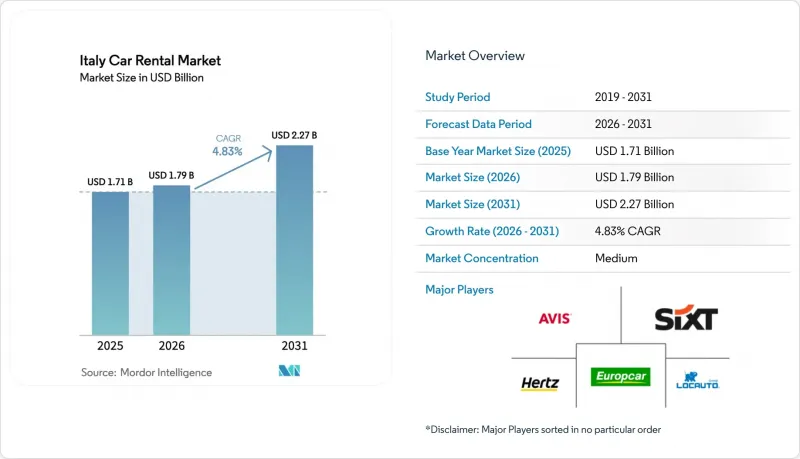
根據 Mordor Intelligence 預測,義大利租車市場預計將從 2025 年的 17.1 億美元成長到 2026 年的 17.9 億美元,到 2031 年達到 22.7 億美元,2026 年至 2031 年的複合年成長率預計為 4.83%。
本報告按預訂方式(線下和線上)、用途(休閒和商務)、最終用戶(個人自駕、司機駕駛及其他)、車輛類型(微型車和經濟型轎車及其他)、租賃期限(短期、中期和長期)以及地區(義大利北部、義大利中部、義大利南部和島嶼)進行細分。市場預測以美元計價。
義大利汽車租賃市場的趨勢與洞察
旅遊業復甦和累積的旅遊需求
2024年第四季,外國遊客入境人數成長6.8%,住宿人數達2.501億人次,旅遊旺季延長至7月和8月之後。淡季遊客數量的增加提高了車輛運轉率,有助於避免先前冬季淡季遊客數量大幅下降的情況。休閒貢獻了大部分收入,預計將保持穩定成長,並有望維持遊客數量的成長勢頭。為回應新的透明度法規,營運商正嘗試透過將燃油成本和保險費用納入固定價格套餐來提高平均客戶消費。儘管機票和住宿成本的上漲可能會抑制自由行需求,但先前被抑制的需求激增以及彈性工作安排的普及正在推動淡季預訂量的成長。
義大利主要商業中心企業差旅的復甦
儘管租車交易量仍低於危機前水平,但每輛車的單價卻顯著成長,反映出消費者正大力轉向高階電動車。跨國公司正在整合籌資策略,優先考慮能夠與SAP Concur無縫整合以實現費用自動追蹤的全國性網路。米蘭馬爾彭薩機場和羅馬菲烏米奇諾機場繼續發揮主要樞紐的作用,而隨著企業分散辦公地點,波隆那和都靈機場正成為熱門的替代方案。中型獨立公司,尤其是那些營運結構分散的公司,正感受到來自大型企業批量折扣的壓力。未來的成長預測並非取決於經濟的進一步萎縮,而是取決於混合辦公模式的建立。
需求的季節性和集中性
過去幾個月,住宿數量顯著增加。然而,冬季運轉率仍然很低。夏季需求旺盛的業者不得不應對冬季車輛閒置的問題。這不僅擠壓了利潤空間,還迫使他們提供大幅折扣。南部島嶼夏季運轉率很高,但冬季卻急劇下降。這種突變導致營運商需要將車輛北調以滿足不斷成長的需求,從而增加了成本。短期租賃收入佔比過高加劇了市場波動。預計這種不穩定性將持續到透過訂閱和長期租賃來實現需求曲線穩定為止。
細分市場分析
到2025年,線上預訂將佔義大利汽車租賃市場佔有率的54.76%,預計到2031年將以7.11%的複合年成長率成長,這主要得益於智慧型手機普及率的提高以及整合式搜尋帶來的更高透明度,這些因素正在改變消費者的購買行為。儘管線下門市的市佔率預計將會下降,但仍有望保持溫和成長。雖然聚合平台的佣金壓力正在擠壓短期利潤空間,但自有應用程式中的獎勵和忠誠度計畫能夠有效彌補損失。
根據義大利汽車租賃協會 (AGCM) 的指南披露數位費用,正在提升信任度並加速其普及。機場仍然是實體櫃檯的主要樞紐,佔據了大部分交易量,這凸顯了混合營運模式的必要性。營運商透過將員工從傳統櫃檯重新部署到路邊取車服務,並將追加提升銷售機會轉移到應用程式通知,成功地縮短了等待時間。在動態定價演算法和應用程式內輔助服務商品搭售銷售的支持下,義大利汽車租賃市場的數位通路收入預計將顯著成長。
預計到2025年,休閒用途將佔義大利汽車租賃市場佔有率的64.11%,並以7.44%的複合年成長率成長,這主要得益於外國住宿數量的增加和淡季的延長。商務用途的成長較為溫和,但隨著越來越多的企業選擇符合ESG標準的優質電動車,其每日租金收入也不斷成長。
米蘭馬爾彭塞機場、羅馬菲烏米奇諾機場和威尼斯馬可波羅機場等主要機場走廊的蓬勃發展,推動了商務和休閒租車需求的成長。營運商正策略性地細分其車輛陣容,為家庭提供經濟型轎車,為高階主管提供配備增強型互聯功能的轎車,從而避免車隊配置過高或過低。儘管預計義大利租車市場的休閒租車需求將略有成長,但真正推動盈利成長並促進供應商之間整合與收購的,是商務租車需求的成長。
其他好處:
- Excel格式的市場預測(ME)表
- 3個月的分析師支持
目錄
第1章:引言
- 研究假設和市場定義
- 調查範圍
第2章:調查方法
第3章執行摘要
第4章 市場狀況
- 市場概覽
- 市場促進因素
- 旅遊業復甦和累積的旅遊需求
- 義大利主要商業中心企業差旅的復甦
- 擴展全通路和基於應用程式的預訂平台
- 電動汽車租賃的興起,得益於 ZTL(限制交通區)的獎勵。
- 與永續發展掛鉤的企業車輛合約
- 出行即服務 (MaaS) 的訂閱模式正在蓬勃發展。
- 市場限制因素
- 需求的季節性和集中性
- 高昂的車隊採購和保險成本
- 與共乘和共享出行服務的競爭
- 半導體短缺導致車輛更換延遲。
- 價值供應鏈分析
- 監理情勢
- 技術展望
- 波特五力分析
第5章 市場規模與成長預測
- 透過預訂方式
- 離線
- 線上
- 透過使用
- 休閒
- 商業
- 最終用戶
- 個人駕駛員
- 駕駛員輔助服務
- 企業車隊訂閱
- 點對點租賃
- 車輛類型
- 小型車和經濟型車
- 小型車和中型車
- 標準尺寸和全尺寸車輛
- SUV 和 MPV
- 豪華/高級汽車
- 租賃期
- 短期(少於30天)
- 中期(1-12個月)
- 長期(12個月或以上)
- 按地區
- 義大利北部
- 義大利中部
- 義大利南部和島嶼
第6章 競爭情勢
- 市場集中度
- 策略趨勢
- 市佔率分析
- 公司簡介
- EUROPCAR INTERNATIONAL SASU
- The Hertz Corporation
- Avis Rent A Car System, LLC
- Sixt SE
- Locauto Group
- Drivalia(Leasys Rent)
- Maggiore
- Goldcar Italy
- Sicily by Car
- Autovia
- Noleggiare
- B-Rent
- Rent Smart24
- Surprice Car Rentals Italy
- Enjoy(ENI)
- Share Now Italy
- Free2Move
- Enterprise-Alamo National Italy
- GreenMotion Italy
- Euronoleggio
第7章 市場機會與未來展望
According to Mordor Intelligence, the italian car rental market size is expected to increase from USD 1.71 billion in 2025 to USD 1.79 billion in 2026 and reach USD 2.27 billion by 2031, growing at a CAGR of 4.83% over 2026-2031.
This report is Segmented by Booking Mode (Offline and Online), Application (Leisure and Business), End User (Self-Drive Individual, Chauffeur-Drive, and More), Vehicle Type (Mini and Economy Cars, and More), Rental Length (Short-Term, Medium-Term, and Long-Term), and Geography (Northern Italy, Central Italy, Southern Italy and Islands). The Market Forecasts are Provided in Terms of Value (USD).
Italy Car Rental Market Trends and Insights
Tourism Rebound And Pent-Up Travel Demand
International arrivals rose 6.8% in Q4 2024 to 250.1 million overnight stays, lengthening the high season beyond July-August. Fleet utilization benefits from higher shoulder-month volumes, helping to avoid winter troughs that previously dipped significantly. The leisure segment, projected to capture a significant revenue share and achieve steady growth, is banking on maintaining its visitor momentum. In response to new transparency regulations, operators are now packaging fuel and insurance into flat-rate deals, enhancing average ticket values. While rising airfare and lodging costs might dampen discretionary travel, a surge in pent-up demand and the rise of flexible work patterns are bolstering off-peak bookings.
Corporate Travel Recovery In Key Italian Business Hubs
Rental transaction volumes remain below the pre-crisis baseline, while spending per rental has increased significantly, reflecting a robust shift towards premium EV adoption. Multinational corporations are consolidating their procurement strategies, favoring nationwide networks that seamlessly integrate with SAP Concur for automated expense tracking. While Milan's Malpensa and Rome's Fiumicino airports continue to serve as primary hubs, Bologna and Turin are emerging as popular alternatives as companies decentralize their offices. Mid-tier independent firms, often with fragmented operations, are feeling the squeeze from corporate volume discounts. The trajectory of growth assumptions hinges on the stabilization of hybrid work models, rather than any further contraction.
Seasonality And Demand Concentration
In recent months, overnight stays have increased significantly. However, during the winter, utilization lagged and remained low. Operators, facing peak summer demands, found themselves with idle fleets during the winter months. This not only squeezed their profit margins but also compelled them to offer steep discounts. While southern islands experienced high utilization rates during the summer, they dropped significantly in the winter. This drastic shift incurred repositioning costs as vehicles were moved northward to meet rising demand. The significant revenue share from short-term rentals amplifies market volatility. This instability is expected to persist until subscriptions and long-term leases stabilize the demand curves.
Other drivers and restraints analyzed in the detailed report include:
- Expansion of Omni-Channel and App-Based Booking Platforms
- Rise of EV Rentals Driven By ZTL Incentives
- High Fleet Procurement and Insurance Costs
For complete list of drivers and restraints, kindly check the Table Of Contents.
Segment Analysis
Online reservations accounted for 54.76% of the Italian car rental market share in 2025, rising at 7.11% CAGR to 2031 as smartphone penetration and metasearch transparency shift buyer behavior. Offline counters are projected to see their market share dip, though modest growth is expected. While commission pressures from aggregators are squeezing near-term margins, direct-app incentives and loyalty tiers are strategically positioned to reclaim that lost value.
Digital fee disclosures, in line with AGCM directives, are bolstering trust and accelerating adoption. Airports remain a stronghold for physical counters, accounting for a significant portion of transactions, underscoring the need for a hybrid operational model. By reallocating staff from traditional desks to kerbside meet-and-greet services, operators are successfully reducing queue times and transitioning upsell opportunities to app notifications. Bolstered by dynamic pricing algorithms and in-app ancillary bundling, the Italian car rental market's digital channel revenue is set to grow significantly.
Leisure use accounted for 64.11% of the Italian car rental market share in 2025 and will expand at a 7.44% CAGR, driven by growth in foreign overnights and broader shoulder seasons. Business rentals, although experiencing modest growth, are yielding higher daily returns as corporations increasingly opt for premium EVs aligned with ESG standards.
Key airport corridors, including Malpensa-Milan, Fiumicino-Rome, and Venice Marco Polo, dominate dual-purpose travel. Operators strategically segment their fleets: offering economy cars for families and connectivity-enhanced sedans for executives, ensuring neither under- nor over-sizing. While leisure's share of the Italian car rental market may increase slightly, it's the growth in business rentals that bolsters profitability and fuels vendor consolidation deals.
List of Companies Covered in this Report:
- EUROPCAR INTERNATIONAL SASU
- The Hertz Corporation
- Avis Rent A Car System, LLC
- Sixt SE
- Locauto Group
- Drivalia (Leasys Rent)
- Maggiore
- Goldcar Italy
- Sicily by Car
- Autovia
- Noleggiare
- B-Rent
- Rent Smart24
- Surprice Car Rentals Italy
- Enjoy (ENI)
- Share Now Italy
- Free2Move
- Enterprise-Alamo National Italy
- GreenMotion Italy
- Euronoleggio
Additional Benefits:
- The market estimate (ME) sheet in Excel format
- 3 months of analyst support
TABLE OF CONTENTS
1 Introduction
- 1.1 Study Assumptions and Market Definition
- 1.2 Scope of the Study
2 Research Methodology
3 Executive Summary
4 Market Landscape
- 4.1 Market Overview
- 4.2 Market Drivers
- 4.2.1 Tourism Rebound and Pent-Up Travel Demand
- 4.2.2 Corporate Travel Recovery in Key Italian Business Hubs
- 4.2.3 Expansion Of Omni-Channel and App-Based Booking Platforms
- 4.2.4 Rise Of EV Rentals Driven by ZTL (Restricted-Traffic) Incentives
- 4.2.5 Sustainability-Linked Corporate Fleet Agreements
- 4.2.6 Mobility-As-A-Service Subscription Models Gaining Traction
- 4.3 Market Restraints
- 4.3.1 Seasonality and Demand Concentration
- 4.3.2 High Fleet Procurement and Insurance Costs
- 4.3.3 Competition From Ride-Hailing and Shared-Mobility Options
- 4.3.4 Semiconductor Shortage Delaying Vehicle Renewals
- 4.4 Value / Supply-Chain Analysis
- 4.5 Regulatory Landscape
- 4.6 Technological Outlook
- 4.7 Porter's Five Forces Analysis
- 4.7.1 Threat of New Entrants
- 4.7.2 Bargaining Power of Suppliers
- 4.7.3 Bargaining Power of Buyers
- 4.7.4 Threat of Substitutes
- 4.7.5 Competitive Rivalry
5 Market Size and Growth Forecasts (Value, USD)
- 5.1 By Booking Mode
- 5.1.1 Offline
- 5.1.2 Online
- 5.2 By Application
- 5.2.1 Leisure
- 5.2.2 Business
- 5.3 By End User
- 5.3.1 Self-Drive Individual
- 5.3.2 Chauffeur-Drive
- 5.3.3 Corporate Fleet Subscription
- 5.3.4 Peer-to-Peer Rental
- 5.4 By Vehicle Type
- 5.4.1 Mini and Economy Cars
- 5.4.2 Compact and Intermediate Cars
- 5.4.3 Standard and Full-Size Cars
- 5.4.4 SUVs and MPVs
- 5.4.5 Luxury / Premium Cars
- 5.5 By Rental Length
- 5.5.1 Short-Term (Less than 30 days)
- 5.5.2 Medium-Term (1-12 months)
- 5.5.3 Long-Term (Above 12 months)
- 5.6 By Region
- 5.6.1 Northern Italy
- 5.6.2 Central Italy
- 5.6.3 Southern Italy and Islands
6 Competitive Landscape
- 6.1 Market Concentration
- 6.2 Strategic Moves
- 6.3 Market Share Analysis
- 6.4 Company Profiles {(Includes Global level Overview, Market level overview, Core Segments, Financials as available, Strategic Information, Market Rank/Share for key companies, Products and Services, and Recent Developments)}
- 6.4.1 EUROPCAR INTERNATIONAL SASU
- 6.4.2 The Hertz Corporation
- 6.4.3 Avis Rent A Car System, LLC
- 6.4.4 Sixt SE
- 6.4.5 Locauto Group
- 6.4.6 Drivalia (Leasys Rent)
- 6.4.7 Maggiore
- 6.4.8 Goldcar Italy
- 6.4.9 Sicily by Car
- 6.4.10 Autovia
- 6.4.11 Noleggiare
- 6.4.12 B-Rent
- 6.4.13 Rent Smart24
- 6.4.14 Surprice Car Rentals Italy
- 6.4.15 Enjoy (ENI)
- 6.4.16 Share Now Italy
- 6.4.17 Free2Move
- 6.4.18 Enterprise-Alamo National Italy
- 6.4.19 GreenMotion Italy
- 6.4.20 Euronoleggio
7 Market Opportunities and Future Outlook
- 7.1 White-space and Unmet-Need Assessment

 租車市場:2026-2032年全球市場預測(依租賃期限、燃料類型、服務特色、用戶層、車輛類型及預訂方式分類)汽車租賃市場:2026-2032年全球市場預測(按服務類型、租賃期限、驅動方式、客戶群、車輛狀況、車輛類型和分銷管道分類)
 歐洲汽車租賃:市場佔有率分析、產業趨勢與統計及成長預測(2026-2031)
 汽車麥克風市場:按類型、應用、價格範圍、車輛類型、分銷管道、國家和地區分類-行業分析、市場規模、市場佔有率和預測(2026-2033 年)
 汽車麥克風市場規模、佔有率和成長分析:按麥克風類型、應用、連接方式、車輛類型和地區分類-2026-2033年產業預測
 租車市場機會、成長要素、產業趨勢分析及2026-2035年預測。
 租車市場:按車輛類型、類別和地區分類
 2026年全球自駕汽車租賃市場報告2026年全球乘用車租賃市場報告2026年全球汽車租賃市場報告