


 |
市場調查報告書
商品編碼
2061720
堆高機電池:市場佔有率分析、產業趨勢與統計、成長預測(2026-2031)Forklift Battery - Market Share Analysis, Industry Trends & Statistics, Growth Forecasts (2026 - 2031) |
||||||

※ 本網頁內容可能與最新版本有所差異。詳細情況請與我們聯繫。
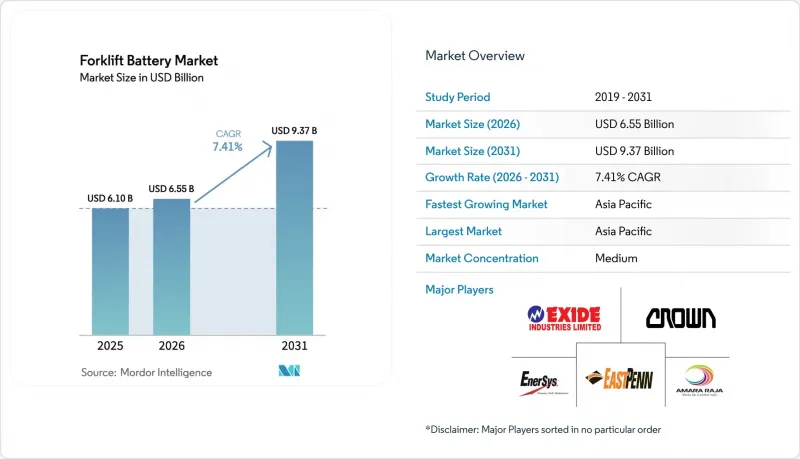
根據 Mordor Intelligence 預測,堆高機電池市場規模將從 2025 年的 61 億美元成長到 2026 年的 65.5 億美元,到 2031 年達到 93.7 億美元,在預測期(2026-2031 年)內,複合年預計成長率為 7.41%。
本報告按電池類型(鉛酸電池、鋰離子電池等)、電壓容量(低於24V、24V-36V等)、應用領域(倉儲物流、製造等)、銷售管道(OEM(目的地設備製造商)、售後市場)和地區進行細分。市場預測以美元(USD)計價。
全球堆高機電池市場趨勢及洞察
鋰離子電池成本更低,整體擁有成本更低
近年來,鋰離子電池組的平均價格顯著下降,隨著正極材料規模化生產和電芯到電池組的整合化技術的進步,預計價格還將進一步降低。磷酸鋰鐵(LFP)電池組的價格遠低於鎳錳鈷電池,目前已在全球電動車(EV)電池市場佔據相當大的佔有率,為堆高機買家帶來了顯著的規模經濟效益。由於無需供水、通風和專用電池室,與傳統的鉛酸電池系統相比,營運商可以顯著降低總營運成本。此外,鋰電池系統的再生煞車能量回收率高於鉛酸系統,從而降低了電力成本,尤其是在高負載作業環境下。成本優勢不僅限於電池組本身。例如,在封閉式工作環境中推廣使用電動設備已顯著降低了年度成本,這主要歸功於通風需求的減少。
電子商務和倉儲自動化領域的快速成長
隨著線上零售的快速發展,物流格局正發生翻天覆地的變化。隨著電子商務滲透市場,對額外倉儲空間的需求顯著成長。現代倉庫,尤其是那些主要採用多班次堆高機作業的倉庫,正在逐步轉向鋰離子電池。這些電池可以自動充電,且不存在電壓下降的風險。 Geekplus 為 JJCL 實施的低溫運輸自動化系統就是這一趨勢的典型例證,該系統顯著提高了儲存密度並提升了揀貨效率。此類機器人技術的進步對於縮短鋰離子電池升級的投資回收期至關重要。從傳統零售店向專業履約中心的轉變,大大增加了每美元銷售額所需的物流空間。這種變化推動了對密封、免維護電池化學成分的需求。由於許多托運人期望更快的交貨速度,對多班次運作模式的依賴也隨之激增。然而,鉛酸電池已無法滿足這種不斷成長的需求。
鋰離子電池回收基礎設施有限以及責任風險
歐洲電池法規規定了鈷、鋰和鎳的回收基準值,並設定了雄心勃勃的回收目標。然而,中國在全球電池回收市場的主導地位意味著歐洲和北美面臨本地回收設施有限的挑戰。由於缺乏閉合迴路網路,營運商被迫將廢棄電池組出口或掩埋,而供應商則面臨生產者延伸責任制(EPR)下的法律責任和不斷上漲的回收成本。回收設施中熱失控事故的增加也導致保險費上漲,如果沒有昂貴的消防設備升級,這將阻礙中型擁有者採用鋰電池。強制性的電池數位化護照要求材料可追溯性,這給缺乏先進IT系統的中小型供應商帶來了額外的成本。 Northvolt位於埃特的工廠在破產前就面臨低運轉率的問題,凸顯了鋰價下跌和高昂的人事費用對歐洲國內回收業務的影響。
細分市場分析
截至2025年,鉛酸電池將佔據堆高機電池市場70.21%的佔有率,這主要得益於其完善的服務體係以及與舊式充電器的兼容性。然而,鋰離子電池預計到2031年將以8.11%的複合年成長率成長,尤其是在多班次作業環境和冷庫等場所,因為其總擁有成本比鉛酸電池低約40%。固態電池系統仍處於試驗階段,而鎳氫電池技術仍屬於小眾市場,其電池組價格超過400美元/kWh。
鋰電池技術的興起得益於便利的改裝套件,其模組均通過了UL認證,可相容於豐田、海斯特、林德和永恆等品牌的卡車。相較之下,AGM電池和改良液態鉛酸電池(例如GS Yuasa公司的YBX9625)雖然循環壽命長,但目前在能量密度和快速充電能力方面仍不及鋰電池。
截至2025年,24-36V規格的堆高機電池佔了38.22%的市場佔有率,適用於單班制托盤搬運車和揀貨車。然而,預計到2031年,36-48V規格的堆高機電池將以8.28%的複合年成長率成長。目前,大型倉庫優先考慮扭力更大、提升速度更快的設備。此外,更高的電壓運作可以降低電阻損耗,並實現顯著的能量回收。
儘管單價轉換成本較高,但低溫運輸和食品服務車隊仍毫不猶豫地採用這些設備,因為他們優先考慮的是可靠的低溫性能和衛生密封的外殼。市場正逐步向更高電壓方向發展,原始設備製造商(OEM)發布的新產品也印證了這一點,例如EP北美公司推出的配備鋰電池組和車載充電功能的車型。
區域分析
預計到2025年,亞太地區將佔據堆高機電池市場46.34%的佔有率,並在2031年之前以7.89%的複合年成長率成長。這主要得益於中國在全球鋰離子電池產能中佔據主導地位,而印度也大規模投資興建超級工廠。業界領導企業寧德時代(CATL)為全球電動車和電網儲能提供大部分電池。這項優勢使得亞太地區的整合商能夠以遠低於歐美同行的價格提供堆高機電池組。為了響應日本雄心勃勃的碳中和目標,BSLBATT正在關鍵地區進行戰略佈局。
在歐洲市場,法規強制要求揭露碳足跡,並對回收材料的使用制定了標準。由於能源和人事費用高昂,歐洲電池製造商的定價遠高於中國同業。近期一家歐洲大型製造商的破產凸顯了該地區的金融風險。儘管德國正在投資建造大型卡車的充電基礎設施,但堆高機的充電設施仍然有限。這種短缺促使倉庫業者主導出擊,自費安裝充電樁。
加州的清潔車隊政策已成為北美地區的重要推手。在冷庫中,由於磷酸鋰鐵電池組在低溫環境下具有卓越的容量維持性能,其應用正在不斷擴大。這種轉變減少了對備用電池組的需求。關稅大幅提高了中國製造的電氣設備的到岸成本。因此,許多組裝製造商更換了供應商,轉而選擇來自韓國和日本的電芯。儘管前期投入成本高昂,但南美洲的未來發展前景廣闊。巴西的電子商務和阿根廷的採礦業正在推動鋰需求的激增。在中東,沙烏地阿拉伯的一個設施維修計畫凸顯了鋰電池在極端高溫和惡劣環境下的優異性能。
其他好處:
- Excel格式的市場預測(ME)表
- 3個月的分析師支持
目錄
第1章:引言
- 研究假設和市場定義
- 調查範圍
第2章:調查方法
第3章執行摘要
第4章 市場狀況
- 市場概覽
- 市場促進因素
- 電子商務和倉儲自動化蓬勃發展
- 鋰離子電池成本更低,整體擁有成本更低
- 更嚴格的零排放法規
- 低溫運輸和第三方物流的多班次需求
- 配備人工智慧的建築管理系統用於能源最佳化
- 透過電池即服務 (BaaS) 模式降低資本支出
- 市場限制因素
- 鋰離子電池回收的基礎設施不足和責任風險。
- 缺乏快速充電基礎設施
- 售後改裝中原廠保固的複雜性
- LFP正極前驅體的供應波動
- 價值供應鏈分析
- 監理情勢
- 技術展望
- 波特五力模型
第5章 市場規模與成長預測
- 依電池類型
- 鉛酸電池
- 鋰離子電池
- 鎳氫電池(NiMH)
- 其他(包括固態電池)
- 按電壓容量
- 低於24伏
- 24V~36V
- 36V~48V
- 48伏特或以上
- 透過使用
- 倉儲/物流
- 製造業
- 建造
- 礦業
- 零售和批發
- 其他
- 按銷售管道
- 目的地設備製造商 (OEM)
- 售後市場
- 按地區
- 北美洲
- 美國
- 加拿大
- 其他北美國家
- 南美洲
- 巴西
- 阿根廷
- 其他南美國家
- 歐洲
- 德國
- 英國
- 法國
- 義大利
- 西班牙
- 其他歐洲國家
- 亞太地區
- 中國
- 印度
- 日本
- 韓國
- 其他亞太國家
- 中東和非洲
- 阿拉伯聯合大公國
- 沙烏地阿拉伯
- 南非
- 土耳其
- 其他中東和非洲國家
- 北美洲
第6章 競爭情勢
- 市場集中度
- 策略趨勢
- 市佔率分析
- 公司簡介
- EnerSys
- East Penn Manufacturing Company
- Exide Industries Ltd.
- GS Yuasa International Ltd.
- Hoppecke
- Crown Equipment Corporation
- Trojan Battery Company, LLC.
- Flux Power
- Amara Raja Batteries Ltd.
- Zhejiang Narada Power Source Co., Ltd
- Saft Groupe SAS
- Storage Battery Systems
- BSL NEW ENERGY TECHNOLOGY CO., LTD
- MIDAC SpA
第7章 市場機會與未來展望
According to Mordor Intelligence, the forklift battery market size is expected to increase from USD 6.10 billion in 2025 to USD 6.55 billion in 2026 and is forecast to reach USD 9.37 billion by 2031, growing at a CAGR of 7.41% during the forecast period (2026-2031).
This report is Segmented by Battery Type (Lead-Acid, Lithium-Ion, and More), Voltage Capacity (Below 24V, 24V-36V, and More), Application (Warehousing and Distribution, Manufacturing, and More), Sales Channel (Original Equipment Manufacturer (OEM) and Aftermarket), and Geography. The Market Forecasts are Provided in Terms of Value (USD).
Global Forklift Battery Market Trends and Insights
Falling Li-ion Costs and TCO Advantage
Average prices for lithium-ion battery packs have significantly declined in recent years, with further reductions expected as advancements in cathode scaling and cell-to-pack integration continue. Lithium-iron-phosphate (LFP) packs, which are considerably cheaper than their nickel-manganese-cobalt counterparts, now dominate a substantial portion of global electric vehicle (EV) battery installations, offering forklift buyers notable economies of scale. By removing the need for watering labor, ventilation equipment, and dedicated battery rooms, operators can achieve significant reductions in total operating costs compared to traditional lead-acid systems. Additionally, regenerative braking in lithium systems recovers a higher percentage of energy than in lead-acid systems, resulting in lower electricity costs, particularly in high-throughput environments. The cost benefits extend beyond the battery packs themselves; for example, transitioning to electric equipment in enclosed operations has demonstrated substantial annual savings, primarily due to reduced ventilation requirements.
E-commerce and Warehouse-Automation Boom
As online retail surges, it's reshaping the distribution landscape. Every increase in e-commerce penetration drives significant demand for additional warehouse space. Modern warehouses, dominated by multi-shift forklift operations, are increasingly turning to lithium-ion batteries. These batteries allow for opportunity charging without the risk of voltage sag. Highlighting the trend, Geekplus' cold-chain automation for JJCL significantly increased storage density and boosted picking efficiency. Such robotic advancements are proving instrumental in hastening the payback period for lithium battery retrofits. The transition from traditional retail stores to specialized fulfillment hubs has greatly increased the distribution space required per sales dollar. This shift has intensified the demand for sealed, maintenance-free battery chemistries. With many shippers now anticipating faster delivery times, the reliance on multi-shift duty cycles has surged. However, lead-acid batteries are struggling to keep pace with this increased demand.
Limited Li-ion Recycling Infrastructure and Liability Risks
Europe's Battery Regulation mandates recycled-content thresholds for cobalt, lithium, and nickel, alongside ambitious collection targets. However, with China dominating global battery recycling, Europe and North America face challenges due to limited local facilities. The lack of closed-loop networks forces operators to export end-of-life packs or landfill them, exposing suppliers to extended producer responsibility liabilities and increased recycling costs. Rising thermal runaway incidents at recycling yards have also driven up insurance premiums, discouraging mid-size fleets from adopting lithium without costly fire-suppression upgrades. Mandatory digital battery passports will require material tracing, adding costs for smaller suppliers without advanced IT systems. Northvolt's Ett plant, which struggled with low utilization before insolvency, highlights the impact of declining lithium prices and high labor costs on Europe's domestic recycling efforts.
Other drivers and restraints analyzed in the detailed report include:
- Stricter Zero-Emission Regulations
- Cold-Chain and 3PL Multi-Shift Demand
- Sparse Fast-Charging Infrastructure
For complete list of drivers and restraints, kindly check the Table Of Contents.
Segment Analysis
Lead-acid batteries accounted for 70.21% of the forklift battery market share in 2025, mainly due to entrenched service ecosystems and compatibility with legacy chargers. Still, lithium-ion units are projected to grow at an 8.11% CAGR through 2031, as total ownership costs drop by about 40% below those of lead-acid, especially in multi-shift and cold-storage sites. While solid-state systems are still in the experimental phase, nickel-metal-hydride technology remains a niche player, with pack prices exceeding USD 400/kWh.
The rise of lithium technology is supported by the introduction of user-friendly retrofit kits. For example, BSLBATT launched a drop-in series featuring UL-certified modules compatible with trucks from brands such as Toyota, Hyster, Linde, and Jungheinrich. In contrast, AGM and enhanced-flooded lead-acid variants, like GS Yuasa's YBX9625, offer extended cycle life but cannot match lithium's superior energy density and rapid charging capabilities.
The 24-36V class owned 38.22% of the forklift battery market share in 2025, suitable for single-shift pallet trucks and order pickers. Yet 36-48V solutions will expand at an 8.28% CAGR through 2031. Heavy-duty warehouses are now prioritizing equipment that offers significantly higher torque and faster lifts. Additionally, operating at a higher voltage reduces resistive losses, enabling notable energy recuperation.
Despite substantial conversion costs per truck, cold-chain and food-service fleets remain undeterred, emphasizing the need for reliable low-temperature performance and hygienically sealed housings. The market's gradual shift towards higher voltage is evident in OEM launches, such as EP North America's model featuring a lithium pack and onboard charging.
Geography Analysis
Asia-Pacific captured 46.34% of the forklift battery market share in 2025 and is on course for a 7.89% CAGR through 2031, as China dominates the global lithium-ion cell capacity with a significant share, while India has made substantial commitments to gigafactories . CATL, a major player, supplies a large portion of the world's EV and grid-storage batteries. This dominance allows regional integrators to price forklift packs significantly lower than their Western counterparts. In line with Japan's ambitious goal of carbon neutrality, BSLBATT has strategically opened hubs in key locations .
Europe's market is under the purview of regulations mandating carbon-footprint disclosures and setting recycled-content benchmarks. Due to higher energy and labor costs, European cell manufacturers are considerably pricier than their Chinese counterparts. The recent bankruptcy of a major European manufacturer underscores the financial risks in the region. While Germany invests in charging infrastructure for heavy trucks, facilities for forklifts remain limited. This scarcity has led warehouse operators to take the initiative, self-financing their own chargers.
California's clean fleet policies are pivotal drivers in North America. Cold-storage facilities are increasingly adopting LFP packs, reaping benefits from their superior low-temperature capacity retention. This transition diminishes the need for redundant battery sets. Tariffs led to a notable surge in the landed cost of Chinese electrical gear. Consequently, many assemblers shifted their sourcing, now opting for cells from Korea or Japan. Despite high capital costs, South America shows promise: Brazil's e-commerce and Argentina's mining sectors are driving a burgeoning demand for lithium. In the Middle East, Saudi Arabia's retrofitting initiatives highlighted lithium's capabilities in extreme heat and challenging conditions.
- EnerSys
- East Penn Manufacturing Company
- Exide Industries Ltd.
- GS Yuasa International Ltd.
- Hoppecke
- Crown Equipment Corporation
- Trojan Battery Company, LLC.
- Flux Power
- Amara Raja Batteries Ltd.
- Zhejiang Narada Power Source Co., Ltd
- Saft Groupe SAS
- Storage Battery Systems
- BSL NEW ENERGY TECHNOLOGY CO., LTD
- MIDAC S.p.A.
Additional Benefits:
- The market estimate (ME) sheet in Excel format
- 3 months of analyst support
TABLE OF CONTENTS
1 Introduction
- 1.1 Study Assumptions and Market Definition
- 1.2 Scope of the Study
2 Research Methodology
3 Executive Summary
4 Market Landscape
- 4.1 Market Overview
- 4.2 Market Drivers
- 4.2.1 E-Commerce and Warehouse-Automation Boom
- 4.2.2 Falling Li-Ion Costs and TCO Advantage
- 4.2.3 Stricter Zero-Emission Regulations
- 4.2.4 Cold-Chain and 3PL Multi-Shift Demand
- 4.2.5 AI-Enabled BMS For Energy Optimization
- 4.2.6 Battery-as-a-Service Models Lowering Capex
- 4.3 Market Restraints
- 4.3.1 Limited Li-ion Recycling Infrastructure and Liability Risks
- 4.3.2 Sparse Fast-Charging Infrastructure
- 4.3.3 OEM-Warranty Complexity on Retrofits
- 4.3.4 LFP-Cathode Precursor Supply Volatility
- 4.4 Value / Supply-Chain Analysis
- 4.5 Regulatory Landscape
- 4.6 Technological Outlook
- 4.7 Porter's Five Forces
- 4.7.1 Threat of New Entrants
- 4.7.2 Bargaining Power of Suppliers
- 4.7.3 Bargaining Power of Buyers
- 4.7.4 Threat of Substitutes
- 4.7.5 Competitive Rivalry
5 Market Size and Growth Forecasts (Value in USD)
- 5.1 By Battery Type
- 5.1.1 Lead-Acid Batteries
- 5.1.2 Lithium-Ion Batteries
- 5.1.3 Nickel-Metal Hydride (NiMH)
- 5.1.4 Others (incl. Solid-State)
- 5.2 By Voltage Capacity
- 5.2.1 Below 24V
- 5.2.2 24V - 36V
- 5.2.3 36V - 48V
- 5.2.4 Above 48V
- 5.3 By Application
- 5.3.1 Warehousing and Distribution
- 5.3.2 Manufacturing
- 5.3.3 Construction
- 5.3.4 Mining
- 5.3.5 Retail and Wholesale
- 5.3.6 Others
- 5.4 By Sales Channel
- 5.4.1 Original Equipment Manufacturer (OEM)
- 5.4.2 Aftermarket
- 5.5 By Geography
- 5.5.1 North America
- 5.5.1.1 United States
- 5.5.1.2 Canada
- 5.5.1.3 Rest of North America
- 5.5.2 South America
- 5.5.2.1 Brazil
- 5.5.2.2 Argentina
- 5.5.2.3 Rest of South America
- 5.5.3 Europe
- 5.5.3.1 Germany
- 5.5.3.2 United Kingdom
- 5.5.3.3 France
- 5.5.3.4 Italy
- 5.5.3.5 Spain
- 5.5.3.6 Rest of Europe
- 5.5.4 Asia-Pacific
- 5.5.4.1 China
- 5.5.4.2 India
- 5.5.4.3 Japan
- 5.5.4.4 South Korea
- 5.5.4.5 Rest of Asia-Pacific
- 5.5.5 Middle East and Africa
- 5.5.5.1 United Arab Emirates
- 5.5.5.2 Saudi Arabia
- 5.5.5.3 South Africa
- 5.5.5.4 Turkey
- 5.5.5.5 Rest of Middle East and Africa
- 5.5.1 North America
6 Competitive Landscape
- 6.1 Market Concentration
- 6.2 Strategic Moves
- 6.3 Market Share Analysis
- 6.4 Company Profiles {(Includes Global level Overview, Market level overview, Core Segments, Financials as available, Strategic Information, Market Rank/Share for key companies, Products and Services, and Recent Developments)}
- 6.4.1 EnerSys
- 6.4.2 East Penn Manufacturing Company
- 6.4.3 Exide Industries Ltd.
- 6.4.4 GS Yuasa International Ltd.
- 6.4.5 Hoppecke
- 6.4.6 Crown Equipment Corporation
- 6.4.7 Trojan Battery Company, LLC.
- 6.4.8 Flux Power
- 6.4.9 Amara Raja Batteries Ltd.
- 6.4.10 Zhejiang Narada Power Source Co., Ltd
- 6.4.11 Saft Groupe SAS
- 6.4.12 Storage Battery Systems
- 6.4.13 BSL NEW ENERGY TECHNOLOGY CO., LTD
- 6.4.14 MIDAC S.p.A.
7 Market Opportunities and Future Outlook
- 7.1 White-space and Unmet-need Assessment


