


 |
市場調查報告書
商品編碼
2061694
油氣蓄能器:市場佔有率分析、產業趨勢與統計及成長預測(2026-2031 年)Oil And Gas Accumulator - Market Share Analysis, Industry Trends & Statistics, Growth Forecasts (2026 - 2031) |
||||||

※ 本網頁內容可能與最新版本有所差異。詳細情況請與我們聯繫。
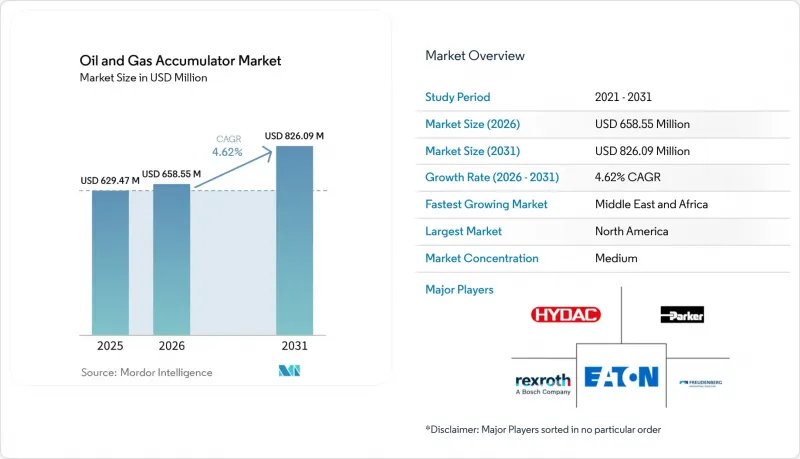
根據 Mordor Intelligence 預測,石油和天然氣蓄能器市場規模將從 2025 年的 6.2947 億美元成長到 2026 年的 6.5855 億美元,到 2031 年將達到 8.2609 億美元,2026 年至 2031 年的複合年成長率為 4.62%。
本報告按蓄能器類型(囊式、金屬波紋管式等)、耐壓等級(小於3000 PSI等)、容量(小於10加侖等)、安裝位置(陸上和海上)、應用領域(鑽井等)以及地區(北美、歐洲、亞太、南美、中東和非洲)進行細分。市場預測以美元計價。
全球油氣蓄能器市場趨勢與洞察
全球海上開採鑽機數量增加。
2024年,海上運作中鑽機數量達639座,運轉率恢復至82%。這加速了驅動高規格控壓鑽井系統的蓄壓器組的更換和升級週期。目前,船隊投資優先考慮現有鑽機的升級改造而非新建,這推動了對能夠延長使用壽命並提高防噴器操作速度的先進液壓儲能系統的需求。預計2025年至2028年深海工程將以每年8%的速度成長,這將繼續推動油氣蓄能器市場邁向更高的壓力和溫度閾值。 2025年至2026年拉丁美洲和西非浮體式鑽機的訂單將進一步擴大高階蓄能器組件的潛在市場機會。
嚴格的防噴器安全標準(API 16D)
API 16D 標準規定了關鍵防噴器 (BOP) 蓄能器的最小容量、預充壓力和反應時間標準,迫使業者採用具有冗餘組的大容量蓄能器。監管審計現在更加重視遠程操作車輛(ROV) 的介入以及第三方重新認證的準備情況,並敦促升級到優先採用金屬波紋管和能夠承受 20,000 psi 工作壓力的活塞設計的規範。持續的合規週期為提供檢驗、測試和充填服務的原始設備製造商 (OEM) 服務部門帶來了持續的收入。
原油價格波動正在抑制鑽探預算。
不穩定的商品價格促使業者延長設備使用壽命,延後蓄壓器升級,並優先選擇延壽套件而非整體更換。儘管市場活動本身保持穩定,但價格下跌減少了用於升級高品質液壓系統的可支配支出,對供應商的短期收入成長帶來壓力。
細分市場分析
預計到2025年,囊式油氣蓄能器市場仍將保持最大佔有率,佔據47.25%的市場佔有率,這主要得益於其成熟的供應鏈和易於維護等優勢。然而,金屬波紋管蓄能器在20,000 psi的壓力下運作具有卓越的抗疲勞性能,例如在雪佛龍的安克油田,預計其複合年成長率將達到5.72%,成為成長最快的市場。
此外,金屬波紋管結構能夠承受酸性氣體環境而不導致彈性體劣化,因此預計該領域在高壓高溫(HPHT)環境下將實現長期成長。活塞式和隔膜式蓄壓器在需要精確容積控制和流體分離的特定迴路中仍然發揮作用,而彈簧式蓄能器則用於安裝空間有限的老式鑽井平台。在油氣蓄能器產業,模組化平台(僅允許更換內部元件而非整個容器)正日益受到青睞,這種成本節約趨勢對柔軟性的OEM製造商來說十分有利。
到2025年,額定壓力低於3000 psi的系統將佔據54.45%的市場佔有率,這主要歸功於陸上鑽井的普及。隨著美國墨西哥灣和巴西深水及超深水井數量的增加,額定壓力超過5000 psi的型號預計將實現6.27%的複合年成長率。
高壓產品需要鍛造合金外殼、更嚴格的焊接工藝和先進的無損檢測 (NDT) 技術,這會增加單位成本,但隨著容量的增加,船舶總數會減少。同時,壓力範圍在 3,001 至 5,000 psi 的中型蓄壓器正被廣泛應用於淺海油田改造專案中,營運商擴大選擇維修老舊平台,而不是新建設。油氣蓄能器市場正持續向高壓型號轉型,這些型號可以跨多個鑽井平台進行標準化,從而簡化物流。
區域分析
北美地區持續保持銷售領先地位,預計2025年將佔總收入的37.15%,主要得益於頁岩氣井的持續改造和海上油氣開發的謹慎復甦。該地區越來越重視資本效率和電壓裂設備的採用,從而帶動了對整合即時雲端分析功能的緊湊型、數位化監控蓄能器的強勁需求。阿根廷和巴西的上游開發商也透過需要20,000 psi解決方案的海底採油樹的訂單實現了進一步成長。
預計到2031年,中東和非洲油氣蓄能器市場將以6.08%的最高複合年成長率成長。大規模鑽井平台鑽機暫時訂單,但阿布達比國家石油公司(ADNOC)升降式鑽機的擴張以及奈米比亞和安哥拉近海油氣開發的前景,仍在推動這一成長勢頭。此外,區域在地採購義務促使原始設備製造商(OEM)將組裝和服務設施本地化,從而縮短前置作業時間並創建新的合資企業結構。
在歐洲和亞太地區,設備主導的需求持續穩定。歐洲北海業者正在維修老舊鑽機,以符合新的環保法規,並在現有撬裝設備上加裝感測器和防漏波紋管。以中國和印尼為首的亞太地區上游資本投資預計到2025年將超過3000億美元,這將支撐中壓裝置的新訂單,這些裝置適用於現有設施的延壽項目。同時,北海地區二氧化碳儲存試點計畫的增加,使得儲存裝置在二氧化碳注入系統中扮演新的角色,為耐腐蝕設計開闢了一個互補的市場。
其他好處:
- Excel格式的市場預測(ME)表
- 3個月的分析師支持
目錄
第1章:引言
- 研究假設和市場定義
- 調查範圍
第2章:調查方法
第3章執行摘要
第4章 市場狀況
- 市場概覽
- 市場促進因素
- 全球海上鑽油平臺的數量正在增加。
- 嚴格的防噴器安全標準(API 16D)
- 頁岩油井完井數量的快速成長
- 中東和北非(MENA)地區酸性天然氣專案資本投資的回收
- 低排放量電液單元維修計劃
- 數位雙胞胎能夠實現預測性維護。
- 市場限制因素
- 原油價格波動限制了鑽探預算。
- 重新認證和ASME合規成本高昂
- 向全電動海底防噴器的過渡正在減少液壓系統的應用範圍。
- 環境、社會及公司治理(ESG)對液壓油洩漏風險的影響
- 供應鏈分析
- 監理情勢
- 技術展望
- 波特五力模型
第5章 市場規模與成長預測
- 蓄能器類型
- 膀胱
- 活塞
- 隔膜
- 金屬風箱
- 彈簧和其他
- 耐壓等級
- 小於3000磅/平方英寸
- 3,001~5,000 psi
- 超過5000磅/平方英寸
- 按產能
- 少於10加侖
- 10-50加侖
- 50加侖或更多
- 按部署位置
- 陸上
- 離岸
- 透過使用
- 挖掘
- 油井維修和乾預
- 防噴裝置控制單元
- 水力壓裂裝置
- 其他上游業務
- 按地區
- 北美洲
- 美國
- 加拿大
- 墨西哥
- 歐洲
- 德國
- 英國
- 義大利
- 挪威
- 俄羅斯
- 其他歐洲國家
- 亞太地區
- 中國
- 印度
- 日本
- 韓國
- 東南亞國協
- 其他亞太國家
- 南美洲
- 巴西
- 阿根廷
- 其他南美國家
- 中東和非洲
- 沙烏地阿拉伯
- 阿拉伯聯合大公國
- 卡達
- 南非
- 埃及
- 奈及利亞
- 其他非洲國家
- 北美洲
第6章 競爭情勢
- 市場集中度
- 策略趨勢(併購、聯盟、購電協議)
- 市場佔有率分析(主要公司的市場排名和佔有率)
- 公司簡介
- HYDAC International GmbH
- Parker-Hannifin Corp.
- Eaton Corporation plc
- Freudenberg Sealing Technologies(Tobul)
- Bosch Rexroth AG
- Nippon Accumulator Co., Ltd.
- Roth Industries LLC
- Technetics Group
- Continental Hydraulics Inc.
- Olaer Group
- Accumulators Inc.
- Hydrotechnik GmbH
- Blacoh Fluid Control
- Rotec Hydraulics Ltd.
- Eaton Filtration LLC
- Bosch Auto Accumulator Systems
- Kawasaki Hydraulics
- KYB Corporation
- Danfoss Power Solutions
- Hallite Seals International
第7章 市場機會與未來展望
According to Mordor Intelligence, the oil and gas accumulator market size is expected to grow from USD 629.47 million in 2025 to USD 658.55 million in 2026 and is forecast to reach USD 826.09 million by 2031 at 4.62% CAGR over 2026-2031.
This report is Segmented by Accumulator Type (Bladder, Metal Bellows, and More), Pressure Rating (Below 3, 000 Psi, and More), Capacity (Below 10 Gal, and More), Location of Deployment (Onshore and Offshore), Application (Drilling, and More), and Geography (North America, Europe, Asia-Pacific, South America, and Middle East and Africa). The Market Forecasts are Provided in Terms of Value (USD).
Global Oil And Gas Accumulator Market Trends and Insights
Up-cycle in Global Offshore Rig Count
Offshore rig utilisation rebounded to 82% in 2024 with 639 active units, stimulating replacement and upgrade cycles for accumulator banks that power high-spec managed-pressure drilling systems. Fleet investment now favours upgrading existing rigs over newbuilds, extending service lifetimes, and raising demand for advanced hydraulic storage capable of faster BOP actuation. Deepwater projects, forecasted to grow at 8% annually from 2025 to 2028, will continue to push the oil & gas accumulator market toward higher pressure and temperature thresholds. Floating rig awards in Latin America and West Africa, scheduled for 2025-2026, further enlarge the addressable opportunity for premium accumulator packages.
Stringent BOP Safety Mandates (API 16D)
API 16D sets minimum accumulator volume, pre-charge, and response time criteria for critical BOP functions, compelling operators to adopt high-capacity units with redundant banks. Regulatory audits now emphasize the readiness of remote-operated vehicle intervention and third-party recertification, prompting specification upgrades that favor metal bellows and piston designs rated for 20,000 psi service. Ongoing compliance cycles generate repeat revenue for OEM service divisions that supply inspection, testing, and recharge programs.
Oil-Price Volatility Curbing Drilling Budgets
Erratic commodity prices encourage operators to stretch equipment life, delaying accumulator renewals and favouring service-life extension kits over full replacements. While activity remains steady, discretionary spend on premium hydraulic upgrades contracts during price dips, tightening near-term revenue growth for suppliers.
Other drivers and restraints analyzed in the detailed report include:
- Surging Shale Well Recompletions
- CAPEX Rebound in MENA Sour-Gas Projects
- High Recertification & ASME Code Compliance Costs
For complete list of drivers and restraints, kindly check the Table Of Contents.
Segment Analysis
The oil & gas accumulator market size for bladder designs remained the largest in 2025, capturing a 47.25% share due to the strength of a mature supply chain and ease of maintenance. However, metal bellows units are set to record the fastest 5.72% CAGR, thanks to their superior fatigue resistance at 20,000 psi deployments, such as Chevron's Anchor field.
Metal bellows construction also tolerates sour-gas environments without elastomer degradation, positioning the segment for long-term growth in deep-HPHT projects. Piston and diaphragm types retain roles in niche circuits where precise volume control or fluid separation is crucial, while spring accumulators serve legacy rigs with compact space envelopes. The oil & gas accumulator industry increasingly favours modular platforms that allow operators to swap internal elements rather than replacing complete vessels, a cost-saving trend benefiting flexible OEMs.
Systems rated below 3,000 psi held a 54.45% share in 2025, primarily due to the widespread adoption of onshore drilling. Above 5,000 psi models are expected to log a 6.27% CAGR as deepwater and ultra-deepwater wells proliferate across the US Gulf and Brazil.
Higher ratings demand forged alloy shells, stricter welding procedures, and advanced NDT, driving unit prices upward but reducing total vessel count through increased capacity. At the same time, intermediate units with pressures of 3,001-5,000 psi serve proliferating shallow-water redevelopment projects, where operators upgrade aging platforms rather than sanction greenfield builds. The oil & gas accumulator market continues to pivot toward high-pressure variants that can be standardised across multiple rig classes to simplify logistics.
Geography Analysis
North America retained a 37.15% revenue lead in 2025 owing to sustained shale recompletion and a cautious offshore revival. The region's emphasis on capital efficiency and adoption of electric fracturing fleets keeps demand steady for compact, digitally monitored accumulators that integrate with real-time cloud analytics. Upstream developers in Argentina and Brazil are adding incremental growth through subsea tree awards, which require 20,000 psi solutions.
The Middle East & Africa oil & gas accumulator market size is expected to register the highest CAGR of 6.08% through 2031. Massive sour-gas projects such as Jafurah, with compression trains and thousands of kilometres of pipeline, need large-volume vessels rated for H2S service. ADNOC's rig expansion and subsea prospects off Namibia and Angola reinforce the trajectory despite temporary jack-up cancellations. Regional content mandates also motivate OEMs to localise assembly and service hubs, reducing lead times and creating new joint-venture structures.
Europe and the Asia-Pacific exhibit stable replacement-driven demand. European North Sea operators retrofit ageing rigs to meet new environmental regulations, adding sensors and leak-proof bellows to existing skids. Asia-Pacific's upstream capex, led by China and Indonesia, tops USD 300 billion in 2025 and underpins fresh orders for medium-pressure units suited to brownfield life-extension projects. Meanwhile, the growing number of carbon-storage pilots across the North Sea introduces novel accumulator roles in CO2 injection systems, opening a complementary market for corrosion-resistant designs.
- HYDAC International GmbH
- Parker-Hannifin Corp.
- Eaton Corporation plc
- Freudenberg Sealing Technologies (Tobul)
- Bosch Rexroth AG
- Nippon Accumulator Co., Ltd.
- Roth Industries LLC
- Technetics Group
- Continental Hydraulics Inc.
- Olaer Group
- Accumulators Inc.
- Hydrotechnik GmbH
- Blacoh Fluid Control
- Rotec Hydraulics Ltd.
- Eaton Filtration LLC
- Bosch Auto Accumulator Systems
- Kawasaki Hydraulics
- KYB Corporation
- Danfoss Power Solutions
- Hallite Seals International
Additional Benefits:
- The market estimate (ME) sheet in Excel format
- 3 months of analyst support
TABLE OF CONTENTS
1 Introduction
- 1.1 Study Assumptions & Market Definition
- 1.2 Scope of the Study
2 Research Methodology
3 Executive Summary
4 Market Landscape
- 4.1 Market Overview
- 4.2 Market Drivers
- 4.2.1 Up-cycle in global offshore rig count
- 4.2.2 Stringent BOP safety mandates (API 16D)
- 4.2.3 Surging shale well recompletions
- 4.2.4 CAPEX rebound in MENA sour-gas projects
- 4.2.5 Retrofit programmes for low-emission electro-hydraulic units
- 4.2.6 Digital twins enabling predictive accumulator maintenance
- 4.3 Market Restraints
- 4.3.1 Oil-price volatility curbing drilling budgets
- 4.3.2 igh re-certification & ASME code compliance costs
- 4.3.3 Shift toward all-electric subsea BOPs reducing hydraulic scope
- 4.3.4 ESG pressure on hydraulic-fluid spill risk
- 4.4 Supply-Chain Analysis
- 4.5 Regulatory Landscape
- 4.6 Technological Outlook
- 4.7 Porter's Five Forces
- 4.7.1 Bargaining Power of Suppliers
- 4.7.2 Bargaining Power of Buyers
- 4.7.3 Threat of New Entrants
- 4.7.4 Threat of Substitutes
- 4.7.5 Competitive Rivalry
5 Market Size & Growth Forecasts
- 5.1 By Accumulator Type
- 5.1.1 Bladder
- 5.1.2 Piston
- 5.1.3 Diaphragm
- 5.1.4 Metal Bellows
- 5.1.5 Spring and Others
- 5.2 By Pressure Rating
- 5.2.1 Below 3,000 psi
- 5.2.2 3,001 to 5,000 psi
- 5.2.3 Above 5,000 psi
- 5.3 By Capacity
- 5.3.1 Below 10 gal
- 5.3.2 10 to 50 gal
- 5.3.3 Above 50 gal
- 5.4 By Location of Deployment
- 5.4.1 Onshore
- 5.4.2 Offshore
- 5.5 By Application
- 5.5.1 Drilling
- 5.5.2 Well Workover and Intervention
- 5.5.3 Blowout Preventer Control Units
- 5.5.4 Hydraulic Fracturing Units
- 5.5.5 Other Upstream Operations
- 5.6 By Geography
- 5.6.1 North America
- 5.6.1.1 United States
- 5.6.1.2 Canada
- 5.6.1.3 Mexico
- 5.6.2 Europe
- 5.6.2.1 Germany
- 5.6.2.2 United Kingdom
- 5.6.2.3 Italy
- 5.6.2.4 Norway
- 5.6.2.5 Russia
- 5.6.2.6 Rest of Europe
- 5.6.3 Asia-Pacific
- 5.6.3.1 China
- 5.6.3.2 India
- 5.6.3.3 Japan
- 5.6.3.4 South Korea
- 5.6.3.5 ASEAN Countries
- 5.6.3.6 Rest of Asia-Pacific
- 5.6.4 South America
- 5.6.4.1 Brazil
- 5.6.4.2 Argentina
- 5.6.4.3 Rest of South America
- 5.6.5 Middle East and Africa
- 5.6.5.1 Saudi Arabia
- 5.6.5.2 United Arab Emirates
- 5.6.5.3 Qatar
- 5.6.5.4 South Africa
- 5.6.5.5 Egypt
- 5.6.5.6 Nigeria
- 5.6.5.7 Rest of Africa
- 5.6.1 North America
6 Competitive Landscape
- 6.1 Market Concentration
- 6.2 Strategic Moves (M&A, Partnerships, PPAs)
- 6.3 Market Share Analysis (Market Rank/Share for key companies)
- 6.4 Company Profiles (includes Global level Overview, Market level overview, Core Segments, Financials as available, Strategic Information, Products & Services, and Recent Developments)
- 6.4.1 HYDAC International GmbH
- 6.4.2 Parker-Hannifin Corp.
- 6.4.3 Eaton Corporation plc
- 6.4.4 Freudenberg Sealing Technologies (Tobul)
- 6.4.5 Bosch Rexroth AG
- 6.4.6 Nippon Accumulator Co., Ltd.
- 6.4.7 Roth Industries LLC
- 6.4.8 Technetics Group
- 6.4.9 Continental Hydraulics Inc.
- 6.4.10 Olaer Group
- 6.4.11 Accumulators Inc.
- 6.4.12 Hydrotechnik GmbH
- 6.4.13 Blacoh Fluid Control
- 6.4.14 Rotec Hydraulics Ltd.
- 6.4.15 Eaton Filtration LLC
- 6.4.16 Bosch Auto Accumulator Systems
- 6.4.17 Kawasaki Hydraulics
- 6.4.18 KYB Corporation
- 6.4.19 Danfoss Power Solutions
- 6.4.20 Hallite Seals International
7 Market Opportunities & Future Outlook
- 7.1 White-space & Unmet-Need Assessment

 煞車蓄壓器市場規模、佔有率和成長分析:按產品類型、車輛類型、應用、最終用戶、銷售管道和地區分類-2026-2033年產業預測
 油氣蓄能器市場-全球產業規模、佔有率、趨勢、機會、預測:按類型、應用、部署、地區和競爭格局分類,2021-2031年
 汽車液體蓄壓器市場:按類型、材質、容量、車輛類型、應用、銷售管道和地區分類船用蓄壓器市場:按類型、應用和地區分類
 油氣蓄能器市場報告:按類型、安裝位置、應用和地區分類(2026-2034 年)
 電池充電器市場:2026-2032年全球市場預測(按電池類型、充電技術、輸出範圍、應用、銷售管道和最終用戶分類)電動車電池市場:全球市場按產品類型、容量、電壓和應用分類的預測-2026-2032年蓄能器市場:按類型、排放壓力範圍、工作模式、終端用戶產業和銷售管道,全球預測,2026-2032年
 2026年全球油蓄能器市場報告
 儲液囊市場 - 2026-2031年預測