


 |
市場調查報告書
商品編碼
2061647
工業紡織品:市場佔有率分析、產業趨勢與統計、成長預測(2026-2031)Industrial Fabric - Market Share Analysis, Industry Trends & Statistics, Growth Forecasts (2026 - 2031) |
||||||

※ 本網頁內容可能與最新版本有所差異。詳細情況請與我們聯繫。
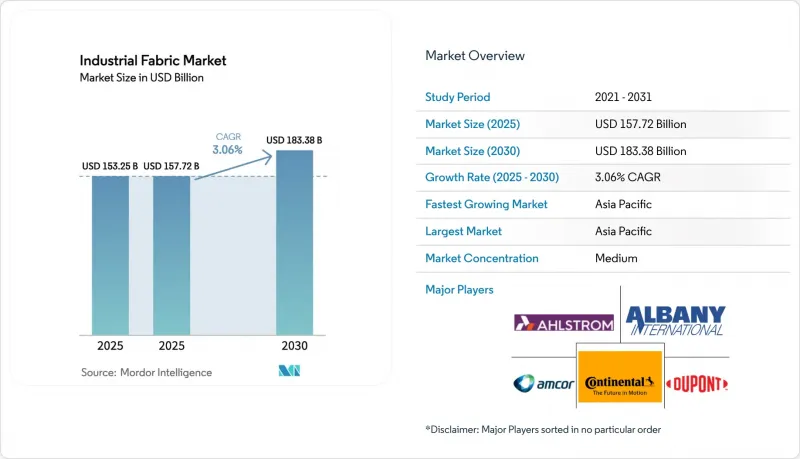
據 Mordor Intelligence 稱,2025 年工業紡織品市場價值為 1532.5 億美元,預計在預測期(2025-2030 年)內將以 3.06% 的複合年成長率成長,從 2025 年的 1577.2 億美元成長到 2030 億美元。
本報告按纖維類型(玻璃纖維紗、聚醯胺、聚酯等)、織物結構(機織織物、不織布等)、應用領域(汽車內裝、輸送機等)、終端用戶產業(汽車及運輸、採礦及物料搬運等)及地區(亞太地區、北美地區等)進行細分。市場預測以美元計價。
全球工業紡織品市場趨勢與洞察
物流對輸送機和傳動皮帶的需求增加
全球電商履約中心正經歷創紀錄的每日訂單量,促使輸送機的運轉率大幅提升。需求的激增推動了亞太地區大型倉庫前所未有的輸送帶部署。在智利丘基卡馬塔銅礦,克維拉增強型輸送帶比鋼絲輸送帶更輕、更節能,且使用壽命更長。大陸集團的「CONTIFLEX」系列輸送帶採用聚酯和尼龍混紡布料,具有寬幅和高抗張強度,在煤炭運輸中展現出極高的可靠性。森佩瑞特公司的「Transoil」系列輸送帶具有耐油性和符合美國食品藥物管理局(FDA)標準的特性,在食品和化學企業中越來越受歡迎。同時,亞洲宅配樞紐的大規模資本投資計畫也推動了工業布料市場的發展。
促進陸上和離岸風力發電機葉片基礎設施建設
GE Vernova 引擎的葉片大量採用玻璃纖維和碳纖維,導致材料需求激增,並佔據了全球 E 玻璃纖維產量的很大一部分。混合層壓工藝,即在葉尖蓋中使用碳纖維,在葉殼中使用玻璃纖維,實現了減重,提高了輪轂高度,並提升了年發電量。透過感應焊接將熱塑性根部與鋼製嵌件連接起來,無需進行黏合劑測試,並縮短了組裝時間。此外,在後緣策略性地使用玄武岩纖維和醯胺纖維,旨在增強承受數百萬次載荷循環的關鍵疲勞區域的性能。
石化原料價格波動
2026年2月,東北亞石腦油價格飆升至超過中東基準價格的水平。這次價格上漲,加上對苯二甲酸單丁酯(PTA)價格未能跟上原油價格波動的步伐,擠壓了聚酯短纖維的利潤空間。 2025年中期PTA價格的下跌降低了中國工廠的利潤,使其低於五年平均值。同時,地緣政治緊張局勢限制了海灣國家的石腦油出口,迫使亞洲買家以更高的價格購買歐洲石腦油。此外,隨著價格差距的縮小,印度和印尼的中小型工廠將降低織布機運轉率,從而抑制短期纖維需求。
細分市場分析
憑藉其高抗張強度和分解溫度閾值,芳香聚醯胺預計在2026年至2031年的預測期內將以5.89%的複合年成長率成長。這些特性不僅符合NFPA 2112防閃燃防護衣標準,也使其成為鋼絲腰帶的理想替代品。在智利銅礦,克維拉腰帶的採用降低了能耗並延長了使用壽命,從而顯著降低了總擁有成本(TCO)。此外,特瓦隆(Twaron)的輕質特性正被應用於汽車增強材料和葉片後緣的減重。
聚酯纖維憑藉其價格優勢和中國強大的生產能力,預計到2025年將佔據工業用織物市場39.22%的佔有率。聚醯胺纖維在高模量應用領域(例如安全氣囊)找到了利基市場,而玻璃纖維則被用於風力發電機葉片外殼。此外,新興的PEN纖維因其高玻璃化轉變溫度而聞名,在電容器薄膜應用領域也正在擴大市場佔有率。
到2025年,機織織物將佔工業織物市場的45.28%,預計在2026年至2031年的預測期內將以4.21%的複合年成長率成長。這一成長主要得益於多軸無捻(NCF)織物,這種織物不僅減少了樹脂用量,還提高了剛性。 SAERTEX的無捻(NCF)織物已成為翼梁帽的首選材料,而大陸集團的Plylon Plus皮帶則採用雙斜紋編織,具有優異的抗撕裂性和卓越的拉伸強度。
由於ISO 8級不織布在超級工廠的牆體和工作服中發揮著至關重要的作用,不織布在銷售中佔據了很大的佔有率。熔噴聚丙烯因其對亞微米顆粒的高捕獲率而成為外科口罩的黃金標準,其價格高於紡粘產品。針織物市場佔有率較小,其彈性優勢使其適用於座椅套,但其拉伸強度不如梭織物。
區域分析
到2025年,亞太地區將佔據工業用織物市場41.14%的主導佔有率,預計在2026年至2031年的預測期內將以5.67%的複合年成長率成長。中國作為全球供應鏈的基石,其聚酯短纖維產能為該地區的成本成長提供了強大的支撐。 2025年,六個千兆級項目運作,進一步增強了原料的穩定供應。恆益、同坤和中石化等公司正在拓展業務範圍,增加安全氣囊和不織布的生產線,凸顯了該地區向特種產品轉型的趨勢。
北美和歐洲佔據了相當大的需求佔有率,同時也佔據著至關重要的戰略位置。維吉尼亞、密西根州和德國的電池超級工廠需要符合 ISO 8 標準的無塵室,因此消耗大量的不織布面板,這印證了上述觀點。杜邦公司的Tyvek 400 Dual TG連身工作服符合 EN 1149-5 防靜電標準,專為鋰電池處理區域設計。此外,大眾汽車位於薩爾茨吉特的工廠正在擴大電池產能,因此對乾燥室用織物也有顯著的需求。
在南美洲,智利和秘魯的採礦活動推動了可觀的收入成長。這些礦場使用克維拉纖維帶降低能耗並延長使用壽命,進一步促進了這一趨勢。在中東和非洲,市場貢獻巨大,沙烏地阿美和阿布達比國家石油公司(ADNOC)制定了芳香聚醯胺軟管和海洋地工織物的相關規範,重點關注其抗紫外線性能。此外,南非的鉑金礦和煤礦每年對纖維帶的需求量超過數百萬條,進一步推動了聚酯纖維織物的消費。
其他好處:
- Excel格式的市場預測(ME)表
- 3個月的分析師支持
目錄
第1章:引言
- 研究假設和市場定義
- 調查範圍
第2章:調查方法
第3章執行摘要
第4章 市場狀況
- 市場概覽
- 市場促進因素
- 汽車輕量化領域的快速發展
- 物流對傳送帶和傳動皮帶的需求增加
- 促進陸上和離岸風力發電機葉片基礎設施建設
- 水泥廠和金屬廠高溫過濾系統的更新換代
- 向先進地工織物過渡,打造適應氣候變遷的基礎設施
- 市場限制因素
- 石化原料價格波動
- 向生物基功能纖維的轉變將蠶食合成纖維市場。
- 自修復彈性體動力傳動帶
- 價值鏈分析
- 波特五力模型
第5章 市場規模與成長預測
- 依纖維類型
- 玻璃纖維紗線
- 聚醯胺
- 聚酯纖維
- 芳香聚醯胺
- 尼龍
- 其他纖維類型(人造絲、PEN)
- 織物結構
- 織物
- 不織布
- 針織
- 透過使用
- 汽車內裝
- 輸送機
- 傳動皮帶
- 防火服
- 其他用途(例如,工業過濾)
- 按最終用戶行業分類
- 汽車和運輸業
- 採礦和物料運輸
- 石油和天然氣
- 建造
- 食品加工
- 能源(風能和太陽能)
- 醫療保健和衛生
- 其他終端用戶產業(例如農業)
- 按地區
- 亞太地區
- 中國
- 印度
- 日本
- 韓國
- 其他亞太國家
- 北美洲
- 美國
- 加拿大
- 墨西哥
- 歐洲
- 德國
- 英國
- 法國
- 義大利
- 其他歐洲國家
- 南美洲
- 巴西
- 阿根廷
- 其他南美國家
- 中東和非洲
- 沙烏地阿拉伯
- 南非
- 其他中東和非洲國家
- 亞太地區
第6章 競爭情勢
- 市場集中度
- 策略趨勢
- 市佔率和排名分析
- 公司簡介
- Ahlstrom
- Albany International Corp.
- Amcor
- Barnet
- Bridgestone Corporation
- Cerex Advanced Fabrics, Inc.
- Continental AG
- DuPont
- Fibertex Nonwovens A/S
- Fitesa SA and Affiliates
- Forbo Movement Systems
- Freudenberg Group
- Habasit
- Huesker International
- KCWW
- Shawmut Corporation
- Toray Industries Inc.
第7章 市場機會與未來展望
According to Mordor Intelligence, the industrial fabric market size was valued at USD 153.25 billion in 2025 and is estimated to grow from USD 157.72 billion in 2025 to reach USD 183.38 billion by 2030, at a CAGR of 3.06% during the forecast period (2025-2030).
This report is Segmented by Fiber Type (Fiberglass Yarn, Polyamide, Polyester, and More), Fabric Construction (Woven, Non-Woven, and More), Application (Automotive Interior Trim, Conveyor Belts, and More), End-User Industry (Automotive and Transportation, Mining and Material Handling, and More), and Geography (Asia-Pacific, North America, and More). The Market Forecasts are Provided in Terms of Value (USD).
Global Industrial Fabric Market Trends and Insights
Rising Demand for Conveyor and Transmission Belts in Intralogistics
Global e-commerce fulfillment centers are processing a record number of daily orders, underscoring the need for high conveyor uptime. This surge in demand has spurred unprecedented belt installations across megawarehouses in the Asia-Pacific region. At Chile's Chuquicamata copper mine, Kevlar-reinforced belts, which are lighter and more energy-efficient than their steel-cord counterparts, are enjoying an extended service life. Continental's CONTIFLEX series, crafted from polyester-nylon, features wide widths and high tensile ratings, making them reliable for transporting coal. Semperit's Transoil covers, which are oil-resistant and FDA-compliant, are making inroads in food and chemical plants. Concurrently, robust capital expenditure programs at Asian express-parcel hubs are fueling the growth of the industrial fabric market.
Infrastructure Push for On-Shore and Off-Shore Wind-Turbine Blades
GE Vernova's blades, which heavily utilize glass and carbon fiber, are driving a surge in material demand, capturing a significant slice of the global E-glass output. By incorporating carbon in spar caps and glass in shells, hybrid lay-ups achieve weight reductions, enabling taller hub heights and enhanced annual energy capture. Thermoplastic roots, when paired with steel inserts through induction welding, eliminate the need for adhesive inspections and reduce assembly time. Furthermore, the strategic use of basalt and aramid fibers in trailing edges targets fatigue-critical zones, which endure millions of load cycles.
Petrochemical Feedstock Price Volatility
In February 2026, Northeast Asia's naphtha prices surged past Middle-Eastern benchmarks. This uptick, coupled with PTA prices lagging behind crude fluctuations, squeezed polyester-staple margins. A mid-2025 dip in PTA prices led to diminished earnings for Chinese mills, falling short of their five-year average. Concurrently, geopolitical tensions curtailed Gulf naphtha exports, prompting Asian buyers to procure European cargoes at a premium. Furthermore, when price spreads tighten, smaller mills in India and Indonesia scale back loom utilization, tempering short-term fiber demand.
Other drivers and restraints analyzed in the detailed report include:
- High-Temperature Filtration Upgrades in Cement and Metal Plants
- Shift to Advanced Geotextiles for Climate-Resilient Infrastructure
- Transition Toward Bio-Based Technical Textiles Cannibalizing Synthetics
For complete list of drivers and restraints, kindly check the Table Of Contents.
Segment Analysis
Aramid is projected to expand at a CAGR of 5.89% through the forecast period of 2026-2031, driven by its high tensile strength and decomposition thresholds. These characteristics not only meet the NFPA 2112 standards for flash-fire apparel but also serve as a substitute for steel-cord belts. In Chilean copper mines, the adoption of Kevlar belts has led to reduced energy consumption and an extended lifespan, translating to notable savings in total cost-of-ownership. Twaron's lightweight properties are being leveraged to reduce weight in automotive reinforcements and blade trailing edges.
Polyester commands a 39.22% share of the industrial fabric market in 2025, thanks to its competitive pricing and China's strong production capabilities. Polyamide finds its niche in high-modulus applications such as airbags, while fiberglass is utilized for wind-blade shells. Additionally, emerging PEN fibers, known for their high glass-transition points, are carving a space in capacitor-film applications.
In 2025, woven architectures accounted for 45.28% of the industrial fabric market and are projected to grow at a CAGR of 4.21% during the forecast period of 2026-2031. This growth is largely attributed to multiaxial non-crimp fabrics, which not only reduce resin usage but also enhance stiffness. SAERTEX's non-crimp fabrics (NCFs) have become the preferred choice for spar caps, while Continental's Plylon Plus belts, with their rip-resistant dual-twill weaves, boast impressive tensile ratings.
Non-woven fabrics are capturing a significant revenue share, thanks to ISO 8 cleanroom fabrics that play pivotal roles in gigafactory walls and coveralls. Melt-blown polypropylene, the gold standard for surgical masks due to its high sub-micron capture rates, commands a premium over its spunbond counterpart. Knitted textiles, though a smaller market segment, provide stretch benefits for seat covers but lack the tensile strength of woven fabrics.
Geography Analysis
In 2025, the Asia-Pacific region commanded a dominant 41.14% share of the industrial fabric market revenue, with projections indicating a rise at a 5.67% CAGR through the forecast period of 2026-2031. China's polyester-staple capacity, a linchpin in the global supply chain, firmly anchors the region's cost curves. Bolstering feedstock security, six gigascale projects came online in 2025. Companies such as Hengyi, Tongkun, and Sinopec are diversifying their portfolios, ramping up production lines for airbags and cleanroom non-wovens, highlighting the region's pivot towards specialty products.
North America and Europe, while absorbing a significant portion of the demand, wield considerable strategic importance. This is underscored by the fact that battery gigafactories in Virginia, Michigan, and Germany, which require ISO 8 cleanrooms, consume a substantial volume of non-woven panels. DuPont's Tyvek 400 Dual TG coveralls, adhering to EN 1149-5 antistatic codes, are tailored for lithium-handling areas. Volkswagen's Salzgitter plant, which is augmenting cell capacity, also has a pronounced demand for dry-room fabrics.
In South America, driven by the mining activities in Chile and Peru, there is a notable revenue contribution. These mines, leveraging Kevlar belts for reduced energy consumption and extended lifespan, underscore the trend. In the Middle-East and Africa, where the market sees significant contributions, Saudi Aramco and ADNOC have made specifications for aramid hoses and offshore geotextiles, emphasizing UV stability. Moreover, South African platinum and coal pits have an annual demand for belts that surpasses millions, further driving the consumption of woven polyester.
- Ahlstrom
- Albany International Corp.
- Amcor
- Barnet
- Bridgestone Corporation
- Cerex Advanced Fabrics, Inc.
- Continental AG
- DuPont
- Fibertex Nonwovens A/S
- Fitesa SA and Affiliates
- Forbo Movement Systems
- Freudenberg Group
- Habasit
- Huesker International
- KCWW
- Shawmut Corporation
- Toray Industries Inc.
Additional Benefits:
- The market estimate (ME) sheet in Excel format
- 3 months of analyst support
TABLE OF CONTENTS
1 Introduction
- 1.1 Study Assumptions and Market Definition
- 1.2 Scope of the Study
2 Research Methodology
3 Executive Summary
4 Market Landscape
- 4.1 Market Overview
- 4.2 Market Drivers
- 4.2.1 Rapidly growing application in automotive lightweighting
- 4.2.2 Rising demand for conveyor and transmission belts in intralogistics
- 4.2.3 Infrastructure push for on-shore and off-shore wind-turbine blades
- 4.2.4 High-temperature filtration upgrades in cement and metal plants
- 4.2.5 Shift to advanced geotextiles for climate-resilient infrastructure
- 4.3 Market Restraints
- 4.3.1 Petrochemical feedstock price volatility
- 4.3.2 Transition toward bio-based technical textiles cannibalizing synthetics
- 4.3.3 Self-healing elastomer power-transmission belts
- 4.4 Value Chain Analysis
- 4.5 Porter's Five Forces
- 4.5.1 Threat of New Entrants
- 4.5.2 Bargaining Power of Buyers
- 4.5.3 Bargaining Power of Suppliers
- 4.5.4 Threat of Substitutes
- 4.5.5 Degree of Competition
5 Market Size and Growth Forecasts (Value)
- 5.1 By Fiber Type
- 5.1.1 Fiberglass yarn
- 5.1.2 Polyamide
- 5.1.3 Polyester
- 5.1.4 Aramid
- 5.1.5 Nylon
- 5.1.6 Other Fiber Types (Rayon, PEN)
- 5.2 By Fabric Construction
- 5.2.1 Woven
- 5.2.2 Non-woven
- 5.2.3 Knitted
- 5.3 By Application
- 5.3.1 Automotive Interior Trim
- 5.3.2 Conveyor Belts
- 5.3.3 Transmission Belts
- 5.3.4 Fire Protective Apparel
- 5.3.5 Other Application (Industrial Filtration, etc.)
- 5.4 By End-User Industry
- 5.4.1 Automotive and Transportation
- 5.4.2 Mining and Material Handling
- 5.4.3 Oil and Gas
- 5.4.4 Construction
- 5.4.5 Food Processing
- 5.4.6 Energy (Wind and Solar)
- 5.4.7 Healthcare and Hygiene
- 5.4.8 Other End-User Industries (Agriculture, etc.)
- 5.5 By Geography
- 5.5.1 Asia-Pacific
- 5.5.1.1 China
- 5.5.1.2 India
- 5.5.1.3 Japan
- 5.5.1.4 South Korea
- 5.5.1.5 Rest of Asia-Pacific
- 5.5.2 North America
- 5.5.2.1 United States
- 5.5.2.2 Canada
- 5.5.2.3 Mexico
- 5.5.3 Europe
- 5.5.3.1 Germany
- 5.5.3.2 United Kingdom
- 5.5.3.3 France
- 5.5.3.4 Italy
- 5.5.3.5 Rest of Europe
- 5.5.4 South America
- 5.5.4.1 Brazil
- 5.5.4.2 Argentina
- 5.5.4.3 Rest of South America
- 5.5.5 Middle-East and Africa
- 5.5.5.1 Saudi Arabia
- 5.5.5.2 South Africa
- 5.5.5.3 Rest of Middle-East and Africa
- 5.5.1 Asia-Pacific
6 Competitive Landscape
- 6.1 Market Concentration
- 6.2 Strategic Moves
- 6.3 Market Share(%)/Ranking Analysis
- 6.4 Company Profiles (includes Global level Overview, Market level overview, Core Segments, Financials as available, Strategic Information, Products and Services, Recent Developments)
- 6.4.1 Ahlstrom
- 6.4.2 Albany International Corp.
- 6.4.3 Amcor
- 6.4.4 Barnet
- 6.4.5 Bridgestone Corporation
- 6.4.6 Cerex Advanced Fabrics, Inc.
- 6.4.7 Continental AG
- 6.4.8 DuPont
- 6.4.9 Fibertex Nonwovens A/S
- 6.4.10 Fitesa SA and Affiliates
- 6.4.11 Forbo Movement Systems
- 6.4.12 Freudenberg Group
- 6.4.13 Habasit
- 6.4.14 Huesker International
- 6.4.15 KCWW
- 6.4.16 Shawmut Corporation
- 6.4.17 Toray Industries Inc.
7 Market Opportunities and Future Outlook
- 7.1 White-space and Unmet-need Assessment
- 7.2 Growth of battery gigafactories requiring clean-room non-wovens


