


 |
市場調查報告書
商品編碼
2061616
汽車薄膜:市佔率分析、產業趨勢與統計、成長預測(2026-2031)Automotive Films - Market Share Analysis, Industry Trends & Statistics, Growth Forecasts (2026 - 2031) |
||||||

※ 本網頁內容可能與最新版本有所差異。詳細情況請與我們聯繫。
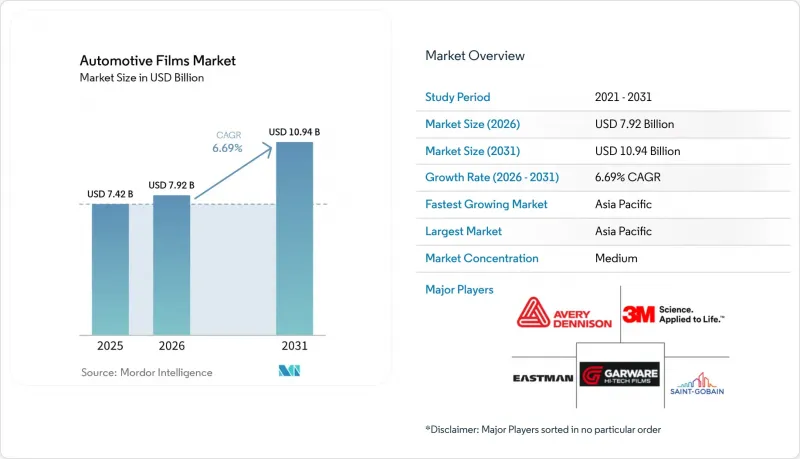
根據 Mordor Intelligence 預測,汽車薄膜市場規模將從 2025 年的 74.2 億美元成長到 2026 年的 79.2 億美元,然後在 2031 年達到 109.4 億美元,2026 年至 2031 年的複合年成長率為 6.69%。
本報告按薄膜類型(窗膜/隔熱膜[染色、金屬化、陶瓷、碳纖維等]、漆面保護膜、包裝膜)、車輛類型(乘用車和商用車)以及地區(亞太地區、北美地區、歐洲地區、南美地區、中東和非洲地區)進行細分。市場預測以美元計價。
全球汽車薄膜市場趨勢及洞察
對車輛美觀和表面保護的需求日益成長。
豪華車車主越來越重視車漆保護膜(PPF),將其作為抵禦石子撞擊和太陽紋的有效手段。他們意識到車漆保護膜能夠提升車輛的轉售價值,並願意投資全車貼膜。 2023年,一項大規模收購迅速建立起覆蓋200個安裝點的分銷網路,顯著提升了其在汽車外觀維護對購車決策影響巨大的市場中的影響力。為了因應這項市場需求,該公司推出了使用壽命長達8-10年的自修復車漆保護膜。憑藉極具競爭力的價格,其產品價格甚至高於老牌廠商的保固費用,加劇了歐洲市場的競爭。對於沒有自有面漆的中小型加工商而言,較短的保固期是一個挑戰,但消費者卻因此受益,擁有了更多選擇,價格波動也更小。因此,汽車貼膜市場正在演變成一種啞鈴狀結構:高階和入門級產品蓬勃發展,而中端金屬化產品則逐漸被市場淘汰。
嚴格的隔熱和紫外線防護規定
美國國家公路交通安全管理局 (NHTSA) 的 FMVSS 205 標準規定了美國擋風玻璃的最低可見光穿透率 (VLT) 要求。這導致市場對能夠阻擋紅外線輻射而不使玻璃變暗的奈米陶瓷薄膜的需求增加。同時,歐洲對這些標準的執行力度各不相同。例如,德國強調紅外線性能,而斯堪地那維亞國家則專注於嚴格的可見光透射率 (VLT) 測試。這種不一致促使供應商生產針對特定地區的 SKU(庫存單位)。某些產品在阻擋全部太陽能的同時,由於不使用金屬,因此能夠避免射頻干擾。這種市場細分有利於垂直整合的製造商,他們能夠提供配方柔軟性和認證計劃,確保安裝商始終掌握最新資訊。然而,在中東,相關法規開始收緊,尤其是在紫外線 (UV)閾值方面。此舉預示著需求激增,尤其是在遭受極端高溫的城市,旨在減輕長時間運作的共享出行車輛的負擔。
可見光透射率的監管標準
由於斯堪地那維亞國家的警察積極在路邊檢查中使用光度計來打擊不合規的薄膜。陶瓷奈米顆粒薄膜可以阻擋紅外線並透射可見光,提供了合規的解決方案,但與染色薄膜相比,其較高的成本阻礙了其廣泛應用。此外,金屬化產品存在無線電干擾問題,這使得它們在電子收費系統和GPS可靠性至關重要的地區吸引力下降。因此,新興地區的法規正在放鬆,而成熟市場的利潤潛力則停滯不前。
細分市場分析
預計到2025年,窗膜和有色膜將引領汽車薄膜市場,佔據49.22%的市佔率。然而,預計到2031年,漆面保護膜將超越所有其他類別,年複合成長率(CAGR)將達到7.12%。這項快速成長得益於創新的自修復TPU技術,該技術能夠巧妙地去除引擎熱循環過程中產生的微刮痕。陶瓷窗膜在高階市場佔據較大佔有率,但每平方英尺的價格遠高於有色膜。這種價格趨勢導致收入高度集中在這些高階產品上。同時,有色膜面臨雙重挑戰:一方面,隱私玻璃的興起使其黯然失色;另一方面,其隔熱性能有限。金屬化薄膜則因5G和GPS日益普及帶來的射頻干擾問題而市佔率下滑。混合晶體薄膜兼具成本和性能優勢,但市場滲透率仍然較低。這種限制源自於安裝人員學習起來比較困難,而且與單層產品相比,需要更長的工作時間。
漆面保護膜的效益取決於其應用範圍。這些數據,加上其貢獻毛利,使其成為產業領導者的重點目標。碳纖維增強彩色薄膜兼顧了兩者,在價格高於染色薄膜的情況下,仍能提供適度的紅外線阻隔性能,同時避免了導電性問題。汽車包裝膜利用品牌認知度帶來的經濟效益。一輛送貨車每天就能創造數千次曝光機會,而如果採購團隊批准了設計模板,車隊的貼膜量可以激增至每位業者數百張。隨著奈米陶瓷薄膜的日益普及,供應商將保存期限延長至10年或特定里程,這表明他們對產品在各種氣候條件下的抗褪色性和黏合耐久性充滿信心。
區域分析
預計到2025年,亞太地區將佔全球銷售量的44.43%,到2031年將維持7.02%的複合年成長率。這一成長主要得益於中國、印度和東南亞農村地區汽車保有量的增加。 2024年,中國新能源汽車銷售的成長將推動對溫度控管產品的需求,因為能夠降低車內溫度的薄膜可望延長600公里電池組的續航里程。目前,印度正規的汽車美容市場僅涵蓋了潛在客戶群的一小部分。然而,Garware計劃於2026年2月推出的新產品(石墨烯陶瓷多層膜套裝)旨在彌補這一市場空白。此套裝將車漆保護膜(PPF)、塗層和擋風玻璃膜無縫整合到單一服務中。同時,日本和韓國則專注於OEM管道。例如, Lintec Corporation透過將擋風玻璃薄膜納入工廠出貨的玻璃包裝中,提高了銷售額,這凸顯了價值向組裝廠的重大轉變。
北美在全球銷售額中佔很大佔有率,其售後市場PPF和陶瓷隔熱膜的單車支出最高。然而,其成長速度已放緩至中等水平。這一放緩歸因於隱私玻璃的普及導致對隔熱膜的需求下降,以及各州對可見光穿透率(VLT)法規的限制,使得隔熱膜的選擇範圍有限。在加拿大,季節性因素也發揮了作用,冬季道路除冰劑的使用增加了戶定板PPF的需求。同時,在墨西哥,瓜納華託的一家OEM工廠正專注於生產原廠貼膜,以滿足美國出口標準。 3M的交通運輸與電子事業部在2024年出現下滑。然而,若不計入其退出PFAS(全氟烷基物質)相關業務的影響,該事業部仍展現出令人矚目的內部成長,凸顯了其在日益嚴格的環境法規下向非氟化化學品戰略轉型的舉措。
歐洲佔據了相當大的市場佔有率,但區域差異顯著。在德國,後窗允許使用較深的色調,但為了保護收費感測器,金屬層的使用受到限制。相較之下,英國對擋風玻璃的可見光穿透率 (VLT) 有特定要求,這實際上淘汰了大部分售後市場著色膜。伊士曼公司計劃於 2026 年在根特投資,旨在將薄膜基材整合到擋風玻璃的層壓製程中,以緩衝售後市場可能出現的萎縮。巴西、沙烏地阿拉伯和南非合計佔全球整體銷售額的一小部分,但佔有率不容忽視。在沙烏地阿拉伯的利雅德和吉達等城市,極端高溫推動了對紅外線 (IR) 切割膜的需求。然而,與歐洲相比,沙烏地阿拉伯的檢驗標準較為寬鬆,允許使用顏色較深的薄膜,這為進口高利潤的奈米陶瓷薄膜創造了機會。
其他好處:
- Excel格式的市場預測(ME)表
- 3個月的分析師支持
目錄
第1章:引言
- 研究的先決條件
- 調查範圍
第2章:調查方法
第3章執行摘要
第4章 市場動態
- 促進因素
- 對汽車美觀和表面保護的需求日益成長。
- 嚴格的散熱和紫外線控制
- 亞太地區註冊車輛數量快速成長
- 從重新噴漆到顏色變更貼膜的過渡
- 智慧電致變色窗膜的商業化
- 抑制因子
- 可見光透射率(VLT)的監管標準
- PET和TPU的原物料價格波動很大。
- 工廠預著色玻璃正在降低售後市場需求。
- 產業價值鏈分析
- 波特五力分析
第5章 市場規模與成長預測
- 按膠片類型
- 窗膜/有色膜
- 染色窗膜
- 金屬化窗膜
- 陶瓷窗膜
- 碳纖維窗膜
- 其他窗膜/有色膜(混合型、晶體型等)
- 汽車漆面保護膜
- 汽車車身包裝膜
- 窗膜/有色膜
- 車輛類型
- 搭乘用車
- 商用車輛
- 按地區
- 亞太地區
- 中國
- 印度
- 日本
- 韓國
- 其他亞太國家
- 北美洲
- 美國
- 加拿大
- 墨西哥
- 歐洲
- 德國
- 英國
- 義大利
- 法國
- 其他歐洲國家
- 南美洲
- 巴西
- 阿根廷
- 其他南美國家
- 中東和非洲
- 沙烏地阿拉伯
- 南非
- 其他中東和非洲國家
- 亞太地區
第6章 競爭情勢
- 市場集中度
- 策略趨勢
- 市佔率和排名分析
- 公司簡介
- 3M
- ADS Window Films Ltd.
- All Pro Window Films
- Avery Dennison Corporation
- Eastman Chemical Company
- FILMTACK PTE LTD.
- Garware Suncontrol Film
- Global Window Films
- HEXIS SAS
- Johnson Window Films Inc.
- LINTEC Corporation
- Nexfil USA
- Saint-Gobain
- Sun Tint
- TORAY INDUSTRIES INC.
第7章 市場機會與未來趨勢
- 評估未開發的領域和未滿足的需求
According to Mordor Intelligence, the automotive films market size is expected to grow from USD 7.42 billion in 2025 to USD 7.92 billion in 2026 and is forecast to reach USD 10.94 billion by 2031 at a 6.69% CAGR over 2026-2031.
This report is Segmented by Film Type (Window Films/Tints [Dyed, Metallized, Ceramic, Carbon, and Other], Paint Protection Films, and Wrapping Films), Vehicle Type (Passenger Vehicles and Commercial Vehicles), and Geography (Asia-Pacific, North America, Europe, South America, and Middle-East and Africa). The Market Forecasts are Provided in Terms of Value (USD).
Global Automotive Films Market Trends and Insights
Rising Demand for Vehicle Aesthetics and Surface Protection
Owners of premium vehicles are increasingly viewing Paint Protection Film (PPF) as a safeguard against stone chips and swirl marks. They're willing to invest in full-body installations, recognizing the potential boost in resale value. In 2023, a major acquisition established an immediate distribution network spanning 200 installer hubs, propelling presence in a market where cosmetic preservation heavily influences purchasing decisions. In response, a self-healing film with a lifespan of 8 to 10 years was launched. Priced competitively, it undercuts the warranty premiums of established players, intensifying the competitive landscape in Europe. While warranty compression poses challenges for smaller converters without proprietary top coats, consumers are reaping the rewards with a wider selection and reduced price variability. As a result, the automotive films market is evolving into a barbell structure: luxury-grade and entry-grade solutions are flourishing, while mid-tier metallized variants are fading into obscurity.
Stringent Heat-Reduction and UV Regulations
The NHTSA's FMVSS 205 mandates a minimum visible light transmission (VLT) for front windshields in the U.S. This drives up the demand for nano-ceramic films, which can reject infrared radiation without darkening the glass. In Europe, enforcement of these standards is inconsistent. For instance, while Germany places a premium on infrared performance, Scandinavian countries focus on stringent VLT checks. This inconsistency has led suppliers to produce jurisdiction-specific stock-keeping units (SKUs). A specific product avoids radio-frequency interference by not using metals, yet it achieves commendable rejection of total solar energy. Such market fragmentation benefits vertically integrated producers who possess both formulation flexibility and certification programs, ensuring their installers remain updated. Meanwhile, the Middle East has started tightening regulations, particularly on UV thresholds. This move indicates a burgeoning demand, especially as cities, grappling with extreme heat, aim to alleviate stress on rideshare fleets operating for extended hours.
Visible-Light-Transmission Regulatory Limits
Installers face a complex landscape due to FMVSS 205's VLT rule and varying state regulations, risking fines and limiting the darker shades favored by many consumers. Europe faces similar hurdles; Scandinavian police actively use photometers in roadside checks to combat non-compliant films. While ceramic nano-particle films, blocking infrared radiation and transmitting visible light, offer a compliant solution, their higher cost compared to dyed alternatives stifles widespread adoption. Additionally, metallized products grapple with signal interference, diminishing their appeal in areas where e-toll and GPS reliability is paramount. As a result, while emerging regions ease regulations, mature markets see their revenue potential capped.
Other drivers and restraints analyzed in the detailed report include:
- Rapid Vehicle-Parc Growth Across Asia-Pacific
- Shift From Repainting to Color-Change Wraps
- Volatile PET and TPU Raw-Material Prices
For complete list of drivers and restraints, kindly check the Table Of Contents.
Segment Analysis
In 2025, window films and tints dominated the automotive films market, claiming a 49.22% share. Paint protection films, however, are set to outpace all categories with a projected 7.12% CAGR through 2031. This surge is driven by the innovative self-healing TPU technology, which adeptly removes micro-scratches during engine heat cycles. Ceramic window tints, while holding a significant stake in premium sales, command prices per square foot that are significantly higher than their dyed counterparts. This pricing dynamic skews revenue heavily towards these high-spec formulations. Dyed films face a dual challenge: they are overshadowed by the rise of privacy glass and their limited heat rejection capabilities. On the other hand, metallized layers are losing ground due to RF interference issues, which conflict with the growing reliance on 5G and GPS. Hybrid crystalline films, though they offer a balance of cost and performance, struggle to penetrate the market significantly. This limitation is attributed to the steeper learning curve for installers, which extends job times compared to single-layer products.
Paint protection films boast dealer ticket sizes that vary depending on coverage. These figures, coupled with their contribution margins, make them prime targets for industry giants. Carbon-infused tints strike a balance, offering moderate IR blockage at a premium over dyed films, all while sidestepping conductivity issues. Automotive wrapping films tap into the economics of brand visibility. With each delivery van racking up thousands of daily impressions, fleet roll-outs can soar to hundreds of units per operator, especially once procurement teams greenlight design templates. As nano-ceramic films gain traction, suppliers are bolstering their warranties to a decade or a specified mileage, a testament to their faith in the product's fade resistance and adhesive durability across varied climates.
Geography Analysis
Asia-Pacific anchors 44.43% of 2025 revenue and is forecast to post a 7.02% CAGR to 2031. This growth is driven by China, India, and Southeast Asia expanding vehicle ownership into rural areas. In 2024, China's sales of NEVs (New Energy Vehicles) are spurring a heightened demand for thermal management. This is because films that can reduce cabin temperatures potentially extend the vehicle's range on a 600-km battery pack. Currently, India's organized detailing market taps into a small fraction of its potential clientele. However, Garware's upcoming launch in February 2026, featuring graphene-ceramic multi-layer kits, aims to bridge this gap. These kits seamlessly integrate PPF, coatings, and windshield films into a singular service. Meanwhile, Japan and South Korea are honing in on OEM channels. For instance, LINTEC's integration of windshield films into factory glazing packages has bolstered its turnover, highlighting a significant shift of value towards assembly plants.
North America, contributing a substantial share to global revenue, boasts the highest per-vehicle expenditure on aftermarket PPF and ceramic tints. However, growth is tapering to a moderate pace. This slowdown is attributed to privacy glass diminishing the demand for dyed films and state VLT regulations limiting shade options. Seasonal dynamics play a role in Canada, where winter road salt boosts PPF demand on rocker panels. Concurrently, in Mexico, OEM hubs in Guanajuato are delving into factory-applied tints to align with U.S. export standards. 3M's Transportation and Electronics segment faced a dip in 2024. Yet, when excluding the impacts of PFAS exits, the segment showcases commendable organic growth, emphasizing a strategic shift towards non-fluorinated chemistries amidst tightening environmental regulations.
Europe, while contributing a notable share to the market, reveals pronounced regional disparities. Germany allows darker shades on rear windows but limits metallized layers to safeguard toll-collection sensors. In contrast, the UK mandates a specific VLT on windscreens, effectively sidelining most aftermarket tints. Eastman's 2026 investment in Ghent aims to embed film substrates during windshield lamination, serving as a buffer against potential aftermarket declines. Collectively, Brazil, Saudi Arabia, and South Africa account for a small but significant portion of global revenue. In Saudi cities like Riyadh and Jeddah, extreme heat drives demand for IR-blocking films. However, lenient inspection practices permit darker shades than those in Europe, presenting an opportunity for higher-margin nano-ceramic imports.
- 3M
- ADS Window Films Ltd.
- All Pro Window Films
- Avery Dennison Corporation
- Eastman Chemical Company
- FILMTACK PTE LTD.
- Garware Suncontrol Film
- Global Window Films
- HEXIS SAS
- Johnson Window Films Inc.
- LINTEC Corporation
- Nexfil USA
- Saint-Gobain
- Sun Tint
- TORAY INDUSTRIES INC.
Additional Benefits:
- The market estimate (ME) sheet in Excel format
- 3 months of analyst support
TABLE OF CONTENTS
1 Introduction
- 1.1 Study Assumptions
- 1.2 Scope of the Study
2 Research Methodology
3 Executive Summary
4 Market Dynamics
- 4.1 Drivers
- 4.1.1 Rising demand for vehicle aesthetics and surface protection
- 4.1.2 Stringent heat-reduction and UV regulations
- 4.1.3 Rapid vehicle-parc growth across Asia-Pacific
- 4.1.4 Shift from repainting to color-change wraps
- 4.1.5 Commercialisation of smart electro-chromic window films
- 4.2 Restraints
- 4.2.1 Visible-light-transmission (VLT) regulatory limits
- 4.2.2 Volatile PET and TPU raw-material prices
- 4.2.3 Factory-fitted tinted glass reducing aftermarket demand
- 4.3 Industry Value Chain Analysis
- 4.4 Porter's Five Forces Analysis
- 4.4.1 Bargaining Power of Suppliers
- 4.4.2 Bargaining Power of Consumers
- 4.4.3 Threat of New Entrants
- 4.4.4 Threat of Substitute Products and Services
- 4.4.5 Degree of Competition
5 Market Size and Growth Forecasts (Value)
- 5.1 By Film Type
- 5.1.1 Window Films/Tints
- 5.1.1.1 Dyed Window Tint
- 5.1.1.2 Metallized Window Tint
- 5.1.1.3 Ceramic Window Tint
- 5.1.1.4 Carbon Window Tint
- 5.1.1.5 Other Window Films/ Tints (Hybrid, Crystalline, etc.)
- 5.1.2 Automotive Paint Protection Films
- 5.1.3 Automotive Wrapping Films
- 5.1.1 Window Films/Tints
- 5.2 By Vehicle Type
- 5.2.1 Passenger Vehicles
- 5.2.2 Commercial Vehicles
- 5.3 By Geography
- 5.3.1 Asia-Pacific
- 5.3.1.1 China
- 5.3.1.2 India
- 5.3.1.3 Japan
- 5.3.1.4 South Korea
- 5.3.1.5 Rest of Asia-Pacific
- 5.3.2 North America
- 5.3.2.1 United States
- 5.3.2.2 Canada
- 5.3.2.3 Mexico
- 5.3.3 Europe
- 5.3.3.1 Germany
- 5.3.3.2 United Kingdom
- 5.3.3.3 Italy
- 5.3.3.4 France
- 5.3.3.5 Rest of Europe
- 5.3.4 South America
- 5.3.4.1 Brazil
- 5.3.4.2 Argentina
- 5.3.4.3 Rest of South America
- 5.3.5 Middle-East and Africa
- 5.3.5.1 Saudi Arabia
- 5.3.5.2 South Africa
- 5.3.5.3 Rest of Middle-East and Africa
- 5.3.1 Asia-Pacific
6 Competitive Landscape
- 6.1 Market Concentration
- 6.2 Strategic Moves
- 6.3 Market Share(%)/Ranking Analysis
- 6.4 Company Profiles (includes Global Overview, Market Overview, Core Segments, Financials, Strategic Information, Products and Services, Recent Developments)
- 6.4.1 3M
- 6.4.2 ADS Window Films Ltd.
- 6.4.3 All Pro Window Films
- 6.4.4 Avery Dennison Corporation
- 6.4.5 Eastman Chemical Company
- 6.4.6 FILMTACK PTE LTD.
- 6.4.7 Garware Suncontrol Film
- 6.4.8 Global Window Films
- 6.4.9 HEXIS SAS
- 6.4.10 Johnson Window Films Inc.
- 6.4.11 LINTEC Corporation
- 6.4.12 Nexfil USA
- 6.4.13 Saint-Gobain
- 6.4.14 Sun Tint
- 6.4.15 TORAY INDUSTRIES INC.
7 Market Opportunities and Future Trends
- 7.1 White-space and Unmet-Need Assessment

 全球汽車薄膜市場規模、佔有率、趨勢和成長分析報告(2026-2034年)
 隱形汽車保護膜市場:全球市場預測,2026-2032年
 汽車窗膜市場:按材料、車輛類型、薄膜類型、功能和地區分類。全球汽車包裝膜市場規模、佔有率、趨勢及成長分析報告(2026-2034)汽車窗膜市場-2026-2032年全球市場預測
 汽車薄膜市場預測至2034年—按薄膜類型、車輛類型、材料、應用和地區分類的全球分析
 全球汽車薄膜市場
 2026年全球汽車自修復塗料市場報告
 汽車薄膜市場規模、佔有率和趨勢分析報告:按薄膜類型、應用、車輛類型、地區和細分市場預測(2026-2033 年)2026年全球汽車薄膜市場報告