


 |
市場調查報告書
商品編碼
2044223
版本控制系統:市場佔有率分析、行業趨勢和統計數據、成長預測(2026-2031 年)Version Control System - Market Share Analysis, Industry Trends & Statistics, Growth Forecasts (2026 - 2031) |
||||||

※ 本網頁內容可能與最新版本有所差異。詳細情況請與我們聯繫。
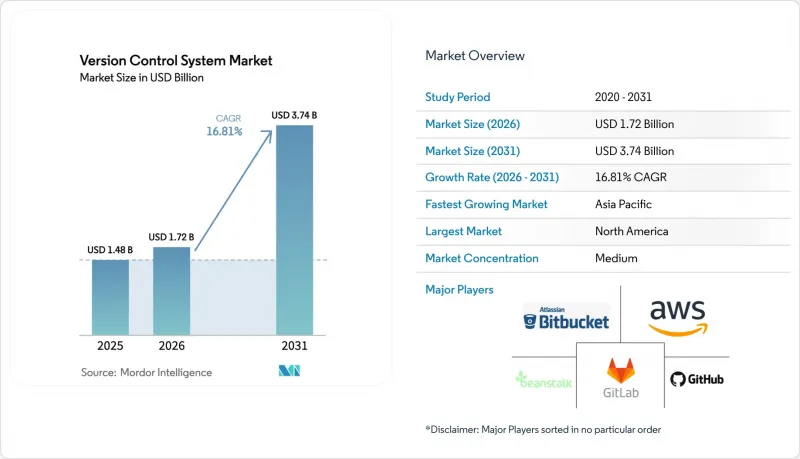
預計到 2025 年,版本控制系統市場規模將達到 14.8 億美元,到 2026 年將達到 17.2 億美元,到 2031 年將達到 37.4 億美元,2026 年至 2031 年的複合年成長率為 16.81%。
企業正將先前分散的工具鏈整合到一個基於 Git 的平台上,該平台整合了持續整合、安全掃描和工件溯源追蹤功能,這反映出企業正向單一供應商的 DevSecOps 套件轉型。 2025 年 9 月,21 家網路安全機構聯合發布了軟體材料清單(SBOM) 指南,這進一步提升了買家對合規程式碼庫的興趣。同時,GitHub Copilot 和 GitLab Duo 等基於代理的 AI 服務的快速部署,正將程式碼庫轉變為人機協作中心。這種需求源自於雲端部署的彈性,它能夠支援團隊採用持續交付後提交量的激增,以及歐洲、澳洲和美國新興主權法規對資料居住選項的需求。隨著微軟、GitLab 和 Atlassian 競相整合 AI、簽章提交強制執行和單一租戶架構等吸引受監管產業的解決方案,競爭日益激烈。
全球版本控制系統市場趨勢及洞察
DevOps 管線的主流化
持續整合的工作量正在激增,GitHub Actions 的使用時長在 2024 年至 2025 年間將達到 115 億分鐘,便是最好的例證。這比上一年成長了 35%,顯示提交和自動化測試的整合更加緊密。捷豹路虎等汽車製造商在遷移到整合 GitLab 的 DevSecOps 環境後,已將回饋週期縮短了 99%,現在每天最多可以執行 70 次部署。 Perforce 的研究數據顯示,汽車產業 30% 的團隊正在整合靜態分析、版本控制和持續測試,以提高程式碼品質。隨著事務量的增加,可擴展的分支策略、自動衝突解決和功能標誌管理的需求日益成長,企業級 Git 平台也成為首選。因此,各組織將整合版本控制視為可靠、快速交付軟體的先決條件。
遷移到雲端原生工作流程
雲端託管程式碼庫減輕了基礎設施負擔,並提供了一個彈性運算環境,支援在自管理環境中無法實現的 AI 服務。 GitLab 的 SaaS 營收在 2026 會計年度第二季年增 39%,占公司總營收的 30%。微軟正在將數十萬個 Azure Repos 授權移轉到 GitHub,以便客戶能夠利用 Copilot 的自主程式碼產生功能。 GitHub Enterprise Cloud 於 2024 年推出了歐盟資料駐留功能,並於 2025 年擴展到澳洲和美國,消除了金融服務業客戶的資料主權障礙。 Atlassian 計畫於 2026 年為 Bitbucket Cloud 增加歐盟資料駐留功能,以吸引風險規避型企業。儘管雲端採用仍然存在供應商鎖定方面的擔憂,但將本地程式碼庫(用於儲存敏感資產)與雲端實例(用於協作)相結合的混合模式正在降低遷移阻力。
複雜的多供應商工具鏈
儘管近四分之三的組織使用七種或更多安全工具,但只有不到一半的組織同時掃描程式碼和二進位文件,這凸顯了整合方面的差距,而這種差距會延緩交付速度。 Atlassian 於 2025 年 12 月嘗試對 Bitbucket 的自託管運行器單獨收費,引發了強烈反對,揭示了多層定價如何加劇摩擦。從 Azure DevOps 遷移到 GitHub 的公司需要重建管道、看板和測試套件,從而延長了轉型時間。跨越儲存庫、CI/CD 和註冊表的 API 令牌增加了合規性風險,刺激了對統一身分管理的需求。協調異質工具的複雜性仍然是市場擴張的瓶頸。
細分市場分析
隨著企業優先考慮可擴展性和免維護運營,到 2025 年,雲端部署將佔據版本控制系統市場 62.77% 的佔有率。預計到 2031 年,該細分市場將以 17.32% 的複合年成長率成長,這主要得益於依賴超大規模運算的 AI 輔助駕駛技術的整合。 GitHub 企業雲端在歐盟、澳洲和美國部署的資料居住感知解決方案解決了許多主權問題,並促進了從 Azure Repos 和自託管 Git 伺服器的遷移。因此,在監管機構認可已獲得 FedRAMP、ISO 27001 和 SOC 2 認證的 SaaS 平台的地區,雲端用戶的版本控制系統市場將以最快的速度成長。
在國防、半導體和航太航太等對空氣間隙環境要求極高的產業,企業仍傾向選擇本地部署。 GitLab 的數據顯示,儘管 SaaS 的成長速度超過了本地部署的銷售,但到 2026 會計年度第三季度,自管理授權仍將佔其收入的 70%。 Perforce Helix Core 和 Unity Version Control 仍然是工作室和汽車製造商在 ISO 26262 工作流程下處理大規模二進位資產時的主要工具。混合策略,即利用本地部署處理敏感知識產權,並利用雲端進行外部協作,正在彌合可靠性差距,並將版本控制系統市場拓展到更多較保守的買家群體。
預計到 2025 年,Git 等去中心化平台將佔據版本控制系統市場 92.43% 的佔有率,其主導地位源自於靈活的分支機制、離線提交功能以及豐富的插件生態系統。 GitHub 的開發者數量已突破 1 億,而 GitLab 目前超過一半的活躍客戶是財富 100 強企業,這進一步鞏固了去中心化工作流程的普及。隨著人工智慧驅動的程式碼產生技術不斷推動提交事件的增加,與去中心化工具相關的版本控制系統市場規模預計將持續擴大。
隨著以二進位為中心的產業重新評估排他性鎖定模型,集中式版本控制系統預計將呈現更快的成長速度,到 2031 年小規模年成長率將達到 17.64%,而其成長基礎仍處於起步階段。 Perforce 收購 Snowtrack(後來更名為 P4 One)讓藝術家和設計師的工作流程更加方便用戶使用,而 Unity 版本控制系統提案了智慧鎖定功能,方便在不同分支之間切換。汽車、遊戲和媒體產業的團隊重視線性歷史記錄、確定性建構和Petabyte級程式碼庫。這些特殊需求創造了成長機會,並維持了集中式工具在更廣泛的版本控制系統市場中的地位。
區域分析
預計到2025年,北美將佔據39.78%的市場。這主要歸功於GitHub在財富100強企業中的深度滲透,以及聯邦採購法規對DevSecOps套件強制要求FedRAMP中等認證的要求。 GitLab的政府專用服務將於2026年初獲得同等認證,使公共機構能夠在保持資料主權的同時進行競爭性競標。加拿大和墨西哥的市佔率僅次於美國,但金融科技和近岸軟體外包產業對基於SaaS的儲存庫的採用正在擴大區域版本控制系統市場。
預計到2031年,亞太地區的複合年成長率將達到18.02%,成為全球成長最快的地區。印度服務公司、中國網路巨頭和東南亞電商巨頭正在將單體程式碼庫遷移到分散式Git工作流程。日本和韓國的遊戲產業中心依賴Perforce和Unity來管理TB級的Terabyte資源,而澳洲公共部門則採用GitHub企業雲端並結合本地資料儲存。監管碎片化和中小企業支出疲軟阻礙了成長,但超大規模雲端的普及應用仍在不斷挖掘潛在需求。
歐洲的市佔率主要受《網路彈性法案》(將於2024年1月生效)和《數位營運彈性法案》(將於2025年1月17日生效)的影響。這兩項法案均強制要求創建系統行為對象手冊(SBOM)並揭露漏洞,從而推動了對合規平台的需求。德國、英國和法國在汽車、金融和工業IoT領域的應用方面處於領先地位。南美洲、中東和非洲在版本控制系統市場中所佔佔有率仍然較小,但巴西、沙烏地阿拉伯和南非強制推行的主權雲表明,隨著本地資料中心投入運作和開發人員數量的成長,這些地區未來具有成長潛力。
其他好處:
- Excel格式的市場預測(ME)表
- 3個月的分析師支持
目錄
第1章:引言
- 研究假設和市場定義
- 調查範圍
第2章:調查方法
第3章執行摘要
第4章 市場狀況
- 市場概覽
- 市場促進因素
- 採用主流DevOps管線
- 遷移到雲端原生工作流程
- 軟體交付中成本最佳化的必要性
- 人工智慧驅動的程式碼審查和可追溯性
- 數位產品合規性(SBOM、安全供應鏈)
- 遊戲和媒體中的即時資產協作
- 市場限制因素
- 複雜的多供應商工具鏈
- 存儲庫可擴展性的局限性
- 缺乏高級VCS技能
- 開放原始碼許可證和漏洞風險
- 產業供應鏈分析
- 宏觀經濟因素對市場的影響
- 監理情勢
- 技術展望
- 波特五力分析
- 供應商的議價能力
- 買方的議價能力
- 新進入者的威脅
- 替代品的威脅
- 競爭公司之間的競爭
第5章 市場規模與成長預測
- 部署模式
- 現場
- 雲
- 按類型
- 分散式版本控制系統
- 集中式版本控制系統
- 按最終用戶行業分類
- 資訊科技和通訊
- BFSI
- 零售與電子商務
- 醫療保健和生命科學
- 媒體與娛樂
- 教育
- 遊戲和每月內容
- 汽車和嵌入式系統
- 航太/國防
- 其他終端用戶產業
- 按組織規模
- 小型企業
- 大公司
- 按地區
- 北美洲
- 美國
- 加拿大
- 墨西哥
- 南美洲
- 巴西
- 阿根廷
- 南美洲其他地區
- 歐洲
- 德國
- 英國
- 法國
- 義大利
- 西班牙
- 其他歐洲地區
- 亞太地區
- 中國
- 日本
- 印度
- 韓國
- 澳洲
- 亞太其他地區
- 中東和非洲
- 中東
- 沙烏地阿拉伯
- 阿拉伯聯合大公國
- 土耳其
- 其他中東國家
- 非洲
- 南非
- 奈及利亞
- 肯亞
- 其他非洲地區
- 中東
- 北美洲
第6章 競爭情勢
- 市場集中度
- 策略趨勢
- 市佔率分析
- 公司簡介
- GitHub(Microsoft Corporation)
- GitLab Inc.
- Bitbucket(Atlassian Corporation Plc)
- Perforce Software Inc.
- Amazon Web Services Inc.
- Azure DevOps(Microsoft Corporation)
- Google Cloud Source Repositories(Google LLC)
- Digital.ai Software Inc.
- Unity Technologies(Plastic SCM)
- Apache Subversion
- Beanstalk(Wildbit, LLC)
- Mercurial SCM
- Canonical Ltd.(Launchpad)
- Fossil SCM
- Azure Repos
- IBM Corporation(Rational Team Concert)
- SAP SE(SAP Cloud ALM)
- JetBrains sro(Space)
- Helix Core(Perforce Software Inc.)
- Dynatrace GmbH(Keptn)
- Anchorpoint Software GmbH
第7章 市場機會與未來展望
The version control system market size is projected to be USD 1.48 billion in 2025, USD 1.72 billion in 2026, and reach USD 3.74 billion by 2031, growing at a CAGR of 16.81% from 2026 to 2031.
Enterprises are consolidating fragmented toolchains around Git-based platforms that now bundle continuous integration, security scanning and artifact provenance, reflecting a shift to single-vendor DevSecOps suites. Joint software bill of materials guidance released by twenty-one cybersecurity agencies in September 2025 intensified buyer focus on compliance-ready repositories, while the rapid rollout of agentic AI services such as GitHub Copilot and GitLab Duo is turning the repository into a hub for human-AI collaboration. Demand is reinforced by cloud deployment's elasticity, which supports surging commit volumes as teams adopt continuous delivery, and by the need for data-residency options that satisfy emerging sovereignty rules in Europe, Australia and the United States. Competitive intensity is growing as Microsoft, GitLab, and Atlassian race to integrate AI, signed-commit enforcement, and single-tenant architectures that appeal to regulated sectors.
Global Version Control System Market Trends and Insights
Mainstream DevOps Pipeline Adoption
Continuous integration workloads are soaring, illustrated by 11.5 billion GitHub Actions minutes consumed during 2024-2025, a 35% year-over-year increase that underscores tighter coupling between commits and automated testing. Automotive firms such as Jaguar Land Rover trimmed feedback cycles by 99% and executed as many as 70 daily deploys after moving to GitLab's unified DevSecOps environment. Survey data from Perforce shows 30% of automotive teams now bundle static analysis, version control, and continuous testing to raise code quality. Rising transaction volumes demand scalable branching strategies, conflict-resolution automation, and feature-flag management, favoring enterprise-grade Git platforms. Organizations, therefore, view integrated version control as a prerequisite for reliable, rapid software delivery.
Shift Toward Cloud-Native Workflows
Cloud-hosted repositories remove infrastructure burden and expose elastic compute that supports AI services unavailable in self-managed environments. GitLab's SaaS revenue grew 39% year-over-year in its fiscal Q2 2026, constituting 30% of company turnover. Microsoft is migrating hundreds of thousands of Azure Repos seats to GitHub so customers can tap Copilot's autonomous code generation. GitHub Enterprise Cloud introduced EU data residency in 2024 and expanded to Australia and the United States in 2025, removing sovereignty hurdles for financial services clients. Atlassian will add EU data residency for Bitbucket Cloud in 2026 to court risk-averse enterprises. Although cloud adoption raises vendor lock-in concerns, hybrid models that mix on-premise repositories for sensitive assets with cloud instances for collaboration are easing migration inertia.
Complex Multi-Vendor Toolchains
Nearly three-quarters of organizations run seven or more security tools, yet fewer than half scan both code and binaries, illustrating integration gaps that slow delivery. Atlassian's attempt to charge separately for Bitbucket self-hosted runners in December 2025 triggered backlash, revealing how layered pricing amplifies friction. Enterprises migrating from Azure DevOps to GitHub must rewire pipelines, boards, and testing suites, extending transformation timelines. API tokens spread across repositories, CI/CD, and registries increase compliance risk, prompting demand for unified identity management. The complexity of harmonizing disparate tools remains a brake on market expansion.
Other drivers and restraints analyzed in the detailed report include:
- AI-Assisted Code Review and Traceability
- Digital Product Compliance (SBOM, Secure Supply Chain)
- Repository Scalability Limitations
For complete list of drivers and restraints, kindly check the Table Of Contents.
Segment Analysis
Cloud deployment commanded 62.77% of the version control system market share in 2025 as enterprises prioritized elasticity and zero-maintenance operations. The segment is forecast to grow at a 17.32% CAGR through 2031, supported by the integration of AI copilots that rely on hyperscale compute. GitHub Enterprise Cloud's data-residency rollout in the EU, Australia and the United States has neutralized many sovereignty objections and catalyzed migrations from Azure Repos and self-managed Git servers. The version control system market size for cloud users will therefore expand fastest where regulators now accept SaaS platforms that hold FedRAMP, ISO 27001 and SOC 2 credentials.
On-premise installations persist among defense, semiconductor and aerospace organizations that mandate air-gapped environments. GitLab revealed that self-managed licenses still generated 70% of revenue in fiscal Q3 2026, although SaaS growth is outpacing on-premise sales. Perforce Helix Core and Unity Version Control remain staples for studios and automotive firms manipulating large binary assets under ISO 26262 workflows. Hybrid strategies-on-premise for sensitive IP and cloud for external collaboration-are closing the confidence gap and extending the version control system market to conservative buyers.
Distributed platforms such as Git held 92.43% of the version control system market share in 2025, a dominance born of flexible branching, offline commits and a rich plugin ecosystem. GitHub crossed the 100 million-developer threshold, while GitLab now counts more than half of the Fortune 100 among active customers, confirming the ubiquity of distributed workflows. The version control system market size attached to distributed tools will continue to rise as AI code generation multiplies commit events.
Centralized systems are expected to post a faster 17.64% CAGR through 2031 from a smaller base because binary-centric industries are revisiting exclusive locking models. Perforce's acquisition of Snowtrack, rebranded P4 One, makes the workflow friendlier for artists and designers, while Unity Version Control pitches smart locks that travel across branches. Automotive, gaming, and media teams value linear history, deterministic builds, and petabyte repositories. Their specialized needs create pockets of growth that preserve centralized tools' relevance inside the broader version control system market.
The Version Control System Market Report is Segmented by Deployment Mode (On-Premise, and Cloud), Type (Distributed VCS, and Centralized VCS), End-User Industry (IT and Telecom, BFSI, Retail and E-Commerce, Healthcare and Life Sciences, Media and Entertainment, Education, and More), Organization Size (Small and Medium Enterprises, and Large Enterprises), and Geography. The Market Forecasts are Provided in Terms of Value (USD).
Geography Analysis
North America dominated 39.78% of the market share in 2025, owing to GitHub's heavy Fortune 100 penetration and federal procurement rules that require FedRAMP Moderate authorization for DevSecOps suites. GitLab secured the same clearance for its Dedicated for Government service in early 2026, enabling public agencies to solicit competitive bids while preserving data sovereignty. Canada and Mexico trail the United States but are adopting SaaS repositories across fintech and near-shore software outsourcing, extending the regional version control system market.
Asia-Pacific is forecast to post an 18.02% CAGR through 2031, the fastest worldwide. India's services firms, China's internet conglomerates, and Southeast Asia's e-commerce leaders are migrating monolithic code bases to distributed Git workflows. Gaming hubs in Japan and South Korea rely on Perforce and Unity to manage terabyte-scale art assets, while Australia's public sector adopts GitHub Enterprise Cloud with local data storage. Fragmented regulations and lower SME spending temper growth, yet hyperscale cloud rollouts continue to unlock latent demand.
Europe's share is shaped by the Cyber Resilience Act, effective January 2024, and the Digital Operational Resilience Act, enforceable since January 17 2025. Both laws require SBOM generation and vulnerability disclosure, spurring demand for compliance-ready platforms. Germany, the United Kingdom and France lead adoption in automotive, finance and industrial IoT. South America, the Middle East and Africa still contribute a small portion of the version control system market, yet sovereign cloud mandates in Brazil, Saudi Arabia and South Africa signal future upside as local data centers come online and developer populations expand.
- GitHub (Microsoft Corporation)
- GitLab Inc.
- Bitbucket (Atlassian Corporation Plc)
- Perforce Software Inc.
- Amazon Web Services Inc.
- Azure DevOps (Microsoft Corporation)
- Google Cloud Source Repositories (Google LLC)
- Digital.ai Software Inc.
- Unity Technologies (Plastic SCM)
- Apache Subversion
- Beanstalk (Wildbit, LLC)
- Mercurial SCM
- Canonical Ltd. (Launchpad)
- Fossil SCM
- Azure Repos
- IBM Corporation (Rational Team Concert)
- SAP SE (SAP Cloud ALM)
- JetBrains s.r.o. (Space)
- Helix Core (Perforce Software Inc.)
- Dynatrace GmbH (Keptn)
- Anchorpoint Software GmbH
Additional Benefits:
- The market estimate (ME) sheet in Excel format
- 3 months of analyst support
TABLE OF CONTENTS
1 INTRODUCTION
- 1.1 Study Assumptions and Market Definition
- 1.2 Scope of the Study
2 RESEARCH METHODOLOGY
3 EXECUTIVE SUMMARY
4 MARKET LANDSCAPE
- 4.1 Market Overview
- 4.2 Market Drivers
- 4.2.1 Mainstream DevOps Pipeline Adoption
- 4.2.2 Shift Toward Cloud-Native Workflows
- 4.2.3 Cost Optimization Imperatives in Software Delivery
- 4.2.4 AI-Assisted Code Review and Traceability
- 4.2.5 Digital Product Compliance (SBOM, Secure Supply Chain)
- 4.2.6 Real-Time Asset Collaboration in Gaming and Media
- 4.3 Market Restraints
- 4.3.1 Complex Multi-Vendor Toolchains
- 4.3.2 Repository Scalability Limitations
- 4.3.3 Shortage of Advanced VCS Skill Sets
- 4.3.4 Open-Source License and Vulnerability Exposure
- 4.4 Industry Supply Chain Analysis
- 4.5 Impact of Macroeconomic Factors on the Market
- 4.6 Regulatory Landscape
- 4.7 Technological Outlook
- 4.8 Porter's Five Forces Analysis
- 4.8.1 Bargaining Power of Suppliers
- 4.8.2 Bargaining Power of Buyers
- 4.8.3 Threat of New Entrants
- 4.8.4 Threat of Substitutes
- 4.8.5 Intensity of Competitive Rivalry
5 MARKET SIZE AND GROWTH FORECASTS (VALUE)
- 5.1 By Deployment Mode
- 5.1.1 On-Premise
- 5.1.2 Cloud
- 5.2 By Type
- 5.2.1 Distributed VCS
- 5.2.2 Centralized VCS
- 5.3 By End-user Industry
- 5.3.1 IT and Telecom
- 5.3.2 BFSI
- 5.3.3 Retail and E-commerce
- 5.3.4 Healthcare and Life Sciences
- 5.3.5 Media and Entertainment
- 5.3.6 Education
- 5.3.7 Gaming and Digital Content
- 5.3.8 Automotive and Embedded Systems
- 5.3.9 Aerospace and Defense
- 5.3.10 Other End-user Industries
- 5.4 By Organization Size
- 5.4.1 Small and Medium Enterprises
- 5.4.2 Large Enterprises
- 5.5 By Geography
- 5.5.1 North America
- 5.5.1.1 United States
- 5.5.1.2 Canada
- 5.5.1.3 Mexico
- 5.5.2 South America
- 5.5.2.1 Brazil
- 5.5.2.2 Argentina
- 5.5.2.3 Rest of South America
- 5.5.3 Europe
- 5.5.3.1 Germany
- 5.5.3.2 United Kingdom
- 5.5.3.3 France
- 5.5.3.4 Italy
- 5.5.3.5 Spain
- 5.5.3.6 Rest of Europe
- 5.5.4 Asia-Pacific
- 5.5.4.1 China
- 5.5.4.2 Japan
- 5.5.4.3 India
- 5.5.4.4 South Korea
- 5.5.4.5 Australia
- 5.5.4.6 Rest of Asia-Pacific
- 5.5.5 Middle East and Africa
- 5.5.5.1 Middle East
- 5.5.5.1.1 Saudi Arabia
- 5.5.5.1.2 United Arab Emirates
- 5.5.5.1.3 Turkey
- 5.5.5.1.4 Rest of Middle East
- 5.5.5.2 Africa
- 5.5.5.2.1 South Africa
- 5.5.5.2.2 Nigeria
- 5.5.5.2.3 Kenya
- 5.5.5.2.4 Rest of Africa
- 5.5.5.1 Middle East
- 5.5.1 North America
6 COMPETITIVE LANDSCAPE
- 6.1 Market Concentration
- 6.2 Strategic Moves
- 6.3 Market Share Analysis
- 6.4 Company Profiles (Includes Global Level Overview, Market Level Overview, Core Segments, Financials as Available, Strategic Information, Market Rank/Share, Products and Services, and Recent Developments)
- 6.4.1 GitHub (Microsoft Corporation)
- 6.4.2 GitLab Inc.
- 6.4.3 Bitbucket (Atlassian Corporation Plc)
- 6.4.4 Perforce Software Inc.
- 6.4.5 Amazon Web Services Inc.
- 6.4.6 Azure DevOps (Microsoft Corporation)
- 6.4.7 Google Cloud Source Repositories (Google LLC)
- 6.4.8 Digital.ai Software Inc.
- 6.4.9 Unity Technologies (Plastic SCM)
- 6.4.10 Apache Subversion
- 6.4.11 Beanstalk (Wildbit, LLC)
- 6.4.12 Mercurial SCM
- 6.4.13 Canonical Ltd. (Launchpad)
- 6.4.14 Fossil SCM
- 6.4.15 Azure Repos
- 6.4.16 IBM Corporation (Rational Team Concert)
- 6.4.17 SAP SE (SAP Cloud ALM)
- 6.4.18 JetBrains s.r.o. (Space)
- 6.4.19 Helix Core (Perforce Software Inc.)
- 6.4.20 Dynatrace GmbH (Keptn)
- 6.4.21 Anchorpoint Software GmbH
7 MARKET OPPORTUNITIES AND FUTURE OUTLOOK
- 7.1 White-space and Unmet-Need Assessment

 應用開發軟體市場-2026-2032年全球市場預測
 版本控制系統市場規模、佔有率和成長分析:按類型、部署模式、組織規模和地區分類-2026-2033年產業預測
 2026年全球應用封裝與部署市場報告2026年全球需求管理工具市場報告2026年服務導向的架構全球市場報告2026年全球應用發布編配軟體市場報告服務導向的架構市場:按元件、組織規模、服務類型、管治、安全、部署模式和產業分類 - 全球預測 2026-2032 年2026年全球資料清洗工具市場報告2026年全球應用開發軟體市場報告
 應用開發軟體市場分析及預測(至2035年):依類型、產品類型、服務、技術、元件、應用、部署類型、最終使用者、功能及解決方案分類