


 |
市場調查報告書
商品編碼
2044221
超寬頻:市場佔有率分析、行業趨勢和統計數據、成長預測(2026-2031 年)Ultra Wideband - Market Share Analysis, Industry Trends & Statistics, Growth Forecasts (2026 - 2031) |
||||||

※ 本網頁內容可能與最新版本有所差異。詳細情況請與我們聯繫。
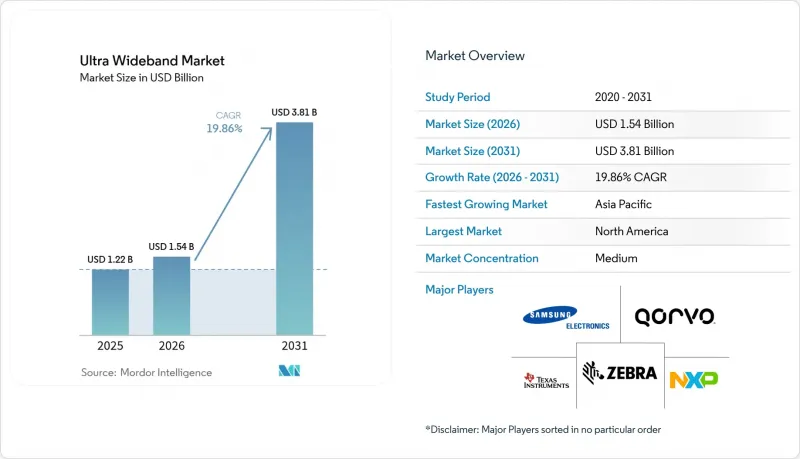
2025 年超寬頻 (UWB) 市值為 12.3 億美元,預計到 2031 年將達到 38.1 億美元,而 2026 年為 15.4 億美元,預測期(2026-2031 年)複合年成長率為 19.86%。
憑藉公分級的定位精度,這項技術正從智慧型手機的一項新奇功能轉變為工業4.0自動化、港口物流以及抗繼電器攻擊數位鑰匙等領域的關鍵要素。製造商在部署精度低於10公分的資產追蹤系統後,與堆高機碰撞相關的保險理賠減少了30%至40%。同時,車輛租賃保險公司也為配備基於UWB技術的被動式門禁系統的車輛降低了高達12%的保費。監管方面的進展,特別是歐盟2024/1467號決議和中國工業和資訊化部的相關規定,將允許的室外通訊範圍擴大了一倍,並取消了省級認證延遲,從而獎勵了大規模基礎設施的部署。另一方面,低功耗藍牙(BLE)到達角測量系統以UWB半導體三分之一的成本實現了50公分的精度,使得成本而非純粹的精度成為競爭的焦點。由於晶圓代工廠優先生產高利潤的智慧型手機處理器,28 奈米以下晶片的供應仍然緊張,模組前置作業時間已延長至 18 週,迫使晶片製造商確保替代產能或過渡到更精細的製程。
全球超寬頻 (UWB) 市場趨勢及洞察
工業4.0工廠對即時定位系統(RTLS)的需求爆炸性成長
汽車和零件製造商報告稱,由於用直接整合到SAP製造執行系統中的UWB錨點取代了條碼掃描,在製品庫存減少了18%至25%,並且能夠在90秒內啟動托盤交付。到2025年,光是在德國供應商,UWB錨點的部署占地面積就將達到120萬平方公尺。一家日本電子組裝製造商已將UWB技術擴展到協作機器人的安全區域,其中基於IEEE 802.15.4z的安全測距技術可防止偽造的緊急停止功能已停用。隨著模組價格降至每1萬個模組3.5美元以下,一個主要的成本障礙已被消除。一家韓國半導體製造廠正在試驗無塵室工具追蹤系統,以防止製程車間出現錯誤的情況。因此,一場結構性轉變正在發生,從概念驗證(PoC)到全球工廠網路中的企業級部署。
智慧型手機廠商必須強制實現空間辨識功能
蘋果在2025年推出的所有iPhone機型中都配備了UWB超寬頻技術,從而實現了精準的AirTag定位、用於空間音訊的頭部追蹤以及防繼電器攻擊的支付功能。三星隨後在Galaxy S25 Ultra和Z Fold 6上也採用了這項技術,而小米15S Pro則將UWB技術與比亞迪和蔚來汽車的數位鑰匙相結合。作為回應,保險公司為配備UWB安全租賃晶片的設備提供5-8%的折扣,從而提振了高階智慧型手機的需求。谷歌在Android 15中為相容Matter的智慧家庭設定添加了UWB初始設定功能,在beta測試中將設定時間縮短了40%。在FiRa聯盟規範帶來的互通性壓力下,跨品牌相容性已成為所有旗艦設備的必備條件。
BLE AoA/AoD 在精度小於 50 公分時具有成本優勢
售價約為 1.20 美元的藍牙定位模組在零售店內可實現小於 50 公分的定位精度,使其成為注重成本的企業替代 UWB 的理想選擇。在醫院追蹤數萬件資產的情況下,每個標籤可節省 2 美元,相當於數十萬美元的資本支出。一項 2025 年零售業先導計畫證實,BLE 足以滿足貨架等級的庫存搜尋,這表明 UWB 的部署僅適用於防盜。隨著藍牙技術聯盟 (Bluetooth SIG) 6.0 版本的藍圖,預計精度差距將縮小至 20 厘米,進一步加劇價格競爭。雖然 UWB 供應商目前強調安全測距和抗繼電器攻擊能力,但這些在汽車和金融產業備受重視的優勢,在通用市場中並不那麼重要。
細分市場分析
儘管超寬頻 (UWB) 市場的成長勢頭依賴於硬體優勢,但企業擴大將網路校準和韌體更新外包,預計到 2031 年,服務業將以 20.22% 的複合年成長率成長。在擁有 200 至 500 個錨點、分佈於多棟建築的設施中,預測傳播模型已被證明不足以捕捉金屬貨架和輸送機的影響,因此需要進行現場調整,每個工廠的成本在 5 萬至 15 萬美元之間。硬體價格正在快速下降,預計 DW3000 模組的成本將在 2023 年至 2025 年間下降 40%,這將對利潤率造成壓力。
在軟體領域(市佔率約15%),原始座標資料正轉換為諸如AGV調度等運行指令。同時,採用分形和陶瓷設計的創新天線已將面積縮小了50%,使其可應用於智慧型手錶和耳機等領域。整合晶片、天線和電源管理功能的模組已將認證週期縮短了一半。定期維護合約通常佔實施成本的12%至18%,可確保整合商獲得可預測的現金流量。
智慧建築中超寬頻(UWB)技術的應用正在推動UWB市場的發展,獲得LEED鉑金認證的維修需要進行人員佔用檢測,以最佳化暖通空調(HVAC)負載。商業地產業主表示,空間利用率提高了20-30%,並且推遲了昂貴的擴建項目。雖然預計到2025年,消費性電子產品將佔UWB銷售額的27.42%,但隨著UWB成為標配功能,其成長速度正在放緩。
由於安全測距功能可防止徽章複製,UWB 門禁控制已成為高安全等級設施的首選。在汽車和物流行業,它憑藉數位鑰匙和 V2I(車路協同)定位技術保持著兩位數的市場佔有率;而在醫療保健行業,它透過追蹤輸液泵和輪椅來減少因丟失造成的損失。持續的分析使用費提高了智慧建築的獲利能力,即使硬體日趨商品化,也能支持持續投資。
區域分析
到2025年,北美將佔全球銷售量的36.93%;美國保險公司將為配備UWB數位鑰匙的車輛提供8%至12%的車隊保費折扣;核心工廠的佔地面積將達到1500萬平方英尺。加拿大由於頻率分配延遲而落後,該問題最終在2026年1月解決。同時,由於近岸外包熱潮,墨西哥從一開始就採用了即時定位系統(RTLS)。低功耗藍牙(BLE)在成本敏感產業更受歡迎,而半導體短缺加劇了汽車產業的交付延遲。
亞太地區預計將達到21.01%的複合年成長率,成為全球成長最快的地區。中國統一了7163-8812MHz頻段的法規,將智慧型手機的核准週期縮短至八週,旗艦機型現已將超寬頻(UWB)技術與電動車的數位鑰匙結合。日本2024年修訂的ARIB標準將使東京地鐵站從2026年3月起每天能夠進行5萬次超寬頻支付。韓國的監管統一使得三星無需額外認證即可推出支援超寬頻技術的Galaxy S25 Ultra。由於價格敏感,印度和東南亞大部分地區仍處於起步階段,但新加坡和吉隆坡的試點計畫顯示,行人流量提高了30%至40%。澳洲和紐西蘭已符合歐盟標準,這促進了超寬頻技術在採礦業的應用。
在歐洲,由於2024/1467號決定解除了戶外使用禁令並提高了產量限制,預計到2025年,這項技術將佔據20%左右的市場。德國在汽車業強制實施即時定位系統(RTLS)方面處於領先地位,其佔地800萬平方英尺的工廠已部署了該系統。在法國和英國,雙重認證是必要的,這使得市場准入延遲最多12週。西班牙和義大利專注於需要溫控的藥品物流,而俄羅斯的貿易限制則限制了先進晶片組的取得。杜拜和阿布達比的海灣合作理事會(GCC)港口已試點厘米級貨櫃追蹤,但非洲的實施才剛剛起步,南非在礦業安全計劃方面落後於其他國家。
其他好處:
- Excel格式的市場預測(ME)表
- 3個月的分析師支持
目錄
第1章:引言
- 研究假設和市場定義
- 調查範圍
第2章:調查方法
第3章執行摘要
第4章 市場狀況
- 市場概覽
- 市場促進因素
- 工業4.0工廠對即時定位系統(RTLS)的需求爆炸性成長
- 智慧型手機廠商必須採用空間辨識功能。
- 歐洲和亞太地區對Sub-GHz頻段寬頻技術進行監管核准。
- 汽車產業向數位鑰匙和車載雷達的過渡
- 開放原始碼UWB韌體降低了進入門檻。
- 國家為智慧港口和機場提供基礎建設資金
- 市場限制因素
- BLE AoA/AoD 在精度小於 50 公分時具有成本優勢
- 28奈米及更小尺寸晶片供應瓶頸
- 各地區頻寬監理規定的碎片化導致認證延遲。
- 高級微定位欺騙和側通道攻擊
- 產業價值鏈分析
- 監理情勢
- 技術展望
- 波特五力分析
- 供應商的議價能力
- 買方的議價能力
- 新進入者的威脅
- 替代品的威脅
- 競爭公司之間的競爭
- 宏觀經濟因素對市場的影響
第5章 市場規模與成長預測
- 按組件
- 硬體
- 積體電路/晶片組
- 天線
- 模組
- 軟體
- 服務
- 硬體
- 最終用戶
- 家用電子電器
- 汽車和交通運輸
- 衛生保健
- 製造業和工業
- 零售和倉儲
- 國防/公共安全
- 智慧建築
- 依設備類型
- 智慧型手機
- 穿戴式裝置和可聽設備
- 車輛
- 無人機和機器人
- 固定基礎設施(閘道器、信標)
- 按頻段
- 3.1~4.8 GHz
- 6~10.6 GHz
- 按功能
- 短距離(小於10公尺)
- 中程(10-30公尺)
- 長距離(超過30公尺)
- 透過使用
- 即時位置資訊系統(RTLS)
- 安全數位金鑰
- 擴增實境(AR)和虛擬實境(VR)地圖
- 資產追蹤和庫存管理
- 智慧家庭和建築自動化
- 按地區
- 北美洲
- 美國
- 加拿大
- 墨西哥
- 南美洲
- 巴西
- 南美洲其他地區
- 歐洲
- 德國
- 法國
- 英國
- 義大利
- 西班牙
- 俄羅斯
- 其他歐洲地區
- 亞太地區
- 中國
- 日本
- 韓國
- 印度
- 澳洲和紐西蘭
- 東南亞
- 亞太其他地區
- 中東
- GCC
- 土耳其
- 其他中東國家
- 非洲
- 南非
- 其他非洲地區
- 北美洲
第6章 競爭情勢
- 市場集中度
- 策略趨勢
- 市佔率分析
- 公司簡介
- Apple Inc.
- Qorvo Inc.
- NXP Semiconductors NV
- Zebra Technologies Corp.
- Texas Instruments Inc.
- Samsung Electronics Co. Ltd.
- Sony Group Corporation
- STMicroelectronics NV
- Infineon Technologies AG
- Qualcomm Inc.
- Broadcom Inc.
- Pulse-Link Inc.
- Humatics Corp.
- Alereon Inc.
- Fractus SA
- Johanson Technology Inc.
- BeSpoon SAS
- Sewio Networks sro
- Decawave Ltd.(Qorvo)
- Nanotron Technologies GmbH
- Ubisense Ltd.
- Murata Manufacturing Co. Ltd.
第7章 市場機會與未來展望
The Ultra-Wideband market size was valued at USD 1.23 billion in 2025 and estimated to grow from USD 1.54 billion in 2026 to reach USD 3.81 billion by 2031, at a CAGR of 19.86% during the forecast period (2026-2031).
Centimeter-level positioning accuracy is shifting the technology from smartphone novelty to an indispensable layer in Industry 4.0 automation, port logistics, and relay-attack-resistant digital keys. Manufacturers observed a 30%-40% drop in forklift-collision insurance claims after adopting sub-10-centimeter asset tracking, while fleet-leasing insurers cut premiums by up to 12% for vehicles fitted with UWB-based passive-entry systems. Regulatory momentum, notably European Union Decision 2024/1467 and China MIIT rules, doubled permissible outdoor range and removed provincial certification delays, creating an incentive for large-scale infrastructure rollouts. Meanwhile, BLE angle-of-arrival systems now reach 50-centimeter precision at one-third of UWB silicon cost, positioning cost as the main competitive battleground rather than raw accuracy. Chip supply below 28 nanometers remains tight because foundries prioritize higher-margin smartphone processors, extending module lead times to 18 weeks and forcing chipmakers to secure alternative capacity or migrate to finer geometries.
Global Ultra Wideband Market Trends and Insights
Explosive RTLS Demand Across Industry 4.0 Plants
Automotive and discrete-parts manufacturers documented 18%-25% cuts in work-in-progress inventory after replacing barcode scans with UWB anchors that integrate directly into SAP manufacturing execution systems, triggering pallet delivery within 90 seconds. German suppliers alone deployed anchors across 1.2 million m2 of floor space in 2025. Japanese electronics assemblers extended UWB to collaborative-robot safety zones where IEEE 802.15.4z secure ranging prevents spoofed emergency-stop overrides. Module price erosion to below USD 3.50 at 10,000-unit volumes removed a key cost barrier, and South Korean semiconductor fabs are piloting cleanroom tool tracking to avert process-bay misrouting. The result is a structural transition from proof-of-concept to enterprise-wide adoption across global factory networks.
Smartphone OEM Mandate for Spatial-Awareness Features
Apple shipped iPhones with UWB across its entire 2025 lineup, enabling precise AirTag finding, spatial audio head-tracking, and relay-attack-resistant payments. Samsung followed with Galaxy S25 Ultra and Z Fold 6, and Xiaomi's 15S Pro paired UWB with digital keys for BYD and NIO vehicles. Insurers responded by offering 5%-8% discounts on devices carrying UWB secure-ranging chips, catalysing demand in premium-tier smartphones. Google added UWB commissioning to Android 15's Matter-compliant smart-home setup, shortening onboarding time by 40% in beta trials. Interoperability pressure from FiRa Consortium profiles made cross-brand compatibility table stakes for any flagship handset.
BLE AoA/AoD Cost Advantage Under 50 cm Accuracy
Bluetooth direction-finding modules priced near USD 1.20 achieved sub-50-centimeter precision inside retail stores, giving budget-conscious operators a viable alternative to UWB. Hospitals tracking tens of thousands of assets save USD 2 per tag, translating into six-figure capital savings. Retail pilots in 2025 confirmed BLE sufficiency for aisle-level inventory searches, with UWB justified only for theft prevention. Bluetooth SIG's 6.0 roadmap narrows the accuracy gap to 20 centimeters, intensifying price pressure. UWB suppliers now emphasize secure ranging and relay-attack resistance, benefits that resonate in automotive and finance but less so in horizontal markets.
Other drivers and restraints analyzed in the detailed report include:
- Regulatory Green-Lights for Sub-GHz UWB in Europe and Asia-Pacific
- Automotive Shift to Digital Keys and In-Cabin Radar
- Chip Supply Bottlenecks Below 28 nm
For complete list of drivers and restraints, kindly check the Table Of Contents.
Segment Analysis
Ultra-wideband market size momentum rests on hardware dominance, yet enterprises increasingly outsource network calibration and firmware updates, driving services toward a 20.22% CAGR through 2031. Facilities installing 200-500 anchors across multiple buildings learned that predictive propagation models fail to capture metal racks and conveyor belts, requiring on-site tuning that often costs USD 50,000-USD 150,000 per plant. Hardware price erosion is rapid; DW3000 module costs fell 40% between 2023 and 2025, putting pressure on margins.
Software's mid-teens slice translates raw coordinates into business triggers such as AGV dispatch, while antenna innovation from fractal and ceramic designs trims footprint 50%, enabling smartwatch and earbud use cases. Modules that bundle chips, antennas, and power management now cut certification time in half. Recurring maintenance contracts, typically 12%-18% of deployment cost, secure predictable cash flows for integrators.
Smart-building deployments propel the ultra-wideband market as LEED Platinum retrofits demand occupancy sensing to optimize HVAC loads. Commercial landlords reported 20%-30% space-utilization gains, postponing costly expansions. Consumer electronics led 2025 revenue at 27.42%, yet its growth is plateauing as UWB becomes a standard flagship feature.
Secure ranging prevents badge cloning, making UWB access control the default choice in high-security facilities. Automotive and logistics maintain double-digit share via digital keys and vehicle-to-infrastructure positioning, while healthcare tracks infusion pumps and wheelchairs to reduce loss write-offs. Recurring analytics fees bolster smart-building margins, supporting continued investment even as hardware commoditizes.
The Ultra Wideband Market Report is Segmented by Component (Hardware, Software, and Services), End-User Vertical (Consumer Electronics, Automotive and Transportation, and More), Device Type (Smartphones, and More), Frequency Band (3. 1-4. 8 GHz, and 6-10. 6 GHz), Range Capability (Short-Range, and More), Application (RTLS, Secure Digital Keys, and More), and Geography. Market Forecasts are Provided in Terms of Value (USD).
Geography Analysis
North America accounted for 36.93% of 2025 revenue, with United States insurers granting 8%-12% fleet-premium cuts for UWB digital-key vehicles and factories covering 15 million ft2 with anchors. Canada lagged due to delayed spectrum allocation, corrected only in January 2026, while Mexico's nearshoring boom deployed RTLS from day one. Cost-sensitive verticals lean toward BLE, and semiconductor shortages exacerbate automotive wait times.
Asia-Pacific is forecast to register a 21.01% CAGR, the fastest globally. China's unified 7163-8812 MHz rules shortened smartphone approval cycles to eight weeks, and flagship phones paired UWB with EV digital keys. Japan's 2024 ARIB update enabled 50,000 daily UWB payments at Tokyo metro stations starting March 2026. South Korea's rule harmonization let Samsung launch UWB-enabled Galaxy S25 Ultra without extra certification. India and most of Southeast Asia remain early-stage due to price sensitivity, though Singapore and Kuala Lumpur pilots improved pedestrian flow 30%-40%. Australia and New Zealand mirrored EU standards, easing mining-sector adoption.
Europe captured a mid-twenties share in 2025 thanks to Decision 2024/1467 that opened outdoor use and raised power limits. Germany leads with automotive mandates and 8 million ft2 of RTLS-equipped plants. France and United Kingdom face dual certification, slowing market entry by up to 12 weeks. Spain and Italy focus on temperature-controlled pharma logistics, while Russia's access to advanced chipsets is limited by trade restrictions. GCC ports in Dubai and Abu Dhabi piloted 20-centimeter container tracking, whereas African adoption is nascent, with South Africa trailing mining safety programs.
- Apple Inc.
- Qorvo Inc.
- NXP Semiconductors NV
- Zebra Technologies Corp.
- Texas Instruments Inc.
- Samsung Electronics Co. Ltd.
- Sony Group Corporation
- STMicroelectronics NV
- Infineon Technologies AG
- Qualcomm Inc.
- Broadcom Inc.
- Pulse-Link Inc.
- Humatics Corp.
- Alereon Inc.
- Fractus SA
- Johanson Technology Inc.
- BeSpoon SAS
- Sewio Networks s.r.o.
- Decawave Ltd. (Qorvo)
- Nanotron Technologies GmbH
- Ubisense Ltd.
- Murata Manufacturing Co. Ltd.
Additional Benefits:
- The market estimate (ME) sheet in Excel format
- 3 months of analyst support
TABLE OF CONTENTS
1 INTRODUCTION
- 1.1 Study Assumptions and Market Definition
- 1.2 Scope of the Study
2 RESEARCH METHODOLOGY
3 EXECUTIVE SUMMARY
4 MARKET LANDSCAPE
- 4.1 Market Overview
- 4.2 Market Drivers
- 4.2.1 Explosive RTLS Demand Across Industry 4.0 Plants
- 4.2.2 Smartphone OEM Mandate for Spatial-Awareness Features
- 4.2.3 Regulatory Green-Lights for Sub-GHz UWB in Europe and Asia-Pacific
- 4.2.4 Automotive Shift to Digital Keys and In-Cabin Radar
- 4.2.5 Open-Source UWB Firmware Lowering Entry Barriers
- 4.2.6 National Infrastructure Funding for Smart Ports and Airports
- 4.3 Market Restraints
- 4.3.1 BLE AoA/AoD Cost Advantage Under 50 cm Accuracy
- 4.3.2 Chip Supply Bottlenecks Below 28 nm
- 4.3.3 Fragmented Regional Spectrum Rules Slowing Certification
- 4.3.4 Sophisticated Micro-Location Spoofing and Side-Channel Attacks
- 4.4 Industry Value-Chain Analysis
- 4.5 Regulatory Landscape
- 4.6 Technological Outlook
- 4.7 Porter's Five Forces Analysis
- 4.7.1 Bargaining Power of Suppliers
- 4.7.2 Bargaining Power of Buyers
- 4.7.3 Threat of New Entrants
- 4.7.4 Threat of Substitute Products
- 4.7.5 Intensity of Competitive Rivalry
- 4.8 Impact of Macroeconomic Factors on the Market
5 MARKET SIZE AND GROWTH FORECASTS (VALUE)
- 5.1 By Component
- 5.1.1 Hardware
- 5.1.1.1 ICs/Chipsets
- 5.1.1.2 Antennas
- 5.1.1.3 Modules
- 5.1.2 Software
- 5.1.3 Services
- 5.1.1 Hardware
- 5.2 By End-User Vertical
- 5.2.1 Consumer Electronics
- 5.2.2 Automotive and Transportation
- 5.2.3 Healthcare
- 5.2.4 Manufacturing and Industrial
- 5.2.5 Retail and Warehousing
- 5.2.6 Defense and Public Safety
- 5.2.7 Smart Buildings
- 5.3 By Device Type
- 5.3.1 Smartphones
- 5.3.2 Wearables and Hearables
- 5.3.3 Vehicles
- 5.3.4 Drones and Robots
- 5.3.5 Fixed Infrastructure (Gateways, Beacons)
- 5.4 By Frequency Band
- 5.4.1 3.1-4.8 GHz
- 5.4.2 6-10.6 GHz
- 5.5 By Range Capability
- 5.5.1 Short-Range (Less than 10 m)
- 5.5.2 Mid-Range (10-30 m)
- 5.5.3 Long-Range (More than 30 m)
- 5.6 By Application
- 5.6.1 Real-Time Location Systems (RTLS)
- 5.6.2 Secure Digital Keys
- 5.6.3 Augmented and Virtual Reality (AR/VR) Mapping
- 5.6.4 Asset Tracking and Inventory Management
- 5.6.5 Smart Home and Building Automation
- 5.7 By Geography
- 5.7.1 North America
- 5.7.1.1 United States
- 5.7.1.2 Canada
- 5.7.1.3 Mexico
- 5.7.2 South America
- 5.7.2.1 Brazil
- 5.7.2.2 Rest of South America
- 5.7.3 Europe
- 5.7.3.1 Germany
- 5.7.3.2 France
- 5.7.3.3 United Kingdom
- 5.7.3.4 Italy
- 5.7.3.5 Spain
- 5.7.3.6 Russia
- 5.7.3.7 Rest of Europe
- 5.7.4 Asia-Pacific
- 5.7.4.1 China
- 5.7.4.2 Japan
- 5.7.4.3 South Korea
- 5.7.4.4 India
- 5.7.4.5 Australia and New Zealand
- 5.7.4.6 Southeast Asia
- 5.7.4.7 Rest of Asia-Pacific
- 5.7.5 Middle East
- 5.7.5.1 GCC
- 5.7.5.2 Turkey
- 5.7.5.3 Rest of Middle East
- 5.7.6 Africa
- 5.7.6.1 South Africa
- 5.7.6.2 Rest of Africa
- 5.7.1 North America
6 COMPETITIVE LANDSCAPE
- 6.1 Market Concentration
- 6.2 Strategic Moves
- 6.3 Market Share Analysis
- 6.4 Company Profiles (includes Global Level Overview, Market Level Overview, Core Segments, Financials as available, Strategic Information, Market Rank/Share, Products and Services, Recent Developments)
- 6.4.1 Apple Inc.
- 6.4.2 Qorvo Inc.
- 6.4.3 NXP Semiconductors NV
- 6.4.4 Zebra Technologies Corp.
- 6.4.5 Texas Instruments Inc.
- 6.4.6 Samsung Electronics Co. Ltd.
- 6.4.7 Sony Group Corporation
- 6.4.8 STMicroelectronics NV
- 6.4.9 Infineon Technologies AG
- 6.4.10 Qualcomm Inc.
- 6.4.11 Broadcom Inc.
- 6.4.12 Pulse-Link Inc.
- 6.4.13 Humatics Corp.
- 6.4.14 Alereon Inc.
- 6.4.15 Fractus SA
- 6.4.16 Johanson Technology Inc.
- 6.4.17 BeSpoon SAS
- 6.4.18 Sewio Networks s.r.o.
- 6.4.19 Decawave Ltd. (Qorvo)
- 6.4.20 Nanotron Technologies GmbH
- 6.4.21 Ubisense Ltd.
- 6.4.22 Murata Manufacturing Co. Ltd.
7 MARKET OPPORTUNITIES AND FUTURE OUTLOOK
- 7.1 White-Space and Unmet-Need Assessment

 2026-2030年全球超寬頻市場
 超寬頻 (UWB) 市場:2026-2032 年全球市場預測(按組件、產品類型、技術類型、最終用戶產業、應用和部署模式分類)
 2026年全球超寬頻市場報告UWB RTLS標籤市場按產品類型、部署類型、通訊範圍、資料類型、銷售管道、應用和最終用戶產業分類 - 全球預測 2026-2032
 超寬頻技術市場-全球產業規模、佔有率、趨勢、機會和預測,按系統類型、技術、應用、最終用戶、地區和競爭格局分類,2020-2030年預測
 全球超寬頻市場(按定位系統、範圍、應用、垂直產業和地區分類)- 預測至 2030 年
 UWB 市場發展:汽車與物聯網應用
 超寬頻錨點和標籤市場機會、成長動力、產業趨勢分析和預測 2025 - 2034