


 |
市場調查報告書
商品編碼
2044216
氯烯丙基:市場佔有率分析、產業趨勢與統計、成長預測(2026-2031)Allyl Chloride - Market Share Analysis, Industry Trends & Statistics, Growth Forecasts (2026 - 2031) |
||||||

※ 本網頁內容可能與最新版本有所差異。詳細情況請與我們聯繫。
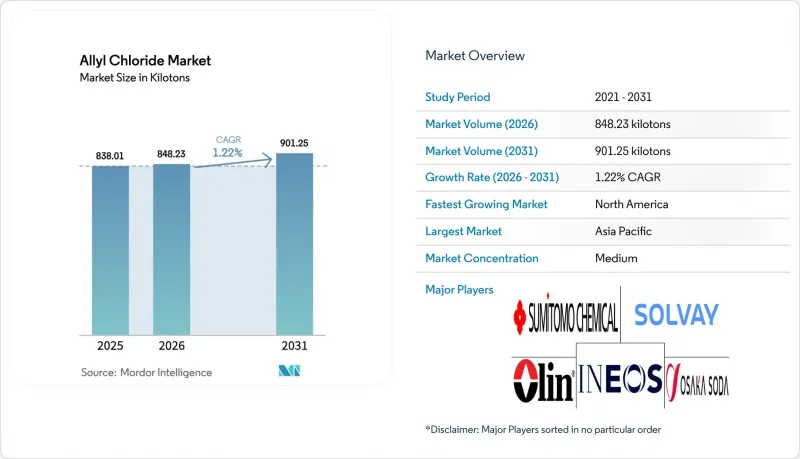
2025 年烯丙基氯市場價值為 838.01 千噸,預計到 2031 年將達到 901.25 千噸,而 2026 年為 848.23 千噸,預測期(2026-2031 年)複合年成長率為 1.22%。
烯丙基氯市場目前仍主要由環氧氯丙烷的生產所驅動,但由於製程進步和區域原料優勢,這種依賴性正在逐漸降低。環氧樹脂在風力發電機葉片和電動車複合材料等領域的應用不斷擴大、北美基礎設施投資的恢復以及歐美更嚴格的廢水排放法規,都為這一成長提供了支撐。此外,由於生物環氧氯丙烷的產能目前已佔全球供應量的六分之一以上,生產商不得不權衡丙烯和甘油基替代品的經濟可行性。利用數位雙胞胎技術實現自動化正在減少意外運作,提高產量,並在一定程度上緩解丙烯和電力成本波動的影響。同時,歐美更嚴格的職業暴露限值推高了合規成本,同時也刺激了對高純度、高價位產品的需求。
全球烯丙基氯市場趨勢及洞察
風力發電機葉片和電動車複合材料對環氧樹脂的需求激增。
2024年,全球風力發電設備的安裝將使用超過12萬噸環氧樹脂,每新增1吉瓦裝置容量約需1700噸樹脂,這將直接推動環氧氯丙烷的需求。 2024年,電池式電動車(BEV)複合材料零件的使用量較去年同期成長15%,推動烯丙基氯市場轉型為高價值樹脂等級。 2024年,中國新增風電裝置容量70吉瓦,歐洲18吉瓦,美國12吉瓦,這三大洲將成為市場成長的主要驅動力。環氧樹脂生產商日益重視可追溯的供應鏈,烯丙基氯生產商也隨之加強了批次認證流程。預計到2026年,電池式電動車產量將達到2,500萬輛,即使生物基生產方法日益普及,對高純度環氧氯丙烷的需求預計仍將保持強勁。
全球工業水處理法規的擴展
2024年最終定稿的修訂版《市政污水處理指令》規定,大型都會區必須在2045年前採用季銨鹽處理,並要求製藥和化妝品公司承擔去除微量污染物80%的成本。該指令已為新建處理設施籌集了36億歐元的資金。 2026年,全氟烷基和多氟烷基物質的監測成為強制性要求,擴大了對源自氯烯丙基的季銨化合物的需求。在美國,針對這些物質的建議最大污染物濃度限值(MCL)的合規期限設定為2029年,迫使公共產業採用依賴烯丙基前驅物的離子交換樹脂。在日本,1,4-二噁烷的排放標準於2024年收緊;而在印度,紡織工業中心的零液體排放(ZLD)法規得到擴展,增加了對特種凝聚劑的需求。由於這些監管趨勢,氯丙烯市場繼續與基礎設施投資同步波動,而不是與大宗商品價格的周期性波動同步波動。
嚴格的職業接觸和排放標準(美國/歐盟/日本)
美國職業安全與健康管理局 (OSHA) 規定,8 小時平均濃度標準為 1 ppm,並強制安裝封閉回路型輸送系統。這可能會使一座中型工廠的成本增加約 1,000 萬美元。歐洲的 REACH 法規對工人適用類似的 1 ppm 標準,並對公眾暴露設定了更嚴格的 0.1 ppm 標準,要求安裝蒸氣回收設備。這將使新計畫的成本增加約 20%。日本經濟產業省也採用類似的暴露標準,並強制要求每年進行健康檢查,這可能會使每年的營運成本增加高達 70 萬美元。歐盟的工業排放法規(將於 2024 年修訂)將反應器的 VOC排放限制在 5 mg/m³,鼓勵對熱氧化設備進行投資。目前,江蘇和古吉拉突邦已因違反法規而暫時停產,年產量約 12 千噸,凸顯了合規的風險。
細分市場分析
環氧氯丙烷在2025年佔總產量的89.08%。儘管生物基替代品日益普及,風力發電、電動車和電子產品仍消耗了大部分環氧氯丙烷產量。然而,成長最快的領域卻在另一個產業。隨著公共產業遵守更嚴格的微量污染物法規,水處理化學品的年複合成長率在2031年之前將達到3.59%。用於製藥的Allylamines受益於對非專利抗真菌劑的需求。價格較高的縮水甘油醚和烯丙磺酸鹽對於那些能夠在通用產品和特殊產品之間切換生產的工廠來說,仍然是具有吸引力的選擇。
在完成大規模環氧氯丙烷生產後,製造商重新調整了生產計劃,將重點轉向特種應用領域,從而在大規模大量資本投入的情況下最大限度地提高了產運轉率。數位雙胞胎系統實現了在36小時內過渡到符合藥用級氯丙烯標準(氯化物濃度低於50 ppm)的氯丙烯生產。這種柔軟性提高了高純度氯丙烯的市場佔有率,並緩解了利潤率的下滑,即使在丙烯價格高企時期也是如此。隨著生物環氧氯丙烷市場的擴張,均衡的投資組合策略對於確保資產永續性日益重要。
《氯烯丙基市場報告》按應用領域(環氧氯丙烷、Allylamines、烯丙磺酸鹽、縮水甘油醚、水處理化學品等)和地區(亞太地區、北美地區、歐洲地區、南美地區以及中東和非洲地區)進行細分。市場預測以噸為單位。
區域分析
2025年,亞太地區佔全球總產量的52.32%。該地區的烯丙基氯市場主要得益於大規模風電和電子產業的發展,但隨著進口生物基環氧氯丙烷(bio-ECH)進入市場,替代壓力日益增大。為滿足水性塗料的需求,印度在2025年將其位於古吉拉突邦的烯丙基氯年產量提高了1.2萬噸。在日本,憑藉嚴格的品管體系,醫藥級烯丙基氯產品的出口持續保持主導地位。韓國則利用其丙烯盈餘供應東南亞市場。
預計北美將呈現最高的成長率,到2031年複合年成長率將達到1.36%。這反映了美國墨西哥灣墨西哥灣沿岸豐富的頁岩丙烯資源和完善的氯氣生產能力。中西部和大西洋沿岸風力發電廠的快速成長保持了環氧氯丙烷供需的強勁勢頭,而陶氏化學在亞伯達新建的生物工廠則為買家提供了減少碳排放(產品中的碳含量)的選擇。墨西哥則受益於近岸外包趨勢,該趨勢正將塑膠製造業從東亞轉移到北美。
在歐洲,嚴格的排放法規提高了營運成本,這有利於大型綜合企業。德國仍然是最大的消費國,但向經認可的生物基材料的轉型導致傳統樹脂需求每年下降約3%。在東歐,特別是波蘭和捷克共和國,基礎建設的改善增加了樹脂需求,部分抵消了西歐的需求下降。
其他好處:
- Excel格式的市場預測(ME)表
- 3個月的分析師支持
目錄
第1章:引言
- 研究假設和市場定義
- 調查範圍
第2章:調查方法
第3章執行摘要
第4章 市場狀況
- 市場概覽
- 市場促進因素
- 風力發電機葉片和電動車複合材料對環氧樹脂的需求激增。
- 全球工業水處理法規的擴展
- 需要高純度烯丙基中間體的醫藥和農業生產流程
- 利用數位雙胞胎技術實現自動化,正在提高工廠運轉率和設備運轉率。
- 維修氯化設備,以實現小規模、低資本支出(CAPEX)工廠。
- 市場限制因素
- 嚴格的職業接觸和排放限制(美國/歐盟/日本)
- 丙烯和電力價格的波動給利潤率帶來了壓力。
- 生物基環氧氯丙烷(bio-ECH)產量的增加導致對氯烯丙基的需求佔有率下降。
- 價值鏈分析
- 波特五力模型
- 供應商的議價能力
- 消費者議價能力
- 新進入者的威脅
- 替代品的威脅
- 競爭程度
第5章 市場規模與成長預測
- 透過使用
- 環氧氯丙烷
- Allylamines
- 烯丙基磺酸鹽
- 縮水甘油醚
- 水處理化學品
- 其他用途(黏合劑、香水、藥品等)
- 按地區
- 亞太地區
- 中國
- 印度
- 日本
- 韓國
- 亞太其他地區
- 北美洲
- 美國
- 加拿大
- 墨西哥
- 歐洲
- 德國
- 英國
- 法國
- 義大利
- 其他歐洲地區
- 南美洲
- 巴西
- 阿根廷
- 南美洲其他地區
- 中東和非洲
- 沙烏地阿拉伯
- 南非
- 其他中東和非洲
- 亞太地區
第6章 競爭情勢
- 市場集中度
- 策略趨勢
- 市佔率(%)/排名分析
- 公司簡介
- AccuStandard
- Aditya Birla Chemicals
- Arkema SA
- Befar Group Co., Ltd.
- Dow Inc.
- Gelest Inc.
- INEOS
- Kashima Chemical Co., Ltd.
- Olin Corporation
- OSAKA SODA
- Shandong Jinling Chemical Co.
- SINOPEC Baling Petrochemical Co., Ltd.
- Solvay
- Sumitomo Chemical Co., Ltd.
- Thermo Fisher Scientific Inc.
- Vizag Chemical
- WEGO CHEMICAL GROUP
第7章 市場機會與未來展望
The Allyl Chloride Market size was valued at 838.01 kilotons in 2025 and is estimated to grow from 848.23 kilotons in 2026 to reach 901.25 kilotons by 2031, at a CAGR of 1.22% during the forecast period (2026-2031).
The allyl chloride market remains centered on epichlorohydrin production, though advancements in processes and regional feedstock benefits are gradually reducing this reliance. Growth is supported by increasing epoxy resin applications in wind turbine blades and electric vehicle composites, renewed infrastructure investments in North America, and stricter wastewater regulations in Europe and the United States. Additionally, bio-epichlorohydrin capacity now accounts for over one-sixth of global supply, compelling producers to weigh the economics of propylene against glycerol-based alternatives. The adoption of digital-twin automation is reducing unplanned downtime and improving yields, partially mitigating the impact of fluctuating propylene and electricity costs. Meanwhile, stricter occupational exposure limits in both Europe and the United States are driving up compliance costs but also fostering demand for higher-purity products that command premium prices.
Global Allyl Chloride Market Trends and Insights
Surging Epoxy-Resin Demand in Wind-Turbine Blades and Electric-Vehicle Composites
Global wind installations utilized more than 120,000 metric tons of epoxy resin in 2024, with each gigawatt of added capacity requiring approximately 1,700 metric tons of resin, directly driving epichlorohydrin demand. Composite components in battery-electric vehicles increased by 15% year-on-year in 2024, shifting the allyl chloride market toward higher-value resin grades. China added 70 GW of wind power in 2024, Europe contributed 18 GW, and the United States added 12 GW, forming a growth engine across three continents. Epoxy formulators are increasingly focusing on traceable supply chains, leading allyl-chloride producers to tighten batch certification processes. Battery-electric vehicle production is expected to reach 25 million units by 2026, maintaining demand for high-purity epichlorohydrin even as bio-based production methods gain traction.
Expansion of Industrial Water-Treatment Regulations Worldwide
The European Union's revised Urban Wastewater Treatment Directive, finalized in 2024, requires quaternary treatment for large agglomerations by 2045 and mandates pharmaceutical and cosmetic companies to cover 80% of micropollutant removal costs, unlocking EUR 3.6 billion for new treatment facilities. Monitoring of per- and polyfluoroalkyl substances became mandatory in 2026, boosting demand for quaternary-ammonium compounds derived from allyl chloride. In the United States, proposed maximum contaminant levels for these substances include compliance deadlines in 2029, prompting utilities to adopt ion-exchange resins that rely on allyl precursors. Japan tightened discharge limits on 1,4-dioxane in 2024, while India extended zero-liquid-discharge rules for textile hubs, increasing specialty-coagulant volumes. These regulatory developments keep the allyl chloride market aligned with infrastructure investments rather than cyclical commodity fluctuations.
Stringent Occupational-Exposure and Emission Limits (US/EU/JP)
The US Occupational Safety and Health Administration enforces an 8-hour limit of 1 ppm, requiring closed-loop transfer systems that can add approximately USD 10 million to the costs of a mid-size unit. Europe's REACH framework enforces the same 1 ppm worker limit and a stricter 0.1 ppm limit for public exposure, necessitating vapor-recovery units that increase greenfield project costs by about 20%. Japan's Ministry of Economy, Trade and Industry applies similar exposure limits and mandates annual health checks, which can add up to USD 700,000 annually to operating expenses. Revised EU Industrial Emissions rules in 2024 now cap reactor VOC emissions at 5 mg/m3, prompting investments in thermal oxidizers. Non-compliance has already resulted in temporary shutdowns of approximately 12 kilotons per year in Jiangsu and Gujarat, highlighting enforcement risks.
Other drivers and restraints analyzed in the detailed report include:
- Pharma and Agrochemical Pipeline Requiring High-Purity Allyl Intermediates
- Digital-Twin Automation Boosting Plant Uptime and Capacity Utilization
- Volatile Propylene and Electricity Prices Squeezing Margins
For complete list of drivers and restraints, kindly check the Table Of Contents.
Segment Analysis
Epichlorohydrin captured 89.08% of the 2025 volume. Wind energy, electric vehicles, and electronics consumed the bulk of these volumes even as bio-alternatives began to gain traction. Yet the fastest expansion lay elsewhere: water-treatment chemicals advanced at a 3.59% CAGR through 2031 as utilities complied with stricter micropollutant rules. Pharma-focused allyl amines benefited from the demand for generic antifungal products. Glycidyl ethers and allyl sulfonates with higher pricing remained attractive for plants that could switch between commodity and specialty batches.
Producers reconfigured scheduling so that specialty campaigns followed large epichlorohydrin runs, maximizing uptime without major capital additions. Digital-twin systems allowed a 36-hour changeover to pharmaceutical-grade allyl chloride that met sub-50 ppm chloride limits. This flexibility raised the allyl chloride market share of high-purity output during periods of propylene price spikes, cushioning margins. As bio-epichlorohydrin gained a footprint, the balanced portfolio approach became more critical for asset sustainability.
The Allyl Chloride Market Report is Segmented by Application (Epichlorohydrin, Allyl Amines, Allyl Sulfonates, Glycidyl Ethers, Water Treatment Chemicals, and Other Applications) and Geography (Asia-Pacific, North America, Europe, South America, and Middle-East and Africa). The Market Forecasts are Provided in Terms of Volume (Tons).
Geography Analysis
Asia-Pacific anchored 52.32% of global volume in 2025, with the region's allyl chloride market size buffered by large wind and electronics sectors, yet substitution pressure rose as imported bio-ECH made inroads. India expanded Gujarat output by 12 kilotons per year in 2025 to back water-borne coatings, and Japan's pharmaceutical-grade exports remained dominant thanks to tight quality systems. South Korea leveraged its propylene surplus to feed Southeast Asian customers.
North America posted the quickest 1.36% CAGR through 2031, reflecting ample shale-based propylene and integrated chlorine capacity on the U.S. Gulf Coast. Rapid wind-farm additions in the Midwest and offshore Atlantic kept epichlorohydrin flows healthy, while Dow's new Alberta bio unit gave buyers the option to lower embodied carbon. Mexico gained from near-shoring dynamics that redirected plastics manufacturing from East Asia into North America.
In Europe, strict emission limits raised operating costs, favoring integrated majors with scale. Germany stayed the largest consumer, but a shift toward certified bio-materials trimmed conventional demand by roughly 3% annually. Eastern Europe, led by Poland and Czechia on infrastructure upgrades that raised resin needs, partially offset Western European contraction.
- AccuStandard
- Aditya Birla Chemicals
- Arkema S.A.
- Befar Group Co., Ltd.
- Dow Inc.
- Gelest Inc.
- INEOS
- Kashima Chemical Co., Ltd.
- Olin Corporation
- OSAKA SODA
- Shandong Jinling Chemical Co.
- SINOPEC Baling Petrochemical Co., Ltd.
- Solvay
- Sumitomo Chemical Co., Ltd.
- Thermo Fisher Scientific Inc.
- Vizag Chemical
- WEGO CHEMICAL GROUP
Additional Benefits:
- The market estimate (ME) sheet in Excel format
- 3 months of analyst support
TABLE OF CONTENTS
1 Introduction
- 1.1 Study Assumptions and Market Definition
- 1.2 Scope of the Study
2 Research Methodology
3 Executive Summary
4 Market Landscape
- 4.1 Market Overview
- 4.2 Market Drivers
- 4.2.1 Surging epoxy-resin demand in wind-turbine blades and Electronic Vehicle composites
- 4.2.2 Expansion of industrial water-treatment regulations worldwide
- 4.2.3 Pharma and agrochemical pipeline requiring high-purity allyl intermediates
- 4.2.4 Digital-twin automation boosting plant uptime and capacity utilization
- 4.2.5 On-purpose chlorination revamps enabling small-scale, low-CAPEX plants
- 4.3 Market Restraints
- 4.3.1 Stringent occupational-exposure and emission limits (US/EU/JP)
- 4.3.2 Volatile propylene and electricity prices squeezing margins
- 4.3.3 Bio-ECH scale-up eroding allyl-chloride demand share
- 4.4 Value Chain Analysis
- 4.5 Porter's Five Forces
- 4.5.1 Bargaining Power of Suppliers
- 4.5.2 Bargaining Power of Consumers
- 4.5.3 Threat of New Entrants
- 4.5.4 Threat of Substitutes
- 4.5.5 Degree of Competition
5 Market Size and Growth Forecasts (Volume)
- 5.1 By Application
- 5.1.1 Epichlorohydrin
- 5.1.2 Allyl Amines
- 5.1.3 Allyl Sulfonates
- 5.1.4 Glycidyl Ethers
- 5.1.5 Water Treatment Chemicals
- 5.1.6 Other Applications (Adhesives, Perfumes, Pharmaceuticals, etc.)
- 5.2 By Geography
- 5.2.1 Asia-Pacific
- 5.2.1.1 China
- 5.2.1.2 India
- 5.2.1.3 Japan
- 5.2.1.4 South Korea
- 5.2.1.5 Rest of Asia-Pacific
- 5.2.2 North America
- 5.2.2.1 United States
- 5.2.2.2 Canada
- 5.2.2.3 Mexico
- 5.2.3 Europe
- 5.2.3.1 Germany
- 5.2.3.2 United Kingdom
- 5.2.3.3 France
- 5.2.3.4 Italy
- 5.2.3.5 Rest of Europe
- 5.2.4 South America
- 5.2.4.1 Brazil
- 5.2.4.2 Argentina
- 5.2.4.3 Rest of South America
- 5.2.5 Middle-East and Africa
- 5.2.5.1 Saudi Arabia
- 5.2.5.2 South Africa
- 5.2.5.3 Rest of Middle-East and Africa
- 5.2.1 Asia-Pacific
6 Competitive Landscape
- 6.1 Market Concentration
- 6.2 Strategic Moves
- 6.3 Market Share (%)/Ranking Analysis
- 6.4 Company Profiles (includes Global level Overview, Market level overview, Core Segments, Financials as available, Strategic Information, Products and Services, and Recent Developments)
- 6.4.1 AccuStandard
- 6.4.2 Aditya Birla Chemicals
- 6.4.3 Arkema S.A.
- 6.4.4 Befar Group Co., Ltd.
- 6.4.5 Dow Inc.
- 6.4.6 Gelest Inc.
- 6.4.7 INEOS
- 6.4.8 Kashima Chemical Co., Ltd.
- 6.4.9 Olin Corporation
- 6.4.10 OSAKA SODA
- 6.4.11 Shandong Jinling Chemical Co.
- 6.4.12 SINOPEC Baling Petrochemical Co., Ltd.
- 6.4.13 Solvay
- 6.4.14 Sumitomo Chemical Co., Ltd.
- 6.4.15 Thermo Fisher Scientific Inc.
- 6.4.16 Vizag Chemical
- 6.4.17 WEGO CHEMICAL GROUP
7 Market Opportunities and Future Outlook
- 7.1 White-space and Unmet-Need Assessment


