


 |
市場調查報告書
商品編碼
2044189
雷射感測器:市場佔有率分析、產業趨勢與統計、成長預測(2026-2031)Laser Sensor - Market Share Analysis, Industry Trends & Statistics, Growth Forecasts (2026 - 2031) |
||||||

※ 本網頁內容可能與最新版本有所差異。詳細情況請與我們聯繫。
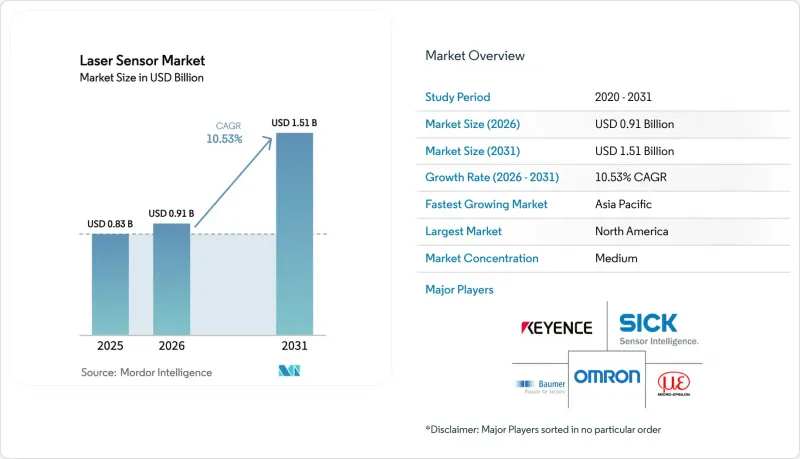
預計雷射感測器市場將從 2025 年的 8.3 億美元成長到 2026 年的 9.1 億美元,然後在 2031 年達到 15.1 億美元,2026 年至 2031 年的複合年成長率為 10.53%。
強勁的需求源自於高精度應用場景,在這些場景中,機械測量工具容易受到污染,而視覺系統無法透過三角測量或飛行時間 (ToF) 設備確保亞微米級的重複性。電動車電池堆疊、先進半導體封裝和倉庫自動化是三個最具影響力的應用領域,隨著週期時間和良率目標的日益嚴格,這三個領域都顯著推高了資本支出預算。硬體升級目前通常將邊緣分析與多軸雷射位移測量頭相結合,在滿足 ISO 10360 和 FDA 21 CFR Part 11 可追溯性要求的同時,最大限度地降低資料延遲。儘管在供不應求,但供應商仍在通過認證用於中功率陣列的氮化鎵發送器來規避風險。
全球雷射感測器市場趨勢及洞察
消除電動車電池組裝中的精確縫隙將加速雷射位移感測器的應用。
隨著電動車的日益普及,到2025年,從電池到電池組的組裝公差將降至50閾值以下。藍紫共聚焦感測器目前可實現0.5微米的重複精度,取代了存在箔片損壞風險的機械測量工具。特斯拉柏林工廠在採用線上輪廓儀後,返工率降低了12%。隨著中國主要鋰離子電池製造商陸續採用GB/T 36276標準,市場需求進一步擴大。供應商正在整合邊緣分析功能,並在50毫秒內完成回饋迴路,從而減少了70%的伺服器流量,並在歐洲和亞洲獲得了廣泛的設計應用。中國、德國和美國的補貼計畫持續推進,使雷射感測器的需求保持在高位。
半導體封裝中 3D AOI 的擴展正在推動對 3D 線感測器的需求。
晶片級、扇出型晶圓級和混合鍵結節點需要±10微米的共面性控制,而2DAOI在經濟高效的週期時間內無法達到此精度。3D射線感測器以10 kHz的頻率投射結構光,可在每片晶圓不到200毫秒的時間內實現0.1微米的Z軸解析度。台積電報告稱,2025年將部署超過300套此類感測器,使良率提高8個百分點。歐洲的「TIPS法案」為CpK值超過1.67的感測器提供補貼,有效地推動了線上雷射測量技術的普及。同時,日本經濟產業省(METI)已撥款2,000億日圓(約14億美元)用於國內測量設備的研發。這些措施共同加速了雷射感測器在封裝廠市場的滲透。
CMOS ToF 相機的替代品所帶來的價格壓力
售價低於 50 美元、解析度為 640x480 的深度圖攝影機正在對消費機器人領域售價超過 80 美元的雷射測距感測器構成威脅。預計到 2025 年,68% 的新型清潔機器人將配備飛行時間 (ToF) 感測器。供應商正透過在感測器上捆綁物件分類韌體來應對這一挑戰,但在對成本敏感的細分市場,價格彈性仍然有利於攝影機。在工業細分市場,雷射感測器由於不易受陽光影響且精度可達亞毫米級,仍然佔據主導地位,但隨著入門級產品平均售價 (ASP) 逐年下降 8-10%,其優勢正在縮小。這一趨勢將導致雷射感測器市場的複合年成長率 (CAGR) 預計下降 0.8 個百分點,尤其是在亞太地區的消費性電子中心。
細分市場分析
到2025年,硬體將佔據82.13%的市場佔有率,這主要得益於對多軸輪廓儀的一次性資本投資,每台設備的成本在6萬至12萬美元之間。可追溯校準、預測性維護API和感測器融合軟體的售後市場正在不斷擴大,隨著工廠將測量設備整合到MES平台中,它們獲得了持續的預算支持,服務業務的複合年成長率將達到11.54%。領先的供應商預計,在航太夾具±10微米精度保證合約的推動下,2026年業務收益將實現兩位數成長,這些合約推高了服務價格。訂閱合約通常持續3至5年,這不僅鞏固了供應商的鎖定作用,也平緩了收入波動。
軟體如同連接組織。點雲庫、SPC儀錶板和AI分類器將原始距離測量數據轉化為可執行的洞察,從而將產品生命週期價值提升至遠超硬體利潤率的水平。 Cognex的2025年授權(每用戶1200美元)實現了與第三方雷射的互通性,清楚地印證了這一趨勢。同時,在新興市場,設備的資本支出(CAPEX)仍超過年度使用費,儘管入門級測距設備的平均售價(ASP)每年下降6%,但硬體銷量依然強勁。這些趨勢共同作用,使得服務領域成為整個雷射感測器市場中成長最快的細分市場。
預計2025年,測距設備將維持30.25%的市場佔有率,其應用領域包括料位測量、離地間隙測量和起重機防撞。然而,隨著小包裹轉運中心、白車身生產線和輪胎工廠對輪廓測繪的要求日益嚴格,輪廓感測器和線型感測器的年複合成長率預計將達到11.71%,直到2031年。亞馬遜部署了8,000台輪廓感測器,並在一年內將分類錯誤率降低了14%,充分證明了這種轉變的有效性。在晶圓凸塊高度檢測等對精度要求高於速度的應用中,位移感測器和三角測量感測器仍然至關重要。
儘管由於價格下降和CMOS相機普及,對基礎距離測量模組的需求有所減少,但工業買家仍然支援雷射感測器,尤其是在眩光抑制、測量範圍和抗運動模糊方面,雷射感測器在某些領域優於相機。此外,輪廓儀由於能夠與AI邊緣模組原生整合,在自主揀選和尺寸測量領域擁有先發優勢。這項優勢持續推動雷射感測器市場在倉儲業和汽車產業的成長。
區域分析
預計到2025年,北美將佔據39.82%的市場佔有率,這主要得益於電動車(EV)計畫、航太品質標準以及美國在倉儲自動化領域120億美元的投資。美國食品藥物管理局(FDA)的《聯邦法規彙編》第21篇第11部分正在推動製藥業可追溯測量技術的發展,而加拿大魁北克省和安大略省的航太生產線則透過改用雷射追蹤儀,夾具週轉率實現了兩位數的下降。預計到2025年,墨西哥的近岸外包熱潮將新增1,800萬平方英尺的廠房占地面積,其中大部分將採用雷射導引焊接單元來滿足原始設備製造商(OEM)的公差要求。
亞太地區是成長最快的地區,複合年成長率達12.01%,這主要得益於中國、日本和韓國對智慧工廠維修和半導體封裝生產線的補貼。中國工業和資訊化部已撥款150億元人民幣(約21億美元)用於測量技術升級,日本也投入2,000億日圓(約14億美元)用於3D檢測設備,降低了國內半導體製造業的進入門檻。在印度,到2025年將新增4,500萬平方英尺的A級倉庫空間,同時,配備雷射感測器的自主移動機器人(AMR)的引入也在穩步推進,以實現24小時不間斷配送,預計這將推動雷射感測器市場在整個南亞地區的擴張。
在歐洲,由於IEC 60825標準和機械指令對在開放式生產線上部署高功率輪廓儀的限制,成長緩慢。德國仍佔據該地區62%的需求,是汽車和工具機產業的主要驅動力。法國環境與能源管理署(ADEME)提供的5,000萬歐元(5,400萬美元)津貼正在加速低溫運輸設施中雷射雷達(LiDAR)的部署,英國航太產業叢集也因複合材料缺陷檢測而節省了成本。在中東和非洲地區,沙烏地阿拉伯的NEOM大型企劃已初見成效;在南美洲,儘管宏觀經濟波動,但巴西汽車產業的產能擴張仍為該產業帶來益處。
其他好處:
- Excel格式的市場預測(ME)表
- 3個月的分析師支持
目錄
第1章:引言
- 研究假設和市場定義
- 調查範圍
第2章:調查方法
第3章執行摘要
第4章 市場狀況
- 市場概覽
- 市場促進因素
- 解決電動車電池組裝中的精度差距將加速雷射位移感測器的應用。
- 半導體封裝中 3D AOI 的擴展正在推動對 3D 線感測器的需求。
- 智慧倉庫中從超音波測距感測器過渡到雷射測距感測器
- 固體雷射雷達成本的降低使得在歐洲將飛行時間感測器引入自動導引車成為可能。
- 軟性OLED檢測光電整合位移感測器
- 積層製造中的量子級聯雷射測量
- 市場限制因素
- CMOS ToF 相機的替代品所帶來的價格壓力
- 3B類和4類功率排放的監管限制
- 高功率VCSEL陣列所需的InP外延生產能力短缺
- 邊緣運算產生的熱負荷限制了自主無人機中的感測器融合。
- 宏觀經濟因素對市場的影響
- 產業供應鏈分析
- 技術展望
- 監理情勢
- 波特五力分析
- 新進入者的威脅
- 買方的議價能力
- 供應商的議價能力
- 替代品的威脅
- 競爭公司之間的競爭
第5章 市場規模與成長預測
- 按組件
- 硬體
- 軟體
- 服務
- 依感測器類型
- 距離/範圍感測器
- 位移感測器
- 輪廓/線感應器
- 振動和能量感測器
- 三角測量感測器
- 其他感測器類型
- 按測量範圍
- 小於100毫米(短距離)
- 100-300 毫米(中距離)
- 超過 300 毫米(遠距離)
- 依輸出類型
- 小於1兆瓦
- 1~100 MW
- 101~500 MW
- 超過500兆瓦
- 按尺寸
- 一維單點感測器
- 2D區域感測器
- 3D輪廓感測器
- 按最終用戶行業分類
- 電子設備製造
- 汽車與出行
- 航太航太
- 建築/施工
- 醫療保健和醫療設備
- 食品/飲料加工
- 物流、倉儲、機器人
- 其他終端用戶產業
- 按地區
- 北美洲
- 美國
- 加拿大
- 墨西哥
- 南美洲
- 巴西
- 阿根廷
- 南美洲其他地區
- 歐洲
- 德國
- 英國
- 法國
- 義大利
- 其他歐洲地區
- 亞太地區
- 中國
- 日本
- 韓國
- 澳洲
- 印度
- 亞太其他地區
- 中東和非洲
- 中東
- 沙烏地阿拉伯
- 阿拉伯聯合大公國
- 土耳其
- 其他中東國家
- 非洲
- 南非
- 埃及
- 其他非洲地區
- 中東
- 北美洲
第6章 競爭情勢
- 市場集中度
- 策略趨勢
- 市佔率分析
- 公司簡介
- Keyence Corporation
- SICK AG
- OMRON Corporation
- Micro-Epsilon Messtechnik GmbH and Co. KG
- IFM Electronic GmbH
- Baumer Electric AG
- SmartRay GmbH
- Rockwell Automation Inc.
- Dimetix AG
- First Sensor AG(TE Connectivity)
- Banner Engineering Corp.
- Panasonic Industry Co.
- Cognex Corporation
- FARO Technologies Inc.
- Honeywell International Inc.
- Polytec GmbH
- OMS Corporation
- Teledyne DALSA
- Acuity Laser(Schmitt Measurement)
- Hokuyo Automatic Co. Ltd.
- Datalogic SpA
- Lumentum Holdings Inc.
- Trimble Inc.
- Hexagon AB
第7章 市場機會與未來展望
The laser sensor market size is expected to grow from USD 0.83 billion in 2025 to USD 0.91 billion in 2026 and is forecast to reach USD 1.51 billion by 2031 at a 10.53% CAGR over 2026-2031. Robust demand stems from precision-critical use cases where mechanical gauges risk contamination and vision systems cannot match the sub-micron repeatability offered by triangulation and time-of-flight devices. Electric-vehicle cell stacking, advanced semiconductor packaging, and warehouse automation are the three most influential adoption vectors, each exerting measurable pull on capital budgets as cycle-time and yield targets tighten. Hardware upgrades now routinely pair edge analytics with multi-axis laser displacement heads, curbing data latency while satisfying ISO 10360 and FDA 21 CFR Part 11 traceability mandates. Supply-side resilience is improving after indium-phosphide epitaxy shortages in 2025, yet vendors still hedge risk by qualifying gallium-nitride emitters for mid-power arrays.
Global Laser Sensor Market Trends and Insights
Precision-Gap Closure in EV Battery Assembly Accelerates Laser Displacement Sensor Uptake
Wider adoption of electric vehicles forced cell-to-pack assembly tolerances beneath the 50-micron threshold in 2025. Blue-violet confocal sensors now reach 0.5-micron repeatability, displacing mechanical gauges that risk foil damage. Tesla's Berlin plant cut rework by 12% after installing inline profilers, and Chinese lithium-ion giants cascading GB/T 36276 compliance have multiplied demand further. Vendors embed edge analytics to close feedback loops within 50 milliseconds, reducing server traffic by 70% and securing design wins across Europe and Asia. Subsidy programs in China, Germany, and the United States sustain momentum, keeping laser sensor market demand elevated.
Expansion of 3-D AOI in Semiconductor Packaging Spurs 3-D Line Sensor Demand
Chiplet, fan-out wafer-level, and hybrid bonding nodes call for co-planarity control within +-10 microns, a regime unachievable for 2-D AOI at economical takt times. Three-dimensional laser line sensors projecting structured light at 10 kHz now deliver 0.1-micron z-resolution in <200 milliseconds per substrate. TSMC deployed more than 300 units in 2025, citing an 8-point yield boost. Europe's Chips Act links subsidies to CpK above 1.67, effectively institutionalizing inline laser metrology, while Japan's METI has earmarked JPY 200 billion (USD 1.4 billion) for domestic toolsets. These mandates collectively accelerate laser sensor market penetration in packaging fabs.
Price Pressure from CMOS ToF Camera Alternatives
Depth-map cameras delivering 640X480 resolution at <USD 50 threaten laser distance sensors priced more than USD 80 in consumer robotics. ToF attach rates reached 68% of new vacuum robots in 2025. Suppliers counter by bundling on-sensor object-classification firmware, but price elasticity favors cameras in cost-driven segments. Industrial niches still shield lasers thanks to sunlight immunity and sub-millimeter accuracy, yet year-on-year entry-level ASP compression of 8-10% narrows this moat. The dynamic trims 0.8 points from the projected laser sensor market CAGR, especially in Asia-Pacific's appliance hubs.
Other drivers and restraints analyzed in the detailed report include:
- Migration from Ultrasonic to Laser Range Sensors in Smart Warehouses
- Falling Solid-State LiDAR Costs Enable ToF Sensors in European AGVs
- Regulatory Constraints on Class 3B and Class 4 Power Emissions
For complete list of drivers and restraints, kindly check the Table Of Contents.
Segment Analysis
Hardware represented 82.13% of the share in 2025, driven by one-off capital purchases of multi-axis profilers that each list between USD 60,000 and USD 120,000. A growing aftermarket for traceable calibration, predictive maintenance APIs, and sensor-fusion software now captures recurring budgets as factories tie metrology assets to MES platforms, pushing services to an 11.54% CAGR. Major vendors publicized double-digit service revenue lifts in 2026, confirming that contracts guaranteeing +-10-micron accuracy across aerospace jigs command premium pricing. Subscription layers typically run three to five years, embedding vendor lock-in while smoothing earnings volatility.
Software is the connective tissue; point-cloud libraries, SPC dashboards, and AI classifiers turn raw range data into actionable insights, lifting lifetime value well beyond hardware margin. Cognex's 2025 license, enabling interoperability with third-party lasers at USD 1,200 per seat, illustrates the trend. Meanwhile, emerging markets still allocate more capex to devices than to annual fees, sustaining hardware volume even as ASPs decline 6% each year for entry-level distance units. The combined dynamic positions services as the highest-growth pocket inside the broader laser sensor market.
Distance and range devices retained a 30.25% share in 2025, entrenched in fill-level, ground-clearance, and crane anti-collision tasks. Profiling and line sensors, however, are charting a CAGR of 11.71% through 2031 as parcel hubs, body-in-white lines, and tire plants intensify contour-mapping requirements. Amazon's roll-out of 8,000 profilers cut mis-sorts by 14% in one year, validating the switch. Displacement and triangulation sensors remain critical where sub-micron scrutiny outranks speed, such as wafer bump height checks.
Price erosion and CMOS camera creep siphon volume from basic distance segments, but industrial buyers stay loyal where lasers beat cameras on glare rejection, range, and motion blur immunity. Profilers also integrate natively with AI edge modules, awarding them an early mover edge in autonomous picking and dimensioning. This advantage keeps profiling at the vanguard of laser sensor market size gains across warehousing and automotive.
The Laser Sensor Market Report is Segmented by Component (Hardware, Software, and Services), Sensor Type (Distance/Range, Displacement, and More), Measurement Range (Less Than 100 Mm, and More), Power Output (Less Than 1 MW, 1-100 MW, and More), Dimensionality (1D Point, 2D Area, and 3D Profile), End-User Industry (Electronics, Automotive, and More), and Geography. The Market Forecasts are Provided in Terms of Value (USD).
Geography Analysis
North America held 39.82% of the share in 2025 thanks to electric-vehicle programs, aerospace quality charters, and USD 12 billion in U.S. warehouse-automation spend. FDA 21 CFR Part 11 bolsters traceable metrology in pharmaceuticals, while Canadian aerospace lines in Quebec and Ontario trimmed jig times by double digits after switching to laser trackers. Mexico's near-shoring boom added 18 million ft2 of plant floor in 2025, many with laser-guided welding cells to satisfy OEM tolerances.
Asia-Pacific is the fastest-growing region at a 12.01% CAGR because China, Japan, and South Korea inject subsidies into smart-factory retrofits and chip packaging lines. China's MIIT earmarked CNY 15 billion (USD 2.1 billion) for metrology upgrades, and Japan's JPY 200 billion (USD 1.4 billion) allotment for 3-D inspection tooling lowers entry barriers for domestic fabs. India's 45 million ft2 of new Grade-A warehouse space in 2025 banks on laser-equipped AMRs for 24-hour delivery promises, extending the laser sensor market's footprint across South Asia.
Europe grows more slowly as IEC 60825 and the Machinery Directive restrict high-power profiler deployment on open lines. Germany still accounts for 62% of regional demand, leveraging automotive and machine-tool sectors. France's ADEME grants of EUR 50 million (USD 54 million) speed LiDAR adoption in cold-chain sites, and the U.K. aerospace corridor captures savings from composite layup defect detection. The Middle East and Africa see early traction through Saudi Arabia's NEOM construction mega-project, while South America benefits from Brazilian automotive tool-ups despite macro volatility.
List of Companies Covered in this Report:
- Keyence Corporation
- SICK AG
- OMRON Corporation
- Micro-Epsilon Messtechnik GmbH and Co. KG
- IFM Electronic GmbH
- Baumer Electric AG
- SmartRay GmbH
- Rockwell Automation Inc.
- Dimetix AG
- First Sensor AG (TE Connectivity)
- Banner Engineering Corp.
- Panasonic Industry Co.
- Cognex Corporation
- FARO Technologies Inc.
- Honeywell International Inc.
- Polytec GmbH
- OMS Corporation
- Teledyne DALSA
- Acuity Laser (Schmitt Measurement)
- Hokuyo Automatic Co. Ltd.
- Datalogic S.p.A.
- Lumentum Holdings Inc.
- Trimble Inc.
- Hexagon AB
Additional Benefits:
- The market estimate (ME) sheet in Excel format
- 3 months of analyst support
TABLE OF CONTENTS
1 INTRODUCTION
- 1.1 Study Assumptions and Market Definition
- 1.2 Scope of the Study
2 RESEARCH METHODOLOGY
3 EXECUTIVE SUMMARY
4 MARKET LANDSCAPE
- 4.1 Market Overview
- 4.2 Market Drivers
- 4.2.1 Precision-Gap Closure in EV Battery Assembly Accelerates Laser Displacement Sensor Uptake
- 4.2.2 Expansion of 3D AOI in Semiconductor Packaging Spurs 3D Line Sensor Demand
- 4.2.3 Migration from Ultrasonic to Laser Range Sensors in Smart Warehouses
- 4.2.4 Falling Solid-State LiDAR Costs Enable ToF Sensors in European AGVs
- 4.2.5 Photonics-Integrated Displacement Sensors for Flexible OLED Inspection
- 4.2.6 Quantum-Cascade Laser Metrology in Additive Manufacturing
- 4.3 Market Restraints
- 4.3.1 Price Pressure from CMOS ToF Camera Alternatives
- 4.3.2 Regulatory Constraints on Class 3B and 4 Power Emissions
- 4.3.3 Limited InP Epitaxy Capacity for High-Power VCSEL Arrays
- 4.3.4 Edge-Compute Thermal Load Limits Sensor Fusion in Autonomous Drones
- 4.4 Impact of Macroeconomic Factors on the Market
- 4.5 Industry Supply-Chain Analysis
- 4.6 Technological Outlook
- 4.7 Regulatory Landscape
- 4.8 Porter's Five Forces Analysis
- 4.8.1 Threat of New Entrants
- 4.8.2 Bargaining Power of Buyers
- 4.8.3 Bargaining Power of Suppliers
- 4.8.4 Threat of Substitutes
- 4.8.5 Intensity of Competitive Rivalry
5 MARKET SIZE AND GROWTH FORECASTS (VALUE)
- 5.1 By Component
- 5.1.1 Hardware
- 5.1.2 Software
- 5.1.3 Services
- 5.2 By Sensor Type
- 5.2.1 Distance / Range Sensors
- 5.2.2 Displacement Sensors
- 5.2.3 Profiling / Line Sensors
- 5.2.4 Vibration and Energy Sensors
- 5.2.5 Triangulation Sensors
- 5.2.6 Other Sensor Types
- 5.3 By Measurement Range
- 5.3.1 Less than 100 mm (Short-Range)
- 5.3.2 100-300 mm (Medium-Range)
- 5.3.3 Greater than 300 mm (Long-Range)
- 5.4 By Power Output
- 5.4.1 Less than 1 MW
- 5.4.2 1-100 MW
- 5.4.3 101-500 MW
- 5.4.4 Greater than 500 MW
- 5.5 By Dimensionality
- 5.5.1 1D Point Sensors
- 5.5.2 2D Area Sensors
- 5.5.3 3D Profile Sensors
- 5.6 By End-user Industry
- 5.6.1 Electronics Manufacturing
- 5.6.2 Automotive and Mobility
- 5.6.3 Aerospace and Aviation
- 5.6.4 Building and Construction
- 5.6.5 Healthcare and Medical Devices
- 5.6.6 Food and Beverage Processing
- 5.6.7 Logistics, Warehousing and Robotics
- 5.6.8 Other End-user Industries
- 5.7 By Geography
- 5.7.1 North America
- 5.7.1.1 United States
- 5.7.1.2 Canada
- 5.7.1.3 Mexico
- 5.7.2 South America
- 5.7.2.1 Brazil
- 5.7.2.2 Argentina
- 5.7.2.3 Rest of South America
- 5.7.3 Europe
- 5.7.3.1 Germany
- 5.7.3.2 United Kingdom
- 5.7.3.3 France
- 5.7.3.4 Italy
- 5.7.3.5 Rest of Europe
- 5.7.4 Asia-Pacific
- 5.7.4.1 China
- 5.7.4.2 Japan
- 5.7.4.3 South Korea
- 5.7.4.4 Australia
- 5.7.4.5 India
- 5.7.4.6 Rest of Asia-Pacific
- 5.7.5 Middle East and Africa
- 5.7.5.1 Middle East
- 5.7.5.1.1 Saudi Arabia
- 5.7.5.1.2 United Arab Emirates
- 5.7.5.1.3 Turkey
- 5.7.5.1.4 Rest of Middle East
- 5.7.5.2 Africa
- 5.7.5.2.1 South Africa
- 5.7.5.2.2 Egypt
- 5.7.5.2.3 Rest of Africa
- 5.7.5.1 Middle East
- 5.7.1 North America
6 COMPETITIVE LANDSCAPE
- 6.1 Market Concentration
- 6.2 Strategic Moves
- 6.3 Market Share Analysis
- 6.4 Company Profiles (Includes Global Level Overview, Market Level Overview, Core Segments, Financials as Available, Strategic Information, Market Rank/Share, Products and Services, and Recent Developments)
- 6.4.1 Keyence Corporation
- 6.4.2 SICK AG
- 6.4.3 OMRON Corporation
- 6.4.4 Micro-Epsilon Messtechnik GmbH and Co. KG
- 6.4.5 IFM Electronic GmbH
- 6.4.6 Baumer Electric AG
- 6.4.7 SmartRay GmbH
- 6.4.8 Rockwell Automation Inc.
- 6.4.9 Dimetix AG
- 6.4.10 First Sensor AG (TE Connectivity)
- 6.4.11 Banner Engineering Corp.
- 6.4.12 Panasonic Industry Co.
- 6.4.13 Cognex Corporation
- 6.4.14 FARO Technologies Inc.
- 6.4.15 Honeywell International Inc.
- 6.4.16 Polytec GmbH
- 6.4.17 OMS Corporation
- 6.4.18 Teledyne DALSA
- 6.4.19 Acuity Laser (Schmitt Measurement)
- 6.4.20 Hokuyo Automatic Co. Ltd.
- 6.4.21 Datalogic S.p.A.
- 6.4.22 Lumentum Holdings Inc.
- 6.4.23 Trimble Inc.
- 6.4.24 Hexagon AB
7 MARKET OPPORTUNITIES AND FUTURE OUTLOOK
- 7.1 White-space and Unmet-Need Assessment

 對射式雷射感測器市場報告:趨勢、預測及競爭分析(至2035年)粉塵濃度感測器市場報告:趨勢、預測和競爭分析(至2035年)車載顆粒物感測器市場報告:趨勢、預測及競爭分析(至2035年)
 2026年全球道路輪廓雷射感測器市場報告
 工業雷射感測器市場:按雷射類型、檢測原理、檢測範圍、應用、終端用戶產業和銷售管道分類-2026-2032年全球市場預測
 雷射感測器市場規模、佔有率、趨勢和預測:按類型、組件、應用、最終用戶和地區分類,2026-2034年汽車雷射粉塵感測器市場按車輛類型、雷射類型、電源類型、應用和最終用戶分類,全球預測(2026-2032年)雷射粉塵濃度感測器市場(按產品類型、應用、最終用戶、連接方式、部署方式、組件和銷售管道),全球預測,2026-2032年
 雷射測距感測器市場分析及預測(至2035年):按類型、產品類型、技術、組件、應用、材質、最終用戶、功能、安裝類型和解決方案分類
 雷射感測器市場 - 全球產業規模、佔有率、趨勢、機會及預測(按類型、組件、應用、產業、地區和競爭格局分類),2021-2031年