


 |
市場調查報告書
商品編碼
2044170
硝酸銨:市場佔有率分析、產業趨勢與統計、成長預測(2026-2031)Ammonium Nitrate - Market Share Analysis, Industry Trends & Statistics, Growth Forecasts (2026 - 2031) |
||||||

※ 本網頁內容可能與最新版本有所差異。詳細情況請與我們聯繫。
預計到 2026 年,硝酸銨市場規模將達到 5,343 萬噸,到 2031 年將達到 5,819 萬噸,在預測期(2026-2031 年)內,複合年成長率將達到 4.36%。
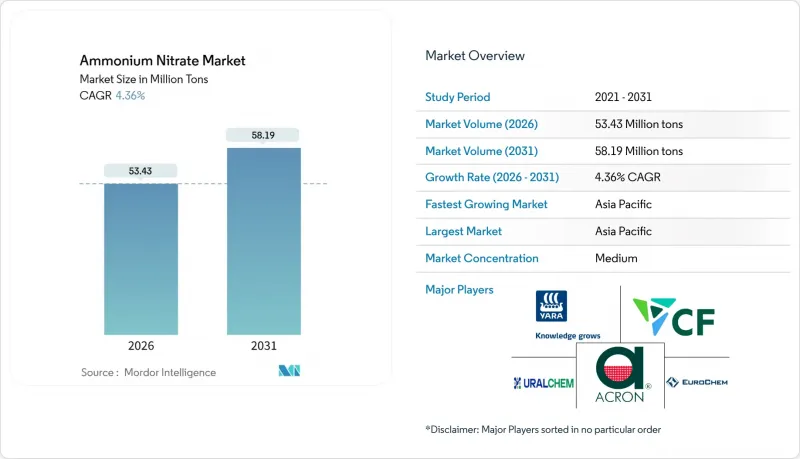
硝酸銨市場正受到一系列趨勢的影響,例如加強碳排放邊境調節措施、炸藥生產向新興銅鎳中心集中,以及精密農業更傾向於使用緩釋型包膜顆粒肥料)。礦商正在指定使用高能量配方來開採更深層的礦床,而藍氨和綠氨計畫正在重塑下游硝酸鹽產品的成本曲線,這些產品需進行碳排放報告。雅苒(Yara)、CF Industries 和 OCI 等老牌企業正在投資低排放原料,以鞏固其市場地位,同時,區域性新興企業正在為特定回收項目和國防領域建立規模小規模、更靈活的生產設施。硝酸銨市場在亞太和南美地區的成長與北美和歐洲的監管阻力之間持續保持平衡。
全球硝酸銨市場趨勢及洞察
大型露天礦場中硝銨炸藥和乳化炸藥的推廣應用
露天煤礦、銅礦和鋰礦正轉向使用高能量硝銨炸藥(ANFO)和乳化炸藥,以降低鑽探密度並加快表土剝離速度,從而導致工業級硝酸銨的消耗量增加。 Orica 的 4D 散裝炸藥平台結合了乳化炸藥和多孔顆粒炸藥,可最佳化壓裂效果並提供可變能量輸出,最大限度地降低每噸岩石剝離的單位成本。與傳統的硝銨炸藥混合物相比,印尼的紅土鎳礦計畫和智利高地的銅礦每噸礦石需要多消耗 20-30% 的硝酸銨,因為水的滲入劣化傳統燃料油混合物的效能。沙烏地阿拉伯的 SCCL 計劃在拉斯蓋爾建造一座年產 30 萬噸的工業級硝酸銨工廠,這表明沿岸地區的生產商正在實現炸藥採購的本地化,並向非洲的礦業公司供應炸藥。隨著礦場追求更高的回收率,硝酸銨市場受益於對價格敏感度低於農業部門的需求結構。
全球農業對化肥的需求不斷成長
儘管人口成長帶動了氮肥基本需求的增加,但區域差異仍然存在。印度的補貼制度仍偏向尿素,而巴西塞拉多地區的農民則轉向使用硝酸銨鈣來應對土壤酸化。歐盟的「從農場到餐桌」策略正在推廣精密農業技術,迫使經銷商轉向聚合物包膜顆粒狀硝酸銨以減少淋溶損失。受外匯匯率的推動,阿根廷小麥生產商預計到2025年將硝酸銨採購量增加8%。這顯示價格波動的影響可能超過傳統的作物和養分管理方式。因此,硝酸銨市場不僅受氮肥成本的影響,也受到補貼制度、碳標籤和農業差異化的影響。在這種政策環境複雜的地區,將包膜或硝酸銨鈣產品與諮詢服務結合的供應商正在獲得定價權。
對硝酸銨的儲存和運輸有嚴格的規定
在進行安全審查後,美國菸酒槍砲及爆炸物管理局 (ATF) 收緊了儲存標準,迫使許多地方經銷商減少硝酸銨庫存並轉向尿素硝銨溶液 (UAN)。在加拿大,爆炸物法規要求必須上鎖儲存並保持安全距離,這限制了農場儲存,導致生產商轉向散裝運輸的液體肥料。澳洲各州的分區法規禁止在住宅500 公尺範圍內建造新倉庫,從而縮小了郊區的分銷範圍。雖然亞洲的監管相對寬鬆,但經合組織 (OECD) 國家不斷上漲的合規成本正導致 5% 至 10% 的氮肥需求轉向替代品。因此,硝酸銨市場必須克服法規環境的差異,這降低了其作為大面積農田肥料的吸引力。
細分市場分析
炸藥市場正以4.91%的複合年成長率成長,比硝酸銨整體市場成長高出近1個百分點,而化肥市場因尿素的替代而成長放緩。智利、秘魯和印尼的銅鎳礦正在使用乳化炸藥,與傳統的ANFO(硝酸銨-氟化銨混合炸藥)相比,每次爆破需要多25%至35%的工業級硝酸鹽,這推動了對密度均勻的多孔顆粒狀炸藥的高階需求。
儘管化肥需求總量仍占主導地位,但其兩極化日益加劇。在歐洲,符合養分利用效率監管要求的聚合物包衣顆粒硝酸鹽正獲得越來越多的投資;而在亞洲,人們則依賴補貼尿素,硝酸銨的使用僅限於特種作物。相比之下,炸藥的價格敏感度較低。這是因為未爆的炸藥會迅速增加採礦成本,使得供應商能夠為農業級炸藥設定每噸20-30美元的溢價。
顆粒狀產品是成長最快的形式,複合年成長率達 5.66%,但到 2025 年,多孔顆粒仍將佔總量的 60.25%,作為 ANFO 的主要原料。精準撒播機需要均勻的顆粒大小,而聚合物包覆的顆粒狀產品可在 60 至 90 天內釋放養分,符合歐洲「從農場到餐桌」的目標。
多孔顆粒炸藥在炸藥領域保持優勢,因為它們能夠快速吸收燃料油,並確保散裝炸藥系統中穩定的爆速。像阿佐蒂集團這樣的綜合生產企業透過在同一廠區內生產這兩種形式的炸藥來分散風險,從而平衡礦石出口和中歐包膜性肥料的銷售。
《硝酸銨市場報告》按應用領域(化肥、炸藥及其他)、形態(多孔顆粒、粒狀物、液體溶液/懸浮液)、等級(農業級和工業級)、終端用戶行業(農業、採礦、國防及其他終端用戶行業)和地區(亞太地區、北美、歐洲、南美以及中東和非洲)進行細分。市場預測以噸為單位。
區域分析
預計到2025年,亞太地區將佔全球市場佔有率的45.46%,保持領先地位,並以5.01%的複合年成長率成長。這主要得益於中國向非洲和拉丁美洲礦山出口工業級氨,以及印度逐步從尿素轉向差異化硝酸鹽。儘管中國煤製氨仍具有成本競爭力,但出口商正轉向多孔顆粒氨以獲得採礦業的溢價,這加劇了硝酸銨市場供應轉移到炸藥應用領域的趨勢。
北美市場規模仍然龐大,但由於農業倉儲稅 (ATF) 法規對農場倉儲的限制,經銷商正轉向散裝尿素硝酸銨 (UAN),與此同時,藍氨計畫也開始運作,以滿足歐洲碳邊境調節機制 (CBAM) 相關買家的需求。加拿大的鉀肥和油砂產業支撐著該地區對技術級產品的需求,並緩解了農業領域面臨的不利因素。
在歐洲,各國正努力遵守碳排放交易體系(CBAM)的報告要求,該體系會對高排放進口產品進行處罰,導致買家轉向國內低碳來源,例如阿佐蒂集團(Grupa Azoti)的塔爾諾夫工廠和雅苒(Yara)的綠色氨計畫。南部地區的生產商依賴從北非進口,而北部地區的生產商則正在投資維修碳捕集設施以保住市場佔有率。
南美市場受巴西大豆產量成長和智利銅礦開採的推動,但該地區缺乏一體化生產能力,並且從中東和中國進口多孔顆粒,因此容易受到運費波動的影響。
在中東和非洲,沿岸地區的藍氨計畫(包括QAFCO 7計畫)將在2026年前新增120萬噸低排放原料,使該地區成為歐洲買家遵守排放法規的避險選擇。沙烏地阿拉伯計劃建造的技術級藍氨工廠以及南非採礦業需求的成長,進一步鞏固了多元化的需求基礎。
其他好處:
- Excel格式的市場預測(ME)表
- 3個月的分析師支持
目錄
第1章:引言
- 研究假設和市場定義
- 調查範圍
第2章:調查方法
第3章執行摘要
第4章 市場狀況
- 市場概覽
- 市場促進因素
- 由於再生農業計畫的開展,對硝酸銨鈣的需求激增。
- 大型露天礦場廣泛使用硝銨炸藥和乳化炸藥。
- 與頁岩油管道維修相關的受控拆除活動增加。
- 全球農業對化肥的需求不斷成長
- 氨脫碳計畫促進低碳硝酸鹽的應用。
- 市場限制因素
- 對硝酸銨的儲存和運輸有嚴格的規定
- 替代氮肥(尿素、尿素硝銨溶液、尿素+硝基苯酚)的可用性
- 高排放硝酸銨的碳邊境調節成本
- 價值鏈分析
- 波特五力模型
- 供應商的議價能力
- 買方的議價能力
- 新進入者的威脅
- 替代品的威脅
- 競爭程度
第5章 市場規模和成長預測(價值和數量)
- 透過使用
- 肥料
- 霹靂
- 其他應用(氣體發生器、冷卻包、煙火、火箭推進和工業過程)
- 按形式
- 多孔顆粒
- 顆粒狀
- 液體溶液/懸浮液
- 按年級
- 農業級
- 工業級
- 按最終用戶行業分類
- 農業
- 礦業
- 防禦
- 其他終端用戶產業(汽車、食品業、石油與天然氣、醫療保健、建築)
- 按地區
- 亞太地區
- 中國
- 印度
- 日本
- 韓國
- 東南亞國協
- 亞太其他地區
- 北美洲
- 美國
- 加拿大
- 墨西哥
- 歐洲
- 德國
- 英國
- 法國
- 義大利
- 西班牙
- 北歐國家
- 其他歐洲地區
- 南美洲
- 巴西
- 阿根廷
- 南美洲其他地區
- 中東和非洲
- 沙烏地阿拉伯
- 南非
- 其他中東和非洲地區
- 亞太地區
第6章 競爭情勢
- 市場集中度
- 策略趨勢
- 市佔率(%)/排名分析
- 公司簡介
- Abu Qir Fertilizers and Chemical Industries Company
- Acron
- Austin Powder
- Casale SA
- CF Industries Holdings, Inc.
- Dyno Nobel
- ENAEX
- EuroChem Group
- Fertiberia
- Grupa Azoty
- Hanwha Group
- MAXAMCORP HOLDING, SL
- Neochim Plc
- OCI
- Orica Limited
- OSTCHEM
- PJSC KuibyshevAzot
- Qatar Fertiliser Company(QPSC)
- San Corporation
- Sasol
- URALCHEM JSC
- Yara
第7章 市場機會與未來展望
The Ammonium Nitrate Market size is estimated at 53.43 Million tons in 2026, and is expected to reach 58.19 Million tons by 2031, at a CAGR of 4.36% during the forecast period (2026-2031).
The ammonium nitrate market is responding to tighter carbon-border policies, localized explosive production near emerging copper and nickel hubs, and precision-agriculture adoption that favors coated granules with slower nutrient release. Mining operators are specifying higher-energy blends to unlock deeper ore bodies, while blue and green ammonia projects are reshaping the cost curve for downstream nitrates qualifying for embedded-carbon reporting. Incumbents such as Yara, CF Industries, and OCI are funneling capital into low-emission feedstock to defend their positions, as regional disruptors build smaller, flexible units that serve niche regenerative programs and defense channels. The ammonium nitrate market continues to balance growth in Asia-Pacific and South America against regulatory headwinds in North America and Europe.
Global Ammonium Nitrate Market Trends and Insights
Expansion of ANFO and Emulsion Explosives in Large-Scale Surface Mining
Surface coal, copper, and lithium operations are turning to higher-energy ANFO and emulsion blends that reduce drilling density and speed up overburden removal, increasing technical-grade ammonium nitrate consumption. Orica's 4D bulk-explosives platform combines emulsion with porous prills, offering variable energy output that tailors fragmentation and minimizes unit cost per ton of rock moved. Indonesia's nickel laterite projects and Chile's high-altitude copper pits require 20-30% more ammonium nitrate per ton of ore than older ANFO mixes because water ingress undermines conventional fuel-oil blends. Saudi Arabia's SCCL plans a 300,000 ton-per-year technical-grade plant at Ras Al Khair, demonstrating how Gulf producers intend to localize explosive inputs and serve African mining ventures. As mines chase higher recovery rates, the ammonium nitrate market benefits from a demand profile that is less price-sensitive than agriculture.
Increasing Demand for Fertilizers in Global Agriculture
Baseline nitrogen demand rises as populations grow, yet regional divergence persists: India's subsidy regime still favors urea, while Brazil's Cerrado growers move to calcium-ammonium-nitrate to counter soil acidification. The European Union's Farm to Fork strategy promotes precision technologies, pushing distributors toward polymer-coated granular ammonium nitrate that cuts leaching losses. Argentina's wheat producers lifted ammonium nitrate purchases 8% in 2025 on currency tailwinds, proving that price swings can override crop-nutrient traditions. The ammonium nitrate market, therefore, hinges on subsidy structures, carbon labeling, and agronomic differentiation rather than bulk nitrogen cost alone. Suppliers that bundle advisory services with coated or CAN products gain pricing power in this uneven policy landscape.
Stringent Regulations on Storage and Transport of Ammonium Nitrate
Following safety reviews, the US Bureau of Alcohol, Tobacco, Firearms, and Explosives shortened storage thresholds, compelling many rural distributors to drop ammonium nitrate inventories and pivot to UAN. Canada's Explosives Regulations impose locked magazines and setback distances that hinder on-farm storage, driving growers toward liquid solutions delivered in bulk. Australia's state zoning rules ban new depots within 500 meters of residences, shrinking distribution in peri-urban belts. While Asia maintains lighter oversight, the added compliance cost in OECD regions diverts 5-10% of nitrogen demand to substitutes. The ammonium nitrate market must therefore navigate uneven regulatory terrain that erodes its broad-acre fertilizer appeal.
Other drivers and restraints analyzed in the detailed report include:
- Decarbonised-Ammonia Projects Spurring Low-Carbon Nitrate Adoption
- Surge in Calcium-Ammonium-Nitrate Demand from Regenerative Farming Programs
- Availability of Substitute Nitrogen Fertilizers (Urea, UAN, Urea + NBPT)
For complete list of drivers and restraints, kindly check the Table Of Contents.
Segment Analysis
Explosives expand at a 4.91% CAGR, nearly a full point above the overall ammonium nitrate market, while fertilizers grow more slowly due to urea substitution. Copper and nickel mines in Chile, Peru, and Indonesia use emulsion blends that require 25-35% more technical-grade nitrate per blast than conventional ANFO, driving premium demand for porous prills with consistent density.
Fertilizer demand remains dominant in tonnage but is bifurcating: Europe invests in polymer-coated granular nitrate that satisfies nutrient-efficiency mandates, whereas Asia leans on subsidized urea, relegating ammonium nitrate to specialty crops. Explosives, by contrast, remain less price-sensitive because blasting misfires quickly inflate mining costs, allowing suppliers to command USD 20-30 per ton premiums over agricultural-grade product.
Granular product is the fastest-growing form at 5.66% CAGR, although porous prills still held 60.25% of volume in 2025 as the feedstock of choice for ANFO. Precision spreaders require uniform particle size, and polymer-coated granules extend nutrient release across 60-90 days, aligning with Europe's Farm to Fork goals.
Porous prills maintain dominance in explosives thanks to their ability to absorb fuel oil rapidly, ensuring stable detonation velocity in bulk systems. Integrated producers such as Grupa Azoty hedge bets by manufacturing both forms in the same complex, balancing mining exports with coated fertilizer sales in Central Europe.
The Ammonium Nitrate Market Report is Segmented by Application (Fertilizers, Explosives, and Other), Form (Porous Prills, Granular, and Liquid Solution/Suspension), Grade (Agricultural and Industrial), End-User Industry (Agriculture, Mining, Defense, and Other End-User Industries), and Geography (Asia-Pacific, North America, Europe, South America, and Middle East and Africa). Market Forecasts are Provided in Terms of Volume (tons).
Geography Analysis
Asia-Pacific led the global volume with 45.46% in 2025 and is advancing at a 5.01% CAGR, propelled by China's technical-grade exports to African and Latin American mines and India's gradual shift from urea dependence toward differentiated nitrates. China's coal-based ammonia remains cost-competitive, yet exporters increasingly upgrade to porous prills to capture mining premiums, reinforcing the ammonium nitrate market's supply pivot toward explosives.
North America held a substantial market volume, but ATF rules curtail on-farm storage, pushing distributors toward bulk UAN even as blue-ammonia projects come online to satisfy CBAM-linked buyers in Europe. Canada's potash and oil-sands industries sustain regional technical-grade demand that bypasses agricultural headwinds.
Europe grapples with CBAM reporting that penalizes high-emission imports, steering buyers toward domestic low-carbon supply such as Grupa Azoty's Tarnow plant and Yara's green-ammonia programs. Southern producers rely on North African imports, while Northern regions invest in carbon-capture retrofits to defend market share.
South America's market volume is driven by Brazil's soybean expansion and Chile's copper mining, yet the region lacks integrated capacity and imports porous prills from the Middle East and China, exposing it to freight volatility.
In the Middle East and Africa, Gulf blue-ammonia projects such as QAFCO 7 add 1.2 million tons of low-emission feedstock in 2026, positioning the region as a compliance hedge for European buyers. Saudi Arabia's forthcoming technical-grade unit and South Africa's mining uptake round out a diversified demand base.
- Abu Qir Fertilizers and Chemical Industries Company
- Acron
- Austin Powder
- Casale SA
- CF Industries Holdings, Inc.
- Dyno Nobel
- ENAEX
- EuroChem Group
- Fertiberia
- Grupa Azoty
- Hanwha Group
- MAXAMCORP HOLDING, SL
- Neochim Plc
- OCI
- Orica Limited
- OSTCHEM
- PJSC KuibyshevAzot
- Qatar Fertiliser Company (Q.P.S.C)
- San Corporation
- Sasol
- URALCHEM JSC
- Yara
Additional Benefits:
- The market estimate (ME) sheet in Excel format
- 3 months of analyst support
TABLE OF CONTENTS
1 Introduction
- 1.1 Study Assumptions and Market Definition
- 1.2 Scope of the Study
2 Research Methodology
3 Executive Summary
4 Market Landscape
- 4.1 Market Overview
- 4.2 Market Drivers
- 4.2.1 Surge in calcium-ammonium-nitrate demand from regenerative farming programs
- 4.2.2 Expansion of ANFO and emulsion explosives in large-scale surface mining
- 4.2.3 Rising controlled-blasting activity for shale-oil pipeline retrofits
- 4.2.4 Increasing demand for fertilizers in global agriculture
- 4.2.5 Decarbonised-ammonia projects spurring low-carbon nitrate adoption
- 4.3 Market Restraints
- 4.3.1 Stringent regulations on storage and transport of ammonium nitrate
- 4.3.2 Availability of substitute nitrogen fertilizers (urea, UAN, urea + NBPT)
- 4.3.3 Carbon-border-adjustment costs on high-emission ammonium nitrate
- 4.4 Value Chain Analysis
- 4.5 Porter's Five Forces
- 4.5.1 Bargaining Power of Suppliers
- 4.5.2 Bargaining Power of Buyers
- 4.5.3 Threat of New Entrants
- 4.5.4 Threat of Substitutes
- 4.5.5 Degree of Competition
5 Market Size and Growth Forecasts (Value and Volume)
- 5.1 By Application
- 5.1.1 Fertilizers
- 5.1.2 Explosives
- 5.1.3 Other Application (Gas Generators, Cold Packs, Pyrotechnics, Rocket Propulsion, and Industrial Processes)
- 5.2 By Form
- 5.2.1 Porous Prills
- 5.2.2 Granular
- 5.2.3 Liquid Solution / Suspension
- 5.3 By Grade
- 5.3.1 Agricultural Grade
- 5.3.2 Industrial Grade
- 5.4 By End-user Industry
- 5.4.1 Agriculture
- 5.4.2 Mining
- 5.4.3 Defense
- 5.4.4 Other End-user Industries (Automotive, Food Industry, Oil and Gas, Medical, and Construction)
- 5.5 By Geography
- 5.5.1 Asia-Pacific
- 5.5.1.1 China
- 5.5.1.2 India
- 5.5.1.3 Japan
- 5.5.1.4 South Korea
- 5.5.1.5 ASEAN Countries
- 5.5.1.6 Rest of Asia-Pacific
- 5.5.2 North America
- 5.5.2.1 United States
- 5.5.2.2 Canada
- 5.5.2.3 Mexico
- 5.5.3 Europe
- 5.5.3.1 Germany
- 5.5.3.2 United Kingdom
- 5.5.3.3 France
- 5.5.3.4 Italy
- 5.5.3.5 Spain
- 5.5.3.6 Nordic Countries
- 5.5.3.7 Rest of Europe
- 5.5.4 South America
- 5.5.4.1 Brazil
- 5.5.4.2 Argentina
- 5.5.4.3 Rest of South America
- 5.5.5 Middle East and Africa
- 5.5.5.1 Saudi Arabia
- 5.5.5.2 South Africa
- 5.5.5.3 Rest of Middle East and Africa
- 5.5.1 Asia-Pacific
6 Competitive Landscape
- 6.1 Market Concentration
- 6.2 Strategic Moves
- 6.3 Market Share(%)/Ranking Analysis
- 6.4 Company Profiles (includes Global level Overview, Market level overview, Core Segments, Financials as available, Strategic Information, Market Rank/Share for key companies, Products and Services, and Recent Developments)
- 6.4.1 Abu Qir Fertilizers and Chemical Industries Company
- 6.4.2 Acron
- 6.4.3 Austin Powder
- 6.4.4 Casale SA
- 6.4.5 CF Industries Holdings, Inc.
- 6.4.6 Dyno Nobel
- 6.4.7 ENAEX
- 6.4.8 EuroChem Group
- 6.4.9 Fertiberia
- 6.4.10 Grupa Azoty
- 6.4.11 Hanwha Group
- 6.4.12 MAXAMCORP HOLDING, SL
- 6.4.13 Neochim Plc
- 6.4.14 OCI
- 6.4.15 Orica Limited
- 6.4.16 OSTCHEM
- 6.4.17 PJSC KuibyshevAzot
- 6.4.18 Qatar Fertiliser Company (Q.P.S.C)
- 6.4.19 San Corporation
- 6.4.20 Sasol
- 6.4.21 URALCHEM JSC
- 6.4.22 Yara
7 Market Opportunities and Future Outlook
- 7.1 White-space and Unmet-Need Assessment
- 7.2 Development of Smart Explosives

 2026-2030年全球硝酸銨市場
 硝酸銨市場:依形態、純度、生產流程、最終用途及通路分類-2026-2032年全球市場預測
 硝酸銨市場規模、佔有率和成長分析:按應用、產品形式、終端用戶產業、分銷管道和地區分類-2026-2033年產業預測
 全球硝酸銨市場規模、佔有率、趨勢和成長分析報告(2026-2034年)
 2026年全球硝酸銨市場報告九水硝酸鋁市場依等級、形態、終端用途產業及銷售管道,全球預測(2026-2032年)催化用九水硝酸鋁市場:依形態、純度、應用、終端用戶產業和銷售管道分類,全球預測,2026-2032年工業級九水硝酸鋁市場按類型、純度、物理形態、應用、最終用途和配銷通路分類,全球預測(2026-2032年)全球硝酸銨市場:市場規模、佔有率、成長率、產業分析、按類型、應用和地區劃分的考量、未來預測(2026-2034)
 硝酸銨市場規模、佔有率和趨勢分析報告:按應用、地區和細分市場預測(2026-2033 年)