


 |
市場調查報告書
商品編碼
2044161
電動車電源逆變器:市場佔有率分析、產業趨勢與統計及成長預測(2026-2031)Electric Vehicle Power Inverter - Market Share Analysis, Industry Trends & Statistics, Growth Forecasts (2026 - 2031) |
||||||

※ 本網頁內容可能與最新版本有所差異。詳細情況請與我們聯繫。
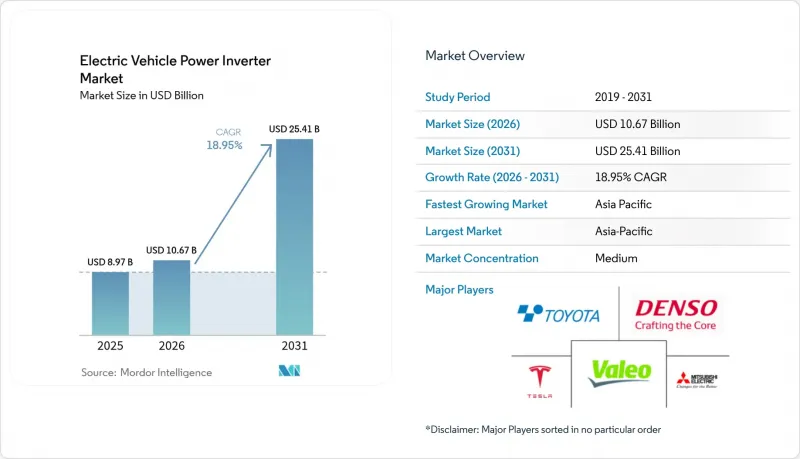
預計電動車電源逆變器市場將從 2025 年的 89.7 億美元和 2026 年的 106.7 億美元成長到 2031 年的 254.1 億美元,2026 年至 2031 年的複合年成長率為 18.95%。
電動車功率逆變器市場的成長主要受三大因素驅動:800V電氣架構的普及、碳化矽功率半導體的商業化,以及主要汽車生產國為逐步淘汰內燃機驅動系統而實施的零排放法規。儘管電池式電動車車型仍是市場需求的核心,但面向重型卡車和巴士的氫燃料電池專案表明,動力系統正在多元化發展,設計要求預計也將保持動態變化。一級供應商正日益關注整合式電驅動橋,這種電驅動橋將馬達、逆變器和變速箱整合到單一機殼中,預計在2026年後量產平台投入運作時,將為汽車製造商帶來成本和重量優勢。同時,從北卡羅來納州的Wolfspeed到德累斯頓的英飛凌,碳化矽(SiC)產能的擴張也印證了業界的通用:寬能隙裝置(而非傳統的矽IGBT)將帶來逆變器效率的下一個飛躍。
全球電動車電源逆變器市場趨勢與洞察
SiC 和 GaN 功率半導體技術的快速發展
碳化矽 (SiC) MOSFET 和氮化鎵 (GaN) HEMT 的結溫可承受高達 175 度C 度C可減少散熱器質量並提高功率密度。 Wolfspeed 斥資 65 億美元擴建其位於莫霍克谷的工廠,英飛凌斥資 50 億歐元(約 65 億美元)擴建其位於德累斯頓的工廠,這些都表明晶圓供應正在擴展到汽車生產規模。雖然氮化鎵仍然主要用於汽車充電器,但碳化矽顯然正在成為主流逆變器的藍圖,尤其是在 800V 及以上電壓的平台上,其開關損耗的降低幅度可達兩倍。傳統的 IGBT 仍然保持著一定的市場佔有率,因為其成本結構適合對價格敏感的 400V 車輛,但隨著車型年份的增加,效率差距正在擴大,加速了向寬能隙的轉變。基於 ISO 26262 的功能安全檢驗正在增加早期測試,但領先收集的長期可靠性數據正在降低後進企業的准入門檻。
OEM廠商向800V車輛平台過渡
汽車製造商正在採用 800V 或更高電壓的系統,以將直流快速充電時間縮短一半,並將銅線束的質量減少近三分之一。保時捷 Taycan 和現代 Ionic 5 等早期車型已經驗證了這一概念,而寶馬的「Neue Klasse」平台計劃於 2027 年將高壓電池組引入高階量產車型領域。逆變器設計必須能夠承受更高的截止電壓和更快的電壓變化率 (dv/dt)。這項規格要求有利於擁有先進封裝隔離技術和低電感佈局的供應商。公共充電樁的普及速度較慢,因為大多數現有充電樁的電壓為 400V,而雙電壓相容性要求使得逆變器控制迴路更加複雜。儘管如此,性能優勢對買家來說極具吸引力,原始設備製造商 (OEM) 正在努力在量產開始前敲定 800V 組件的供應合約。
SiC裝置高成本且供應不穩定
碳化矽 (SiC) 晶圓的成本是矽晶圓的數倍,且產能集中在五家晶圓代工廠,這使得原始設備製造商 (OEM) 在需求激增時極易受到現貨價格波動的影響。汽車零件的認證流程需要 18 至 24 個月,這意味著新工廠投產後需要相當長的時間才能緩解運作供不應求。一些汽車製造商透過同時採購碳化矽和傳統 IGBT 組件來規避風險,犧牲效率以確保供應穩定。此外,坩堝和晶體生長設備的供應商有限,加上出口限制的不確定性,也增加了風險因素。作為權宜之計,一些一級供應商維持策略性庫存,但倉儲成本正在影響利潤率。
細分市場分析
到2025年,在中國和歐洲完善的充電網路推動下,電池式電動車(BEV)將繼續佔據電動車逆變器市場54.12%的佔有率。相較之下,插電式混合動力汽車(PHEV)在電網發展落後的地區則扮演著過渡性解決方案的角色。預計到2031年,燃料電池電動車將以19.35%的複合年成長率實現最高成長,這得益於日本、韓國和歐洲部分地區氫能走廊的建設降低了加氫基礎設施的風險。而沒有外部充電功能的混合動力汽車則正在穩步下降,因為法規現在更重視「零排放」而非部分電氣化。
由於燃料電池堆的直流輸出電壓低於鋰離子電池組,其逆變器需與降壓直流-直流轉換器和低電感匯流排配合使用,以控制駕駛員請求扭力時產生的瞬時電流湧。不受電池溫度限制的持續供電,使其適用於電池重量超過載貨負載容量的長途客車和卡車。其成長取決於綠氫的成本趨勢和加氫站的密度,而這兩者都因可再生能源過剩背景下電解槽的日益普及而得到改善。
預計到2025年,乘用車將佔電動車電源逆變器市場63.91%的佔有率,這反映了主要汽車市場消費者對電動車的接受度。同時,由於零排放區的引入,柴油車正逐步退出都市區,重型商用車和巴士的複合年成長率最高,達到19.42%。輕型商用車也能受惠於基地台充電,但由於其對價格較為敏感,在電池成本曲線趨於平緩之前,其普及速度將落後於乘用車。
用於40噸卡車的逆變器必須能夠承受超過300kW的持續功率輸出,並能承受遠超乘用車的振動週期。因此,其設計重點在於加強匯流排、冗餘電流感測器,並支援符合CharIN規範的兆瓦級充電。雖然乘用車逆變器優先考慮靜音運行和緊湊的機殼,但城市公車逆變器允許更大的尺寸,以確保可維護性和散熱裕度。
區域分析
預計到2025年,亞太地區將佔據電動車電源逆變器市場39.19%的佔有率,並在2031年之前以19.36%的複合年成長率持續成長。中國憑藉其垂直整合的供應鏈在亞太地區電動車電源逆變器市場佔據主導地位,該供應鏈涵蓋從碳化矽晶圓生長到最終整車組裝的所有環節,均由同一家公司統一運作。日本憑藉其數十年的電力電子技術經驗,電裝和三菱電機已成為日本國內OEM生態系統的首選供應商。韓國現代摩比斯與LG能源解決方案公司合作,部署了一套800V系統,該系統擁有目前市售產品中最高的充電速度。
儘管歐洲在絕對產量上落後於其他地區,但其受益於嚴格的碳排放法規,這些法規提供了清晰的需求預測。德國、法國和斯堪地那維亞的汽車製造商正在實現逆變器本地化採購,以滿足國內含量要求並降低與長供應鏈相關的風險。德勒斯登和卡塔尼亞的半導體製造廠正在獲得公共資金,以確保即使在2035年後禁止銷售燃油車的禁令生效後,碳化矽的供應仍能保持在單一市場內。
北美地區的成長依賴《通膨控制法案》,該法案將7,500美元的消費者稅額扣抵與最終組裝和礦產來源的相關規定掛鉤,而這項政策也影響了逆變器的採購。 Wolfspeed在北卡羅來納州的巨型工廠以及中西部地區新興的一級電動汽車車橋工廠正在將關鍵工藝轉移到國內,但充電基礎設施的部署卻落後於沿海地區。因此,為了應對兩極分化的市場局面,該地區的供應商正在優先考慮模組化設計,以同時支援傳統的400V電動車和下一代800V電動車。
其他好處:
- Excel格式的市場預測(ME)表
- 3個月的分析師支持
目錄
第1章:引言
- 研究假設和市場定義
- 調查範圍
第2章:調查方法
第3章執行摘要
第4章 市場狀況
- 市場概覽
- 市場促進因素
- SiC 和 GaN 功率半導體技術的快速發展
- 整車廠商向800V汽車平臺過渡
- 電動車需求不斷成長
- 政府獎勵和排放法規
- 雙向V2G相容逆變器的架構
- 一級供應商透過規模經濟降低成本
- 市場限制因素
- SiC裝置高成本且供應不穩定
- 功率超過 300 千瓦的系統溫度控管非常複雜。
- 充電基礎設施瓶頸
- V2G相容逆變器的網路安全風險
- 價值/供應鏈分析
- 監理情勢
- 技術展望
- 波特五力模型
- 供應商的議價能力
- 買方的議價能力
- 新進入者的威脅
- 替代品的威脅
- 競爭強度
第5章 市場規模及成長預測(價值(美元))
- 依推進類型
- 混合動力電動車(HEV)
- 插電式混合動力汽車(PHEV)
- 電池式電動車(BEV)
- 燃料電池汽車(FCEV)
- 車輛類型
- 搭乘用車
- 輕型商用車
- 大型商用車輛和巴士
- 電壓架構
- 低於 400 伏特的系統
- 401-799 V 系統
- 電壓為 800V 或更高的系統
- 透過半導體材料
- 矽IGBT
- 碳化矽 MOSFET
- 氮化鎵高電子遷移率電晶體
- 依整合程度
- 獨立式逆變器
- 整合式電力驅動橋(馬達+逆變器+變速箱)
- 逆變器+直流/直流轉換器(CIDD)
- 按地區
- 北美洲
- 美國
- 加拿大
- 北美其他地區
- 南美洲
- 巴西
- 阿根廷
- 南美洲其他地區
- 歐洲
- 德國
- 英國
- 法國
- 義大利
- 西班牙
- 俄羅斯
- 其他歐洲地區
- 亞太地區
- 中國
- 日本
- 印度
- 韓國
- 亞太其他地區
- 中東和非洲
- 沙烏地阿拉伯
- 阿拉伯聯合大公國
- 土耳其
- 南非
- 埃及
- 奈及利亞
- 其他中東和非洲地區
- 北美洲
第6章 競爭情勢
- 市場集中度
- 策略趨勢
- 市佔率分析
- 公司簡介
- Robert Bosch GmbH
- DENSO Corporation
- Toyota Industries Corporation
- Hitachi Astemo Ltd
- Meidensha Corporation
- BorgWarner Inc.
- Mitsubishi Electric Corp.
- Tesla Inc.
- Marelli Holdings
- Valeo SA
- Lear Corporation
- Infineon Technologies AG
- Eaton Corporation
- STMicroelectronics NV
- ON Semiconductor Corp.
- Wolfspeed Inc.
- ROHM Semiconductor
- Continental AG
- ZF Friedrichshafen AG
- Dana Incorporated
第7章 市場機會與未來展望
The Electric Vehicle Power Inverter market size is projected to expand from USD 8.97 billion in 2025 and USD 10.67 billion in 2026 to USD 25.41 billion by 2031, registering an 18.95% CAGR between 2026 and 2031.
Momentum in the Electric Vehicle Power Inverter market is driven by three forces: the wider adoption of 800-volt electrical architectures, the commercialization of silicon-carbide power semiconductors, and zero-emission regulations that phase out internal-combustion drivetrains in the largest auto-producing economies. Battery-electric models continue to anchor demand, but hydrogen fuel-cell programs aimed at heavy trucks and buses signal a diversified propulsion landscape that will keep design requirements fluid. Tier-1 suppliers are sharpening their focus on integrated e-Axles, betting that consolidating the motor, inverter, and gearbox into a single housing will give automakers a cost-and-weight advantage when high-volume platforms launch after 2026. At the same time, silicon-carbide capacity expansions, from Wolfspeed in North Carolina to Infineon in Dresden, underscore industry consensus that wide-bandgap devices, not legacy silicon IGBTs, will unlock the next step-change in inverter efficiency.
Global Electric Vehicle Power Inverter Market Trends and Insights
Rapid Advances in SiC & GaN Power Semiconductors
Silicon-carbide MOSFETs and gallium-nitride HEMTs allow junction temperatures up to 175 °C, compared with 150 °C for silicon IGBTs, which reduces heat-sink mass and increases power density . Wolfspeed's USD 6.5 billion Mohawk Valley capacity build, and Infineon's EUR 5 billion (~USD 6.5 billion) Dresden expansion illustrate how wafer supply is scaling to automotive volumes. Gallium-nitride still skews toward onboard chargers, yet the mainstream inverter roadmap is firmly SiC, especially for >=800-V platforms where switching-loss savings are multiplied. Legacy IGBTs hold share because their cost profile suits price-sensitive 400-V cars, but the efficiency delta widens each model year, accelerating the migration to wide-bandgap. Functional-safety validation under ISO 26262 adds up-front testing, but the long-term reliability data collected by early movers lowers the barrier for fast followers.
OEM Transition to 800-V Vehicle Platforms
Automakers adopt >=800-V systems to halve DC-fast-charge times and trim copper harness mass by nearly one-third. Early showcases such as the Porsche Taycan and Hyundai Ioniq 5 proved the concept, and BMW's Neue Klasse platform will bring high-voltage stacks into the premium-volume segment in 2027. Inverter designs must now withstand higher blocking voltages and faster dv/dt, a specification window that plays to suppliers with advanced package insulation and low-inductance layouts. Public chargers lag because most existing sites are 400 V, forcing dual-voltage compatibility that complicates inverter control loops. Even so, the performance narrative resonates with buyers, prompting OEMs to lock in 800-V supply contracts well before mass production kicks off.
High SiC Device Cost & Supply Volatility
Silicon-carbide wafers cost multiples of silicon, and capacity is concentrated among five foundries, leaving OEMs exposed to spot-price swings when demand spikes. Automotive qualification runs 18-24 months, so new fabs only ease shortages with a significant lag. Some automakers hedge by dual-sourcing SiC and legacy IGBT parts, trading efficiency for supply security. Export-control uncertainty adds further risk because crucible and crystal-growth tools come from a narrow supplier base. As a stopgap, several tier-1s hold strategic inventory, but carrying costs erode margin.
Other drivers and restraints analyzed in the detailed report include:
- Rising Demand for Electric Vehicles
- Government Incentives & Emission Mandates
- Thermal-Management Complexity >=300 kW
For complete list of drivers and restraints, kindly check the Table Of Contents.
Segment Analysis
Battery-electric cars retain 54.12% of the electric-vehicle power inverter market share in 2025, driven by dense charging networks in China and Europe. In contrast, plug-in hybrids serve as transitional solutions in regions where grid upgrades lag. Fuel-cell electric vehicles are projected to post the fastest 19.35% CAGR through 2031, as hydrogen corridors in Japan, South Korea, and parts of Europe reduce the risk of refueling infrastructure. Hybrid electrics without external charging contracts steadily because regulatory rules now credit zero tailpipe emissions rather than partial electrification.
Fuel-cell stacks output lower DC voltages than lithium-ion packs, so their inverters pair with step-down DC-DC converters and low-inductance busbars that manage rapid current rise when drivers demand torque. Continuous power delivery without battery-temperature limits favors long-haul buses and trucks where battery mass would otherwise exceed freight payload. Growth hinges on green-hydrogen cost trajectories and station density, both of which are trending positively as electrolyzer deployments piggyback on renewable overcapacity.
Passenger cars commanded 63.91% of the electric vehicle power inverter market size in 2025, reflecting consumer uptake in the core auto markets, while heavy commercial vehicles and buses posted the strongest 19.42% CAGR as zero-emission zones lock diesel fleets out of cities. Light commercial vans also benefit from depot charging but are more price-sensitive, so adoption lags passenger cars until battery cost curves flatten.
Inverters for 40-ton trucks must handle continuous ratings above 300 kW and withstand vibration cycles far beyond those of passenger cars. Designs therefore emphasize reinforced busbars, redundant current sensors, and megawatt charging compatibility per CharIN's specification. Passenger-car units focus on acoustic comfort and compact housings, while city-bus variants allow more envelope space in exchange for serviceability and thermal headroom.
The Electric Vehicle Power Inverter Market Report is Segmented by Propulsion Type (HEV, PHEV, BEV, and FCEV), Vehicle Type (Passenger Cars, Light Commercial Vehicles, and More), Voltage Architecture (Less Than or Equal To 400V and More), Semiconductor Material (Silicon IGBT and More), Integration Level (Stand-Alone, E-Axle, and CIDD), and Geography. Market Forecasts are Provided in Terms of Value (USD).
Geography Analysis
Asia Pacific held a 39.19% of the electric-vehicle power inverter market share in 2025 and is forecasted to expand at a 19.36% CAGR through 2031. China dominates the regional electric-vehicle power-inverter market owing to vertically integrated supply chains that span from SiC wafer growth to final vehicle assembly under one corporate umbrella. Japan leverages decades of power-electronics know-how, with Denso and Mitsubishi Electric holding preferred-supplier status within local OEM ecosystems. South Korea's Hyundai Mobis partners with LG Energy Solution to roll out 800-V systems that rank among the highest-charging-speed models on sale.
Europe trails in absolute volume but benefits from tight carbon legislation that provides visibility into demand. German, French, and Scandinavian automakers localize inverter sourcing to meet domestic-content thresholds and de-risk long supply lines. Semiconductor fabs in Dresden and Catania receive public funding packages to ensure that SiC volumes remain within the single market once combustion bans take effect after 2035.
North America's growth rests on the Inflation Reduction Act, which ties a USD 7,500 consumer credit to final-assembly and mineral-origin rules that ripple through inverter sourcing. Wolfspeed's North Carolina mega-fab and emerging tier-1 e-Axle plants in the Midwest bring critical stages stateside, but the rollout of charging infrastructure lags coastal adoption. The region's suppliers, therefore, prioritize modular designs that support both 400-V legacy and 800-V next-gen vehicles to address a bifurcated market landscape.
- Robert Bosch GmbH
- DENSO Corporation
- Toyota Industries Corporation
- Hitachi Astemo Ltd
- Meidensha Corporation
- BorgWarner Inc.
- Mitsubishi Electric Corp.
- Tesla Inc.
- Marelli Holdings
- Valeo SA
- Lear Corporation
- Infineon Technologies AG
- Eaton Corporation
- STMicroelectronics N.V.
- ON Semiconductor Corp.
- Wolfspeed Inc.
- ROHM Semiconductor
- Continental AG
- ZF Friedrichshafen AG
- Dana Incorporated
Additional Benefits:
- The market estimate (ME) sheet in Excel format
- 3 months of analyst support
TABLE OF CONTENTS
1 Introduction
- 1.1 Study Assumptions & Market Definition
- 1.2 Scope of the Study
2 Research Methodology
3 Executive Summary
4 Market Landscape
- 4.1 Market Overview
- 4.2 Market Drivers
- 4.2.1 Rapid Advances in SiC & GaN Power Semiconductors
- 4.2.2 OEM Transition to 800V Vehicle Platforms
- 4.2.3 Rising Demand for Electric Vehicles
- 4.2.4 Government Incentives & Emission Mandates
- 4.2.5 Bidirectional V2G-Ready Inverter Architectures
- 4.2.6 Tier-1 Scale-Driven Cost Reductions
- 4.3 Market Restraints
- 4.3.1 High SiC Device Cost & Supply Volatility
- 4.3.2 Thermal-Management Complexity at More than 300 kW
- 4.3.3 Charging-Infrastructure Bottlenecks
- 4.3.4 Cyber-Security Risk in V2G-Enabled Inverters
- 4.4 Value / Supply-Chain Analysis
- 4.5 Regulatory Landscape
- 4.6 Technological Outlook
- 4.7 Porter's Five Forces
- 4.7.1 Bargaining Power of Suppliers
- 4.7.2 Bargaining Power of Buyers
- 4.7.3 Threat of New Entrants
- 4.7.4 Threat of Substitutes
- 4.7.5 Intensity of Rivalry
5 Market Size & Growth Forecasts (Value (USD))
- 5.1 By Propulsion Type
- 5.1.1 Hybrid Electric Vehicle (HEV)
- 5.1.2 Plug-in Hybrid Electric Vehicle (PHEV)
- 5.1.3 Battery Electric Vehicle (BEV)
- 5.1.4 Fuel Cell Electric Vehicle (FCEV)
- 5.2 By Vehicle Type
- 5.2.1 Passenger Cars
- 5.2.2 Light Commercial Vehicles
- 5.2.3 Heavy Commercial Vehicles & Buses
- 5.3 By Voltage Architecture
- 5.3.1 Less than or equal to 400 V Systems
- 5.3.2 401-799 V Systems
- 5.3.3 More than or equal to 800 V Systems
- 5.4 By Semiconductor Material
- 5.4.1 Silicon IGBT
- 5.4.2 Silicon-Carbide MOSFET
- 5.4.3 Gallium-Nitride HEMT
- 5.5 By Integration Level
- 5.5.1 Stand-alone Inverter
- 5.5.2 Integrated e-Axle (Motor + Inverter + Gearbox)
- 5.5.3 Combined Inverter + DC/DC (CIDD)
- 5.6 By Geography
- 5.6.1 North America
- 5.6.1.1 United States
- 5.6.1.2 Canada
- 5.6.1.3 Rest of North America
- 5.6.2 South America
- 5.6.2.1 Brazil
- 5.6.2.2 Argentina
- 5.6.2.3 Rest of South America
- 5.6.3 Europe
- 5.6.3.1 Germany
- 5.6.3.2 United Kingdom
- 5.6.3.3 France
- 5.6.3.4 Italy
- 5.6.3.5 Spain
- 5.6.3.6 Russia
- 5.6.3.7 Rest of Europe
- 5.6.4 Asia Pacific
- 5.6.4.1 China
- 5.6.4.2 Japan
- 5.6.4.3 India
- 5.6.4.4 South Korea
- 5.6.4.5 Rest of Asia Pacific
- 5.6.5 Middle East and Africa
- 5.6.5.1 Saudi Arabia
- 5.6.5.2 United Arab Emirates
- 5.6.5.3 Turkey
- 5.6.5.4 South Africa
- 5.6.5.5 Egypt
- 5.6.5.6 Nigeria
- 5.6.5.7 Rest of Middle East and Africa
- 5.6.1 North America
6 Competitive Landscape
- 6.1 Market Concentration
- 6.2 Strategic Moves
- 6.3 Market Share Analysis
- 6.4 Company Profiles (Includes Global Level Overview, Market Level Overview, Core Segments, Financials as Available, Strategic Information, Market Rank/Share for Key Companies, Products and Services, SWOT Analysis, and Recent Developments)
- 6.4.1 Robert Bosch GmbH
- 6.4.2 DENSO Corporation
- 6.4.3 Toyota Industries Corporation
- 6.4.4 Hitachi Astemo Ltd
- 6.4.5 Meidensha Corporation
- 6.4.6 BorgWarner Inc.
- 6.4.7 Mitsubishi Electric Corp.
- 6.4.8 Tesla Inc.
- 6.4.9 Marelli Holdings
- 6.4.10 Valeo SA
- 6.4.11 Lear Corporation
- 6.4.12 Infineon Technologies AG
- 6.4.13 Eaton Corporation
- 6.4.14 STMicroelectronics N.V.
- 6.4.15 ON Semiconductor Corp.
- 6.4.16 Wolfspeed Inc.
- 6.4.17 ROHM Semiconductor
- 6.4.18 Continental AG
- 6.4.19 ZF Friedrichshafen AG
- 6.4.20 Dana Incorporated
7 Market Opportunities & Future Outlook
- 7.1 White-space & Unmet-need Assessment

 電動車電源逆變器市場:按電力電子技術、車輛電氣化類型、車輛等級、驅動系統、功率輸出、銷售管道和應用分類-全球市場預測(2026-2032 年)
 電動車電源逆變器市場:按車輛類型、應用、銷售管道和地區分類
 電動車電源逆變器市場:策略性洞察與預測(2026-2031年)電動汽車電源逆變器市場規模、佔有率、成長及全球產業分析:按類型、應用和地區的洞察,2026-2034年預測
 2026年全球電動車電源逆變器市場報告
 電動車電源逆變器市場規模、趨勢、分析報告:按推進類型、輸出、車輛類型、地區和細分市場預測,2025 年至 2030 年
 電動車電源逆變器市場,按逆變器類型、按推進類型、按功率輸出、按電壓類型、按車輛類型、按國家/地區分類 - 2025 年至 2032 年全球產業分析、市場規模、市場佔有率及預測
 電動車電源逆變器市場規模、佔有率及成長分析(按推進類型、車輛類型、逆變器類型、整合度和地區)-2025-2032 年產業預測