


 |
市場調查報告書
商品編碼
2044158
塑膠混煉機:市場佔有率分析、產業趨勢與統計、成長預測(2026-2031)Plastic Compounding Machinery - Market Share Analysis, Industry Trends & Statistics, Growth Forecasts (2026 - 2031) |
||||||

※ 本網頁內容可能與最新版本有所差異。詳細情況請與我們聯繫。
預計塑膠混煉機市場規模將從 2025 年的 89.1 億美元成長到 2026 年的 94.5 億美元,到 2031 年將達到 130.9 億美元,2026 年至 2031 年的複合年成長率為 6.73%。
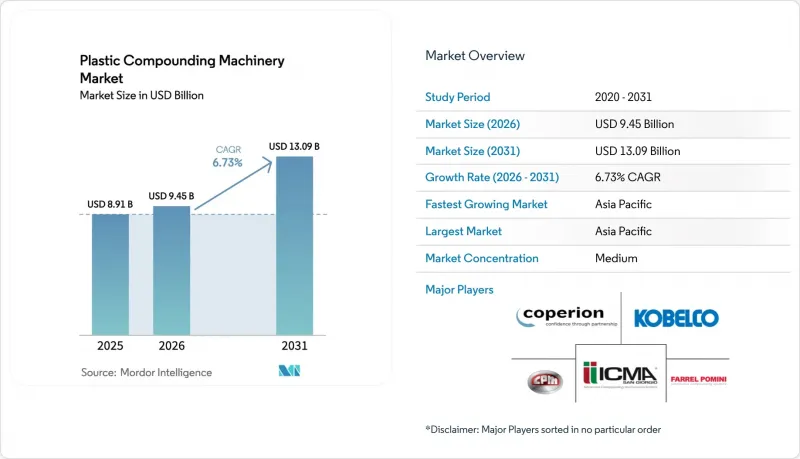
這一成長軌跡反映了對再生材料含量的更嚴格監管、醫療設備可追溯性要求的不斷提高,以及電動車電池工廠內現場成型生產線的普及。加工商目前優先考慮模組化雙螺桿和行星輥系統,這些系統可以縮短換型時間、提高再生樹脂含量,並整合雲端連接的預測性維護工具。亞太地區仍然是需求的支柱,因為中國改性塑膠的採用率已接近全球平均值。同時,在歐洲,對包裝廢棄物的嚴格監管正在推動技術創新。與競爭對手相比,關鍵差異化優勢包括螺桿元件庫、合金供應以及數位雙胞胎服務,這些服務可以幫助成型機快速檢驗新配方並節省高價值添加劑。影響塑膠混煉機市場的主要趨勢包括向輕量化、可回收包裝的轉變、醫用級雙螺桿擠出機的快速普及以及用於積層製造的長絲生產線的商業化。透過供應鏈最佳化技術和齒輪泵整合實現15-20%生產率提升的設備製造商正在取代傳統的單螺桿擠出機。然而,高達數百萬美元的高價、漫長的投資回收期以及特殊螺桿料筒合金供應鏈的瓶頸,正在減緩資本投資。聚合物價格的波動進一步擠壓了利潤空間,迫使南美、中東和非洲那些融資狀況不佳的加工企業推遲設備升級或選擇租賃模式。
全球塑膠混煉機市場趨勢與洞察
全球對輕量、可回收包裝材料的需求正在激增。
根據新的歐洲法規,品牌所有者的目標是到2030年實現30%至65%的再生材料含量,這迫使薄膜和熱成型加工商對雙螺桿生產線進行改造,加裝高容量熔融過濾器,以便在不劣化聚合物鏈的情況下去除標籤粘合劑、油墨和食物殘渣。日本經濟產業省已投資300億日圓(約1.995億美元)用於回收基礎設施建設,並推動對行星式輥筒擠出機的投資,該擠出機可在閉合迴路中處理汽車和電子廢棄物。採用這些生產線的加工商可將成品包裝重量減少高達50%,並在維持阻隔性能的同時降低運輸過程中的排放。儘管由於需要攤銷昂貴的過濾設備,利潤率受到擠壓,但自清潔雙螺桿設計減少了清潔時間並保持了加工能力,部分抵消了再生樹脂成本的增加。隨著越來越多的品牌所有者採用基於可回收性的供應商評估方法,不斷成長的需求正推動全球複合年成長率提高1.2個百分點。
雙螺桿擠出機在醫用級聚合物成型領域的快速應用
由於ASTM F648和ISO 13485可追溯性條款要求一致的分子量分佈和電子資料收集,整形外科植入製造商正從間歇式混合機轉向連續雙螺桿擠出機。歐盟醫療設備法規2017/745進一步強制要求加工商記錄所有溫度設定和螺桿扭力值,加速了配備線上近紅外線光譜儀和自動化品質控制面板的擠出機的訂單成長。日本和德國供應商提供的數位雙胞胎類比技術可協助工程師在無需消耗醫用級樹脂的情況下檢驗螺桿配置,從而為每次認證測試節省數千美元的成本。醫療保健領域的終端用戶正以8.19%的複合年成長率成長,他們傾向於選擇中等直徑的同向旋轉螺桿,這種螺桿能夠快速切換配方,同時將殘留污染物控制在0.5%以下。這一累積優勢使整體市場成長率提高了0.9個百分點。
多成分注塑機的資本投入高,投資回收期長。
配備計量給料機、側人員編制口和條狀造粒機的全自動雙螺桿生產線價格在150萬美元至350萬美元之間,對於EBITDA獲利率低於7%的加工商而言,這是一筆不小的負擔。在巴西、土耳其和南非,商業金融機構將塑膠成型產業歸類為成熟的高風險產業,由於小規模加工商通常缺乏抵押品,因此企劃案融資的等待時間進一步延長。儘管一些歐美供應商正在探索引入「設備即服務(EaaS)」契約,將機械設備、維護和分析功能打包按月收費,但在北美和西歐以外的地區,新裝機量中採用率仍低於5%。由於缺乏優惠融資,加工商延長了單螺桿生產線的使用壽命,即使節能超過15%,也延後了升級改造。由此造成的投資不足使全球複合年成長率(CAGR)的預期值下降了0.7個百分點。
細分市場分析
到2025年,雙螺桿擠出機將佔據46.37%的市場佔有率,這充分展現了其在通用混煉、工程塑膠和反應擠出等領域的廣泛應用,涵蓋塑膠混煉機市場的所有主要區域。反向旋轉擠出機在PVC管材和型材擠出領域佔據主導地位,而旋轉式擠出機則適用於需要高填充母粒、退火處理以及符合嚴格可追溯性法規的醫療模塑製品。行星輥技術目前是成長最快的細分市場,預計到2031年將達到7.23%的複合年成長率。這主要是由於特種聚合物製造商需要低剪切環境來防止熱劣化和顏色變化。模組化輥筒的表面積是同類雙螺桿擠出機的5到10倍,即使使用阻燃劑和導電填料,也能確保較窄的熔融溫度範圍。供應改進附件和齒輪泵模組有助於保持雙螺桿擠出機的效用,因為加工商維修現有工廠,從而為傳統供應商提供了強大的訂單管道。
由於行星輥系統具有高度可擴展性,因此在從試生產到大規模生產的整個過程中,行星輥系統正逐漸被那些無需反复驗證即可證明製程等效性的代工注塑機所採用。操作人員可以在現場延長料筒長度或增加輥軸,從而調整設備產能以適應客戶需求的波動,同時保持停留時間的均衡分佈。同時,單螺桿注塑機仍應用於低複雜度的色漿稀釋製程中,在這些製程中,價格敏感度優先於混合性能,這間接地支撐了現有設備的業務收益。因此,這三種主要機型的共存維持了多層次的設備等級結構,導致市場競爭較為集中,但也為區域新進入者贏得價格敏感型合約留下了空間。整體而言,多樣化的機器選擇確保了各產能層級的均衡成長,從而保護了塑膠混煉機市場免受劇烈波動的影響。
區域分析
預計到2025年,亞太地區將佔40.43%的市場佔有率,並將在2031年之前以7.79%的複合年成長率成長,這主要得益於中國模塑樹脂滲透率上升至塑膠總消費量的50%。江蘇、廣東等中國省份擁有多條模塑生產線組成的叢集,受益於政府激勵措施、充足的樹脂供應以及接近性電子和汽車產業的地理優勢。日本向回收基金撥款300億日圓(約1.995億美元),加速了傳統單螺桿擠出機的更新換代,推動向採用雙排氣筒的同向旋轉擠出機轉型,以加工再生薄片。印度和東南亞國家正利用關稅中立的出口平台吸引下游投資,擴大區域對能夠處理頻繁換色和中等比例再生樹脂配方的中型擠出機的需求。
歐洲的設備訂單與歐盟第2025/40號法規的實施密切相關,該法規規定食品接觸包裝的再生材料含量必須達到30-65%,並禁止使用某些含氟添加劑。德國和義大利仍然是機械製造中心,向全球出口行星輥式和高扭矩雙螺桿式設備。同時,法國、西班牙和荷蘭正優先考慮將生產設備改造為配備先進熔體過濾系統的雙螺桿式設備。在英國,生產者延伸責任制(EPR)費用結算的延遲暫時降低了合規成本,使國內加工商有機會在適應歐洲大陸標準的同時進行臨時資本投資。東歐加工商正逐步升級設備,同時也要平衡以歐元計價的設備成本、國內樹脂價格波動和勞動力短缺等因素。
北美受惠於豐富的乙烷基原料和高度整合的石化產業鏈,但墨西哥灣沿岸地區頻繁的天氣災害和不可抗力事件導致樹脂供應存在不確定性。美國注塑機製造商正透過在中西部和東南部走廊地區分散產能來規避風險,從而增加了對可按需移動的模組化雙螺桿混煉機的訂單。在美墨加協定(USMCA)貿易保護措施的支持下,加拿大和墨西哥的工廠正在採購中型系統,以供應當地汽車子公司,這些子公司需要快速換色和可追溯性。南美、中東和非洲仍然是小規模的市場,受到持續高企的借貸成本和外匯波動的影響,但巴西對農用薄膜的需求、沙烏地阿拉伯向下游行業的多元化發展以及南非的汽車零件項目正在形成局部需求集群,這些集群有利於低成本的中國製造雙螺桿包裝機。總體而言,地理多元化正在緩解整體市場收入的波動,並增強塑膠混煉機市場中期的穩定成長勢頭。
其他好處
- Excel格式的市場預測(ME)表
- 3個月的分析師支持
目錄
第1章:引言
- 研究假設和市場定義
- 調查範圍
第2章:調查方法
第3章執行摘要
第4章 市場狀況
- 市場概覽
- 市場促進因素
- 全球對輕量、可回收包裝材料的需求正在激增。
- 雙螺桿擠出機在醫用級聚合物成型領域的快速應用
- 積層製造絲材生產線的成長
- 歐洲和北美過去曾推出監管措施,強制要求在產品中加入再生材料。
- 電動汽車電池工廠向分散式現場成型過渡
- 人工智慧驅動的預測性維護的興起正在降低整體擁有成本。
- 市場限制因素
- 多成分注塑機的資本投入高,投資回收期長。
- 特殊螺桿和料筒所用合金的供應鏈出現瓶頸
- 聚合物原料價格波動
- 工業4.0合規生產線營運技能缺口
- 產業價值鏈分析
- 監理情勢
- 技術展望
- 宏觀經濟因素對市場的影響
- 波特五力分析
- 新進入者的威脅
- 供應商的議價能力
- 買方的議價能力
- 替代品的威脅
- 競爭公司之間的競爭
第5章 市場規模與成長預測
- 按機器類型
- 單螺絲
- 雙螺桿
- 同向旋轉雙螺桿
- 反向旋轉雙螺桿
- 行星滾輪
- 其他
- 透過使用
- 塑膠
- 母粒生產
- 特種聚合物
- 地板材料裝飾線條
- 其他
- 按最終用戶行業分類
- 包裝
- 建築和基礎設施
- 醫療保健
- 車
- 電子學
- 化學品
- 其他
- 按地區
- 北美洲
- 美國
- 加拿大
- 墨西哥
- 南美洲
- 巴西
- 阿根廷
- 智利
- 南美洲其他地區
- 歐洲
- 英國
- 德國
- 法國
- 義大利
- 西班牙
- 其他歐洲國家
- 亞太地區
- 中國
- 印度
- 日本
- 韓國
- 澳洲
- 亞太其他地區
- 中東和非洲
- 中東
- 沙烏地阿拉伯
- 阿拉伯聯合大公國
- 土耳其
- 其他中東國家
- 非洲
- 南非
- 奈及利亞
- 其他非洲地區
- 中東
- 北美洲
第6章 競爭情勢
- 市場集中度
- 策略趨勢
- 市佔率分析
- 公司簡介
- Coperion GmbH
- CPM Extricom Extrusion GmbH
- Farrel Corporation
- ICMA San Giorgio SpA
- Ikegai Corporation
- Kobe Steel, Ltd.
- KraussMaffei Group GmbH
- Nordson Corporation
- Randcastle Extrusion Systems, Inc.
- Technovel Corporation
- The Japan Steel Works, Ltd.
- Theysohn Extrusionstechnik GmbH
- Shibaura Machine Co., Ltd.
- TPV Compound Srl
- Useon Extrusion Machinery Co., Ltd.
- Welset Plast Extrusions Pvt. Ltd.
- Leistritz Extrusionstechnik GmbH
- Buhler AG
- Entek Manufacturing, LLC
- Bausano and Figli SpA
第7章 市場機會與未來展望
The plastic compounding machinery market size is expected to increase from USD 8.91 billion in 2025 to USD 9.45 billion in 2026 and reach USD 13.09 billion by 2031, growing at a CAGR of 6.73% over 2026-2031.
This growth trajectory reflects stricter recycled-content mandates, rising traceability requirements for medical devices, and the spread of on-site compounding lines within electric-vehicle battery plants. Processors now prioritize modular twin-screw and planetary-roller systems that shorten changeovers, enable higher reclaimed-resin loadings, and embed cloud-connected predictive-maintenance tools. Asia-Pacific remains the volume anchor as China's modified-plastics penetration climbs toward the global average, while Europe drives technology refreshes through aggressive packaging-waste regulations. Competitive differentiation hinges on screw-element libraries, alloy availability, and digital-twin services that help compounders validate new recipes quickly and conserve high-value additives. Key trends shaping the plastic compounding machinery market include the pivot to lightweight, recyclable packaging, the rapid uptake of medical-grade twin-screw extruders, and the commercialization of additive-manufacturing filament lines. Equipment builders able to demonstrate 15%-20% productivity gains through feed-enhancement technology or gear-pump integration are displacing legacy single-screw assets. Capital-expenditure momentum is tempered, however, by multi-million-dollar price tags, lengthy payback horizons, and supply-chain bottlenecks in specialty screw-barrel alloys. Polymer price volatility further compresses margins, prompting financially constrained converters in South America, the Middle East and Africa to defer upgrades or pursue leasing models.
Global Plastic Compounding Machinery Market Trends and Insights
Surge in Global Demand for Lightweight, Recyclable Packaging
Brand owners target 30%-65% recycled content by 2030 under new European law, forcing film and thermoforming converters to retrofit twin-screw lines with high-capacity melt filters that can remove label glue, ink, and food residue without degrading polymer chains. Japan's Ministry of Economy, Trade and Industry committed JPY 30 billion (USD 199.5 million) to recycling infrastructure, unlocking capex for planetary-roller extruders that process closed-loop automotive and electronics waste. Processors adopting these lines reduce finished-pack weight by up to 50%, trimming freight emissions while maintaining barrier performance. The need to amortize costly filtration equipment pressures margins, yet twin-screw designs with self-wiping elements shorten clean-out time and preserve throughput, partially offsetting recycled-resin premiums. As more brand owners invoke supplier scorecards tied to recyclability, the demand uplift contributes a 1.2-percentage-point boost to the global CAGR.
Rapid Adoption of Twin-Screw Extruders in Medical-Grade Polymer Compounding
Orthopedic-implant makers migrate from batch mixers to continuous twin-screw extrusion because ASTM F648 and ISO 13485 traceability clauses demand consistent molecular-weight distribution and electronic data capture. European Union Medical Device Regulation 2017/745 further obliges processors to log every temperature set-point and screw-torque value, accelerating orders for extruders with in-line near-infrared spectroscopy and automated quality dashboards. Digital-twin simulations offered by Japanese and German suppliers help engineers validate screw configurations without consuming medical-grade resin, saving thousands of dollars per qualification run. Medical and healthcare end users, growing at an 8.19% CAGR, therefore choose mid-diameter co-rotating screws that allow rapid formula changeovers with less than 0.5% residual contamination. The cumulative benefit adds 0.9 percentage points to overall market growth.
High Capex and Long Pay-Back Period for Multi-Component Compounders
Fully automated twin-screw lines with gravimetric feeders, side stuffing ports, and strand pelletizers range from USD 1.5 million to USD 3.5 million, a sum that strains converters operating on sub-7% EBITDA margins. In Brazil, Turkey, and South Africa, commercial lenders classify plastics compounding as mature and high-risk, demanding collateral that smaller processors seldom hold, further lengthening the project-finance queue. Some Western suppliers now pilot equipment-as-a-service contracts bundling machinery, maintenance, and analytics for a monthly fee, but adoption outside North America and Western Europe remains below 5% of new installations. Without concessional credit, converters stretch single-screw life cycles, deferring upgrades even when energy savings could exceed 15%. The resulting under-investment subtracts 0.7 percentage points from anticipated global CAGR.
Other drivers and restraints analyzed in the detailed report include:
- Growth in Additive-Manufacturing Filament Production Lines
- Regulatory Push for Recycled-Content Mandates in Europe and North America
- Supply-Chain Bottlenecks in Specialty Screw-Barrel Alloys
For complete list of drivers and restraints, kindly check the Table Of Contents.
Segment Analysis
Twin-screw extruders commanded 46.37% of the share in 2025, underscoring their versatility in commodity blends, engineered plastics, and reactive extrusion across every major region of the plastic compounding machinery market. Counter-rotating versions dominate PVC pipe and profile extrusion, whereas co-rotating models handle high-fill masterbatch, devolatilization, and medical-grade compounds that must meet strict traceability rules. Planetary-roller technology is now the fastest-growing niche at a 7.23% CAGR through 2031 because specialty-polymer producers need low-shear environments that prevent thermal degradation and color shift. Modular roller barrels deliver surface areas five to ten times larger than twin-screw equivalents, ensuring narrow melt-temperature bands even with flame-retardant or conductive fillers. As processors retrofit brownfield plants, feed-enhancement attachments and gear-pump modules help twin-screws retain relevance, sustaining healthy order pipelines for established European and Japanese suppliers.
Scalability is driving incremental adoption of planetary-roller systems among contract compounders that must prove process equivalence from pilot to large-scale runs without repeated validation tests. Operators can extend barrel length or add additional roller spindles in the field, aligning installed capacity with fluctuating customer demand while preserving residence-time distribution. Meanwhile, single-screw machines persist in low-complexity color-concentrate let-down where price sensitivity outweighs mixing performance, indirectly anchoring installed-base service revenues. The coexistence of three core machine archetypes therefore sustains a multi-tier equipment hierarchy, reinforcing moderately concentrated competition that nevertheless allows regional entrants to win price-sensitive contracts. Collectively, varied machinery preferences keep growth balanced across throughput bands, insulating the plastic compounding machinery market from severe cyclical swings.
The Plastic Compounding Machinery Market Report is Segmented by Machinery Type (Single-Screw, Twin-Screw, and More), Application Type (Plastics, Masterbatch Production, Specialty Polymers, Flooring Compounds, and More), End-User Industry (Packaging, Construction and Infrastructure, Medical and Healthcare, Automotive, Electronics, and More), and Geography. The Market Forecasts are Provided in Terms of Value (USD).
Geography Analysis
Asia-Pacific generated 40.43% of share in 2025, and the region is poised to grow at a 7.79% CAGR through 2031 as China's compounded-resin penetration climbs toward 50% of total plastics consumption. Chinese provinces such as Jiangsu and Guangdong host multi-line compounding clusters that benefit from state incentives, bulk resin availability, and proximity to electronics and automotive hubs. Japan's JPY 30 billion (USD 199.5 million) recycling-fund allocation accelerates replacement of legacy single-screw extruders with co-rotating models fitted with twin-vent barrels for recycled flake processing. India and Southeast Asian nations leverage tariff-neutral export platforms to attract downstream investment, expanding regional demand for mid-throughput extruders that can handle frequent color changes and moderate recycled-resin loadings.
Europe's equipment orders track the rollout of Regulation (EU) 2025/40, which imposes 30%-65% recycled-content thresholds and bans selected fluorinated additives in food-contact packs. Germany and Italy remain machinery-manufacturing strongholds that export planetary-roller and high-torque twin-screw units worldwide, while France, Spain, and the Netherlands prioritize twin-screw retrofits equipped with advanced melt-filtration systems. The United Kingdom briefly enjoys lower compliance costs due to deferred extended-producer-responsibility fees, giving domestic converters a temporary capital-expenditure window before alignment with continental standards. Eastern-European processors upgrade gradually, balancing euro-denominated equipment costs against domestic resin-price volatility and tight labor availability.
North America benefits from abundant ethane-based feedstocks and a tightly integrated petrochemical chain, yet frequent Gulf-Coast weather disruptions and force-majeure events inject resin-supply uncertainty. U.S. compounders hedge risk by distributing capacity across Midwest and Southeast corridors, driving orders for modular twin-screws that can relocate as needed. Canadian and Mexican plantscanchored by USMCA trade protectionscbuy mid-range systems to serve automotive transplants that demand rapid color changes and traceability. South America, the Middle East and Africa collectively remain smaller markets constrained by elevated borrowing costs and currency volatility, although Brazilian agricultural-film demand, Saudi downstream diversification, and South-African auto-component projects create localized hot spots that favor lower-cost Chinese twin-screw packages. Overall, geographic diversification helps smooth total-market revenue swings, reinforcing a steady medium-term growth path for the plastic compounding machinery market.
- Coperion GmbH
- CPM Extricom Extrusion GmbH
- Farrel Corporation
- ICMA San Giorgio S.p.A.
- Ikegai Corporation
- Kobe Steel, Ltd.
- KraussMaffei Group GmbH
- Nordson Corporation
- Randcastle Extrusion Systems, Inc.
- Technovel Corporation
- The Japan Steel Works, Ltd.
- Theysohn Extrusionstechnik GmbH
- Shibaura Machine Co., Ltd.
- TPV Compound S.r.l.
- Useon Extrusion Machinery Co., Ltd.
- Welset Plast Extrusions Pvt. Ltd.
- Leistritz Extrusionstechnik GmbH
- Buhler AG
- Entek Manufacturing, LLC
- Bausano and Figli S.p.A.
Additional Benefits:
- The market estimate (ME) sheet in Excel format
- 3 months of analyst support
TABLE OF CONTENTS
1 INTRODUCTION
- 1.1 Study Assumptions and Market Definition
- 1.2 Scope of the Study
2 RESEARCH METHODOLOGY
3 EXECUTIVE SUMMARY
4 MARKET LANDSCAPE
- 4.1 Market Overview
- 4.2 Market Drivers
- 4.2.1 Surge in Global Demand for Lightweight, Recyclable Packaging
- 4.2.2 Rapid Adoption of Twin-Screw Extruders in Medical-Grade Polymer Compounding
- 4.2.3 Growth in Additive Manufacturing Filament Production Lines
- 4.2.4 Regulatory Push for Recycled-Content Mandates in Europe and North America
- 4.2.5 Shift Toward Decentralised, On-Site Compounding in EV Battery Plants
- 4.2.6 Emergence of AI-Driven Predictive Maintenance Lowering Total Cost of Ownership
- 4.3 Market Restraints
- 4.3.1 High Capex and Long Pay-Back Period for Multi-Component Compounders
- 4.3.2 Supply-Chain Bottlenecks in Specialty Screw-Barrel Alloys
- 4.3.3 Volatility in Polymer Feedstock Prices
- 4.3.4 Skill Gap in Operating Industry 4.0-Enabled Lines
- 4.4 Industry Value Chain Analysis
- 4.5 Regulatory Landscape
- 4.6 Technological Outlook
- 4.7 Impact of Macroeconomic Factors on the Market
- 4.8 Porter's Five Forces Analysis
- 4.8.1 Threat of New Entrants
- 4.8.2 Bargaining Power of Suppliers
- 4.8.3 Bargaining Power of Buyers
- 4.8.4 Threat of Substitutes
- 4.8.5 Intensity of Competitive Rivalry
5 MARKET SIZE AND GROWTH FORECASTS (VALUE)
- 5.1 By Machinery Type
- 5.1.1 Single-Screw
- 5.1.2 Twin-Screw
- 5.1.2.1 Co-Rotating Twin-Screw
- 5.1.2.2 Counter-Rotating Twin-Screw
- 5.1.3 Planetary Roller
- 5.1.4 Other Machinery Types
- 5.2 By Application Type
- 5.2.1 Plastics
- 5.2.2 Masterbatch Production
- 5.2.3 Specialty Polymers
- 5.2.4 Flooring Compounds
- 5.2.5 Other Application Types
- 5.3 By End-User Industry
- 5.3.1 Packaging
- 5.3.2 Construction and Infrastructure
- 5.3.3 Medical and Healthcare
- 5.3.4 Automotive
- 5.3.5 Electronics
- 5.3.6 Chemicals
- 5.3.7 Other End-User Industries
- 5.4 By Geography
- 5.4.1 North America
- 5.4.1.1 United States
- 5.4.1.2 Canada
- 5.4.1.3 Mexico
- 5.4.2 South America
- 5.4.2.1 Brazil
- 5.4.2.2 Argentina
- 5.4.2.3 Chile
- 5.4.2.4 Rest of South America
- 5.4.3 Europe
- 5.4.3.1 United Kingdom
- 5.4.3.2 Germany
- 5.4.3.3 France
- 5.4.3.4 Italy
- 5.4.3.5 Spain
- 5.4.3.6 Rest of Europe
- 5.4.4 Asia-Pacific
- 5.4.4.1 China
- 5.4.4.2 India
- 5.4.4.3 Japan
- 5.4.4.4 South Korea
- 5.4.4.5 Australia
- 5.4.4.6 Rest of Asia-Pacific
- 5.4.5 Middle East and Africa
- 5.4.5.1 Middle East
- 5.4.5.1.1 Saudi Arabia
- 5.4.5.1.2 United Arab Emirates
- 5.4.5.1.3 Turkey
- 5.4.5.1.4 Rest of Middle East
- 5.4.5.2 Africa
- 5.4.5.2.1 South Africa
- 5.4.5.2.2 Nigeria
- 5.4.5.2.3 Rest of Africa
- 5.4.5.1 Middle East
- 5.4.1 North America
6 COMPETITIVE LANDSCAPE
- 6.1 Market Concentration
- 6.2 Strategic Moves
- 6.3 Market Share Analysis
- 6.4 Company Profiles (Includes Global Level Overview, Market Level Overview, Core Segments, Financials as Available, Strategic Information, Market Rank/Share, Products and Services, and Recent Developments)
- 6.4.1 Coperion GmbH
- 6.4.2 CPM Extricom Extrusion GmbH
- 6.4.3 Farrel Corporation
- 6.4.4 ICMA San Giorgio S.p.A.
- 6.4.5 Ikegai Corporation
- 6.4.6 Kobe Steel, Ltd.
- 6.4.7 KraussMaffei Group GmbH
- 6.4.8 Nordson Corporation
- 6.4.9 Randcastle Extrusion Systems, Inc.
- 6.4.10 Technovel Corporation
- 6.4.11 The Japan Steel Works, Ltd.
- 6.4.12 Theysohn Extrusionstechnik GmbH
- 6.4.13 Shibaura Machine Co., Ltd.
- 6.4.14 TPV Compound S.r.l.
- 6.4.15 Useon Extrusion Machinery Co., Ltd.
- 6.4.16 Welset Plast Extrusions Pvt. Ltd.
- 6.4.17 Leistritz Extrusionstechnik GmbH
- 6.4.18 Buhler AG
- 6.4.19 Entek Manufacturing, LLC
- 6.4.20 Bausano and Figli S.p.A.
7 MARKET OPPORTUNITIES AND FUTURE OUTLOOK
- 7.1 White-Space and Unmet-Need Assessment

 塑膠混煉市場:2026-2032年全球市場預測(按材料、添加劑、混煉方法、供應來源、分銷管道和最終用途行業分類)
 塑膠化合物市場規模、佔有率和趨勢分析報告:按產品、應用、地區和細分市場分類的預測(2026-2033 年)
 塑膠化合物市場:依原料、產品、應用和地區分類塑膠化合物市場:按類型、加工技術、形狀、終端用途產業和應用分類-2026-2032年全球市場預測
 全球塑膠化合物市場規模、佔有率、趨勢和成長分析報告(2026-2034年)
 塑膠化合物市場規模、佔有率、趨勢和預測:按產品、應用和地區分類,2026-2034年塑膠混煉機械市場:依機器類型、材料類型、製程、產能和應用分類-全球預測,2026-2032年全球塑膠複合材料市場規模、佔有率、趨勢和成長分析報告(2026-2034年)
 2026年全球聚丙烯塑膠材料和樹脂市場報告2026年全球聚苯乙烯塑膠材料和樹脂市場報告