


 |
市場調查報告書
商品編碼
2044137
氣凝膠:市場佔有率分析、產業趨勢與統計、成長預測(2026-2031)Aerogel - Market Share Analysis, Industry Trends & Statistics, Growth Forecasts (2026 - 2031) |
||||||

※ 本網頁內容可能與最新版本有所差異。詳細情況請與我們聯繫。
預計氣凝膠市場將從 2025 年的 9 億美元和 2026 年的 9.9 億美元成長到 2031 年的 15.9 億美元,2026 年至 2031 年的年複合成長率(CAGR)為 9.94%。
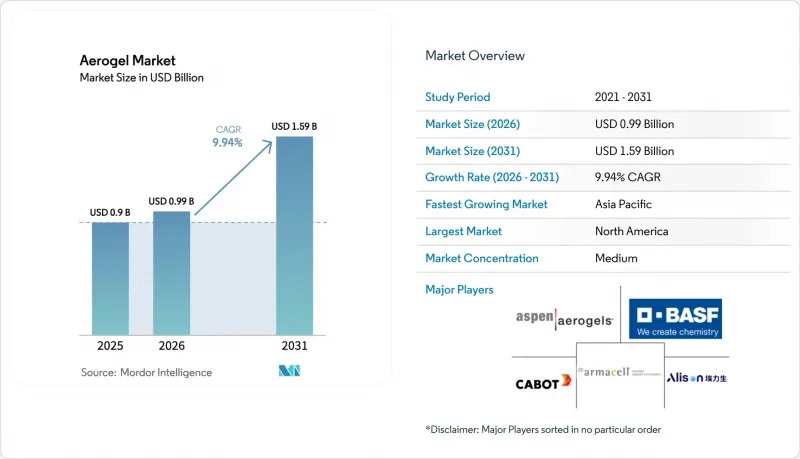
能源、建築和交通運輸領域對超輕且高隔熱材料的需求不斷成長,推動了氣凝膠市場持續高速成長。隨著人們對循環經濟和可回收性的日益關注,氣凝膠作為一種能量損失極低的可再生材料,正吸引越來越多的目光。亞太地區液化天然氣(LNG)資產的持續投資、美國、加拿大和歐洲日益嚴格的建築節能法規,以及電動車電池安全維修的快速推進,都促進了氣凝膠市場收入的成長。主要供應商不斷擴大產能,而諸如大氣乾燥和溶劑回收等製程效率的提升,正逐步消除氣凝膠傳統的成本劣勢。
全球氣凝膠市場趨勢與洞察
由於可重複使用和可回收,其應用範圍擴大。
由於氣凝膠即使經過多次使用循環仍能保持其結構完整性,操作人員無需特殊工具即可從管道、煉油廠或外牆回收氣凝膠毯和顆粒。在海上石油生產中,回收的氣凝膠墊即使經過多達三個完整的維護循環,仍能達到A1級防火標準。這使得工業用戶能夠降低掩埋成本和新材料採購成本,從而降低整體生命週期成本。此外,其可回收性符合德國、法國和美國多個州正在實施的生產者延伸責任制(EPR)規定。政府採購團隊擴大將可回收的隔熱材料納入規範,這一趨勢正在推動氣凝膠在公共基礎設施競標中的應用。綜上所述,氣凝膠的可回收性和政策支援正在緩解過去對「浪費」的擔憂,並擴大其在工業維護項目中的市場。
建築業對高性能隔熱材料的需求日益成長
隨著2030年實現建築淨零排放的目標壓力日益增大,大型建設公司尤其關注北歐地區,因為該地區的供暖度日數異常高。建築師開始採用氣凝膠抹灰,這種抹灰與密度低於200 kg/m³、導熱係數λ低於15 mW/m·K的二氧化矽截面結合使用,無需使用厚牆即可滿足嚴格的U值要求。老舊多用戶住宅的維修蘊藏著巨大的商機。例如,丹麥最近的測試表明,在磚砌外牆上塗覆25毫米厚的氣凝膠塗層可顯著降低熱損失。在美國4-6氣候區,考慮到目前的天然氣價格,生命週期模型顯示其投資回收期較短。這些性能指標和高成本效益正在推動對氣凝膠毯的需求激增,從而顯著促進市場成長,尤其是在建築圍護結構領域。
與傳統隔熱材料相比,製造成本更高
儘管不斷努力最佳化製程,但以交付價格計算,二氧化矽毯的平均售價仍然高於礦物棉。在傳統的間歇式生產流程中,超臨界乾燥和溶劑交換會顯著增加總能耗,推高營運成本。當專案預算緊張時,中小型建築商往往會轉向價格較低的發泡材,這減緩了對價格敏感的住宅領域的銷售成長。雖然計劃於2026年推出的快速循環常壓反應器有望降低能耗,但業內專家預測,價格的顯著趨同要到2028年或更晚才會出現。這種延遲阻礙了低利潤率的氣凝膠市場在建築項目中的全面滲透。
細分市場分析
預計到2025年,二氧化矽氣凝膠將佔據全球氣凝膠市場72.87%的佔有率,這主要得益於其成熟的生產基礎和廣泛的應用前景。二氧化矽氣凝膠毯在石油和天然氣管道隔熱材料領域持續獲得大規模競標,而二氧化矽粉末衍生物作為建築石膏的保溫添加劑也日益普及。與間苯二酚碳化物和甲醛基氣凝膠相比,二氧化矽基氣凝膠具有許多優勢,例如可規模化生產的溶膠-凝膠化學製程、豐富的原料來源以及相對較低的環境影響。預計到2031年,二氧化矽基氣凝膠的複合年成長率將達到10.87%,繼續保持整體成長勢頭,並在大規模生產的工業領域不斷擴大市場佔有率。
碳氣凝膠因其卓越的導電性而備受青睞,在超級電容器電極和航太內飾的電磁干擾屏蔽領域正日益受到關注。然而,高溫熱解所需的巨大能量以及有機前驅體的高昂成本仍然是其廣泛應用的一大挑戰。氧化鋁氣凝膠憑藉其優異的耐酸性,在嚴苛的化學加工環境中佔有了一席之地。儘管像 Aspen Aerogels 這樣的製造商已於 2026 年增設了氧化鋁氣凝膠的中試生產線,但其商業化生產仍處於小規模。隨著客戶在熱學、電學和化學性能方面不斷調整其優先考慮因素,多材料混合配方正逐步進入商業化階段,這預示著全球氣凝膠市場的產品組合將逐步多元化。
預計到2025年,毯狀氣凝膠產品將佔氣凝膠市場收入的64.19%。這主要得益於煉油廠、液化天然氣業者和建築維修團隊對這類產品的易用性和可操作性的重視。預貼合加工套管進一步縮短了安裝時間,降低了現場人事費用。雖然毯狀氣凝膠產品仍保持著較高的透氣性,但顆粒狀氣凝膠預計將以10.92%的複合年成長率實現最高成長,其價值在於能夠分散到水泥基抹灰和聚合物母粒。製造商可以透過調整粉末配方來調節導熱係數和密度,而無需重新設計成品。塊狀和板狀氣凝膠用於一些特殊應用,例如採光幕牆構件和研究用低溫恆溫器,但目前僅佔氣凝膠市場的一小部分佔有率。
在研發領域,人們對無需粘合劑、可提高光學透明度的整體式面板製程越來越感興趣。瑞典和日本的試驗生產線正在成功開發面板製造技術。如果這些技術能夠投入實用化,它們將為建築帷幕牆和太陽能熱捕獲領域開闢新的途徑,進一步振興本已多元化的氣凝膠產業。
區域分析
預計北美將繼續保持其在氣凝膠銷售領域的領先地位,到2025年將佔據41.18%的市場佔有率。這主要得益於美國和加拿大成熟的油氣產業,以及高於平均水準的建築維修活動。聯邦政府對節能型商業建築的稅收優惠政策,加上墨西哥灣沿岸液化天然氣出口碼頭建設的擴張,直接促成了大規模訂單的產生。該地區成熟的採購流程和健全的監管合規體係正在加速高性能材料的應用,凸顯了北美對全球氣凝膠市場動態的持續影響力。
歐洲仍然是高價需求的主要中心,這主要得益於歐洲大陸嚴格的建築節能法規和對電動車的早期推廣。德國、義大利和英國等國正在投入公共補貼用於大規模維修項目,這刺激了對歷史建築中顆粒增強石膏的需求,因為出於美觀考慮,歷史建築的牆體厚度必須受到限制。歐盟委員會更新的「2025年維修」計畫正在推動持續的維修活動,為建築業的氣凝膠供應商帶來穩定的訂單來源。同時,挪威加強碳捕獲基礎設施建設,正在為高溫隔熱開闢一個專門的細分市場,從而擴大該地區的收入來源。
亞太地區正崛起為成長最快的地區,預計到2031年將以10.36%的複合年成長率成長,這主要得益於中國液化天然氣進口的快速成長、韓國電池產量的激增以及印度城市地區掩埋都市區的蓬勃發展。區域各國政府正在加強基於性能的建築標準,建築師也開始轉向輕薄、高隔熱(高R值)的結構,而氣凝膠在這方面表現出色。像廣東艾利森科技有限公司這樣的本土隔熱材料製造商正在為其節能材料產品線爭取省級激勵措施,這降低了總體成本並提高了產品的可及性。除了日本和韓國工業熱整合計畫的協同效應外,東南亞煉油廠維修帶來的需求也正在擴大亞太地區的氣凝膠市場,使該地區能夠在預測期內縮小與北美的差距。
其他好處
- Excel格式的市場預測(ME)表
- 3個月的分析師支持
目錄
第1章:引言
- 研究假設和市場定義
- 調查範圍
第2章:調查方法
第3章執行摘要
第4章 市場狀況
- 市場概覽
- 市場促進因素
- 由於可重複使用和可回收,其應用範圍不斷擴大。
- 建築業對高性能隔熱材料的需求日益成長
- 北美和歐洲的能源效率法規正在提振需求。
- 亞太地區液化天然氣基礎設施的擴張
- 推出電動車電池的防火毯。
- 市場限制因素
- 與傳統隔熱材料相比,製造成本更高
- 二氧化矽前驅體供不應求/價格波動
- 在建築領域與高性能聚合物泡棉材料競爭
- 價值鏈分析
- 波特五力模型
- 供應商的議價能力
- 買方的議價能力
- 新進入者的威脅
- 替代品的威脅
- 競爭程度
第5章 市場規模與成長預測
- 按類型
- 二氧化矽
- 碳
- 氧化鋁
- 其他
- 按形式
- 毯子
- 粒子
- 堵塞
- 控制板
- 透過使用
- 隔熱材料
- 隔音和聲阻
- 催化劑和吸附劑
- 電池和儲能
- 透光和半透明面板
- 其他
- 按最終用戶行業分類
- 石油和天然氣
- 建造
- 車
- 船
- 航太
- 其他
- 按地區
- 亞太地區
- 中國
- 印度
- 日本
- 韓國
- 亞太其他地區
- 北美洲
- 美國
- 加拿大
- 墨西哥
- 歐洲
- 德國
- 英國
- 義大利
- 法國
- 其他歐洲國家
- 南美洲
- 巴西
- 阿根廷
- 南美洲其他地區
- 中東和非洲
- 沙烏地阿拉伯
- 阿拉伯聯合大公國
- 南非
- 奈及利亞
- 其他中東和非洲國家
- 亞太地區
第6章 競爭情勢
- 市場集中度
- 策略趨勢
- 市佔率分析
- 公司簡介
- Acoustiblok, Inc.
- Active Aerogels
- Aerogel Technologies, LLC
- aerogel-it
- Armacell
- Aspen Aerogels, Inc.
- BASF
- Blueshift Materials Inc.
- Cabot Corporation
- ENERSENS
- Guangdong Alison Technology Co., Ltd.
- JIOS Aerogel
- Knauf Insulation
- Nano Tech Co., Ltd.
- Ningbo Surnano Aerogel Co., Ltd
- Porex
- Sino Aerogel
- Svenska Aerogel AB
- TAASI Corporation
- Thermablok Aerogels Ltd.
第7章 市場機會與未來展望
The Aerogel Market size is projected to expand from USD 0.90 billion in 2025 and USD 0.99 billion in 2026 to USD 1.59 billion by 2031, registering a CAGR of 9.94% between 2026 to 2031.
Mounting demand for ultra-lightweight yet thermally robust materials in energy, construction, and mobility applications keeps the growth curve steep. Heightened focus on circularity and recyclability puts aerogels in a favorable spotlight because the material can be reclaimed without large energy penalties. Steady capital expenditure on liquefied natural gas assets across Asia-Pacific, stricter building-energy rules in the United States, Canada, and Europe, and a rapid uptick in electric-vehicle battery safety retrofits jointly sustain revenue expansion in the Aerogel market. Major suppliers continue to widen production capacity, while process-streamlining steps such as ambient-pressure drying and solvent recycling progressively chip away at historical cost disadvantages.
Global Aerogel Market Trends and Insights
Rise in Adoption Owing to Reusability and Recyclability
Aerogels maintain structural integrity even after multiple service cycles, letting operators reclaim blankets or particles from pipelines, refineries, or facades without specialized tools. In offshore oil production, reused aerogel mats have logged up to three full maintenance cycles while still meeting Class A1 fire ratings. Industrial users thus cut overall lifecycle costs as landfill expense and fresh material purchases decline. Recyclability also aligns with extended-producer-responsibility provisions being rolled out in Germany, France, and several U.S. states. Government procurement teams increasingly specify circular thermal insulants, a move that strengthens the purchasing case for aerogels in public infrastructure tenders. Taken together, salvage potential and policy nudges remove earlier hesitancy around perceived wastefulness and widen the addressable Aerogel market in industrial maintenance programs.
Growing Construction Demand for High-Performance Insulation
Under mounting pressure to achieve net-zero buildings by 2030, large contractors are particularly focused on Northern Europe, where heating-degree days are notably high. Architects are turning to aerogel plasters, which, combined with silica blankets that achieve λ-values below 15 mW/m*K at densities under 200 kg/m3, allow them to meet stringent U-factor targets without resorting to thick wall sections. There's a notable opportunity in retrofitting aging multifamily units; for instance, a recent trial in Denmark showcased a significant reduction in heat loss when a 25 mm aerogel render was applied over brick facades. In U.S. climate zones 4 to 6, life-cycle models indicate a short payback period, given the current natural-gas tariffs. Such performance metrics and cost efficiencies are driving a surge in demand for aerogel blankets, fueling significant growth in the market, particularly in building envelopes.
High Production Cost Versus Conventional Insulators
Despite ongoing efforts to optimize processes, silica blankets command higher average selling prices than mineral wool, when compared on a delivered basis. In traditional batch processes, supercritical drying and solvent exchange significantly contribute to total energy consumption, driving up overhead costs. When project budgets tighten, smaller construction contractors often pivot to more affordable foams, stunting volume growth in the price-sensitive residential sector. While the introduction of rapid-cycle ambient-pressure reactors in 2026 promises to reduce energy consumption, industry experts predict a noticeable price convergence won't materialize until after 2028. This delay hinders the Aerogel market's full integration into low-margin building projects.
Other drivers and restraints analyzed in the detailed report include:
- Energy-Efficiency Regulations in North America and Europe Spur Demand
- Expansion of LNG Infrastructure Across Asia-Pacific
- Limited Availability and Price Swings of Silica Precursors
For complete list of drivers and restraints, kindly check the Table Of Contents.
Segment Analysis
Global demand for silica aerogels stood at 72.87% of the total Aerogel market share in 2025, driven by a mature manufacturing base and broad application compatibility. Silica blankets continue to secure large oil and gas pipe insulation tenders, while powder derivatives advance as thermal additives in building plasters. The silica cohort benefits from scalable sol-gel chemistry, ample precursor availability, and a relatively benign environmental profile compared with carbonized resorcinol-formaldehyde systems. At a projected 10.87% CAGR to 2031, silica remains the backbone of overall growth, stretching the market in high-volume industrial segments.
Carbon aerogels, valued for superior electrical conductivity, gain traction in supercapacitor electrodes and EMI shielding for aerospace interiors. Still, high pyrolysis energy requirements and costly organic precursors restrain mass adoption. Alumina aerogels occupy a niche in aggressive chemical processing environments thanks to excellent acid resistance. Producers like Aspen Aerogels added a pilot alumina line in 2026, yet commercial volumes remain modest. As customers align thermal, electrical, and chemical priorities, multi-material hybrid formulations enter the commercialization funnel, hinting at gradual portfolio diversification inside the aerogel global market.
Blanket products generated 64.19% of the Aerogel market revenue in 2025 because refineries, LNG operators, and building retrofit teams value roll-out convenience and consistent handling. Pre-laminated jacketing further trims installation time, translating into lower field labor costs. Although blanket penetration stays strong, particle aerogels register the swiftest 10.92% CAGR forecast, fueled by their dispersibility in cementitious plasters and polymer masterbatches. Manufacturers can adjust thermal conductivity and density through powder integration, all without the need to redesign finished parts. While block and panel forms serve specialized roles-like daylight-transmitting facade elements and research-grade cryostats-they currently make up a small portion of the Aerogel market share.
There's a growing emphasis in research and development on monolithic panel processes, which eliminate binders for enhanced optical clarity. Pilot lines in Sweden and Japan have successfully advanced panel production techniques. If these techniques are scaled, they could open new avenues in architectural facades and solar thermal collectors, further energizing the already diverse Aerogel industry.
The Aerogel Market Report is Segmented by Type (Silica, Carbon, Alumina, and Other Types), Form (Blanket, Particle, Block, and Panel), Application (Thermal Insulation, Acoustic Insulation, and More), End-User Industry (Oil and Gas, Construction, Automotive, Marine, Aerospace, and Other End-User Industries), and Geography (Asia-Pacific, North America, Europe, and More). The Market Forecasts are Provided in Terms of Value (USD).
Geography Analysis
North America retained revenue leadership with a 41.18% share of the Aerogel market in 2025, anchored by a well-established oil and gas sector in the United States and Canada and reinforced by above-average construction retrofit activity. Federal tax incentives for energy-efficient commercial buildings, coupled with LNG export terminal build-outs along the Gulf Coast, translate directly into large blanket order books. The region's mature procurement practices and robust code-enforcement culture accelerate specification of high-performance materials, underscoring North America's continuing influence on global Aerogel market dynamics.
Europe remains a premium-priced demand center, propelled by the continent's stringent building-energy laws and early adoption of electrified mobility. Countries such as Germany, Italy, and the United Kingdom channel public subsidies into deep renovation programs, catalyzing demand for particle-enhanced plasters on heritage structures where wall thickness must stay limited for aesthetic reasons. With the European Commission's 2025 Renovation Wave update driving consistent renovation activity, aerogel suppliers in the construction sector benefit from a steady pipeline. Concurrently, Norway's bolstering of its carbon-capture infrastructure carves out specialized niches for high-temperature insulation, broadening the region's income avenues.
Asia-Pacific emerges as the fastest-growing cluster with a 10.36% CAGR through 2031, riding on China's rapid LNG import ramp-up, South Korea's battery-manufacturing surge, and India's urban-infill construction boom. Regional governments intensify performance-based building codes, pushing architects toward slim, high-R-value assemblies where aerogels excel. Local blanket manufacturers like Guangdong Alison Technology secure provincial incentives for energy-efficient material lines, lowering landed costs and improving accessibility. The compound effect of industrial heat-integration programs in Japan and South Korea, plus inflows from Southeast Asian refinery upgrades, broadens the aerogel market across Asia-Pacific, enabling the region to close the gap with North America over the forecast horizon.
- Acoustiblok, Inc.
- Active Aerogels
- Aerogel Technologies, LLC
- aerogel-it
- Armacell
- Aspen Aerogels, Inc.
- BASF
- Blueshift Materials Inc.
- Cabot Corporation
- ENERSENS
- Guangdong Alison Technology Co., Ltd.
- JIOS Aerogel
- Knauf Insulation
- Nano Tech Co., Ltd.
- Ningbo Surnano Aerogel Co., Ltd
- Porex
- Sino Aerogel
- Svenska Aerogel AB
- TAASI Corporation
- Thermablok Aerogels Ltd.
Additional Benefits:
- The market estimate (ME) sheet in Excel format
- 3 months of analyst support
TABLE OF CONTENTS
1 Introduction
- 1.1 Study Assumptions and Market Definition
- 1.2 Scope of the Study
2 Research Methodology
3 Executive Summary
4 Market Landscape
- 4.1 Market Overview
- 4.2 Market Drivers
- 4.2.1 Rise in adoption due to re-usability and recyclability
- 4.2.2 Growing construction demand for high-performance insulation
- 4.2.3 Energy-efficiency regulations in North America and Europe spur demand
- 4.2.4 Expansion of LNG infrastructure across Asia-Pacific
- 4.2.5 Emergence of EV-battery fire-protection blankets
- 4.3 Market Restraints
- 4.3.1 High production cost vs. conventional insulators
- 4.3.2 Limited availability / price swings of silica precursors
- 4.3.3 Competition from high-performance polymer foams in buildings
- 4.4 Value Chain Analysis
- 4.5 Porter's Five Forces
- 4.5.1 Bargaining Power of Suppliers
- 4.5.2 Bargaining Power of Buyers
- 4.5.3 Threat of New Entrants
- 4.5.4 Threat of Substitutes
- 4.5.5 Degree of Competition
5 Market Size and Growth Forecasts (Value)
- 5.1 By Type
- 5.1.1 Silica
- 5.1.2 Carbon
- 5.1.3 Alumina
- 5.1.4 Other Types
- 5.2 By Form
- 5.2.1 Blanket
- 5.2.2 Particle
- 5.2.3 Block
- 5.2.4 Panel
- 5.3 By Application
- 5.3.1 Thermal Insulation
- 5.3.2 Acoustic Insulation
- 5.3.3 Catalyst and Adsorbent
- 5.3.4 Battery and Energy Storage
- 5.3.5 Day-lighting and Translucent Panels
- 5.3.6 Other Applications
- 5.4 By End-user Industry
- 5.4.1 Oil and Gas
- 5.4.2 Construction
- 5.4.3 Automotive
- 5.4.4 Marine
- 5.4.5 Aerospace
- 5.4.6 Other End-user Industries
- 5.5 By Geography
- 5.5.1 Asia-Pacific
- 5.5.1.1 China
- 5.5.1.2 India
- 5.5.1.3 Japan
- 5.5.1.4 South Korea
- 5.5.1.5 Rest of Asia-Pacific
- 5.5.2 North America
- 5.5.2.1 United States
- 5.5.2.2 Canada
- 5.5.2.3 Mexico
- 5.5.3 Europe
- 5.5.3.1 Germany
- 5.5.3.2 United Kingdom
- 5.5.3.3 Italy
- 5.5.3.4 France
- 5.5.3.5 Rest of Europe
- 5.5.4 South America
- 5.5.4.1 Brazil
- 5.5.4.2 Argentina
- 5.5.4.3 Rest of South America
- 5.5.5 Middle-East and Africa
- 5.5.5.1 Saudi Arabia
- 5.5.5.2 United Arab Emirates
- 5.5.5.3 South Africa
- 5.5.5.4 Nigeria
- 5.5.5.5 Rest of Middle-East and Africa
- 5.5.1 Asia-Pacific
6 Competitive Landscape
- 6.1 Market Concentration
- 6.2 Strategic Moves
- 6.3 Market Share Analysis
- 6.4 Company Profiles {(includes Global level Overview, Market level overview, Core Segments, Financials as available, Strategic Information, Market Rank/Share for key companies, Products and Services, and Recent Developments)}
- 6.4.1 Acoustiblok, Inc.
- 6.4.2 Active Aerogels
- 6.4.3 Aerogel Technologies, LLC
- 6.4.4 aerogel-it
- 6.4.5 Armacell
- 6.4.6 Aspen Aerogels, Inc.
- 6.4.7 BASF
- 6.4.8 Blueshift Materials Inc.
- 6.4.9 Cabot Corporation
- 6.4.10 ENERSENS
- 6.4.11 Guangdong Alison Technology Co., Ltd.
- 6.4.12 JIOS Aerogel
- 6.4.13 Knauf Insulation
- 6.4.14 Nano Tech Co., Ltd.
- 6.4.15 Ningbo Surnano Aerogel Co., Ltd
- 6.4.16 Porex
- 6.4.17 Sino Aerogel
- 6.4.18 Svenska Aerogel AB
- 6.4.19 TAASI Corporation
- 6.4.20 Thermablok Aerogels Ltd.
7 Market Opportunities and Future Outlook
- 7.1 White-space and Unmet-need Assessment

 氣凝膠與超輕量輕量材料市場:預測至2034年-材料類型、產品形式、製造流程、密度、性能特性、應用、最終使用者和地區分類的全球分析
 氣凝膠市場-2026-2032年全球市場預測
 全球氣凝膠市場:按形態、類型、加工方法、應用和地區分類-預測至2031年氣凝膠材料市場預測至2034年-按產品類型、形態、加工方法、功能、應用、通路和地區分類的全球分析
 氣凝膠市場:依產品、技術、形態、終端應用產業及地區分類
 氣凝膠市場規模、佔有率、趨勢和預測:按類型、形態、加工方法、應用和地區分類,2026-2034年
 2026年全球氣凝膠市場報告
 全球二氧化矽氣凝膠市場:市場規模、佔有率、成長率、產業分析、依類型、應用和地區劃分的分析以及未來預測(2026-2034)
 全球熱解凝膠絕緣材料市場按產品類型、材料成分、形態、應用、最終用途產業、分銷管道和地區劃分-市場規模、產業趨勢、機會分析和預測(2026-2035年)
 氣凝膠市場-全球產業規模、佔有率、趨勢、機會及預測(按類型、形態、加工、應用、地區和競爭格局分類),2021-2031年