


 |
市場調查報告書
商品編碼
2044115
自助服務:市場佔有率分析、產業趨勢與統計、成長預測(2026-2031 年)Self-Service - Market Share Analysis, Industry Trends & Statistics, Growth Forecasts (2026 - 2031) |
||||||

※ 本網頁內容可能與最新版本有所差異。詳細情況請與我們聯繫。
預計自助服務市場將從 2025 年的 383.6 億美元和 2026 年的 412.7 億美元成長到 2031 年的 594.2 億美元,2026 年至 2031 年的年複合成長率(CAGR)為 7.58%。
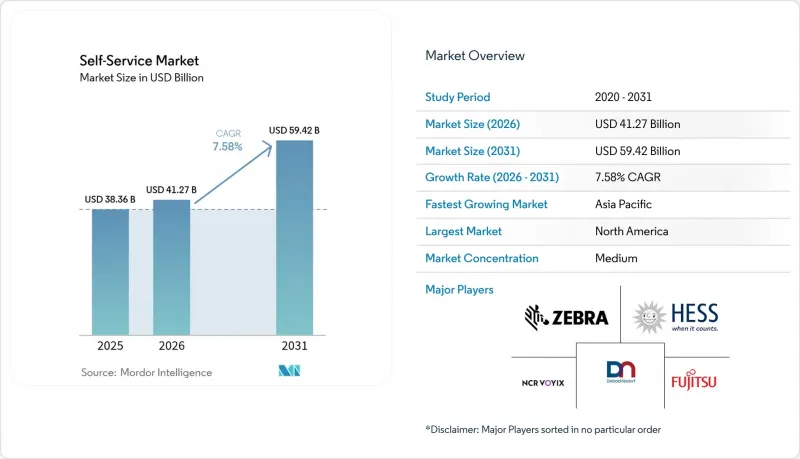
這一成長與疫情後向非接觸式服務的轉變、企業更嚴格的數位化政策以及公眾對數位錢包的廣泛認知直接相關。硬體和軟體供應商正透過整合人工智慧、電腦視覺和生物識別模組來滿足這一需求,這些技術能夠降低延遲、增強安全性,並在包括銀行、零售、醫療保健和公共服務在內的眾多領域開闢新的應用情境。QR碼和基於近場通訊(NFC)的支付生態系統目前在許多都市區佔據主導地位,支撐著對能夠兼容用戶偏好的任何身份驗證方式的自助終端的穩定需求。供應商也正著力於服務合約和平台使用費,將曾經的一次性硬體銷售轉變為持續的收入來源,從而穩定現金流。然而,抵禦人為破壞、惡劣戶外天氣條件以及電商替代的能力仍然是實現盈利部署的先決條件。
全球自助服務市場趨勢與洞察
後疫情時代非接觸式支付的普及
全球數位支付普及率從2014年的44%飆升至2022年的三分之二成年人,證實了無現金消費行為的永久轉變。歐洲的研究表明,出於衛生考慮,人們持續避免使用現金,微型超市營運商在實施無現金支付模組後,銷售額有所成長。瑞典等國家在過去十年中現金使用量減少了一半,凸顯了政策、商家和消費者如何快速朝向數位化通用發展。這一趨勢也延伸至生物識別和語音引導,推動了自助服務市場各領域對非接觸式認證的支持。
智慧零售模式的迅速普及
未來,採用RFID閘機、電腦視覺和智慧貨架的自主商店預計將大幅成長。在德國,自助結帳系統商店的數量最近已超過5,000家,零售商正計劃進一步擴張。在美國,像山姆會員店這樣的批發連鎖店正在引入人工智慧設備,這些設備可以在幾秒鐘內掃描購物車,從而減少排隊並重新分配員工。微型倉配中心雖然面臨整合方面的挑戰,但它們能夠在人口密集地區實現當日補貨,並催生了對儲物櫃和混合型自助服務終端的需求,這些終端支援全天候取貨和退貨。
持續不斷的破壞行為以及與現金處理相關的安全風險。
根據英國電信的數據,在強大的鎖具和警報系統出現之前,公共電話每年都會遭受數萬次攻擊。隨著複雜的盜刷和側錄技術層出不窮,預計2032年,實體安全和網路安全市場規模將達到324億美元。雖然營運商正在部署指紋、臉部認證和多因素認證來打擊欺詐,但每增加一個新模組都會增加成本,延長認證週期。與警方聯合巡邏和人工智慧監控可以減少損失,但無法完全消除損失。
細分市場分析
預計到2025年,自助服務終端將佔自助服務市場的35.74%,凸顯了其在辦理入住、票務和帳單支付等領域的柔軟性。自助服務終端市場規模的成長得益於持續的軟體更新,這些更新增加了語言包、人工智慧虛擬形象和支付選項。隨著雜貨店和零售商降低人事費用和縮短結帳等待時間,自助結帳系統通道正以8.01%的複合年成長率快速擴張。 ATM機仍然是現金生態系統的基石,但隨著許多小額轉帳需求現在可以透過行動支付滿足,其年度安裝量已趨於穩定。自動販賣機正在擴大其社會影響力,其產品範圍已從零食擴展到非處方藥、個人防護工具(PPE)和有時效性的疫苗。智慧儲物櫃已收到來自物流公司的活躍訂單,這些公司需要降低最後一公里配送成本,並允許在營業時間外取件。醫療自助服務終端市場預計將從2025年的8.6億美元成長到2029年的19.2億美元,這表明診斷、遠端醫療和處方箋更新等功能可以整合到緊湊的安裝空間中。零售商正在透過應用電腦視覺技術來最大限度地減少錯誤和客戶不滿,例如使用攝影機自動測量農產品的重量。在產品陣容中,那些將耐用性與雲端連接相結合,從而提供即時洞察和遠端服務的供應商將繼續保持其競爭優勢。
為了符合無障礙法規,自助服務終端供應商正投資抗菌表面、觸覺回饋和無障礙佈局。自助結帳系統機製造商正與金融科技閘道合作,在遵守支付安全標準的前提下,實現「先買後付」功能。 ATM供應商正將業務多元化,拓展至視訊櫃員和加密貨幣模組,以保持市場競爭力。自動販賣機專家正在試行動態冷凍技術和人工智慧貨架陳列圖,以優先展示暢銷商品,提高每平方英吋的銷售額。儲物櫃供應商正在為食品雜貨和藥品行業增加溫度控制功能。因此,豐富的產品系列組合持續發揮應對自助服務市場不斷變化的消費趨勢和經濟狀況的作用。
預計到 2025 年,硬體銷售額將佔總銷售額的 53.52%,而軟體則以每年 8.66% 的速度成長,是實現終身獲利的關鍵。供應商正在採用容器化作業系統,無需現場存取即可進行安全更新,從而縮短新功能的平均上市時間。雲端控制面板能夠清楚顯示使用高峰,使零售商能夠僅在客流量需求較高時才部署員工。迪堡多富 (Diebold Nixdorf) 的 DN Vynamic 套件連接超過 23 萬個終端,並發送預測性維護警報,以減少意外停機時間。部署在邊緣的 AI 引擎可在幾毫秒內偵測可疑的提款模式,並支援即時鎖定帳戶。與會員平台的整合也支援直接在螢幕上創建提升銷售機會。
服務涵蓋安裝、拆卸、軟體修補程式和合規性審核,是對組件策略的補充。隨著續約合約的增加,服務利潤率可能超過硬體出貨利潤率。無障礙顧問確保符合《聯邦公報》中規定的觸覺、聽覺和視覺標準。將ERP和POS數據與自助服務終端遙測數據結合的公司可以實現閉合迴路分析,並按SKU、班次和地點顯示銷售成長情況。這種可視性對於在全球自助服務市場部署自助服務終端且資本投資週期有限的大型連鎖企業至關重要。
自助服務市場報告按產品類型(自助服務終端、ATM 等)、組件(硬體、軟體、服務)、最終用戶行業(銀行、金融服務和保險、零售和快餐店等)、技術(支援生物識別、NFC/非接觸式、人工智慧驅動/電腦視覺等)、安裝位置(室內/室外)和地區進行細分。
區域分析
預計到2025年,北美將佔全球銷售額的39.02%,這反映了多年來ATM技術的普及、零售業的廣泛應用以及注重隱私的監管法規。隨著銀行卡普及率接近100%,數位錢包也逐漸成為主流,商家優先考慮支援晶片、非接觸式和行動身分驗證的終端。聯邦機構正將經濟刺激預算投入寬頻和數位政府入口網站建設中,並致力於在公共服務亭中打造一致的使用者體驗。企業對人工智慧、雲端運算和網路安全的關注度在每個預算週期都在不斷提升,從而推動了對基於現有硬體的軟體升級的需求。
在歐洲,永續性與包容性正在尋求平衡。歐盟委員會倡導生態設計和透明的供應鏈,敦促製造商延長設備使用壽命並揭露其碳足跡。無障礙法規強制要求配備點字小鍵盤、語音提示和字體大小調節功能,這影響材料清單(BOM) 和韌體設計。德國的 EHI舉措透過統計數千條自助結帳系統通道,展現了其龐大的商業性需求。同時,該地區正在探討能夠與自助服務終端和自動櫃員機無縫整合的最佳數位歐元形式。營運商正在對車輛進行改造,加裝遠端遙測系統,以減少服務車輛的行駛里程,從而符合氣候目標。
亞太地區以8.17%的複合年成長率成長,受益於推動數位化政策和智慧型手機QR碼支付的爆炸性成長。在印度,每月有數十億筆UPI轉賬,QR碼支付甚至在當地的自助服務終端也十分普遍。在中國,央行數位貨幣(CBDC)試點計畫正在進行中,預計將整合到公共交通和自動販賣機網路中,這要求業者迅速更新韌體。東南亞國協政府正資助在郵局內設立電子政府櫃檯,簡化行政程序,同時確保偏遠地區居民也能獲得同等服務。南美和中東地區雖然發展落後,但隨著通訊業者推廣行動支付以及旅遊業復甦帶動多語言售票機需求的成長,其發展速度正在加快。
其他好處:
- Excel格式的市場預測(ME)表
- 3個月的分析師支持
目錄
第1章:引言
- 研究假設和市場定義
- 調查範圍
第2章:調查方法
第3章執行摘要
第4章 市場狀況
- 市場概覽
- 市場促進因素
- 新冠疫情後時代非接觸式交易的普及
- 智慧零售模式的快速發展
- 全通路銀行營運的自動化浪潮
- 政府計劃無現金社會
- 人工智慧驅動的自適應使用者介面
- 微型倉配和全天候無人運作概念
- 市場限制因素
- 持續不斷的破壞行為以及與現金處理相關的安全風險。
- 戶外裝置在惡劣氣候條件下總擁有成本較高
- 無障礙標準的標準化進程進展緩慢。
- 電子商務的興起繞過了銷售管道
- 價值鏈分析
- 技術展望
- 波特五力分析
- 供應商的議價能力
- 買方的議價能力
- 新進入者的威脅
- 替代品的威脅
- 競爭公司之間的競爭
- 主要技術趨勢
- 自助服務終端的演變
- 無障礙資訊亭標準與工作小組
- 重點案例研究和使用者調查
第5章 市場規模與成長預測
- 依產品類型
- 亭
- ATM
- 自動販賣機
- 自助結帳系統系統
- 智慧儲物櫃/宅配箱
- 按組件
- 硬體
- 軟體
- 服務
- 按最終用戶行業分類
- BFSI
- 零售和快餐店
- 飯店業
- 衛生保健
- 交通和旅行樞紐
- 政府和公共部門
- 透過技術
- 支援生物識別
- NFC/非接觸式
- 人工智慧驅動和電腦視覺
- 雲端連線
- 按引入區域
- 室內的
- 戶外的
- 按地區
- 北美洲
- 美國
- 加拿大
- 墨西哥
- 歐洲
- 德國
- 英國
- 法國
- 義大利
- 西班牙
- 俄羅斯
- 其他歐洲地區
- 亞太地區
- 中國
- 日本
- 印度
- 韓國
- ASEAN
- 澳洲和紐西蘭
- 亞太其他地區
- 南美洲
- 巴西
- 阿根廷
- 南美洲其他地區
- 中東和非洲
- 中東
- 沙烏地阿拉伯
- 阿拉伯聯合大公國
- 土耳其
- 其他中東國家
- 非洲
- 南非
- 奈及利亞
- 其他非洲地區
- 中東
- 北美洲
第6章 競爭情勢
- 市場集中度
- 策略趨勢
- 市佔率分析
- 公司簡介
- NCR Corporation
- Diebold Nixdorf
- Crane Payment Innovations
- Fujitsu Ltd.
- Glory Global Solutions
- Zebra Technologies
- Advantech Co. Ltd.
- Frank Mayer and Associates Inc.
- HESS Cash Systems GmbH
- Azkoyen Group
- Embross
- SEDCO
- IER Group
- Maas International BV
- RedyRef Interactive
- Olea Kiosks Inc.
- Posiflex Technology Inc.
- SlabbKiosks
- KIOSK Information Systems
第7章 市場機會與未來展望
The Self-Service Market size is projected to expand from USD 38.36 billion in 2025 and USD 41.27 billion in 2026 to USD 59.42 billion by 2031, registering a CAGR of 7.58% between 2026 to 2031.
This growth links directly to the shift toward contactless engagement that gathered pace after the pandemic, tighter corporate mandates for digitization, and broad public familiarity with digital wallets. Hardware and software suppliers are responding by embedding AI, computer vision, and biometric modules that cut wait times, strengthen security, and open new use-cases across banking, retail, healthcare, and public venues. Payment ecosystems built on QR and NFC are now mainstream in many urban centers, and they underpin steady demand for self-service terminals able to accept any credential the user prefers. Vendors also highlight service contracts and platform fees, turning what was once a one-off hardware sale into a recurring revenue stream that smooths cash flow. However, resilience against vandalism, outdoor weather extremes, and e-commerce substitution remains a prerequisite for profitable roll-outs.
Global Self-Service Market Trends and Insights
Ubiquity of Contact-Free Transactions Post-COVID
Global digital payment participation jumped from 44% in 2014 to two-thirds of adults in 2022, confirming a permanent tilt toward cashless behaviors. European research shows sustained intentions to avoid cash because of hygiene concerns, and operators of micro-markets report higher revenues after installing cashless modules. Countries like Sweden, where cash use halved in the past decade, underscore how rapidly policy, merchants, and consumers converge on digital rails. This preference extends to biometric taps and voice prompts, driving every corner of the self-service market to support no-touch authentication.
Rapid Rollout of Smart Retail Formats
Autonomous stores relying on RFID gates, computer vision, and smart shelving are projected to grow significantly. Germany counted more than 5,000 self-checkout outlets recently, and retailers plan further acceleration. In the United States, wholesale chains such as Sam's Club deployed AI-enhanced devices that scan carts in seconds, shrinking queues and redeploying staff. Micro-fulfilment hubs, despite integration headaches, promise same-hour replenishment for densely populated districts, creating a pull for lockers and hybrid kiosks able to dispense and accept goods around the clock.
Persistent Vandalism and Cash-Handling Security Risks
Data from British Telecom revealed tens of thousands of attacks on pay-phones each year until ruggedized locks and alarms curbed incidents. Sophisticated jackpotting and skimming drives a physical and cyber security market forecast to reach USD 32.4 billion by 2032. Operators add fingerprint, facial recognition and multi-factor prompts to counter fraud, yet every new module raises cost per unit and elongates certification cycles. Collaborative patrols with police and AI-driven surveillance mitigate losses but cannot erase them entirely.
Other drivers and restraints analyzed in the detailed report include:
- Omni-Channel Banking Automation Wave
- Government Push for Cash-Lite Societies
- High TCO for Outdoor Deployments in Harsh Climates
For complete list of drivers and restraints, kindly check the Table Of Contents.
Segment Analysis
Kiosks controlled 35.74% self-service market share in 2025, highlighting their flexibility across check-in, ticketing, and bill payment. The self-service market size tied to kiosks benefits from continuous software refreshes that add language packs, AI avatars, and payment choices. Self-checkout lanes are growing at an 8.01% CAGR as grocers and general merchandisers curb labor expenses and speed the line. ATMs still anchor cash ecosystems, yet annual installations are plateauing because mobile transfers now satisfy many low-value needs. Vending machines move beyond snacks into OTC medicines, PPE, and time-sensitive vaccines, which widens their social footprint. Smart lockers registered brisk orders from logistics firms under pressure to cut last-mile costs and allow after-hours parcel pick-up. Healthcare kiosks, projected to ramp from USD 0.86 billion in 2025 to USD 1.92 billion by 2029, illustrate how diagnosis, telehealth, and prescription renewal can converge in compact footprints. Retailers adopt computer vision so cameras automatically weigh produce, minimizing errors and shopper frustration. The product mix will continue to reward vendors who merge durability with cloud hooks that unlock real-time insights and remote service.
Kiosk suppliers invest in antimicrobial surfaces, haptic feedback, and wheelchair-friendly layouts to stay ahead of accessibility rules. Self-checkout makers partner with fintech gateways to switch on buy-now-pay-later while still conforming to payment security standards. ATM vendors pivot toward Video Teller Machines and cryptocurrency modules to preserve relevance. Vending specialists test dynamic refrigeration and AI planograms to display fast-moving inventory first, which uplifts sales per square inch. Locker providers add temperature control for the grocery and pharmaceutical segments. Portfolio breadth, therefore, remains a hedge against shifts in consumer flow and merchant economics within the self-service market.
Hardware was responsible for 53.52% of revenue in 2025, yet software is advancing 8.66% each year and is the key to lifetime monetization. Vendors deploy containerized operating systems that permit secure updates without field visits, shortening mean-time-to-market for new features. Cloud dashboards spotlight usage spikes, allowing retailers to preload staff only when traffic demands. Diebold Nixdorf's DN Vynamic suite connects more than 230,000 endpoints and pushes predictive maintenance alerts that reduce unscheduled downtime. AI engines sit at the edge, flagging suspicious withdrawal patterns within milliseconds and supporting instant lockouts. Integrations with loyalty platforms also open upsell moments right on the screen.
Services round out the component play, spanning installation, decommissioning, software patching, and compliance audits. As recurring contracts expand, service margins may eclipse those of hardware shipments. Accessibility consultants ensure adherence to tactile, speech, and visual standards laid out in the Federal Register. Firms that couple ERP and point-of-sale data with kiosk telemetry enable closed-loop analytics showing sales uplift by SKU, shift, and location. This visibility is central to procurement decisions at large chains that roll kiosks worldwide on thin capex cycles within the self-service market.
The Self-Service Market Report is Segmented by Product Type (Kiosk, ATM, and More), Component (Hardware, Software, and Services), End-User Industry (BFSI, Retail and Quick-Service Restaurant, and More), Technology (Biometric-Enabled, NFC / Contactless, AI-Driven and Computer-Vision, and More), Deployment Location (Indoor and Outdoor), and Geography.
Geography Analysis
North America held 39.02% of revenue in 2025, reflecting long-standing adoption of automated teller technology, wide retail deployment, and supportive privacy regulations. Payment card penetration is nearly universal, and digital wallets are mainstream, so merchants prioritize terminals that handle chip, tap, and mobile credentials. Federal agencies devote stimulus budgets to broadband and digital government portals, fostering a consistent user experience in public service kiosks. Corporate appetite for AI, cloud, and cybersecurity rises each budget cycle, reinforcing demand for software-centric upgrades that sit atop existing hardware.
Europe balances sustainability and inclusion. The European Commission urges eco-design and transparent supply chains, pushing manufacturers to lengthen device lifespans and publish carbon footprints. Accessibility law compels tactile keypads, audio prompts, and adjustable font sizes, which influence BOM and firmware design. Germany's EHI initiative demonstrates commercial appetite by counting thousands of self-checkout lanes, while the region debates best formats for a digital euro that could seamlessly link to kiosks and ATMs. Operators retrofit remote telemetry to trim service van miles, aligning with climate targets.
Asia-Pacific, advancing at an 8.17% CAGR, benefits from pro-digitization edicts and an explosion of smartphone-linked QR payments. India stages billions of UPI transfers each month, normalizing QR taps even in rural kiosks. China pilots a central bank digital currency that will likely integrate into transit and vending networks, placing pressure on operators to update firmware fast. Governments in ASEAN fund e-government lobbies inside post offices, reducing red tape while ensuring remote citizens receive equal service. South America and the Middle East trail but accelerate as telcos push mobile money and as tourism revives interest in multi-language ticketing stations.
- NCR Corporation
- Diebold Nixdorf
- Crane Payment Innovations
- Fujitsu Ltd.
- Glory Global Solutions
- Zebra Technologies
- Advantech Co. Ltd.
- Frank Mayer and Associates Inc.
- HESS Cash Systems GmbH
- Azkoyen Group
- Embross
- SEDCO
- IER Group
- Maas International B.V.
- RedyRef Interactive
- Olea Kiosks Inc.
- Posiflex Technology Inc.
- SlabbKiosks
- KIOSK Information Systems
Additional Benefits:
- The market estimate (ME) sheet in Excel format
- 3 months of analyst support
TABLE OF CONTENTS
1 INTRODUCTION
- 1.1 Study Assumptions and Market Definition
- 1.2 Scope of the Study
2 RESEARCH METHODOLOGY
3 EXECUTIVE SUMMARY
4 MARKET LANDSCAPE
- 4.1 Market Overview
- 4.2 Market Drivers
- 4.2.1 Ubiquity of contact-free transactions post-COVID
- 4.2.2 Rapid rollout of smart retail formats
- 4.2.3 Omni-channel banking automation wave
- 4.2.4 Government push for cash-lite societies
- 4.2.5 AI-powered adaptive user interfaces
- 4.2.6 Micro-fulfilment and 24/7 unmanned concepts
- 4.3 Market Restraints
- 4.3.1 Persistent vandalism and cash-handling security risks
- 4.3.2 High TCO for outdoor deployments in harsh climates
- 4.3.3 Limited accessibility standards harmonisation
- 4.3.4 Rising e-commerce bypassing vending channels
- 4.4 Value Chain Analysis
- 4.5 Technological Outlook
- 4.6 Porter's Five Forces Analysis
- 4.6.1 Bargaining Power of Suppliers
- 4.6.2 Bargaining Power of Buyers
- 4.6.3 Threat of New Entrants
- 4.6.4 Threat of Substitutes
- 4.6.5 Competitive Rivalry
- 4.7 Major Technological Developments
- 4.7.1 Evolution of Self-Service Kiosks
- 4.7.2 Barrier-Free Kiosk Standards and Working Groups
- 4.7.3 Leading Case Studies and User-Surveys
5 MARKET SIZE AND GROWTH FORECASTS (VALUE)
- 5.1 By Product Type
- 5.1.1 Kiosk
- 5.1.2 ATM
- 5.1.3 Vending Machine
- 5.1.4 Self-Checkout System
- 5.1.5 Smart Locker / Parcel Station
- 5.2 By Component
- 5.2.1 Hardware
- 5.2.2 Software
- 5.2.3 Services
- 5.3 By End-user Industry
- 5.3.1 BFSI
- 5.3.2 Retail and Quick-Service Restaurant
- 5.3.3 Hospitality
- 5.3.4 Healthcare
- 5.3.5 Transportation and Travel Hubs
- 5.3.6 Government and Public Sector
- 5.4 By Technology
- 5.4.1 Biometric-Enabled
- 5.4.2 NFC / Contactless
- 5.4.3 AI-Driven and Computer-Vision
- 5.4.4 Cloud-Connected
- 5.5 By Deployment Location
- 5.5.1 Indoor
- 5.5.2 Outdoor
- 5.6 By Geography
- 5.6.1 North America
- 5.6.1.1 United States
- 5.6.1.2 Canada
- 5.6.1.3 Mexico
- 5.6.2 Europe
- 5.6.2.1 Germany
- 5.6.2.2 United Kingdom
- 5.6.2.3 France
- 5.6.2.4 Italy
- 5.6.2.5 Spain
- 5.6.2.6 Russia
- 5.6.2.7 Rest of Europe
- 5.6.3 Asia-Pacific
- 5.6.3.1 China
- 5.6.3.2 Japan
- 5.6.3.3 India
- 5.6.3.4 South Korea
- 5.6.3.5 ASEAN
- 5.6.3.6 Australia and New Zealand
- 5.6.3.7 Rest of Asia-Pacific
- 5.6.4 South America
- 5.6.4.1 Brazil
- 5.6.4.2 Argentina
- 5.6.4.3 Rest of South America
- 5.6.5 Middle East and Africa
- 5.6.5.1 Middle East
- 5.6.5.1.1 Saudi Arabia
- 5.6.5.1.2 UAE
- 5.6.5.1.3 Turkey
- 5.6.5.1.4 Rest of Middle East
- 5.6.5.2 Africa
- 5.6.5.2.1 South Africa
- 5.6.5.2.2 Nigeria
- 5.6.5.2.3 Rest of Africa
- 5.6.5.1 Middle East
- 5.6.1 North America
6 COMPETITIVE LANDSCAPE
- 6.1 Market Concentration
- 6.2 Strategic Moves
- 6.3 Market Share Analysis
- 6.4 Company Profiles (includes Global level Overview, Market level overview, Core Segments, Financials as available, Strategic Information, Market Rank/Share for key companies, Products and Services, and Recent Developments)
- 6.4.1 NCR Corporation
- 6.4.2 Diebold Nixdorf
- 6.4.3 Crane Payment Innovations
- 6.4.4 Fujitsu Ltd.
- 6.4.5 Glory Global Solutions
- 6.4.6 Zebra Technologies
- 6.4.7 Advantech Co. Ltd.
- 6.4.8 Frank Mayer and Associates Inc.
- 6.4.9 HESS Cash Systems GmbH
- 6.4.10 Azkoyen Group
- 6.4.11 Embross
- 6.4.12 SEDCO
- 6.4.13 IER Group
- 6.4.14 Maas International B.V.
- 6.4.15 RedyRef Interactive
- 6.4.16 Olea Kiosks Inc.
- 6.4.17 Posiflex Technology Inc.
- 6.4.18 SlabbKiosks
- 6.4.19 KIOSK Information Systems
7 MARKET OPPORTUNITIES AND FUTURE OUTLOOK
- 7.1 White-Space and Unmet-Need Assessment

 自助式超級市場市場規模、佔有率及成長分析(依技術、配送類型、應用、最終用戶及地區分類)-2026-2033年產業預測
 自助服務市場規模、佔有率和成長分析(按類型、最終用戶和地區分類)-2026-2033年產業預測
 2032 年自助服務技術市場預測:按產品類型、部署模式、技術、應用、最終用戶和地區進行的全球分析自助服務技術市場至2030年的預測:按產品類型、部署模式、介面、最終用戶和地區的全球分析
 自助服務技術的全球市場
 自助服務應用程式市場,按產品類型、按組件、按部署、按應用程式、按國家和地區 - 2024-2032 年行業分析、市場規模、市場佔有率和預測
 自助服務技術的全球市場 2024-2028