


 |
市場調查報告書
商品編碼
2044107
旋轉幫浦:市場佔有率分析、產業趨勢與統計、成長預測(2026-2031)Rotary Pumps - Market Share Analysis, Industry Trends & Statistics, Growth Forecasts (2026 - 2031) |
||||||

※ 本網頁內容可能與最新版本有所差異。詳細情況請與我們聯繫。
預計旋轉幫浦市場將從 2025 年的 112 億美元和 2026 年的 119.8 億美元成長到 2031 年的 168.7 億美元,2026 年至 2031 年的複合年成長率為 7.09%。
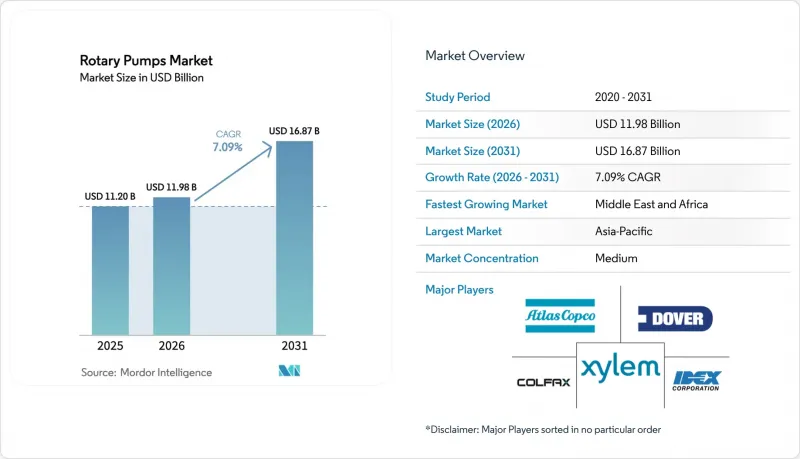
隨著煉油廠維修高黏度流體輸送管線、亞洲石化聯合企業安裝符合API-676標準的齒輪泵和螺旋泵,以及北美食品加工商為滿足日益嚴格的衛生標準而更換傳統衛生級離心泵,結構性需求正在不斷成長。海上作業者正在深海FPSO中標準化雙螺桿幫浦機組,以避免脈動疲勞。同時,美國市政當局正利用《基礎設施投資與就業法案》的津貼,指定離心式幫浦幫浦和單軸螺旋泵浦用於污泥、消化池和污水處理。監測振動、溫度和密封狀態數據的數位雙胞胎平台日益普及,正推動著市場從一次性備件銷售轉向長期監測契約,這使得擁有大規模安裝經驗的成熟製造商佔據了優勢。儘管歐洲對假冒售後零件和揮發性有機化合物(VOC)的更嚴格監管使得總擁有成本(TCO)的計算變得複雜,但API-676認證和基於感測器的可靠性仍然是各個終端市場的重要採購標準。
全球旋轉幫浦市場趨勢與洞察
能源產業的棕地維修正在推動對高黏度流體處理的需求。
北美和中東的煉油商正將資金從待開發區項目轉向瓶頸改造項目,以適應更重的原油混合物和可再生原料,這導致離心式幫浦大規模替換為經認證的外嚙合齒輪泵和雙螺旋泵能夠處理粘度超過5000 cP的原油。 Equinor公司在其蒙斯塔德煉油廠投資10億美元的現代化改造計畫正在安裝電動旋轉泵,預計可減少30%的範圍2排放。石油天然氣氣候舉措(OGCI)預測,到2028年,其成員公司將需要額外2500台旋轉泵,這鞏固了未來多年的需求前景。 API-676標準對密封、振動和泵殼的嚴格要求限制了認證供應商的數量,符合該標準的供應商可以獲得溢價。這些因素共同確保了即使棕地整體建設放緩,對現有煉油廠高黏度幫浦升級的需求仍將持續成長。
中國和印度石化工廠的擴建需要符合 API-676 標準的旋轉泵浦。
預計到2025年,中國原油加工能力將達到創紀錄的1,481萬桶/日。在浙江榮盛煉油廠(年產能4000萬噸)的支援下,長期訂單正穩步轉向高壓齒輪幫浦和螺旋泵。這其中包括本地設計的70兆帕額定壓力產品,旨在降低對進口的依賴。在印度,一項到2030年日處理能力達到150萬桶的煉油廠擴建計畫正在進行中。同時,信實工業和印度石油公司已對用於聚合物級丙烯和丁二烯輸送作業的雙螺旋泵供應商進行了預認證。國際能源總署(IEA)預測,到2030年,石化原料的需求將以每年6.2%的速度成長,這將進一步增加樹脂和彈性體工廠對符合API-676標準的設備的需求。為滿足日益嚴格的環保法規,工程、採購和施工 (EPC) 承包商強制要求使用帶有洩漏檢測口的雙壓密封件,這促進了供應商之間的差異化競爭。因此,在預測期內,亞洲石化大型企劃仍將是受監管旋轉泵浦的最大訂單來源。
亞洲非官方供應商分銷低成本仿冒零件。
根據歐盟智慧財產局 (EUIPO) 的數據,在歐盟邊境查獲的工業零件中,假轉子、密封件和軸承佔 12%,其中大部分來自中國和印度。劣質彈性體在高溫和化學腐蝕環境下會迅速劣化,導致過早洩漏和代價高昂的停機。電子商務平台使得未經認證的零件唾手可得,令缺乏嚴格供應商認證流程的維修團隊不堪負荷。儘管液壓學會已推出基於QR碼和區塊鏈的認證框架,但其在北美以外地區的應用仍然有限,灰色市場通路仍然存在。除非工廠營運商統一實施檢驗系統,否則假冒備件將繼續侵蝕合法售後市場的利潤,並損害原始設備製造商 (OEM) 的品牌價值。
細分市場分析
截至2025年,外嚙合齒輪幫浦的市佔率為32.47%。這主要歸功於其結構簡單堅固,使其能夠承受上游油田中含沙原油和高吸程的考驗。隨著雙螺桿幫浦(預計到2031年將成長8.43%)解決FPSO上部模組和聚合物反應器中常見的脈動和氣體夾帶問題,外嚙合齒輪幫浦的市佔率預計將會下降。 Seatrium公司與FPSO簽訂的P-84和P-85 FPSO契約,以及NETZSCH公司1400立方米/小時XXLB-F型泵的投產,都表明運營商和供應商正在為大型企劃推廣雙螺桿泵技術,推動市場向性能差異化解決方案轉型。同時,內嚙合齒輪幫浦正在飲料、巧克力和個人護理液等對低剪切力要求較高的衛生細分市場站穩腳跟。另一方面,葉片泵浦和三螺旋泵的應用仍局限於移動油壓設備和高壓船舶潤滑領域。 Roto Pumps 的模組化 P 系列產品表明,即使在成熟的外嚙合齒輪設計領域,創新仍在繼續,但螺桿技術有望延長密封件壽命並降低振動,因此在總體擁有成本 (TCO) 方面變得越來越有優勢。
目前,客戶規範越來越要求將符合 API-676 標準和數位化連接功能作為整體解決方案,迫使供應商即使在標準機架中也必須整合感測器連接埠和工廠預裝的振動探頭。隨著生質油和可再生柴油等能源轉換燃料湧入管道,流體黏度波動日益顯著,能夠調節轉速而不影響容積效率的螺旋泵的價值也隨之提升。因此,旋轉幫浦市場的競爭格局可能更有利於那些能夠大規模生產堅固耐用、具備數位化功能的雙螺桿幫浦平台,同時又能在外嚙合齒輪幫浦替代業務中保持一定利潤空間的供應商。
受上游、中游和下游廣泛應用的推動,石油和天然氣產業預計到2025年將佔據28.42%的市場佔有率。然而,由於脫碳目標的推動,石化燃料領域的資本投資受到限制,其成長動能落後於整體市場的複合年成長率。相較之下,受《食品安全現代化法案》(FSMA) 和歐盟「從農場到餐桌」舉措的推動,食品飲料加工商預計到2031年將以9.11%的複合年成長率擴大泵的採購量,這兩項法案均要求對衛生設備進行系統性現代化改造。整合到新型衛生管線中的感測器可以產生有關清潔週期和製程溫度的可操作數據,從而降低合規風險,並解釋了該領域強勁的普及曲線。
在化學和石化工廠,尤其是在中國和印度加工聚合物級單體的複雜裝置中,對高壓高溫齒輪泵和螺旋泵的高價值訂單持續不斷。水處理、污水處理和電力行業的需求穩定,而《基礎設施投資與就業法案》下的預算撥款正推動美國老舊設備被單軸螺旋泵浦和LOBE泵取代。採礦和紙漿造紙業對耐磨旋轉泵的需求波動較大,預計將使供應商的收入來源多元化,並降低其在整個預測期內對原油價格波動的敏感度。
區域分析
預計到2025年,亞太地區將佔全球市場佔有率的40.19%,主要得益於中國煉油廠運轉率創歷史新高,以及印度進口替代政策帶動國內API-676供應商訂單增加。中東和非洲地區預計將實現9.08%的複合年成長率,其中沙烏地阿美吉贊煉油廠擴建項目、阿拉伯聯合大公國魯瓦伊斯煉油廠以及奈及利亞丹格特煉油廠(日處理能力65萬桶)均已達到運作,並分別指定使用高流量、高壓齒輪泵和螺桿泵。北美地區訂單穩定,這得益於現有煉油廠加氫設備的升級改造以及聯邦政府500億美元的水利基礎設施支出津貼市政水泵升級。
在歐洲,由於衛生幫浦領域的技術創新以及VOC法規帶來的維修需求,業者正在權衡雙密封和無密封方案的成本,預計市場將保持穩定但溫和的成長。南美洲的成長軌跡高度依賴巴西的FPSO建設項目和智利的銅精礦管道項目,預計耐磨和低脈動泵的訂單將持續較長時間且規模有限。總體而言,區域多元化正在緩解宏觀經濟波動,並為旋轉泵供應商提供均衡的全球成長前景。
亞洲已開發國家也正在向低碳燃料轉型,例如日本已將其三分之一的閒置煉油產能用於生產永續航空燃料。這一轉變已催生了對額定壓力超過100巴的雙螺桿螺旋泵的新競標。同時,澳洲液化天然氣業者正在其水處理模組中安裝旋轉葉片泵和單軸螺旋泵浦,以符合更嚴格的排放法規,這為在珀斯和達爾文設有服務基地的供應商帶來了更高的售後服務收入。在韓國,蔚山和麗水的化學回收生產線正在進行升級改造,以處理混合塑膠廢棄物,並指定使用配備磁力耦合器的API-676齒輪泵,以消除揮發性有機化合物(VOC)洩漏並滿足相當於工業排放指令的當地標準。最後,新加坡裕廊島正在提高其生物裂解裝置的處理能力,需要流量超過500立方公尺/小時的螺旋泵,以處理黏度超過1000厘泊的脂肪酸原料。這進一步鞏固了東南亞作為高性能旋轉設備主要市場的地位。
其他好處:
- Excel格式的市場預測(ME)表
- 3個月的分析師支持
目錄
第1章:引言
- 研究假設和市場定義
- 調查範圍
第2章:調查方法
第3章執行摘要
第4章 市場狀況
- 市場概覽
- 市場促進因素
- 能源領域現有設施的維修正在推動對高黏度流體處理的需求。
- 隨著中國和印度石化工廠的擴張,需要符合 API-676 標準的旋轉幫浦。
- 巴西海上FPSO建設的復甦帶動了雙螺旋泵幫浦的訂單成長。
- 隨著美國 FSMA 強制實施 CIP(就地清洗)要求,食品級齒輪幫浦越來越受歡迎。
- 歐洲精釀啤酒廠的興起推動了低剪切LOBE泵的採用。
- 人工智慧驅動的預測性維護模型擴大了售後市場收入。
- 市場限制因素
- 亞洲非官方供應商提供的低成本仿冒零件
- 歐盟嚴格的 VOC排放法規限制了旋轉泵浦機械軸封的選擇。
- 與供水設施中的離心式替代方案相比:初始成本高
- 撒哈拉以南非洲地區螺旋泵幫浦維護人員短缺
- 產業價值鏈分析
- 監理情勢
- 技術展望
- 宏觀經濟因素對市場的影響
- 波特五力分析
- 新進入者的威脅
- 買方的議價能力
- 供應商的議價能力
- 替代品的威脅
- 競爭公司之間的競爭
第5章 市場規模與成長預測
- 按類型
- 外齒輪
- 內齒輪
- 雙螺桿
- 三軸螺桿
- 貝恩
- 按最終用戶行業分類
- 石油和天然氣
- 發電
- 化工/石油化工
- 食品/飲料
- 用水和污水
- 其他終端用戶產業
- 排氣壓力
- 最高可達 10 巴
- 10~25 bar
- 25~100 bar
- 100巴或以上
- 水泵流量(立方米/小時)
- 最多 50
- 51~150
- 151~500
- 500人或以上
- 按地區
- 北美洲
- 美國
- 加拿大
- 墨西哥
- 南美洲
- 巴西
- 阿根廷
- 智利
- 南美洲其他地區
- 歐洲
- 英國
- 德國
- 法國
- 義大利
- 西班牙
- 其他歐洲地區
- 亞太地區
- 中國
- 印度
- 日本
- 韓國
- 澳洲
- 亞太其他地區
- 中東和非洲
- 中東
- 沙烏地阿拉伯
- 阿拉伯聯合大公國
- 土耳其
- 其他中東國家
- 非洲
- 南非
- 奈及利亞
- 其他非洲地區
- 中東
- 北美洲
第6章 競爭情勢
- 市場集中度
- 策略趨勢
- 市佔率分析
- 公司簡介
- Dover Corporation(Pump Solutions Group)
- IDEX Corporation(Viking Pump)
- Colfax Corporation(IMO/Allweiler)
- SPX Flow Inc.
- Xylem Inc.
- Atlas Copco AB
- Gardner Denver Holdings Inc.
- Pfeiffer Vacuum Technology AG
- ULVAC Inc.
- Busch SE
- Flowserve Corporation
- KSB SE and Co. KGaA
- Netzsch Pumpen and Systeme GmbH
- Alfa Laval AB
- PCM SA
- Seepex GmbH
- ITT Inc.
- Sulzer Ltd.
- DESMI A/S
- Kirloskar Brothers Ltd.
- Verder Group
- Roto Pumps Ltd.
- Tuthill Corporation
- Blackmer(PSG brand)
- Vogelsang GmbH and Co. KG
- Roper Technologies Inc.(Roper Pump Company)
- Leistritz AG
- Eureka Pumps AS
第7章 市場機會與未來展望
The rotary pumps market size is projected to expand from USD 11.20 billion in 2025 and USD 11.98 billion in 2026 to USD 16.87 billion by 2031, registering a 7.09% CAGR between 2026 and 2031.
Structural demand is strengthening as refineries retrofit high-viscosity service lines, Asian petrochemical complexes commission API-676 gear and screw models, and North American food processors replace legacy sanitary centrifugals to meet tightening hygiene rules. Offshore operators are standardizing twin-screw units on deep-water FPSOs to avoid pulsation-induced fatigue, while United States municipalities, armed with Infrastructure Investment and Jobs Act grants, are specifying rotary lobe and progressive-cavity pumps for sludge, digester, and influent duties. Rising adoption of digital-twin platforms that monitor vibration, temperature, and seal-health data is converting transactional spare-part sales into long-term monitoring contracts, handing an advantage to incumbents with large installed bases. Counterfeit aftermarket parts and stricter volatile-organic-compound (VOC) rules in Europe complicate total-cost-of-ownership calculations, yet API-676 certification and sensor-enabled reliability remain decisive purchase criteria across end markets.
Global Rotary Pumps Market Trends and Insights
Energy-Sector Brownfield Upgrades Driving High-Viscosity Fluid Handling Demand
Refiners across North America and the Middle East are redirecting capital from greenfield projects to debottlenecking programs that must accommodate heavier crude blends and renewable feedstocks, prompting large-scale replacement of centrifugal pumps with external-gear and twin-screw models certified for viscosities above 5,000 cP. Equinor's USD 1 billion modernization at the Mongstad refinery integrates electrified rotary pumps that are expected to curb Scope 2 emissions by 30%. The Oil and Gas Climate Initiative projects that member companies will require 2,500 additional rotary units by 2028, anchoring multi-year demand visibility. Strict API-676 seal, vibration, and casing limits restrict the qualified supplier pool, enabling compliant vendors to secure premium pricing. Together these factors ensure that even when overall refinery construction slows, brownfield replacement volumes for high-viscosity pumps will keep expanding.
Petrochemical Capacity Additions in China and India Requiring API-676 Compliant Rotary Pumps
China's record 14.81 million bpd throughput in 2025, supported by Rongsheng's 40 million t/yr Zhejiang complex, is steadily shifting long-term orders toward high-pressure gear and screw pumps that now include locally engineered 70 MPa ratings to reduce import dependence. India's 1.5 million bpd refinery expansion plan through 2030 has led Reliance and Indian Oil to pre-qualify twin-screw suppliers for polymer-grade propylene and butadiene transfer duties. The International Energy Agency forecasts petrochemical feedstock demand to rise 6.2% annually through 2030, reinforcing the pull for API-676 equipment across resin and elastomer plants. Engineering, procurement, and construction contractors are mandating dual-pressurized seals with leak-detection ports to satisfy tighter environmental rules, bolstering supplier differentiation. Consequently, Asian petrochemical mega-projects will remain the single largest booking source for compliant rotary pumps over the forecast horizon.
Availability of Low-Cost Counterfeit Spares from Unorganized Asian Vendors
The European Union Intellectual Property Office notes that counterfeit rotors, seals, and bearings now represent 12% of industrial parts seized at EU borders, with most originating in China and India. Substandard elastomers degrade quickly in high-temperature or chemically aggressive environments, leading to premature leaks and costly downtime. E-commerce platforms make uncertified parts easy to procure, overwhelming maintenance teams that lack strict vendor-qualification protocols. The Hydraulic Institute has introduced QR-code and blockchain authentication frameworks, but adoption outside North America remains limited, allowing gray-market channels to persist. Until plant operators universally implement verification systems, counterfeit spares will continue to erode legitimate aftermarket margins and damage OEM brand equity.
Other drivers and restraints analyzed in the detailed report include:
- Recovery of Offshore FPSO Construction in Brazil Boosting Twin-Screw Pump Orders
- Food-Grade Gear Pump Uptake Amid U.S. FSMA Clean-in-Place Mandates
- Strict VOC-Emission Rules Limiting Mechanical-Seal Selection for Rotary Pumps in EU
For complete list of drivers and restraints, kindly check the Table Of Contents.
Segment Analysis
External-gear pumps commanded 32.47% of share in 2025 because their simple, rugged architecture tolerates sand-laden crude and high suction lift in upstream fields. Their share is expected to slide as twin-screw models, projected to grow 8.43% through 2031, solve pulsation and gas-entrainment issues common on FPSO topsides and polymer reactors. Seatrium's P-84 and P-85 FPSO contracts and NETZSCH's 1,400 m3/h XXLB-F launch confirm that operators and suppliers are scaling two-screw technology for mega-project service, reinforcing the shift toward performance-differentiated solutions. Internal-gear pumps, meanwhile, are securing hygienic niches in beverage, chocolate, and personal-care fluids where low shear is critical, while vane and triple-screw types remain limited to mobile hydraulics and high-pressure marine lubrication. Roto Pumps' modular P-Range shows that innovation continues in mature external-gear designs, but total cost-of-ownership metrics increasingly favor screw technologies that promise longer seal life and lower vibration.
Customer specifications now bundle API-676 compliance with digital-readiness, forcing vendors to embed sensor ports or factory-installed vibration probes even on standard frames. As energy-transition fuels such as bio-oils and renewable diesel flood pipelines, fluid viscosities vary more widely, amplifying the value of screw pumps that can adjust speed without losing volumetric efficiency. Consequently, competitive dynamics in the rotary pumps market should tilt toward suppliers capable of mass-producing robust, digitally enabled twin-screw platforms while retaining niche margins in external-gear replacement business.
Oil and gas accounted for 28.42% of the share in 2025 through broader upstream, midstream, and downstream deployment, yet the segment's forward momentum trails the headline market CAGR as decarbonization targets cap fossil-fuel capital spending. Food and beverage processors, by contrast, are forecast to expand pump purchases at a 9.11% CAGR through 2031 because FSMA mandates and EU Farm-to-Fork incentives compel systematic upgrades to sanitary equipment. Integrated sensors in new hygienic lines generate actionable data on cleaning cycles and process temperature, reducing compliance risk and explaining the segment's robust adoption curve.
Chemical and petrochemical plants still generate large-ticket orders for high-pressure, high-temperature gear and screw pumps, especially at Chinese and Indian complexes processing polymer-grade monomers. Water, wastewater, and power create steady base demand, with Infrastructure Investment and Jobs Act allocations lining up progressive-cavity and lobe pump replacements in aging U.S. facilities. Mining, pulp, and paper add volatility-resilient demand for abrasion-resistant rotary designs, ensuring that supplier revenue streams become more diversified and less sensitive to oil-price cycles over the forecast horizon.
The Rotary Pumps Market Report is Segmented by Type (External-Gear, Internal-Gear, and More), End-User Industry (Oil and Gas, Power Generation, Chemicals and Petrochemicals, Food and Beverage, and More), Discharge Pressure (Up To 10 Bar, 10-25 Bar, 25-100 Bar, and Above 100 Bar), Pump Capacity (Up To 50 M3/H, 51-150 M3/H, 151-500 M3/H, and Above 500 M3/H), and Geography. The Market Forecasts are Provided in Terms of Value (USD).
Geography Analysis
Asia-Pacific held 40.19% of share in 2025, buoyed by record Chinese refinery runs and India's import-substitution policy that channels orders to domestic API-676 suppliers. The Middle East and Africa are forecast to post a 9.08% CAGR as Saudi Aramco's Jazan expansion, the UAE's Ruwais complex, and Nigeria's 650,000 bpd Dangote refinery reach full capacity, each specifying high-flow, high-pressure gear and screw models. North America benefits from brownfield hydroprocessing upgrades and USD 50 billion in federal water-infrastructure spending that subsidizes municipal pump replacements, anchoring a dependable order pipeline.
Europe combines hygienic pump innovation with VOC-induced retrofit headwinds, producing steady but not spectacular growth as operators weigh the cost of double seals against sealless options. South America's trajectory leans heavily on Brazil's FPSO build program and Chilean copper-concentrate pipelines, ensuring a long though narrower backlog for abrasion-resistant and low-pulsation units. Overall, geographic diversification tempers macro volatility and supports a balanced global growth outlook for rotary pump suppliers.
Asia's developed economies are also pivoting toward lower-carbon fuels, with Japan repurposing one-third of its idled refining capacity for sustainable-aviation-fuel production, a shift that is already generating new tenders for duplex-steel twin-screw pumps rated above 100 bar. Australia's LNG liquefaction operators are meanwhile installing rotary lobe and progressive-cavity units on water-treatment modules to comply with tightened discharge permits, expanding aftermarket service revenue for vendors that maintain Perth or Darwin service depots. South Korea is upgrading chemical recycling lines at Ulsan and Yeosu to process mixed plastic waste, specifying API-676 gear pumps fitted with magnetic couplings to eliminate fugitive VOC emissions and meet Industrial Emissions Directive-equivalent local standards. Finally, Singapore's Jurong Island is adding bio-cracker capacity that calls for above-500 m3/h screw pumps capable of handling fatty-acid feedstocks with viscosities above 1,000 cP, reinforcing Southeast Asia's role as a premium market for high-performance rotary equipment.
- Dover Corporation (Pump Solutions Group)
- IDEX Corporation (Viking Pump)
- Colfax Corporation (IMO / Allweiler)
- SPX Flow Inc.
- Xylem Inc.
- Atlas Copco AB
- Gardner Denver Holdings Inc.
- Pfeiffer Vacuum Technology AG
- ULVAC Inc.
- Busch SE
- Flowserve Corporation
- KSB SE and Co. KGaA
- Netzsch Pumpen and Systeme GmbH
- Alfa Laval AB
- PCM SA
- Seepex GmbH
- ITT Inc.
- Sulzer Ltd.
- DESMI A/S
- Kirloskar Brothers Ltd.
- Verder Group
- Roto Pumps Ltd.
- Tuthill Corporation
- Blackmer (PSG brand)
- Vogelsang GmbH and Co. KG
- Roper Technologies Inc. (Roper Pump Company)
- Leistritz AG
- Eureka Pumps AS
Additional Benefits:
- The market estimate (ME) sheet in Excel format
- 3 months of analyst support
TABLE OF CONTENTS
1 INTRODUCTION
- 1.1 Study Assumptions and Market Definition
- 1.2 Scope of the Study
2 RESEARCH METHODOLOGY
3 EXECUTIVE SUMMARY
4 MARKET LANDSCAPE
- 4.1 Market Overview
- 4.2 Market Drivers
- 4.2.1 Energy-Sector Brown-Field Upgrades Driving High-Viscosity Fluid Handling Demand
- 4.2.2 Petrochemical Capacity Additions in China and India Requiring API-676 Compliant Rotary Pumps
- 4.2.3 Recovery of Offshore FPSO Construction in Brazil Boosting Twin-Screw Pump Orders
- 4.2.4 Food-Grade Gear Pump Uptake Amid U.S. FSMA Clean-In-Place Mandates
- 4.2.5 Rising European Craft-Brewery Installations Favoring Low-Shear Lobe Pumps
- 4.2.6 AI-Enabled Predictive Maintenance Models Increasing Aftermarket Revenues
- 4.3 Market Restraints
- 4.3.1 Availability of Low-Cost Counterfeit Spares from Unorganized Asian Vendors
- 4.3.2 Strict VOC-Emission Rules Limiting Mechanical-Seal Selection for Rotary Pumps in EU
- 4.3.3 High Upfront Cost Versus Centrifugal Alternatives in Municipal Water Plants
- 4.3.4 Skilled-Labor Shortage for Screw-Pump Maintenance in Sub-Saharan Africa
- 4.4 Industry Value Chain Analysis
- 4.5 Regulatory Landscape
- 4.6 Technological Outlook
- 4.7 Impact of Macroeconomic Factors on the Market
- 4.8 Porter's Five Forces Analysis
- 4.8.1 Threat of New Entrants
- 4.8.2 Bargaining Power of Buyers
- 4.8.3 Bargaining Power of Suppliers
- 4.8.4 Threat of Substitutes
- 4.8.5 Intensity of Competitive Rivalry
5 MARKET SIZE AND GROWTH FORECASTS (VALUE)
- 5.1 By Type
- 5.1.1 External-Gear
- 5.1.2 Internal-Gear
- 5.1.3 Twin-Screw
- 5.1.4 Triple-Screw
- 5.1.5 Vane
- 5.2 By End-user Industry
- 5.2.1 Oil and Gas
- 5.2.2 Power Generation
- 5.2.3 Chemicals and Petrochemicals
- 5.2.4 Food and Beverage
- 5.2.5 Water and Waste-water
- 5.2.6 Other End-user Industries
- 5.3 By Discharge Pressure
- 5.3.1 Up to 10 bar
- 5.3.2 10-25 bar
- 5.3.3 25-100 bar
- 5.3.4 Above 100 bar
- 5.4 By Pump Capacity (m3/h)
- 5.4.1 Up to 50
- 5.4.2 51-150
- 5.4.3 151-500
- 5.4.4 Above 500
- 5.5 By Geography
- 5.5.1 North America
- 5.5.1.1 United States
- 5.5.1.2 Canada
- 5.5.1.3 Mexico
- 5.5.2 South America
- 5.5.2.1 Brazil
- 5.5.2.2 Argentina
- 5.5.2.3 Chile
- 5.5.2.4 Rest of South America
- 5.5.3 Europe
- 5.5.3.1 United Kingdom
- 5.5.3.2 Germany
- 5.5.3.3 France
- 5.5.3.4 Italy
- 5.5.3.5 Spain
- 5.5.3.6 Rest of Europe
- 5.5.4 Asia-Pacific
- 5.5.4.1 China
- 5.5.4.2 India
- 5.5.4.3 Japan
- 5.5.4.4 South Korea
- 5.5.4.5 Australia
- 5.5.4.6 Rest of Asia-Pacific
- 5.5.5 Middle East and Africa
- 5.5.5.1 Middle East
- 5.5.5.1.1 Saudi Arabia
- 5.5.5.1.2 United Arab Emirates
- 5.5.5.1.3 Turkey
- 5.5.5.1.4 Rest of Middle East
- 5.5.5.2 Africa
- 5.5.5.2.1 South Africa
- 5.5.5.2.2 Nigeria
- 5.5.5.2.3 Rest of Africa
- 5.5.5.1 Middle East
- 5.5.1 North America
6 COMPETITIVE LANDSCAPE
- 6.1 Market Concentration
- 6.2 Strategic Moves
- 6.3 Market Share Analysis
- 6.4 Company Profiles (Includes Global Level Overview, Market Level Overview, Core Segments, Financials as Available, Strategic Information, Market Rank/Share, Products and Services, and Recent Developments)
- 6.4.1 Dover Corporation (Pump Solutions Group)
- 6.4.2 IDEX Corporation (Viking Pump)
- 6.4.3 Colfax Corporation (IMO / Allweiler)
- 6.4.4 SPX Flow Inc.
- 6.4.5 Xylem Inc.
- 6.4.6 Atlas Copco AB
- 6.4.7 Gardner Denver Holdings Inc.
- 6.4.8 Pfeiffer Vacuum Technology AG
- 6.4.9 ULVAC Inc.
- 6.4.10 Busch SE
- 6.4.11 Flowserve Corporation
- 6.4.12 KSB SE and Co. KGaA
- 6.4.13 Netzsch Pumpen and Systeme GmbH
- 6.4.14 Alfa Laval AB
- 6.4.15 PCM SA
- 6.4.16 Seepex GmbH
- 6.4.17 ITT Inc.
- 6.4.18 Sulzer Ltd.
- 6.4.19 DESMI A/S
- 6.4.20 Kirloskar Brothers Ltd.
- 6.4.21 Verder Group
- 6.4.22 Roto Pumps Ltd.
- 6.4.23 Tuthill Corporation
- 6.4.24 Blackmer (PSG brand)
- 6.4.25 Vogelsang GmbH and Co. KG
- 6.4.26 Roper Technologies Inc. (Roper Pump Company)
- 6.4.27 Leistritz AG
- 6.4.28 Eureka Pumps AS
7 MARKET OPPORTUNITIES AND FUTURE OUTLOOK
- 7.1 White-space and Unmet-Need Assessment

 旋轉幫浦市場:按驅動類型、幫浦類型、材質和最終用戶分類-全球預測,2026-2032年
 旋轉泵市場規模、佔有率、趨勢和預測:按類型、容量、泵特性、原料、終端用戶行業和地區分類,2026-2034年
 旋轉葉片幫浦市場規模、佔有率、成長及全球產業分析:按類型、應用和地區的洞察,2026-2034年的預測
 全球旋轉幫浦市場:市場規模、佔有率和趨勢分析(按類型、最終用途和地區分類),細分市場預測(2026-2033 年)
 旋轉幫浦市場分析及預測(至2035年):依類型、產品、技術、應用、最終用戶、材質、組件、功能、安裝類型及製程分類全球旋轉幫浦市場規模、佔有率、趨勢和成長分析報告(2026-2034年)
 旋轉葉片浦市場 - 全球產業規模、佔有率、趨勢、機會及預測(按產品、應用、分銷管道、地區和競爭格局分類,2021-2031年)
 2025-2029年全球工業LOBE泵市場
 全球旋轉幫浦市場(2024-2028)