


 |
市場調查報告書
商品編碼
2044068
資料中心伺服器:市場佔有率分析、產業趨勢與統計、成長預測(2026-2031)Data Center Server - Market Share Analysis, Industry Trends & Statistics, Growth Forecasts (2026 - 2031) |
||||||

※ 本網頁內容可能與最新版本有所差異。詳細情況請與我們聯繫。
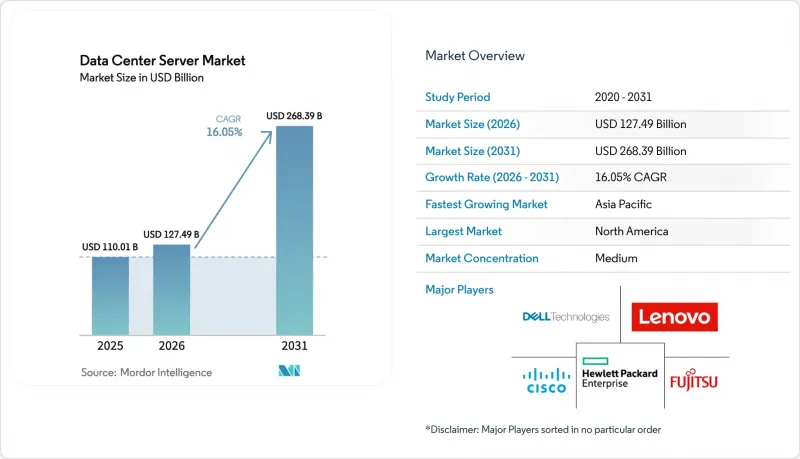
預計資料中心伺服器市場將從 2025 年的 1,100.1 億美元成長到 2026 年的 1,274.9 億美元,到 2031 年達到 2,683.9 億美元,2026 年至 2031 年的複合年成長率為 16.05%。
人工智慧訓練運行次數的增加、邊緣基礎設施的快速擴張以及液冷技術的普及,正在縮短更新周期,並支撐強勁的市場需求。歐洲和中東地區主權人工智慧指令的訂定,推動了本地叢集的部署,使資料中心伺服器市場擺脫了對公共雲端的過度集中。超大規模業者正在將GPU密度機架標準化,使其功耗超過80千瓦,迫使原始設備製造商(OEM)重新設計底盤以適應晶片級液冷(DTC)。高頻寬記憶體的供應限制促使超大規模營運商簽訂多年期組件契約,從而保證了中期出貨量的穩定。
全球資料中心伺服器市場趨勢及洞察
人工智慧和機器學習工作負載激增,對高密度GPU伺服器的需求日益成長
大規模語言模式的訓練已經需要使用超過 10,000 個 NVIDIA H100 或 AMD MI300X 加速器的集群,這使得機架功耗達到了傳統風冷無法承受的水平。 Meta 計劃在 2026 年底前部署 350,000 個 H100 等效 GPU,這意味著在不到兩年的時間內將新增約 175 兆瓦的負載。微軟已在多個 Azure 區域部署了專用 GPU叢集,以確保 GPT-4 用戶能夠獲得亞秒的推理延遲,這表明延遲目標和成本都是決定伺服器部署位置的關鍵因素。傳統的以 CPU 為中心的機架缺乏多模態學習所需的記憶體頻寬和 NVLink 架構,導致刷新週期縮短。因此,供應商正在將水冷 GPU 托架作為標準配置,從而將前置作業時間縮短一半,並使硬體部署與超大規模資料中心業者資料中心的計畫保持一致。
超大規模和邊緣資料中心擴張的勢頭
亞馬遜網路服務(AWS)承諾在2030年投資1500億美元用於新增運算能力,顯示運算需求的成長遠未達到飽和。谷歌正在沙烏地阿拉伯的NEOM新城建設1吉瓦的園區。園區採用海水冷卻技術,實現了低於1.1的電源使用效率(PUE),預計將成為沙漠地區部署的典範。 Verizon已在美國營運47個邊緣節點,以支援其5G獨立網路核心網,每個節點最多可容納50台低延遲伺服器。領先的託管公司正在改造現有機房,配備30千瓦的電源,以滿足人工智慧的需求,而無需租戶租賃整個機房。因此,超大規模和邊緣運算模式的整合正在模糊傳統的層級分類,並重塑採購標準。
先進伺服器組件供應鏈的波動
HBM 晶片的生產仍集中在 SK 海力士和美光兩家公司,導致 NVIDIA H200 伺服器的前置作業時間為 40 週,Blackwell 系統的交貨週期為 52 週。 SK 海力士已將其 HBM3e 的良率提高到 70%,但其產能將持續滿載運轉至 2026 年年中。 NVIDIA 正在優先向已簽訂多年預購合約的客戶分配晶片,這使得規模較小的供應商難以獲得供應。台積電的 CoWoS 封裝生產線產運轉率超過 95%,預計這種情況要到 2026 年底或更晚才能緩解。因此,AI 最佳化型伺服器的價格高出 25% 至 30%,這給簽訂固定價格合約的託管業者的利潤率帶來了壓力。
細分市場分析
隨著企業在同時運作多個系統時既需要冗餘備份又不想承擔全部維護成本,到2025年,Tier 3級資料中心將主導資料中心伺服器市場,佔據56.72%的佔有率。受金融和醫療保健公司因停機而面臨日益嚴厲的處罰的推動,Tier 4級資料中心的普及率正以17.54%的複合年成長率加速成長。根據執行時間 Institute預測,2025年23%的新計畫將需要Tier 4級認證,比2023年成長9個百分點。高規格的資料中心整合了雙電源和獨立的冷卻迴路,每台伺服器的成本增加800至1200美元,但可以有效防止單路徑故障。 Tier 1級和Tier 2級資料中心仍然用於邊緣區域,在這些區域,短期停機是可以接受的,而且資本支出預算仍然緊張。
隨著超大規模資料中心業者跳過傳統的伺服器等級分類,並實施自身的容錯方案以在200毫秒以內實現跨區域工作負載的路由,架構上的差異也在同步出現。巴塞爾委員會的業務連續性指南敦促銀行將三級伺服器作為最低標準,這間接影響了伺服器採購決策。託管資料中心的所有者正在採用模組化UPS系統,以實現容量的逐步擴展,從而應對租戶成長不確定性加劇帶來的現金流出問題。
預計到2025年,超大規模園區將佔據58.94%的市場佔有率,凸顯了市場對用地面積超過50萬平方英尺的人工智慧訓練叢集的青睞。隨著Meta和微軟運作千兆瓦級園區,預計到2031年,該細分市場將以17.48%的複合年成長率成長。大規模區域資料中心滿足了二級雲端服務供應商的需求,而中型設施則支援中端市場的託管服務。儘管存在大量小規模邊緣站點,但由於其伺服器容量有限,因此對資料中心伺服器市場規模的貢獻不大。
OEM廠商正在重組銷售團隊,專注於需要客製化基板、專有韌體和即時物流的超大規模客戶。像廣達和緯創這樣的OEM廠商優先考慮大量生產,犧牲利潤率,以每季5萬台的速度向雲端客戶供貨。中型企業傾向於融合式基礎架構基礎設施,這種架構簡化了部署,但也加劇了對供應商的依賴。邊緣運營商則偏愛能夠承受工業級溫度環境的堅固耐用的刀片伺服器,而這一細分市場主要由專業供應商主導。
區域分析
到2025年,北美將佔據39.83%的市場佔有率,這主要得益於超大規模資本投資和液冷技術的早期應用。該地區擁有成熟的電網、豐富的光纖資源以及能夠抵消不斷上漲的土地成本的稅收優惠。由於自主雲端的需求並不高,多租戶託管仍然是尋求快速擴展容量的企業的理想選擇。然而,維吉尼亞北部和加利福尼亞州的授權流程延誤延長了建設週期,促使營運商考慮將業務遷移到中西部和山地西部地區,因為這些地區的互聯核准速度更快。
亞太地區是成長最快的地區,預計到2031年複合年成長率將達到18.01%。在中國,由於出口限制導致尖端GPU供應不足,市場需求正轉向浪潮和華為平台,優先考慮國內伺服器廠商。印度的生產連結獎勵計畫計畫吸引了富士康和緯創等公司的組裝廠,降低了進口關稅,縮短了本地雲端服務供應商的前置作業時間。在日本,由於海底光纜的接近性和強大的電網,投資集中在東京和大阪,而其他地區城市則面臨產能瓶頸。
在歐洲,隨著強制性可再生能源的推廣,市場趨於穩定,這促使超大規模資料中心業者營運商進軍斯堪的納維亞半島和愛爾蘭,這些地區的水力發電和風力發電降低了碳排放強度。法蘭克福和阿姆斯特丹嚴格的用水法規迫使開發商轉向封閉回路型冷卻或棕地。中東和非洲正在崛起為新的成長中心,沙烏地阿拉伯和阿拉伯聯合大公國承諾投資超過500億美元用於數位基礎建設,使其經濟擺脫對油氣資源的依賴。南美洲的市場規模仍然相對小規模,但巴西的資料保護法鼓勵本地部署,以避免跨境資料傳輸。非洲新興的伺服器市場集中在南非和奈及利亞,這兩個國家使用柴油-太陽能混合系統來彌補不可靠的電網,但總成本比已開發國家的基準高出40%。
其他好處:
- Excel格式的市場預測(ME)表
- 3個月的分析師支持
目錄
第1章:引言
- 研究假設和市場定義
- 調查範圍
第2章:調查方法
第3章執行摘要
第4章 市場狀況
- 市場概覽
- 市場促進因素
- 雲端運算服務簡介
- 5G網路的大規模商業化
- 超大規模和邊緣資料中心建設的擴張勢頭
- 人工智慧和機器學習工作負載激增,對高密度GPU伺服器的需求日益成長
- 適用於功率超過 80 kW 機架的水冷式伺服器設計
- 遷移到 ARM 和 RISC-V 架構以降低整體擁有成本 (TCO)
- 市場限制因素
- 增加資料中心建置的資本投資
- 網路安全和勒索軟體風險日益惡化。
- 先進伺服器元件(HBM、GPU)的供應鏈波動性
- 主要城市的電網限制和授權延遲
- 產業供應鏈分析
- 監理情勢
- 技術展望
- 波特五力分析
- 新進入者的威脅
- 買方的議價能力
- 供應商的議價能力
- 替代品的威脅
- 競爭公司之間的競爭
- 對影響市場的宏觀經濟因素進行評估
第5章 市場規模與成長預測
- 層級類型
- 一級和二級
- 三級
- 第四級
- 按資料中心規模
- 小規模資料中心
- 中型資料中心
- 大型資料中心
- 超大規模資料中心
- 依資料中心類型
- 託管資料中心
- 超大規模資料中心業者資料中心/雲端服務供應商
- 企業和邊緣資料中心
- 按外形規格
- 半高刀片
- 全高刀片
- 四分之一高度/微刀片
- 按應用程式/工作負載
- 虛擬化和私有雲端
- 高效能運算(HPC)
- 人工智慧/機器學習和數據分析
- 以儲存為中心
- 邊緣/物聯網閘道器
- 按地區
- 北美洲
- 美國
- 加拿大
- 墨西哥
- 南美洲
- 巴西
- 阿根廷
- 南美洲其他地區
- 歐洲
- 德國
- 英國
- 法國
- 義大利
- 西班牙
- 其他歐洲地區
- 亞太地區
- 中國
- 印度
- 日本
- 韓國
- 亞太其他地區
- 中東和非洲
- 中東
- 沙烏地阿拉伯
- 阿拉伯聯合大公國
- 其他中東國家
- 非洲
- 南非
- 奈及利亞
- 其他非洲地區
- 中東
- 北美洲
第6章 競爭情勢
- 市場集中度
- 策略趨勢
- 市佔率分析
- 公司簡介
- Dell Technologies
- Hewlett Packard Enterprise
- Lenovo Group Limited
- Fujitsu Limited
- Cisco Systems Inc.
- Kingston Technology Co. Inc.
- Huawei Technologies Co. Ltd.
- Inspur Group
- IBM Corporation
- Atos SE
- Super Micro Computer Inc.
- Quanta Cloud Technology
- ZT Systems
- Hon Hai/Foxconn Technology Group
- Advanced Micro Devices
- NVIDIA Corporation
- Oracle Corporation
- NEC Corporation
- Arista Networks
- Broadcom Inc.
第7章 市場機會與未來展望
The Data Center Server Market size is expected to increase from USD 110.01 billion in 2025 to USD 127.49 billion in 2026 and reach USD 268.39 billion by 2031, growing at a CAGR of 16.05% over 2026-2031.
Escalating artificial-intelligence training runs, rapid edge buildouts, and the adoption of liquid cooling are shortening refresh cycles and underpinning robust demand. Sovereign-AI mandates in Europe and the Middle East are encouraging on-premises clusters, fragmenting the data center server market away from public-cloud concentration. Hyperscale operators are standardizing on GPU-dense racks that exceed 80 kilowatts, forcing OEMs to redesign chassis around direct-to-chip liquid cooling. Supply constraints for high-bandwidth memory are prompting hyperscalers to lock in multiyear component contracts, which, in turn, stabilize medium-term shipment visibility.
Global Data Center Server Market Trends and Insights
Proliferation of AI and ML Workloads Demanding GPU-Dense Servers
Training runs for large language models already involve clusters that exceed 10,000 NVIDIA H100 or AMD MI300X accelerators, elevating rack power to levels that conventional air-cooling cannot support. Meta plans to deploy 350,000 H100-equivalent GPUs by end-2026, translating into roughly 175 megawatts of incremental load in less than two years. Microsoft provisioned dedicated GPU clusters across multiple Azure regions to maintain sub-second inference latency for GPT-4 users, highlighting how latency targets now drive server location as strongly as cost. Older CPU-centric racks lack the memory bandwidth and NVLink fabric needed for multimodal training, which is compressing refresh cycles. Server vendors are therefore shipping liquid-cooled GPU trays as baseline configurations, halving lead times and aligning hardware with hyperscaler deployment schedules.
Hyperscale and Edge Data-Center Build-Out Momentum
Amazon Web Services committed USD 150 billion through 2030 for new capacity, signaling that compute-demand growth remains far from saturation. Google is erecting a 1-gigawatt campus in Saudi Arabia's NEOM zone that leverages seawater cooling to achieve sub-1.1 power-usage effectiveness, which could serve as a template for desert deployments. Verizon already operates 47 edge nodes across the United States to support 5G standalone cores, each housing up to 50 low-latency servers. Colocation leaders are retrofitting legacy halls with 30 kilowatt feeds to capture AI demand without forcing tenants to lease entire suites. The convergence of hyperscale and edge models is therefore blurring traditional tier classifications and reshaping procurement criteria.
Supply-Chain Volatility for Advanced Server Components
HBM production remains concentrated in SK Hynix and Micron, resulting in 40-week lead times for NVIDIA H200 servers and 52-week waits for Blackwell systems. SK Hynix raised HBM3e yields to 70%, yet capacity is fully booked until mid-2026. NVIDIA allocates chips to customers that pre-commit multi-year volumes, sidelining mid-tier providers lacking such scale. TSMC's CoWoS packaging lines are operating above 95% utilization with relief not expected until late 2026. As a result, AI-optimized servers carry 25%-30% premiums, eroding margins for colocation landlords bound by fixed-rate contracts.
Other drivers and restraints analyzed in the detailed report include:
- Liquid-Cooling-Ready Server Designs Enabling More than 80 kW Racks
- Adoption of Cloud-Computing Services
- Rising CapEx for Data-Center Construction
For complete list of drivers and restraints, kindly check the Table Of Contents.
Segment Analysis
Tier 3 sites dominated the data center server market, accounting for 56.72% of the market in 2025, as enterprises sought redundancy without the full cost of concurrent maintainability. Tier 4 adoption is accelerating at a 17.54% CAGR, driven by financial and healthcare firms confronting rising downtime penalties. The Uptime Institute noted that 23% of new projects in 2025 requested Tier 4 certification, up nine points from 2023. High-specification facilities integrate dual power supplies and independent cooling loops, adding USD 800-USD 1,200 per server but safeguarding against single-path failure. Tier 1 and Tier 2 environments persist at the edge, where brief outages are tolerable, and capex budgets remain tight.
A parallel architectural divergence is emerging as hyperscalers deploy custom resilience schemes that bypass traditional tier labels, routing workloads across zones in under 200 milliseconds. Basel Committee operational resilience guidelines are nudging banks toward Tier 3 minimums, indirectly influencing server procurement decisions. Colocation landlords are adopting modular UPS systems that scale capacity incrementally, aligning cash outflow with uncertain tenant growth.
Hyperscale campuses captured 58.94% of the market share in 2025, underscoring how AI training clusters favor footprints exceeding 500,000 square feet. The segment is tracking a 17.48% CAGR through 2031 as Meta and Microsoft commission gigawatt-scale parks. Large regional halls fill the gap for second-tier cloud providers, while medium facilities support mid-market colocation. Small edge sites, though numerous, contribute modestly to the data center server market size because they have limited server counts.
OEMs are reorganizing sales teams around hyperscale accounts that demand custom boards, proprietary firmware, and just-in-time logistics. Original design manufacturers such as Quanta and Wistron are exchanging margin for volume, delivering 50,000-unit quarters to cloud clients. Medium enterprises gravitate toward converged infrastructure that simplifies deployment but increases vendor lock-in. Edge operators favor rugged blades rated for industrial temperatures, a niche dominated by specialist suppliers.
The Data Center Server Market Report is Segmented by Tier Type (Tier 1 and 2, Tier 3, and Tier 4), Data Center Size (Small, Medium, Large, and Hyperscale), Data Center Type (Colocation, and More), Form Factor (Half-Height Blades, Full-Height Blades, and Quarter-height/Micro-blades), Application/Workload (Virtualization and Private Cloud, HPC, and More), and Geography. The Market Forecasts are Provided in Terms of Value (USD).
Geography Analysis
North America accounted for 39.83% of the market share in 2025, driven by hyperscale capital expenditure and early liquid-cooling deployments. The region benefits from mature power grids, abundant fiber, and tax incentives that offset rising land costs. Sovereign-cloud requirements are modest, so multitenant colocation remains attractive for enterprises seeking rapid capacity additions. However, permitting delays in Northern Virginia and California are lengthening construction timelines, nudging operators toward Midwest and Mountain-West alternatives with faster interconnection approvals.
Asia-Pacific is the fastest-growing region at an 18.01% CAGR through 2031. China is prioritizing domestic server vendors after export controls curtailed access to leading-edge GPUs, redirecting demand toward Inspur and Huawei platforms. India's production-linked incentive scheme is attracting Foxconn and Wistron assembly plants, reducing import duties and shortening lead times for local cloud providers. Japan clusters investments around Tokyo and Osaka due to cable proximity and resilient grids, while regional cities struggle with capacity caps.
Europe is stabilizing as renewable-energy mandates encourage hyperscalers to expand in the Nordics and Ireland where hydro and wind lower carbon intensity. Stringent water-usage regulations in Frankfurt and Amsterdam push developers toward closed-loop cooling and brownfield conversions. The Middle East and Africa are emerging corridors as Saudi Arabia and the United Arab Emirates pledge more than USD 50 billion for digital infrastructure that diversifies economies away from hydrocarbons. South America remains comparatively small, yet Brazil's data-protection law is stimulating local deployments to avoid cross-border data transfers. Africa's nascent server market concentrates in South Africa and Nigeria where diesel-solar hybrids mitigate unreliable grids, although total cost exceeds developed-market benchmarks by up to 40%.
- Dell Technologies
- Hewlett Packard Enterprise
- Lenovo Group Limited
- Fujitsu Limited
- Cisco Systems Inc.
- Kingston Technology Co. Inc.
- Huawei Technologies Co. Ltd.
- Inspur Group
- IBM Corporation
- Atos SE
- Super Micro Computer Inc.
- Quanta Cloud Technology
- ZT Systems
- Hon Hai / Foxconn Technology Group
- Advanced Micro Devices
- NVIDIA Corporation
- Oracle Corporation
- NEC Corporation
- Arista Networks
- Broadcom Inc.
Additional Benefits:
- The market estimate (ME) sheet in Excel format
- 3 months of analyst support
TABLE OF CONTENTS
1 INTRODUCTION
- 1.1 Study Assumptions and Market Definition
- 1.2 Scope of the Study
2 RESEARCH METHODOLOGY
3 EXECUTIVE SUMMARY
4 MARKET LANDSCAPE
- 4.1 Market Overview
- 4.2 Market Drivers
- 4.2.1 Adoption of Cloud Computing Services
- 4.2.2 Large-Scale Commercialization of 5G Networks
- 4.2.3 Hyperscale and Edge Data Center Build-Out Momentum
- 4.2.4 Proliferation of AI and ML Workloads Demanding GPU-Dense Servers
- 4.2.5 Liquid-Cooling-Ready Server Designs Enabling More than 80 kW Racks
- 4.2.6 Shift Toward ARM and RISC-V Architectures to Cut Total Cost of Ownership
- 4.3 Market Restraints
- 4.3.1 Rising CapEx for Data Center Construction
- 4.3.2 Escalating Cyber-Security and Ransomware Risks
- 4.3.3 Supply-Chain Volatility for Advanced Server Components (HBM, GPUs)
- 4.3.4 Power-Grid Constraints and Permitting Delays in Tier-1 Metros
- 4.4 Industry Supply-Chain Analysis
- 4.5 Regulatory Landscape
- 4.6 Technological Outlook
- 4.7 Porter's Five Forces Analysis
- 4.7.1 Threat of New Entrants
- 4.7.2 Bargaining Power of Buyers
- 4.7.3 Bargaining Power of Suppliers
- 4.7.4 Threat of Substitutes
- 4.7.5 Intensity of Competitive Rivalry
- 4.8 Assesment of Macroeconomic Factors on the Market
5 MARKET SIZE AND GROWTH FORECASTS (VALUE)
- 5.1 By Tier Type
- 5.1.1 Tier 1 and 2
- 5.1.2 Tier 3
- 5.1.3 Tier 4
- 5.2 By Data Center Size
- 5.2.1 Small Data Center
- 5.2.2 Medium Data Center
- 5.2.3 Large Data Center
- 5.2.4 Hyperscale Data Center
- 5.3 By Data Center Type
- 5.3.1 Colocation Data Center
- 5.3.2 Hyperscalers Data Center/CSPs
- 5.3.3 Enterprise and Edge Data Center
- 5.4 By Form Factor
- 5.4.1 Half-height Blades
- 5.4.2 Full-height Blades
- 5.4.3 Quarter-height / Micro-blades
- 5.5 By Application / Workload
- 5.5.1 Virtualisation and Private Cloud
- 5.5.2 High-Performance Computing (HPC)
- 5.5.3 Artificial Intelligence/Machine Learning and Data Analytics
- 5.5.4 Storage-centric
- 5.5.5 Edge / IoT Gateways
- 5.6 By Geography
- 5.6.1 North America
- 5.6.1.1 United States
- 5.6.1.2 Canada
- 5.6.1.3 Mexico
- 5.6.2 South America
- 5.6.2.1 Brazil
- 5.6.2.2 Argentina
- 5.6.2.3 Rest of South America
- 5.6.3 Europe
- 5.6.3.1 Germany
- 5.6.3.2 United Kingdom
- 5.6.3.3 France
- 5.6.3.4 Italy
- 5.6.3.5 Spain
- 5.6.3.6 Rest of Europe
- 5.6.4 Asia-Pacific
- 5.6.4.1 China
- 5.6.4.2 India
- 5.6.4.3 Japan
- 5.6.4.4 South Korea
- 5.6.4.5 Rest of Asia-Pacific
- 5.6.5 Middle East and Africa
- 5.6.5.1 Middle East
- 5.6.5.1.1 Saudi Arabia
- 5.6.5.1.2 United Arab Emirates
- 5.6.5.1.3 Rest of Middle East
- 5.6.5.2 Africa
- 5.6.5.2.1 South Africa
- 5.6.5.2.2 Nigeria
- 5.6.5.2.3 Rest of Africa
- 5.6.5.1 Middle East
- 5.6.1 North America
6 COMPETITIVE LANDSCAPE
- 6.1 Market Concentration
- 6.2 Strategic Moves
- 6.3 Market Share Analysis
- 6.4 Company Profiles (Includes Global Level Overview, Market Level Overview, Core Segments, Financials as Available, Strategic Information, Market Rank/Share, Products and Services, and Recent Developments)
- 6.4.1 Dell Technologies
- 6.4.2 Hewlett Packard Enterprise
- 6.4.3 Lenovo Group Limited
- 6.4.4 Fujitsu Limited
- 6.4.5 Cisco Systems Inc.
- 6.4.6 Kingston Technology Co. Inc.
- 6.4.7 Huawei Technologies Co. Ltd.
- 6.4.8 Inspur Group
- 6.4.9 IBM Corporation
- 6.4.10 Atos SE
- 6.4.11 Super Micro Computer Inc.
- 6.4.12 Quanta Cloud Technology
- 6.4.13 ZT Systems
- 6.4.14 Hon Hai / Foxconn Technology Group
- 6.4.15 Advanced Micro Devices
- 6.4.16 NVIDIA Corporation
- 6.4.17 Oracle Corporation
- 6.4.18 NEC Corporation
- 6.4.19 Arista Networks
- 6.4.20 Broadcom Inc.
7 MARKET OPPORTUNITIES AND FUTURE OUTLOOK
- 7.1 White-Space and Unmet-Need Assessment

 資料中心伺服器市場規模及預測(2021-2034 年),全球及區域佔有率、趨勢和成長機會分析報告:按類型、資料中心規模、層級、最終用戶和地區分類
 2026-2030年全球資料中心伺服器市場
 資料中心伺服器市場規模、佔有率、趨勢和預測:按產品、應用和地區分類(2026-2034 年)
 2026年全球資料中心伺服器市場報告
 日本資料中心伺服器:市佔率分析、產業趨勢與統計及成長預測(2026-2031)
 風冷伺服器市場:依伺服器類型、部署類型、冷卻類型、最終用戶和通路分類,全球預測,2026-2032年
 資料中心伺服器市場規模、佔有率和成長分析(按組件、類型、設計、公司規模、層級和地區分類)-2026-2033年產業預測
 資料中心伺服器市場機會、成長促進因素、產業趨勢分析及預測(2025-2034年)
 資料中心智慧推理伺服器:全球市場佔有率和排名、總收入和需求預測(2025-2031 年)
 CPX和Rubin的整合:全球伺服器的GDDR7