


 |
市場調查報告書
商品編碼
2044062
越野摩托車:市場佔有率分析、行業趨勢和統計數據、成長預測(2026-2031)Dirt Bike - Market Share Analysis, Industry Trends & Statistics, Growth Forecasts (2026 - 2031) |
||||||

※ 本網頁內容可能與最新版本有所差異。詳細情況請與我們聯繫。
預計到 2025 年,越野摩托車市場規模將達到 97.3 億美元,到 2026 年將達到 102.8 億美元,到 2031 年將達到 135.7 億美元,2026 年至 2031 年的複合年成長率為 5.70%。
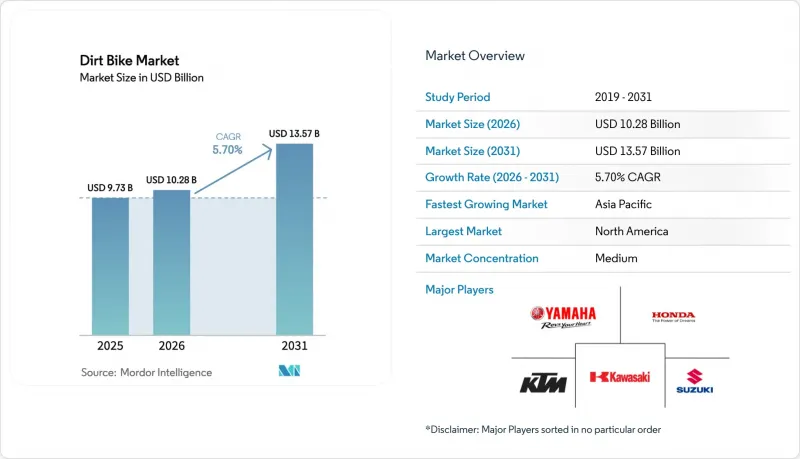
推動市場需求的因素包括:監管機構對電動化的施壓、業餘騎手數量的穩步成長以及探險旅遊的蓬勃發展,後者將越野摩托車定位為前往偏遠地區休閒的入門選擇。隨著廣播合約和串流服務的成長,越野摩托車運動保持著較高的知名度,這直接轉化為摩托車的銷售量。同時,輕量化材料的創新正在降低車身重量,提升騎乘舒適度。此外,隨著數位原生代消費者對透明定價和送貨上門的需求日益成長,線上直銷管道(DTC)也正在蓬勃發展。同時,經銷商繼續透過試駕、以舊換新和融資管道的普及來捍衛其市場佔有率。短期不利因素包括:土地使用法規限制了賽道的使用;鋰價波動導致電動摩托車的成本預測難以確定;以及輪胎磨損加劇推高了總擁有成本。然而,政策獎勵和電池生產成本的下降正在推動越野摩托車市場逐步走向電動化。
全球越野摩托車市場趨勢及洞察
摩托車越野賽和越野賽車的日益普及。
2025年,職業摩托車越野錦標賽的串流觀看量顯著成長,美國各地的比賽場館都擠滿了觀眾。這表明摩托車越野賽在推動越野摩托車銷售方面發揮著至關重要的作用。目前,像豪爾赫·普拉多和安東尼奧·凱羅利這樣的歐洲廠商車手在美國參賽,凸顯了這項運動的全球融合以及品牌曝光度的不斷提升。基層專案也在積極回應。 Monster Energy AMA業餘國家摩托車越野錦標賽透過推出「Prospect」應用程式,實現了青少年參與方式的現代化,該應用程式可用於追蹤排名和共用影片片段。英國汽車聯盟設立了新的女子青年組別,擴大了參與範圍,並鼓勵家庭購買摩托車。隨著媒體將直播權和數位精彩片段商業化,贊助商也在增加獎金池,進一步加速了良性循環:更高的知名度吸引了更多參與者,而參與者又推動了裝備的更換。
休閒探險騎行與旅遊的發展
在美國多條路線上,「偏遠地區探索路線」顯著促進了旅遊消費。這顯示多日雙用途摩托車旅行越來越受歡迎,尤其是在那些偏好高階裝備的富裕騎士群中。土地管理局 (BLM) 的報告顯示,公共土地的休閒遊客數量大幅增加,非公路用車輛許可證數量也顯著上升,凸顯了人們對越野路線的強勁需求。加州的「非公路用車輛通行便利化計畫」在城市中心附近開闢了新的騎行區域。該計劃將越野摩托車運動與露營、釣魚和遠足等適合家庭的活動完美結合。此類政策決策促進了越野摩托車市場的發展,使越野摩托車成為人們參與各種戶外活動的入門選擇。為此,製造商們不斷推出配備行李架和寬齒比變速箱的輕型雙用途摩托車,力求在越野路段的靈活性和公路騎行的舒適性之間取得平衡。
高昂的購置和維修成本
根據阿貢國家實驗室的研究,電動機車(電助力自行車)的價格高於內燃機(ICE)車型,但維護成本也更低。這種價格溢價源自於電池外殼和車架等改進,這些改進推高了單價。同時,內燃機摩托車也面臨成本上升的困境。更嚴格的蒸發排放法規和強制性診斷系統迫使原始設備製造商(OEM)改進燃油系統,而燃油系統的成本更高,導致零售價格上漲。此外,這對越野摩托車愛好者來說也是一筆不小的開銷。易損零件以及頻繁更換活塞和氣門機構的需求,對於活躍的賽車手來說,每年的維護成本可能相當可觀。展望未來,電池組成本預計到2032年將會下降,但價格波動難以預測,可能會進一步推遲價格趨於一致的目標實現。這種複雜的成本結構將越野摩托車市場分類為兩個截然不同的細分市場:「富裕的愛好者」和「注重預算的騎士」。後一群人往往傾向二手摩托車或價格較實惠的中國製造的進口汽車。
細分市場分析
預計到2025年,越野摩托車將佔整個越野摩托車市場的33.25%,並以5.93%的複合年成長率成長,這主要得益於強大的電視轉播協議、青少年發展體係以及頻繁的車型升級加速了裝備的更換。相較之下,耐力賽和林道摩托車更受那些偏好技術性單車道和耐力賽的騎士青睞,因此擁有週期更長。雙用途摩托車通過DOT認證的裝備彌合了公路和越野之間的差距,而探險車型則配備了更大的引擎和行李箱,以滿足多日旅行的需求。迷你組和青少年組正在培養未來的客戶,而汽車製造商提供的融資和以舊換新計劃則降低了家庭參與的門檻。持續的媒體曝光保持了越野摩托車的吸引力,確保這項運動在越野摩托車市場中保持主導地位。
業餘賽車手通常每隔一到兩個賽季更換摩托車以保持競爭力,這使得零件供應持續旺盛。專業賽車上的贊助商標誌會影響配件的購買,進一步提升售後市場的價值。耐力賽車手優先考慮可靠性,這帶動了零件的強勁銷售,但也導致新車更換週期延長。雙用途摩托車車主通常會在公路性能方面做出妥協,以平衡排放法規要求、越野性能和公路行駛性能。探險摩托車吸引著追求舒適性和載物能力的年長騎手,但在崎嶇地形上的操控性略遜一籌。青少年的車款輕巧、自動擋且價格實惠,這促使家長購買,從而擴大了參與者群體。總而言之,儘管越野摩托車仍保持其旗艦地位,但越野摩托車市場預計將在多個消費族群中持續擴張。
到2025年,內燃機摩托車將佔總銷售量的72.16%,這得益於其完善的經銷商服務網路、便捷的加油方式以及用戶熟悉的性能範圍。然而,在更嚴格的排放氣體法規和更低運行成本的推動下,預計到2031年,電動機車的複合年成長率將達到7.12%。加州已設定目標,到2035年,電動機車的銷售,這充分證明了小型電池組設計在人口密集的都市區的成本效益。
內燃機(ICE)動力傳動系統在續航里程和加油速度至關重要的長距離耐力賽中表現出色,但由於蒸發排放法規和強制性車載診斷(OBD)系統,其成本不斷增加。另一方面,電動機車在公園等環境中蓬勃發展,30-60英里的續航里程就足夠了,由於噪音法規的限制,靜音運行至關重要,而且再生煞車可以降低維護成本。電池重量仍然是一個障礙,但隨著能量密度的不斷提高,這個問題正在逐步解決。可更換電池組系統解決了充電造成的停機問題,但需要大規模的標準化,目前只有中國提供這種系統。因此,動力系統的市場佔有率將根據使用場景而分類,電動車將在郊區公園佔據主導地位,而內燃機仍將在山區和賽車領域繼續主導地位。
區域分析
到2025年,北美將佔全球越野摩托車市場收入的35.12%。這主要得益於成熟的賽車生態系統、較高的可支配收入以及聯邦政府管理的越野車道系統。加州分階段的電動化政策迫使汽車製造商加快零排放車輛的交付,鞏固了該地區作為需求中心和監管先鋒的地位。郊區越野車道的關閉減緩了區域成長,但州立越野公園的擴建在一定程度上彌補了通行權的損失。加拿大在省級越野車道建設資金的支持下,為春季至秋季的穩定銷售做出了貢獻,這反映了美國人對越野騎行的偏好。
亞太地區是成長最快的地區,預計到2031年將達到6.81%的複合年成長率。這主要得益於印度和中國電動二輪車的普及,而收入成長和政府補貼是推動這一趨勢的主要因素。都市化帶動了人們對主要城市兩小時車程範圍內短途休閒的需求。同時,中國的換電網路為無需在家充電的短途旅行提供了支援。東南亞緊隨其後,雖然基數較小,但印尼和泰國的本地組裝和旅遊導向越野路線叢集的激勵措施為其發展提供了支撐。日本和韓國市場規模雖小,但技術先進,更青睞高配置的越野摩托車和雙用途摩托車。
在歐洲,由於崎嶇的阿爾卑斯山地形和國際摩托車聯合會(FIM)認可的賽事日程,耐力賽、雙用途摩托車和探險摩托車的需求較為均衡。更嚴格的歐5排放和噪音法規迫使汽車製造商轉向小型引擎和電動動力傳動系統,但各國補貼政策的差異導致不同地區的普及率有差異。南美洲依賴成本績效的進口車輛,巴西憑藉其摩托車產業政策,在生產中心扮演關鍵角色。儘管經濟波動減緩了銷售成長,但穿越熱帶雨林和安第斯山脈的路線魅力仍然保持著人們的渴望。在中東和非洲部分地區,海灣國家和南非的摩托車市場正在成長,儘管規模有限。然而,氣候和道路通行條件是主要的阻礙因素。
其他好處:
- Excel格式的市場預測(ME)表
- 3個月的分析師支持
目錄
第1章:引言
- 研究假設和市場定義
- 調查範圍
第2章:調查方法
第3章執行摘要
第4章 市場狀況
- 市場概覽
- 市場促進因素
- 摩托車越野賽和越野賽車運動日益普及
- 休閒探險騎行與旅遊的發展
- 推動電動越野摩托車相關法規的製定
- 輕量化材料和懸吊創新
- 拓展500cc以下入門車型市場
- OEM營運的電競/虛擬MX平台
- 市場限制因素
- 高昂的購置和維修成本
- 因土地用途和噪音法規限制,電路關閉
- 電池用鋰的價格波動
- 輪胎快速磨損導致總擁有成本增加
- 價值/供應鏈分析
- 監理情勢
- 技術展望
- 波特五力模型
- 新進入者的威脅
- 買方的議價能力
- 供應商的議價能力
- 替代品的威脅
- 競爭公司之間的競爭
第5章 市場規模及成長預測(價值(美元)及數量(單位))
- 按類型
- 越野摩托車
- 耐力賽
- 蹤跡
- 雙運動
- 冒險
- 迷你/青少年
- 透過推進力
- 內燃機(ICE)
- 電
- 按引擎排氣量
- 125cc或以下
- 126~250 cc
- 251~500 cc
- 500cc或以上
- 最終用戶
- 專業(賽車隊)
- 業餘/休閒
- 商業(租賃、工業、國防)
- 按價格範圍
- 低價
- 中階
- 優質的
- 透過分銷管道
- 經銷商和展示室
- 線上直接面對消費者
- 賽車運動用品專賣店
- 按地區
- 北美洲
- 美國
- 加拿大
- 北美其他地區
- 南美洲
- 巴西
- 阿根廷
- 南美洲其他地區
- 歐洲
- 德國
- 英國
- 法國
- 西班牙
- 俄羅斯
- 其他歐洲地區
- 亞太地區
- 中國
- 印度
- 日本
- 韓國
- 澳洲和紐西蘭
- 亞太其他地區
- 中東和非洲
- 埃及
- 土耳其
- 沙烏地阿拉伯
- 阿拉伯聯合大公國
- 其他中東和非洲地區
- 北美洲
第6章 競爭情勢
- 市場集中度
- 策略趨勢
- 市佔率分析
- 公司簡介
- Honda Motor Co., Ltd.
- KTM AG
- Yamaha Motor Co., Ltd.
- Kawasaki Heavy Industries, Ltd.
- Betamotor SpA
- Suzuki Motor Corporation
- Triumph Motorcycles Ltd.
- Sherco Motorcycles
- TM Racing SpA
- Fantic Motor SpA
- Rieju SA
- Segway Powersports
- BMW AG
- Hero MotoCorp Ltd.
- Loncin Motorcycle
- CFMoto
- AJP Moto
第7章 市場機會與未來展望
The dirt bike market size is projected to be USD 9.73 billion in 2025, USD 10.28 billion in 2026, and reach USD 13.57 billion by 2031, growing at a CAGR of 5.70% from 2026 to 2031.
Demand is underpinned by regulatory pressure for electrification, a steady influx of new amateur riders, and the expansion of adventure tourism that frames dirt bikes as gateway vehicles for remote recreation. Motocross maintains high visibility through broadcast contracts and streaming growth that translate directly into bike sales, while lightweight material innovations cut unsprung mass and improve ride comfort. In parallel, online direct-to-consumer (DTC) channels gain traction as digitally native buyers seek transparent pricing and doorstep delivery, even as dealerships defend share through test rides, trade-in convenience, and financing penetration. Near-term headwinds include land-use restrictions that limit track availability, lithium price volatility that clouds electric cost projections, and rapid tire wear that elevates total cost of ownership, yet policy incentives and cost declines in battery production continue to steer the dirt bike market toward gradual electrification.
Global Dirt Bike Market Trends and Insights
Rising Popularity of Motocross and Off-Road Racing
In 2025, the Pro Motocross Championship experienced a significant increase in streaming viewership and attracted a large number of live attendees at various United States rounds, underscoring motocross's pivotal role in driving dirt bike sales. European factory riders such as Jorge Prado and Antonio Cairoli now compete in the United States, underscoring the sport's global convergence and escalating brand exposure. Grass-roots programs respond in kind: the Monster Energy AMA Amateur National Motocross Championship integrated the Prospect app to track rankings and share video clips, modernizing youth engagement. The United Kingdom's Auto-Cycle Union created new women's youth categories that widen the participant funnel and stimulate family bike purchases. As media outlets monetize live rights and digital highlights, sponsors increase purse levels, further fueling a cycle in which visibility drives participation, and participation sustains equipment turnover.
Growth in Recreational Adventure Riding and Tourism
Across several United States routes, Backcountry Discovery Routes spurred significant tourism spending. This underscores the allure of multi-day dual-sport trips, particularly among affluent riders keen on premium gear. The Bureau of Land Management reported substantial recreation visits to public lands, with a notable uptick in off-highway vehicle permits, highlighting the robust demand for trails. California's Off-Highway Vehicle Access and Enhancement Plan has introduced new riding areas within a short radius of metro centers. This initiative seamlessly integrates dirt biking with family activities like camping, fishing, and hiking. Such policy decisions bolster the dirt bike market, positioning off-road motorcycles as gateways to diverse outdoor pursuits. In response, manufacturers are rolling out lightweight dual-sport models, equipped with luggage racks and wide-ratio transmissions, striking a balance between trail agility and backroad comfort.
High Purchase and Maintenance Costs
Studies from Argonne reveal that while electric motorcycles (e-motorcycles) enjoy a price premium over internal combustion engine (ICE) counterparts, they also benefit from reduced maintenance costs. This premium largely stems from enhancements like rugged battery housings and reinforced frames, which add high costs per unit. On the flip side, ICE motorcycles grapple with rising costs. Stricter evaporative and diagnostic mandates compel original equipment manufacturers (OEMs) to undertake pricier fuel-system revisions, consequently driving up retail prices. Additionally, motocross enthusiasts face significant expenses: high-wear parts and piston and valve-train refreshes required frequently can result in substantial annual costs for active racers. Looking ahead, while battery pack costs are anticipated to drop by 2032, unpredictable volatility scenarios might push the timeline for achieving price parity further out. This intricate expense landscape carves the dirt bike market into two distinct segments: affluent enthusiasts and budget-conscious riders, the latter often gravitating towards used bikes or more affordable Chinese imports.
Other drivers and restraints analyzed in the detailed report include:
- Regulatory Push Toward Electric Dirt Bikes
- Lightweight Materials and Suspension Innovations
- Track Closures Due to Land-Use and Noise Rules
For complete list of drivers and restraints, kindly check the Table Of Contents.
Segment Analysis
Motocross contributed 33.25% to the dirt bike market in 2025 and is set to grow at 5.93% CAGR through robust broadcast deals, youth feeder systems, and frequent model upgrades that accelerate equipment turnover. In contrast, enduro and trail categories appeal to riders who favor technical single-track and endurance, resulting in longer ownership cycles. Dual-sport bikes bridge on- and off-road with DOT equipment, while adventure models integrate larger engines and luggage for multi-day travel. Mini and youth classes cultivate future customers; OEM-sponsored financing and trade-in programs lower the entry barrier for families. Ongoing media exposure keeps motocross aspirational, ensuring that this discipline retains primacy within the dirt bike market.
Amateur racers typically replace bikes every one to two seasons to remain competitive, injecting continuous demand into the pipeline. Sponsorship logos on professional machines influence accessory purchases, further lifting aftermarket value. Enduro riders focus on reliability, fueling steady parts sales but slower new-unit turnover. Dual-sport owners weigh emissions compliance against off-road capability, often accepting some street bias for freeway legality. Adventure bikes pull older demographics seeking comfort and load capacity, but surrender technical prowess in tight terrain. Youth models are lightweight, automatic, and affordable, supporting parental purchasing decisions and broadening the participant base. Combined, these dynamics ensure that the dirt bike market size continues to expand across multiple consumer cohorts while motocross maintains the flagship role.
Internal combustion engines held 72.16% of 2025 unit sales, underscoring entrenched dealer service networks, fast refueling, and familiar performance envelopes. Even so, electric bikes deliver a 7.12% CAGR to 2031, buoyed by tighter emissions laws and lower running costs. California targets 50% electric motorcycle sales by 2035, a policy that cascades nationwide as manufacturers minimize SKU complexity. India and Southeast Asia drive volume through subsidies and battery-swap stations, revealing the cost-effectiveness of small-pack designs in dense urban corridors.
ICE powertrains excel in remote endurance events where range and refuel speed dominate, but they face rising costs from evaporative and OBD mandates. Electric bikes shine in park environments where a 30-60 mile range suffices, noise caps favor silent operation, and regenerative braking cuts maintenance. Battery weight remains a hurdle, though continuous energy-density gains chip away at this penalty. Swappable pack systems answer charge downtime but require standardization that only China currently offers at scale. Therefore, propulsion share will diverge by use case, with urban-proximate parks tilting electric while back-country and race formats keep ICE in command.
The Dirt Bike Market Report is Segmented by Type (Motocross, Enduro, and More), Propulsion (Internal Combustion Engine (ICE) and Electric), Engine Displacement (<=125 Cc, 126-250 Cc, and More), End-User (Professional, Amateur/Recreational, and More), Price Range (Low-Cost, Mid-Range, and More), Distribution Channel (Dealerships and Showrooms and More), and Geography. Market Forecasts Provided in Value (USD) and Volume (Units).
Geography Analysis
North America generated 35.12% of the global dirt bike market revenue in 2025, driven by mature racing ecosystems, high discretionary income, and federally managed trail systems. California's phased electric mandate compels OEMs to accelerate zero-emission offerings, reinforcing the region's role as both demand center and regulatory bellwether. Track closures in suburban corridors slow local growth, yet expansion of state off-highway parks partially offsets access loss. Canada contributes stable spring-to-fall sales that mirror the United States trail preferences, buoyed by provincial trail-pass funding.
Asia-Pacific is the fastest expanding region, scoring a 6.81% CAGR through 2031 as India and China combine rising incomes with policy subsidies to elevate electric two-wheeler adoption. Urbanization fuels demand for short-haul recreation within two hours of major cities, while battery-swap networks in China support day-trip usage without home charging. Southeast Asia follows, albeit from a small base, helped by local assembly incentives and tourism-oriented trail clusters in Indonesia and Thailand. Japan and South Korea remain modest but technology-rich markets that favor high-spec trail and dual-sport machines.
Europe exhibits balanced demand across enduro, dual-sport, and adventure classes, backed by rugged alpine terrain and FIM-sanctioned race calendars. Stricter Euro 5 tailpipe rules and noise caps push OEMs toward smaller displacement and electric powertrains, although fragmented national subsidies create uneven adoption rates. South America leans on value-oriented imports, with Brazil serving as a production hub under its motorcycle industrial policy. Economic volatility tempers unit growth, yet the allure of rainforest and Andean routes sustains aspirational purchases. Middle East and Africa pockets show limited but rising activity in Gulf states and South Africa, constrained mainly by climate and trail access.
- Honda Motor Co., Ltd.
- KTM AG
- Yamaha Motor Co., Ltd.
- Kawasaki Heavy Industries, Ltd.
- Betamotor S.p.A.
- Suzuki Motor Corporation
- Triumph Motorcycles Ltd.
- Sherco Motorcycles
- TM Racing S.p.A.
- Fantic Motor S.p.A.
- Rieju S.A.
- Segway Powersports
- BMW AG
- Hero MotoCorp Ltd.
- Loncin Motorcycle
- CFMoto
- AJP Moto
Additional Benefits:
- The market estimate (ME) sheet in Excel format
- 3 months of analyst support
TABLE OF CONTENTS
1 Introduction
- 1.1 Study Assumptions and Market Definition
- 1.2 Scope of the Study
2 Research Methodology
3 Executive Summary
4 Market Landscape
- 4.1 Market Overview
- 4.2 Market Drivers
- 4.2.1 Rising Popularity of Motocross and Off-Road Racing
- 4.2.2 Growth in Recreational Adventure Riding and Tourism
- 4.2.3 Regulatory Push Toward Electric Dirt Bikes
- 4.2.4 Lightweight Materials and Suspension Innovations
- 4.2.5 Expansion of Less Than or Equal to 500 cc Entry-Level Models
- 4.2.6 OEM-Run E-Sport/Virtual MX Platforms
- 4.3 Market Restraints
- 4.3.1 High Purchase and Maintenance Costs
- 4.3.2 Track Closures Due to Land-Use and Noise Rules
- 4.3.3 Battery-Grade Lithium Price Volatility
- 4.3.4 Rapid Tire Attrition Elevating TCO
- 4.4 Value / Supply-Chain Analysis
- 4.5 Regulatory Landscape
- 4.6 Technological Outlook
- 4.7 Porter's Five Forces
- 4.7.1 Threat of New Entrants
- 4.7.2 Bargaining Power of Buyers
- 4.7.3 Bargaining Power of Suppliers
- 4.7.4 Threat of Substitutes
- 4.7.5 Intensity of Competitive Rivalry
5 Market Size and Growth Forecasts (Value (USD) and Volume (Units))
- 5.1 By Type
- 5.1.1 Motocross
- 5.1.2 Enduro
- 5.1.3 Trail
- 5.1.4 Dual-Sport
- 5.1.5 Adventure
- 5.1.6 Mini / Youth
- 5.2 By Propulsion
- 5.2.1 Internal Combustion Engine (ICE)
- 5.2.2 Electric
- 5.3 By Engine Displacement
- 5.3.1 Less than and equal to 125 cc
- 5.3.2 126 to 250 cc
- 5.3.3 251 to 500 cc
- 5.3.4 More than 500 cc
- 5.4 By End-User
- 5.4.1 Professional (Race Teams)
- 5.4.2 Amateur / Recreational
- 5.4.3 Commercial (Rental, Industrial, Defense)
- 5.5 By Price Range
- 5.5.1 Low-Cost
- 5.5.2 Mid-Range
- 5.5.3 Premium
- 5.6 By Distribution Channel
- 5.6.1 Dealerships and Showrooms
- 5.6.2 Online Direct-to-Consumer
- 5.6.3 Specialty Motorsport Retailers
- 5.7 By Geography
- 5.7.1 North America
- 5.7.1.1 United States
- 5.7.1.2 Canada
- 5.7.1.3 Rest of North America
- 5.7.2 South America
- 5.7.2.1 Brazil
- 5.7.2.2 Argentina
- 5.7.2.3 Rest of South America
- 5.7.3 Europe
- 5.7.3.1 Germany
- 5.7.3.2 United Kingdom
- 5.7.3.3 France
- 5.7.3.4 Spain
- 5.7.3.5 Russia
- 5.7.3.6 Rest of Europe
- 5.7.4 Asia-Pacific
- 5.7.4.1 China
- 5.7.4.2 India
- 5.7.4.3 Japan
- 5.7.4.4 South Korea
- 5.7.4.5 Australia and New Zealand
- 5.7.4.6 Rest of Asia-Pacific
- 5.7.5 Middle East and Africa
- 5.7.5.1 Egypt
- 5.7.5.2 Turkey
- 5.7.5.3 Saudi Arabia
- 5.7.5.4 United Arab Emirates
- 5.7.5.5 Rest of the Middle East and Africa
- 5.7.1 North America
6 Competitive Landscape
- 6.1 Market Concentration
- 6.2 Strategic Moves
- 6.3 Market Share Analysis
- 6.4 Company Profiles (includes Global Level Overview, Market Level Overview, Core Segments, Financials as Available, Strategic Information, Market Rank/Share for Key Companies, Products and Services, SWOT Analysis, and Recent Developments)
- 6.4.1 Honda Motor Co., Ltd.
- 6.4.2 KTM AG
- 6.4.3 Yamaha Motor Co., Ltd.
- 6.4.4 Kawasaki Heavy Industries, Ltd.
- 6.4.5 Betamotor S.p.A.
- 6.4.6 Suzuki Motor Corporation
- 6.4.7 Triumph Motorcycles Ltd.
- 6.4.8 Sherco Motorcycles
- 6.4.9 TM Racing S.p.A.
- 6.4.10 Fantic Motor S.p.A.
- 6.4.11 Rieju S.A.
- 6.4.12 Segway Powersports
- 6.4.13 BMW AG
- 6.4.14 Hero MotoCorp Ltd.
- 6.4.15 Loncin Motorcycle
- 6.4.16 CFMoto
- 6.4.17 AJP Moto
7 Market Opportunities and Future Outlook
- 7.1 White-Space and Unmet-Need Assessment

 越野摩托車市場分析及預測(至2035年):類型、產品類型、服務、技術、零件、應用、材料類型、製造流程、最終用戶
 礫石自行車市場:按車架材料、應用和地區分類
 2026年全球越野摩托車市場報告
 越野摩托車市場-全球產業規模、佔有率、趨勢、機會及預測(按動力類型、類型、應用、地區和競爭格局分類,2021-2031年)
 越野摩托車市場規模、佔有率和成長分析(按摩托車類型、動力方式、引擎排氣量、應用和地區分類)-2026-2033年產業預測
 越野摩托車輪胎:全球市場佔有率和排名、總銷售量和需求預測(2025-2031年)
 全球越野摩托車市場全球越野車市場越野車市場 - 全球產業規模、佔有率、趨勢機會和預測,按類型、推進類型、應用、地區和競爭細分,2020-2030F
 越野摩托車市場機會、成長動力、產業趨勢分析與 2025 - 2034 年預測