


 |
市場調查報告書
商品編碼
2043971
聚羥基烷酯:市場佔有率分析、產業趨勢與統計、成長預測(2025-2030)Polyhydroxyalkanoates Packaging - Market Share Analysis, Industry Trends & Statistics, Growth Forecasts (2025 - 2030) |
||||||

※ 本網頁內容可能與最新版本有所差異。詳細情況請與我們聯繫。
預計到 2025 年,聚羥基烷酯(PHA) 包裝市場規模將達到 24,520 噸,到 2030 年將達到 68,540 噸,在預測期(2025-2030 年)內,複合年成長率將達到 22.82%。
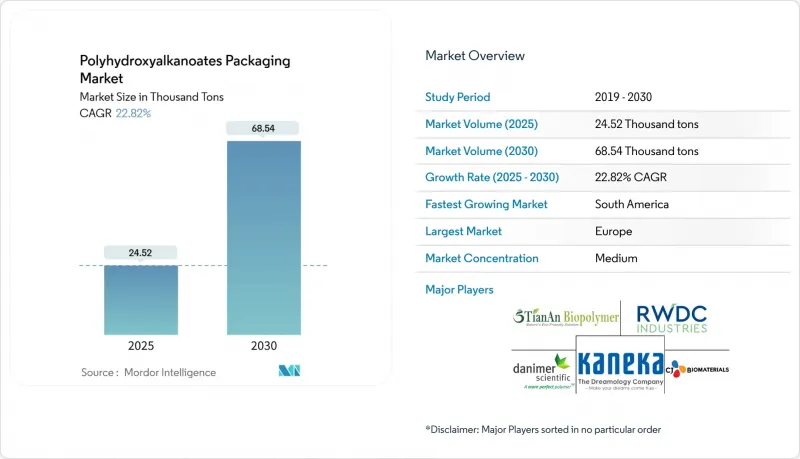
多種因素共同作用,推動了市場需求的加速成長:法規禁止使用一次性塑膠、第三代原料大規模降低成本,以及品牌所有者的永續發展措施。歐洲監管的進步、南美洲原料的優勢以及加工技術的快速創新,正在塑造競爭優勢。雖然剛性應用是初期需求的主要驅動力,但高成長的發泡體和纖維產品預示著下一波市場浪潮的到來。那些正在擴大海洋生物分解等級產品生產規模、確保廢棄物衍生原料以及達成品牌合作協議的製造商,預計將在這個不斷擴張的市場中佔據主導地位。
全球聚羥基烷酯(PHA)包裝市場趨勢與洞察
經合組織市場禁止使用一次性塑膠
歐盟、加拿大和美國多個州的法律法規都明確規定了吸管、刀叉餐具和外帶餐盒等傳統產品的逐步淘汰計畫。品牌所有者正在用符合 ISO 17088 堆肥要求的 PHA 等級產品取代被禁用的產品,從而實現全球材料標準化。在需求前景明朗的情況下,生產商可以更有理由擴大多產品發酵設施的規模,而國際零售商也在發展中市場推廣類似的規範,以降低材料的複雜性。
歐洲對可堆肥生物聚合物的補貼
德國包裝方法下的費用減免以及法國的生產者延伸責任制(EPR)信用計劃,使聚羥基脂肪酸酯(PHAs)的實際成本(包括生命週期遵循成本)最多可降低25%。荷蘭和丹麥針對海洋可生物分解材料的額外信用計畫進一步改善了相對經濟效益,並鼓勵加工商在2027年歐盟包裝法規修訂前更換生產線。
PHA發酵廠資本密集度高
建造一座商業化工廠需要1.5億至2億美元用於發酵和下游精煉工藝,遠超普通轉換器所需的投資。專用設備基礎設施和漫長的建設週期限制了新參與企業的企劃案融資選擇。因此,擴張落後於需求,供應持續緊張,高價位將持續存在,直到大規模資本力量進入市場。
細分市場分析
截至2024年,硬質包裝佔PHA包裝市場佔有率的38.91%,由於監管機構禁止使用石油基翻蓋、托盤和鉸鏈蓋,硬質包裝仍然是初期需求的基礎。這種材料的結構強度高、阻隔性能適中,且與現有熱成型生產線相容,從而降低了加工商的轉型成本。採用新型化學發泡製成的泡沫產品以24.59%的複合年成長率位居榜首,它們正在取代發泡聚苯乙烯,成為運輸保護材料和外帶包裝的理想選擇。瞄準這一細分市場的製造商報告說累積訂單穩定,並且在市政堆肥設施中觀察到PHA發泡體在好氧系統中快速分解,這促進了生活垃圾收集試點項目的開展。由於這種聚合物熔體流動性均勻且密封溫度低,軟性薄膜仍然是第二大包裝形式,這有助於在生產過程中節省能量。隨著造紙商尋求可堆肥的防潮層,紙板塗層越來越受歡迎,瓦楞紙板製造商和生物聚合物供應商的聯合測試也支持了這一趨勢。
塗層和黏合劑等級的進步正在開闢新的收入來源。專業供應商正在開發用於電子商務運輸信封的熱封層,方法是將PHA與澱粉或纖維素混合,因此無需使用塑膠內襯。硬質包裝製造商也在嘗試使用基於PHA的油墨進行套模標籤生產,以保持單一材料的特性。顆粒均勻性和熱穩定性的不斷提高正在減少換型過程中的停機時間,這對於大批量生產場所至關重要。這些進步共同拓展了PHA包裝市場的應用範圍,並進一步深化了其最初佔有一席之地的領域的應用。
《PHA包裝市場報告》依產品形式(硬包裝、軟膜、塗層紙板、發泡體及其他)、終端用戶行業(餐飲服務業、食品飲料零售業、個人護理及化妝品業、醫藥及生物醫學業及其他)、加工技術(薄膜擠出、射出成型、吹塑成型、熱成型及其他)及地區進行細分。市場預測以噸為單位。
區域分析
歐洲預計到2024年將佔據32.92%的市場佔有率,並繼續保持其核心區域的地位。這得歸功於包裝和包裝廢棄物法規中對可堆肥產品的豁免,以及工業堆肥的廣泛應用。市政當局的廢棄物審計顯示,生物聚合物的回收率不斷提高,補貼計畫也正在縮小與石化塑膠的價格差距。供應商正將生產能力集中在法國、義大利和荷蘭等原料中心附近,以降低物流成本並確保甜菜和乳清廢料的供應。德國和斯堪地那維亞的品牌所有者正透過引入飲料多包裝單材料PHA套管的測試,鞏固其在該地區的主導地位。
南美洲的複合年成長率高達24.49%,位居全球之首,這主要得益於巴西對進口發酵設備的稅額扣抵以及豐富的甘蔗渣資源。州開發銀行提供的低利率貸款降低了資金籌措門檻,吸引了國內農產品加工企業與跨國包裝公司進行合資合作。阿根廷甘蔗渣加工業的擴張確保了低成本的原料來源,布宜諾斯艾利斯也成為新興的出口中心。在監管方面,巴西修訂後的《國家固態廢棄物政策》納入了生物分解目標,使公共採購與生物聚合物的引入相銜接,明確了相關法律框架。
亞太地區呈現均衡發展趨勢。中國正在擴大發酵產能,並推動一項國家支持的甲烷制聚羥基脂肪酸酯(PHA)轉化試點計畫;日本電子產業對用於元件封裝的高純度PHA需求旺盛。在北美,近期FDA的批准以及企業零廢棄物承諾為市場發展提供了助力,但高昂的人事費用導致部分產能轉移至海外。中東和非洲仍處於起步階段,但海灣國家煉油廠的多元化策略包括生物聚合物生產線,而從肯亞延伸至埃及的農業經濟區正在考慮建造PHA多層膜計畫。這些區域趨勢共同支撐著PHA包裝市場的長期擴張。
其他好處
- Excel格式的市場預測(ME)表
- 3個月的分析師支持
目錄
第1章:引言
- 研究假設和市場定義
- 調查範圍
第2章:調查方法
第3章執行摘要
第4章 市場狀況
- 市場概覽
- 市場促進因素
- 經合組織市場禁止使用一次性塑膠
- 歐洲對可生物分解生物聚合物的補貼
- 食品級認證加速品牌推廣
- 由於第三代原料的應用,成本迅速降低
- 零售商的淨零包裝指示
- 擴大分散式厭氧消化處理能力
- 市場限制因素
- PHA發酵廠資本密集度高
- 與EVOH層壓板相比,其阻隔性有局限性
- 供應鏈對甘蔗和玉米原料價格波動的依賴性
- 分段式工業堆肥基礎設施
- 產業價值鏈分析
- 監理情勢
- 技術展望
- 宏觀經濟因素的影響
- 波特五力分析
- 新進入者的威脅
- 供應商的議價能力
- 買方的議價能力
- 替代品的威脅
- 競爭公司之間的競爭
第5章 市場規模與成長預測
- 按產品形式
- 硬包裝
- 軟性薄膜
- 塗佈紙
- 形式
- 其他產品形式
- 按最終用途行業分類
- 餐飲服務業
- 食品和飲料零售
- 個人護理和化妝品
- 製藥和生物醫學
- 工業和農業
- 透過加工技術
- 薄膜擠出
- 射出成型
- 吹塑成型
- 熱成型
- 紡織紡紗
- 按地區
- 北美洲
- 美國
- 加拿大
- 墨西哥
- 南美洲
- 巴西
- 阿根廷
- 南美洲其他地區
- 歐洲
- 德國
- 英國
- 法國
- 義大利
- 西班牙
- 俄羅斯
- 其他歐洲國家
- 亞太地區
- 中國
- 日本
- 印度
- 韓國
- 東南亞
- 亞太其他地區
- 中東和非洲
- 中東
- 沙烏地阿拉伯
- 阿拉伯聯合大公國
- 土耳其
- 其他中東國家
- 非洲
- 南非
- 奈及利亞
- 其他非洲地區
- 中東
- 北美洲
第6章 競爭情勢
- 市場集中度
- 策略趨勢
- 市佔率分析
- 公司簡介
- Danimer Scientific Inc.
- CJ Biomaterials Inc.
- RWDC Industries Ltd.
- Kaneka Corporation
- TianAn Biologic Materials Co. Ltd.
- Bluepha Co. Ltd.
- TotalEnergies Corbion PLA BV
- Yield10 Bioscience Inc.
- PHAbuilder BIoTech Co. Ltd.
- Newlight Technologies Inc.
- Full Cycle Bioplastics Inc.
- Bioextrax AB
- Biomer PHA GmbH
- Shangdong TianSen BIoTech Co. Ltd.
- Tepha Inc.(Becton Dickenson)
- Mango Materials Inc.
- Seegro Inc.
- Nodax PHA LLC
- Paques Biomaterials BV
- PolyFerm Canada Inc.
- Novamont SpA
- NaturePlast SAS
- Eranova SAS
- Kaneka Biopolymers Vietnam Co. Ltd.
- Genecis Bioindustries Inc.
第7章 市場機會與未來展望
The Polyhydroxyalkanoates (PHA) Packaging Market size is estimated at 24.52 Thousand tons in 2025, and is expected to reach 68.54 Thousand tons by 2030, at a CAGR of 22.82% during the forecast period (2025-2030).
Regulatory bans on single-use plastics, large-scale cost breakthroughs from third-generation feedstocks, and brand owners' sustainability commitments are combining to accelerate demand. Europe's regulatory push, South America's feedstock advantage, and rapid innovations in processing are shaping competitive positioning. Rigid applications are consolidating early demand, while high-growth foam and fiber formats signal the next wave of adoption. Producers that scale marine-degradable grades, secure waste-based feedstocks, and lock in brand contracts are positioned to capture a disproportionate share of the expansion.
Global Polyhydroxyalkanoates Packaging Market Trends and Insights
Ban on Single-Use Plastics in OECD Markets
Legislation in the European Union, Canada, and several U.S. states mandates clear phase-out schedules for conventional items, including straws, cutlery, and takeaway containers. Brand owners are replacing banned formats with PHA grades that meet the ISO 17088 compostability requirements, allowing for global material harmonization. Demand visibility enables producers to justify multi-line fermentation expansions, and international retailers are rolling out the same specifications across developing markets to reduce material complexity.
Subsidies for Compostable Biopolymers in Europe
Fee reductions under Germany's Packaging Act and extended producer responsibility credits in France lower effective PHA costs by up to 25% when lifecycle compliance fees are included. Additional credits in the Netherlands and Denmark for marine-degradable materials further improve relative economics, incentivizing converters to switch lines ahead of the 2027 review of EU packaging rules.
High Capital Intensity of PHA Fermentation Plants
Commercial plants require USD 150-200 million for fermentation and downstream purification, a figure well above typical converter investments. The specialized equipment base and extended construction cycles limit project finance options for newer entrants. As a result, expansion lags demand, keeping supply tight and reinforcing premium pricing until larger balance sheets commit capital.
Other drivers and restraints analyzed in the detailed report include:
- Food-Grade Certifications Accelerating Brand Adoption
- Rapid Cost Decline from Gen-3 Feedstocks
- Limited Barrier Properties vs. EVOH Laminates
For complete list of drivers and restraints, kindly check the Table Of Contents.
Segment Analysis
Rigid formats account for 38.91% of the PHA packaging market share in 2024 and continue to anchor early demand given regulatory bans on petroleum clamshells, trays, and hinged lids. The material's structural strength, moderate barrier performance, and compatibility with existing thermoforming lines ease converter transition costs. Foam formats, enabled by new chemical blowing agents, post the highest 24.59% CAGR as they replace expanded polystyrene in protective transit and takeaway items. Producers targeting this niche are reporting stable order backlogs, and municipal composters highlight PHA foam's rapid disintegration in aerobic systems, supporting household collection pilots. Flexible films remain the second-largest format, thanks to the polymer's uniform melt flow and low sealing temperatures, which deliver process energy savings. Paperboard coatings are gaining popularity as mills seek compostable moisture barriers, a trend supported by joint trials between corrugators and biopolymer suppliers.
Progress in coatings and adhesive grades is opening adjacent revenue streams. Specialty suppliers are blending PHA with starch and cellulose to create heat-seal layers for e-commerce mailers that eliminate the need for plastic liners. Rigid format producers are also experimenting with in-mold labels using PHA-based inks to keep mono-material status. Continual improvements in pellet consistency and thermal stability are lowering downtime during changeovers, a key factor for mass-production sites. Collectively, these advances help the PHA packaging market broaden addressable applications while deepening adoption in its early beachheads.
The PHA Packaging Market Report is Segmented by Product Form (Rigid Packaging, Flexible Films, Coated Paperboard, Foam, and More), End-Use Industry (Food Service, Food and Beverage Retail, Personal Care and Cosmetics, Pharmaceutical and Biomedical, and More), Processing Technology (Film Extrusion, Injection Molding, Blow Molding, Thermoforming, and More), and Geography. The Market Forecasts are Provided in Terms of Volume (Tons).
Geography Analysis
Europe, with a 32.92% share in 2024, remains the anchor region, supported by the Packaging and Packaging Waste Regulation's compostable carve-outs and widespread access to industrial composting. Municipal waste audits reveal increasing biopolymer capture rates, and subsidy frameworks are narrowing the price differential with petrochemical plastics. Suppliers are clustering their capacity around feedstock hubs in France, Italy, and the Netherlands to shorten logistics and secure sugar beet and whey waste streams. Brand owners in Germany and Scandinavia are piloting mono-material PHA sleeves for beverage multipacks, reinforcing regional leadership.
South America posts the fastest 24.49% CAGR, driven by Brazil's tax credits on fermentation equipment imports and abundant sugarcane residue. State development banks offer low-interest loans that lower capital hurdles, attracting joint ventures between domestic agro-processors and multinational packaging converters. Argentina's expansion of bagasse processing yields low-cost feedstock streams, making Buenos Aires a budding export hub. Regulatory clarity follows the revisions to Brazil's National Solid Waste Policy, which include compostable targets that align public procurement with biopolymer uptake.
The Asia-Pacific region exhibits balanced dynamics: China scales up its fermentation capacity alongside state-backed methane-to-PHA pilots, while Japan's electronics sector demands high-purity grades for component packaging. North America benefits from recent FDA clearances and corporate zero-waste pledges, though higher labor costs keep some capacity offshore. The Middle East and Africa remain in the early stages, yet refinery diversification strategies in the Gulf include biopolymer lines, and agricultural economies from Kenya to Egypt are exploring PHA mulch film projects. Collectively, these regional vectors underpin the long-run expansion of the PHA packaging market.
- Danimer Scientific Inc.
- CJ Biomaterials Inc.
- RWDC Industries Ltd.
- Kaneka Corporation
- TianAn Biologic Materials Co. Ltd.
- Bluepha Co. Ltd.
- TotalEnergies Corbion PLA B.V.
- Yield10 Bioscience Inc.
- PHAbuilder Biotech Co. Ltd.
- Newlight Technologies Inc.
- Full Cycle Bioplastics Inc.
- Bioextrax AB
- Biomer PHA GmbH
- Shangdong TianSen Biotech Co. Ltd.
- Tepha Inc. (Becton Dickenson)
- Mango Materials Inc.
- Seegro Inc.
- Nodax PHA LLC
- Paques Biomaterials B.V.
- PolyFerm Canada Inc.
- Novamont S.p.A.
- NaturePlast SAS
- Eranova SAS
- Kaneka Biopolymers Vietnam Co. Ltd.
- Genecis Bioindustries Inc.
Additional Benefits:
- The market estimate (ME) sheet in Excel format
- 3 months of analyst support
TABLE OF CONTENTS
1 INTRODUCTION
- 1.1 Study Assumptions and Market Definition
- 1.2 Scope of the Study
2 RESEARCH METHODOLOGY
3 EXECUTIVE SUMMARY
4 MARKET LANDSCAPE
- 4.1 Market Overview
- 4.2 Market Drivers
- 4.2.1 Ban on Single-Use Plastics in OECD Markets
- 4.2.2 Subsidies for Compostable Biopolymers in Europe
- 4.2.3 Food-Grade Certifications Accelerating Brand Adoption
- 4.2.4 Rapid Cost Decline from Gen-3 Feedstocks
- 4.2.5 Retailer's Net-Zero Packaging Mandates
- 4.2.6 Expansion of Decentralised Anaerobic Digestion Capacity
- 4.3 Market Restraints
- 4.3.1 High Capital Intensity of PHA Fermentation Plants
- 4.3.2 Limited Barrier Properties vs. EVOH Laminates
- 4.3.3 Supply-Chain Dependence on Cane and Corn Feedstock Volatility
- 4.3.4 Fragmented Industrial Composting Infrastructure
- 4.4 Industry Value Chain Analysis
- 4.5 Regulatory Landscape
- 4.6 Technological Outlook
- 4.7 Impact of Macroeconomic Factors
- 4.8 Porter's Five Forces Analysis
- 4.8.1 Threat of New Entrants
- 4.8.2 Bargaining Power of Suppliers
- 4.8.3 Bargaining Power of Buyers
- 4.8.4 Threat of Substitutes
- 4.8.5 Competitive Rivalry
5 MARKET SIZE AND GROWTH FORECASTS (VALUE)
- 5.1 By Product Form
- 5.1.1 Rigid Packaging
- 5.1.2 Flexible Films
- 5.1.3 Coated Paperboard
- 5.1.4 Foam
- 5.1.5 Other Product Forms
- 5.2 By End-Use Industry
- 5.2.1 Food Service
- 5.2.2 Food and Beverage Retail
- 5.2.3 Personal Care and Cosmetics
- 5.2.4 Pharmaceutical and Biomedical
- 5.2.5 Industrial and Agriculture
- 5.3 By Processing Technology
- 5.3.1 Film Extrusion
- 5.3.2 Injection Molding
- 5.3.3 Blow Molding
- 5.3.4 Thermoforming
- 5.3.5 Fibre Spinning
- 5.4 By Geography
- 5.4.1 North America
- 5.4.1.1 United States
- 5.4.1.2 Canada
- 5.4.1.3 Mexico
- 5.4.2 South America
- 5.4.2.1 Brazil
- 5.4.2.2 Argentina
- 5.4.2.3 Rest of South America
- 5.4.3 Europe
- 5.4.3.1 Germany
- 5.4.3.2 United Kingdom
- 5.4.3.3 France
- 5.4.3.4 Italy
- 5.4.3.5 Spain
- 5.4.3.6 Russia
- 5.4.3.7 Rest of Europe
- 5.4.4 Asia-Pacific
- 5.4.4.1 China
- 5.4.4.2 Japan
- 5.4.4.3 India
- 5.4.4.4 South Korea
- 5.4.4.5 South-East Asia
- 5.4.4.6 Rest of Asia-Pacific
- 5.4.5 Middle East and Africa
- 5.4.5.1 Middle East
- 5.4.5.1.1 Saudi Arabia
- 5.4.5.1.2 United Arab Emirates
- 5.4.5.1.3 Turkey
- 5.4.5.1.4 Rest of Middle East
- 5.4.5.2 Africa
- 5.4.5.2.1 South Africa
- 5.4.5.2.2 Nigeria
- 5.4.5.2.3 Rest of Africa
- 5.4.5.1 Middle East
- 5.4.1 North America
6 COMPETITIVE LANDSCAPE
- 6.1 Market Concentration
- 6.2 Strategic Moves
- 6.3 Market Share Analysis
- 6.4 Company Profiles (includes Global level Overview, Market level overview, Core Segments, Financials as available, Strategic Information, Market Rank/Share for key companies, Products and Services, and Recent Developments)
- 6.4.1 Danimer Scientific Inc.
- 6.4.2 CJ Biomaterials Inc.
- 6.4.3 RWDC Industries Ltd.
- 6.4.4 Kaneka Corporation
- 6.4.5 TianAn Biologic Materials Co. Ltd.
- 6.4.6 Bluepha Co. Ltd.
- 6.4.7 TotalEnergies Corbion PLA B.V.
- 6.4.8 Yield10 Bioscience Inc.
- 6.4.9 PHAbuilder Biotech Co. Ltd.
- 6.4.10 Newlight Technologies Inc.
- 6.4.11 Full Cycle Bioplastics Inc.
- 6.4.12 Bioextrax AB
- 6.4.13 Biomer PHA GmbH
- 6.4.14 Shangdong TianSen Biotech Co. Ltd.
- 6.4.15 Tepha Inc. (Becton Dickenson)
- 6.4.16 Mango Materials Inc.
- 6.4.17 Seegro Inc.
- 6.4.18 Nodax PHA LLC
- 6.4.19 Paques Biomaterials B.V.
- 6.4.20 PolyFerm Canada Inc.
- 6.4.21 Novamont S.p.A.
- 6.4.22 NaturePlast SAS
- 6.4.23 Eranova SAS
- 6.4.24 Kaneka Biopolymers Vietnam Co. Ltd.
- 6.4.25 Genecis Bioindustries Inc.
7 MARKET OPPORTUNITIES AND FUTURE OUTLOOK
- 7.1 White-space and Unmet-need Assessment

 2026-2030年全球可生物分解包裝材料市場
 生物基包裝循環解決方案市場預測至2034年—全球生物基材料、包裝類型、循環解決方案、應用、循環經營模式、最終用戶和地區分析
 Skep瓶市場規模、佔有率和成長分析:按材料、產能、應用、最終用戶、分銷管道和地區分類-2026-2033年產業預測
 零廢棄包裝解決方案市場分析及預測至 2035 年:按類型、產品類型、服務、技術、應用、材料類型、製程、最終用戶和解決方案分類。永續食品包裝市場預測至2034年—按材料類型、包裝形式、永續性屬性、應用、最終用戶和地區分類的全球分析
 生物分解包裝解決方案:市場佔有率分析、行業趨勢和統計數據、成長預測(2026-2031 年)
 拋棄式包裝市場規模、佔有率、成長和行業分析:按材料類型、產品類型、最終用途和地區分類,並預測至2034年生物基包裝市場預測至2034年-按材料、包裝形式、產品類型、最終用途產業和地區分類的全球分析
 生物分解包裝市場:按類型、終端用戶產業和地區分類全球再生塑膠容器市場預測至2034年:按材料類型、容器類型、再生原料、加工類型、分銷管道、最終用戶和地區分類的分析