


 |
市場調查報告書
商品編碼
2043912
黃原酸鹽:市場佔有率分析、行業趨勢和統計數據、成長預測(2026-2031)Xanthates - Market Share Analysis, Industry Trends & Statistics, Growth Forecasts (2026 - 2031) |
||||||

※ 本網頁內容可能與最新版本有所差異。詳細情況請與我們聯繫。
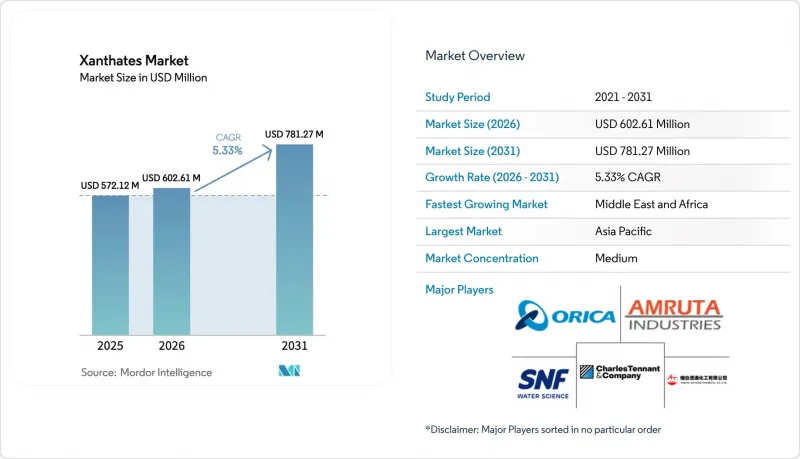
黃原酸鹽市場預計將從 2025 年的 5.7212 億美元和 2026 年的 6.0261 億美元成長到 2031 年的 7.8127 億美元,2026 年至 2031 年的年複合成長率(CAGR)為 5.33%。
在剛果民主共和國(剛果(金))、尚比亞、智利和秘魯,由於銅、鈷和鋰浮選新製程的引入,捕收劑的需求激增。這些項目正推動硫化物礦石加工量達到歷史新高。儘管亞太地區仍然是消費中心,但預計中東地區的成長速度將超過其他所有地區。這種轉變體現在剛果(金)礦石加工廠和尚比亞冶煉廠的供應商增加的試劑預算。液態黃原酸鹽配方越來越受歡迎。這些配方可以降低粉塵處理的風險並減少二硫化碳(CS2)的排放。這一趨勢與美國和歐盟制定的嚴格的職業暴露和尾礦水法規相符。同時,人工智慧(AI)驅動的加藥平台正在提高捕收劑的整體消耗量。這些平台透過最大化低品位礦石堆的淨現值來實現這一目標,即使每噸礦石的試劑用量減少。
全球黃原酸鹽市場趨勢與洞察
非洲和拉丁美洲重要礦產項目的快速成長
2025年,艾芬豪礦業公司位於剛果民主共和國(DRC)的卡莫阿-卡庫拉礦區實現了其年度銅產量目標。該礦區計劃於2027年運作其三期選礦廠,預計將增加對黃原酸鹽的需求。同時,智利森蒂內拉和克布拉達布蘭卡計畫二期產能的擴建,以及阿根廷PSJ Cobre Mendocino計畫的開發,預計到2027年將提升銅精礦的整體產量。預計這一成長將在2026年至2031年的預測期內推動對新型礦石提取設備的需求。隨著這些發展,安第斯走廊和中非銅帶正在鞏固其作為黃原酸鹽市場主要參與者的地位。
偏遠礦山液態黃原酸鹽物流轉型
科萊恩的 HOSTAFLOT 液態產品無需現場溶解罐,並縮短了試劑配製時間,從而提高了作業效率。這些優勢已在智利的鋰鹵水礦和澳洲的鐵礦中得到驗證。在秘魯安第斯山脈高鐵礦石帶,安塔米納礦和拉斯班巴斯礦在改用預先溶解的異丙基黃黃原酸鹽後,試劑處理事故顯著減少。此外,這些液體捕集劑透過抑制二氧化硫的揮發,幫助礦場符合歐盟嚴格的 50 mg/m³ 限值和美國職業安全與健康管理局 (OSHA) 20 ppm 的長期平均限值。這些日益嚴格的法規正在推動產品組合快速轉型為液態解決方案。
基於配體的無黃原酸鹽回收劑的商業化
在智利的初步試驗中,索爾維的氨基甲酸酯產品 Aero MX 5004 的性能優於異丙基黃黃原酸鹽,實現了更高的銅回收率。此外,本產品也成功將尾礦中的二氧化硫濃度降低至允許限值以下,符合 DS 90 水質標準。同時,BASF的 Lupromin-D(Hydroxamates)產品計劃於 2025 年前在菲律賓的一座鎳礦中實現氧化物循環中完全淘汰黃原酸鹽。與傳統方法相比,該產品顯著降低了用量和廢棄物處理成本,為礦場節省了大量營運成本。這在排放法規嚴格的地區尤其重要,因為這些法規將限制黃原酸鹽市場的長期成長。
細分市場分析
到2025年,異丙基黃黃原酸鹽將佔據黃原酸鹽市場34.28%的佔有率,這主要得益於其在分離銅和黃原酸鹽優異的選擇性以及在斑岩礦床中的廣泛應用。這種領先品級的產品是優質混合捕收劑系統的基礎,與乙基黃原酸鈉相比,其回收率更高。戊黃原酸鹽酸鉀成為成長最快的產品,預計到2031年將以6.18%的複合年成長率成長。其優點在於對細粒硫化物具有很強的吸附能力,尤其是在難以選礦的金礦和複雜的多金屬礦中。異丁基黃原酸鈉仍然是鉛鋅製程的首選,尤其是在澳洲布羅肯希爾和中國雲南礦區。其適中的鍊長使其在吸附能力和選擇性之間實現了理想的平衡。另一方面,儘管乙基黃原酸鈉具有成本效益,但在高品質銅金礦的選礦流程中,其應用正在逐漸減弱。這些電路現在對二硫化碳 (CS2)排放限值和冶金性能提出了更高的要求。
在黃原酸鹽市場,氯化鉀因其高溶解度而備受關注。這項特性減少了處理量,為位於非洲和澳洲偏遠地區的礦場提供了顯著的物流優勢。另一個快速成長的領域是混合配方。例如,2025年,秘魯一座多金屬礦場使用60:40的異丙基黃原酸鹽和戊基黃原酸鹽混合物,提高了銅和鋅的總合回收率。這一成功表明,供應商正致力於開發客製化的預混合料產品。這些趨勢表明,圍繞鍊長、溶解度和混合技術的創新將重塑黃原酸鹽市場的競爭格局。
區域分析
2025年,亞太地區引領市場,佔總營收的46.38%。中國擁有強大的黃原酸鹽生產能力,其一體化產業叢集主要推動了對印尼、越南和菲律賓等鄰國的出口。在印度,由於印度斯坦鋅業公司蘭普拉阿格查礦的擴建以及印度煤炭公司粉煤浮選項目的推進,需求激增,導致礦石開採商的產能提升。澳洲憑藉其自給自足的供應鏈,成為一個新興的子市場,必和必拓和力拓主要從奧瑞卡和庫吉化學公司採購液態黃原酸鹽。這項策略性選擇旨在降低公司在皮爾巴拉和昆士蘭營運的風險。
儘管中東和非洲的市場佔有率較小,但預計在2026年至2031年的預測期內,其複合年成長率將達到5.93%,位居全球最高。這一成長主要得益於剛果民主共和國卡莫阿卡庫拉礦的擴建,預計到2028年,該礦對捕收劑的需求將大幅成長;此外,贊比亞的坎桑西礦和恩特普賴斯礦的擴建也將推動成長。在南非,布希菲爾德鉑系元素透過柱式浮選增加了黃原酸鹽用量,以彌補機械攪拌的減少。同時,沙烏地阿拉伯礦業公司(Maaden)的磷酸鹽業務也從重力浮選轉向黃原酸鹽輔助浮選,使該地區的藥劑趨勢更加多元化。
北美地區對2025年的銷售額貢獻顯著,主要得益於亞利桑那州和猶他州(銅和鉬)、安大略省(黃金)以及阿拉斯加和育空特區的鋅礦項目。歐洲市場則呈現停滯狀態。波蘭和芬蘭的礦場關閉抵消了基準用量,但像伍德史密斯這樣的新業務為了緩解二硫化碳(CS2)問題,正在避免使用黃原酸鹽。在市場佔有率較大的南美,科德爾科公司在各業務部門大量使用黃原酸鹽。該公司正在考慮進行策略調整,計劃從2026年起,根據其範圍3目標,以Aero MX硫代氨基甲酸酯取代部分異丙醇鈉。此外,持續存在的基礎設施挑戰,包括銅帶地區的鐵路瓶頸,導致貨運溢價飆升,並引發了人們對現場合成的興趣。如果這種方法廣泛應用,則有可能降低市售產品的需求。
其他好處:
- Excel格式的市場預測(ME)表
- 3個月的分析師支持
目錄
第1章:引言
- 研究假設和市場定義
- 調查範圍
第2章:調查方法
第3章執行摘要
第4章 市場狀況
- 市場概覽
- 市場促進因素
- 非洲和拉丁美洲重要礦產項目的快速成長
- 偏遠礦山液態黃原酸鹽物流轉型
- 人工智慧驅動的試劑加藥最佳化正在推高收集器的消耗量。
- 對需要黃原酸鹽浸出劑的鹼性電池回收需求激增。
- 亞太地區二硫化碳原料供應緊張,推高了價格。
- 市場限制因素
- 基於配體的無黃原酸鹽捕收劑的商業化
- 歐盟尾礦指令排放了二硫化碳(CS2)的排放限值。
- 現場CS2拆卸系統可實現內部收集器合成
- 價值鏈分析
- 波特五力模型
- 供應商的議價能力
- 買方的議價能力
- 新進入者的威脅
- 替代品的威脅
- 競爭程度
第5章 市場規模與成長預測
- 依產品類型
- 乙基黃原酸鈉
- 異丙基黃原酸鈉
- 異丁基黃原酸鈉
- 戊黃酸鉀
- 其他產品類型
- 透過使用
- 礦業
- 橡膠加工
- 殺蟲劑
- 其他用途
- 按地區
- 亞太地區
- 中國
- 印度
- 日本
- 韓國
- 亞太其他地區
- 北美洲
- 美國
- 加拿大
- 墨西哥
- 歐洲
- 德國
- 英國
- 法國
- 義大利
- 其他歐洲地區
- 南美洲
- 巴西
- 阿根廷
- 南美洲其他地區
- 中東和非洲
- 沙烏地阿拉伯
- 南非
- 其他中東和非洲
- 亞太地區
第6章 競爭情勢
- 市場集中度
- 策略趨勢
- 市佔率(%)/排名分析
- 公司簡介
- Amruta Industries
- Charles Tennant and Company
- Coogee Chemicals
- CTC Energy & Mining Company
- Florrea Chemicals
- Kemcore
- Merck KGaA
- Orica Limited
- Qingdao Ruchang Mining Industry
- QiXia TongDa Flotation Reagent Co. Ltd
- Senmin International(Pty)Ltd
- SNF Flomin
- SNF Group
- Thermo Fisher Scientific Inc.
- Tieling Flotation Reagent Co. Ltd
- Vanderbilt Chemicals LLC
- Y&X Beijing Technology
- Yantai Humon Chemical Auxiliary Co. Ltd
第7章 市場機會與未來展望
The Xanthates Market size is projected to expand from USD 572.12 million in 2025 and USD 602.61 million in 2026 to USD 781.27 million by 2031, registering a CAGR of 5.33% between 2026 to 2031.
Collector demand is surging in the Democratic Republic of Congo (DRC), Zambia, Chile, and Peru, driven by new flotation circuits for copper, cobalt, and lithium. These projects are pushing sulfide-ore throughput beyond historical levels. While the Asia-Pacific region continues to anchor consumption, the Middle-East is poised to outpace all others. This shift is evident as Congolese concentrators and Zambian smelter-feed operations expand their reagent budgets. Liquid xanthate formulations are becoming increasingly popular. They mitigate dust-handling risks and reduce carbon-disulfide (CS2) off-gassing. This trend aligns with the United States and European Union's stringent limits on occupational exposure and tailings water. Concurrently, artificial-intelligence (AI) dosing platforms are boosting overall collector consumption. They achieve this by maximizing net present value from lower-grade stockpiles, even as the intensity of reagents per tonne decreases.
Global Xanthates Market Trends and Insights
Booming Critical-Minerals Projects in Africa and Latin America
In 2025, Ivanhoe Mines' Kamoa-Kakula complex in the DRC achieved an annualized copper output. By 2027, the complex is set to roll out a Phase 3 concentrator, which is expected to increase the demand for sodium isopropyl xanthate. Simultaneously, capacity expansions at Chile's Centinela and Quebrada Blanca Phase 2, along with Argentina's PSJ Cobre Mendocino development, are projected to collectively augment copper-concentrate output by 2027. This growth is anticipated to drive new collector offtake during the forecast period of 2026-2031. With these advancements, the Andean-Corridor and the Central-African Copperbelt are solidifying their positions as leading players in the xanthates market.
Shift to Liquid Xanthate Logistics at Remote Mines
Clariant's HOSTAFLOT liquid grades have streamlined operations by eliminating the need for on-site dissolution tanks and reducing reagent preparation time. These advantages have been realized at lithium brine operations in Chile and iron ore sites in Australia. In Peru's high-Andes copper belt, both Antamina and Las Bambas reported a notable drop in reagent-handling incidents after transitioning to pre-dissolved sodium isopropyl xanthate. Furthermore, these liquid collectors, by curbing CS2 volatilization, help mines comply with the European Union's stringent cap of 50 mg/m3, and OSHA's average limit of 20 ppm over time. This regulatory push is catalyzing a rapid shift in the product mix toward liquid solutions.
Commercialisation of Ligand-Based Xanthate-Free Collectors
In Chilean pilot trials, Solvay's Aero MX 5004 thionocarbamate outperformed sodium isopropyl xanthate, achieving higher copper recovery. Additionally, it successfully reduced tailings CS2 levels to below the permissible limit, adhering to the DS 90 water-quality standard. Meanwhile, in 2025, BASF's Lupromin-D hydroxamates enabled a nickel mine in the Philippines to completely eliminate xanthate from its oxide circuits. With dosing levels significantly reduced compared to conventional methods and a decrease in waste-treatment costs, the mine realized notable operating savings. This is particularly significant in regions with stringent emissions regulations, which in turn curtail the long-term growth of the xanthates market.
Other drivers and restraints analyzed in the detailed report include:
- AI-Optimized Reagent Dosing Boosting Collector Consumption
- Surge in Alkaline Battery Recycling Requiring Xanthate Leaching Aids
- EU Tailings Directive Lowering Allowable CS2 Emissions
For complete list of drivers and restraints, kindly check the Table Of Contents.
Segment Analysis
In 2025, sodium isopropyl xanthate commanded a 34.28% share of the xanthates market, driven by its superior selectivity in copper-pyrite separation and a strong presence in porphyry deposits. This leading grade forms the backbone of premium blended-collector systems, achieving recovery gains over sodium-ethyl counterparts. Potassium amyl xanthate has emerged as the fastest-growing player, boasting a 6.18% CAGR through 2031. Its edge comes from a stronger adsorption on fine-grained sulfides, particularly in refractory gold and intricate polymetallic ores. Sodium isobutyl xanthate remains a favored choice in lead-zinc flowsheets, notably in Australia's Broken Hill and China's Yunnan Province. Its mid-chain length strikes an ideal balance between power and selectivity. Meanwhile, sodium ethyl xanthate, despite its cost-effectiveness, is losing traction in premium copper and gold circuits. These circuits are now leaning toward stricter CS2 limits and enhanced metallurgical performance.
Potassium salts are gaining traction in the xanthates market, primarily due to their heightened solubility. This attribute reduces handling volumes, a significant logistical advantage for remote mining sites in Africa and Australia. Another burgeoning segment is blended formulations. For instance, a 60:40 mix of isopropyl and amyl xanthate boosted combined copper-zinc recovery at a Peruvian polymetallic mine in 2025. This success underscores suppliers' momentum toward tailored pre-mixes. Such developments indicate that innovations focusing on chain length, solubility, and blending techniques will reshape the competitive landscape of the xanthates market.
The Xanthates Market Report is Segmented by Product Type (Sodium Ethyl Xanthate, Sodium Isopropyl Xanthate, Sodium Isobutyl Xanthate, Potassium Amyl Xanthate, and Other Product Types), Application (Mining, Rubber Processing, Agrochemicals, and Other Applications), and Geography (Asia-Pacific, North America, Europe, South America, and Middle-East and Africa). Market Forecasts are Provided in Terms of Value (USD).
Geography Analysis
In 2025, the Asia-Pacific region led the market, capturing 46.38% of total revenue. China's integrated clusters, with their robust xanthate capacity, primarily fueled exports to neighboring nations such as Indonesia, Vietnam, and the Philippines. In India, demand surged due to expansions at Hindustan Zinc's Rampura Agucha and Coal India's fine-coal flotation projects, resulting in increased collector offtake. Australia emerged as a self-sufficient sub-market, with BHP and Rio Tinto predominantly sourcing liquid xanthates from Orica and Coogee Chemicals. This strategic choice aimed to mitigate hazards in their operations located in Pilbara and Queensland.
While the Middle-East and Africa held a smaller market share, they boasted the fastest projected CAGR of 5.93% during the forecast period of 2026-2031. This growth was fueled by expansions at DRC's Kamoa-Kakula and Zambia's Kansanshi and Enterprise, which anticipated a heightened demand for collectors by 2028. In South Africa, Bushveld's platinum group augmented xanthate dosages via column flotation to compensate for reduced mechanical agitation. Simultaneously, Saudi Arabia's Ma'aden phosphate operations shifted from gravity methods to xanthate-assisted flotation, diversifying the regional reagent landscape.
North America made a significant contribution to the 2025 revenue, driven by projects in Arizona and Utah (copper and molybdenum), Ontario (gold), and zinc operations in Alaska and the Yukon. Europe experienced stagnation; while mine closures in Poland and Finland balanced out the baseline usage, new ventures like Woodsmith avoided xanthates to evade CS2 issues. South America, with a substantial market share, witnessed Codelco's widespread xanthate consumption across its divisions. The company is considering a strategic shift, aiming to substitute a segment of its sodium isopropyl volumes with Aero MX thionocarbamates starting in 2026, in line with its Scope 3 objectives. Additionally, persistent infrastructure challenges, notably the Copperbelt rail bottlenecks, elevated freight premiums and ignited interest in on-site synthesis. If this method gains traction, it holds the potential to diminish merchant volume.
- Amruta Industries
- Charles Tennant and Company
- Coogee Chemicals
- CTC Energy & Mining Company
- Florrea Chemicals
- Kemcore
- Merck KGaA
- Orica Limited
- Qingdao Ruchang Mining Industry
- QiXia TongDa Flotation Reagent Co. Ltd
- Senmin International (Pty) Ltd
- SNF Flomin
- SNF Group
- Thermo Fisher Scientific Inc.
- Tieling Flotation Reagent Co. Ltd
- Vanderbilt Chemicals LLC
- Y&X Beijing Technology
- Yantai Humon Chemical Auxiliary Co. Ltd
Additional Benefits:
- The market estimate (ME) sheet in Excel format
- 3 months of analyst support
TABLE OF CONTENTS
1 Introduction
- 1.1 Study Assumptions and Market Definition
- 1.2 Scope of the Study
2 Research Methodology
3 Executive Summary
4 Market Landscape
- 4.1 Market Overview
- 4.2 Market Drivers
- 4.2.1 Booming critical-minerals projects in Africa and Latin America
- 4.2.2 Shift to liquid xanthate logistics at remote mines
- 4.2.3 AI-optimised reagent dosing boosting collector consumption
- 4.2.4 Surge in alkaline battery recycling requiring xanthate leaching aids
- 4.2.5 Tightening Asia-Pacific supply of carbon-disulfide feedstock inflates prices
- 4.3 Market Restraints
- 4.3.1 Commercialisation of ligand-based xanthate-free collectors
- 4.3.2 EU tailings directive lowering allowable CS2 emissions
- 4.3.3 On-site CS2 cracking units enabling captive collector synthesis
- 4.4 Value Chain Analysis
- 4.5 Porter's Five Forces
- 4.5.1 Bargaining Power of Suppliers
- 4.5.2 Bargaining Power of Buyers
- 4.5.3 Threat of New Entrants
- 4.5.4 Threat of Substitutes
- 4.5.5 Degree of Competition
5 Market Size and Growth Forecasts (Value)
- 5.1 By Product Type
- 5.1.1 Sodium Ethyl Xanthate
- 5.1.2 Sodium Isopropyl Xanthate
- 5.1.3 Sodium Isobutyl Xanthate
- 5.1.4 Potassium Amyl Xanthate
- 5.1.5 Other Product Types
- 5.2 By Application
- 5.2.1 Mining
- 5.2.2 Rubber Processing
- 5.2.3 Agrochemicals
- 5.2.4 Other Applications
- 5.3 By Geography
- 5.3.1 Asia-Pacific
- 5.3.1.1 China
- 5.3.1.2 India
- 5.3.1.3 Japan
- 5.3.1.4 South Korea
- 5.3.1.5 Rest of Asia-Pacific
- 5.3.2 North America
- 5.3.2.1 United States
- 5.3.2.2 Canada
- 5.3.2.3 Mexico
- 5.3.3 Europe
- 5.3.3.1 Germany
- 5.3.3.2 United Kingdom
- 5.3.3.3 France
- 5.3.3.4 Italy
- 5.3.3.5 Rest of Europe
- 5.3.4 South America
- 5.3.4.1 Brazil
- 5.3.4.2 Argentina
- 5.3.4.3 Rest of South America
- 5.3.5 Middle-East and Africa
- 5.3.5.1 Saudi Arabia
- 5.3.5.2 South Africa
- 5.3.5.3 Rest of Middle-East and Africa
- 5.3.1 Asia-Pacific
6 Competitive Landscape
- 6.1 Market Concentration
- 6.2 Strategic Moves
- 6.3 Market Share(%)/Ranking Analysis
- 6.4 Company Profiles (includes Global Overview, Market Overview, Core Segments, Financials, Strategic Information, Products and Services, Recent Developments)
- 6.4.1 Amruta Industries
- 6.4.2 Charles Tennant and Company
- 6.4.3 Coogee Chemicals
- 6.4.4 CTC Energy & Mining Company
- 6.4.5 Florrea Chemicals
- 6.4.6 Kemcore
- 6.4.7 Merck KGaA
- 6.4.8 Orica Limited
- 6.4.9 Qingdao Ruchang Mining Industry
- 6.4.10 QiXia TongDa Flotation Reagent Co. Ltd
- 6.4.11 Senmin International (Pty) Ltd
- 6.4.12 SNF Flomin
- 6.4.13 SNF Group
- 6.4.14 Thermo Fisher Scientific Inc.
- 6.4.15 Tieling Flotation Reagent Co. Ltd
- 6.4.16 Vanderbilt Chemicals LLC
- 6.4.17 Y&X Beijing Technology
- 6.4.18 Yantai Humon Chemical Auxiliary Co. Ltd
7 Market Opportunities and Future Outlook
- 7.1 White-space and Unmet-Need Assessment


