


 |
市場調查報告書
商品編碼
2043849
網路安全保險:市場佔有率分析、產業趨勢與統計、成長預測(2026-2031)Cybersecurity Insurance - Market Share Analysis, Industry Trends & Statistics, Growth Forecasts (2026 - 2031) |
||||||

※ 本網頁內容可能與最新版本有所差異。詳細情況請與我們聯繫。
網路安全保險市場預計到 2025 年將達到 204.2 億美元,到 2026 年將達到 232.9 億美元,到 2031 年將達到 460.6 億美元,2026 年至 2031 年的複合年成長率為 14.61%。
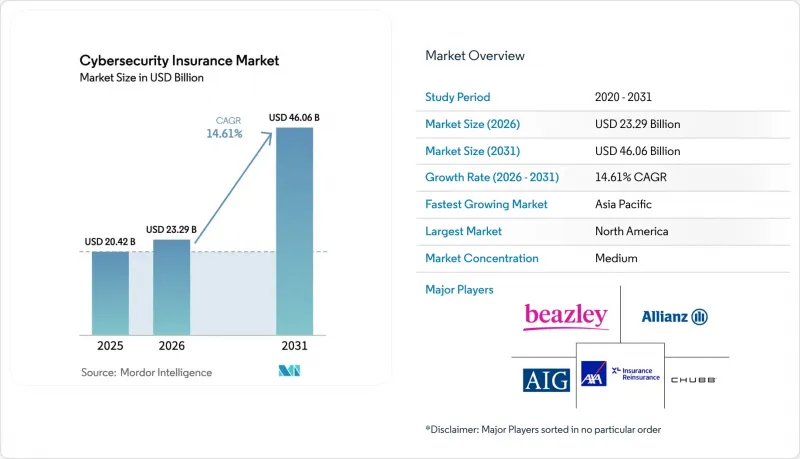
較低的保費率、不斷擴大的監管範圍以及董事會層面日益成長的對量化網路風險轉移的需求,正在推動市場需求的成長。承保能力正在擴大,但由於保險公司將資本配置到系統性風險集中的行業,承保標準仍然嚴格。隨著從僅承保責任險產品轉向綜合保險保障模式,內建的控制措施降低了索賠的嚴重性,賠付率正在下降。縮短理賠週期並吸引服務不足的中小企業的參數型保險創新也促進了成長前景。這一趨勢在亞太地區尤其顯著,該地區新的資料保護法提高了最低承保限額。
全球網路安全保險市場趨勢與洞察
雲端優先的數位轉型正在增加網路損失的風險。
快速向多租戶雲端平台的轉型正在擴大安全漏洞的傳播途徑,例如儲存配置錯誤、服務帳戶被盜用以及租戶間的橫向移動。 2024年2月,Change Healthcare遭受勒索軟體攻擊,造成23億美元的直接損失和業務中斷成本,這顯示單一服務中斷對美國關鍵醫療保健工作流程的連鎖反應。如今,保險公司在投保人簽訂保險合約前,要求提供多因素身份驗證、特權存取控制和不可篡改的備份,並且許多保險公司對雲端服務供應商中斷的承保範圍進行了限制。因此,雲端服務中斷可能在數小時內癱瘓地理位置分散的業務運營,推動了擴大第一方業務中斷保險範圍的需求。儘管整體市場承保能力有所擴大,但這些技術前提條件正在收緊承保標準,這有助於在保持盈利的同時,留住那些雲密集型企業的保險需求。
加強監管要求(GDPR、紐約州金融服務部、DORA、美國證券交易委員會規則)
網路安全韌性相關法規的統一正在將網路安全保險從一項可選支出轉變為一種合規手段。將於2025年1月生效的《數位營運韌性法案》(Digital Operational Resilience Act)強制要求歐盟超過2萬家金融機構進行年度網路安全韌性測試,並在嚴格的時限內揭露網路安全事件。紐約州2023年通過的《數位金融服務修正案》(DFS Amendment)要求大型金融機構對其網路安全計畫進行認證,並對違規行為處以每日最高1000美元的罰款。同時,美國證券交易委員會(SEC)的資訊揭露規則要求上市公司在四個工作天內揭露重大網路安全事件,並說明其董事會的監督情況,將網路風險報告納入受託責任範疇。這些法規共同提高了基本承保限額,尤其是在第三方罰款和法律辯護費用方面,從而導致保險費總額增加。
缺乏精算數據和建模的不確定性
由於攻擊途徑的變化速度遠超損失資料累積的速度,傳統精算方法的有效性有所降低。 2021 年的 Kaseya 勒索軟體攻擊透過託管服務供應商傳播,影響了超過 1500 家下游客戶。這顯示零時差攻擊如何在一夜之間扭曲相關性假設。保險公司正在採取應對措施,例如設定單次事件賠償上限、排除與超過 30 天未修復漏洞相關的事件,以及對未受保護的遠端桌面連接埠徵收高額額外保費。歐洲和北美以外地區資料外洩報告法律的碎片化阻礙了準確頻率統計數據的獲取,增加了模型誤差的定價緩衝,並減緩了缺乏透明通知系統的司法管轄區的業務擴張。
細分市場分析
在伊利諾州《生物辨識隱私權法案》等嚴格法規的約束下,隨著隱私權相關罰款和集體訴訟案件的不斷增加,預計到2031年,第三方責任責任險的需求將超過第一方保險的需求,複合年成長率將達到15.32%。第一方保險在2025年佔據了網路安全保險市場佔有率的42.66%,仍然是事件回應、業務中斷和贖金支付資金籌措的基礎,但隨著北美和歐洲承保限額的持續提高,該市場正步入成熟階段。隨著醫療保健和製造業對營運技術的依賴性不斷增強,導致直接損失的情況也日益增多,促使保險公司增加雲端服務中斷和設備改造費用的子限額,即使保費趨於穩定,需求依然持續成長。
歐盟《一般資料保護規範》(GDPR) 允許處以最高相當於全球銷售額 4% 的罰款,由此帶來的訴訟風險正推動法律和和解費用附加條款的普及,尤其是在跨成員國處理資料的國際平台上。將兩種類型的損失合併在統一限額下的混合型產品,有助於跨國公司避免因贖金支付升級為集體訴訟而引發的責任糾紛。這種混合型產品透過確保頻繁的第一方損失和高額責任索賠之間的保費收入平衡,穩定了綜合比率,從而使網路安全保險市場對再保險公司保持吸引力。
到2025年,獨立保單將佔全球保費的53.17%,增速達15.72%,主要得益於風險管理人員將網路風險與財產和產物保險分開,以確保條款更加清晰。 NotPetya事件引發的爭議——蘇黎世保險公司拒絕了億滋國際1億美元的財產損失索賠——凸顯了「全險」條款的模糊性,並刺激了對能夠凌駕於戰爭免責條款之上的客製化條款的需求。如今,獨立保單包含詳細的保障條款,例如強制性多因素身份驗證和30天補丁期,這些條款在一般責任險附加條款中很少見。
對於價格敏感度高於全面保障的微企業而言,捆綁式附加險仍然重要,但許多保險公司正在從這些附加險中移除勒索軟體、社交工程和業務中斷的保障。像Coalition的主動保險模式這樣的持續掃描服務,透過讓投保人即時了解外部攻擊面,並允許負責人在保單有效期內發現高風險漏洞時修改條款,正在增強人們對獨立保險的偏好。這一趨勢正在推動網路安全保險市場獨立產品的持續成長。
區域分析
到2025年,北美將佔全球保險費的39.66%。這主要得益於其廣泛的資訊揭露法律以及訴訟盛行的社會環境,後者往往導致與第三方的和解金額虛高。美國證券交易委員會(SEC)要求上市公司在事故發生後四個工作天內報告,此舉正在規範理賠處理流程,並提高理賠模型的準確性。加拿大2024年對資料外洩通知法規的修訂統一了跨境要求,並促進了區域性計畫的製定。然而,財富500強客戶群的飽和限制了銷售量成長,迫使保險公司將重心轉向中型企業和地方政府。
預計到2031年,亞太地區的成長率將達到16.12%,成為成長最快的地區。這主要得益於中國的《個人資料保護法》,該法強制跨國公司簽訂當地認可的保險合約;以及印度CERT-In關於六小時內報告網路事件的指令。新加坡和香港的監理機關目前建議將網路保險納入銀行的營運風險資本計畫。同時,澳洲修訂後的《關鍵基礎設施安全法》透過強制要求在12小時內報告服務中斷並對違規行為處以重罰,正在加速電信和能源產業的網路保險應用。儘管有限的歷史理賠數據仍然限制了承保能力,但保險公司正在與區域再保險公司合作,以分擔累積風險。
歐洲的趨勢正受到《數位營運風險法案》(DORA) 的影響,該法案強制要求金融機構每三年進行一次韌性測試,並明確董事會在網路安全監控方面的課責。德國聯邦金融監理局 (BaFin) 目前正將資本儲備與已評估的風險敞口掛鉤,並鼓勵銀行將風險轉移給第三方。勞合社於 2023 年推出的戰爭除外條款 LMA5565 將國家支持的活動排除在外,迫使歐洲買家協商反向承保條款,並確保獲得政治風險的補充賠償。在南美洲、中東和非洲,市場仍處於發展階段。儘管阿拉伯聯合大公國和沙烏地阿拉伯已製定國家層面的網路安全義務,但當地的承保能力仍然有限,這為參數型保險、前端保險或再保險解決方案促進市場發展創造了空間。
其他好處:
- Excel格式的市場預測(ME)表
- 3個月的分析師支持
目錄
第1章:引言
- 研究假設和市場定義
- 調查範圍
第2章:調查方法
第3章執行摘要
第4章 市場狀況
- 市場概覽
- 市場促進因素
- 雲端優先的數位轉型正在增加網路損失的風險。
- 加強監管要求(GDPR、紐約州金融服務部、DORA、美國證券交易委員會規則)
- 董事會層級關注量化網路風險
- 中小企業的低成本參數型保險正在興起。
- InsurSec模式結合了保全服務和賠償。
- 代幣化網路保險證券將吸引新的承銷能力。
- 市場限制因素
- 缺乏精算數據和建模的不確定性
- 高昂的保險費和高額的自付費用阻礙了中小企業的發展。
- 合約戰爭和系統性風險免責條款
- 關鍵基礎設施風險的再保險承保限額
- 產業供應鏈分析
- 監管情勢和行業準則
- 技術展望(人工智慧核保、巨災模型、區塊鏈參數化)
- 波特五力分析
- 供應商的議價能力
- 消費者議價能力
- 新進入者的威脅
- 替代品的威脅
- 競爭公司之間的競爭
- 宏觀經濟因素對市場的影響
第5章 市場規模與成長預測
- 按補償類型
- 個人補償
- 第三方責任
- 捆綁式/混合式
- 按保險類型
- 獨立網路
- 套餐/推薦
- 按公司規模
- 中小企業
- 大公司
- 按最終用戶行業分類
- BFSI
- 衛生保健
- 零售與電子商務
- 資訊科技和通訊
- 製造業
- 政府和公共部門
- 其他終端用戶產業
- 按地區
- 北美洲
- 美國
- 加拿大
- 墨西哥
- 南美洲
- 巴西
- 阿根廷
- 南美洲其他地區
- 歐洲
- 英國
- 德國
- 法國
- 瑞典
- 其他歐洲地區
- 亞太地區
- 中國
- 日本
- 印度
- 澳洲
- 韓國
- 亞太其他地區
- 中東和非洲
- 中東
- 沙烏地阿拉伯
- 阿拉伯聯合大公國
- 土耳其
- 其他中東國家
- 非洲
- 南非
- 奈及利亞
- 其他非洲地區
- 中東
- 北美洲
第6章 競爭情勢
- 市場集中度
- 策略趨勢
- 市佔率分析
- 公司簡介
- American International Group(AIG)
- Chubb Limited
- Zurich Insurance Group
- AXA XL
- Allianz Global Corporate and Specialty
- Fairfax Financial Holdings
- Beazley plc
- Munich Re Group
- Berkshire Hathaway Insurance Group
- Travelers Companies
- CNA Financial
- Hiscox Ltd.
- AXIS Capital Holdings
- Tokio Marine Holdings
- Sompo Holdings
- Aon plc
- Marsh McLennan
- Lockton Companies
- Coalition, Inc.
- Cowbell Cyber
- Swiss Reinsurance Company
- Lloyd's of London
- At-Bay
第7章 市場機會與未來展望
The cybersecurity insurance market size is projected to be USD 20.42 billion in 2025, USD 23.29 billion in 2026, and reach USD 46.06 billion by 2031, growing at a CAGR of 14.61% from 2026 to 2031.
Premium rate moderation, wider regulatory coverage requirements, and growing board-level demand for quantified cyber-risk transfer are reinforcing demand momentum. Capacity is expanding, yet underwriting discipline remains tight as carriers reserve capital for sectors with concentrated systemic exposure. The shift from indemnity-only offerings toward integrated InsurSec models is compressing loss ratios because embedded controls lower claim severity. Growth prospects also benefit from parametric innovation that shortens claims cycles and attracts under-served small and medium enterprises, particularly in Asia-Pacific where new data-protection statutes are raising minimum coverage limits.
Global Cybersecurity Insurance Market Trends and Insights
Cloud-First Digitalization Upsizes Cyber-Loss Exposure
Rapid migration to multi-tenant cloud platforms has widened breach pathways through misconfigured storage, compromised service accounts, and lateral movement between tenants. The February 2024 ransomware strike on Change Healthcare, which generated USD 2.3 billion in direct and business-interruption costs, showed how a single service disruption can ripple through critical U.S. healthcare workflows. Insurers now demand multi-factor authentication, privileged-access controls, and immutable backups before binding coverage, and many apply sub-limits to cloud-service-provider outages. Demand for first-party business-interruption extensions is therefore rising because a cloud outage can paralyze geographically dispersed operations within hours. These technical prerequisites are tightening selection standards even as headline capacity grows, thereby preserving profitability while sustaining policy uptake among cloud-heavy enterprises.
Escalating Regulatory Mandates (GDPR, NY DFS, DORA, SEC Rules)
Harmonized resilience laws are transforming cybersecurity insurance from discretionary spending into a compliance instrument. The Digital Operational Resilience Act, effective January 2025, obliges more than 20,000 EU financial entities to test cyber-resilience annually and disclose incidents within strict timelines. New York's 2023 DFS amendment compels large financial firms to certify cybersecurity programs and imposes penalties of up to USD 1,000 per day for non-compliance. Parallel disclosure rules from the U.S. SEC require listed companies to announce material incidents within four business days and describe board oversight, embedding cyber-risk reporting in fiduciary duty. Together these statutes elevate baseline coverage limits, particularly for third-party fines and legal defense, thereby lifting overall premium volume.
Actuarial Data Scarcity and Modeling Uncertainty
Attack vectors mutate faster than loss data accumulates, undermining classical actuarial techniques. The 2021 Kaseya ransomware campaign spread through managed-service providers and harmed more than 1,500 downstream clients, showing how a zero-day exploit can distort correlation assumptions overnight. Carriers react by capping per-event aggregates, excluding incidents tied to unpatched vulnerabilities older than 30 days, and charging steep additional premiums for undefended remote-desktop ports. Fragmented breach-reporting laws outside Europe and North America suppress accurate frequency statistics, inflating pricing buffers against modeling error and delaying expansion in jurisdictions lacking transparent notification regimes.
Other drivers and restraints analyzed in the detailed report include:
- Board-Level Focus on Quantifying Cyber Risk
- SME-Focused Low-Cost Parametric Covers Emerging
- High Premium and Retention Levels Deter SMEs
For complete list of drivers and restraints, kindly check the Table Of Contents.
Segment Analysis
Third-party liability coverage is projected to outstrip first-party demand at a 15.32% CAGR through 2031 as privacy fines and class actions proliferate under stringent statutes such as Illinois's Biometric Information Privacy Act. First-party protection, which commanded 42.66% of cybersecurity insurance market share in 2025, remains foundational for funding incident response, business-interruption, and ransom outlays but is maturing in North America and Europe where attachment points keep rising. Growing reliance on operational technology in healthcare and manufacturing multiplies direct-loss scenarios, so insurers are adding sub-limits for cloud-outage or equipment-recalibration costs, sustaining incremental demand even as pricing moderates.
Litigation risk from regulatory fines under the EU GDPR, which allows sanctions up to 4% of global turnover, is propelling uptake of defense and settlement towers, especially among international platforms that process data across member states. Hybrid products that consolidate both loss types under unified limits help multinationals avoid allocation disputes when a ransom payment morphs into class-action liability. This hybridization stabilizes combined ratios by ensuring balanced premium inflows across frequency-prone first-party and severity-heavy liability claims, keeping the cybersecurity insurance market attractive for reinsurers.
Stand-alone contracts captured 53.17% of global premiums in 2025 and are accelerating at 15.72% as risk managers decouple cyber perils from property and casualty covers to secure clearer wording. The NotPetya disputes that followed Zurich's denial of Mondelez's USD 100 million property claim highlighted ambiguity in "all-risk" forms and spurred demand for bespoke language that overrides war exclusions. Dedicated policies now integrate granular warranties such as mandatory multifactor authentication and 30-day patching windows, which general-liability endorsements rarely enforce.
Packaged extensions retain relevance for micro-enterprises where price sensitivity trumps coverage breadth, yet many carriers have removed ransomware, social engineering, and business-interruption protections from these endorsements. Continuous-scanning offerings like Coalition's active-insurance model reinforce the stand-alone preference by giving insureds real-time visibility into external attack surfaces and allowing underwriters to amend terms mid-policy when high-risk vulnerabilities appear. This dynamic underpins sustainable growth in the cybersecurity insurance market size for stand-alone products.
The Cybersecurity Insurance Market Report is Segmented by Coverage Type (First-Party Coverage, Third-Party Liability, and Bundled/Hybrid), Insurance Type (Stand-Alone Cyber, and Packaged/Endorsement), Organization Size (SMEs, and Large Enterprises), End-User Industry (BFSI, Healthcare, Retail and E-Commerce, IT and Telecom, Manufacturing, and More), and Geography. The Market Forecasts are Provided in Terms of Value (USD).
Geography Analysis
North America generated 39.66% of global premiums in 2025, anchored by pervasive disclosure laws and a litigious environment that magnifies third-party settlement values. SEC rules obliging public issuers to report incidents within four business days standardize claims timelines and improve model accuracy. Canada's 2024 breach-notification amendments have harmonized cross-border requirements, making regional programs easier to structure. Yet saturation among Fortune 500 buyers is tempering volume growth, directing carrier focus toward middle-market firms and municipalities.
Asia-Pacific is expected to log the fastest expansion at 16.12% through 2031, propelled by China's Personal Information Protection Law and India's CERT-In six-hour incident-report directive, both of which compel multinational companies to arrange local-admitted policies. Singapore and Hong Kong regulators now encourage cyber insurance as part of operational-risk capital planning for banks, while Australia's revised Security of Critical Infrastructure Act imposes 12-hour outage reporting and heavy penalties for non-compliance, driving uptake in telecom and energy sectors. Low historical claims data still suppresses capacity, but carriers are partnering with regional reinsurers to share accumulation risk.
Europe's trajectory is shaped by DORA, which forces financial entities to test resilience triennially and hold boards accountable for cyber oversight. Germany's BaFin now links capital reserves to measured exposure, nudging banks toward third-party transfer. Lloyd's war-exclusion clause LMA5565, introduced in 2023, excludes state-sponsored operations and has driven European buyers to negotiate carve-backs or secure supplemental political-risk covers. South America, the Middle East and Africa remain nascent; while the United Arab Emirates and Saudi Arabia have national cyber-security mandates, local underwriting capacity remains thin, opening space for parametric, fronted, or reinsurance-backed solutions to seed market development.
- American International Group (AIG)
- Chubb Limited
- Zurich Insurance Group
- AXA XL
- Allianz Global Corporate and Specialty
- Fairfax Financial Holdings
- Beazley plc
- Munich Re Group
- Berkshire Hathaway Insurance Group
- Travelers Companies
- CNA Financial
- Hiscox Ltd.
- AXIS Capital Holdings
- Tokio Marine Holdings
- Sompo Holdings
- Aon plc
- Marsh McLennan
- Lockton Companies
- Coalition, Inc.
- Cowbell Cyber
- Swiss Reinsurance Company
- Lloyd's of London
- At-Bay
Additional Benefits:
- The market estimate (ME) sheet in Excel format
- 3 months of analyst support
TABLE OF CONTENTS
1 INTRODUCTION
- 1.1 Study Assumptions and Market Definition
- 1.2 Scope of the Study
2 RESEARCH METHODOLOGY
3 EXECUTIVE SUMMARY
4 MARKET LANDSCAPE
- 4.1 Market Overview
- 4.2 Market Drivers
- 4.2.1 Cloud-First Digitalization Upsizes Cyber-Loss Exposure
- 4.2.2 Escalating Regulatory Mandates (GDPR, NY DFS, DORA, SEC Rules)
- 4.2.3 Board-Level Focus on Quantifying Cyber Risk
- 4.2.4 SME-Focused Low-Cost Parametric Covers Emerging
- 4.2.5 InsurSec Models Bundling Security Services and Cover
- 4.2.6 Tokenized Cyber ILS Attracting New Capacity
- 4.3 Market Restraints
- 4.3.1 Actuarial Data Scarcity and Modeling Uncertainty
- 4.3.2 High Premium and Retention Levels Deter SMEs
- 4.3.3 Contractual War and Systemic-Risk Exclusions
- 4.3.4 Reinsurance Capacity Caps for Critical-Infrastructure Risks
- 4.4 Industry Supply-Chain Analysis
- 4.5 Regulatory Landscape and Industry Guidelines
- 4.6 Technological Outlook (AI Underwriting, CAT Models, Blockchain Parametrics)
- 4.7 Porter's Five Forces Analysis
- 4.7.1 Bargaining Power of Suppliers
- 4.7.2 Bargaining Power of Consumers
- 4.7.3 Threat of New Entrants
- 4.7.4 Threat of Substitutes
- 4.7.5 Intensity of Competitive Rivalry
- 4.8 Impact of Macroeconomic Factors on the Market
5 MARKET SIZE AND GROWTH FORECASTS (VALUE)
- 5.1 By Coverage Type
- 5.1.1 First-Party Coverage
- 5.1.2 Third-Party Liability
- 5.1.3 Bundled / Hybrid
- 5.2 By Insurance Type
- 5.2.1 Stand-Alone Cyber
- 5.2.2 Packaged / Endorsement
- 5.3 By Organisation Size
- 5.3.1 Small and Medium Enterprises (SMEs)
- 5.3.2 Large Enterprises
- 5.4 By End-User Industry
- 5.4.1 BFSI
- 5.4.2 Healthcare
- 5.4.3 Retail and E-Commerce
- 5.4.4 IT and Telecom
- 5.4.5 Manufacturing
- 5.4.6 Government and Public Sector
- 5.4.7 Other End-User Industries
- 5.5 By Geography
- 5.5.1 North America
- 5.5.1.1 United States
- 5.5.1.2 Canada
- 5.5.1.3 Mexico
- 5.5.2 South America
- 5.5.2.1 Brazil
- 5.5.2.2 Argentina
- 5.5.2.3 Rest of South America
- 5.5.3 Europe
- 5.5.3.1 United Kingdom
- 5.5.3.2 Germany
- 5.5.3.3 France
- 5.5.3.4 Sweden
- 5.5.3.5 Rest of Europe
- 5.5.4 Asia-Pacific
- 5.5.4.1 China
- 5.5.4.2 Japan
- 5.5.4.3 India
- 5.5.4.4 Australia
- 5.5.4.5 South Korea
- 5.5.4.6 Rest of Asia-Pacific
- 5.5.5 Middle East and Africa
- 5.5.5.1 Middle East
- 5.5.5.1.1 Saudi Arabia
- 5.5.5.1.2 United Arab Emirates
- 5.5.5.1.3 Turkey
- 5.5.5.1.4 Rest of Middle East
- 5.5.5.2 Africa
- 5.5.5.2.1 South Africa
- 5.5.5.2.2 Nigeria
- 5.5.5.2.3 Rest of Africa
- 5.5.5.1 Middle East
- 5.5.1 North America
6 COMPETITIVE LANDSCAPE
- 6.1 Market Concentration
- 6.2 Strategic Moves
- 6.3 Market Share Analysis
- 6.4 Company Profiles (includes Global Level Overview, Market Level Overview, Core Segments, Financials as available, Strategic Information, Market Rank/Share, Products and Services, Recent Developments)
- 6.4.1 American International Group (AIG)
- 6.4.2 Chubb Limited
- 6.4.3 Zurich Insurance Group
- 6.4.4 AXA XL
- 6.4.5 Allianz Global Corporate and Specialty
- 6.4.6 Fairfax Financial Holdings
- 6.4.7 Beazley plc
- 6.4.8 Munich Re Group
- 6.4.9 Berkshire Hathaway Insurance Group
- 6.4.10 Travelers Companies
- 6.4.11 CNA Financial
- 6.4.12 Hiscox Ltd.
- 6.4.13 AXIS Capital Holdings
- 6.4.14 Tokio Marine Holdings
- 6.4.15 Sompo Holdings
- 6.4.16 Aon plc
- 6.4.17 Marsh McLennan
- 6.4.18 Lockton Companies
- 6.4.19 Coalition, Inc.
- 6.4.20 Cowbell Cyber
- 6.4.21 Swiss Reinsurance Company
- 6.4.22 Lloyd's of London
- 6.4.23 At-Bay
7 MARKET OPPORTUNITIES AND FUTURE OUTLOOK
- 7.1 White-Space and Unmet-Need Assessment

 網路安全保險市場-2026-2032年全球市場預測
 網路安全保險市場:按保險類型、承保範圍、公司規模、最終用戶和地區分類
 2026年全球網路安全保險市場報告
 網路安全保險市場分析及預測(至2035年):按類型、產品、服務、技術、組件、應用、部署類型、最終用戶和解決方案分類
 全球網路安全保險市場規模、佔有率、趨勢和成長分析報告(2026-2034)網路安全財產保險市場按承保範圍、公司規模、保單類型、風險類型、部署模式、最終用戶產業和銷售管道分類-2026年至2032年全球預測
 安全保障市場規模、佔有率和成長分析(按服務類型、組織規模、部署模式、應用、垂直產業和地區分類)-2026年至2033年產業預測
 網路安全保險市場規模、佔有率和成長分析(按產品、承保範圍、合規要求和地區分類)-2026-2033年產業預測
 安全保障市場 - 全球產業規模、佔有率、趨勢、機會和預測(按應用、組織規模、垂直產業、地區和競爭細分,2020-2030 年預測)
 網路安全保險市場:按產品、覆蓋範圍、保單類型、提供者類型、行業垂直領域和地區分類的全球市場 - 預測至 2030 年