


 |
市場調查報告書
商品編碼
2043827
電泳塗裝(E-coat):市場佔有率分析、產業趨勢與統計、成長預測(2026-2031)Electrocoating (E-coat) - Market Share Analysis, Industry Trends & Statistics, Growth Forecasts (2026 - 2031) |
||||||

※ 本網頁內容可能與最新版本有所差異。詳細情況請與我們聯繫。
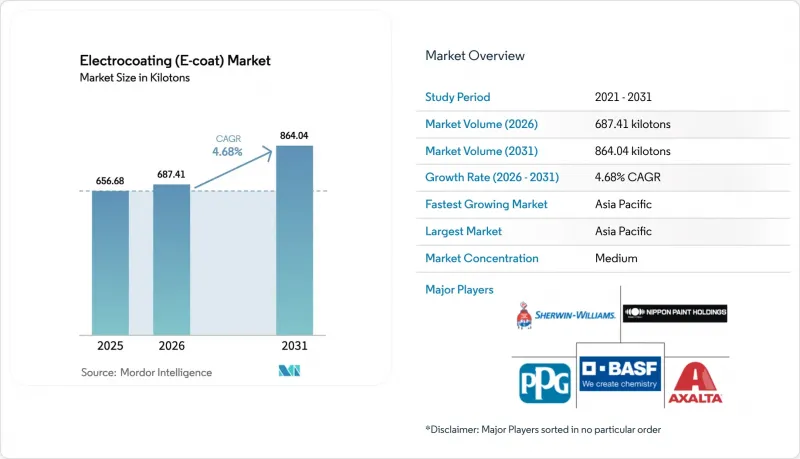
預計電泳塗裝市場將從 2025 年的 656.68 千噸和 2026 年的 687.41 千噸成長到 2031 年的 864.04 千噸,2026 年至 2031 年的年複合成長率(CAGR)為 4.68%。
三大變革正在重塑市場格局:亞太地區汽車產量成長、800V以上電動車電池外殼強制要求採用介電屏蔽,以及農業機械組裝在拉丁美洲的在地化程度不斷提高。這些變革正將塗料需求從傳統的歐洲和北美中心轉移。陰極環氧系統以其高介電強度和卓越的轉移效率而著稱,正逐漸成為最佳選擇。這些優勢不僅使汽車和消費性電子產品原始設備製造商 (OEM) 能夠滿足嚴格的防腐蝕和永續性標準,而且與傳統噴塗底漆相比,還能顯著降低揮發性有機化合物 (VOC)的排放。
全球電泳塗裝(E-coat)市場趨勢及洞察
亞太地區汽車產量成長
2024年,中國和印度成為亞太地區的主要貢獻者,汽車產量龐大。如此龐大的產量鞏固了該地區在結構塗料需求方面的主導地位。為了滿足OEM廠商長達10年的防腐蝕保固,所有車身本體均採用陰極電泳塗裝浸漬處理。 2025年商品及服務稅(GST)下調後,印度國內汽車銷售量顯著成長,迫使合約塗裝商實施兩班制。泰國和韓國也出現了類似的成長。此外,由於電動車電池組重量增加,法規要求增加底盤塗層厚度。隨著生產集中在特定地區,化合物製造商將工廠策略性地佈局在同一地點,有效降低了與短保存期限環氧樹脂分散體相關的庫存風險。預計到2031年,這些趨勢將佔據電泳塗裝市場的相當大佔有率。
對溶劑型底漆具有優異的耐腐蝕性
與溶劑型底漆相比,陰極電泳塗料展現出更優異的鹽霧試驗耐久性。隨著OEM廠商保固期的延長,此優勢愈發顯著。高轉移效率可顯著減少過噴廢棄物,並降低每輛車的VOC排放。這項進展有助於滿足美國EPA Tier 3和歐盟Stage V排放標準。BASF的「CathoGuard 800 RE」成功降低了烘烤溫度,從而在保持最佳邊緣覆蓋率的同時,減少了天然氣消耗。雖然建造新的浸塗生產線需要大量投資,但將這部分成本分攤到長期,將有助於維持單件塗裝成本的競爭力,並支持2026年至2031年預測期內電泳塗裝市場的成長。
外部塑膠部件的紫外線穩定性低
環氧樹脂電泳塗層在長時間暴露於340奈米紫外光下會發生粉化現象。因此,汽車製造商通常會在其表面噴塗粉末透明塗層或選擇丙烯酸底漆,尤其是在保險桿和後視鏡蓋等部位。丙烯酸電泳塗層即使在長時間暴露於QUV-A紫外線後仍能保持光澤,而環氧樹脂電泳塗層則表現不佳。然而,丙烯酸塗層也存在局限性,例如耐久性和介電強度不足以滿足邊緣塗層的需求。在中東和澳洲等陽光充足的地區,豪華車專案擴大採用未噴漆的黑色塑膠。這種趨勢導致單位面積可進行電泳塗裝的表面積減少。目前的專利申請表明,樹脂技術短期內預計不會有重大進展,這很可能在2026年至2031年的預測期內持續成為電泳塗裝市場面臨的挑戰。
細分市場分析
2025年,陰極電泳塗裝系統將佔據市場主導地位,銷售量佔比高達97.72%,預計在2026年至2031年的預測期內,其複合年成長率將達到4.67%。陰極電泳塗裝的優勢源自於其優異的耐鹽霧性能和卓越的介電強度,這兩項特性對於現代電動車(EV)車身至關重要。到了2025年,陰極電泳塗裝在電泳塗裝市場中佔相當大的佔有率。透過不斷改進配方,陰極電泳塗裝產品在維持優異邊緣覆蓋率的同時,也能確保符合歐盟REACH法規的要求。陽極電塗裝會溶解更多的金屬,產生更高的污泥負荷。這種轉變雖然限制了陽極電泳塗裝的發展潛力,但也突顯了其對非鐵金屬基材的優異附著力。
儘管陰極技術近乎壟斷,阻礙了新進入者,但生物基環氧樹脂分散體和奈米顏料封裝仍有機會。這些創新技術有望進一步最佳化隱蔽模腔中的塗層厚度。鑑於 ISO 12944 認證週期長達 24 個月,旨在挑戰現有陰極系統供應商的創新化學技術必須展現出明顯的永續性或成本優勢。展望 2031 年,陽極氧化預計在電泳塗裝領域仍將保持小規模的市場佔有率,主要集中在建築鋁材和部分消費性電子產品機殼。
本「電泳塗裝市場報告」按類型(陰極和陽極)、技術(環氧塗裝技術和丙烯酸塗裝技術)、應用(乘用車、商用車、汽車零件及配件、重型機械、消費性電子產品等)和地區(亞太地區、北美地區、歐洲地區等)進行細分。市場預測以噸為單位。
區域分析
2025年,亞太地區在電化學塗層市場佔據主導地位,產量佔全球的55.45%。預計2026年至2031年預測期內,該地區將以5.05%的複合年成長率穩定成長。這一成長主要得益於中國強勁的產能,以及印度市場在商品和服務稅(GST)政策推動下銷售額的激增。 2025年,中國電池式電動車(BEV)的生產推動了對介電屏蔽材料需求的激增。同時,泰國和韓國混合動力汽車生產線的投產,使得需要厚度增加25μm的薄膜來容納更重的電池組。日本向混合動力汽車的轉型也使其基礎產量保持穩定。
預計北美將在2025年佔據較大的市場佔有率,並保持穩定成長。在墨西哥,出口激增促使瓜納華托州和克雷塔羅州新建浸沒式電池槽,為汽車和農業機械框架提供電池。然而,電動車相關資產的大幅減損損失抑制了市場對超高壓電池托盤的熱情。在美國,熟練操作人員的短缺限制了產能運轉率,儘管初始產量正接近最佳水平,但成長緩慢。
歐洲預計將在2025年佔據相當大的生產佔有率,目前正處於穩定成長的軌道上。該地區面臨許多挑戰,例如純電動車的普及速度低於預期,以及由於對錫催化劑的嚴格監管而導致的昂貴化合物變更。德國的需求成長強勁,而英國和義大利的產量則有所下降,因為汽車製造商將生產轉移到了東部成本效益更高的工廠。在南美洲,儘管佔有率較小,但巴西和阿根廷的曳引機近岸生產是推動成長的主要動力。相較之下,中東地區則舉步維艱,受到當地車輛組裝有限以及對預塗裝產品的依賴等因素的限制。
其他好處:
- Excel格式的市場預測(ME)表
- 3個月的分析師支持
目錄
第1章:引言
- 研究的先決條件
- 調查範圍
第2章:調查方法
第3章執行摘要
第4章 市場動態
- 促進因素
- 亞太地區汽車產量成長
- 對溶劑型底漆具有優異的耐腐蝕性
- 採用電泳塗層進行介電屏蔽的電動汽車電池外殼
- 採用奈米技術改善邊緣覆蓋率和分散性的配方。
- 拉丁美洲國家農業機械生產的近岸外包
- 抑制因子
- 外部塑膠部件的紫外線穩定性差。
- 自動化浸沒式水槽工藝熟練工人短缺
- 生物基環氧樹脂分散體的供應不穩定
- 產業價值鏈分析
- 波特五力分析
- 供應商的議價能力
- 消費者議價能力
- 新進入者的威脅
- 替代產品和服務的威脅
- 競爭程度
第5章 市場規模與成長預測
- 按類型
- 陰極
- 陽極
- 透過技術
- 環氧塗層技術
- 丙烯酸塗層技術
- 透過使用
- 搭乘用車
- 商用車輛
- 汽車零件及配件
- 大型重型機械
- 家用電器
- 其他用途
- 按地區
- 亞太地區
- 中國
- 印度
- 日本
- 韓國
- 亞太其他地區
- 北美洲
- 美國
- 加拿大
- 墨西哥
- 歐洲
- 德國
- 英國
- 義大利
- 法國
- 其他歐洲地區
- 南美洲
- 巴西
- 阿根廷
- 南美洲其他地區
- 中東和非洲
- 沙烏地阿拉伯
- 南非
- 其他中東和非洲
- 亞太地區
第6章 競爭情勢
- 市場集中度
- 策略趨勢
- 市佔率(%)/排名分析
- 公司簡介
- Axalta Coating Systems
- BL DOWNEY Company LLC
- BASF SE
- Burkard Industries
- Dymax Corporation
- Electro Coatings Inc.
- Greenkote
- HE Orr Company
- Hawking Electrotechnology Limited
- Henkel AG & Co. KGaA
- Lippert Components Inc.
- Nippon Paint Holdings Co., Ltd.
- PPG Industries Inc.
- The Sherwin-Williams Company
- Valmont Industries Inc.
第7章 市場機會與未來趨勢
- 評估未開發的領域和未滿足的需求
The Electrocoating Market size is projected to expand from 656.68 kilotons in 2025 and 687.41 kilotons in 2026 to 864.04 kilotons by 2031, registering a CAGR of 4.68% between 2026 to 2031.
Three key shifts are reshaping the landscape: the Asia-Pacific region is increasing its vehicle production, electric-vehicle (EV) battery housings now mandate dielectric shielding for systems surpassing 800 V, and agricultural-equipment assembly is moving closer to home in the Latin America region. This realignment is shifting coating demand away from traditional centers in Europe and North America. Cathodic epoxy systems, known for their high dielectric strength and impressive transfer efficiency, have emerged as the preferred choice. This advantage enables automotive and appliance OEMs to not only adhere to stringent corrosion and sustainability benchmarks but also to significantly reduce volatile organic compound (VOC) emissions compared to conventional spray primers.
Global Electrocoating (E-coat) Market Trends and Insights
Automotive Production Growth in Asia-Pacific
In 2024, the Asia-Pacific region produced a significant number of vehicles, with China and India being major contributors. This output solidified the region's dominance in structural coating demand. To meet a decade-long OEM corrosion warranty, every body-in-white underwent cathodic e-coat immersion. Following a GST reduction in 2025, India's local vehicle sales experienced substantial growth, compelling toll coaters to implement second shifts. Both Thailand and South Korea saw similar upticks. Additionally, as EVs now bear heavier battery packs, regulations mandate thicker films on their underbodies. With production concentrated in specific areas, formulators strategically co-located plants, effectively mitigating inventory risks associated with short-shelf-life epoxy dispersions. These trends are projected to account for a significant portion of the Electrocoating market volume by 2031.
Superior Corrosion-Resistance vs. Solvent-Borne Primers
Cathodic e-coat exhibits superior salt-spray durability compared to solvent primers. This advantage has become more prominent as OEM warranties have extended. Due to its high transfer efficiency, overspray waste is significantly reduced, leading to lower VOC output per vehicle. This development facilitates compliance with U.S. EPA Tier 3 and EU Stage V regulations. BASF's CathoGuard 800 RE has successfully reduced bake temperatures, which decreases natural gas consumption while maintaining optimal edge coverage. Although establishing a greenfield dip line requires substantial investment, spreading this cost over time ensures that the per-unit coating expense remains competitive, supporting the growth of the Electrocoating market during the forecast period of 2026-2031.
Limited UV Stability for Exterior Plastic Parts
Extended exposure to 340 nm UV light causes epoxy e-coats to chalk. Consequently, OEMs often apply powder clearcoats or choose acrylic primers, particularly on bumpers and mirror caps. While acrylic e-coats preserve their gloss after extended QUV-A exposure, epoxy e-coats do not fare as well. However, acrylics have limitations, lacking in edge-coverage toughness and dielectric strength. In sun-drenched regions like the Middle-East and Australia, premium vehicle programs are gravitating towards unpainted black plastics. This trend has resulted in a decreased e-coatable surface per unit. Current patent filings indicate no forthcoming advancements in resin technology, posing a continuing challenge for the Electrocoating market, with projections extending through the forecast period of 2026-2031.
Other drivers and restraints analyzed in the detailed report include:
- EV Battery Housings Adopting E-Coat for Dielectric Shielding
- Nano-Enabled Formulas Improving Throw Power
- Skilled-Operator Gap for Automated Dip-Tank Processes
For complete list of drivers and restraints, kindly check the Table Of Contents.
Segment Analysis
In 2025, cathodic systems dominated the market, capturing 97.72% of the volume, and are projected to grow at a compound annual growth rate (CAGR) of 4.67% during the forecast period of 2026-2031. Their dominance is attributed to features such as a high salt-spray endurance and strong dielectric ratings, both of which are crucial for modern electric vehicle (EV) bodies. This segment represented a significant portion of the Electrocoating market in 2025. Ongoing reformulations ensure that cathodic options remain compliant with EU REACH regulations while maintaining strong edge-coverage ratios. Although anodic e-coat occupies a small niche for aluminum extrusions, benefiting from oxide formation that enhances adhesion, its growth rate lags behind the broader Electrocoating market. Anodic baths, which dissolve more metal and generate higher sludge loads, have led many architects and appliance original equipment manufacturers (OEMs) to shift toward powder coatings. This transition, while limiting anodic coatings' growth potential, highlights their favorable adhesion properties on non-ferrous substrates.
Despite the near-monopoly of cathodic technology, which stifles new entrants, opportunities exist in bio-based epoxy dispersions and nano-pigment packages. These innovations could further optimize film build in concealed cavities. Given that ISO 12944 qualification cycles span up to 24 months, any disruptive chemistries aiming to challenge established cathodic suppliers must demonstrate clear sustainability or cost advantages. Looking ahead, anodic coatings are expected to maintain a small market share in the Electrocoating sector through 2031, focusing primarily on architectural aluminum and select consumer electronics housings.
The Electrocoating Market Report is Segmented by Type (Cathodic and Anodic), Technology (Epoxy Coating Technology and Acrylic Coating Technology), Application (Passenger Cars, Commercial Vehicles, Automotive Parts and Accessories, Heavy Duty Equipment, Appliances, and Other Applications), and Geography (Asia-Pacific, North America, Europe, and More). The Market Forecasts are Provided in Terms of Volume (Tons).
Geography Analysis
In 2025, the Asia-Pacific region dominated the electrocoating market, accounting for 55.45% of the volume. Projections indicate steady growth at a CAGR of 5.05% during the forecast period of 2026-2031. China's robust output, coupled with a sales surge in India, driven by the GST, fuels this expansion. In 2025, China's production of BEVs spiked the demand for dielectric shielding. Concurrently, Thailand and South Korea rolled out hybrid lines, necessitating thicker 25 μm films for their heavier battery packs. Japan's pivot towards hybrids has ensured its base volumes remain stable.
North America, boasting a significant share in 2025, is poised for consistent growth. Mexico's export boom has spurred the creation of new dip tanks in Guanajuato and Queretaro, serving both automotive and agricultural machinery frames. However, a notable write-down on EV assets has tempered enthusiasm for ultra-high-voltage battery trays. In the United States, a shortage of skilled operators has constrained capacity utilization, inching first-pass yields towards their optimal mark.
Europe, commanding a substantial portion of the 2025 volume, is on a steady growth path. The region faced hurdles with a slower-than-expected BEV adoption and stringent tin catalyst restrictions, resulting in costly reformulations. While Germany led the demand charge, the United Kingdom and Italy experienced volume declines as OEMs pivoted to more cost-effective eastern plants. South America, with its modest share, saw growth driven by tractor nearshoring in Brazil and Argentina. In contrast, the Middle-East lagged, hindered by limited local vehicle assembly and a reliance on pre-coated imports.
- Axalta Coating Systems
- B.L DOWNEY Company LLC
- BASF SE
- Burkard Industries
- Dymax Corporation
- Electro Coatings Inc.
- Greenkote
- H.E. Orr Company
- Hawking Electrotechnology Limited
- Henkel AG & Co. KGaA
- Lippert Components Inc.
- Nippon Paint Holdings Co., Ltd.
- PPG Industries Inc.
- The Sherwin-Williams Company
- Valmont Industries Inc.
Additional Benefits:
- The market estimate (ME) sheet in Excel format
- 3 months of analyst support
TABLE OF CONTENTS
1 Introduction
- 1.1 Study Assumptions
- 1.2 Scope of the Study
2 Research Methodology
3 Executive Summary
4 Market Dynamics
- 4.1 Drivers
- 4.1.1 Automotive production growth in Asia-Pacific
- 4.1.2 Superior corrosion-resistance vs. solvent-borne primers
- 4.1.3 EV battery housings adopting e-coat for dielectric shielding
- 4.1.4 Nano-enabled formulas improving edge-coverage and throw-power
- 4.1.5 Nearshoring of ag-equipment production in LATAM Countries
- 4.2 Restraints
- 4.2.1 Limited UV stability for exterior plastic parts
- 4.2.2 Skilled-operator gap for automated dip-tank processes
- 4.2.3 Volatile supply of bio-based epoxy dispersions
- 4.3 Industry Value Chain Analysis
- 4.4 Porter's Five Forces Analysis
- 4.4.1 Bargaining Power of Suppliers
- 4.4.2 Bargaining Power of Consumers
- 4.4.3 Threat of New Entrants
- 4.4.4 Threat of Substitute Products and Services
- 4.4.5 Degree of Competition
5 Market Size and Growth Forecasts (Volume)
- 5.1 By Type
- 5.1.1 Cathodic
- 5.1.2 Anodic
- 5.2 By Technology
- 5.2.1 Epoxy Coating Technology
- 5.2.2 Acrylic Coating Technology
- 5.3 By Application
- 5.3.1 Passenger Cars
- 5.3.2 Commercial Vehicles
- 5.3.3 Automotive Parts and Accessories
- 5.3.4 Heavy Duty Equipment
- 5.3.5 Appliances
- 5.3.6 Other Applications
- 5.4 By Geography
- 5.4.1 Asia-Pacific
- 5.4.1.1 China
- 5.4.1.2 India
- 5.4.1.3 Japan
- 5.4.1.4 South Korea
- 5.4.1.5 Rest of Asia-Pacific
- 5.4.2 North America
- 5.4.2.1 United States
- 5.4.2.2 Canada
- 5.4.2.3 Mexico
- 5.4.3 Europe
- 5.4.3.1 Germany
- 5.4.3.2 United Kingdom
- 5.4.3.3 Italy
- 5.4.3.4 France
- 5.4.3.5 Rest of Europe
- 5.4.4 South America
- 5.4.4.1 Brazil
- 5.4.4.2 Argentina
- 5.4.4.3 Rest of South America
- 5.4.5 Middle-East and Africa
- 5.4.5.1 Saudi Arabia
- 5.4.5.2 South Africa
- 5.4.5.3 Rest of Middle-East and Africa
- 5.4.1 Asia-Pacific
6 Competitive Landscape
- 6.1 Market Concentration
- 6.2 Strategic Moves
- 6.3 Market Share(%)/Ranking Analysis
- 6.4 Company Profiles (includes Global Overview, Market Overview, Core Segments, Financials, Strategic Information, Products and Services, Recent Developments)
- 6.4.1 Axalta Coating Systems
- 6.4.2 B.L DOWNEY Company LLC
- 6.4.3 BASF SE
- 6.4.4 Burkard Industries
- 6.4.5 Dymax Corporation
- 6.4.6 Electro Coatings Inc.
- 6.4.7 Greenkote
- 6.4.8 H.E. Orr Company
- 6.4.9 Hawking Electrotechnology Limited
- 6.4.10 Henkel AG & Co. KGaA
- 6.4.11 Lippert Components Inc.
- 6.4.12 Nippon Paint Holdings Co., Ltd.
- 6.4.13 PPG Industries Inc.
- 6.4.14 The Sherwin-Williams Company
- 6.4.15 Valmont Industries Inc.
7 Market Opportunities and Future Trends
- 7.1 White-space and Unmet-need Assessment

 電塗裝塗層市場:全球市場預測,2026-2032年
 陰極電塗裝塗層市場:按應用和地區分類 -電著底漆市場:按電塗裝方法、基材和最終用途產業分類的全球市場預測,2026-2032年電鍍市場:依電鍍類型、電鍍技術、基材及最終用途產業分類-2026-2032年全球市場預測
 全球電塗裝塗層市場規模、佔有率、趨勢和成長分析報告(2026-2034)
 2026年全球電塗裝塗佈市場報告工業電塗裝塗層市場(依基材類型、沉積製程、電壓範圍、材料類型及最終用途產業分類)-2026-2032年全球預測工業電塗裝塗層市場:依沉積方法、製程、樹脂、應用和最終用途產業分類,全球預測(2026-2032年)陰極電塗裝塗層市場(依塗層類型、最終用途、塗覆方法、基材和通路分類)-2026-2032年全球預測陽極電塗裝塗層市場按類型、塗層製程和應用分類-2026-2032年全球預測