


 |
市場調查報告書
商品編碼
2035085
葡萄糖酸:市場佔有率分析、產業趨勢與統計、成長預測(2026-2031)Glucaric Acid - Market Share Analysis, Industry Trends & Statistics, Growth Forecasts (2026 - 2031) |
||||||

※ 本網頁內容可能與最新版本有所差異。詳細情況請與我們聯繫。
預計葡萄糖酸市場規模將從 2025 年的 7.8 億美元成長到 2026 年的 8.4 億美元,到 2031 年將達到 12.2 億美元,2026 年至 2031 年的複合年成長率為 7.78%。
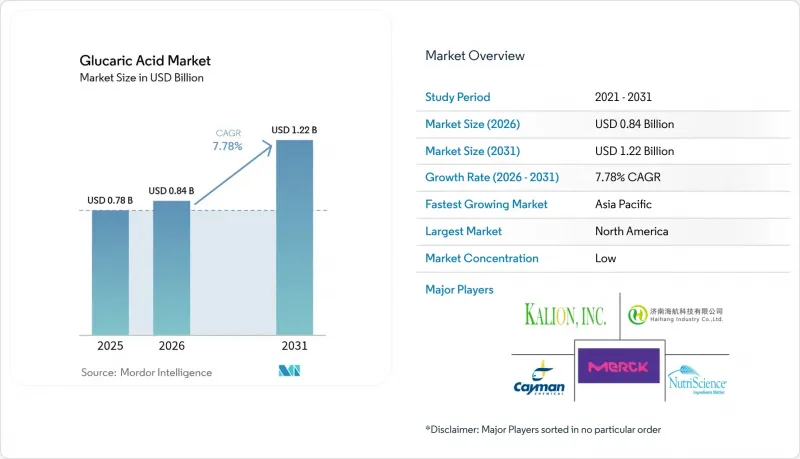
在嚴格的環境法規和全球永續化學替代品趨勢的推動下,葡糖二酸市場展現出強勁的成長動能。推動這一上升趨勢的關鍵因素包括生物技術的進步以及在製藥和食品加工領域應用範圍的擴大。減少對石油化工產品依賴的需求日益成長,也進一步促進了市場成長。目前,市場主要由精製葡糖二酸產品驅動,這些產品已展現出商業性成熟度和廣泛的應用前景。然而,用於保健品領域的葡糖二酸衍生物市場正在蓬勃發展,預計在不久的將來將得到更快速的推廣。消費者健康意識的提高正在推動這一領域的成長。雖然清潔劑仍然是葡糖二酸的主要應用領域,但食品級葡糖二酸的使用量正在顯著成長,這主要得益於消費者對潔淨標示和功能性成分日益成長的需求。這一趨勢與食品生產領域向透明度和永續性發展的趨勢一致。已開發國家憑藉完善的工業基礎設施和有利的法規,仍佔據最大的市場佔有率。然而,亞太地區正因其快速的工業化進程和強力的環境永續性發展政策舉措,成為成長最快的地區,並因此備受關注。該地區中產階級的壯大和可支配收入的增加進一步推動了市場成長。在創新引領和區域趨勢共同作用下,市場正蓄勢待發,即將迎來變革性發展。
全球葡萄糖酸市場趨勢及洞察
各行各業的消費者都偏好無毒無致敏添加劑
對無毒、無致敏添加劑日益成長的需求正在改變各行業的化學品籌資策略,而葡萄醣醛酸正逐漸成為傳統螯合劑的替代品。美國環保署 (EPA) 修訂的「更安全選擇」標準將於 2024 年 8 月生效,該標準要求在產品認證中提高成分分析和生命週期分析的透明度,從而鼓勵採用生物基替代品。這與歐盟 (EU) 指令 2024/825 一致,該指令要求對環境聲明檢驗,並對永續性標籤進行第三方認證,從而杜絕未經證實的「環保」行銷宣傳。這些監管變化有利於能夠證明其產品具有可量化環境效益的葡萄醣醛酸生產商。工業採購商正在優先考慮無毒添加劑,以最大限度地降低責任風險並實現企業永續發展目標,並將評估標準擴展到成本因素之外。製藥業在代謝健康產品中使用葡萄醣醛酸鈣,並有臨床研究證實其在血糖管理方面的有效性,這表明安全性因素如何影響定價策略。
消費者對排毒和代謝健康的興趣日益濃厚
隨著代謝性疾病的日益普遍,市場對葡萄醣醛酸衍生物(尤其是葡萄醣醛酸鈣)的需求激增。這一成長主要源於消費者對代謝健康管理意識的提高,以及對經科學驗證的天然藥物替代療法的需求。葡萄醣醛酸化合物在調節GLP-1反應路徑方面展現出巨大潛力,使其成為不斷成長的體重管理市場中處方藥的可靠替代品。醫療機構正擴大將這些化合物納入治療方案,作為治療多種代謝性疾病的經濟有效治療方法。同時,人口老化和糖尿病發病率上升等人口結構變化,為基於葡萄醣醛酸的健康解決方案,特別是預防醫學和代謝支持領域,創造了強大的市場基礎。例如,根據世界銀行的數據,到2023年,日本65歲及以上人口的比例將達到30%,位居世界第一,其次是義大利,為24%。
一個複雜且耗能的淨化過程。
醫藥級和食品級葡糖二酸嚴格的純化要求阻礙了市場成長,尤其對中小型生物技術公司影響尤為顯著。傳統的純化方法需要多步驟結晶和嚴格的雜質控制措施。某些地區的高昂能源成本限制了純化過程,只有那些能夠獲得價格合理的清潔能源的生產商才能從中受益。電滲析和膜分離等先進技術提供了可行的替代方案,但這些調查方法需要大量的資本投入和專業的技術知識。在不同的原料和發酵參數下維持產品品質的標準化本身就極具挑戰性,這為成熟的生產者提供了競爭優勢。此外,美國食品藥物管理局(FDA) 和歐洲藥品管理局 (EMA) 制定的法規結構,要求提供全面的文件和驗證方案,也為小規模生產商帶來了巨大的營運障礙。這些因素共同作用,顯著影響葡糖二酸產業的市場成長軌跡和營運動態。
細分市場分析
到2025年,純D-葡糖二酸將佔據30.12%的市場佔有率,這主要得益於其在製藥、工業和研究領域的關鍵作用,在這些領域,純度至關重要。成熟的生產技術和合規性,尤其是在水處理領域,為該領域的擴張提供了支持。獲得《有毒物質管制法》(TSCA) 的核准具有競爭優勢。純D-葡糖二酸用途廣泛,從化學中間體到環保解決方案,其多功能性進一步推動了市場對其的需求,也契合了永續性的永續發展理念。此外,生產技術的進步有望提高效率並降低成本,從而進一步加速其在各個領域的應用。同時,受製藥應用和代謝健康臨床研究的關注,D-葡糖二酸鈣預計到2031年將以9.01%的複合年成長率成長。與遊離酸形式相比,其鈣鹽形式具有更高的生物利用度和穩定性,使其成為膳食補充劑的理想選擇。消費者對健康和保健意識的不斷提高,也促使膳食補充劑中對葡萄糖酸鈣的需求增加。
D-葡糖二酸鉀和鈉產品主要應用於工業領域,尤其是在溶解度和pH穩定性至關重要的清潔劑配方中。這些產品因其在提升洗滌劑性能方面的作用而備受關注,尤其是在硬水條件下。 D-葡糖二酸-1,4-內酯在聚合物化學和合成反應領域佔據了獨特的市場地位。其獨特的化學性質使其成為高性能材料和先進製造流程的關鍵成分。 「其他」類別包括各種新興衍生物和針對特定工業應用而客製化的配方。市場細分錶明,其應用領域正從基礎化學應用轉向高階藥品和特種產品。生技公司處於產業前沿,致力於開發不僅能提升性能而且價格更高的衍生物。預計衍生物開發的持續創新將為市場成長開闢新的途徑,尤其是在藥物輸送系統和先進工業製程等高價值應用領域。
區域分析
到2025年,北美將佔據30.74%的市場佔有率,這主要得益於其強大的生物技術基礎設施、嚴格的環境法規以及對永續化學的廣泛承諾。該地區的領先企業率先開發了基於發酵的生產技術,並在水處理領域獲得了監管部門的核准。更安全選擇標準的修訂和更嚴格的環境合規要求正在推動對生物基替代品的穩定需求。同時,該地區成熟的製藥和特種化學品領域也蘊藏著盈利的市場機會。此外,先進的研究設施和對創新的高度重視進一步鞏固了北美的市場地位。憑藉其適應不斷變化的監管環境的能力以及對永續性的重視,北美有望在推動生物基解決方案的普及應用方面發揮領導作用。
亞太地區正處於高速成長期,預計到2031年複合年成長率將達到9.21%。這一快速成長得益於研發設施的大量投資、生物基化學品的日益普及以及製藥行業需求的不斷成長。政府主導的促進永續化學品生產的舉措、製造商環保意識的增強以及從食品保鮮到個人護理等應用領域的不斷拓展,都進一步推動了該地區的成長。此外,該地區龐大且快速成長的人口也推動了各產業對永續產品的需求。同時,全球企業的不斷湧入以及與本地製造商的合作,也加速了生物基技術在亞太地區的開發和應用。
在歐洲市場,受消費者日益成長的永續永續性趨勢、嚴格的REACH法規以及循環經濟計劃的推動,生物基化學品的需求正在激增。該地區健全的法規結構確保了品質和安全標準的一致性,進一步加速了生物基替代品的普及。此外,歐洲致力於減少碳排放和實現氣候目標,這與對永續產品日益成長的需求不謀而合。同時,在南美洲、中東和非洲,生物基化學品的普及仍處於起步階段,這主要得益於農業部門的快速發展、對生物金融設施投資的增加以及為減少化學品生產中對石油的依賴而採取的協調一致的努力。這些地區也在探索利用其豐富的自然資源開發生物基化學品的機會,這有望使它們成為全球市場的新興力量。
其他好處:
- Excel格式的市場預測(ME)表
- 3個月的分析師支持
目錄
第1章:引言
- 研究假設和市場定義
- 調查範圍
第2章:調查方法
第3章執行摘要
第4章 市場狀況
- 市場概覽
- 市場促進因素
- 各行各業的消費者偏好選擇無毒無害的添加劑。
- 消費者對排毒和代謝健康的興趣日益濃厚
- 加強對無磷清潔劑監管的舉措
- 對生物基化學品作為永續替代品的需求日益成長
- 工業界正轉向更安全、無腐蝕性的酸替代品
- 葡萄糖酸在清潔劑和清潔產品中有著廣泛的應用
- 市場限制因素
- 這是一個複雜且耗能的淨化過程。
- 大眾市場的價格敏感性
- 在有機溶劑中的溶解度低
- 主要合成技術的專利限制
- 供應鏈分析
- 監理展望
- 波特五力模型
- 新進入者的威脅
- 買方和消費者的議價能力
- 供應商的議價能力
- 替代品的威脅
- 競爭公司之間的競爭
第5章 市場規模與成長預測
- 依產品類型
- 純D-葡糖二酸
- D-葡萄醣醛酸鈣
- D-葡萄糖酸鉀/鈉
- D-葡糖二酸-1,4-內酯
- 其他
- 透過使用
- 食品原料
- 清潔劑
- 製藥
- 其他
- 按地區
- 北美洲
- 美國
- 加拿大
- 墨西哥
- 北美其他地區
- 歐洲
- 德國
- 英國
- 義大利
- 法國
- 西班牙
- 荷蘭
- 其他歐洲地區
- 亞太地區
- 中國
- 印度
- 日本
- 澳洲
- 亞太其他地區
- 南美洲
- 巴西
- 南美洲其他地區
- 中東和非洲
- 南非
- 沙烏地阿拉伯
- 阿拉伯聯合大公國
- 其他中東和非洲地區
- 北美洲
第6章 競爭情勢
- 市場集中度
- 策略趨勢
- 市場排名分析
- 公司簡介
- Merck KGaA
- Kalion Inc.
- Haihang Group
- Cayman Chemical Company
- NutriScience Innovations, LLC
- Rivertop Renewables
- Johnson Matthey plc
- Anmol Chemicals Pvt.Ltd
- Alfa Chemistry
- AK Scientific Inc.
- Jungbunzlauer Suisse AG
- Shanpar Industries Private Limited
- Jiaan Biotech
- Tokyo Chemicals Industry Pvt Ltd
- Geocon Products
- Spectrum Chemical Mfg. Corp.
- Hindustan Bec Tech India Pvt. Ltd.
- Santa Cruz Biotechnology, Inc.
- Surfachem Group Ltd
- Kanto Chemical Co., Inc.
第7章 市場機會與未來展望
The glucaric acid market size is expected to grow from USD 0.78 billion in 2025 to USD 0.84 billion in 2026 and is forecast to reach USD 1.22 billion by 2031 at 7.78% CAGR over 2026-2031.
Driven by stringent environmental regulations and a global push for sustainable chemical alternatives, the glucaric acid market is gaining significant momentum. Key drivers of this upward trend include advancements in biotechnology and an increasing application in pharmaceuticals and food processing. The growing focus on reducing dependency on petrochemical-based products further supports the market's expansion. Purified forms currently lead the market, showcasing their commercial maturity and widespread application. Yet, derivatives aimed at the health supplement segments are on the rise, with expectations of a faster adoption rate in the near future. The increasing consumer awareness regarding health and wellness is driving this segment's growth. While detergents hold the top spot in applications, there's a notable surge in food-grade uses, driven by a growing demand for clean-label and functional ingredients. This trend aligns with the broader shift toward transparency and sustainability in food production. Mature economies, bolstered by established industrial infrastructures and supportive regulations, still command the largest market share. However, the Asia-Pacific region is making waves as the fastest-growing area, propelled by swift industrialization and robust policy initiatives championing environmental sustainability. The region's expanding middle-class population and rising disposable incomes further contribute to the market's growth. With innovation at the forefront and regional dynamics in play, the market is poised for a transformative evolution.
Global Glucaric Acid Market Trends and Insights
Consumer Preference for Non-Toxic, Allergen Free Additives Across Industries
The increasing demand for non-toxic, allergen-free additives is transforming chemical procurement strategies across industries, with glucaric acid emerging as an alternative to conventional chelating agents. The Environmental Protection Agency (EPA)'s Safer Choice Standard amendments, taking effect in August 2024, mandate improved ingredient transparency and lifecycle analysis for product certification, supporting the adoption of bio-based alternatives . This aligns with the European Union's Directive 2024/825, which requires verification of environmental claims and third-party certification for sustainability labels, eliminating unsubstantiated "eco-friendly" marketing claims. These regulatory changes provide advantages to glucaric acid manufacturers who can demonstrate quantifiable environmental benefits. Industrial purchasers prioritize non-toxic additives to minimize liability risks and meet corporate sustainability goals, expanding their evaluation criteria beyond cost factors. The pharmaceutical industry's use of calcium glucarate in metabolic health products illustrates how safety considerations influence pricing strategies, as supported by clinical studies that confirm its effectiveness in glucose management.
Surging Consumer Focus on Detox and Metabolic Health
The increasing prevalence of metabolic health conditions has generated substantial market demand for glucaric acid derivatives, particularly calcium glucarate. This growth is primarily attributed to consumers' heightened awareness of metabolic health management and their pursuit of scientifically validated natural alternatives to conventional pharmaceutical interventions. Glucaric acid compounds have demonstrated significant potential in modulating GLP-1 response pathways, positioning them as credible alternatives to prescription medications within the expanding weight management market. Healthcare institutions are increasingly integrating these compounds into their treatment protocols as cost-effective interventions for various metabolic disorders. The concurrent demographic shifts toward aging populations and the rising incidence of diabetes create a strong market foundation for glucaric acid-based health solutions, particularly in preventive healthcare and metabolic support applications. For instance, according to World Bank data, in 2023, Japan reported the highest proportion of individuals aged 65 or older at 30% of its population, with Italy following at 24% .
Complex and Energy-Intensive Purification Process
Stringent purification requirements for pharmaceutical and food-grade glucaric acid restrain market growth, particularly affecting smaller biotechnology companies. Traditional purification methods demand multiple crystallization steps and strict impurity control measures. High energy costs in certain regions limit purification processes, benefiting only producers with access to affordable clean energy. Although advanced technologies such as electrodialysis and membrane separation present viable alternatives, these methodologies necessitate considerable capital expenditure and specialized technical expertise. The inherent complexity of maintaining standardized product quality across diverse feedstock materials and fermentation parameters creates a competitive advantage for established manufacturing entities. Furthermore, the regulatory framework established by the Food and Drug Administration (FDA) and European Medicines Agency (EMA) mandates comprehensive documentation and validation protocols, presenting substantial operational barriers for smaller-scale producers. These combined factors significantly influence the market's growth trajectory and operational dynamics within the glucaric acid industry.
Other drivers and restraints analyzed in the detailed report include:
- Increasing Regulatory Push for Phosphate-Free Detergents
- Rising Demand for Bio-Based Chemicals as Sustainable Alternatives
- Price Sensitivity in Mass-Market
For complete list of drivers and restraints, kindly check the Table Of Contents.
Segment Analysis
In 2025, pure D-glucaric acid commands a 30.12% share of the market, driven by its critical role in pharmaceuticals, industry, and research, where purity is paramount. This segment's expansion is bolstered by established production techniques and adherence to regulations, especially in water treatment. Here, approvals under the Toxic Substances Control Act (TSCA) confer a competitive edge. The demand for pure D-lucaric acid is further supported by its versatility in applications, ranging from chemical intermediates to environmentally friendly solutions, which align with the growing emphasis on sustainability. Additionally, advancements in production technologies are expected to enhance efficiency and reduce costs, further driving their adoption across various segments. Meanwhile, calcium D-glucarate is on track to expand at a 9.01% CAGR through 2031, fueled by its pharmaceutical uses and clinical research focus on metabolic health. Its calcium salt form boasts superior bioavailability and stability over its free acid counterpart, making it a prime choice for dietary supplements. The increasing consumer awareness regarding health and wellness is also contributing to the rising demand for calcium-D-glucarate in dietary formulations.
Potassium and sodium-D-glucarate variants find their primary application in the industrial segments, notably in detergent formulations where both solubility and pH stability are paramount. These variants are also gaining traction due to their role in enhancing the performance of cleaning agents, particularly in hard water conditions. D-glucaric acid-1,4-lactone carves out a specialized niche in polymer chemistry and synthesis reactions. Its unique chemical properties make it an essential component in high-performance materials and advanced manufacturing processes. The 'other' category encompasses a range of emerging derivatives and tailored formulations for distinct industrial applications. This market segmentation indicates a transition from fundamental chemical uses to premium pharmaceutical and specialty products. Biotechnology firms are at the forefront, crafting derivatives that not only enhance performance but also fetch premium prices. The ongoing innovation in derivative development is expected to open new avenues for market growth, particularly in high-value applications such as drug delivery systems and advanced industrial processes.
The Global Glucaric Acid Market is Segmented by Product Type (Pure D-Glucaric Acid, Calcium-D-Glucarate, Potassium/Sodium-D-Glucarate, D-Glucaric Acid-1, 4-Lactone, and Others), by Application (Food Ingredients, Detergents, Pharmaceuticals, and Others), and by Geography (North America, Europe, Asia-Pacific, South America, and Middle East and Africa). The Market Forecasts are Provided in Terms of Value (USD).
Geography Analysis
In 2025, North America commands a dominant 30.74% market share, bolstered by its robust biotechnology infrastructure, stringent environmental regulations, and a broad embrace of sustainable chemistry. Major companies in the region are pioneering fermentation-based production technologies and obtaining regulatory nods for water treatment. Modifications to the Safer Choice Standard and heightened environmental compliance demands fuel a steady appetite for bio-based alternatives. Meanwhile, the region's well-established pharmaceutical and specialty chemical segments present lucrative market opportunities. Additionally, the presence of advanced research facilities and a strong focus on innovation further strengthens North America's position in the market. The region's ability to adapt to evolving regulatory landscapes and its emphasis on sustainability make it a key player in driving the adoption of bio-based solutions.
Asia-Pacific is on track to achieve the highest growth trajectory, boasting a 9.21% CAGR through 2031. This surge is fueled by significant investments in research and development facilities, a rising embrace of bio-based chemicals, and an escalating demand from the pharmaceutical sector. Government-backed initiatives championing sustainable chemical production, heightened environmental awareness among manufacturers, and a broadened scope of applications from food preservation to personal care further bolster the region's growth. The region also benefits from its large and rapidly growing population, which drives demand for sustainable products across various industries. Furthermore, the increasing presence of global players and collaborations with local manufacturers are accelerating the development and adoption of bio-based technologies in Asia-Pacific.
European markets, navigating under stringent REACH regulations and circular economy initiatives, are witnessing a surge in bio-based chemicals, spurred by a growing consumer inclination towards sustainability. The region's strong regulatory framework ensures consistent quality and safety standards, which further encourage the adoption of bio-based alternatives. Additionally, Europe's focus on reducing carbon emissions and achieving climate goals aligns with the increasing demand for sustainable products. Meanwhile, South America and the Middle East and Africa are in the nascent stages of adoption, driven by their burgeoning agricultural sectors, escalating investments in bio-refineries, and a concerted effort to diminish reliance on petroleum for chemical production. These regions are also exploring opportunities to leverage their abundant natural resources to develop bio-based chemicals, which could position them as emerging players in the global market.
- Merck KGaA
- Kalion Inc.
- Haihang Group
- Cayman Chemical Company
- NutriScience Innovations, LLC
- Rivertop Renewables
- Johnson Matthey plc
- Anmol Chemicals Pvt.Ltd
- Alfa Chemistry
- AK Scientific Inc.
- Jungbunzlauer Suisse AG
- Shanpar Industries Private Limited
- Jiaan Biotech
- Tokyo Chemicals Industry Pvt Ltd
- Geocon Products
- Spectrum Chemical Mfg. Corp.
- Hindustan Bec Tech India Pvt. Ltd.
- Santa Cruz Biotechnology, Inc.
- Surfachem Group Ltd
- Kanto Chemical Co., Inc.
Additional Benefits:
- The market estimate (ME) sheet in Excel format
- 3 months of analyst support
TABLE OF CONTENTS
1 INTRODUCTION
- 1.1 Study Assumptions and Market Definition
- 1.2 Scope of the Study
2 RESEARCH METHODOLOGY
3 EXECUTIVE SUMMARY
4 MARKET LANDSCAPE
- 4.1 Market Overview
- 4.2 Market Drivers
- 4.2.1 Consumer Preference for Non-Toxic, Allergien Free Additives Across Industries
- 4.2.2 Surging Consumer Focus on Detox and Metabolic Health
- 4.2.3 Increasing Regulatory Push for Phosphate-Free Detergents
- 4.2.4 Rising Demand for Bio-Based Chemical as Sustinable Alternatives
- 4.2.5 Industrial Shift Towards Safer and Non-Corrosive Acid Alternatives
- 4.2.6 Wide Application of Glucaric Acid in Detergent and Cleaning Products
- 4.3 Market Restraints
- 4.3.1 Complex and Energy-Intensive Purification Process
- 4.3.2 Price Sensitivity in Mass-Market
- 4.3.3 Low Solubility in Organic Solvents
- 4.3.4 Patent Constraints in Key Synthesis Technologies
- 4.4 Supply Chain Analysis
- 4.5 Regulatory Outlook
- 4.6 Porter's Five Forces
- 4.6.1 Threat of New Entrants
- 4.6.2 Bargaining Power of Buyers/Consumers
- 4.6.3 Bargaining Power of Suppliers
- 4.6.4 Threat of Substitute Products
- 4.6.5 Intensity of Competitive Rivalry
5 MARKET SIZE AND GROWTH FORECASTS (VALUE)
- 5.1 By Product Type
- 5.1.1 Pure D-Glucaric Acid
- 5.1.2 Calcium-D-Glucarate
- 5.1.3 Potassium/Sodium-D-Glucarate
- 5.1.4 D-Glucaric Acid-1,4-Lactone
- 5.1.5 Others
- 5.2 By Application
- 5.2.1 Food Ingredients
- 5.2.2 Detergents
- 5.2.3 Pharmaceuticals
- 5.2.4 Others
- 5.3 By Geography
- 5.3.1 North America
- 5.3.1.1 United States
- 5.3.1.2 Canada
- 5.3.1.3 Mexico
- 5.3.1.4 Rest of North America
- 5.3.2 Europe
- 5.3.2.1 Germany
- 5.3.2.2 United Kingdom
- 5.3.2.3 Italy
- 5.3.2.4 France
- 5.3.2.5 Spain
- 5.3.2.6 Netherlands
- 5.3.2.7 Rest of Europe
- 5.3.3 Asia-Pacific
- 5.3.3.1 China
- 5.3.3.2 India
- 5.3.3.3 Japan
- 5.3.3.4 Australia
- 5.3.3.5 Rest of Asia-Pacific
- 5.3.4 South America
- 5.3.4.1 Brazil
- 5.3.4.2 Rest of South America
- 5.3.5 Middle East and Africa
- 5.3.5.1 South Africa
- 5.3.5.2 Saudi Arabia
- 5.3.5.3 United Arab Emirates
- 5.3.5.4 Rest of Middle East and Africa
- 5.3.1 North America
6 COMPETITIVE LANDSCAPE
- 6.1 Market Concentration
- 6.2 Strategic Moves
- 6.3 Market Ranking Analysis
- 6.4 Company Profiles (includes Global-level Overview, Market-level Overview, Core Segments, Financials (if available), Strategic Information, Market Rank/Share, Products and Services, Recent Developments)
- 6.4.1 Merck KGaA
- 6.4.2 Kalion Inc.
- 6.4.3 Haihang Group
- 6.4.4 Cayman Chemical Company
- 6.4.5 NutriScience Innovations, LLC
- 6.4.6 Rivertop Renewables
- 6.4.7 Johnson Matthey plc
- 6.4.8 Anmol Chemicals Pvt.Ltd
- 6.4.9 Alfa Chemistry
- 6.4.10 AK Scientific Inc.
- 6.4.11 Jungbunzlauer Suisse AG
- 6.4.12 Shanpar Industries Private Limited
- 6.4.13 Jiaan Biotech
- 6.4.14 Tokyo Chemicals Industry Pvt Ltd
- 6.4.15 Geocon Products
- 6.4.16 Spectrum Chemical Mfg. Corp.
- 6.4.17 Hindustan Bec Tech India Pvt. Ltd.
- 6.4.18 Santa Cruz Biotechnology, Inc.
- 6.4.19 Surfachem Group Ltd
- 6.4.20 Kanto Chemical Co., Inc.


