


 |
市場調查報告書
商品編碼
2035018
建築管理系統:市場佔有率分析、產業趨勢與統計、成長預測(2026-2031)Building Management System - Market Share Analysis, Industry Trends & Statistics, Growth Forecasts (2026 - 2031) |
||||||

※ 本網頁內容可能與最新版本有所差異。詳細情況請與我們聯繫。
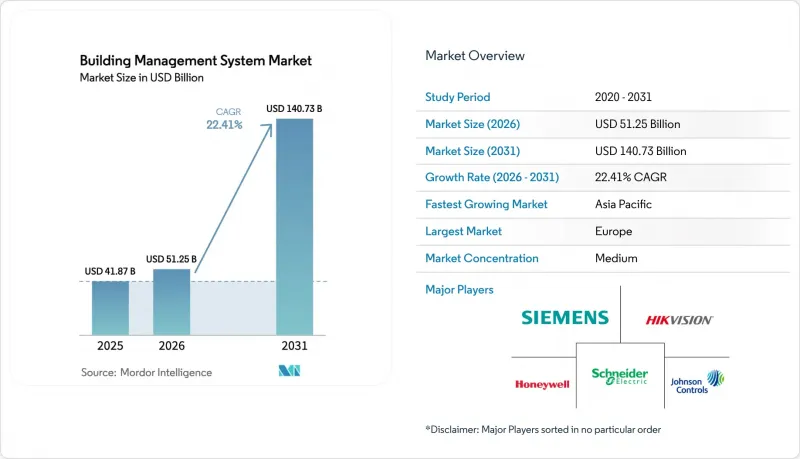
2025年建築管理系統(BMS)市值為418.7億美元,預計從2026年的512.5億美元成長到2031年的1407.3億美元。
預測期(2026-2031 年)的複合年成長率預計為 22.41%。
智慧城市預算的增加、更嚴格的淨零排放法規以及疫情時代對健康的高度重視,正在加速新舊設施的數位轉型。結合人工智慧和雲端原生軟體的供應商正獲得競爭優勢,因為他們可以透過預測分析降低能源成本並延長設備使用壽命。雖然硬體仍然至關重要,但成長最快的領域是軟體模組,這些模組透過開放協議整合感測器、控制器和第三方設備。隨著現有暖通空調和自動化供應商不斷收購人工智慧專家,以提供符合區域合規目標的整合平台,該產業正在整合。
全球建築管理系統市場趨勢及洞察
智慧城市快速投資
2014年至2023年間,市政當局在智慧城市資訊通訊技術(ICT)方面的支出超過634億美元,其中相當一部分投資於建築自動化平台,這些平台能夠匯總能源、入住率和安全數據,用於城市儀錶板。 2024年,智慧建築新創企業的創業融資達到69億美元,這進一步增強了投資者對互聯建築將成為智慧城市生態系統數位骨幹的信心。新加坡的「智慧國家」計畫將已安裝在公共和私人建築中的10萬多個感測器連接起來,以實現即時負載平衡和舒適度最佳化。巴塞隆納的自適應路燈專案利用建築整合控制系統,在提高夜間安全的同時,降低了30%的市政能源成本。這些專案展現了整合平台的投資回報,並正在加速區域對可互通建築管理解決方案的需求。
永續性和淨零排放義務
歐盟強制要求所有新建建築在2030年前實現零營運排放,迫使業主實施能夠即時測量和糾正能源偏差的自動化系統。法國的RE2020法案設定了「隱含碳排放」上限,並將每三年降低一次,直至2031年,從而促進在建築施工和運營過程中對排放進行持續監測。到了2024年,僅有八個歐盟成員國完全實現「近零能耗建築」的目標,凸顯了先進自動化技術如何能彌補這一差距。氣候相關債券現在要求提供即時性能數據以追蹤脫碳進展,這使得擁有精細化能源管理模組的設施在資金籌措更具優勢。自動報告和需量反應功能正成為資金籌措和使用許可的必要條件,這些政策共同推動了建築管理系統市場的發展。
高初始資本投入
承包建築管理系統專案的價格從小規模設施的 5 萬美元到多棟建築園區的 100 萬美元以上不等,這給注重現金流的業主帶來了沉重的負擔。即將訂定的美國環保署 (EPA) 冷媒法規將使暖通空調 (HVAC) 系統的更換成本增加 10% 至 30%,進一步壓縮了原本用於自動化系統的預算。半導體短缺持續延長控制器前置作業時間,迫使業主要么儲備備件,要么接受延期交付。平均投資回收期為 21 個月,這對大型企業來說尚可接受,但對於中小企業而言卻是一個挑戰。儘管能源績效合約和綠色債券等資金籌措模式正在加速建築管理系統的普及,但在可預見的未來,高昂的資本支出仍將繼續阻礙建築管理系統市場的發展。
細分市場分析
在建築管理系統市場,預計2025年,硬體將佔據42.18%的市場。這反映了控制器、感測器和閘道器等即時現場操作設備的廣泛應用。軟體銷售雖然規模較小,但正以25.05%的複合年成長率成長。這是因為,一旦硬體基礎設施到位,就可以透過雲端儀表板和人工智慧工具包來利用預測功能。隨著業主將複雜的生命週期營運外包給專業公司,包括整合、遠端監控和網路安全審計在內的服務成為成長最快的收入來源。邊緣運算晶片儲存本地演算法,即使現場連接中斷也能保護營運。如今,競爭格局的焦點已從專有設備轉向軟體差異化,投資也轉向開放API平台。
建築業者強調,軟體能夠自動偵測設備並映射點數據,從而縮短試運行週期。例如,西門子的維修方案將邊緣控制器連接到無需代碼的雲端工作室,連接後數小時內即可可視化能源波動,顯著縮短專案工期。通用感測器的價格壓力迫使供應商透過分析服務訂閱而非在實體組件上加價來發展業務。因此,在預測期內,建築管理系統市場的硬體利潤率將下降,而軟體利潤率將保持在 20% 以上,這證明了向基於結果的服務合約模式轉變的合理性。
2025年,整合工單工具、資產日誌和合規性報告的設施管理套件將主導市場,佔據建築管理系統市場32.10%的佔有率。然而,隨著企業致力於減緩氣候變化,對千瓦時和排放的監控要求日益精細,能源管理模組正以27.15%的複合年成長率快速成長。新產品結合了機器學習引擎和氣象API,可在不影響使用者舒適度的前提下降低高峰需求費用。基礎設施和緊急應變模組在需要集中管理發電機、火災和疏散的關鍵任務設施中穩步成長。安全儀錶板將門禁控制和影像分析整合到單一螢幕上,從而減輕了操作員的工作量。
該平台憑藉其強大的分析功能,可將實際用電量與能源強度 (EUI) 目標進行比較,並在偏差超過 5% 時發出警報。在卡爾·T·海登退伍軍人醫療中心,透過結合冷水蓄能系統和預測性調度來平衡尖峰負載,最終使總公用事業成本降低了 25% 以上。在預測期內,尋求氣候債券資金籌措的業主將優先考慮符合全球報告框架的產品,並將能源管理功能納入所有重大採購交易中。
這份「建築管理系統市場報告」按組件(硬體、軟體、服務)、軟體模組(設施管理、安全管理、能源管理等)、部署模式(本地部署、雲端部署)、通訊協定(BACnet、Modbus、KNS 等)、最終用戶產業(住宅、商業建築等)和地區對產業進行細分。
區域分析
歐洲是最大的區域銷售來源,預計到2025年將佔建築管理系統市場佔有率的39.00%。歐盟的零排放指令和近零能耗建築(NZEB)法規正將自動化從可選升級轉變為強制性規劃要求。法國的RE2020碳排放上限每三年收緊一次,迫使開發商實施分錶計量和人工智慧調度,以確保排放量符合限制。德國、英國和北歐國家正在部署以熱泵為中心的控制系統,該系統將天氣預報與即時能源定價相結合,以最低成本維持舒適的環境。成熟的整合商正在提供承包維修解決方案,可實現兩位數的內部收益率(IRR),使自動化成為維修預算的關鍵組成部分。
亞太地區是建築管理系統市場成長最快的地區,預計複合年成長率將達26.10%。中國正地方政府對物聯網賦能區域的投入,將每棟建築視為大規模電網連接系統中的一個節點。在印度,城市人口的快速成長導致電力需求翻番,迫使各邦制定建築規範,強制要求採用智慧控制系統以提高冷凍效率。新加坡在全國部署感測器,證明了精細化監控的可行性,促使吉隆坡和曼谷也開始實施類似計畫。日本和韓國正利用其半導體技術優勢,在邊緣端整合人工智慧,從而降低電梯調度和安全分析的延遲。區域供應商正與全球領導企業合作,進行軟體在地化,以滿足語言和合規性要求,進一步拓展建築管理系統市場。
在北美,市場規模依然龐大,主要驅動力來自醫療設施維修、校園現代化和住宅電氣化。在美國,聯邦政府的稅收優惠政策(最高可報銷符合條件的節能投資的30%)鼓勵屋主在升級暖通空調系統時安裝先進的控制系統。加拿大則專注於最佳化寒冷氣候條件下的節能方案,而墨西哥則在其快速發展的工業區中加速推廣應用。儘管北美地區的成長速度低於亞太地區,但在不斷提高的健康建築標準和脫碳承諾的推動下,整個北美大陸的節能支出仍然保持穩定。
其他好處:
- Excel格式的市場預測(ME)表
- 3個月的分析師支持
目錄
第1章:引言
- 研究假設和市場定義
- 調查範圍
第2章:調查方法
第3章執行摘要
第4章 市場狀況
- 市場概覽
- 市場促進因素
- 智慧城市快速投資
- 永續發展和實現淨零排放的監管要求
- 疫情後健康建築認證
- 物聯網感測器和無線網路的成本不斷降低,使得將其改造到現有設備中成為可能。
- 利用人工智慧進行預測性維護的投資報酬率演示
- 透過與建築性能相關的關鍵績效指標掛鉤的綠色債券資金籌措。
- 市場限制因素
- 高初始投資(資本支出)
- OT網路中的網路安全風險
- 碎片化傳統建構協定的互通性
- 廠商鎖定限制了開放標準的發展。
- 重要法規結構的評估
- 價值鏈分析
- 技術展望
- 波特五力模型
- 供應商的議價能力
- 買方的議價能力
- 新進入者的威脅
- 替代品的威脅
- 競爭公司之間的競爭
- 對關鍵相關人員的影響評估
- 主要用例和案例研究
- 市場對宏觀經濟因素的影響
- 投資分析
第5章 市場區隔
- 按組件
- 硬體
- 軟體
- 服務
- 透過軟體模組
- 設施管理
- 安全管理
- 能源管理
- 基礎設施管理
- 緊急管理
- 依部署類型
- 現場
- 基於雲端的
- 透過通訊協定
- BACnet
- Modbus
- KNX
- LonWorks
- Zigbee
- 基於 Wi-Fi/IP 的
- 專有協議
- 按最終用途行業分類
- 住宅建築
- 商業建築
- 工業設施
- 公共和政府設施
- 醫療設施
- 教育機構
- 按地區
- 北美洲
- 美國
- 加拿大
- 墨西哥
- 南美洲
- 巴西
- 阿根廷
- 南美洲其他地區
- 歐洲
- 英國
- 德國
- 法國
- 義大利
- 西班牙
- 北歐國家
- 其他歐洲地區
- 中東和非洲
- 中東
- 沙烏地阿拉伯
- 阿拉伯聯合大公國
- 土耳其
- 其他中東國家
- 非洲
- 南非
- 埃及
- 奈及利亞
- 其他非洲地區
- 中東
- 亞太地區
- 中國
- 印度
- 日本
- 韓國
- ASEAN
- 澳洲
- 紐西蘭
- 亞太其他地區
- 北美洲
第6章 競爭情勢
- 市場集中度
- 策略趨勢
- 市佔率分析
- 公司簡介
- Johnson Controls International plc
- Schneider Electric SE
- Siemens AG
- Honeywell International Inc.
- Trane Technologies plc
- Carrier Global Corporation
- ABB Ltd.
- Delta Controls Inc.
- Automated Logic Corporation
- Distech Controls Inc.
- Crestron Electronics, Inc.
- Cisco Systems, Inc.
- IBM Corporation
- Convergint Technologies LLC
- Legrand SA
- BuildingIQ, Inc.
- KMC Controls, Inc.
- Bosch Security Systems GmbH
- ENGIE SA(Cofely Services)
- Rexel Group
第7章 市場機會與未來展望
The Building Management System Market size was valued at USD 41.87 billion in 2025 and estimated to grow from USD 51.25 billion in 2026 to reach USD 140.73 billion by 2031, at a CAGR of 22.41% during the forecast period (2026-2031).
Expanding smart-city budgets, stricter net-zero rules, and post-pandemic health priorities are accelerating digital modernization across new and existing facilities. Vendors that pair AI with cloud-native software gain an edge because predictive analytics lower energy bills and extend equipment life. Hardware remains essential, yet the fastest gains come from software modules that orchestrate sensors, controllers, and third-party devices through open protocols. Consolidation continues as established HVAC and automation suppliers acquire AI specialists to deliver unified platforms that meet regional compliance targets.
Global Building Management System Market Trends and Insights
Rapid smart-city investments
Municipal spending on smart-city ICT exceeded USD 63.4 billion between 2014 and 2023, and a sizable share funnels into building automation platforms that aggregate energy, occupancy, and safety data for urban dashboards. Venture funding in smart-building start-ups reached USD 6.9 billion in 2024, underscoring investor confidence that connected buildings form the digital backbone of smart-city ecosystems. Singapore's Smart Nation initiative already connects more than 100,000 sensors in public and private buildings to enable real-time load balancing and comfort optimization. Barcelona's adaptive street-lighting program uses building-linked controls to lower municipal energy costs by 30% while improving nighttime safety. These projects validate the return on integrated platforms and accelerate regional demand for interoperable building management solutions.
Sustainability and net-zero mandates
The European Union requires all new buildings to achieve zero operational emissions by 2030, a rule that pushes owners to adopt automation capable of measuring and correcting energy deviations in real time. France's RE2020 law sets embodied-carbon ceilings that fall every three years until 2031, encouraging continuous monitoring of construction and operational emissions. Only eight EU states fully met nearly-zero-energy-building targets by 2024, highlighting a shortfall that advanced automation can close. Climate-aligned bonds now require live performance data to verify decarbonization pathways, creating a financing advantage for facilities equipped with granular energy-management modules. These policies collectively elevate the building management system market because automated reporting and demand-response functions become prerequisites for capital access and occupancy permits.
High upfront CAPEX
Turn-key building management projects range from USD 50,000 for small facilities to more than USD 1 million for multi-building campuses, putting pressure on cash-flow-focused owners. Upcoming EPA refrigerant rules are adding 10-30% to HVAC replacement costs, stretching budgets that could cover automation. Semiconductor shortages still inflate controller lead times, forcing owners to stock spares or absorb delays. Payback periods average 21 months, acceptable to corporates yet tight for smaller enterprises. Financing models such as energy-performance contracts and green bonds are easing adoption, but high CAPEX remains a near-term drag on the building management system market.
Other drivers and restraints analyzed in the detailed report include:
- Post-pandemic healthy-building certifications
- Declining IoT-sensor and wireless-network costs
- Cybersecurity risks in OT networks
For complete list of drivers and restraints, kindly check the Table Of Contents.
Segment Analysis
The building management system market recorded a 42.18% hardware share in 2025, reflecting widespread use of controllers, sensors, and gateways that handle real-time field tasks. Software revenue, though smaller, is climbing at a 25.05% CAGR because cloud dashboards and AI toolkits unlock predictive functions once the hardware baseline is in place. Services-including integration, remote monitoring, and cyber-security audits-form the fastest-rising revenue stream as owners outsource complex lifecycle tasks to specialists. Edge computing chips store local algorithms, safeguarding operations whenever the site loses connectivity. Competitive dynamics now revolve around software differentiation rather than proprietary devices, steering investment toward open-API platforms.
Building operators highlight condensed commissioning cycles when software auto-discovers devices and maps point data. Siemens retrofit packages, for example, slash project timelines by linking edge controllers to a no-code cloud studio that visualizes energy drift within hours of connection. Pricing pressure on commodity sensors means vendors must grow via analytics subscriptions, not mark-ups on physical parts. Over the forecast period, the building management system market will therefore see hardware margins contract while software sticks above 20%, validating a shift toward outcome-based service contracts.
Facility-management suites led with a 32.10% share of the building management system market size in 2025, bundling work-order tools, asset logs, and compliance reports. Energy-management modules, however, are expanding at 27.15% CAGR as corporate climate pledges require granular monitoring of kilowatt-hours and emissions. New releases combine machine-learning engines with weather APIs to shave peak demand charges without affecting occupant comfort. Infrastructure and emergency modules grow steadily in mission-critical sites that require centralized generator, fire, and evacuation oversight. Security dashboards converge access control and video analytics in a single pane, reducing operator workload.
Analytics-rich platforms now benchmark actual usage against Energy Use Intensity targets and issue alerts when deviations exceed 5%. The Carl T. Hayden VA Medical Center cut total utility bills by more than 25% after pairing chilled-water storage with predictive scheduling that flatten peak loads. Over the forecast period, owners seeking climate-bond financing will favor products that align with global reporting frameworks, locking energy-management functions into every major procurement.
The Building Management System Market Report Segments the Industry Into Component (Hardware, Software, and Services), Software Module (Facility Management, Security Management, Energy Management, and More), Deployment Type (On-Premise, Cloud-Based), Communication Protocol (BACnet, Modbus, KNS, and More), End-User Industry (Residential Buildings, Commercial Buildings, and More), and Geography.
Geography Analysis
Europe generated the largest regional revenue, holding 39.00% of the building management system market in 2025. EU zero-emission mandates and nearly-zero-energy-building rules turn automation from a discretionary upgrade into a planning prerequisite. France's RE2020 carbon caps tighten every three years, compelling developers to adopt sub-metering and AI scheduling to remain within limits. Germany, the United Kingdom, and the Nordics deploy heat-pump-centric controls that combine weather forecasting with real-time energy pricing to maintain comfort at minimal cost. Established integrators supply turnkey retrofits that demonstrate double-digit IRRs, making automation a mainstream line item in refurbishment budgets.
Asia-Pacific is the fastest-growing region in the building management system market, forecast at a 26.10% CAGR. China pours municipal funds into IoT-ready districts that treat each building as a node in a larger grid-interactive system. India's urban population surge doubles electricity demand, pushing states to adopt building codes that mandate smart controls for cooling efficiency. Singapore's nation-wide sensor rollout proves the feasibility of granular oversight, inspiring similar programs in Kuala Lumpur and Bangkok. Japan and South Korea leverage semiconductor prowess to embed AI at the edge, shrinking latency for elevator dispatch and security analytics. Regional suppliers partner with global majors to localize software for language and compliance, further expanding the building management system market.
North America maintains sizeable volume through healthcare upgrades, campus modernizations, and residential electrification. U.S. federal tax incentives reimburse up to 30% of qualified efficiency investments, motivating owners to add advanced controls during HVAC swaps. Canada emphasizes cold-climate optimization, while Mexico accelerates adoption in its growing industrial corridors. Despite slower growth than APAC, rising healthy-building standards and decarbonization pledges sustain steady spending across the continent.
- Johnson Controls International plc
- Schneider Electric SE
- Siemens AG
- Honeywell International Inc.
- Trane Technologies plc
- Carrier Global Corporation
- ABB Ltd.
- Delta Controls Inc.
- Automated Logic Corporation
- Distech Controls Inc.
- Crestron Electronics, Inc.
- Cisco Systems, Inc.
- IBM Corporation
- Convergint Technologies LLC
- Legrand SA
- BuildingIQ, Inc.
- KMC Controls, Inc.
- Bosch Security Systems GmbH
- ENGIE SA (Cofely Services)
- Rexel Group
Additional Benefits:
- The market estimate (ME) sheet in Excel format
- 3 months of analyst support
TABLE OF CONTENTS
1 INTRODUCTION
- 1.1 Study Assumptions and Market Definition
- 1.2 Scope of the Study
2 RESEARCH METHODOLOGY
3 EXECUTIVE SUMMARY
4 MARKET LANDSCAPE
- 4.1 Market Overview
- 4.2 Market Drivers
- 4.2.1 Rapid smart-city investments
- 4.2.2 Sustainability and Net-Zero compliance mandates
- 4.2.3 Post-pandemic healthy-building certifications
- 4.2.4 Declining IoT-sensor and wireless-network costs enabling retrofits
- 4.2.5 AI-driven predictive-maintenance ROI proofs
- 4.2.6 Green-bond financing tied to building-performance KPIs
- 4.3 Market Restraints
- 4.3.1 High upfront CAPEX
- 4.3.2 Cyber-security risks in OT networks
- 4.3.3 Fragmented legacy-building protocol interoperability
- 4.3.4 Vendor-proprietary lock-in limiting open standards
- 4.4 Evaluation of Critical Regulatory Framework
- 4.5 Value Chain Analysis
- 4.6 Technological Outlook
- 4.7 Porter's Five Forces
- 4.7.1 Bargaining Power of Suppliers
- 4.7.2 Bargaining Power of Buyers
- 4.7.3 Threat of New Entrants
- 4.7.4 Threat of Substitutes
- 4.7.5 Competitive Rivalry
- 4.8 Impact Assessment of Key Stakeholders
- 4.9 Key Use Cases and Case Studies
- 4.10 Impact on Macroeconomic Factors of the Market
- 4.11 Investment Analysis
5 MARKET SEGMENTATION
- 5.1 By Component
- 5.1.1 Hardware
- 5.1.2 Software
- 5.1.3 Services
- 5.2 By Software Module
- 5.2.1 Facility Management
- 5.2.2 Security Management
- 5.2.3 Energy Management
- 5.2.4 Infrastructure Management
- 5.2.5 Emergency Management
- 5.3 By Deployment Type
- 5.3.1 On-Premise
- 5.3.2 Cloud-Based
- 5.4 By Communication Protocol
- 5.4.1 BACnet
- 5.4.2 Modbus
- 5.4.3 KNX
- 5.4.4 LonWorks
- 5.4.5 Zigbee
- 5.4.6 Wi-Fi / IP-Based
- 5.4.7 Proprietary Protocols
- 5.5 By End-Use Industry
- 5.5.1 Residential Buildings
- 5.5.2 Commercial Buildings
- 5.5.3 Industrial Facilities
- 5.5.4 Public / Government Buildings
- 5.5.5 Healthcare Facilities
- 5.5.6 Education Campuses
- 5.6 By Geography
- 5.6.1 North America
- 5.6.1.1 United States
- 5.6.1.2 Canada
- 5.6.1.3 Mexico
- 5.6.2 South America
- 5.6.2.1 Brazil
- 5.6.2.2 Argentina
- 5.6.2.3 Rest of South America
- 5.6.3 Europe
- 5.6.3.1 United Kingdom
- 5.6.3.2 Germany
- 5.6.3.3 France
- 5.6.3.4 Italy
- 5.6.3.5 Spain
- 5.6.3.6 Nordics
- 5.6.3.7 Rest of Europe
- 5.6.4 Middle East and Africa
- 5.6.4.1 Middle East
- 5.6.4.1.1 Saudi Arabia
- 5.6.4.1.2 United Arab Emirates
- 5.6.4.1.3 Turkey
- 5.6.4.1.4 Rest of Middle East
- 5.6.4.2 Africa
- 5.6.4.2.1 South Africa
- 5.6.4.2.2 Egypt
- 5.6.4.2.3 Nigeria
- 5.6.4.2.4 Rest of Africa
- 5.6.4.1 Middle East
- 5.6.5 Asia-Pacific
- 5.6.5.1 China
- 5.6.5.2 India
- 5.6.5.3 Japan
- 5.6.5.4 South Korea
- 5.6.5.5 ASEAN
- 5.6.5.6 Australia
- 5.6.5.7 New Zealand
- 5.6.5.8 Rest of Asia-Pacific
- 5.6.1 North America
6 COMPETITIVE LANDSCAPE
- 6.1 Market Concentration
- 6.2 Strategic Moves
- 6.3 Market Share Analysis
- 6.4 Company Profiles (includes Global level Overview, Market level overview, Core Segments, Financials as available, Strategic Information, Market Rank/Share for key companies, Products and Services, and Recent Developments)
- 6.4.1 Johnson Controls International plc
- 6.4.2 Schneider Electric SE
- 6.4.3 Siemens AG
- 6.4.4 Honeywell International Inc.
- 6.4.5 Trane Technologies plc
- 6.4.6 Carrier Global Corporation
- 6.4.7 ABB Ltd.
- 6.4.8 Delta Controls Inc.
- 6.4.9 Automated Logic Corporation
- 6.4.10 Distech Controls Inc.
- 6.4.11 Crestron Electronics, Inc.
- 6.4.12 Cisco Systems, Inc.
- 6.4.13 IBM Corporation
- 6.4.14 Convergint Technologies LLC
- 6.4.15 Legrand SA
- 6.4.16 BuildingIQ, Inc.
- 6.4.17 KMC Controls, Inc.
- 6.4.18 Bosch Security Systems GmbH
- 6.4.19 ENGIE SA (Cofely Services)
- 6.4.20 Rexel Group
7 MARKET OPPORTUNITIES AND FUTURE OUTLOOK
- 7.1 White-space and Unmet-need Assessment

 建築管理系統市場報告:趨勢、預測與競爭分析(至2035年)
 建築管理系統市場:按組件、技術、部署方式、應用和建築類型分類-2026-2032年全球市場預測
 2026-2030年全球建築整合管理系統市場
 2026年全球建築管理與控制系統市場報告無線建築管理服務市場:2026-2032年全球市場預測(依服務類型、連接技術、應用、最終用戶和建築類型分類)分散式電池管理系統市場:按應用、電池化學、組件、最終用戶和通訊方式分類,全球預測,2026-2032年
 全球建築管理系統市場規模、佔有率、趨勢和成長分析報告(2026-2034年)
 建築管理系統市場規模、佔有率及成長分析(依軟體、服務、應用及地區分類)-2026-2033年產業預測Frost Radar:塗料公司數位化,2025年
 建築管理系統市場機會、成長動力、產業趨勢分析及 2025-2034 年預測