


 |
市場調查報告書
商品編碼
1940901
美國藥品倉儲業:市場佔有率分析、產業趨勢與統計及成長預測(2026-2031 年)United States Pharmaceutical Warehousing - Market Share Analysis, Industry Trends & Statistics, Growth Forecasts (2026 - 2031) |
||||||

※ 本網頁內容可能與最新版本有所差異。詳細情況請與我們聯繫。
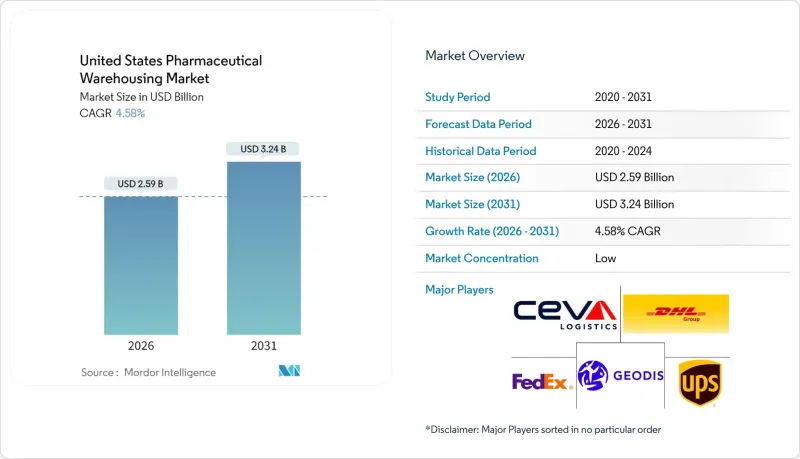
美國藥品倉儲業市場預計將從 2025 年的 24.8 億美元成長到 2026 年的 25.9 億美元,預計到 2031 年將達到 32.4 億美元,2026 年至 2031 年的複合年成長率為 4.58%。
生物製藥產量不斷成長、DSCSA序列化規則的全面實施以及履約需求的激增,正推動著新的資金流入溫控基礎設施和自動化領域。不斷擴展的細胞和基因療法產品線增加了對超低溫的要求,從而提高了每平方英尺的收益;同時,21 CFR 211.142強制要求的安全追蹤系統正在改變倉庫的IT預算結構。儘管能源、房地產和專業勞動力等成本阻力依然顯著,但對機器人、物聯網感測器和環保低溫運輸設計的持續投資正在提升營運效率。領先的第三方物流(3PL)供應商之間加速整合的動力,源於它們渴望贏得利潤豐厚的醫療保健相關合約,並捍衛市場佔有率,抵禦日益垂直整合的製造商和醫療保健系統的競爭。
美國藥品倉儲業市場趨勢與洞察
美國藥品生產強勁成長
2025年,年度資本支出將達到1,600億美元(比2024年成長15%),每增加10億美元的投資,將產生230萬平方英尺的額外倉儲需求。生物製藥佔新建設的44%,需要採用模組化佈局以滿足連續生產的需求。 FDA對先進製造技術的支援正在加速即時監控技術的應用,並鼓勵各設施採用冗餘的電力和數據系統。分散式細胞療法生產正在治療中心附近催生微型倉庫,從而打破傳統的中心輻射式網路。這些變化共同推動了美國醫藥倉儲業市場對安全、高容量儲存場所的需求。
對溫控儲存的需求日益成長
從mRNA疫苗(-80°C)到低溫療法(-196°C),超低溫要求正逐漸成為主流。根據美國聯邦法規21 CFR 600.15,嚴格的溫度控制比室溫基準會增加20-30%的能耗。這就需要採用物聯網技術進行驗證,並配備冗餘的警報系統。永續性目標正在推動可重複使用的運輸貨櫃,從而減少60%的石化燃料依賴。雖然營運商正在對其設施維修,例如安裝高效壓縮機和LED照明以降低能耗,但高昂的資本投入仍然是參與企業進入該領域的障礙。因此,低溫運輸能力在美國藥品倉儲業市場中越來越具有定價權。
嚴格遵守FDA cGMP和GDP法規的成本
持續的溫度記錄、電子追蹤以及隔離區的設立,將使合規預算在2025年之前增加25%。 DSCSA序列化系統的成本在每個設施50萬至200萬美元之間,給小規模企業帶來了沉重負擔,即使在業務穩定後,仍有26%的企業未能合規。處罰措施包括罰款和刑事指控,這加速了行業的整合。日益繁重的文件工作推動了對第三方專業服務的需求,同時也壓縮了通用儲存的利潤空間。這種監管負擔正在減緩美國藥品倉儲業市場的成長動能。
細分市場分析
到2025年,分銷和庫存管理將佔總收入的45.32%,凸顯了長期合約對於穩定美國藥品倉儲業市場現金流的重要性。由於《藥品供應鏈安全法案》(DSCSA)的執行力度加大,附加價值服務(序列化、套件組裝和監管文件)正以5.72%的複合年成長率成長。基於雲端的倉庫管理系統(WMS)解決方案涵蓋了90%的設施,提高了可視性和審核。
附加價值服務通常以基本費率的25%至40%收費,以抵銷合規相關費用。機器人即服務(RaaS)模式降低了中型業者的進入門檻,加劇了市場分散化,同時也提高了效率。 FDA 21 CFR 205.50 法規規範了安全儲存和處理,有利於能夠大規模提供合規服務的營運商。這些趨勢正在加強美國藥品倉儲業市場的儲存營運基礎,同時也增加了服務的複雜性。
儘管非低溫運輸設施仍占美國藥品倉儲業市場的 58.05%,但到 2031 年,低溫運輸產能將繼續以 6.01% 的複合年成長率成長。冷藏、冷凍和超低溫區域的收費比常溫替代方案高出 150-200%,以彌補能源消耗。
為了平衡柔軟性和資本支出,營運商正在對現有建築進行模組化冷卻室改造。物聯網感測器可將溫度偏差風險降低 60%,以避免整個產業每年 350 億美元的損失。溫度控制要求設定了很高的合規門檻,保護了現有企業的利益。隨著生物製藥產品線的擴展,低溫運輸在美國藥品倉儲業市場的佔有率將逐步增加。
其他福利:
- Excel格式的市場預測(ME)表
- 3個月的分析師支持
目錄
第1章 引言
- 研究假設和市場定義
- 調查範圍
第2章調查方法
第3章執行摘要
第4章 市場情勢
- 市場概覽
- 市場促進因素
- 美國藥品生產強勁成長
- 對溫控(2-8°C)儲存的需求日益成長
- 生物製藥和特用藥品產量快速成長
- 快速B2B/B2C電子商務履約要求
- DSCSA序列化日期有助於安全倉庫管理
- 主要城市附近的城市微型倉配中心
- 市場限制
- 嚴格遵守FDA cGMP和GDP法規的成本
- 冷藏倉庫能源和房地產成本不斷上漲
- 高科技倉庫技術純熟勞工短缺
- 日益嚴重的網路安全/資料完整性風險(潛在威脅)
- 價值/供應鏈分析
- 監管狀態(FDA、DSCSA、DEA、OSHA)
- 技術展望(倉庫管理系統、物聯網、自動化、機器人技術)
- 波特五力模型
- 供應商的議價能力
- 買方的議價能力
- 新進入者的威脅
- 替代品的威脅
- 競爭對手之間的競爭
- 地緣政治和疫情對倉儲業的影響
第5章 市場規模與成長預測
- 按服務類型
- 貯存
- 經銷和庫存管理
- 附加價值服務及更多
- 按倉庫類型
- 低溫運輸倉庫
- 冷藏(0-5°C)
- 冷凍(-18 至 0°C)
- 環境的
- 超低溫冷凍(低於-20°C)
- 非低溫運輸倉庫
- 低溫運輸倉庫
- 依產品類型
- 處方藥
- 非處方藥
- 生物製藥和生物相似藥
- 疫苗和血液製品
- 臨床試驗藥物
- 細胞和基因治療
- 特藥(非生物製藥)
- 動物用藥品
- 其他
- 最終用戶
- 製藥公司
- 醫療保健提供者
- 零售商店和藥局
- 批發商和經銷商
- 其他
第6章 競爭情勢
- 市場集中度
- 策略發展與投資
- 市佔率分析
- 公司簡介
- United Parcel Service Inc.
- DHL Group
- FedEx Corp.
- GEODIS SA
- CEVA Logistics
- Lineage Logistics
- Americold Logistics
- Cencora
- BioPharma Logistics
- Rhenus SE & Co. KG
- Kuehne+Nagel
- XPO Logistics
- KRC Logistics
- GXO Logistics
- MD Logistics
- Langham Logistics
- Crown LSP Group
- LifeScience Logistics
- Go Freight
- DSV
第7章 市場機會與未來展望
The United States Pharmaceutical Warehousing Market is expected to grow from USD 2.48 billion in 2025 to USD 2.59 billion in 2026 and is forecast to reach USD 3.24 billion by 2031 at 4.58% CAGR over 2026-2031.
Rising biologics output, full enforcement of the DSCSA serialization rule, and surging e-commerce fulfillment volumes are channeling new capital into temperature-controlled infrastructure and automation. Cell and gene therapy pipelines are adding ultra-low temperature requirements that lift revenue per square foot, while secure track-and-trace systems mandated by 21 CFR 211.142 are reshaping warehouse IT budgets. Cost headwinds energy, real estate and specialized labor remain pronounced, yet continuous investment in robotics, IoT sensors and green cold-chain designs is improving operating leverage. Intensifying consolidation among third-party logistics (3PL) leaders aims to capture higher-margin healthcare contracts and defend share against vertically integrating manufacturers and health-system operators.
United States Pharmaceutical Warehousing Market Trends and Insights
Robust Growth of U.S. Pharmaceutical Output
Annual capital spending of USD 160 billion in 2025 up 15% from 2024 couples every USD 1 billion invested with 2.3 million sq ft of extra warehouse need. Biologics represent 44% of new builds, prompting modular layouts that can flex with continuous-manufacturing schedules. FDA support for Advanced Manufacturing Technologies is accelerating real-time monitoring adoption, pushing facilities to embed redundant power and data systems. Decentralized production of cell therapies is spawning micro-warehouses near treatment centers, eroding the legacy hub-and-spoke network. These shifts collectively lift demand for secure, high-throughput storage nodes across the United States pharmaceutical warehousing market.
Expansion of Temperature-Controlled Storage Needs
Ultra-low requirements from mRNA vaccines (-80 °C) to cryogenic therapies (-196 °C) are now mainstream, raising energy use 20-30% above ambient operations rules under 21 CFR 600.15 mandate precise ranges, prompting IoT-enabled validations and alarm redundancies. Sustainability targets are spurring reusable shippers that cut fossil-fuel reliance 60%. Operators retrofit high-efficiency compressors and LED lighting to curb consumption, yet capital intensity remains a barrier for smaller entrants. Consequently, cold-chain capacity garners pricing power within the United States pharmaceutical warehousing market.
Stringent FDA cGMP & GDP Compliance Costs
Continuous temperature logging, electronic tracing and quarantine zones add 25% to 2025 compliance budgets. DSCSA serialization systems cost USD 0.5-2 million per facility, stretching small operators; 26% remain non-compliant post-stabilization. Penalties range from fines to criminal liability, accelerating consolidation. Documentation load drives demand for third-party specialists, yet shrinks margins for commodity storage. This regulatory burden dampens the growth curve of the United States pharmaceutical warehousing market.
Other drivers and restraints analyzed in the detailed report include:
- Surge in Biologics & Specialty-Drug Volumes
- Rapid B2B/B2C E-commerce Fulfillment Requirements
- Rising Energy and Real-Estate Costs for Cold Storage
For complete list of drivers and restraints, kindly check the Table Of Contents.
Segment Analysis
Distribution and Inventory Management generated 45.32% of 2025 revenue, a testament to long-term contracts that stabilize cash flows within the United States pharmaceutical warehousing market. Value-added offerings-serialization, kitting and regulatory documentation-are scaling at a 5.72% CAGR as DSCSA enforcement tightens. Cloud-based WMS solutions now cover 90% of facilities, enhancing visibility and audit readiness.
Value-added services typically bill 25-40% above baseline rates, offsetting compliance overhead. Robotics-as-a-Service models lower entry barriers for mid-tier operators, supporting market fragmentation while bolstering efficiency. FDA 21 CFR 205.50 stipulates secure storage and handling, favoring providers that can turnkey compliance at scale. These dynamics reinforce storage as the anchor while upgrading service complexity across the United States pharmaceutical warehousing market.
Non-cold-chain sites still constitute 58.05% of the United States pharmaceutical warehousing market size, but cold-chain capacity is outpacing at a 6.01% CAGR through 2031. Chilled, frozen and ultra-low zones command rates 150-200% higher than ambient alternatives, compensating for energy drain.
Operators retrofit ambient structures with modular cool chambers to balance flexibility and capex. IoT sensors cut temperature excursion risk 60%, curbing USD 35 billion annual losses industry-wide temperature mandates create high compliance hurdles, shielding incumbents. As biologics pipelines swell, cold-chain share will progressively rise within the United States pharmaceutical warehousing market.
The United States Pharmaceutical Warehousing Market Report is Segmented by Service Type (Storage, Distribution and Inventory Management, and More), Warehouse Type (Cold-Chain Warehouse, Non-Cold-Chain Warehouse), Product Type (Prescription Drugs, and More), End User (Pharmaceutical Manufacturers, Healthcare Providers, Retail & Pharmacies, and More). The Market Forecasts are Provided in Terms of Value (USD).
List of Companies Covered in this Report:
- United Parcel Service Inc.
- DHL Group
- FedEx Corp.
- GEODIS SA
- CEVA Logistics
- Lineage Logistics
- Americold Logistics
- Cencora
- BioPharma Logistics
- Rhenus SE & Co. KG
- Kuehne + Nagel
- XPO Logistics
- KRC Logistics
- GXO Logistics
- MD Logistics
- Langham Logistics
- Crown LSP Group
- LifeScience Logistics
- Go Freight
- DSV
Additional Benefits:
- The market estimate (ME) sheet in Excel format
- 3 months of analyst support
TABLE OF CONTENTS
1 Introduction
- 1.1 Study Assumptions and Market Definition
- 1.2 Scope of the Study
2 Research Methodology
3 Executive Summary
4 Market Landscape
- 4.1 Market Overview
- 4.2 Market Drivers
- 4.2.1 Robust growth of U.S. pharmaceutical output
- 4.2.2 Expansion of temperature-controlled (2-8 °C) storage needs
- 4.2.3 Surge in biologics and specialty-drug volumes
- 4.2.4 Rapid B2B/B2C e-commerce fulfillment requirements
- 4.2.5 DSCSA serialization deadline boosting secure warehousing
- 4.2.6 Urban micro-fulfillment hubs near key metros
- 4.3 Market Restraints
- 4.3.1 Stringent FDA cGMP and GDP compliance costs
- 4.3.2 Rising energy and real-estate costs for cold storage
- 4.3.3 Skilled-labor shortages in high-tech warehouses
- 4.3.4 Escalating cybersecurity / data-integrity risks (under-the-radar)
- 4.4 Value / Supply-Chain Analysis
- 4.5 Regulatory Landscape (FDA, DSCSA, DEA, OSHA)
- 4.6 Technological Outlook (WMS, IoT, Automation, Robotics)
- 4.7 Porter's Five Forces
- 4.7.1 Bargaining Power of Suppliers
- 4.7.2 Bargaining Power of Buyers
- 4.7.3 Threat of New Entrants
- 4.7.4 Threat of Substitutes
- 4.7.5 Intensity of Competitive Rivalry
- 4.8 Impact of Geopolitics and Pandemic on Warehousing
5 Market Size and Growth Forecasts (Value, USD)
- 5.1 By Service Type
- 5.1.1 Storage
- 5.1.2 Distribution and Inventory Management
- 5.1.3 Value-added Services and Others
- 5.2 By Warehouse Type
- 5.2.1 Cold-Chain Warehouse
- 5.2.1.1 Chilled (0-5°C)
- 5.2.1.2 Frozen (-18-0°C)
- 5.2.1.3 Ambient
- 5.2.1.4 Deep-Frozen / Ultra-Low (less than-20 °C)
- 5.2.2 Non-Cold-Chain Warehouse
- 5.2.1 Cold-Chain Warehouse
- 5.3 By Product Type
- 5.3.1 Prescription Drugs
- 5.3.2 OTC Drugs
- 5.3.3 Biologics and Biosimilars
- 5.3.4 Vaccines and Blood Products
- 5.3.5 Clinical Trail Materials
- 5.3.6 Cell and Gene Therapies
- 5.3.7 Specialty Medicine (non-biologic)
- 5.3.8 Veterinary Medicine
- 5.3.9 Others
- 5.4 By End User
- 5.4.1 Pharmaceutical Manufacturers
- 5.4.2 Healthcare Providers
- 5.4.3 Retail and Pharmacies
- 5.4.4 Distributors and Wholesalers
- 5.4.5 Others
6 Competitive Landscape
- 6.1 Market Concentration
- 6.2 Strategic Moves and Investments
- 6.3 Market Share Analysis
- 6.4 Company Profiles (includes Global Level Overview, Market Level Overview, Core Segments, Financials as available, Strategic Information, Market Rank/Share for key companies, Products and Services, and Recent Developments)
- 6.4.1 United Parcel Service Inc.
- 6.4.2 DHL Group
- 6.4.3 FedEx Corp.
- 6.4.4 GEODIS SA
- 6.4.5 CEVA Logistics
- 6.4.6 Lineage Logistics
- 6.4.7 Americold Logistics
- 6.4.8 Cencora
- 6.4.9 BioPharma Logistics
- 6.4.10 Rhenus SE & Co. KG
- 6.4.11 Kuehne + Nagel
- 6.4.12 XPO Logistics
- 6.4.13 KRC Logistics
- 6.4.14 GXO Logistics
- 6.4.15 MD Logistics
- 6.4.16 Langham Logistics
- 6.4.17 Crown LSP Group
- 6.4.18 LifeScience Logistics
- 6.4.19 Go Freight
- 6.4.20 DSV
7 Market Opportunities and Future Outlook
- 7.1 White-space and Unmet-need Assessment

 醫藥倉儲市場:按溫度類型、服務類型、儲存類型、自動化程度、產品類型和最終用戶分類 - 全球預測(2026-2032 年)
 醫藥倉儲市場規模、佔有率及成長分析(依服務類型、運輸方式、最終用戶及地區分類)-2026-2033年產業預測
 2025年全球醫藥倉儲市場報告
 醫藥倉儲市場-全球產業規模、佔有率、趨勢、機會和預測(按類型、應用、地區和競爭細分,2020-2030 年)
 全球醫藥倉儲市場(2025-2029)
 中國醫藥倉儲:市場佔有率分析、產業趨勢與統計、成長預測(2025-2030 年)德國醫藥倉儲:市場佔有率分析、產業趨勢與統計、成長預測(2025-2030 年)歐洲醫藥倉儲:市場佔有率分析、產業趨勢與統計、成長預測(2025-2030 年)
 全球藥品倉庫市場
 全球藥品倉儲市場規模研究,按類型(冷鏈倉儲、非冷鏈倉儲)、按應用(藥廠、藥房、醫院等)以及 2022-2032 年區域預測