


 |
市場調查報告書
商品編碼
1940871
非洲資料中心:市場佔有率分析、產業趨勢與統計資料、成長預測(2026-2031 年)Africa Data Center - Market Share Analysis, Industry Trends & Statistics, Growth Forecasts (2026 - 2031) |
||||||

※ 本網頁內容可能與最新版本有所差異。詳細情況請與我們聯繫。
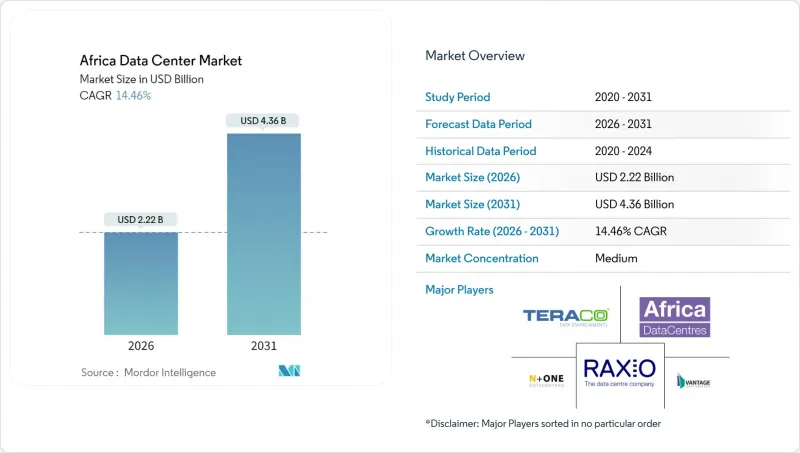
2025年非洲資料中心市場價值19.4億美元,預計到2031年將達到43.6億美元,高於2026年的22.2億美元。
預計在預測期(2026-2031 年)內,複合年成長率將達到 14.46%。
就IT負載容量而言,市場規模預計將從2025年的1,170兆瓦成長到2030年的3,460兆瓦,在預測期(2025-2030年)內複合年成長率(CAGR)為24.29%。市場佔有率和估計值均以兆瓦(MW)為單位計算和報告。這一快速成長反映了企業和政府向自主託管策略的轉變,這得益於海底電纜部署的增加、5G網路的推廣以及嚴格的資料居住規則,所有這些都轉化為更低的延遲和更佳的合規經濟效益,從而惠及非洲的市場領先。隨著電網限制(曾經的障礙)如今有利於能夠將可再生能源與合規專業知識結合的營運商,這種良性投資循環正在加速。此外,雲端優先政策、不斷發展的金融科技生態系統以及降低整體擁有成本的可再生能源園區也推動了需求成長。競爭正從簡單的占地面積轉向能源供應、熟練勞動力和監管合規,從而導致合併和聯盟,將分散的本地能力整合到覆蓋整個非洲資料中心市場的跨區域平台中。
非洲資料中心市場趨勢與洞察
快速擴展的雲端優先數位轉型
非洲企業雲端支出正以每年 25-30% 的速度成長,這推動了對國際超大規模容量和本地託管相結合的需求,以支援低延遲工作負載。政府 IT 法規強制規定最低在地採購,例如奈及利亞 40% 的標準,正在加速從本地部署環境轉向中立運營商設施的轉變。金融機構超過 60% 的交易使用雲端原生核心進行處理,但監管對離岸儲存的限制要求企業使用國內基礎設施以滿足合規性要求。這種混合部署的需求凸顯了高度互聯的資料中心的重要性,這些資料中心能夠連接公共雲端節點和企業機房,而無需透過歐洲或北美的環路連接。由此產生的需求激增有利於那些擁有配備暗纖連接到多個雲端入口點的園區,以及符合銀行、金融服務和保險 (BFSI) 客戶要求的審核資料保護控制措施的營運商。
政府資料主權法律法規
奈及利亞2023年《資料保護法》、南非《個人資訊保護法》和肯亞《資料保護法》共同規定,敏感資料必須儲存在國內。跨國公司作為關鍵資料控制者,必須在本地處理個人記錄,否則將面臨高達年收入2%的罰款,這使得位置標準從電力價格轉向了法律合規性。金融監管機構強制要求客戶銀行資料儲存在國內,從而保證了三級和四級資料中心的最低運轉率。跨境傳輸限制正在瓦解傳統的集中式架構,迫使雲端服務供應商在多個非洲市場複製資料區域。隨著資料居住變得日益複雜,擁有強大運轉率以及法律、網路安全和審核專業知識的營運商正成為首選合作夥伴。
長期電網不穩定
在南非以外,電網可靠性低於60%迫使各設施將石油發電機設計為持續運作,而非僅作為備用電源。奈及利亞的設施需要為柴油燃料預留預算,以應對長達數週的停電,能源成本佔營運支出的55%至65%(成熟市場這一比例為35%至45%)。發電機頻繁跳閘會增加維護成本和排放,使永續性聲明受到質疑,並限制超大規模企業的進入,直到可再生普及為止。南非的輪流停電計畫雖然可預測,但仍需要電網和備用電源1:1冗餘,使得電力基礎設施的資本支出加倍。隨著電池儲能成本的下降,擁有太陽能、風能和地熱資產的營運商享有結構性的成本優勢。
細分市場分析
截至2025年,大型資料中心將佔非洲資料中心市場30.92%的佔有率,顯示客戶明顯偏好能夠簡化合規性審核和互連設計的整合式機房。規模經濟效應能夠顯著提高電力利用效率,實現高彈性的電氣拓撲結構,並整合現場可再生能源,從而降低每個機架的總擁有成本。面臨嚴格資料保護審查的企業更傾向於將關鍵工作負載託管在能夠證明符合ISO 27001標準並具備多層實體安全防護的園區內,從而縮短實質審查週期。此外,基礎設施基金籌集的資金使大型營運商能夠預先建造機屋主體結構,並在主要租戶簽約後再進行內部建設,從而可以根據非洲資料中心市場需求的激增情況調整運轉率。
成長動能依然強勁,年複合成長率高達24.12%,這主要得益於約翰尼斯堡、拉哥斯和內羅畢正在興建的兆瓦級新設施直接連接大型機房。中型機房對尋求客製化辦公空間但無需兆瓦級容量投入的區域企業仍然具有吸引力。小規模機房對於地方政府電子政府和分店的工作負載仍然適用,但由於監管部門提高了運作和安全性的標準,它們面臨升級的壓力。大型和超大型建設項目(主要位於南非)將分流來自跨國雲端服務和內容提供商的流量,並成為洲際互聯基礎設施的接入點。
截至2025年,三級資料中心將佔非洲資料中心市場57.92%的佔有率,在冗餘性和資本密集度之間取得了切實可行的平衡。 99.982%的可用性標準滿足了大多數銀行、金融和保險(BFSI)、電信和政府採購的要求,同時也在當地投資者的計劃預算範圍內。三級認證也符合電力品質的實際情況,因為在許多非洲都市區,雙電源和多樣化的變電站並不現實。這促使營運商採用N+1拓撲結構和模組化電源模組,為隨著電網彈性的提高而升級到四級預留了空間。
然而,受超大規模擴張的推動,Tier 4 的採用率正以 24.05% 的複合年成長率加速成長。這些設施需要可同時維護的系統和容錯電源路徑。它們正成為區域雲端可用區的核心,吸引需要低延遲和本地處理的金融科技和電子商務平台。 Tier 1 和 Tier 2 網站仍然用於內容快取和災害復原應用場景,但正面臨日益嚴格的監管審查,促使所有者進行冗餘改造。因此,隨著非洲數位經濟的成熟,這種分級結構反映了客戶期望的逐步提高。
非洲資料中心市場報告按資料中心規模(大型、超大型、中型、巨型、小規模)、等級標準(Tier 1 & 2、Tier 3、Tier 4)、資料中心類型(超大規模/自建、企業/邊緣、託管)、最終用戶行業(銀行、金融服務和保險 (BFSI)、IT 和 ITES、電子商務、媒體和娛樂等國家/地區細分(南非等地區)以及國家/地區細分。市場預測以 IT 負載容量(兆瓦)為單位。
其他福利:
- Excel格式的市場預測(ME)表
- 3個月的分析師支持
目錄
第1章 引言
- 研究假設和市場定義
- 調查範圍
第2章調查方法
第3章執行摘要
第4章 市場情勢
- 市場概覽
- 市場促進因素
- 快速部署5G與國家骨幹光纖計劃
- 非洲企業正迅速向雲端優先的數位轉型邁進。
- 更多海底電纜登陸站將提升國際頻寬供應。
- 政府資料主權法規推動國內託管
- 創業投資和基礎設施資金正迅速流入非洲資料中心。
- 綠氫能和可再生運作校園的興起
- 市場限制
- 電力系統長期不穩定且依賴柴油發電機
- 缺乏操作重要設施所需的熟練國內勞動力
- 關鍵設備的高進口關稅和物流成本
- 主要成長走廊的政治和安全風險
- 市場展望
- IT負載能力
- 高架樓層面積
- 託管收入
- 預裝機架
- 機架空間利用率
- 海底電纜
- 主要行業趨勢
- 智慧型手機用戶數量
- 每部智慧型手機的數據流量
- 行動資料通訊速度
- 寬頻資料傳輸速度
- 光纖連接網路
- 法律規範
- 南非
- 以色列
- 奈及利亞
- 其他非洲地區
- 價值鍊和通路分析
- 技術展望
- 波特五力分析
- 新進入者的威脅
- 供應商的議價能力
- 買方的議價能力
- 替代品的威脅
- 競爭對手之間的競爭
第5章 市場規模及成長預測(兆瓦)
- 按資料中心規模
- 大規模
- 巨大的
- 中號
- 百萬
- 小規模
- 按層級標準
- 一級和二級
- 三級
- 第四級
- 依資料中心類型
- 超大規模/內部建設
- 企業/邊緣運算
- 搭配
- 未使用的
- 使用
- 零售共址
- 批發託管
- 按最終用戶行業分類
- BFSI
- 資訊科技與資訊科技服務
- 電子商務
- 政府
- 製造業
- 媒體與娛樂
- 溝通
- 其他最終用戶
- 按國家/地區
- 南非
- 以色列
- 奈及利亞
- 其他非洲地區
第6章 競爭情勢
- 市場集中度
- 策略趨勢
- 市佔率分析
- 公司簡介
- Teraco Data Environments Proprietary Limited
- Medallion Communications Limited
- Africa Data Centers
- Paratus Group Holdings Limited
- Vantage Data Centers LLC
- Telecom Egypt
- Agility Logistics Parks(Agility Public Warehousing Company KSCP)
- N+ONE Data Centers
- Open Access Data Centres Limited
- ONIX Data Centre Limited
- Icolo Data Centres Kenya Limited
- Interxion Holding NV(a Digital Realty company)
- Wana Corporate SA(INWI Business)
- Raxio Data Centre Holdings Pte. Ltd.
- MainOne Cable Company Limited(an Equinix company)
第7章 市場機會與未來展望
The Africa Data Center Market was valued at USD 1.94 billion in 2025 and estimated to grow from USD 2.22 billion in 2026 to reach USD 4.36 billion by 2031, at a CAGR of 14.46% during the forecast period (2026-2031).
In terms of IT load capacity, the market is expected to grow from 1.17 thousand megawatt in 2025 to 3.46 thousand megawatt by 2030, at a CAGR of 24.29% during the forecast period (2025-2030). The market segment shares and estimates are calculated and reported in terms of MW. The surge reflects a strategic pivot by enterprises and governments toward sovereign hosting, backed by subsea cable additions, 5G rollouts, and assertive data-residency rules, all of which lower latency and improve compliance economics for early movers in the Africa data center market. The investment up-cycle accelerates because grid constraints, once a deterrent, now favor operators that can bundle renewable power and compliance expertise. Demand also benefits from cloud-first mandates, growing fintech ecosystems, and renewable-powered campuses that lower total cost of ownership. Competition centers on energy sourcing, skilled labor, and regulatory navigation rather than sheer floor space, driving mergers and partnerships that consolidate fragmented local capacity into region-spanning platforms across the Africa data center market.
Africa Data Center Market Trends and Insights
Spiralling Cloud-First Digital Transformation
Corporate cloud spending in Africa is growing 25-30% each year, forcing enterprises to blend international hyperscale capacity with local colocation for low-latency workloads. Government IT mandates that stipulate minimum local sourcing, such as Nigeria's 40% threshold, accelerate migrations from on-premise rooms to carrier-neutral facilities. Financial institutions process more than 60% of transactions via cloud-native cores, yet regulatory ceilings on offshore storage require compliant in-country infrastructure. This hybrid imperative elevates interconnection rich data centers that can knit public cloud nodes to enterprise cages without hair-pinning traffic through Europe or North America. The resulting demand spike benefits operators whose campuses incorporate dark fiber to multiple cloud on-ramps and who can offer audited data-protection controls sought by BFSI clients.
Government Data-Sovereignty Legislation
Nigeria's Data Protection Act 2023, South Africa's Protection of Personal Information Act, and Kenya's Data Protection Act collectively obligate sensitive data to remain within national borders. Multinationals categorised as Data Controllers of Major Importance must process personal records locally or risk penalties up to 2% of annual turnover, reshaping site-selection criteria from power price to legal compliance. Financial regulators stipulate that customer banking data reside domestically, guaranteeing a baseline load for Tier 3 and Tier 4 halls. Cross-border transfer restrictions fragment previously centralised architectures, compelling cloud providers to replicate zones across multiple African markets. Operators that can marshal legal, cybersecurity, and audit expertise alongside robust uptime become preferred partners as data-residency complexity deepens.
Chronic Grid Instability
Outside South Africa, grid reliability hovers below 60%, compelling facilities to size diesel plants for continuous rather than standby use. Nigerian sites budget diesel for weeks-long power gaps, elevating energy to 55-65% of operating expense compared with 35-45% in mature markets. Frequent genset cycling escalates maintenance and emissions, challenging sustainability narratives and limiting hyperscale commitment until renewables scale. South Africa's load-shedding schedule, although predictable, still obliges a 1:1 redundancy between grid and backup sources, doubling capital outlay for electrical infrastructure. Operators with captive solar, wind, or geothermal assets gain a structural cost edge as battery storage costs decline.
Other drivers and restraints analyzed in the detailed report include:
- Rapid 5G and National Backbone Fibre Projects
- Rising Subsea Cable Landings
- Limited Skilled Workforce
For complete list of drivers and restraints, kindly check the Table Of Contents.
Segment Analysis
Large facilities commanded 30.92% of the Africa data center market size in 2025, evidencing customer preference for consolidated halls that streamline compliance audits and interconnection design. Economies of scale allow superior power usage efficiency, more fault-tolerant electrical topologies, and onsite renewable integration, lowering per-rack total cost of ownership. Enterprises facing stringent data-protection reviews prefer hosting critical workloads in campuses that can demonstrate ISO 27001 adherence and layered physical security, reducing due-diligence cycles. Moreover, capital availability from infrastructure funds enables large operators to pre-fit shells and delay internal build until anchor tenants sign, keeping utilisation aligned with demand spikes in the Africa data center market.
The growth trajectory remains steep, 24.12% CAGR, because greenfield megawatts under construction in Johannesburg, Lagos, and Nairobi pipeline directly into large-format halls. Medium-sized sites continue to appeal to regional enterprises that desire customised suites without megawatt-scale commitments. Small footprints, though still relevant for municipal e-government and branch office workloads, face upgrade pressure as regulations tighten uptime and security benchmarks. Massive and mega-scale builds, predominantly in South Africa, serve spill-over traffic from multinational cloud and content providers and act as landing pads for cross-continent interconnection fabrics.
Tier 3 halls made up 57.92% of the Africa data center market size in 2025, striking a pragmatic balance between redundancy and capital intensity. The 99.982% availability threshold satisfies most BFSI, telecom, and government procurement checklists while keeping project budgets within reach for local investors. Tier 3 certification also aligns with power-quality realities, as dual utility feeds or diverse substations remain impractical in many African metros. As a result, operators deploy N+1 topologies with modular power blocks that can evolve toward Tier 4 if grid resilience improves.
Tier 4 adoption is nevertheless accelerating at 24.05% CAGR, predominantly through hyperscale expansions that require concurrently maintainable systems and fault-tolerant electrical paths. Such facilities anchor regional cloud availability zones, attracting fintech and e-commerce platforms that need low-latency, in-country processing. Tier 1 and Tier 2 sites persist for content caching and disaster-recovery use cases but increasingly attract scrutiny from regulators, nudging owners to retrofit additional redundancy. The tier mix therefore mirrors a gradual up-shift in customer expectations as African digital economies mature.
The Africa Data Center Market Report is Segmented by Data Center Size (Large, Massive, Medium, Mega, and Small), Tier Standard (Tier 1 and 2, Tier 3, and Tier 4), Data Center Type (Hyperscale/Self-Built, Enterprise/Edge, and Colocation), End User Industry (BFSI, IT and ITES, E-Commerce, Media and Entertainment, and More), and Country (South Africa and More). The Market Forecasts are Provided in Terms of IT Load Capacity (MW).
List of Companies Covered in this Report:
- Teraco Data Environments Proprietary Limited
- Medallion Communications Limited
- Africa Data Centers
- Paratus Group Holdings Limited
- Vantage Data Centers LLC
- Telecom Egypt
- Agility Logistics Parks (Agility Public Warehousing Company KSCP)
- N+ONE Data Centers
- Open Access Data Centres Limited
- ONIX Data Centre Limited
- Icolo Data Centres Kenya Limited
- Interxion Holding N.V. (a Digital Realty company)
- Wana Corporate S.A. (INWI Business)
- Raxio Data Centre Holdings Pte. Ltd.
- MainOne Cable Company Limited (an Equinix company)
Additional Benefits:
- The market estimate (ME) sheet in Excel format
- 3 months of analyst support
TABLE OF CONTENTS
1 INTRODUCTION
- 1.1 Study Assumptions and Market Definition
- 1.2 Scope of the Study
2 RESEARCH METHODOLOGY
3 EXECUTIVE SUMMARY
4 MARKET LANDSCAPE
- 4.1 Market Overview
- 4.2 Market Drivers
- 4.2.1 Rapid rollout of 5G and national backbone fibre projects
- 4.2.2 Spiralling cloud-first digital transformation among African enterprises
- 4.2.3 Rising subsea cable landings boosting international bandwidth supply
- 4.2.4 Government data-sovereignty legislation driving in-country hosting
- 4.2.5 Surging venture capital and infrastructure fund inflows into African data centers
- 4.2.6 Emergence of green hydrogen and renewable-powered campuses
- 4.3 Market Restraints
- 4.3.1 Chronic grid instability and reliance on diesel generators
- 4.3.2 Limited domestic skilled workforce for critical facility operations
- 4.3.3 High import tariffs and logistics costs for mission-critical equipment
- 4.3.4 Political and security risks in key growth corridors
- 4.4 Market Outlook
- 4.4.1 IT Load Capacity
- 4.4.2 Raised Floor Space
- 4.4.3 Colocation Revenue
- 4.4.4 Installed Racks
- 4.4.5 Rack Space Utilization
- 4.4.6 Submarine Cable
- 4.5 Key Industry Trends
- 4.5.1 Smartphone Users
- 4.5.2 Data Traffic Per Smartphone
- 4.5.3 Mobile Data Speed
- 4.5.4 Broadband Data Speed
- 4.5.5 Fiber Connectivity Network
- 4.5.6 Regulatory Framework
- 4.5.6.1 South Africa
- 4.5.6.2 Israel
- 4.5.6.3 Nigeria
- 4.5.6.4 Rest of Africa
- 4.6 Value Chain and Distribution Channel Analysis
- 4.7 Technological Outlook
- 4.8 Porter's Five Forces Analysis
- 4.8.1 Threat of New Entrants
- 4.8.2 Bargaining Power of Suppliers
- 4.8.3 Bargaining Power of Buyers
- 4.8.4 Threat of Substitutes
- 4.8.5 Competitive Rivalry
5 MARKET SIZE AND GROWTH FORECASTS (MW)
- 5.1 By Data Center Size
- 5.1.1 Large
- 5.1.2 Massive
- 5.1.3 Medium
- 5.1.4 Mega
- 5.1.5 Small
- 5.2 By Tier Standard
- 5.2.1 Tier 1 and 2
- 5.2.2 Tier 3
- 5.2.3 Tier 4
- 5.3 By Data Center Type
- 5.3.1 Hyperscale/Self-built
- 5.3.2 Enterprise/Edge
- 5.3.3 Colocation
- 5.3.3.1 Non-Utilized
- 5.3.3.2 Utilized
- 5.3.3.2.1 Retail Colocation
- 5.3.3.2.2 Wholesale Colocation
- 5.4 By End-User Industry
- 5.4.1 BFSI
- 5.4.2 IT and ITES
- 5.4.3 E-Commerce
- 5.4.4 Government
- 5.4.5 Manufacturing
- 5.4.6 Media and Entertainment
- 5.4.7 Telecom
- 5.4.8 Other End Users
- 5.5 By Country
- 5.5.1 South Africa
- 5.5.2 Israel
- 5.5.3 Nigeria
- 5.5.4 Rest of Africa
6 COMPETITIVE LANDSCAPE
- 6.1 Market Concentration
- 6.2 Strategic Moves
- 6.3 Market Share Analysis
- 6.4 Company Profiles (includes Global level overview, Market level overview, Core Segments, Financials as available, Strategic Information, Market Rank/Share for key companies, Products and Services, and Recent Developments)
- 6.4.1 Teraco Data Environments Proprietary Limited
- 6.4.2 Medallion Communications Limited
- 6.4.3 Africa Data Centers
- 6.4.4 Paratus Group Holdings Limited
- 6.4.5 Vantage Data Centers LLC
- 6.4.6 Telecom Egypt
- 6.4.7 Agility Logistics Parks (Agility Public Warehousing Company KSCP)
- 6.4.8 N+ONE Data Centers
- 6.4.9 Open Access Data Centres Limited
- 6.4.10 ONIX Data Centre Limited
- 6.4.11 Icolo Data Centres Kenya Limited
- 6.4.12 Interxion Holding N.V. (a Digital Realty company)
- 6.4.13 Wana Corporate S.A. (INWI Business)
- 6.4.14 Raxio Data Centre Holdings Pte. Ltd.
- 6.4.15 MainOne Cable Company Limited (an Equinix company)
7 MARKET OPPORTUNITIES AND FUTURE OUTLOOK
- 7.1 White-space and unmet-need assessment

 全快閃資料中心市場:全球市場預測(2026-2032)
 2026年全球資料中心市場報告
 資料中心發展—日本版,2026
 全球資料中心匯流排市場:依導體類型、空間類型、額定電流、IT負載、電源、資料中心類型和地區分類-預測至2032年
 亞特蘭大資料中心:市場佔有率分析、產業趨勢與統計及成長預測(2026-2031 年)倫敦資料中心:市場佔有率分析、產業趨勢與統計及成長預測(2026-2031 年)北加州資料中心:市佔率分析、產業趨勢與統計及成長預測(2026-2031 年)北維吉尼亞資料中心:市場佔有率分析、產業趨勢與統計及成長預測(2026-2031 年)奧斯汀資料中心:市場佔有率分析、產業趨勢與統計及成長預測(2026-2031 年)奧斯陸資料中心:市場佔有率分析、產業趨勢與統計資料、成長預測(2026-2031 年)