


 |
市場調查報告書
商品編碼
1940861
歐洲生物炭:市場佔有率分析、產業趨勢與統計、成長預測(2026-2031)Europe Biochar - Market Share Analysis, Industry Trends & Statistics, Growth Forecasts (2026 - 2031) |
||||||

※ 本網頁內容可能與最新版本有所差異。詳細情況請與我們聯繫。
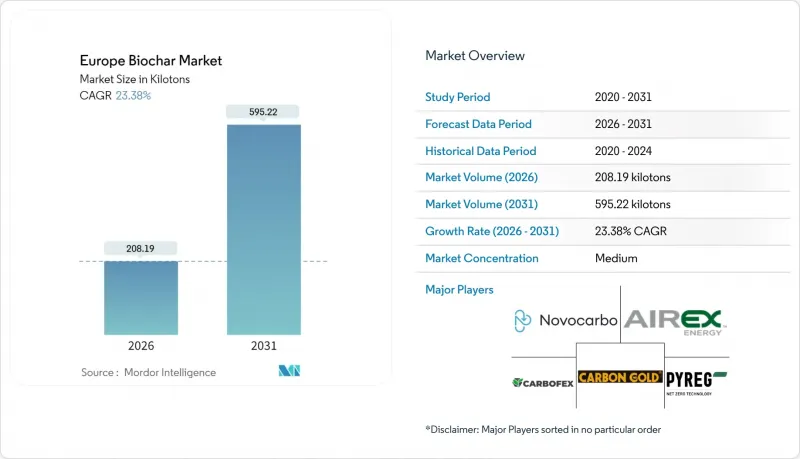
預計到 2026 年,歐洲生物炭市場規模將達到 208.19 千噸。
這意味著從 2025 年的 168.77 千噸成長到 2031 年的 595.22 千噸,2026 年至 2031 年的複合年成長率為 23.38%。
隨著歐盟將生物炭指定為碳移除認證框架下的認可碳移除途徑,以及《肥料產品法規》中的CMC14分類消除品質模糊性並允許跨境貿易,市場需求正在成長。從鋼鐵製造商到地方供水事業,工業買家紛紛簽署多年期契約,以確保新增產能;投資者則將區域供熱熱解裝置視為可同時產生熱能和碳權額的雙重收益資產。德國以29.41%的市佔率主導,這得益於其60多家商業化工廠、經認證的生產通訊協定以及與可再生供熱網路的密切合作。然而,生質能物流分散以及缺乏歐盟範圍內的農藝田間施用量指南阻礙了成本競爭力和農場應用,凸顯了原料集約化和農業標準統一化的必要性。
歐洲生物炭市場趨勢與洞察
歐盟27國可再生和有機農業計畫需求激增
歐盟2023-2027年通用農業政策(CAP)下的生態計畫對農民的碳封存措施(包括生物炭)進行補償。荷蘭溫室種植者透過將精準施肥管理與生物炭結合,番茄產量提高了20%,從而促進了生物炭在高價值園藝領域的應用。在德國,經認證的生物炭正被應用於有機農田(佔該國農田面積的10.20%),以實現淨零排放目標並維持土壤肥力。政策與現有補貼計畫的協調一致,穩定了生產者的收入,並減少了對波動較大的排碳權價格的依賴,從而促進了生物炭的穩定推廣。隨著成員國將農村發展預算分配給碳農業,歐洲生物炭市場正受益於主流農業計畫帶來的可預測需求。
碳權購買協議的快速擴張
自2024年碳移除認證架構正式實施以來,生物炭信用額(以二氧化碳移除證書的形式發放)已在企業永續發展核算中獲得標準化累計。北歐企業已簽署多年期認證移除契約,為ECOERA等生產商提供了可靠的收入來源,以支持工廠擴張。第三方審核檢驗有機碳含量低於0.3,這不僅強化了永續性聲明,也使其能夠獲得溢價,有時甚至達到農業木炭價格的兩倍。企業需求的激增縮短了新熱解能的投資回收期,吸引了機構資本進入歐洲生物炭市場,並促進了認證供應的成長。
歐盟生質能廢棄物物流中斷推高原料成本
由於生物炭原料網路採用分散的區域收集點而非統一的商品交易所運作,運輸距離增加,導致交付德國工廠的生質能價格上漲25%至40%。小規模生產商缺乏談判規模來簽訂長期契約,往往依賴現貨採購,使其營運利潤易受價格波動的影響。與顆粒燃料產業不同,生物炭原料沒有統一的分級或水分含量標準,這使得原料在成員國之間運輸時,品質檢驗變得更加複雜。投資建設集中式收集站和數位化溯源平台可以降低物流成本,但此類基礎設施需要跨國政策協調,而這方面的工作才剛起步。
細分市場分析
2025年,熱解佔據歐洲生物炭市場74.32%的佔有率,預計到2031年將以23.88%的複合年成長率成長,這主要得益於連續流反應器、自動溫度控制和合成氣回收技術帶來的成本降低。熱解法之所以佔據主導地位,是因為它能夠處理木材殘渣、農作物秸稈和污水污泥等多種原料,同時滿足CMC14污染物排放標準。氣化法主要針對高水分原料,佔小規模的市場佔有率,而熱解和水熱碳化法則為活性碳市場提供特殊煤。
設施的經濟效益越來越依賴能源的綜合利用。例如,薩克森州和斯科訥省的聯合熱解和區域供熱廠,其運作熱成本為負,並可將節省的資金用於原料預處理,從而提高整體碳產量。自動化取樣和在線連續光譜分析降低了批次間的差異,這是實現工業買家所需的窄孔徑分佈的關鍵因素。這些製程優勢鞏固了德國設備供應商的高階品牌價值,並強化了熱解作為拓展歐洲生物炭市場基石的地位。
歐洲生物炭市場報告按技術(熱解、氣化系統、其他技術)、應用(農業、畜牧業、工業應用、其他應用)和地區(德國、英國、法國、義大利、西班牙、北歐國家、土耳其、俄羅斯、歐洲其他地區)進行細分。市場預測以噸為單位。
其他福利:
- Excel格式的市場預測(ME)表
- 3個月的分析師支持
目錄
第1章 引言
- 研究假設和市場定義
- 調查範圍
第2章調查方法
第3章執行摘要
第4章 市場情勢
- 市場概覽
- 市場促進因素
- 歐盟27國再生農業和有機農業計畫需求激增
- 碳權購買協議的快速擴張
- 歐盟肥料產品法規中CMC14生物炭的適用範圍
- 區域供熱熱解裝置中工業餘熱回收的經濟性。
- 利用生物炭從污水污泥中回收磷
- 市場限制
- 歐盟內部生質能廢棄物分銷網路的碎片化將推高原料成本。
- 歐盟範圍內缺乏生物炭施用量的統一農藝指南
- 未經認證的木炭可能有長期多環芳烴/重金屬污染風險
- 價值鏈分析
- 波特五力模型
- 供應商的議價能力
- 買方的議價能力
- 新進入者的威脅
- 替代品的威脅
- 競爭程度
第5章 市場規模與成長預測
- 科技
- 熱解
- 氣化系統
- 其他技術
- 目的
- 農業
- 畜牧業
- 工業用途
- 其他用途
- 地區
- 德國
- 英國
- 法國
- 義大利
- 西班牙
- 北歐國家
- 土耳其
- 俄羅斯
- 其他歐洲地區
第6章 競爭情勢
- 市場集中度
- 策略趨勢
- 市佔率(%)/排名分析
- 公司簡介
- Airex Energy
- Bussme Energy AB
- Carbofex Ltd
- Carbon Centric
- Carbon Finland Oy
- Carbon Gold Ltd
- CARBUNA
- CharLine GmbH
- Circular Carbon GmbH
- EGoS GmbH
- EOC Energy Ocean
- LUCRAT GmbH
- Nettenergy BV
- NOVOCARBO GMBH
- PYREG GmbH
- Sonnenerde GmbH
- Verora AG
第7章 市場機會與未來展望
Europe Biochar Market size in 2026 is estimated at 208.19 kilotons, growing from 2025 value of 168.77 kilotons with 2031 projections showing 595.22 kilotons, growing at 23.38% CAGR over 2026-2031.
Demand rises as the European Union positions biochar as an accredited carbon-removal pathway under the Carbon Removal Certification Framework, while the CMC14 classification inside the Fertilising Products Regulation removes quality ambiguity and opens cross-border trade. Industrial buyers-from steel producers to municipal water utilities-are entering multi-year offtake contracts that underwrite new capacity, and investors view district-heating pyrolysis plants as dual-revenue assets that monetize heat and carbon credits. Germany leads with a 29.41% volume share thanks to more than 60 commercial plants, certified production protocols and close integration with renewable-heat networks. However, fragmented biomass logistics and the absence of pan-EU agronomic field-rate guidelines weigh on cost competitiveness and farm adoption, underscoring the need for tighter feedstock aggregation and harmonized agricultural standards.
Europe Biochar Market Trends and Insights
Soaring Demand from EU-27 Regenerative & Organic Farming Programs
European Union eco-schemes inside the 2023-2027 Common Agricultural Policy reimburse farmers for carbon-sequestration practices, and biochar now qualifies for these payments. Dutch greenhouse growers recorded yield gains of up to 20% in tomato production after integrating biochar with precision fertigation, prompting wider adoption across high-value horticulture. Germany's organic acreage-10.20% of national farmland-has embraced certified biochar to maintain soil fertility while meeting net-zero targets. The policy linkage to existing subsidy channels harmonizes revenue for growers and lessens exposure to volatile carbon-credit pricing, accelerating steady volume uptake. As member states earmark rural-development budgets for carbon farming, the Europe biochar market receives predictable pull-through from mainstream agricultural programs.
Rapid Scale-up of Carbon-Credit Purchase Agreements
Since the Carbon Removal Certification Framework became operational in 2024, biochar credits-issued as CO2 Removal Certificates-have gained standardized accounting across corporate sustainability ledgers. Nordic corporates are contracting multiyear tranches of certified removals, giving producers like ECOERA firm revenue visibility that supports plant expansions. Third-party audits that verify H/C_org ratios below 0.3 reinforce permanence claims and enable premium pricing often double that of agricultural-grade char. The surge in corporate demand accelerates payback periods on new pyrolysis assets, drawing institutional capital into the Europe biochar market and lifting credentialed volumes.
Fragmented EU Biomass-Waste Logistics Inflate Feedstock Costs
Biochar feedstock networks operate through decentralized, regional collection hubs instead of unified commodity exchanges, resulting in transport distances that lift delivered biomass prices by 25-40% for German plants. Smaller producers lack the bargaining scale to secure long-term contracts and often rely on spot sourcing, injecting price volatility into operating margins. Unlike the pellet sector, there is no uniform grading or moisture-content standard recognized across borders, complicating quality checks when material moves between member states. Investment in centralized aggregation depots and digital traceability platforms could compress logistics costs, but such infrastructure requires cross-border policy coordination that remains nascent.
Other drivers and restraints analyzed in the detailed report include:
- EU Fertilising Products Regulation Inclusion of CMC14 Biochar
- Industrial Heat-Recovery Economics from District-Heating Pyrolysis Plants
- Absence of Pan-EU Agronomic Guidelines for Biochar Field-Rates
For complete list of drivers and restraints, kindly check the Table Of Contents.
Segment Analysis
Pyrolysis accounted for 74.32% of the Europe biochar market share in 2025, and the pathway is on track for a 23.88% CAGR through 2031 as continuous-flow reactors, automated temperature control, and syngas recovery underpin cost reductions. This dominance stems from the technology's versatility to process wood residuals, crop straw, and sewage sludge while still meeting CMC14 contaminant thresholds. Gasification claims a smaller niche for high-moisture feedstocks, whereas torrefaction and hydrothermal carbonization supply specialty chars for activated-carbon markets.
Unit economics increasingly hinge on integrated energy use. Plants that couple pyrolysis with district-heating, such as facilities in Saxony and Skane, achieve negative operating heat costs and channel savings into feedstock pre-processing, improving overall carbon yields. Automated sampling and inline spectrometry reduce batch-to-batch variability, an essential factor as industrial buyers specify narrow pore-size distributions. These process gains reinforce the premium branding of German equipment suppliers and cement pyrolysis as the backbone of Europe biochar market expansion.
The Europe Biochar Market Report is Segmented by Technology (Pyrolysis, Gasification Systems, Other Technologies), Application (Agriculture, Animal Farming, Industrial Uses, Other Applications), and Geography (Germany, United Kingdom, France, Italy, Spain, Nordic Countries, Turkey, Russia, Rest of Europe). The Market Forecasts are Provided in Terms of Volume (Tons).
List of Companies Covered in this Report:
- Airex Energy
- Bussme Energy AB
- Carbofex Ltd
- Carbon Centric
- Carbon Finland Oy
- Carbon Gold Ltd
- CARBUNA
- CharLine GmbH
- Circular Carbon GmbH
- EGoS GmbH
- EOC Energy Ocean
- LUCRAT GmbH
- Nettenergy BV
- NOVOCARBO GMBH
- PYREG GmbH
- Sonnenerde GmbH
- Verora AG
Additional Benefits:
- The market estimate (ME) sheet in Excel format
- 3 months of analyst support
TABLE OF CONTENTS
1 Introduction
- 1.1 Study Assumptions and Market Definition
- 1.2 Scope of the Study
2 Research Methodology
3 Executive Summary
4 Market Landscape
- 4.1 Market Overview
- 4.2 Market Drivers
- 4.2.1 Soaring demand from EU-27 regenerative and organic farming programmes
- 4.2.2 Rapid scale-up of carbon-credit purchase agreements
- 4.2.3 EU Fertilising Products Regulation inclusion of CMC14 biochar
- 4.2.4 Industrial heat-recovery economics from district-heating pyrolysis plants
- 4.2.5 Biochar-enabled phosphorus recycling from sewage-sludge streams
- 4.3 Market Restraints
- 4.3.1 Fragmented EU biomass-waste logistics inflate feedstock costs
- 4.3.2 Absence of pan-EU agronomic guidelines for biochar field-rates
- 4.3.3 Potential long-term PAH / heavy-metal liability for non-certified char
- 4.4 Value Chain Analysis
- 4.5 Porter's Five Forces
- 4.5.1 Bargaining Power of Suppliers
- 4.5.2 Bargaining Power of Buyers
- 4.5.3 Threat of New Entrants
- 4.5.4 Threat of Substitutes
- 4.5.5 Degree of Competition
5 Market Size and Growth Forecasts (Volume)
- 5.1 Technology
- 5.1.1 Pyrolysis
- 5.1.2 Gasification Systems
- 5.1.3 Other Technologies
- 5.2 Application
- 5.2.1 Agriculture
- 5.2.2 Animal Farming
- 5.2.3 Industrial Uses
- 5.2.4 Other Applications
- 5.3 Geography
- 5.3.1 Germany
- 5.3.2 United Kingdom
- 5.3.3 France
- 5.3.4 Italy
- 5.3.5 Spain
- 5.3.6 Nordic Countries
- 5.3.7 Turkey
- 5.3.8 Russia
- 5.3.9 Rest of Europe
6 Competitive Landscape
- 6.1 Market Concentration
- 6.2 Strategic Moves
- 6.3 Market Share (%)**/Ranking Analysis
- 6.4 Company Profiles (includes Global-Level Overview, Market-Level Overview, Core Segments, Financials as available, Strategic Information, Market Rank/Share, Products and Services, Recent Developments)
- 6.4.1 Airex Energy
- 6.4.2 Bussme Energy AB
- 6.4.3 Carbofex Ltd
- 6.4.4 Carbon Centric
- 6.4.5 Carbon Finland Oy
- 6.4.6 Carbon Gold Ltd
- 6.4.7 CARBUNA
- 6.4.8 CharLine GmbH
- 6.4.9 Circular Carbon GmbH
- 6.4.10 EGoS GmbH
- 6.4.11 EOC Energy Ocean
- 6.4.12 LUCRAT GmbH
- 6.4.13 Nettenergy BV
- 6.4.14 NOVOCARBO GMBH
- 6.4.15 PYREG GmbH
- 6.4.16 Sonnenerde GmbH
- 6.4.17 Verora AG
7 Market Opportunities and Future Outlook
- 7.1 White-Space and Unmet-Need Assessment

 生物炭市場:2026-2032年全球市場預測(依製造技術、原料類型、產品形態、反應器配置、活化方法、應用、通路和最終用戶分類)
 全球生物炭市場:按原料、技術、形態、應用和最終用戶分類-市場規模、產業動態、機會分析和預測(2026-2035 年)
 功能性生物炭市場-全球產業規模、佔有率、趨勢、機會、預測:依技術、應用、區域和競爭格局分類,2021-2031年
 南美洲生物炭:市場佔有率分析、產業趨勢與統計及成長預測(2026-2031 年)
 生物炭市場規模、佔有率和成長分析:按原料類型、製造方法、應用、終端用戶產業和地區分類-2026-2033年產業預測
 生物炭市場規模、佔有率和趨勢:按原料類型、技術類型、產品形式、應用和地區分類,並預測2026年至2034年
 生物炭生產設備市場:按類型、技術和地區分類
 全球生物炭市場(2026-2036)生物炭:市場佔有率分析、產業趨勢與統計、成長預測(2026-2031)全球生物炭市場規模、佔有率、趨勢和成長分析報告(2026-2034年)