


 |
市場調查報告書
商品編碼
1940857
步進馬達:市場佔有率分析、產業趨勢與統計、成長預測(2026-2031)Stepper Motor - Market Share Analysis, Industry Trends & Statistics, Growth Forecasts (2026 - 2031) |
||||||

※ 本網頁內容可能與最新版本有所差異。詳細情況請與我們聯繫。
步進馬達市場預計將從 2025 年的 21.9 億美元成長到 2026 年的 22.6 億美元,預計到 2031 年將達到 26.7 億美元,2026 年至 2031 年的複合年成長率為 3.38%。
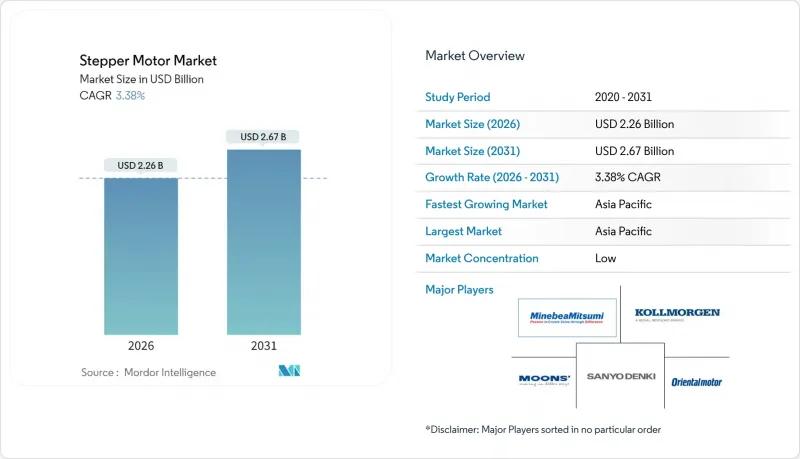
由於機器人、醫療設備和半導體製造設備製造商持續選擇步進馬達技術來實現精確的開放回路定位,從而避免使用高成本的伺服平台,因此市場需求保持穩定。協作機器人擴大應用於組裝單元,加速了緊湊型、符合NEMA標準的機器人的普及,這些機器人能夠提供可預測的扭矩和簡化的編程。半導體產業的資本投資,尤其是在封裝和微影術線方面的投資,支撐了對可在無塵室環境中可靠運作的混合型和線性產品的訂單。對低維護、高重複性致動器的需求也推動了實驗室自動化、桌上型3D列印機和電池生產線的成長。儘管庫存調整導致2024年整體運動控制市場出現萎縮,但2025年工廠自動化投資的恢復預示著市場將回歸穩定的採購週期。
全球步進馬達市場趨勢與洞察
機器人和協作機器人的日益普及
製造工廠在部署協作機器人時,傾向於選擇步進馬達驅動,因為其可預測的步進增量提供了固有的扭矩限制,從而提高了人機安全性。美國的製造業回流計畫和歐洲的生產力提升計畫正在推動模組化運動平台的標準化,這些平台支援低壓兩相混合馬達和微步控制器。配備編碼器的封閉回路型模型可提供類似伺服的平滑度,從而擴展取放系統的工作範圍。以乙太網路為基礎的通訊協定將馬達整合到工廠網路中,實現狀態監測並最大限度地減少非計劃性停機時間。隨著小批量生產在契約製造佔據主導地位,易於切換和快速編程的特性使步進馬達解決方案成為系統整合商的理想選擇。
醫療設備對精密運動控制的需求日益成長
手術機器人、血液分析儀和輸液幫浦需要在緊湊的面積內實現亞微米級的精確度。現代混合式步進馬達與高解析度編碼器相結合,能夠滿足這項要求。設計人員會選擇具有可重複保持扭矩的電機,即使斷電也能保持儀器位置—這是保障患者安全的關鍵措施。透過阻尼演算法將共振頻率移出人耳可聽頻寬,從而實現靜音運行,符合醫院噪音標準。 FDA 和 CE 法規強調可追溯性,並優先選擇擁有 ISO 13485 認證和檢驗的設計歷史文件的供應商。醫療產業較長的更換週期意味著零件供應商能夠獲得可預測的收入。
與伺服/無刷直流馬達的性能比較
儘管步進馬達組的性能有所提升,但其扭矩在轉速超過 1000 RPM 後會急劇下降,這限制了它們在高速拾取放置和輸送機驅動中的應用。入門級伺服的價格下降縮小了以往步進馬達在中等精度任務的優勢成本。整合伺服系統現在標配自動調諧和現場匯流排選項,簡化了部署,並縮小了總安裝成本的差距。因此,負責人正在重點宣傳那些靜態位置保持扭矩比動態要求更重要的應用場景,例如閥門驅動和微孔盤分度。
細分市場分析
混合式步進馬達兼具高扭力密度和1.8度步進解析度,預計到2025年將佔據步進馬達市場54.65%的佔有率。其複合年成長率預計將達到3.95%,超過永磁馬達和可變磁阻馬達。這項優勢正推動著精密磁路研發的持續投入,以在不增加機架尺寸的情況下提高磁通密度。目前,供應商正採用高填充率繞組來降低I²R損耗,實現低電流運行,從而減少發熱並延長軸承壽命。
混合技術的改進也有助於提高能源效率,以滿足IEC 60034-30-1等級標準的要求。釹鐵硼磁體坯料採用雷射加工,最大限度地減少組裝後的變形,並提高微步線性度,這對於光學元件測試平台至關重要。永久磁鐵馬達在對成本敏感的自動販賣機中仍然很受歡迎,而可變磁阻馬達則在極端溫度下的泵浦應用中保持著一定的市場佔有率,因為在這些應用中,磁鐵劣化是一個需要考慮的問題。總體而言,步進馬達市場正受益於以混合技術改進為中心的技術藍圖,該路線圖在不犧牲成本優勢的前提下,縮小了與更便宜的伺服之間的性能差距。
區域分析
亞太地區將繼續保持其在營收方面的領先地位,預計到2025年將佔據35.74%的市場佔有率。這主要得益於中國完善的零件生態系統,該系統能夠簡化磁鐵、軸和驅動器的採購流程。像MOONS' Electric這樣的區域領導企業利用規模經濟優勢,年產量超過百萬台,並透過極具競爭力的價格支持全球出口通路。日本憑藉其大規模生產能力和技術實力,包括專利封閉回路型韌體和高真空設計,引領該地區的半導體設備出口。韓國和東南亞已發展成為契約製造中心,透過將進口的混合產品整合到印表機和機器人的成品子組件中,加強了區域價值鏈。
北美預計將以3.76%的複合年成長率成長,這得益於聯邦政府對自動化升級的支持以及美國本土半導體製造廠的位置。美國系統整合商在建造新的電動車電池工廠時,擴大選擇符合NEMA標準的標準化機架,而非客製化伺服,以縮短前置作業時間。加拿大生命科學和食品包裝企業對耐沖洗的IP65防護等級組件的需求不斷成長,而墨西哥的汽車線束生產線則需要成本最佳化的開放回路步進馬達來支援。
受節能指令(例如2019/1781號法規)的推動,歐洲市場正穩步成長,該法規旨在促進工廠的封閉回路型改造。德國原始設備製造商(OEM)正利用其本地精密加工技術,為全球晶圓加工設備市場提供高真空規格的產品。同時,中東和非洲的新興經濟體也開始在海水淡化、紡織和包裝計劃採用步進馬達驅動器,儘管其應用量仍遠低於成熟地區。整體而言,地域多元化保護了步進馬達市場免受局部衰退的影響,從而支撐起一個具有韌性的多區域需求基礎。
其他福利:
- Excel格式的市場預測(ME)表
- 3個月的分析師支持
目錄
第1章 引言
- 研究假設和市場定義
- 調查範圍
第2章調查方法
第3章執行摘要
第4章 市場情勢
- 市場概覽
- 市場促進因素
- 機器人技術和協作自動化技術的日益普及
- 醫療設備對精密運動控制的需求日益成長
- 擴展 3D 列印和桌面製造生態系統
- 對半導體封裝設備的投資激增
- 轉向節能型閉合迴路馬達解決方案
- 政府對國內運動部件生產的激勵措施
- 市場限制
- 伺服/無刷直流馬達的性能極限及比較
- 來自亞洲低成本製造商的價格壓力
- 整合式智慧致動器將蠶食獨立馬達的市場佔有率。
- 緊湊型設計中的溫度控管挑戰
- 產業供應鏈分析
- 監管環境
- 技術展望
- 波特五力分析
- 供應商的議價能力
- 買方的議價能力
- 新進入者的威脅
- 替代品的威脅
- 競爭對手之間的競爭
- 宏觀經濟因素的影響
第5章 市場規模與成長預測
- 依馬達類型
- 混合
- 永久磁鐵
- 可變磁阻
- 透過驅動系統
- 開放回路
- 閉合迴路
- 透過使用
- 工業設備
- 機器人技術與協作機器人
- 醫療設備和檢測設備
- 電腦/3D列印
- 其他用途
- 按地區
- 北美洲
- 美國
- 加拿大
- 墨西哥
- 南美洲
- 巴西
- 阿根廷
- 南美洲其他地區
- 歐洲
- 德國
- 英國
- 法國
- 義大利
- 西班牙
- 俄羅斯
- 其他歐洲地區
- 亞太地區
- 中國
- 日本
- 印度
- 韓國
- 東南亞
- 亞太其他地區
- 中東和非洲
- 中東
- 沙烏地阿拉伯
- 阿拉伯聯合大公國
- 其他中東地區
- 非洲
- 南非
- 埃及
- 其他非洲地區
- 中東
- 北美洲
第6章 競爭情勢
- 市場集中度
- 策略趨勢
- 市佔率分析
- 公司簡介
- AMETEK, Inc.
- Anaheim Automation, Inc.
- Arcus Technology Inc.
- Changzhou Fulling Motor Co., Ltd.
- Changzhou Leili Intelligent Drive Systems Co., Ltd.
- ElectroCraft, Inc.
- Faulhaber Group
- JVL Industri Elektronik A/S
- Kollmorgen(Regal Rexnord Corp.)
- Lin Engineering, Inc.
- MinebeaMitsumi Inc.
- MOONS'Electric Co., Ltd.
- Nanotec Electronic GmbH & Co. KG
- Nidec Servo Corporation
- Nippon Pulse America, Inc.
- Oriental Motor Co., Ltd.
- Parker-Hannifin Corp.
- Performance Motion Devices, Inc.
- Phytron GmbH
- Schneider Electric SE
- Sanyo Denki Co., Ltd.
- Sonceboz SA
- STMicroelectronics NV
- Tamagawa Seiki Co., Ltd.
- Texas Instruments Inc.
第7章 市場機會與未來展望
The stepper motor market is expected to grow from USD 2.19 billion in 2025 to USD 2.26 billion in 2026 and is forecast to reach USD 2.67 billion by 2031 at 3.38% CAGR over 2026-2031.
Demand holds steady as manufacturers in robotics, medical devices, and semiconductor equipment continue choosing stepper technology for precise open-loop positioning that avoids the higher system cost of servo platforms. Collaborative robots are gaining traction in assembly cells and are accelerating the adoption of compact NEMA-frame units that deliver predictable torque and simplified programming.Semiconductor capital spending, particularly in packaging and lithography lines, sustains orders for hybrid and linear variants that operate reliably in clean-room environments. Growth also stems from laboratory automation, desktop 3-D printers, and battery-manufacturing lines seeking low-maintenance actuators with tight repeatability. While the overall motion-control sector contracted in 2024 because of inventory corrections, renewed factory-automation investment in 2025 signals a return to steady purchasing cycles.
Global Stepper Motor Market Trends and Insights
Growing adoption of robotics and collaborative automation
Manufacturing plants deploying collaborative robots favor stepper drives because predictable step increments allow intrinsic torque limiting that enhances human-machine safety. U.S. reshoring programs and European productivity upgrades are standardizing on modular motion platforms that accept low-voltage, two-phase hybrids with microstepping controllers. Encoder-equipped closed-loop models are now achieving near-servo smoothness, broadening the feasible working envelope for pick-and-place systems. Ethernet-based protocols integrate the motors into plant networks, enabling condition monitoring that minimizes unplanned downtime. As small-lot production dominates contract manufacturing, easy changeover and fast programming keep stepper solutions attractive for integrators.
Rising demand for precision motion control in medical devices
Surgical robots, hematology analyzers, and drug-delivery pumps require sub-micron accuracy within compact footprints, a specification matched by modern hybrid steppers coupled to high-resolution encoders. Designers select the motors for repeatable holding torque that maintains instrument position even when power is cut, a critical patient-safety safeguard. Quiet operation is delivered by damping algorithms that shift resonance away from audible frequencies, meeting hospital noise norms. FDA and CE rules highlight traceability, favoring vendors with ISO 13485 certificates and validated design-history files. Long replacement cycles in healthcare extend revenue visibility for component suppliers.
Performance limits versus servo / BLDC motors
Despite incremental gains, torque in stepper stacks declines sharply above 1,000 RPM, capping suitability in high-speed pick-and-place or conveyor drives. Price erosion in entry-level servos reduces the historical cost gap that once favored steppers for medium-precision work. Integrated servo packages now include automatic tuning and fieldbus options, simplifying commissioning and reducing the total installed cost delta. Marketers, therefore, emphasize use cases where positional holding torque at standstill outweighs dynamic requirements, such as valve actuation or microplate indexing.
Other drivers and restraints analyzed in the detailed report include:
- Expansion of 3-D printing and desktop manufacturing ecosystems
- Surge in semiconductor packaging-equipment investments
- Integrated smart-actuators cannibalizing discrete motors
For complete list of drivers and restraints, kindly check the Table Of Contents.
Segment Analysis
Hybrid variants commanded 54.65% stepper motor market share in 2025 due to their balance of torque density and 1.8-degree step resolution, and they are forecast to expand at a 3.95% CAGR, outpacing permanent-magnet and variable-reluctance formats. This dominance translates into sustained research and development allocations for finer magnetic circuits that raise flux density without enlarging frame size. Vendors now deploy high-fill-factor windings that shave I2R losses and allow operation at reduced current, extending bearing life through lower heat generation.
Hybrid improvements also underpin energy-efficiency upgrades needed to comply with IEC 60034-30-1 classes. Neodymium-iron-boron magnet blanks are laser-machined to minimize post-assembly skew, improving microstep linearity essential for photonics test stages. Permanent-magnet units still serve cost-sensitive vending machines, while variable-reluctance designs retain niches in extreme-temperature pumps where magnet decay is a concern. Overall, the stepper motor market benefits from a technology roadmap centered on hybrid refinements that close the performance gap with inexpensive servos without surrendering the cost advantage.
The Stepper Motor Market Report is Segmented by Motor Type (Hybrid, Permanent Magnet, and Variable Reluctance), Drive Technique (Open-Loop, and Closed-Loop), Application (Industrial Equipment, Robotics and Cobots, Medical and Laboratory Devices, Computing / 3-D Printing, and More), and Geography (North America, South America, Europe, Asia-Pacific, Middle East, and Africa). The Market Forecasts are Provided in Terms of Value (USD).
Geography Analysis
Asia-Pacific remained the 2025 revenue leader with a 35.74% share, anchored by Chinese component ecosystems that streamline magnet, shaft, and driver sourcing. Regional titans such as MOONS' Electric leverage scale economies above 1 million units per year, supporting aggressive pricing that feeds global export channels. Japan complements volume with technology, patented closed-loop firmware, and high-vacuum designs that power the region's semiconductor equipment exports. South Korea and Southeast Asia have emerged as contract-manufacturing hubs that integrate imported hybrids into finished printer and robot sub-assemblies, reinforcing intra-regional value chains.
North America, projected at a 3.76% CAGR, benefits from federal incentives that reimburse automation upgrades and onshore semiconductor fabs. U.S. integrators increasingly specify standardized NEMA frames over custom servos to shorten lead times during green-field EV battery-plant construction. Canadian facilities in life sciences and food packaging drive demand for wash-down IP65 variants, while Mexico supports automotive harness production lines using cost-optimized open-loop steppers.
Europe experiences steady gains under energy-efficiency directives such as Regulation 2019/1781 that push factories toward closed-loop retrofits. German OEMs exploit local precision-machining expertise to supply high-vacuum variants to the global wafer-tool sector. Meanwhile, emerging Middle-East and African economies begin specifying stepper drives in desalination, textile, and packaging projects, though volumes remain a fraction of mature regions. Altogether, geographic diversification shields the stepper motor market from isolated downturns and underscores a resilient multi-regional demand base.
- AMETEK, Inc.
- Anaheim Automation, Inc.
- Arcus Technology Inc.
- Changzhou Fulling Motor Co., Ltd.
- Changzhou Leili Intelligent Drive Systems Co., Ltd.
- ElectroCraft, Inc.
- Faulhaber Group
- JVL Industri Elektronik A/S
- Kollmorgen (Regal Rexnord Corp.)
- Lin Engineering, Inc.
- MinebeaMitsumi Inc.
- MOONS' Electric Co., Ltd.
- Nanotec Electronic GmbH & Co. KG
- Nidec Servo Corporation
- Nippon Pulse America, Inc.
- Oriental Motor Co., Ltd.
- Parker-Hannifin Corp.
- Performance Motion Devices, Inc.
- Phytron GmbH
- Schneider Electric SE
- Sanyo Denki Co., Ltd.
- Sonceboz SA
- STMicroelectronics N.V.
- Tamagawa Seiki Co., Ltd.
- Texas Instruments Inc.
Additional Benefits:
- The market estimate (ME) sheet in Excel format
- 3 months of analyst support
TABLE OF CONTENTS
1 INTRODUCTION
- 1.1 Study Assumptions and Market Definition
- 1.2 Scope of the Study
2 RESEARCH METHODOLOGY
3 EXECUTIVE SUMMARY
4 MARKET LANDSCAPE
- 4.1 Market Overview
- 4.2 Market Drivers
- 4.2.1 Growing adoption of robotics and collaborative automation
- 4.2.2 Rising demand for precision motion control in medical devices
- 4.2.3 Expansion of 3-D printing and desktop manufacturing ecosystems
- 4.2.4 Surge in semiconductor packaging-equipment investments
- 4.2.5 Shift to energy-efficient closed-loop stepper solutions
- 4.2.6 Government incentives for localised motion-component production
- 4.3 Market Restraints
- 4.3.1 Performance limits versus servo / BLDC motors
- 4.3.2 Price pressure from low-cost Asian manufacturers
- 4.3.3 Integrated smart-actuators cannibalising discrete motors
- 4.3.4 Thermal-management challenges in compact designs
- 4.4 Industry Supply Chain Analysis
- 4.5 Regulatory Landscape
- 4.6 Technological Outlook
- 4.7 Porter's Five Forces Analysis
- 4.7.1 Bargaining Power of Suppliers
- 4.7.2 Bargaining Power of Buyers
- 4.7.3 Threat of New Entrants
- 4.7.4 Threat of Substitutes
- 4.7.5 Intensity of Competitive Rivalry
- 4.8 Impact of Macroeconomic Factors
5 MARKET SIZE AND GROWTH FORECASTS (VALUE)
- 5.1 By Motor Type
- 5.1.1 Hybrid
- 5.1.2 Permanent Magnet
- 5.1.3 Variable Reluctance
- 5.2 By Drive Technique
- 5.2.1 Open-Loop
- 5.2.2 Closed-Loop
- 5.3 By Application
- 5.3.1 Industrial Equipment
- 5.3.2 Robotics and Cobots
- 5.3.3 Medical and Laboratory Devices
- 5.3.4 Computing / 3-D Printing
- 5.3.5 Other Applications
- 5.4 By Geography
- 5.4.1 North America
- 5.4.1.1 United States
- 5.4.1.2 Canada
- 5.4.1.3 Mexico
- 5.4.2 South America
- 5.4.2.1 Brazil
- 5.4.2.2 Argentina
- 5.4.2.3 Rest of South America
- 5.4.3 Europe
- 5.4.3.1 Germany
- 5.4.3.2 United Kingdom
- 5.4.3.3 France
- 5.4.3.4 Italy
- 5.4.3.5 Spain
- 5.4.3.6 Russia
- 5.4.3.7 Rest of Europe
- 5.4.4 Asia-Pacific
- 5.4.4.1 China
- 5.4.4.2 Japan
- 5.4.4.3 India
- 5.4.4.4 South Korea
- 5.4.4.5 South-East Asia
- 5.4.4.6 Rest of Asia-Pacific
- 5.4.5 Middle East and Africa
- 5.4.5.1 Middle East
- 5.4.5.1.1 Saudi Arabia
- 5.4.5.1.2 United Arab Emirates
- 5.4.5.1.3 Rest of Middle East
- 5.4.5.2 Africa
- 5.4.5.2.1 South Africa
- 5.4.5.2.2 Egypt
- 5.4.5.2.3 Rest of Africa
- 5.4.5.1 Middle East
- 5.4.1 North America
6 COMPETITIVE LANDSCAPE
- 6.1 Market Concentration
- 6.2 Strategic Moves
- 6.3 Market Share Analysis
- 6.4 Company Profiles (includes Global-level Overview, Market-level Overview, Core Segments, Financials as available, Strategic Information, Market Rank/Share for key companies, Products and Services, and Recent Developments)
- 6.4.1 AMETEK, Inc.
- 6.4.2 Anaheim Automation, Inc.
- 6.4.3 Arcus Technology Inc.
- 6.4.4 Changzhou Fulling Motor Co., Ltd.
- 6.4.5 Changzhou Leili Intelligent Drive Systems Co., Ltd.
- 6.4.6 ElectroCraft, Inc.
- 6.4.7 Faulhaber Group
- 6.4.8 JVL Industri Elektronik A/S
- 6.4.9 Kollmorgen (Regal Rexnord Corp.)
- 6.4.10 Lin Engineering, Inc.
- 6.4.11 MinebeaMitsumi Inc.
- 6.4.12 MOONS' Electric Co., Ltd.
- 6.4.13 Nanotec Electronic GmbH & Co. KG
- 6.4.14 Nidec Servo Corporation
- 6.4.15 Nippon Pulse America, Inc.
- 6.4.16 Oriental Motor Co., Ltd.
- 6.4.17 Parker-Hannifin Corp.
- 6.4.18 Performance Motion Devices, Inc.
- 6.4.19 Phytron GmbH
- 6.4.20 Schneider Electric SE
- 6.4.21 Sanyo Denki Co., Ltd.
- 6.4.22 Sonceboz SA
- 6.4.23 STMicroelectronics N.V.
- 6.4.24 Tamagawa Seiki Co., Ltd.
- 6.4.25 Texas Instruments Inc.
7 MARKET OPPORTUNITIES AND FUTURE OUTLOOK
- 7.1 White-Space and Unmet-Need Assessment

 汽車步進馬達市場:按類型、轉子設計、技術、應用、車輛類型和銷售管道分類-2026-2032年全球市場預測工業混合步進馬達市場:依馬達類型、機架尺寸、維持轉矩和應用分類-2026-2032年全球市場預測步進馬達市場:按類型、技術、扭力、功率、控制機制、控制器介面和應用分類-全球預測,2026-2032年五相開放回路馬達市場:按馬達類型、機架尺寸、扭力範圍、應用和最終用戶分類的全球預測(2026-2032年)
 全球混合伺服馬達電纜市場:2025年
 步進系統市場規模、佔有率、趨勢及預測(按組件類型、最終用途和地區),2025 年至 2033 年
 步進馬達市場:2025年至2030年預測
 全球步進馬達市場:2032 年預測 - 按類型、軸類型、功率範圍、安裝配置、運動控制、應用、最終用戶和地區進行分析
 整合步進馬達市場(2025-2029)
 高扭力步進馬達市場(類型 - 永磁步進馬達、變磁阻步進馬達、混合式步進馬達);功率-低、中、高; - 2025 年至 2035 年全球產業分析、規模、佔有率、成長、趨勢和預測