


 |
市場調查報告書
商品編碼
1940788
汽車煞車皮:市場佔有率分析、產業趨勢與統計、成長預測(2026-2031)Automotive Brake Pad - Market Share Analysis, Industry Trends & Statistics, Growth Forecasts (2026 - 2031) |
||||||

※ 本網頁內容可能與最新版本有所差異。詳細情況請與我們聯繫。
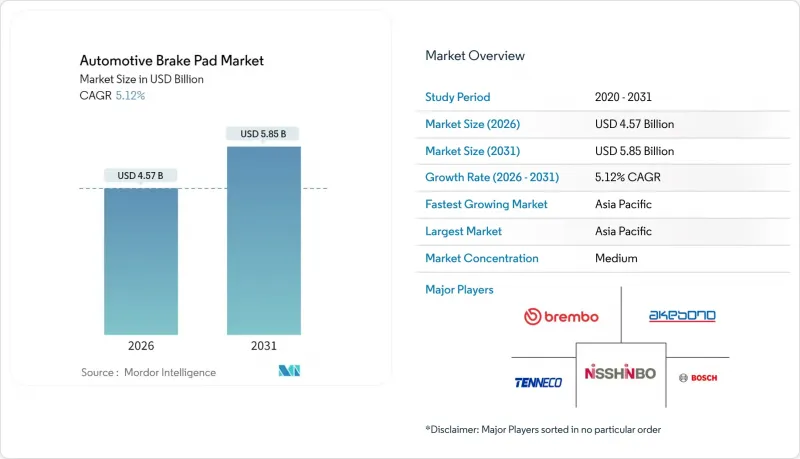
汽車煞車皮市場預計將從 2025 年的 43.5 億美元成長到 2026 年的 45.7 億美元,預計到 2031 年將達到 58.5 億美元,2026 年至 2031 年的複合年成長率為 5.12%。
這項穩定擴張得益於日益嚴格的全球排放氣體法規、電動車數量的成長以及摩擦材料科學的進步,這些進步在不影響煞車安全性的前提下減少了顆粒物排放。亞太地區強大的製造業基礎、取代零件管道向電子商務的轉型以及客戶對低噪音陶瓷複合材料的需求,都在推動該行業的進一步成長。同時,鋼材和酚醛樹脂供應鏈的不穩定性正在擠壓利潤空間,促使製造商投資於流程自動化和人工智慧驅動的配方工具。隨著高階品牌將磨損感測器和軟體整合到煞車片中,並將預測性維護服務建立在新的收入來源之上,競爭壓力也不斷加劇。
全球汽車煞車皮市場趨勢與洞察
更嚴格的安全法規(歐7、國7)
歐盟7排放標準將把煞車顆粒物排放限制在7毫克/公里以內,並強制規定自2025年起,煞車片中銅的含量低於0.5%(重量比),這將使傳統的酚醛-銅混合煞車片被淘汰。中國也正在製定與歐盟標準相符的法規,旨在為全球兩大汽車市場建立統一的合規標準。率先獲得無銅認證的製造商將獲得明顯的銷售優勢,而未能獲得認證的製造商則將面臨高成本高昂的配方變更和生產線停產。這些法規正在加速陶瓷和無機(NAO)材料的應用,迫使原始設備製造商(OEM)在全球平台上實現摩擦片的標準化。美國的先例,例如加州於2025年生效的“更佳煞車規則”,顯示州級措施如何迅速波及整個國家供應鏈。
無銅低排放焊盤材料的快速普及
原始設備製造商 (OEM) 和一級供應商正將無銅化合物定位為性能提升手段,而非僅僅作為合規工具。 Brembo 的水泥基複合材料「眼鏡蛇計劃」獲得了 ECE-R90 認證,同時消除了甲醛並減少了 20% 的顆粒物排放。陶瓷纖維和改性酚醛樹脂的結合,可實現更安靜的煞車和更清潔的輪轂,這對於無法像傳統汽車那樣被引擎噪音掩蓋的電動車車主來說尤其重要。生產轉型導致特殊醯胺纖維和玻璃纖維供應短缺,進而引發了選擇性現貨定價和供應商審核的加強。模具改造(高溫壓平機和更高的混合精度)需要數百萬美元的資本投資,但對於需要更高價格煞車片的高階車型而言,這些投資可以迅速收回成本。
再生煞車可降低更換頻率
純電動轎車車主享有一項顯著優勢:煞車皮更換頻率遠低於傳統車輛。由於能量回收煞車系統,電動轎車車主在首次更換煞車皮前通常行駛里程是傳統車輛的兩倍以上,凸顯了該系統的高效性和低磨損性。較短的保養週期會降低每輛車的售後市場收入;然而,特殊的耐腐蝕塗層會增加每組煞車片的單價。車隊營運商會延長服務合約並推遲批量採購,這給供應商的訂單前景帶來了不確定性。銷售量下滑將首先影響區域分銷商,迫使他們整合業務或將業務轉向其他易耗件,例如輪胎和擋風玻璃雨刷。
細分市場分析
到2025年,半金屬煞車片將佔據汽車煞車皮市場最大佔有率,達到46.34%。鐵粉和銅粉因其在高速煞車過程中高效的散熱性能而繼續受到青睞。同時,受銅粉禁用法規和消費者對低粉塵輪轂需求的推動,陶瓷複合材料預計到2031年將以5.68%的複合年成長率成長。這種成長在價格彈性較高的豪華SUV和高性能轎車領域尤其顯著。
陶瓷煞車片的廣泛應用仍面臨諸多障礙:原料成本高、需要專用窯爐、需要供應商有限的細粒氧化鋁粉末。然而,像 Brembo 這樣的製造商已經證明,無銅陶瓷煞車片能夠保持良好的抗熱衰減性能,使其應用範圍超越了小眾跑車領域。在拉丁美洲和非洲,由於初始價格高於耐用性,無石棉有機煞車片仍應用於低成本車輛。在所有車型類別中,半金屬煞車片對於重型卡車仍然至關重要,因為目前還沒有任何陶瓷混合物能夠在不大幅改進煞車碟盤的情況下達到其熱性能。
到2025年,前輪煞車片總成將佔汽車煞車皮市場規模的65.10%,這反映了車輛前軸承受的物理載重不斷增加的趨勢。電子煞車力道分配系統和先進的穩定性控制系統將更多的煞車力道傳遞至後軸,導致後輪煞車片損耗率更高。預計到2031年,這將推動後輪煞車片細分市場的複合年成長率達到5.98%。汽車製造商正在為後輪煞車系統配備更先進的卡鉗,以支援彎道行駛時的軟體控制扭力向量分配。
在混合動力汽車和電動車車型中,工程師們擴大在後輪上安裝再生煞車電機,以便在電池電量低時選擇性地啟動後輪液壓煞車。此變更會影響後煞車片的耐熱性能,因此需要採用耐腐蝕塗層以延長煞車間隔。售後維修店也相應地調整了庫存比例,訂購的後煞車片數量比過去十年都要多,以避免維修延誤。
區域分析
預計到2025年,亞太地區將佔據全球汽車煞車皮市場47.80%的佔有率,並在2031年之前以5.75%的複合年成長率持續成長。這主要得益於中國、印度和東南亞國協不斷擴大汽車生產規模並培育供應商群。中國從歐盟6標準過渡到歐7標準,需要採用無銅生產方式,這給國內煞車片製造商帶來了挑戰和機會。印度摩托車產業的蓬勃發展推動了擁有一體化鑄造和複合材料生產設施的本土藍籌企業的成長,降低了對進口的依賴。日本和韓國企業正在推進陶瓷和醯胺纖維技術的尖端發展,並將其專業知識輸出到區域子公司。
在北美,車輛平均車齡較長,成熟的替換市場支撐著穩定的售後市場收入。加州和華盛頓州的銅禁令促使供應商早期進行投資,如今這些投資已在全國獲得回報。隨著墨西哥擴大汽車組裝線,美墨加協定(USMCA)鼓勵區域採購的關稅規則意味著大量零件在地採購。加拿大和美國北部各州嚴酷的冬季氣候促進了對耐腐蝕背板和耐鹽蝕分層的特殊低溫黏合劑的需求。
歐洲在監管方面處於領先地位,其製定的歐7標準確地立了限制顆粒物排放的全球標準。德國豪華品牌在陶瓷材料的應用方面處於領先地位,而義大利和西班牙的供應商則在摩托車和高性能汽車領域表現出色。儘管外匯波動和能源價格飆升推高了生產成本,但歐盟的團結彌補了跨境監管的複雜性,使得零件能夠從波蘭自由流通到葡萄牙。由於勞動力成本低廉且擁有符合歐盟標準的品管體系,東歐工廠正擴大贏得新的煞車皮合約。
其他福利:
- Excel格式的市場預測(ME)表
- 3個月的分析師支持
目錄
第1章 引言
- 研究假設和市場定義
- 調查範圍
第2章調查方法
第3章執行摘要
第4章 市場情勢
- 市場概覽
- 市場促進因素
- 更嚴格的安全法規(例如歐7、國7)
- 快速採用無銅低排放焊盤材料
- 售後市場電子商務在煞車零件領域的滲透率
- 電動車的NVH和腐蝕設計要求
- 人工智慧驅動的墊片配方最佳化和虛擬測試
- 對嵌入式煞車片磨損和狀態感測器的需求日益成長
- 市場限制
- 因熱裂紋失效導致產品召回的風險
- 原料(鋼材、樹脂)價格波動所導致的價格壓力
- 再生煞車可降低更換頻率
- 無銅原料的供應鏈能力有限
- 價值/供應鏈分析
- 監管環境
- 技術展望
- 波特五力模型
- 新進入者的威脅
- 買方的議價能力
- 供應商的議價能力
- 替代品的威脅
- 競爭對手之間的競爭
第5章 市場規模及成長預測(金額)
- 依材料類型
- 半金屬
- 非石棉有機物 (NAO)
- 低金屬NAO
- 陶瓷製品
- 按位置
- 正面
- 後部
- 按銷售管道
- 汽車製造商(OEM)
- 售後市場
- 按車輛類型
- 搭乘用車
- 輕型商用車(LCV)
- 重型商用車(HCV)
- 摩托車
- 依推進類型
- 內燃機車輛
- 油電混合車
- 電池式電動車
- 地區
- 北美洲
- 美國
- 加拿大
- 北美其他地區
- 南美洲
- 巴西
- 阿根廷
- 南美洲其他地區
- 歐洲
- 德國
- 英國
- 法國
- 西班牙
- 義大利
- 其他歐洲地區
- 亞太地區
- 中國
- 日本
- 印度
- 韓國
- 亞太其他地區
- 中東和非洲
- 沙烏地阿拉伯
- 阿拉伯聯合大公國
- 土耳其
- 卡達
- 南非
- 其他中東和非洲地區
- 北美洲
第6章 競爭情勢
- 市場集中度
- 策略趨勢
- 市佔率分析
- 公司簡介
- Brembo NV
- Robert Bosch GmbH
- Tenneco Inc.(Ferodo)
- ZF Friedrichshafen AG(TRW)
- Akebono Brake Industry Co.
- Continental AG
- ITT Inc.(ITT Motion Technologies)
- Nisshinbo Holdings Inc.
- Fras-le SA
- ADVICS Co., Ltd.
- Federal-Mogul Holdings LLC
- EBC Brakes
- Sangsin Brake
- Carlisle Brake & Friction
- Gold Phoenix Brake Tech.
- Mando Corporation
- Garrett Motion Inc.
- Belmont Rubber Pvt. Ltd.
第7章 市場機會與未來展望
The automotive brake pad market is expected to grow from USD 4.35 billion in 2025 to USD 4.57 billion in 2026 and is forecast to reach USD 5.85 billion by 2031 at 5.12% CAGR over 2026-2031.
This steady expansion is anchored in stricter global emission rules, growing electrified-vehicle volumes, and advances in friction-material science that lower particulate output without sacrificing braking safety. Asia-Pacific's manufacturing depth, the shift to e-commerce in the replacement parts channel, and customer demand for low-noise ceramic compounds add further momentum. At the same time, supply-chain volatility in steel and phenolic resins squeezes margins, prompting makers to invest in process automation and AI-driven formulation tools. Competitive pressure rises as premium brands embed wear sensors and software into pads, underpinning predictive-maintenance services that create new revenue streams.
Global Automotive Brake Pad Market Trends and Insights
Surging Safety-Regulation Stringency (Euro 7, China 7)
Euro 7 rules cap brake particulate emissions at 7 mg/km from 2025 and force copper content below 0.5% by weight, making legacy phenolic-copper blends obsolete . China is drafting parallel limits that mirror the EU threshold, creating a unified compliance bar across the two largest vehicle markets. Makers that completed copper-free validation early now enjoy a clear sales edge, whereas late movers face costly reformulation and line downtime. The rule set accelerates ceramic and NAO adoption, pushing OEMs to standardize friction packs across global platforms. U.S. precedents such as California's "Better Brake Rule," in force since 2025, underscore how state-level action can quickly spread to nationwide supply chains.
Rapid Copper-Free and Low-Emission Pad Material Adoption
OEMs and tier-one suppliers now treat copper-free compounds as performance upgrades, not compliance tools. Brembo's cement-matrix "Project Cobra" won ECE-R90 approval while eliminating formaldehyde and cutting fine particulates by 20% . Ceramic fibers paired with modified phenolic alternatives enable quieter stops and cleaner wheels, which are prized by EV owners whose cabins lack engine masking noise. Production transitions have strained sourcing of specialized aramid and glass fibers, leading to selective spot pricing and tighter supplier audits. Tooling changes-higher-temperature presses and finer mixing tolerances-require multi-million-dollar capex, but the payback arrives quickly in premium models that command higher pad prices.
Regenerative Braking Reducing Replacement Frequency
Drivers of battery electric sedans enjoy a notable advantage: they replace their brake pads far less frequently than those in conventional vehicles. Thanks to regenerative braking systems, electric sedan drivers can typically go over twice the distance before their first brake pad change, underscoring the system's efficiency and reduced wear. Fewer service intervals shrink aftermarket revenue per vehicle, although each pad set sells at a higher unit price due to specialized corrosion coatings. Fleet operators extend service contracts longer, deferring large-lot pad purchases, which softens order visibility for suppliers. Volume declines hit regional distributors first, forcing consolidation or shifts into other wear parts such as tires and wiper blades.
Other drivers and restraints analyzed in the detailed report include:
- Electrified-Vehicle NVH and Corrosion Design Requirements
- Aftermarket E-Commerce Penetration in Brake Parts
- Product-Recall Risk from Thermal-Cracking Failures
For complete list of drivers and restraints, kindly check the Table Of Contents.
Segment Analysis
Semi-metallic pads generated the most significant slice with 46.34% of the automotive brake pad market size in 2025. They remain popular because iron and copper shavings dissipate heat efficiently during repeated high-speed stops. Ceramic compounds, however, are advancing at a 5.68% CAGR through 2031 thanks to copper bans and consumer demand for low-dust wheels. This growth is most visible in premium SUVs and performance sedans with higher price elasticity.
Ceramic uptake faces hurdles: higher raw-material costs, different curing ovens, and the need for fine-grained alumina powders that only a few suppliers provide. Nonetheless, makers like Brembo demonstrated that copper-free ceramics can retain fade resistance, expanding potential beyond niche sports cars. Non-asbestos organic pads continue to serve budget cars in Latin America and Africa, where upfront price trumps longevity. Across all groups, semi-metallic will remain vital for heavy-duty trucks because no ceramic blend yet matches its thermal capacity without significant rotor upgrades.
Front assemblies held 65.10% of the automotive brake pad market size in 2025, reflecting physics-driven front-axle loading. Electronic brake-force distribution and advanced stability programs now redirect more stopping energy to the rear axle, elevating rear-pad wear rates and pushing that subsegment's 5.98% CAGR through 2031. Automakers equip rear brakes with more sophisticated calipers to support software-controlled torque vectoring in curves.
In hybrid and EV models, engineers often mount regenerative motors on rear wheels, selectively using rear hydraulic brakes when batteries are near complete. This switch changes heat profiles, requiring corrosion-resistant coatings on rear pads, which now sit idle longer between stops. Aftermarket workshops adjust stocking ratios accordingly, ordering higher rear-pad volumes than in the past decade to avoid service delays.
The Automotive Brake Pad Market Report is Segmented by Material Type (Semi-Metallic, Non-Asbestos Organic, Low-Metallic NAO, and Ceramic), Position (Front and Rear), Sales Channel (OEM and Aftermarket), Vehicle Type (Passenger Cars, and More), Propulsion Type (ICE, Hybrid, and Battery Electric), and Geography. The Market Forecasts are Provided in Terms of Value (USD).
Geography Analysis
Asia-Pacific led the automotive brake pad market with a 47.80% share in 2025, growing at a CAGR of 5.75% through 2031, as China, India, and ASEAN nations scaled vehicle output and nurtured dense supplier clusters. China's transition from Euro 6 to Euro 7 standards compels rapid copper-free conversions, creating challenges and opportunities for domestic pad makers. India's two-wheeler boom channels growth to local champions integrating foundries and compound kitchens under one roof, reducing import reliance. Japanese and Korean firms push the frontier of ceramic and aramid fiber technology, exporting recipes to regional affiliates.
North America shows a mature replacement landscape where high vehicle age supports stable aftermarket revenue. State-level copper bans in California and Washington forced early supplier investments that now pay dividends nationwide. Mexico's expanding vehicle assembly lines source a significant volume of parts locally, thanks to USMCA tariff rules that favor regional content. Severe winters in Canada and northern states nurture demand for corrosion-proof back-plates and special low-temperature binders that resist salt-induced delamination.
Europe acts as a regulatory pacesetter, with Euro 7 setting the global template for particulate limits. Premium German marques pull ceramic adoption upward, while Italian and Spanish suppliers excel in motorcycle and performance sectors. Currency swings and energy-price shocks elevate production costs, yet EU cohesion offsets cross-border rule complexity, letting parts flow freely from Poland to Portugal. Eastern European plants increasingly win new pad contracts due to lower labor costs and EU-compliant quality regimes.
- Brembo N.V.
- Robert Bosch GmbH
- Tenneco Inc. (Ferodo)
- ZF Friedrichshafen AG (TRW)
- Akebono Brake Industry Co.
- Continental AG
- ITT Inc. (ITT Motion Technologies)
- Nisshinbo Holdings Inc.
- Fras-le SA
- ADVICS Co., Ltd.
- Federal-Mogul Holdings LLC
- EBC Brakes
- Sangsin Brake
- Carlisle Brake & Friction
- Gold Phoenix Brake Tech.
- Mando Corporation
- Garrett Motion Inc.
- Belmont Rubber Pvt. Ltd.
Additional Benefits:
- The market estimate (ME) sheet in Excel format
- 3 months of analyst support
TABLE OF CONTENTS
1 Introduction
- 1.1 Study Assumptions & Market Definition
- 1.2 Scope of the Study
2 Research Methodology
3 Executive Summary
4 Market Landscape
- 4.1 Market Overview
- 4.2 Market Drivers
- 4.2.1 Surging Safety-Regulation Stringency (E.G., Euro 7, China 7)
- 4.2.2 Rapid Copper-Free and Low-Emission Pad Material Adoption
- 4.2.3 Aftermarket E-Commerce Penetration In Brake Parts
- 4.2.4 Electrified-Vehicle NVH and Corrosion Design Requirements
- 4.2.5 AI-Driven Pad-Formulation Optimization and Test Virtualization
- 4.2.6 Growing Demand for Embedded Pad-Wear/Condition Sensors
- 4.3 Market Restraints
- 4.3.1 Product-Recall Risk from Thermal-Cracking Failures
- 4.3.2 Price Pressure from Raw Materials (Steel, Resin) Volatility
- 4.3.3 Regenerative Braking Reducing Replacement Frequency
- 4.3.4 Limited Copper-Free Raw-Material Supply Chain Capacity
- 4.4 Value / Supply-Chain Analysis
- 4.5 Regulatory Landscape
- 4.6 Technological Outlook
- 4.7 Porter's Five Forces
- 4.7.1 Threat of New Entrants
- 4.7.2 Bargaining Power of Buyers
- 4.7.3 Bargaining Power of Suppliers
- 4.7.4 Threat of Substitutes
- 4.7.5 Competitive Rivalry
5 Market Size and Growth Forecasts (Value (USD))
- 5.1 By Material Type
- 5.1.1 Semi-metallic
- 5.1.2 Non-asbestos Organic (NAO)
- 5.1.3 Low-metallic NAO
- 5.1.4 Ceramic
- 5.2 By Position
- 5.2.1 Front
- 5.2.2 Rear
- 5.3 By Sales Channel
- 5.3.1 Original Equipment Manufacturers (OEM)
- 5.3.2 Aftermarket
- 5.4 By Vehicle Type
- 5.4.1 Passenger Cars
- 5.4.2 Light Commercial Vehicles (LCV)
- 5.4.3 Heavy Commercial Vehicles (HCV)
- 5.4.4 Two-Wheelers
- 5.5 By Propulsion Type
- 5.5.1 Internal-Combustion Engine Vehicles
- 5.5.2 Hybrid Electric Vehicles
- 5.5.3 Battery-Electric Vehicles
- 5.6 Geography
- 5.6.1 North America
- 5.6.1.1 United States
- 5.6.1.2 Canada
- 5.6.1.3 Rest of North America
- 5.6.2 South America
- 5.6.2.1 Brazil
- 5.6.2.2 Argentina
- 5.6.2.3 Rest of South America
- 5.6.3 Europe
- 5.6.3.1 Germany
- 5.6.3.2 United Kingdom
- 5.6.3.3 France
- 5.6.3.4 Spain
- 5.6.3.5 Italy
- 5.6.3.6 Rest of Europe
- 5.6.4 Asia-Pacific
- 5.6.4.1 China
- 5.6.4.2 Japan
- 5.6.4.3 India
- 5.6.4.4 South Korea
- 5.6.4.5 Rest of Asia-Pacific
- 5.6.5 Middle East and Africa
- 5.6.5.1 Saudi Arabia
- 5.6.5.2 United Arab Emirates
- 5.6.5.3 Turkey
- 5.6.5.4 Qatar
- 5.6.5.5 South Africa
- 5.6.5.6 Rest of Middle East and Africa
- 5.6.1 North America
6 Competitive Landscape
- 6.1 Market Concentration
- 6.2 Strategic Moves
- 6.3 Market Share Analysis
- 6.4 Company Profiles (Includes Global-level Overview, Market-level overview, Core Segments, Financials as available, Strategic Information, Market Rank/Share, Products & Services, Recent Developments)
- 6.4.1 Brembo N.V.
- 6.4.2 Robert Bosch GmbH
- 6.4.3 Tenneco Inc. (Ferodo)
- 6.4.4 ZF Friedrichshafen AG (TRW)
- 6.4.5 Akebono Brake Industry Co.
- 6.4.6 Continental AG
- 6.4.7 ITT Inc. (ITT Motion Technologies)
- 6.4.8 Nisshinbo Holdings Inc.
- 6.4.9 Fras-le SA
- 6.4.10 ADVICS Co., Ltd.
- 6.4.11 Federal-Mogul Holdings LLC
- 6.4.12 EBC Brakes
- 6.4.13 Sangsin Brake
- 6.4.14 Carlisle Brake & Friction
- 6.4.15 Gold Phoenix Brake Tech.
- 6.4.16 Mando Corporation
- 6.4.17 Garrett Motion Inc.
- 6.4.18 Belmont Rubber Pvt. Ltd.
7 Market Opportunities and Future Outlook

 2026年全球汽車煞車皮市場報告
 電動汽車煞車皮市場:2026-2032年全球市場預測(依煞車皮類型、摩擦材料類型、車輛類型、應用和銷售管道)煞車皮市場:按煞車皮類型、材質、車輛類型和銷售管道-2026-2032年全球預測燒結石墨船市場:依最終用途、材料等級、形狀、製造流程、溫度範圍、船體尺寸分類,全球預測(2026-2032年)
 汽車煞車皮市場機會、成長要素、產業趨勢分析及2026-2035年預測
 汽車煞車皮市場規模、佔有率、成長率及全球產業分析:按類型、應用和地區分類,預測2026-2034年全球煞車皮市場規模、佔有率、趨勢和成長分析報告(2026-2034年)燒結煞車皮全球市場規模、佔有率、趨勢和成長分析報告(2026-2034)
 燒結煞車皮市場-全球產業規模、佔有率、趨勢、機會和預測:按材料成分、車輛類型、分銷管道、地區和競爭格局分類,2021-2031年
 2026-2030年全球汽車煞車皮市場