


 |
市場調查報告書
商品編碼
1940780
亞太地區設施管理:市場佔有率分析、產業趨勢與統計、成長預測(2026-2031)Asia Pacific Facility Management - Market Share Analysis, Industry Trends & Statistics, Growth Forecasts (2026 - 2031) |
||||||

※ 本網頁內容可能與最新版本有所差異。詳細情況請與我們聯繫。
亞太地區設施管理市場在 2025 年的價值為 5,474.8 億美元,預計到 2031 年將達到 7,150.9 億美元,而 2026 年為 5,723.9 億美元。
預計在預測期(2026-2031 年)內,複合年成長率將達到 4.55%。
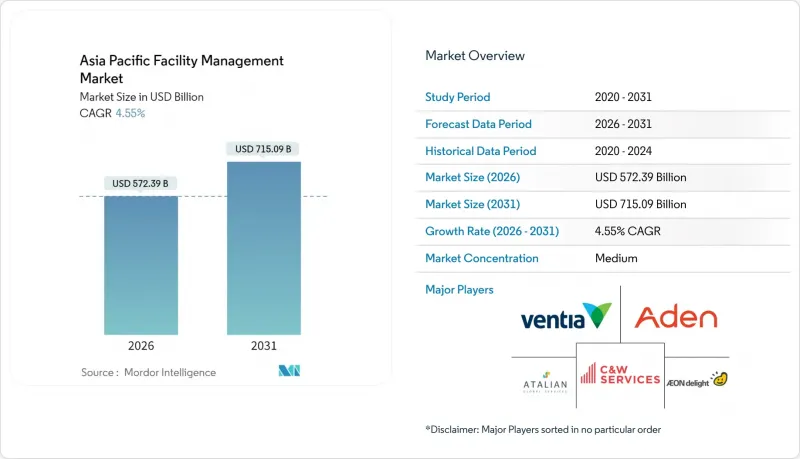
區域需求受到日益嚴格的ESG合規要求、資料中心快速部署以及人工智慧驅動的建築管理系統日益普及的支撐。儘管硬性服務仍佔據支出的大部分,但隨著租戶對職場體驗和安全性的日益重視,軟性服務正逐漸獲得發展動力。外包業務在營運複雜性不斷增加的背景下穩步成長,但供應鏈成本上漲和監管差異等宏觀不利因素限制了其短期成長。
亞太地區設施管理市場趨勢與洞察
建築管理外包日益增多
企業房地產團隊正從分散的內部模式轉向整合式外包,從而獲得監管、數位化和永續性的專業知識。世邦魏理仕 (CBRE) 報告稱,其設施管理業務在 2025 年第一季的收入淨額年增 16%,主要得益於科技、醫療保健和生命科學行業的客戶成長。整合式服務協議簡化了供應商管理,並將績效與可衡量的結果掛鉤。 ISS 與柏克萊續簽的五年全球合約顯示了跨區域捆綁式服務的吸引力。在勞動力短缺的市場,例如日本和新加坡,外包的採用尤其顯著,這些市場老化的勞動力凸顯了外部技術專長的價值。擁有合規認證和數位化可追蹤服務品質的本地供應商正在獲得競爭優勢。中期來看,隨著數位化平台實現透明的成本基準分析並支援按績效付費的定價模式,外包的採用率預計將繼續成長。
安全保障的需求日益成長
世界各國政府都在收緊職場安全法規,迫使企業升級其監控和培訓通訊協定。在新加坡,2025 年《機械和可燃粉塵法規》將提高合規要求,從而推動對具備即時風險分析技能的專業設施合作夥伴的需求。人工智慧設備,例如能夠檢測溢出物和冷凝水的混合式地面濕度感測器,正從試點階段走向主流部署,UnaBiz Singapore 的 2024 年部署計畫就體現了這一點。擁有多個辦公地點的公司需要統一的儀錶板,以實現跨司法管轄區的數據標準化,同時遵守當地的報告法規。擁有成熟的數位安全解決方案的營運商可以實現預測性事故預防,從而幫助降低保險費和停機成本。對員工福祉日益成長的關注,正推動著在人口密集的城市園區內加大對門禁系統、室內空氣品質感測器和智慧疏散系統的投資。
高昂的實施成本
對於中型物業而言,智慧建築硬體、軟體許可和合規方面的初始投資可能超過30萬美元,這給中小業主帶來了採用該技術的障礙。不斷上漲的資本和人事費用進一步延長了投資回收期。然而,先導計畫始終能夠實現兩位數的節能效果。即使是整合基於物聯網的預測性維護的製造商,也需要兩到三年的投資回收期,例如Azbil公司在印尼PT. Aspex Kumbong公司的實施案例。許多租戶為了管理現金流而分階段實施,但部分部署限制了完全整合平台的協同效應。提供按績效付費或資產即服務模式的營運商可以緩解這一障礙,但該地區中小企業的財務限制使得成本成為市場擴張的最大限制因素。
細分市場分析
隨著雇主優先考慮員工體驗指標並採用人工智慧輔助的安保、禮賓和清潔解決方案,軟性服務預計將以更快的速度成長,到2031年將維持6.05%的複合年成長率。亞太地區設施管理市場的軟性服務板塊正受益於日常清潔中機器人的應用以及將佔用率分析整合到服務台應用程式中。在新加坡、東京和雪梨等地的高階辦公空間競標中,非接觸式訪客管理系統和基於人工智慧的監控系統已成為必備條件。同時,將食品分析數據與採購系統連結的先進餐飲平台在企業園區中越來越受歡迎,因為它們有助於推廣健康計畫。
到2025年,硬體服務將維持55.72%的收入佔有率,這主要得益於關鍵基礎設施維護,例如機電(MEP)、暖通空調(HVAC)和消防系統。預測分析正在創造新的價值:例如,Yamaha Motor Co, Ltd.的機器人自動化(降低了60%的工廠人事費用)等應用案例正在提升亞太地區設施管理領域機電供應商的市場佔有率。在曼谷瑞吉酒店試點計畫中,人工智慧最佳化的冷卻器實現了9%的節能效果並延長了設備使用壽命,吸引了業主和能源服務公司的注意。消防系統供應商正在將物聯網感測器與雲端儀錶板結合,以從基於巡檢的模式轉向即時風險緩解。
其他福利:
- Excel格式的市場預測(ME)表
- 3個月的分析師支持
目錄
第1章 引言
- 研究假設和市場定義
- 調查範圍
第2章調查方法
第3章執行摘要
第4章 市場情勢
- 市場概覽
- 目前運轉率
- 主要FM業者的盈利能力
- 勞動指標 - 勞動參與率
- 按服務類型分類的設施管理市場佔有率(%)
- 按硬體服務分類的設施管理市場佔有率(%)
- 以軟性服務分類的設施管理市場佔有率(%)
- 主要都會區的都市化和人口成長
- 亞太地區基礎設施管道投資優先事項(按行業分類)
- 與勞動和安全標準相關的監管因素
- 市場促進因素
- 建築管理外包日益增多
- 日益成長的安全需求
- 設施管理的技術進步
- 推出以ESG主導的綠建築認證
- 亞太地區資料中心建設擴張
- 生命科學和醫療保健設施的激增需要專業的設施管理服務
- 市場限制
- 高昂的實施成本
- 各國監管標準分散
- 傳統設施管理客戶的數位化成熟度較低
- 短期設施管理合約條款限制了長期投資回報。
- 價值鏈分析
- PESTEL 分析
- 新參與企業的監管和法律體制
- 宏觀經濟指標對FM需求的影響
- 波特五力分析
- 供應商的議價能力
- 買方的議價能力
- 新進入者的威脅
- 替代品的威脅
- 競爭對手之間的競爭
- 投資與資金籌措分析
第5章 市場規模與成長預測
- 按服務類型
- 硬服務
- 資產管理
- 機電及暖通空調服務
- 消防系統和安全措施
- 其他硬體維修服務
- 軟服務
- 辦公室支援與安全
- 清潔服務
- 餐飲服務
- 其他軟性調頻服務
- 硬服務
- 按規定表格
- 內部
- 外包
- 單頻調頻
- 捆綁式設施管理
- 綜合設施管理
- 按最終用戶行業分類
- 商業(IT/通訊、零售/倉儲)
- 餐飲服務業(飯店、餐廳、大型餐廳)
- 公共及公共基礎設施(政府、教育、交通)
- 醫療保健(公立和私立機構)
- 工業和流程工業(製造業、能源業、採礦業)
- 其他終端用戶產業(多用戶住宅、娛樂、運動和休閒)
- 按國家/地區
- 中國
- 印度
- 日本
- 韓國
- 印尼
- 泰國
- 亞太其他地區
第6章 競爭情勢
- 市場集中度
- 策略發展與夥伴關係
- 市佔率分析
- 公司簡介
- Aden Group
- Aeon Delight Co. Ltd(AEON Co. Ltd)
- ATALIAN Global Services
- Broadspectrum(Ventia)
- CBRE Group Inc.
- C&W Facility Services Inc.
- Commercial Building Maintenance Corp.
- CPG Corporation
- Cushman & Wakefield plc
- DTSS Facility Services
- EMCOR Group Inc.
- G4S Facilities Management
- ISS Facility Services
- Jones Lang LaSalle(JLL)
- OCS Group International Ltd.
- Sodexo SA
- UEMS Solutions
第7章 市場機會與未來展望
The Asia Pacific facility management market was valued at USD 547.48 billion in 2025 and estimated to grow from USD 572.39 billion in 2026 to reach USD 715.09 billion by 2031, at a CAGR of 4.55% during the forecast period (2026-2031).
Regional demand is anchored in stricter ESG compliance, rapid data-center roll-outs, and the uptake of AI-enabled building operating systems. Hard services continue to dominate spend, yet soft services are gaining momentum as occupiers elevate workplace experience and security priorities. Outsourcing grows steadily on the back of rising operational complexity, while macro headwinds such as supply-chain cost inflation and uneven regulation temper near-term expansion.
Asia Pacific Facility Management Market Trends and Insights
Rising Outsourcing in Building Management
Corporate real-estate teams are shifting from fragmented in-house models toward integrated outsourcing to access specialized regulatory, digital, and sustainability expertise. CBRE reported 16% year-on-year net-revenue growth in its facilities-management segment for Q1 2025, with technology, healthcare, and life-science clients as primary contributors. Integrated service contracts simplify vendor management and link performance to measurable outcomes, with the five-year renewal of ISS's global agreement with Barclays illustrating the appeal of bundled, cross-regional delivery. Outsourcing uptake is especially strong in labor-constrained markets such as Japan and Singapore, where aging workforces elevate the value of external technical specialists. Local providers that demonstrate compliance credentials and digitally traceable service quality are gaining competitive advantages. Over the medium term, outsourcing penetration is expected to climb as digital platforms enable transparent cost benchmarking and support pay-for-performance pricing models.
Heightened Safety and Security Needs
Governments are tightening workplace-safety statutes, compelling occupiers to upgrade monitoring and training protocols. Singapore's 2025 regulations on machinery and combustible dust have raised compliance thresholds, driving demand for specialist facility partners versed in real-time risk analytics. AI-enabled devices such as hybrid floor-wetness sensors that detect spills or condensation are moving from pilot to mainstream deployment, as demonstrated by UnaBiz Singapore's 2024 launch.Multisite corporates require unified dashboards that normalize data across jurisdictions while honoring local reporting rules. Providers with mature digital safety suites can deliver predictive incident prevention, lowering insurance premiums and downtime costs. The heightened focus on employee well-being fuels incremental spend on access control, indoor-air quality sensors, and smart-evacuation systems across dense urban campuses.
High Implementation Costs
Up-front capital for smart-building hardware, software licenses, and compliance upgrades can exceed USD 300,000 for a mid-size property, creating adoption hurdles for small and mid-tier owners. Inflation in equipment and labor costs further stretches payback timelines, even though pilot projects regularly demonstrate double-digit energy reductions. Manufacturers integrating IoT-based predictive maintenance still face recovery periods of two to three years, as illustrated by Azbil Corporation's deployment at PT. Aspex Kumbong in Indonesia. Many occupiers sequence implementations in phases to manage cash flow, but partial roll-outs limit the synergy gains of fully integrated platforms. Providers that structure outcome-based pricing or equipment-as-a-service models can mitigate the barrier, yet balance-sheet limitations among regional SMEs keep cost as the most immediate drag on market expansion.
Other drivers and restraints analyzed in the detailed report include:
- Technological Advancements in Facility Management
- ESG-Driven Green Building Certification Adoption
- Fragmented Regulatory Standards Across Countries
For complete list of drivers and restraints, kindly check the Table Of Contents.
Segment Analysis
Soft services generated faster expansion, recording a 6.05% CAGR through 2031 as employers elevate employee-experience metrics and deploy AI-assisted security, concierge, and cleaning solutions. The Asia Pacific facility management market size for soft services is benefiting from the rollout of robotics for routine cleaning and the integration of occupancy analytics into help-desk applications. Contactless visitor management and AI-based surveillance systems now form mandatory bid requirements in high-grade offices across Singapore, Tokyo, and Sydney. In parallel, advanced catering platforms that link dietary analytics to procurement systems are gaining popularity in corporate campuses looking to meet wellness commitments.
Hard services retained 55.72% revenue share in 2025, supported by critical infrastructure maintenance including MEP, HVAC, and fire-safety systems. Predictive analytics adds new value layers: the Asia Pacific facility management market share for MEP providers is reinforced by use cases such as Yamaha Motor's robotic automation, which has cut factory labor costs by 60%. AI-optimized chillers, exemplified by the St. Regis Bangkok pilot, showcase measurable 9% energy savings and extend equipment life cycles, drawing interest from both owners and energy-service companies. Fire-system vendors are bundling IoT sensors with cloud dashboards to transition from inspection-based models to real-time risk mitigation.
Asia-Pacific Facility Management Market Report is Segmented by Service Type (Hard Services, Soft Services), Offering Type (In-House, Outsourced), End-User Industry (Commercial, Hospitality, Institutional and Public Infrastructure, Healthcare, and More), and Geography (China, India, Japan, Korea, Indonesia, Thailand, Rest of Asia-Pacific). The Market Forecasts are Provided in Terms of Value (USD).
List of Companies Covered in this Report:
- Aden Group
- Aeon Delight Co. Ltd (AEON Co. Ltd)
- ATALIAN Global Services
- Broadspectrum (Ventia)
- CBRE Group Inc.
- C&W Facility Services Inc.
- Commercial Building Maintenance Corp.
- CPG Corporation
- Cushman & Wakefield plc
- DTSS Facility Services
- EMCOR Group Inc.
- G4S Facilities Management
- ISS Facility Services
- Jones Lang LaSalle (JLL)
- OCS Group International Ltd.
- Sodexo S.A.
- UEMS Solutions
Additional Benefits:
- The market estimate (ME) sheet in Excel format
- 3 months of analyst support
TABLE OF CONTENTS
1 INTRODUCTION
- 1.1 Study Assumptions and Market Definition
- 1.2 Scope of the Study
2 RESEARCH METHODOLOGY
3 EXECUTIVE SUMMARY
4 MARKET LANDSCAPE
- 4.1 Market Overview
- 4.1.1 Current Occupancy Rates
- 4.1.2 Profitability Rates of Major FM Players
- 4.1.3 Workforce Indicators - Labor Participation
- 4.1.4 Facility Management Market Share (%) by Service Type
- 4.1.5 Facility Management Market Share (%) by Hard Services
- 4.1.6 Facility Management Market Share (%) by Soft Services
- 4.1.7 Urbanization and Population Growth in Major Metros
- 4.1.8 Sector Investment Priorities in Asia Pacific Infrastructure Pipeline
- 4.1.9 Regulatory Drivers Specific to Labour and Safety Standards
- 4.2 Market Driver
- 4.2.1 Rising Outsourcing in Building Management
- 4.2.2 Heightened Safety and Security Needs
- 4.2.3 Technological Advancements in Facility Management
- 4.2.4 ESG-Driven Green Building Certification Adoption
- 4.2.5 Expansion of Data Centre Construction Across Asia-Pacific
- 4.2.6 Proliferation of Life-Sciences and Healthcare Facilities Requiring Specialized FM Services
- 4.3 Market Restraint
- 4.3.1 High Implementation Costs
- 4.3.2 Fragmented Regulatory Standards Across Countries
- 4.3.3 Low Digital Maturity Among Traditional FM Clients
- 4.3.4 Short FM Contract Tenures Limiting Long-Term Investment Payback
- 4.4 Value Chain Analysis
- 4.5 PESTEL Analysis
- 4.6 Regulatory and Legislative Framework for Market Entrants
- 4.7 Impact of Macroeconomic Indicators on FM Demand
- 4.8 Porter's Five Forces Analysis
- 4.8.1 Bargaining Power of Suppliers
- 4.8.2 Bargaining Power of Buyers
- 4.8.3 Threat of New Entrants
- 4.8.4 Threat of Substitute Services
- 4.8.5 Intensity of Competitive Rivalry
- 4.9 Investment and Funding Analysis
5 MARKET SIZE AND GROWTH FORECASTS (VALUE)
- 5.1 By Service Type
- 5.1.1 Hard Services
- 5.1.1.1 Asset Management
- 5.1.1.2 MEP and HVAC Services
- 5.1.1.3 Fire Systems and Safety
- 5.1.1.4 Other Hard FM Services
- 5.1.2 Soft Services
- 5.1.2.1 Office Support and Security
- 5.1.2.2 Cleaning Services
- 5.1.2.3 Catering Services
- 5.1.2.4 Other Soft FM Services
- 5.1.1 Hard Services
- 5.2 By Offering Type
- 5.2.1 In-house
- 5.2.2 Outsourced
- 5.2.2.1 Single FM
- 5.2.2.2 Bundled FM
- 5.2.2.3 Integrated FM
- 5.3 By End-user Industry
- 5.3.1 Commercial (IT and Telecom, Retail and Warehouses)
- 5.3.2 Hospitality (Hotels, Eateries, Large-scale Restaurants)
- 5.3.3 Institutional and Public Infrastructure (Govt, Education, Transportation)
- 5.3.4 Healthcare (Public and Private Facilities)
- 5.3.5 Industrial and Process (Manufacturing, Energy, Mining)
- 5.3.6 Other End-user Industries (Multi-housing, Entertainment, Sports and Leisure)
- 5.4 By Country
- 5.4.1 China
- 5.4.2 India
- 5.4.3 Japan
- 5.4.4 Korea
- 5.4.5 Indonesia
- 5.4.6 Thailand
- 5.4.7 Rest of Asia-Pacific
6 COMPETITIVE LANDSCAPE
- 6.1 Market Concentration
- 6.2 Strategic Moves and Partnerships
- 6.3 Market Share Analysis
- 6.4 Company Profiles (includes Global level Overview, Market level overview, Core Segments, Financials as available, Strategic Information, Market Rank/Share for key companies, Products and Services, and Recent Developments)
- 6.4.1 Aden Group
- 6.4.2 Aeon Delight Co. Ltd (AEON Co. Ltd)
- 6.4.3 ATALIAN Global Services
- 6.4.4 Broadspectrum (Ventia)
- 6.4.5 CBRE Group Inc.
- 6.4.6 C&W Facility Services Inc.
- 6.4.7 Commercial Building Maintenance Corp.
- 6.4.8 CPG Corporation
- 6.4.9 Cushman & Wakefield plc
- 6.4.10 DTSS Facility Services
- 6.4.11 EMCOR Group Inc.
- 6.4.12 G4S Facilities Management
- 6.4.13 ISS Facility Services
- 6.4.14 Jones Lang LaSalle (JLL)
- 6.4.15 OCS Group International Ltd.
- 6.4.16 Sodexo S.A.
- 6.4.17 UEMS Solutions
7 MARKET OPPORTUNITIES AND FUTURE OUTLOOK
- 7.1 White-space and Unmet-Need Assessment
- 7.2 Technology-led Integrated FM (IoT, BMS, AI-based Predictive Maintenance)

 設施管理服務市場:2026-2032年全球市場預測(依服務類型、合約類型、服務交付方式、最終用戶和組織規模分類)
 2026年全球地下設施維護與管理市場報告2026年全球硬性服務設施管理市場報告2026年全球設施支援服務市場報告2026年全球設施管理服務市場報告2026年全球軟性服務設施管理市場報告
 設施管理市場規模、佔有率、成長及全球產業分析:按類型、應用和地區分類的洞察,2026-2034 年預測硬設施管理市場:依服務類型、合約類型、所有權類型和最終用戶產業分類-2026-2032年全球市場預測2026年全球電腦輔助設施管理(CAFM)市場報告2026年全球整合性機構管理市場報告