


 |
市場調查報告書
商品編碼
1940709
超音波流量計:市場佔有率分析、行業趨勢和統計數據、成長預測(2026-2031)Ultrasonic Flow Meters - Market Share Analysis, Industry Trends & Statistics, Growth Forecasts (2026 - 2031) |
||||||

※ 本網頁內容可能與最新版本有所差異。詳細情況請與我們聯繫。
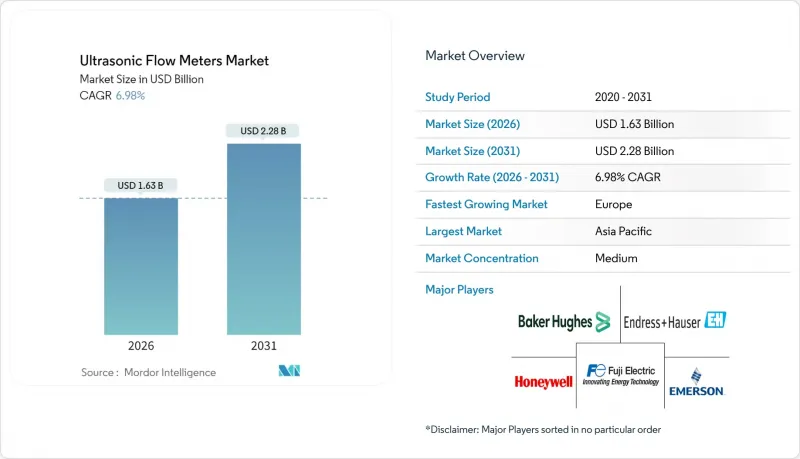
預計到 2026 年,超音波流量計市場規模將達到 16.3 億美元,高於 2025 年的 15.2 億美元。
預計到 2031 年將達到 22.8 億美元,2026 年至 2031 年的複合年成長率為 6.98%。
大口徑天然氣管道中計量式流量計的廣泛應用、老舊水網對夾裝式流量計的維修需求,以及氫能基礎設施的早期投資,共同推動了整個製程工業近兩位數的成長。與差壓式和渦輪式流量計相比,零壓降、可進行預測性維護且整合工業物聯網 (IIoT) 的超音波流量計更受營運商青睞,因為它們能夠降低生命週期內的運行成本。在環境法規要求嚴格控制流量的領域,例如化學工業的零液體排放要求和市政供水系統的洩漏控制計劃,超音波流量計的應用正在加速推進。競爭優勢日益凸顯,企業越來越注重邊緣人工智慧診斷和多路徑冗餘等技術,這些技術即使在嚴苛的貿易計量條件下也能維持 ±0.15% 的重複性。
全球超音波流量計市場趨勢及洞察
加速大直徑天然氣管道計量級超音波流量計的過渡
由於超音波流量計能夠消除壓降損失,降低壓縮機能耗高達15%,且使用壽命長達20年,維護量極低,管道運營商正逐步淘汰渦輪流量計。多通道設計可滿足API標準的精度要求,並支援使用小體積探針進行現場檢驗,從而最大限度地減少校準停機時間。這種應用在北美頁岩氣運輸路線和中東出口管道中尤其明顯,因為這些地區輸送量的波動需要更寬的雷諾數容差範圍。
水資源緊張地區對非侵入式夾裝流量計的快速維修需求
非侵入式夾裝式計量裝置使公共產業無需切割預力混凝土圓柱形管道即可安裝計量設備,從而降低災難性破裂的風險並精確定位洩漏點。在新興經濟體中,洩漏造成的處理水損失佔20%至30%。市政計劃可在數週內安裝數百個計量表,並提供特定區域的計量分析,以最佳化壓力並減少無收益水。
與傳統差壓/渦輪流量計相比,初始資本投資較高。
超音波的安裝成本(包括試運行和培訓)是差壓式檢測方法的3到5倍,儘管其在整個生命週期內具有潛在的運營成本優勢,但對於預算小規模的市政機構而言,這仍然是一個挑戰。資金籌措限制減緩了發展中地區先進診斷技術的應用,因為在這些地區,功能性往往比先進的診斷技術更為重要。
細分市場分析
預計到2025年,在線連續超音波流量計將佔據65.60%的市場。同時,夾裝式流量計預計將以8.18%的複合年成長率成長,反映出亞太地區公共產業維修專案的不斷擴大。夾裝式流量計受惠於WaveInjector感測器外殼,可承受-200°C至+630°C的製程溫度。非侵入式設備正在加速工業工廠對緊急洩漏檢測和臨時審核的需求,以避免生產停機。
第二代耦合墊和自動化安裝鑽機將安裝時間縮短了一半,在停水成本高於水錶價格的環境中,顯著提升了經濟優勢。試點智慧水務計畫的公共產業在安裝夾式流量計後的幾個月內,洩漏率就有所降低,這加快了投資回報,並進一步拓展了超音波流量計在資金受限環境下的市場。
預計到2025年,時差式流量計將佔據82.10%的市場佔有率,並在2031年之前以8.36%的複合年成長率成長。其測量聲速的功能支持成分監測,這對於氫氣混合至關重要,並且隨著脫碳進程的推進,其價值提案也在不斷提升。即使在溫度波動的環境下,利用機器學習進行剖面校正也能維持±0.5%的精確度。
另一方面,多普勒裝置的精度有限,不適用於含污流體環境。對於多相管道,單一技術的限制顯而易見,因此,結合多普勒和飛行時間測量的混合平台正在興起。採用可切換原理的模組化電子設備使操作人員能夠標準化使用單一發送器系列,從而減少各種應用場景下的庫存。
區域分析
到2025年,亞太地區將佔全球營收的41.25%,這主要得益於中國「一帶一路」沿線計劃和印度「智慧城市計畫」對高精度測量的迫切需求。日本和韓國的本土製造商正透過物聯網賦能的變送器和溫度補償感測器來增強自身競爭力,從而提升該地區的供應安全。各國政府正將基礎設施獎勵策略放在污水再利用上,這推動了市政計劃中超音波流量計的應用。
預計歐洲將以10.11%的複合年成長率成長,這主要得益於歐盟政策推動的氫氣管道維修和對計量指令更嚴格的遵守。德國一家化工企業正在其製程強化項目中應用超音波流量計,以降低每噸產品的能耗。荷蘭正在加速推進其氫氣注入試點項目,該項目需要專有的品質調整技術。區域供應商正利用垂直整合,將測量設備與雲端分析結合,以滿足嚴格的永續性審核。
北美地區持續保持個位數溫和成長,這主要得益於頁岩氣交易計量升級以及西部供水事業地區各州的洩漏預防計劃。聯邦基礎設施立法正在津貼採用智慧水系統,該系統使用夾裝式水錶安裝在老舊的球墨鑄鐵管道上。南美和中東/非洲是新興的需求區域,但DN1000以上規格管道的認證校準實驗室數量有限,導致新管道的核准流程延誤。為此,供應商正在透過部署行動服務供應商和遠端支援中心來降低服務門檻。
其他福利:
- Excel格式的市場預測(ME)表
- 3個月的分析師支持
目錄
第1章 引言
- 研究假設和市場定義
- 調查範圍
第2章調查方法
第3章執行摘要
第4章 市場情勢
- 市場概覽
- 宏觀經濟因素的影響
- 市場促進因素
- 加速向大口徑天然氣管道交易型超音波流量計過渡
- 缺水地區對維修非侵入式夾式水錶的需求迅速成長
- 與氫氣相容的超音波設計在能源轉型中帶來先發優勢
- 邊緣人工智慧自診斷技術有助於公共產業降低營運成本並促進預測性維護
- 推動化學工業精準流量控制的因素:強制性零液體排放(ZLD)政策
- 整合到智慧泵中的超音波發送器擴大了可觸及的OEM市場
- 市場限制
- 與傳統差壓式流量計和渦輪流量計相比,初始資本投資成本較高。
- 在不使用高階訊號處理技術的情況下,多相流和漿料環境中的精度漂移問題
- 新興地區缺乏經認證的DN1000以上等級校準實驗室
- 關鍵基礎設施中工業物聯網連接電錶的網路安全隱患
- 產業供應鏈分析
- 監管環境
- 科技展望(物聯網相容性、氫能相容性、人工智慧)
- 波特五力分析
- 新進入者的威脅
- 供應商的議價能力
- 買方的議價能力
- 替代品的威脅
- 競爭對手之間的競爭
第5章 市場規模與成長預測
- 透過安裝方法
- 夾式
- 在線連續
- 透過測量技術
- 交通時刻表
- 多普勒
- 混合/多路徑
- 按最終用戶行業分類
- 石油和天然氣
- 供水和污水處理
- 化工和石油化工
- 工業領域(食品飲料、航太、汽車)
- 其他產業(生命科學、採礦和金屬)
- 按路線數量
- 單一途徑
- 多輪傳球(3輪、4輪、5輪以上)
- 按地區
- 北美洲
- 美國
- 加拿大
- 墨西哥
- 南美洲
- 巴西
- 阿根廷
- 其他南美洲
- 歐洲
- 德國
- 英國
- 法國
- 義大利
- 西班牙
- 俄羅斯
- 其他歐洲地區
- 亞太地區
- 中國
- 日本
- 印度
- 韓國
- 亞太其他地區
- 中東和非洲
- 中東
- 沙烏地阿拉伯
- 阿拉伯聯合大公國
- 土耳其
- 其他中東地區
- 非洲
- 南非
- 奈及利亞
- 其他非洲地區
- 中東
- 北美洲
第6章 競爭情勢
- 市場集中度
- 策略趨勢
- 市佔率分析
- 公司簡介
- Baker Hughes Company
- Endress+Hauser Group Services AG
- Fuji Electric Co., Ltd.
- Honeywell International Inc.
- Emerson Electric Co.
- ABB Ltd.
- Aichi Tokei Denki Co., Ltd.
- Apator SA
- Arad Group
- Badger Meter Inc.
- Bronkhorst High-Tech BV
- Diehl Metering GmbH
- FLEXIM Instruments GmbH
- Itron Inc.
- Kamstrup A/S
- KOBOLD Messring GmbH
- KROHNE Group
- Landis+Gyr AG
- Mueller Systems LLC
- Neptune Technology Group Inc.
- Omega Engineering Inc.
- SICK AG
- Siemens AG
- Sensus USA Inc.
- WEIHAI Ploumeter Co., Ltd.
第7章 市場機會與未來展望
Ultrasonic flow meters market size in 2026 is estimated at USD 1.63 billion, growing from 2025 value of USD 1.52 billion with 2031 projections showing USD 2.28 billion, growing at 6.98% CAGR over 2026-2031.
The growing deployment of custody-transfer-grade meters in large-diameter gas pipelines, retrofit demand for clamp-on devices in aging water networks, and early-stage investments in hydrogen infrastructure sustain near-double-digit demand across the process industries. Operators favor ultrasonic designs for zero pressure loss, predictive maintenance, and IIoT integration, which reduce lifetime operating expenditure compared with differential-pressure or turbine meters. Adoption accelerates where environmental compliance drives high-accuracy flow control, such as zero-liquid-discharge mandates in chemical processing and leakage-reduction programs in municipal water systems. Competitive differentiation is increasingly centered on edge-AI diagnostics and multi-path redundancy, which maintain +-0.15% repeatability in demanding custody-transfer conditions.
Global Ultrasonic Flow Meters Market Trends and Insights
Accelerated shift to custody-transfer-grade ultrasonic meters in large-diameter gas pipelines
Pipeline operators have begun phasing out turbine meters because ultrasonic units eliminate pressure-drop penalties, reducing compressor energy consumption by up to 15% while offering 20-year lifetimes with minimal maintenance. Multi-path designs now deliver API-compliant accuracy and enable field verification through small-volume provers, limiting downtime for calibration. Adoption is most visible in North American shale gas corridors and Middle Eastern export pipelines, where throughput variability requires wide Reynolds-number tolerance.
Rapid retrofit demand for non-invasive clamp-on meters in water-stress hotspots
Non-invasive clamp-on devices enable utilities to instrument prestressed concrete cylinder pipelines without cutting, thereby mitigating the risk of catastrophic failure while identifying leaks responsible for 20-30% of treated-water losses in emerging economies. Municipal projects can deploy hundreds of meters in weeks, enabling district-metered-area analytics that optimize pressure and drive down non-revenue water.
High initial CAPEX vs. legacy DP/turbine meters
Ultrasonic installations cost three to five times more than differential-pressure alternatives once commissioning and training are included, challenging smaller municipal budgets despite lifecycle OPEX savings. Financing constraints slow the adoption of advanced diagnostics in developing regions, where functionality often takes precedence over advanced diagnostics.
Other drivers and restraints analyzed in the detailed report include:
- Hydrogen-ready ultrasonic designs enable early-mover advantage in energy transition
- Edge-AI self-diagnostics cut OPEX for utilities and boost predictive maintenance adoption
- Accuracy drift in multiphase/slurry service without advanced signal conditioning
For complete list of drivers and restraints, kindly check the Table Of Contents.
Segment Analysis
In-line designs accounted for 65.60% of the ultrasonic flow meters market share in 2025. Clamp-on units, however, are projected to register an 8.18% CAGR, reflecting expanding retrofit programs across APAC utilities. The clamp-on segment benefits from WaveInjector transducer housings that can tolerate process ranges of -200 °C to +630 °C. As non-invasive devices avoid production outages, demand accelerates for emergency leak surveys and temporary audits in industrial plants.
Second-generation coupling pads and automated mounting rigs halve installation time, reinforcing economic advantages where shutdown costs exceed instrument price. Utilities piloting smart-water programs confirm leak-rate reductions within months of clamp-on deployments, supporting rapid investment payback and further penetration of the ultrasonic flow meters market in constrained capital environments.
Transit-time units held an 82.10% share in 2025 and are set to grow at an 8.36% CAGR through 2031. Their capability to capture sonic velocity supports composition monitoring needed for hydrogen-gas blends, elevating their value proposition as decarbonization momentum builds. Machine-learning-driven profile correction now sustains +-0.5% accuracy even under variable temperature regimes.
Doppler devices remain confined to dirty-fluid contexts due to their lower precision, while hybrid platforms combining Doppler and transit-time measurements are emerging for multiphase pipelines where shortfalls of single-method approaches are apparent. Modular electronics that switch between principles enable operators to standardize on one transmitter family, reducing inventory even as application diversity expands.
The Ultrasonic Flow Meters Market Report is Segmented by Mounting Method (Clamp-On, In-Line), Measurement Technology (Transit-Time, Doppler, Hybrid/Multipath), End-User Industry (Oil and Gas, Water and Wastewater, Chemical and Petrochemical, Industrial, Other Industries), Number of Paths (Single-Path, Multi-Path), and Geography. The Market Forecasts are Provided in Terms of Value (USD).
Geography Analysis
Asia-Pacific contributed 41.25% of global revenue in 2025, fueled by China's Belt and Road pipeline projects and India's Smart Cities Mission that mandates high-accuracy metering. Local producers in Japan and South Korea enhance competitiveness through IoT-ready transmitters and temperature-compensating transducers, reinforcing regional supply security. Governments channel infrastructure stimulus toward wastewater reuse, thereby elevating the adoption of ultrasonic flow meters in municipal projects.
Europe is projected to expand at a 10.11% CAGR as EU policy drives hydrogen-ready pipeline retrofits and rigorous conformance to the Measuring Instruments Directive. Germany's chemical heartland embeds ultrasonic meters within process intensification programs to reduce energy consumption per ton of output, while the Netherlands accelerates hydrogen injection pilots that require custody-grade mass reconciliation. Regional suppliers leverage vertical integration, combining instruments with cloud analytics to satisfy stringent sustainability audits.
North America sustains mid-single-digit growth, anchored by shale gas custody-transfer upgrades and water utility leakage projects in drought-prone western states. Federal infrastructure bills subsidize smart-water deployments that favor clamp-on meters for aging ductile-iron mains. South America and the Middle East-Africa represent emerging demand pockets, though limited accredited calibration facilities above DN 1000 slow some greenfield pipeline approvals. Suppliers counter by deploying mobile providers and remote support hubs, easing service barriers.
- Baker Hughes Company
- Endress+Hauser Group Services AG
- Fuji Electric Co., Ltd.
- Honeywell International Inc.
- Emerson Electric Co.
- ABB Ltd.
- Aichi Tokei Denki Co., Ltd.
- Apator SA
- Arad Group
- Badger Meter Inc.
- Bronkhorst High-Tech BV
- Diehl Metering GmbH
- FLEXIM Instruments GmbH
- Itron Inc.
- Kamstrup A/S
- KOBOLD Messring GmbH
- KROHNE Group
- Landis+Gyr AG
- Mueller Systems LLC
- Neptune Technology Group Inc.
- Omega Engineering Inc.
- SICK AG
- Siemens AG
- Sensus USA Inc.
- WEIHAI Ploumeter Co., Ltd.
Additional Benefits:
- The market estimate (ME) sheet in Excel format
- 3 months of analyst support
TABLE OF CONTENTS
1 INTRODUCTION
- 1.1 Study Assumptions and Market Definition
- 1.2 Scope of the Study
2 RESEARCH METHODOLOGY
3 EXECUTIVE SUMMARY
4 MARKET LANDSCAPE
- 4.1 Market Overview
- 4.2 Impact of Macroeconomic Factors
- 4.3 Market Drivers
- 4.3.1 Accelerated shift to custody-transfer-grade ultrasonic meters in large-diameter gas pipelines
- 4.3.2 Rapid retrofit demand for non-invasive clamp-on meters in water-stress hotspots
- 4.3.3 Hydrogen-ready ultrasonic designs enable early-mover advantage in energy transition
- 4.3.4 Edge-AI self-diagnostics cut OPEX for utilities and boost predictive maintenance adoption
- 4.3.5 Mandatory zero-liquid-discharge policies push high-accuracy flow control in chemicals
- 4.3.6 OEM-embedded ultrasonic transmitters in smart pumps expand addressable OEM market
- 4.4 Market Restraints
- 4.4.1 High initial CAPEX vs. legacy DP/turbine meters
- 4.4.2 Accuracy drift in multiphase / slurry service without advanced signal conditioning
- 4.4.3 Scarcity of accredited calibration labs above DN 1000 in emerging regions
- 4.4.4 Cyber-security concerns over IIoT-connected meters in critical infrastructure
- 4.5 Industry Supply Chain Analysis
- 4.6 Regulatory Landscape
- 4.7 Technological Outlook (IoT-enabled, hydrogen-ready, AI)
- 4.8 Porter's Five Forces Analysis
- 4.8.1 Threat of New Entrants
- 4.8.2 Bargaining Power of Suppliers
- 4.8.3 Bargaining Power of Buyers
- 4.8.4 Threat of Substitutes
- 4.8.5 Competitive Rivalry
5 MARKET SIZE AND GROWTH FORECASTS (VALUE)
- 5.1 By Mounting Method
- 5.1.1 Clamp-on
- 5.1.2 In-line
- 5.2 By Measurement Technology
- 5.2.1 Transit-time
- 5.2.2 Doppler
- 5.2.3 Hybrid / Multipath
- 5.3 By End-User Industry
- 5.3.1 Oil and Gas
- 5.3.2 Water and Wastewater
- 5.3.3 Chemical and Petrochemical
- 5.3.4 Industrial (F&B, Aerospace, Automotive)
- 5.3.5 Other Industries (Life Sciences, Mining and Metals)
- 5.4 By Number of Paths
- 5.4.1 Single-path
- 5.4.2 Multi-path (3-Path, 4-Path, 5+-Path)
- 5.5 By Geography (Value)
- 5.5.1 North America
- 5.5.1.1 United States
- 5.5.1.2 Canada
- 5.5.1.3 Mexico
- 5.5.2 South America
- 5.5.2.1 Brazil
- 5.5.2.2 Argentina
- 5.5.2.3 Rest of South America
- 5.5.3 Europe
- 5.5.3.1 Germany
- 5.5.3.2 United Kingdom
- 5.5.3.3 France
- 5.5.3.4 Italy
- 5.5.3.5 Spain
- 5.5.3.6 Russia
- 5.5.3.7 Rest of Europe
- 5.5.4 Asia-Pacific
- 5.5.4.1 China
- 5.5.4.2 Japan
- 5.5.4.3 India
- 5.5.4.4 South Korea
- 5.5.4.5 Rest of Asia-Pacific
- 5.5.5 Middle East and Africa
- 5.5.5.1 Middle East
- 5.5.5.1.1 Saudi Arabia
- 5.5.5.1.2 United Arab Emirates
- 5.5.5.1.3 Turkey
- 5.5.5.1.4 Rest of Middle East
- 5.5.5.2 Africa
- 5.5.5.2.1 South Africa
- 5.5.5.2.2 Nigeria
- 5.5.5.2.3 Rest of Africa
- 5.5.5.1 Middle East
- 5.5.1 North America
6 COMPETITIVE LANDSCAPE
- 6.1 Market Concentration
- 6.2 Strategic Moves
- 6.3 Market Share Analysis
- 6.4 Company Profiles (includes Global level Overview, Market level overview, Core Segments, Financials, Strategic Information, Market Rank/Share, Products and Services, Recent Developments)
- 6.4.1 Baker Hughes Company
- 6.4.2 Endress+Hauser Group Services AG
- 6.4.3 Fuji Electric Co., Ltd.
- 6.4.4 Honeywell International Inc.
- 6.4.5 Emerson Electric Co.
- 6.4.6 ABB Ltd.
- 6.4.7 Aichi Tokei Denki Co., Ltd.
- 6.4.8 Apator SA
- 6.4.9 Arad Group
- 6.4.10 Badger Meter Inc.
- 6.4.11 Bronkhorst High-Tech BV
- 6.4.12 Diehl Metering GmbH
- 6.4.13 FLEXIM Instruments GmbH
- 6.4.14 Itron Inc.
- 6.4.15 Kamstrup A/S
- 6.4.16 KOBOLD Messring GmbH
- 6.4.17 KROHNE Group
- 6.4.18 Landis+Gyr AG
- 6.4.19 Mueller Systems LLC
- 6.4.20 Neptune Technology Group Inc.
- 6.4.21 Omega Engineering Inc.
- 6.4.22 SICK AG
- 6.4.23 Siemens AG
- 6.4.24 Sensus USA Inc.
- 6.4.25 WEIHAI Ploumeter Co., Ltd.
7 MARKET OPPORTUNITIES AND FUTURE OUTLOOK
- 7.1 White-space and Unmet-Need Assessment

 超音波流量計市場:按安裝方式、測量技術、最終用戶和應用分類-全球市場預測(2026-2032 年)超音波油罐檢測器市場按安裝類型、產品和最終用戶分類,全球預測(2026-2032年)
 超音波流量計市場 - 全球產業規模、佔有率、趨勢、機會及預測(按感測器類型、技術、終端用戶產業、地區和競爭格局分類,2021-2031年)
 超音波流量計市場規模、佔有率和成長分析(按部署類型、測量技術、測量路徑數量、最終用戶和地區分類)—2026-2033年產業預測全球廢水及污水處理超音波流量計市場-依技術、區域及競爭格局分類的產業規模、佔有率、趨勢、機會及預測(2021-2031年預測)
 全球超音波流量計市場:市場規模、佔有率、成長率、產業分析、依類型、應用和地區劃分的分析、未來預測(2026-2034)油氣超音波流量計市場-全球產業規模、佔有率、趨勢、機會及預測(依感測器類型、技術、地區及競爭格局分類,2021-2031年預測)
 夾裝式超音波流量計市場:按產品類型、技術、產業垂直領域、國家及地區分類 - 全球產業分析、市場規模、市場佔有率及2025-2032年預測
 超音波流量計市場按安裝方式、技術、最終用戶和地區分類超音波流量計市場:2025-2030 年預測