


 |
市場調查報告書
商品編碼
1940684
數位借貸:市場佔有率分析、產業趨勢與統計、成長預測(2026-2031)Digital Lending - Market Share Analysis, Industry Trends & Statistics, Growth Forecasts (2026 - 2031) |
||||||

※ 本網頁內容可能與最新版本有所差異。詳細情況請與我們聯繫。
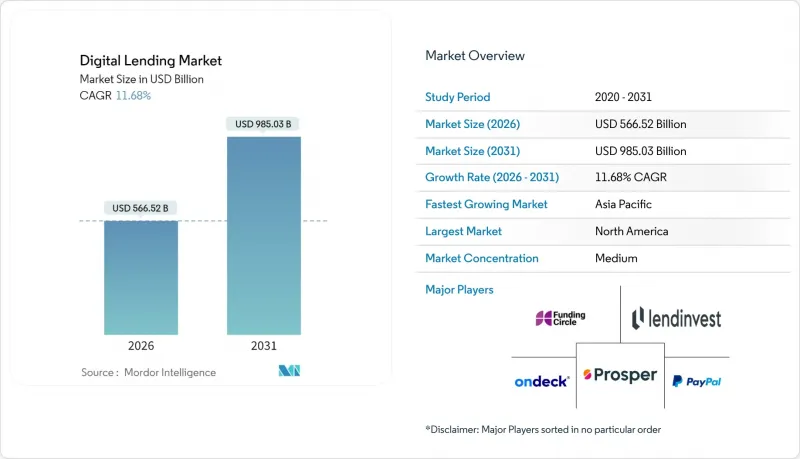
2025年數位借貸市場價值5,072.7億美元,預計到2031年將達到9,850.3億美元,高於2026年的5,665.2億美元。
預計在預測期(2026-2031 年)內,複合年成長率將達到 11.68%。
這一成長趨勢表明,技術驅動的信貸業務正穩步發展,嵌入式金融交易量不斷成長,人工智慧承銷技術也得到了機構的廣泛認可。即時信貸決策、開放銀行資料傳輸以及先買後付(BNPL)選項持續吸引借款人放棄分店分行。金融機構正投資雲端原生貸款系統,以降低處理成本,並將貸款發放時間從數週縮短至數分鐘。另類資料信用評分技術正在創造新的商機,例如針對信用記錄不佳的客戶以及跨境中小企業資金籌措。隨著金融科技公司、傳統銀行和大型科技平台在關鍵地區爭取同一群客戶,競爭日益激烈。
全球數位借貸市場趨勢與洞察
智慧型手機和網路的快速普及加速了行動優先貸款業務的發展。
到2024年,全球智慧型手機用戶數量將達到68億,這將使貸款機構能夠透過行動應用程式直接接觸借款人。光是亞太地區的數位錢包支付額就將達到9.8兆美元,將提升消費者對應用程式內信貸的接受度。如今,貸款機構正利用位置數據、設備元資料和行為模式在幾秒鐘內評估風險,從而向數百萬首次借款人提供信貸。印度資料保護委員會和歐盟人工智慧法等監管機構正在規範資料使用,使貸款機構能夠擴展合規的行動優先模式。
金融科技即時核准平台的興起正在改變借款人的預期。
超過90%的數位貸款申請現在都經過自動化審核引擎,而Upstart無需上傳文件即可達到80%的即時核准。機器學習模型即時分析數百項借款人屬性,從而降低審核成本並提高客戶滿意度。那些無法將核准時間縮短至五分鐘以內的銀行,為了維持市場佔有率,正擴大選擇與金融科技供應商建立白牌合作關係。
網路安全和資料隱私風險對平台擴充性構成挑戰。
儘管金融機構僅有13%的IT預算用於安全,但它們的API使用量卻不斷擴大。到2024年,62%的受訪貸款機構表示詐騙事件將會增加,監管機構也要求在GDPR和CCPA法規下採用零信任架構。不斷上漲的網路保險費和強制性資料外洩通知要求正在推高合規成本,尤其是對於跨境平台而言。
細分市場分析
2025年,受個人金融和先買後付(BNPL)需求的推動,消費貸款佔數位借貸市場的60.78%。同時,預計到2031年,小型企業貸款將以16.08%的複合年成長率成長,這主要得益於採用替代數據模型來評估營運資金缺口和實現即時現金流可見度。預計到2031年,小型企業數位借貸市場規模將達到2,460.9億美元。貸款機構正在將會計軟體與應用程式介面(API)整合,以收集發票、薪資和稅務數據,從而將信貸核准週期從數週縮短至48小時。隨著社群平台實現與消費者貸款組合相當的信貸損失率,全球銀行正透過收益分成夥伴關係來確保分銷管道的暢通。
在消費領域,融入電商支付流程的信貸服務持續擴大其在低收入群體中的滲透率。千禧世代的勞工階級擴大利用薪資週期數據來預支薪資。先進的可解釋人工智慧模型有效降低了偏見,表明大規模企業市場。
到2025年,個人貸款將佔數位借貸市場規模的35.44%,這得益於其即時核准模式和低成本優勢。汽車貸款也將緊隨其後,利用銷售點(POS)整合將經銷商的處理時間縮短至60秒以內[UPSTART.COM]。由於抵押品核准和補貼規定複雜,房屋抵押貸款、住宅淨值貸款和學生貸款領域的數位轉型進程較為緩慢。
預計中小企業營運資金貸款的複合年成長率將達到10.52%。銷售掛鉤貸款將還款與每日信用卡銷售掛鉤,使企業在需求波動時擁有柔軟性。嵌入企業資源計畫 (ERP) 控制面板的應收帳款應收帳款承購平台可在發票開立後24小時內釋放流動資金。這種嵌入式融資方式正吸引全球物流、農業和自由工作者生態系統,這些企業先前缺乏傳統信貸額度所需的抵押品。
區域分析
到2025年,亞太地區將佔據全球數位借貸市場39.35%的佔有率,這得益於超過235家持牌數位銀行以及政府支持的支付基礎設施,例如印度的UPI(平均每月交易量達120億筆)。中國的超級應用程式透過將借貸功能疊加到電子錢包、叫車和外送服務之上,建構了強大的數據循環。新加坡和澳洲政府正在運行監管沙盒,將產品測試週期縮短至六個月,加快新金融機構進入市場的速度。
預計非洲將以21.85%的複合年成長率成為成長最快的地區,到2028年,其收入將達到470億美元。肯亞和加納率先開發的行動支付基礎設施為小額貸款奠定了基礎,透過分析話費購買和個人轉帳來計算風險評分。奈及利亞和埃及的Start-Ups正在吸引國際創業投資資金,為非洲移民開發跨境預支工資解決方案。
北美和歐洲的普及率很高,但表面成長率正在放緩。儘管美國的「先買後付」(BNPL)相關法律仍處於不斷變化之中,但PayPal的累計貸款額已超過300億美元,展現出成熟企業的規模。在歐洲,PSD3和歐盟人工智慧法案的修訂提供了統一的規則,並加強了跨境通行證制度。然而,多項消費信貸指令中的利率上限限制了高收入細分市場的發展。在拉丁美洲,基於即時支付的嵌入式金融交易(例如巴西的PIX)的興起,為兩位數的貸款成長奠定了基礎,即使宏觀經濟波動,也能保持這一成長勢頭。
其他福利:
- Excel格式的市場預測(ME)表
- 分析師支持(3個月)
目錄
第1章 引言
- 研究假設和市場定義
- 調查範圍
第2章調查方法
第3章執行摘要
第4章 市場情勢
- 市場概覽
- 市場促進因素
- 智慧型手機和網路普及率快速成長
- 金融科技即時核准平台的激增
- 有利於開放銀行和電子客戶身份驗證(e-KYC)的法規環境
- 微企業對快速營運資金貸款的需求
- 針對信用狀況良好的借款人的替代數據信用評分
- 非銀行應用程式內嵌入式貸款的興起
- 市場限制
- 網路安全與資料隱私風險
- 監管利率上限和平台重新分類
- P2P市場違約激增引發投資人疲勞
- 第三方雲端基礎架構的集中風險
- 價值/供應鏈分析
- 監管環境
- 技術展望
- 波特五力分析
- 新進入者的威脅
- 買方的議價能力
- 供應商的議價能力
- 替代品的威脅
- 競爭對手之間的競爭
第5章 市場規模與成長預測
- 按類型
- 消費者
- 大型企業/中小企業
- 按貸款類型
- 個人貸款
- 汽車貸款
- 學生貸款
- 房屋抵押貸款/房屋股權貸款
- 小規模企業營運資金貸款
- 透過部署模式
- 基於雲端的平台
- 本地部署解決方案
- 混合
- 按經營模式
- P2P(市場)借貸
- 資產負債表(直接)融資
- 嵌入式融資/先買後付貸款
- 群眾集資及以收益為準貸款
- 透過技術
- 利用人工智慧/機器學習進行信用篩選
- API和開放銀行平台
- 基於區塊鏈的貸款
- 巨量資料分析
- 按地區
- 北美洲
- 美國
- 加拿大
- 墨西哥
- 歐洲
- 德國
- 英國
- 法國
- 俄羅斯
- 其他歐洲地區
- 亞太地區
- 中國
- 日本
- 印度
- 韓國
- 澳洲
- 亞太其他地區
- 中東和非洲
- 中東
- 沙烏地阿拉伯
- 阿拉伯聯合大公國
- 其他中東地區
- 非洲
- 南非
- 埃及
- 其他非洲地區
- 中東
- 南美洲
- 巴西
- 阿根廷
- 南美洲其他地區
- 北美洲
第6章 競爭情勢
- 市場集中度分析
- 策略性舉措(併購、合作、服務發布)
- 市佔率分析(前 15 家公司,2024 年)
- 公司簡介
- Ant Group Co., Ltd.
- WeBank Co., Ltd.
- PayPal Holdings, Inc.
- Klarna Bank AB(publ)
- LendingClub Corporation
- Upstart Holdings, Inc.
- Funding Circle Holdings plc
- On Deck Capital, Inc.
- Prosper Marketplace, Inc.
- SoFi Technologies, Inc.
- Kabbage, Inc.(American Express Co.)
- LendInvest plc
- Zopa Bank Ltd.
- Kaspi.kz JSC
- Ferratum Oyj
- CAN Capital, Inc.
- International Personal Finance plc
- Faircent Tech Pvt. Ltd.
- LenDenClub Techserve Pvt. Ltd.
- CapFloat Financial Services Pvt. Ltd.
- Oriente Group Limited
- Mercado Libre, Inc.
- Square Loans(Block, Inc.)
- PayU Finance India Pvt. Ltd.
- PagSeguro Digital Ltd.
第7章 市場機會與未來趨勢
- 閒置頻段與未滿足需求評估
The digital lending market was valued at USD 507.27 billion in 2025 and estimated to grow from USD 566.52 billion in 2026 to reach USD 985.03 billion by 2031, at a CAGR of 11.68% during the forecast period (2026-2031).
This growth profile underscores steady gains in technology-mediated credit origination, rising embedded-finance volumes, and wider institutional acceptance of AI underwriting. Real-time credit decisioning, open-banking data transfers, and buy-now-pay-later (BNPL) options continue to draw borrowers away from branch channels. Institutions are investing in cloud-native loan-origination systems that trim processing costs and shrink disbursement times from weeks to minutes. New revenue opportunities have emerged around thin-file customers and cross-border small-business funding, aided by alternative-data credit scoring. Competitive intensity is strengthening as fintechs, traditional banks, and BigTech platforms converge on identical customer segments in every major region.
Global Digital Lending Market Trends and Insights
Surge in smartphone and internet penetration accelerates mobile-first lending
Global smartphone users totaled 6.8 billion in 2024, giving lenders a direct path to borrowers through mobile apps. In Asia-Pacific alone, digital-wallet payments hit USD 9.8 trillion, reinforcing customer readiness for in-app credit offers. Lenders now harness geolocation, device metadata, and behavioural signals to evaluate risk in seconds, opening credit lines to millions of first-time borrowers. Regulators such as India's Data Protection Board and the EU's AI Act are standardizing data use, which helps lenders scale compliant mobile-first models.
Proliferation of fintech instant-approval platforms transforms borrower expectations
More than 90% of digital loan applications are now routed through automated underwriting engines, and Upstart reports 80% instant approvals without document uploads. Machine-learning models digest hundreds of borrower attributes in real time, cutting origination costs and elevating customer satisfaction. Banks unable to match sub-five-minute approval windows increasingly choose white-label partnerships with fintech vendors to preserve market share.
Cyber-security and data-privacy risks challenge platform scalability
Financial institutions allocate just 13% of IT budgets to security even as API footprints widen. In 2024, 62% of surveyed lenders registered rising fraud incidents, and regulators now demand zero-trust architectures under GDPR and CCPA regimes. Higher cyber-insurance premiums and mandatory breach notifications inflate compliance costs, particularly for cross-border platforms.
Other drivers and restraints analyzed in the detailed report include:
- Favorable open-banking and e-KYC regulations enable data-driven underwriting
- MSME demand for rapid working-capital loans drives B2B adoption
- Investor fatigue in peer-to-peer markets curbs capital supply
For complete list of drivers and restraints, kindly check the Table Of Contents.
Segment Analysis
Consumer loans retained 60.78% of the digital lending market in 2025, propelled by personal finance and BNPL demand. At the same time, SME facilities are forecast to grow at a 16.08% CAGR to 2031, reflecting working-capital shortages and adoption of alternative-data models that reward real-time cash-flow visibility. The digital lending market size for SME products is projected to reach USD 246.09 billion by 2031. Lenders integrate APIs with accounting software to harvest invoices, payroll, and tax data, reducing underwriting cycles from weeks to 48 hours. As localized platforms achieve credit-loss rates on par with consumer portfolios, global banks are entering revenue-sharing partnerships to secure distribution.
In the consumer arena, embedded credit offers inside e-commerce checkouts continue to extend reach into lower-income cohorts. A growing share of salaried millennials now use pay-period data to unlock salary-advance options. Advanced explainable-AI models mitigate bias, pointing to downward pressure on charge-offs across large peer cohorts. Together, these forces preserve a solid base for consumer-loan volumes while opening an even faster-growing SME lane.
Personal loans represented 35.44% of the digital lending market size in 2025, fueled by instant-decision models and low acquisition costs. Auto loans follow, leveraging point-of-sale integrations that cut dealership desk time to under 60 seconds [UPSTART.COM]. Mortgage, home-equity, and student-loan categories are undergoing slower digital migration due to complex collateral checks and subsidy rules.
Working-capital loans to small businesses are projected to register a 10.52% CAGR. Revenue-based financing aligns repayments with daily card receipts, offering merchants flexibility during demand fluctuations. Invoice-factoring platforms that anchor inside enterprise-resource-planning dashboards unlock liquidity within 24 hours of invoice issuance. This embedded-finance route attracts global logistics, agriculture, and freelancer ecosystems that historically lacked collateral for traditional lines of credit.
The Digital Lending Market Report is Segmented by Type (Consumer, Enterprise/SME), Loan Type (Personal Loans, Auto Loans, and More), Deployment Mode (Cloud-Based, Hybrid and More), Business Model (Peer-To-Peer Marketplace Lending, Balance-Sheet Direct Lending, and More), Technology (AI/ML-driven Underwriting, API and Open-Banking Platforms, and More), and Geography. The Market Forecasts are Provided in Terms of Value (USD).
Geography Analysis
Asia-Pacific accounted for 39.35% of the digital lending market in 2025, supported by more than 235 licensed digital banks and government-backed payment infrastructures such as India's UPI, which averaged 12 billion monthly transactions in 2025. China's super-apps layer credit on top of wallets, ride-hailing, and food-delivery services, creating powerful data loops. Governments in Singapore and Australia operate regulatory sandboxes that shorten product-testing cycles to six months, accelerating market entry for challenger lenders.
Africa recorded the fastest 21.85% CAGR and is forecast to reach USD 47 billion in revenues by 2028. Mobile-money rails pioneered in Kenya and Ghana form the backbone of microlending engines that evaluate airtime purchases and peer-to-peer transfers to score risk. Start-ups in Nigeria and Egypt attract international venture funds and develop cross-border payroll-advance solutions for the African diaspora.
North America and Europe exhibit high penetration but slower headline growth. U.S. BNPL legislation remains fluid, yet PayPal surpassed USD 30 billion in cumulative originations, demonstrating scale for mature players. In Europe, PSD3 upgrades and the EU AI Act provide unified rules that enhance cross-border passporting, though interest-rate caps in several consumer-credit directives restrain high-yield segments. Latin America sees growing embedded-finance deals anchored on real-time payments such as Brazil's PIX, creating a runway for double-digit lending growth despite macro volatility.
- Ant Group Co., Ltd.
- WeBank Co., Ltd.
- PayPal Holdings, Inc.
- Klarna Bank AB (publ)
- LendingClub Corporation
- Upstart Holdings, Inc.
- Funding Circle Holdings plc
- On Deck Capital, Inc.
- Prosper Marketplace, Inc.
- SoFi Technologies, Inc.
- Kabbage, Inc. (American Express Co.)
- LendInvest plc
- Zopa Bank Ltd.
- Kaspi.kz JSC
- Ferratum Oyj
- CAN Capital, Inc.
- International Personal Finance plc
- Faircent Tech Pvt. Ltd.
- LenDenClub Techserve Pvt. Ltd.
- CapFloat Financial Services Pvt. Ltd.
- Oriente Group Limited
- Mercado Libre, Inc.
- Square Loans (Block, Inc.)
- PayU Finance India Pvt. Ltd.
- PagSeguro Digital Ltd.
Additional Benefits:
- The market estimate (ME) sheet in Excel format
- 3 months of analyst support
TABLE OF CONTENTS
1 INTRODUCTION
- 1.1 Study Assumptions and Market Definition
- 1.2 Scope of the Study
2 RESEARCH METHODOLOGY
3 EXECUTIVE SUMMARY
4 MARKET LANDSCAPE
- 4.1 Market Overview
- 4.2 Market Drivers
- 4.2.1 Surge in smartphone and internet penetration
- 4.2.2 Proliferation of fintech instant-approval platforms
- 4.2.3 Favorable open-banking and e-KYC regulations
- 4.2.4 MSME demand for rapid working-capital loans
- 4.2.5 Alternative-data credit scoring for thin-file borrowers
- 4.2.6 Rise of embedded-finance lending inside non-bank apps
- 4.3 Market Restraints
- 4.3.1 Cyber-security and data-privacy risks
- 4.3.2 Regulatory interest-rate caps and platform re-classification
- 4.3.3 Investor fatigue in P2P markets after default spikes
- 4.3.4 Concentration risk on third-party cloud infrastructure
- 4.4 Value / Supply-Chain Analysis
- 4.5 Regulatory Landscape
- 4.6 Technological Outlook
- 4.7 Porter's Five Forces Analysis
- 4.7.1 Threat of New Entrants
- 4.7.2 Bargaining Power of Buyers
- 4.7.3 Bargaining Power of Suppliers
- 4.7.4 Threat of Substitutes
- 4.7.5 Intensity of Competitive Rivalry
5 MARKET SIZE AND GROWTH FORECASTS (VALUE)
- 5.1 By Type
- 5.1.1 Consumer
- 5.1.2 Enterprise / SME
- 5.2 By Loan Type
- 5.2.1 Personal Loans
- 5.2.2 Auto Loans
- 5.2.3 Student Loans
- 5.2.4 Mortgage / Home Equity
- 5.2.5 Small Business Working-Capital Loans
- 5.3 By Deployment Mode
- 5.3.1 Cloud-based Platforms
- 5.3.2 On-premise Solutions
- 5.3.3 Hybrid
- 5.4 By Business Model
- 5.4.1 Peer-to-Peer (Marketplace) Lending
- 5.4.2 Balance-Sheet (Direct) Lending
- 5.4.3 Embedded-Finance / BNPL Lending
- 5.4.4 Crowdfunding and Revenue-Based Financing
- 5.5 By Technology
- 5.5.1 AI / Machine-Learning-driven Underwriting
- 5.5.2 API and Open-Banking Platforms
- 5.5.3 Blockchain-based Lending
- 5.5.4 Big-Data Analytics
- 5.6 By Geography
- 5.6.1 North America
- 5.6.1.1 United States
- 5.6.1.2 Canada
- 5.6.1.3 Mexico
- 5.6.2 Europe
- 5.6.2.1 Germany
- 5.6.2.2 United Kingdom
- 5.6.2.3 France
- 5.6.2.4 Russia
- 5.6.2.5 Rest of Europe
- 5.6.3 Asia-Pacific
- 5.6.3.1 China
- 5.6.3.2 Japan
- 5.6.3.3 India
- 5.6.3.4 South Korea
- 5.6.3.5 Australia
- 5.6.3.6 Rest of Asia-Pacific
- 5.6.4 Middle East and Africa
- 5.6.4.1 Middle East
- 5.6.4.1.1 Saudi Arabia
- 5.6.4.1.2 United Arab Emirates
- 5.6.4.1.3 Rest of Middle East
- 5.6.4.2 Africa
- 5.6.4.2.1 South Africa
- 5.6.4.2.2 Egypt
- 5.6.4.2.3 Rest of Africa
- 5.6.4.1 Middle East
- 5.6.5 South America
- 5.6.5.1 Brazil
- 5.6.5.2 Argentina
- 5.6.5.3 Rest of South America
- 5.6.1 North America
6 COMPETITIVE LANDSCAPE
- 6.1 Market Concentration Analysis
- 6.2 Strategic Moves (M&A, Partnerships, Launches)
- 6.3 Market Share Analysis (Top-15, 2024)
- 6.4 Company Profiles (includes Global Level Overview, Market Level Overview, Core Segments, Financials as available, Strategic Information, Market Rank/Share, Products and Services, Recent Developments)
- 6.4.1 Ant Group Co., Ltd.
- 6.4.2 WeBank Co., Ltd.
- 6.4.3 PayPal Holdings, Inc.
- 6.4.4 Klarna Bank AB (publ)
- 6.4.5 LendingClub Corporation
- 6.4.6 Upstart Holdings, Inc.
- 6.4.7 Funding Circle Holdings plc
- 6.4.8 On Deck Capital, Inc.
- 6.4.9 Prosper Marketplace, Inc.
- 6.4.10 SoFi Technologies, Inc.
- 6.4.11 Kabbage, Inc. (American Express Co.)
- 6.4.12 LendInvest plc
- 6.4.13 Zopa Bank Ltd.
- 6.4.14 Kaspi.kz JSC
- 6.4.15 Ferratum Oyj
- 6.4.16 CAN Capital, Inc.
- 6.4.17 International Personal Finance plc
- 6.4.18 Faircent Tech Pvt. Ltd.
- 6.4.19 LenDenClub Techserve Pvt. Ltd.
- 6.4.20 CapFloat Financial Services Pvt. Ltd.
- 6.4.21 Oriente Group Limited
- 6.4.22 Mercado Libre, Inc.
- 6.4.23 Square Loans (Block, Inc.)
- 6.4.24 PayU Finance India Pvt. Ltd.
- 6.4.25 PagSeguro Digital Ltd.
7 MARKET OPPORTUNITIES AND FUTURE TRENDS
- 7.1 White-space and Unmet-Need Assessment

 2026-2030年全球數位託管平台市場
 數位借貸市場分析及預測(至2035年):按類型、產品、服務、技術、組件、應用、流程、部署、最終用戶和解決方案分類
 數位借貸平台市場規模、佔有率、成長及全球產業分析:按類型、應用和地區分類的洞察,2026-2034 年預測全球數位借貸平台市場規模、佔有率、趨勢和成長分析報告(2026-2034)
 2026-2030年全球數位借貸市場
 數位借貸平台市場預測至2032年:按組件、部署模式、貸款類型、應用、最終用戶和地區分類的全球分析
 2025年借貸技術(LendTech)全球市場報告2025年全球數位借貸平台市場報告
 數位借貸平台市場規模、佔有率、趨勢及預測(按類型、組件、部署模式、產業垂直領域及地區分類),2025 年至 2033 年
 數位借貸平台市場按組件、類型、利率類型、貸款類型、應用、借款人類型和部署模式分類—2025-2030 年全球預測