


 |
市場調查報告書
商品編碼
1940641
鋁罐:市場佔有率分析、產業趨勢與統計、成長預測(2026-2031)Aluminum Cans - Market Share Analysis, Industry Trends & Statistics, Growth Forecasts (2026 - 2031) |
||||||

※ 本網頁內容可能與最新版本有所差異。詳細情況請與我們聯繫。
全球鋁罐市場預計到 2026 年將價值 581.3 億美元,高於 2025 年的 558.9 億美元,預計到 2031 年將達到 707.2 億美元。
預計從 2026 年到 2031 年,其複合年成長率將達到 4.01%。
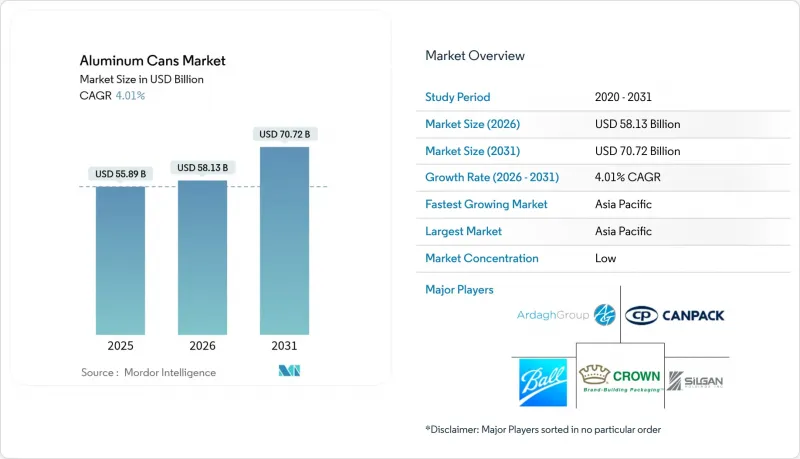
持續的政策壓力推動循環包裝的普及,飲料製造商迅速從PET和玻璃包裝轉向鋁罐,以及高成長地區的產能擴張,共同促成了鋁罐市場的穩定成長。歐盟的押金返還機制確保到2029年實現90%的回收率,顯著改善了回收的經濟效益,促使品牌所有者和加工商加快對閉合迴路生產的投資。亞太地區將繼續保持主導地位,這主要得益於都市區可支配收入的成長;而北美和歐洲將利用優質化和不斷變化的永續性需求來支撐價值成長。儘管產能瓶頸依然存在,但近期的一些收購和新工廠建設預計將逐步改善供需平衡。同時,高階飲料的推出、葡萄酒罐的舉措以及電商對防凹陷包裝的需求,也為鋁罐市場的發展提供了額外的推動力,使其應用範圍遠遠超出傳統的碳酸飲料領域。
全球鋁罐市場趨勢與洞察
高可回收性和閉合迴路收集系統
鋁材能夠永久保持其冶金性能,從而實現塑膠或玻璃無法企及的真正材料循環利用。根據美國罐頭製造商協會統計,迄今生產的所有鋁材中,75%仍在繼續使用,而再生鋁的重熔比原生鋁冶煉所需的能源減少了95%。歐洲冶煉企業康斯坦鋁業(Constellium)、埃爾瓦爾(Elval)、諾貝麗斯(Novelis)和斯佩拉(Speyra)於2024年4月統一了合金規格,使得飲料罐的生產能夠使用高達100%的再生材料。這每噸金屬可減少2.6噸二氧化碳排放,並降低致力於實現科學氣候目標的填充企業的營運成本。儘管美國的回收率在2023年下降至43%,但產業主導的投資旨在到2030年將其恢復到70%,到2050年恢復到90%,從而確保製罐廠的長期原料供應安全。歐洲、加拿大和美國部分州已實施押金返還計劃,每年處理超過400億個容器,顯著提高了回收量。這將降低廢料溢價,並提高一體化製罐企業的利潤率。這些結構性優勢相結合,預計將推動複合年成長率達到1.2個百分點,鞏固鋁作為循環飲料包裝的理想地位。
由於生產者責任延伸制度和塑膠稅政策,PET/玻璃材料正向鋁材過渡。
生產者延伸責任制(EPR)從根本上重塑了材料成本層級。英國2025年的EPR基準費率設定為每噸鋁266英鎊,遠低於PET、多層包裝袋或難以回收的軟包裝的附加稅。加州於2024年1月將容器回收計畫擴展至葡萄酒和烈酒,即時使適用的飲料罐市場每年增加4億個。同時,歐盟法規要求在2029年一次性飲料容器的回收率達到90%,這項標準由於鋁的消費後回收價值高而對鋁極為有利。澳洲要求到2040年食品級鋁的再生材料含量達到80%,也增強了全部區域鋁的需求前景。這些政策綜效提升了鋁的吸引力,促使中期成長預測值上調1.5個百分點。
來自軟性PET和紙盒包裝的競爭
多層紙盒和輕質寶特瓶將繼續佔據主導地位,尤其是在價格敏感的細分市場,例如自有品牌果汁、乳類飲料和常溫水,這些品牌所有者更注重單位成本而非可回收性。新型乙二醇改質技術正在延長PET瓶在碳酸飲料和營養敏感型混合飲料中的保存期限,從而削弱鋁的性能優勢。在開發中國家,消費者為永續性支付溢價的意願仍然較低,限制了其在商品化品類中的應用。然而,歐盟和加拿大對不可可再生塑膠包裝的禁令,以及日益嚴格的生產者延伸責任制(EPR)標準,將逐步削弱軟包裝的競爭優勢。預計這將暫時影響鋁罐市場在2025年至2027年間的複合年成長率,使其下降0.8%。
細分市場分析
到2025年,標準330毫升和355毫升罐裝飲料將佔總收入的55.38%,這主要得益於它們與填充線的兼容性、最快的生產線速度以及最佳的托盤密度。此外,該細分市場也受惠於終端用戶的高度認可,有助於降低全球裝瓶商的轉換成本。然而,以250毫升和310毫升為代表的細長罐裝飲料正以4.06%的複合年成長率快速成長,這主要歸功於其更佳的視覺效果以及在擁擠的零售貨架上更醒目的標識。開發機能飲料、低卡路里和即飲酒精飲料產品的公司重視細長罐裝,因為它可以帶來差異化的貨架空間和在冷藏櫃中更高的可見度。 Ball公司的Dynamark可變圖形平台使行銷人員能夠在標準罐和細長罐裝飲料上部署專屬設計,而無需停機,從而降低庫存風險並提高宣傳活動的靈活性。隨著印刷技術的進步導致單位成本下降,預計細長罐裝飲料將在高利潤SKU中獲得更高的市場佔有率。特殊形狀和紋理壓花工藝尚處於起步階段,但體現了不斷創新以進一步豐富消費者體驗的趨勢。預計整個鋁罐市場將繼續呈現標準量產規格和纖薄高階規格並存的局面,其中後者相對於產能將帶來更高的收入成長。
標準罐仍具有更優的物流經濟效益。一箱24罐355毫升的罐裝飲料比同等規格的玻璃包裝輕20%,從而減少了運輸排放,並降低了零售商在貨架上堆放飲料時造成人員受傷的風險。自1990年代以來採用的厚規格鋁罐,即使在金屬價格上漲的情況下,也為加工商提供了穩定的利潤率。然而,在注重視覺衝擊力和健康理念的生活方式導向市場中,品牌所有者已表現出願意承擔精製罐略微增加的成本,因為在這些市場中,每盎司的價值比視覺衝擊力和健康理念更為重要。到2030年,精製罐預計將獲得兩位數的市場佔有率,從而豐富包裝產品組合,同時保持與現有生產線設備的向下兼容性。這種罐型多樣化增強了鋁罐市場的整體韌性,並降低了希望進入細分飲料市場的裝瓶商的轉換成本。
到2025年,飲料業將佔全球銷售額的48.35%,這反映了碳酸飲料與輕質金屬包裝之間長達一個世紀的共生關係。碳酸飲料、能量飲料和運動飲料仍然是核心產品,確保了罐板軋延廠的規模經濟效益。含酒精氣泡水、CBD注入的滋補飲品和氮氣咖啡的持續兩位數成長將進一步拓寬飲料品類,即使在主流碳酸飲料銷量下滑的淡季,也能使罐體生產線接近滿負荷運作。同時,從除臭劑到噴霧油等氣霧劑產品預計將以5.21%的複合年成長率成長,成為鋁罐市場中成長最快的細分市場。品牌擁有者重視鋁的耐腐蝕性,克服了馬口鐵罐在含有油、推進劑和酒精的配方中常見的劣化問題。增強型牆面熨燙技術可承受高達 18 巴的壓力,使慕斯、顏料和鮮奶油容器能夠膨脹。
寵物食品和人類罐頭食品的市佔率雖小,但全年需求穩定,這得益於存貨周轉和緊急囤貨。 Silgan Holdings 預計 2024 年寵物食品罐頭銷售將達到兩位數成長,顯示高階寵物食品與金屬的氧氣阻隔性能相契合。醫藥和營養補充品應用是新的成長領域,充分利用了小容量管瓶的防竄改和精確稱重特性。終端用戶多元化進一步增強了鋁罐市場免受單一品類疲軟的影響,同時提供了多個成長點,可以分攤製造成本並加速資產回報。
區域分析
亞太地區佔全球鋁罐銷售額的40.74%,預計到2031年,該地區的鋁罐市場將以每年5.52%的速度成長。這主要得益於中國、印度和日本中產階級可支配收入的增加、都市區追求便利的消費文化以及對一次性塑膠製品日益嚴格的監管。中國憑藉其自主軋延能力和蓬勃發展的國內飲料產業,擺脫了對進口的依賴,繼續保持領先地位。印度鋁業公司(Hindalco)100億美元的擴張計畫將擴大印度國內金屬供應,加速當地可樂、能量飲料和預調酒生產商採用鋁罐。日本成熟的飲料市場正在推動高階茶和精品咖啡罐的創新,朝日集團的淨零排放承諾正在推動採購轉型。東南亞市場也蓬勃發展,暹羅聯合鋼鐵公司(NS-Siam United Steel)投資5,850萬美元擴大其鍍錫鋼板生產,並與海外鋁罐鋼板供應商合作。這顯示鋼鐵和鋁供應鏈可以走一條共同發展的道路。
北美地區是全球第二大鋁罐市場,但其出貨量已趨於穩定。該地區正致力於轉向利潤率更高的產品,例如高階纖細罐和特殊感溫變色罐。 2023年,波爾公司出貨約490億個鋁罐,佔該地區鋁罐市佔率的36%。隨著回收系統的擴展,其再生材料含量顯著提高。美國各州容器押金計畫的擴大以及加拿大生產者延伸責任制(EPR)的實施,增強了再生廢棄物的供應,使罐體板材的再生材料含量達到歷史新高。這降低了加工商的金屬採購成本。
儘管歐洲市場已趨於成熟,但仍在大力推動監管舉措,以加速從PET材質轉向鋁材質的轉變。隨著歐盟90%回收率目標的臨近,品牌商正在預付多年鋁罐供應合約款項以符合要求,從而穩定了加工商的訂單量。即將實施的英國押金訂單計畫每年將使140億個金屬容器進入循環經濟體系,並增強原料供應的穩定性。德國和法國正積極試行罐裝葡萄酒,拓展在啤酒市場以外的業務。這些因素正促使歐洲製造商增加產能、提高生產線速度並整合當地可再生能源,即使產量僅略有成長,也能確保該地區鋁罐市場的價值成長。
其他福利:
- Excel格式的市場預測(ME)表
- 3個月的分析師支持
目錄
第1章 引言
- 研究假設和市場定義
- 調查範圍
第2章調查方法
第3章執行摘要
第4章 市場情勢
- 市場概覽
- 市場促進因素
- 高可回收性和閉合迴路收集系統
- 由於生產者延伸責任制(EPR)和塑膠稅政策,PET/玻璃材質正轉向鋁材質。
- 即飲飲料、精釀飲料和機能飲料市場快速成長
- 適用於罐裝包裝的葡萄酒和烈酒包裝市場快速成長
- 電子商務對耐衝擊初級包裝的需求
- 市場限制
- 來自軟性PET和紙盒包裝形式的競爭
- 原生鋁價格和供應波動
- 區域罐頭製造能力瓶頸
- 範圍 3 脫碳成本上升
- 產業供應鏈分析
- 監管環境
- 技術展望
- 波特五力分析
- 供應商的議價能力
- 買方的議價能力
- 新進入者的威脅
- 替代品的威脅
- 競爭對手之間的競爭
第5章 市場規模與成長預測
- 按類型
- 標準
- 光滑
- 苗條的
- 其他類型
- 按最終用戶行業分類
- 飲料
- 酒精飲料
- 不含酒精的飲料
- 食物
- 罐頭食品
- 寵物食品(濕糧和零食)
- 氣霧劑
- 其他終端用戶產業
- 飲料
- 按結構
- 2 件
- 3 件
- 按產能
- 少於250毫升
- 251-500 ml
- 500毫升或以上
- 按地區
- 北美洲
- 美國
- 加拿大
- 墨西哥
- 南美洲
- 巴西
- 阿根廷
- 智利
- 南美洲其他地區
- 歐洲
- 英國
- 德國
- 法國
- 義大利
- 西班牙
- 俄羅斯
- 其他歐洲地區
- 亞太地區
- 中國
- 印度
- 日本
- 韓國
- 澳洲
- 馬來西亞
- 亞太其他地區
- 中東和非洲
- 中東
- 沙烏地阿拉伯
- 阿拉伯聯合大公國
- 土耳其
- 其他中東地區
- 非洲
- 南非
- 奈及利亞
- 其他非洲地區
- 中東
- 北美洲
第6章 競爭情勢
- 市場集中度
- 策略趨勢
- 市佔率分析
- 公司簡介
- Ball Corporation
- Crown Holdings Inc.
- Ardagh Group SA
- Silgan Holdings Inc.
- CAN-PACK SA
- Novelis Inc.
- ORG Technology Co. Ltd.
- Toyo Seikan Group Holdings Ltd.
- CPMC Holdings Limited
- Baosteel Packaging Co. Ltd.
- Envases Universales
- Tecnocap Group
- CCL Container Inc.
- Massilly Holding SAS
- Nampak Ltd.
- Saudi Arabia Packaging Industry(SAPIN)
- Can-One Berhad
- Alltub Deutschland GmbH
- Baofeng Group Co. Ltd.
- Trivium Packaging BV
第7章 市場機會與未來展望
The global aluminum cans market size in 2026 is estimated at USD 58.13 billion, growing from 2025 value of USD 55.89 billion with 2031 projections showing USD 70.72 billion, growing at 4.01% CAGR over 2026-2031.
Sustained policy pressure favoring circular packaging, rapid adoption by beverage producers shifting away from PET and glass, and capacity additions in high-growth regions collectively underpin this steady expansion. Deposit return systems that guarantee 90% collection by 2029 across the European Union sharply improve recycling economics, prompting brand owners and converters to accelerate investments in closed-loop can manufacturing. Asia Pacific retains its leadership position thanks to rising urban disposable incomes, while North America and Europe leverage premiumization and evolving sustainability mandates to support value growth. Capacity bottlenecks persist, yet recent acquisitions and greenfield builds point to a gradually improving supply balance. At the same time, premium beverage launches, wine-in-can initiatives, and e-commerce demand for dent-resistant formats create additional tailwinds that lift the aluminum cans market well beyond traditional carbonated soft drink applications.
Global Aluminum Cans Market Trends and Insights
High Recyclability and Closed-Loop Recovery Systems
Aluminum retains its metallurgical properties indefinitely, enabling genuine material circularity that plastic and glass cannot match. The Can Manufacturers Institute notes that 75% of all aluminum ever produced remains in active use today, and remelting secondary aluminum consumes 95% less energy than primary smelting. European smelters Constellium, Elval, Novelis, and Speira harmonized alloy specifications in April 2024 to allow beverage cans with up to 100% recycled content, cutting carbon emissions by 2.6 tons of CO2 per ton of metal and lowering operating costs for fillers committed to science-based climate targets. U.S. recycling rates slipped to 43% in 2023, but industry-backed investments aim to lift recovery to 70% by 2030 and 90% by 2050, ensuring long-term feedstock security for can plants. Deposit return programs covering more than 40 billion containers annually in Europe, Canada, and select U.S. states materially raise collection volumes, translating into lower scrap premiums and stronger margins for integrated can makers. These structural advantages collectively add 1.2 percentage points to forecast CAGR, cementing aluminum's reputation as the definitive circular beverage package.
Shift from PET/Glass to Aluminum Amid EPR and Plastics-Tax Mandates
Extended Producer Responsibility schemes fundamentally reshape material cost hierarchies. The United Kingdom's 2025 base EPR fee is set at GBP 266 per tonne for aluminum, far below levies applied to PET, multilayer pouches, or difficult-to-recycle flexibles. California expanded its Container Redemption Value program to wine and spirits in January 2024, immediately widening the addressable beverage can universe by 400 million units a year. Meanwhile, EU rules compel 90% collection of single-use beverage containers by 2029, a benchmark that heavily favors aluminum due to its high post-consumer scrap value. Australia will require 80% recycled content in food-grade aluminum by 2040, again reinforcing demand visibility along the entire Pacific Rim. These converging policies collectively boost aluminum's attractiveness and inject an additional 1.5 percentage point lift into medium-term growth forecasts.
Competition from Flexible PET and Carton Formats
Multilayer cartons and lightweight PET bottles continue to dominate price-sensitive segments, especially for private-label juices, dairy drinks, and shelf-stable water, where brand owners prioritize unit cost over recyclability. New glycol-modification techniques have extended PET shelf life for carbonation and sensitive nutrient blends, narrowing aluminum's functional advantage. In developing economies, consumer willingness to pay sustainability premiums remains low, restraining penetration in commoditized categories. However, upcoming bans on non-recyclable plastic formats across the EU and Canada, alongside hard-to-reach EPR thresholds, will gradually erode the competitive edge of flexibles. Net effect is a temporary 0.8% drag on the aluminum cans market CAGR from 2025-2027.
Other drivers and restraints analyzed in the detailed report include:
- Boom in RTD, Craft, and Functional Beverages
- Rapid Growth of Can-Friendly Wine and Spirits Packaging
- Price and Supply Volatility of Primary Aluminum
For complete list of drivers and restraints, kindly check the Table Of Contents.
Segment Analysis
Standard 330-mL and 355-mL bodies retained 55.38% of 2025 revenue, a share underpinned by filling-line compatibility, the highest line speeds, and optimal pallet density. The segment also capitalizes on broad end-user familiarity, which reduces changeover costs for global bottlers. Nevertheless, sleek cans, typified by 250-mL and 310-mL footprints, are advancing swiftly at a 4.06% CAGR thanks to their premium visual ratio and enhanced billboard effect in crowded retail aisles. Beverage formulators serving functional, low-calorie, and alcohol-ready-to-drink segments prize the elongated profile for differentiated shelf blocking and cold-box visibility. Ball's Dynamark variable-graphics platform lets marketers design limited-run art across both standard and sleek formats without line-stopovers, trimming inventory risk and fostering campaign agility. As printing technology lowers per-unit cost, sleek cans should secure incremental penetration in higher-margin SKUs. Specialty shapes and tactile embossing remain nascent but reflect ongoing innovation that further enriches consumer experience. Altogether, the aluminum cans market expects continued coexistence of standard mass-volume formats and sleek premium variants, with the latter responsible for outsized revenue gains relative to capacity installed.
Standard bodies still benefit from superior logistics economics: a 24-count case of 355-mL cans weighs 20% less than an equivalent glass pack, cutting freight emissions and reducing shelf-stack injuries for retailers. Their thicker gauge, tooled since the 1990s, affords converters a stable margin capture even at high metal premiums. Yet brand owners are willing to absorb a slight cost uplift for sleek cans targeting lifestyle positioning where visual disruption and perceived health cues trump per-ounce value. By 2030, sleek units are likely to reach double-digit market share, adding breadth to packaging portfolios while maintaining backward compatibility with legacy line equipment. As such, type diversification reinforces the broader aluminum cans market's resilience and keeps switching costs low for bottlers contemplating entry into niche beverage sub-categories.
Beverages claimed 48.35% of global revenues in 2025, mirroring a century-long symbiosis between carbonated drinks and lightweight metal containers. Carbonated soft drinks, energy shots, and sports hydration products remain workhorse volumes that secure economies of scale for can-sheet rolling mills. Sustained double-digit launches of spiked seltzers, CBD-infused tonics, and nitro-coffee further widen beverage category breadth, allowing can lines to run at near-full utilization even during off-season contractions for mainstream sodas. Meanwhile, aerosol fillings from deodorants to cooking sprays are forecast to post a 5.21% CAGR, marking them the fastest mover within the aluminum cans market. Brand owners appreciate aluminum's corrosion resistance for formulations containing oils, propellants, or alcohols that degrade tinplate alternatives. Enhanced wall ironing processes enable pressure ratings up to 18 bar, paving the way for mousse, paint, and whipped-cream formats as well.
Pet food and human canned foods hold a smaller slice but deliver stable year-round demand anchored in inventory rotation and emergency-stock purchasing behaviors. Silgan Holdings witnessed double-digit pet food can revenue growth in 2024, illustrating premium pet nutrition's alignment with metal's oxygen-barrier features. Pharmaceutical and nutraceutical applications occupy an emerging frontier, leveraging tamper-evidence and precise metering features of small-volume aluminum vials. Collectively, end-user diversification further insulates the aluminum cans market against single-category downturns while providing multiple growth vectors that absorb manufacturing overhead and accelerate asset payback.
The Aluminum Cans Market Report is Segmented by Type (Standard, Sleek, Slim, and More), End-User Industry (Beverage [Alcoholic Beverages, and Non-Alcoholic Beverages], Food [Canned Food, and Pet Food], Aerosol, and More), Structure (2-Piece, and 3-Piece), Capacity (Up To 250 Ml, 251-500 Ml, and Above 500 Ml), and Geography (North America, Europe, Asia Pacific, and More). The Market Forecasts are Provided in Terms of Value (USD).
Geography Analysis
Asia Pacific contributes 40.74% of global sales, and its aluminum cans market size is projected to advance 5.52% annually to 2031, underwritten by rising middle-class disposable incomes, urban convenience culture, and authoritative restrictions on single-use plastics in China, India, and Japan. China retains pole position with in-house rolling capacity and a vibrant domestic beverage sector that collectively eclipses import dependence. Hindalco's USD 10 billion expansion amplifies India's domestic metal supply in anticipation of can adoption by local cola, energy drink, and alcopop producers. Japan's mature beverage environment spurs innovation in premium tea and craft coffee cans, aided by Asahi Group's net-zero pledges driving procurement switch-overs. Southeast Asia is equally dynamic; NS-Siam United Steel allocated USD 58.5 million to bolster tinplate output, yet concurrently partners with foreign can-sheet suppliers, signaling blended development paths for both ferrous and aluminum supply chains.
North America ranks second in absolute size, though its unit volumes plateau. Instead, the region focuses on trading up to sleek, slim, and specialty thermochromic cans that fetch higher margins. Ball shipped roughly 49 billion containers in 2023, representing 36% regional aluminum cans market share and delivering significant recycled content progress as reclamation systems scale. U.S. state-level container deposit expansions plus Canada's EPR rollouts strengthen secondary scrap supply, raising recycled content in can body sheet to record highs and lowering metal purchase costs for converters.
Europe, while mature, leans heavily on regulatory levers to accelerate modal shift from PET to aluminum. With the EU's 90% collection target looming, brand owners pre-pay for compliance by booking multi-year aluminum can supply contracts that stabilize converter order books. The United Kingdom's upcoming deposit return program will funnel 14 billion metal containers into closed-loop paths yearly, solidifying feedstock security. Germany and France aggressively promote wine-in-can pilots, expanding beyond beer's established foothold. These factors allow European producers to deploy new capacity while raising line speeds and integrating on-site renewable energy, ensuring that the aluminum cans market in the bloc grows in value even where volumes edge upward modestly.
- Ball Corporation
- Crown Holdings Inc.
- Ardagh Group S.A.
- Silgan Holdings Inc.
- CAN-PACK S.A.
- Novelis Inc.
- ORG Technology Co. Ltd.
- Toyo Seikan Group Holdings Ltd.
- CPMC Holdings Limited
- Baosteel Packaging Co. Ltd.
- Envases Universales
- Tecnocap Group
- CCL Container Inc.
- Massilly Holding S.A.S
- Nampak Ltd.
- Saudi Arabia Packaging Industry (SAPIN)
- Can-One Berhad
- Alltub Deutschland GmbH
- Baofeng Group Co. Ltd.
- Trivium Packaging B.V.
Additional Benefits:
- The market estimate (ME) sheet in Excel format
- 3 months of analyst support
TABLE OF CONTENTS
1 INTRODUCTION
- 1.1 Study Assumptions and Market Definition
- 1.2 Scope of the Study
2 RESEARCH METHODOLOGY
3 EXECUTIVE SUMMARY
4 MARKET LANDSCAPE
- 4.1 Market Overview
- 4.2 Market Drivers
- 4.2.1 High recyclability and closed-loop recovery systems
- 4.2.2 Shift from PET/glass to aluminum amid EPR and plastics-tax mandates
- 4.2.3 Boom in RTD, craft and functional beverages
- 4.2.4 Rapid growth of can-friendly wine and spirits packaging (under-reported)
- 4.2.5 E-commerce's need for dent-resistant primary packaging (under-reported)
- 4.3 Market Restraints
- 4.3.1 Competition from flexible PET and carton formats
- 4.3.2 Price and supply volatility of primary aluminum
- 4.3.3 Regional can-making capacity bottlenecks (under-reported)
- 4.3.4 Rising Scope-3 decarbonization compliance costs (under-reported)
- 4.4 Industry Supply Chain Analysis
- 4.5 Regulatory Landscape
- 4.6 Technological Outlook
- 4.7 Porter's Five Forces Analysis
- 4.7.1 Bargaining Power of Suppliers
- 4.7.2 Bargaining Power of Buyers
- 4.7.3 Threat of New Entrants
- 4.7.4 Threat of Substitutes
- 4.7.5 Intensity of Competitive Rivalry
5 MARKET SIZE AND GROWTH FORECASTS (VALUE)
- 5.1 By Type
- 5.1.1 Standard
- 5.1.2 Sleek
- 5.1.3 Slim
- 5.1.4 Other Types
- 5.2 By End-user Industry
- 5.2.1 Beverage
- 5.2.1.1 Alcoholic Beverages
- 5.2.1.2 Non-alcoholic Beverages
- 5.2.2 Food
- 5.2.2.1 Canned Food
- 5.2.2.2 Pet Food (Wet and Treats)
- 5.2.3 Aerosol
- 5.2.4 Other End-user Industries
- 5.2.1 Beverage
- 5.3 By Structure
- 5.3.1 2-piece
- 5.3.2 3-piece
- 5.4 By Capacity
- 5.4.1 Up to 250 ml
- 5.4.2 251 - 500 ml
- 5.4.3 More than 500 ml
- 5.5 By Geography
- 5.5.1 North America
- 5.5.1.1 United States
- 5.5.1.2 Canada
- 5.5.1.3 Mexico
- 5.5.2 South America
- 5.5.2.1 Brazil
- 5.5.2.2 Argentina
- 5.5.2.3 Chile
- 5.5.2.4 Rest of South America
- 5.5.3 Europe
- 5.5.3.1 United Kingdom
- 5.5.3.2 Germany
- 5.5.3.3 France
- 5.5.3.4 Italy
- 5.5.3.5 Spain
- 5.5.3.6 Russia
- 5.5.3.7 Rest of Europe
- 5.5.4 Asia Pacific
- 5.5.4.1 China
- 5.5.4.2 India
- 5.5.4.3 Japan
- 5.5.4.4 South Korea
- 5.5.4.5 Australia
- 5.5.4.6 Malaysia
- 5.5.4.7 Rest of Asia Pacific
- 5.5.5 Middle East and Africa
- 5.5.5.1 Middle East
- 5.5.5.1.1 Saudi Arabia
- 5.5.5.1.2 United Arab Emirates
- 5.5.5.1.3 Turkey
- 5.5.5.1.4 Rest of Middle East
- 5.5.5.2 Africa
- 5.5.5.2.1 South Africa
- 5.5.5.2.2 Nigeria
- 5.5.5.2.3 Rest of Africa
- 5.5.5.1 Middle East
- 5.5.1 North America
6 COMPETITIVE LANDSCAPE
- 6.1 Market Concentration
- 6.2 Strategic Moves
- 6.3 Market Share Analysis
- 6.4 Company Profiles (includes Global level Overview, Market level overview, Core Segments, Financials as available, Strategic Information, Market Rank/Share for key companies, Products and Services, and Recent Developments)
- 6.4.1 Ball Corporation
- 6.4.2 Crown Holdings Inc.
- 6.4.3 Ardagh Group S.A.
- 6.4.4 Silgan Holdings Inc.
- 6.4.5 CAN-PACK S.A.
- 6.4.6 Novelis Inc.
- 6.4.7 ORG Technology Co. Ltd.
- 6.4.8 Toyo Seikan Group Holdings Ltd.
- 6.4.9 CPMC Holdings Limited
- 6.4.10 Baosteel Packaging Co. Ltd.
- 6.4.11 Envases Universales
- 6.4.12 Tecnocap Group
- 6.4.13 CCL Container Inc.
- 6.4.14 Massilly Holding S.A.S
- 6.4.15 Nampak Ltd.
- 6.4.16 Saudi Arabia Packaging Industry (SAPIN)
- 6.4.17 Can-One Berhad
- 6.4.18 Alltub Deutschland GmbH
- 6.4.19 Baofeng Group Co. Ltd.
- 6.4.20 Trivium Packaging B.V.
7 MARKET OPPORTUNITIES AND FUTURE OUTLOOK
- 7.1 White-space and Unmet-Need Assessment

 鋁罐市場報告:按應用和地區分類 2026-2034 年日本鋁罐市場:規模、佔有率、趨勢和預測:按應用、地區分類,2026-2034年
 罐裝飲料支架市場:按支架類型、容量、材料、最終用途和分銷管道分類,全球預測(2026-2032年)
 鋁罐市場規模、佔有率及成長分析(按產品類型、銷售、最終用途及地區分類)-2026-2033年產業預測
 鋁製單體罐:全球市場佔有率和排名、總收入和需求預測(2025-2031 年)
 杯架市場:按產品類型、按材料、按最終用戶、按分銷管道、按地區
 全球鋁製整體罐市場:2031 年預測
 2030 年罐架市場預測:按產品、材料、產能、設計風格、分銷管道、最終用戶和地區進行全球分析
 全球鋁罐市場(2024-2028)