


 |
市場調查報告書
商品編碼
1940621
協作機器人:市場佔有率分析、產業趨勢與統計、成長預測(2026-2031)Collaborative Robot - Market Share Analysis, Industry Trends & Statistics, Growth Forecasts (2026 - 2031) |
||||||

※ 本網頁內容可能與最新版本有所差異。詳細情況請與我們聯繫。
預計到 2025 年,協作機器人市場價值將達到 19 億美元,到 2031 年將達到 57.2 億美元,高於 2026 年的 22.8 億美元。
預計在預測期(2026-2031 年)內,複合年成長率將達到 20.15%。
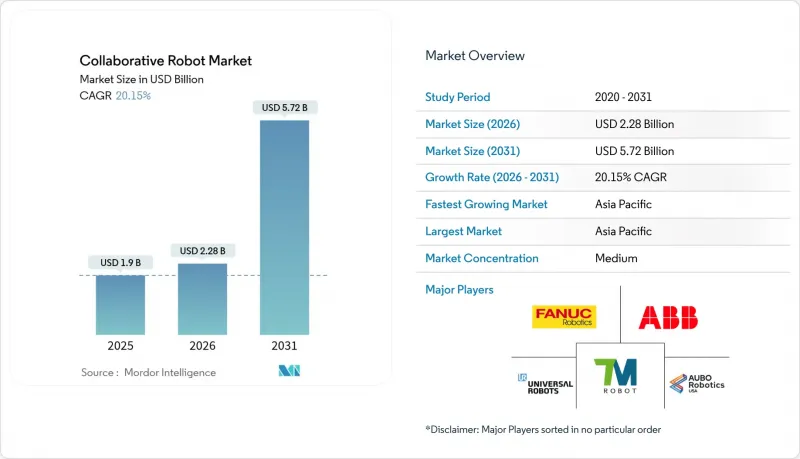
更新後的 ISO/TS 15066 標準明確了安全要求,稅收優惠縮短了投資回收期,勞動力短缺也使得彈性自動化迫在眉睫,這些因素共同推動了市場需求。製造商擴大採用協作機器人來提高生產效率,而非取代工人,而日益成熟的軟體和簡化的程式流程正在縮短引進週期。有效載荷能力的提升、倉庫自動化需求的成長以及服務業應用場景的不斷擴展,都在推動全球價值鏈中協作機器人的普及應用。
全球協作機器人市場趨勢與洞察
針對多品種、小批量生產的經濟高效的搬遷方案
在歐洲和北美的工廠裡,協作機器人現在在同一班次內輪換使用組裝單元,將換線時間從數週縮短到數小時。這種靈活性使汽車供應商能夠承接利潤率小規模、規模更小的訂單,同時也能享受自動化帶來的優勢。
為中小企業推廣即插即用的協作機器人OEM業務
新型控制器、簡化的佈線和預先載入的任務庫使中小製造商無需專業整合商即可採用協作機器人。 Universal Robots 的 UR 系列升級版透過更快的循環時間和直覺的手動引導,降低了整體擁有成本,從而為成千上萬的首次用戶打開了協作機器人市場的大門。
現有PLC架構中的整合瓶頸
傳統 PLC 通常缺乏即時乙太網路或安全操作通道,而將協作機器人添加到使用了幾十年的生產線上需要高成本的控制器升級——這些費用導致一些汽車工廠推遲採用協作機器人,直到對整條生產線維修。
細分市場分析
截至2025年,5公斤以下的協作機器人佔據了52.40%的市場佔有率,這主要得益於電子和醫療設備組裝等對精度要求極高的行業。同時,10-20千噸的協作機器人正以22.95%的複合年成長率快速成長,顯示其在碼垛、機器維護和汽車子組裝等領域的應用日益廣泛。中等重量級的協作機器人還提供了更廣泛的操作範圍,使工人無需移動到新的安全區域即可在生產線旁進行作業。雖然重型(20公斤以上)協作機器人目前仍屬於小眾市場,但在油漆和化學等對防爆認證要求極高的環境中,它們的價值日益凸顯。隨著機器人製造商不斷改進動態扭矩感測技術,預計從2028年起,中等重量級協作機器人市場的成長速度將超過輕型協作機器人市場。
在5-9千噸的負載中,供應商正在將視覺和人工智慧技術整合到機器人中,以實現亞秒級的取放循環,從而滿足半導體後端加工的需求。這種轉變反映了買家對兼具靈活性和強大功能,並能降低設備複雜性的機器人的需求。利用協作機器人市場的製造商可以實現不同負載等級的夾爪和控制器標準化,從而簡化備件管理和操作員培訓。
儘管硬體在2025年仍佔總營收的71.35%,但隨著用戶將智慧化置於機械性能之上,軟體領域正以27.15%的複合年成長率快速成長。視覺引導路徑規劃、車隊編配和預測性維護模組正在將一次性硬體銷售轉化為持續的授權收入,並將供應商的收入來源轉向數位服務。協作機器人現在標配ROS相容的API和雲端連接器,從而能夠快速整合應用程式。
諮詢和生命週期服務的成長反映了中小企業對外部專業知識的依賴。供應商正將安全評估、程式設計和操作員技能提升納入訂閱模式,進一步擴大協作機器人市場。未來,軟體定義的有效載荷升級將縮短更換週期,使工廠管理人員能夠延長機器人框架的運作,並透過韌體增強提升其效能。
協作機器人市場報告按有效載荷(<5 kg、5-9 kg、10-20 kg、>20 kg)、組件(例如硬體)、應用(物料輸送、取放)、終端用戶行業(例如電子、汽車)、程式設計方法(例如手動引導)和地區進行細分。市場預測以美元以金額為準。
區域分析
到2025年,亞洲將佔全球收入的40.55%,這主要得益於中國「十四五」規劃中兆元人民幣的機器人產業發展戰略以及日本融合人工智慧、物聯網和下一代自動化技術的「社會5.0」計畫。中國的電子和電池工廠正在部署協作機器人進行精密黏合和電池堆疊,而日本的醫院正在進行老年護理服務機器人的現場試驗。韓國的「第四個智慧機器人基本規劃」為國內中小企業部署協作機器人解決方案提供資金支持,從而強化了其供應鏈。
北美位居第二。美國的回流政策和創紀錄的勞動力短缺正在推動市場發展。獲得晶片補貼的半導體工廠正在部署雙臂協作機器人進行晶圓搬運,從而降低運輸過程中的污染風險。加拿大汽車零件供應商正在安裝中型機器人用於壓鑄件的精加工,而墨西哥的加工出口企業(maquiladoras)則正在採用協作機器人來平衡不斷上漲的工資水平和出口競爭力。跨境標準化使得整合商能夠重複利用單元設計,從而加速了協作機器人的普及應用。
在歐洲,德國的工業4.0燈塔計劃正大力推動將製造執行系統(MES)數據與協作機器人集群連結。歐洲地平線津貼正用於人機介面研究,而開發人工智慧運動規劃Start-Ups的新創公司在丹麥和義大利蓬勃發展。一家法國航太工廠選擇協作機器人進行碳纖維修整,正是因為它們輕巧且符合人體工學。不斷上漲的能源成本促使工廠尋求更有效率的佈局,而協作機器人則比起籠式機器人面積較小。此外,環保法規也重視協作機器人相比液壓壓平機更低的待機電力消耗,這進一步推動了協作機器人市場在永續性永續發展的地區的擴張。
其他福利:
- Excel格式的市場預測(ME)表
- 3個月的分析師支持
目錄
第1章 引言
- 研究假設和市場定義
- 調查範圍
第2章調查方法
第3章執行摘要
第4章 市場情勢
- 市場概覽
- 市場促進因素
- 在多品種、小批量生產中實現經濟高效的搬遷(歐洲)
- 中小企業的即插即用型協作機器人OEM推廣(北美)
- 快速的電子商務履約推動了倉庫中協作機器人的應用(亞洲)
- 更新至 ISO/TS 15066 標準可緩解責任問題(全球)
- 美國為鼓勵自動化企業回流而提供的稅務優惠
- 市場限制
- 與現有PLC架構整合方面的瓶頸
- 負載容量和速度之間的權衡限制了重型作業。
- 分散式組件生態系統推高了中小企業的整體擁有成本。
- 人機協作工作單元的承保缺口
- 價值/供應鏈分析
- 監理與技術展望
- 波特五力模型
- 供應商的議價能力
- 買方的議價能力
- 新進入者的威脅
- 競爭對手之間的競爭
- 替代品的威脅
- 定價分析
第5章 市場規模與成長預測
- 按有效載荷
- 5公斤以下
- 5~9kg
- 10~20kg
- 超過20公斤
- 按組件
- 硬體
- 軟體
- 服務
- 諮詢與整合
- 維護和培訓
- 透過使用
- 物料輸送
- 揀選和放置
- 組裝
- 碼垛和卸垛
- 焊接和釬焊
- 品質檢驗和測試
- 包裝
- 其他用途
- 按最終用戶行業分類
- 車
- 電子和半導體
- 一般製造業
- 食品/飲料
- 化學品和製藥
- 物流與電子商務
- 醫療保健和生命科學
- 金屬加工
- 其他行業
- 透過程式方法(僅定性)
- 指南教學/直接教學法
- 引導式教學
- 離線程式設計與仿真
- 按地區
- 北美洲
- 美國
- 加拿大
- 墨西哥
- 歐洲
- 德國
- 英國
- 法國
- 義大利
- 北歐國家
- 亞太地區
- 中國
- 日本
- 印度
- 韓國
- 澳洲和紐西蘭
- 南美洲
- 巴西
- 阿根廷
- 中東
- 阿拉伯聯合大公國
- 沙烏地阿拉伯
- 土耳其
- 非洲
- 南非
- 其他非洲地區
- 北美洲
第6章 競爭情勢
- 市場集中度
- 策略趨勢
- 市佔率分析
- 公司簡介
- Universal Robots AS
- FANUC Corp.
- ABB Ltd.
- KUKA AG
- Yaskawa Electric Corp.
- Techman Robot Inc.
- Doosan Robotics Inc.
- AUBO Robotics
- Kawasaki Heavy Industries Ltd.
- Omron Corporation
- Epson Robots
- Precise Automation Inc.
- Staubli International AG
- Hanwha Robotics
- Denso Wave Inc.
- Comau SpA
- Hyundai Robotics
- Festo SE and Co. KG
第7章 市場機會與未來展望
The Collaborative Robot Market was valued at USD 1.9 billion in 2025 and estimated to grow from USD 2.28 billion in 2026 to reach USD 5.72 billion by 2031, at a CAGR of 20.15% during the forecast period (2026-2031).
Demand accelerates as updated ISO/TS 15066 standards clarify safety requirements, tax incentives lower payback periods, and labor shortages raise the urgency of flexible automation. Manufacturers increasingly deploy cobots to lift productivity rather than replace workers, while maturing software and simplified programming shorten deployment cycles. Growing payload capacities, warehouse automation needs, and widening service-sector use cases strengthen adoption momentum across global value chains.
Global Collaborative Robot Market Trends and Insights
Cost-effective Redeployment in High-mix Manufacturing
European and North American factories now rotate cobots across assembly cells within a single shift, cutting changeover from weeks to hours This agility lets automotive suppliers accept smaller, high-margin orders while retaining automation gains.
OEM Push Toward Plug-and-Play Cobots for SMEs
New controllers, capped wiring, and pre-loaded task libraries allow small manufacturers to install cobots without specialist integrators. Universal Robots' UR-series refresh shows how cycle-time gains and intuitive hand-guiding shrink total cost of ownership, opening the collaborative robot market to thousands of first-time users
Integration Bottlenecks with Brownfield PLC Architectures
Legacy PLCs often lack real-time Ethernet or safe-motion channels, forcing costly controller upgrades when cobots are added to decades-old lines . The expense pushes some automotive plants to defer adoption until full line overhauls.
Other drivers and restraints analyzed in the detailed report include:
- Rapid E-commerce Fulfilment Drives Warehouse Cobots
- ISO/TS 15066 Updates Easing Liability Concerns
- Payload-Speed Trade-offs Limiting Heavy-duty Tasks
For complete list of drivers and restraints, kindly check the Table Of Contents.
Segment Analysis
Sub-5 kg models controlled 52.40% of the collaborative robot market in 2025, largely in electronics and medical device assembly where precision is paramount. The 10-20 kg band, however, is pacing a 22.95% CAGR, signaling rising interest in palletizing, machine tending, and automotive sub-assembly. Mid-range units also integrate longer reaches, enabling line-side work without moving humans to new safety zones. Heavy-duty (>20 kg) cobots remain niche but prove valuable in paint and chemical environments where explosion-proof certification is essential. As robot makers refine dynamic torque sensing, the collaborative robot market size for mid-payloads is projected to outgrow light units after 2028.
Within 5-9 kg, vendors package vision and AI for pick-and-place cycles under one second, catering to semiconductor back-end operations. The shift reflects buyers' search for units that bridge dexterity and strength, reducing fleet complexity. Manufacturers leveraging the collaborative robot market gain the option to standardize grippers and controllers across payload classes, simplifying spare-parts management and operator training.
Hardware generated 71.35% of revenue in 2025, yet software is advancing 27.15% annually as users emphasize intelligence over mechanics. Vision-guided path planning, fleet orchestration, and predictive maintenance modules convert one-time hardware sales into recurring licenses, moving vendor profit pools toward digital services. Cobots now ship with ROS-compatible APIs and cloud connectors, allowing quick app integrations.
Growth in consulting and lifecycle services reflects SME reliance on external expertise. Vendors bundle safety assessment, programming, and operator up-skilling into subscription models, further enlarging the collaborative robot market. Over time, software-defined payload upgrades may lower replacement cycles, letting plant managers keep frames in service longer while lifting performance through firmware enhancements.
Collaborative Robots Market Report is Segmented Into by Payload (Less Than 5Kg, 5-9 Kg, 10-20 Kg, More Than 20 KG), Component (Hardware and More), Application (Material Handling, Pick and Place and More), End-User Industry (Electronics, Automotive, and More), Programming Method (Hand-Guiding and More), and Geography. The Market Forecasts are Provided in Terms of Value (USD).
Geography Analysis
Asia generated 40.55% of 2025 revenue, propelled by China's 1-trillion-yuan robotics push under the 14th Five-Year Plan and Japan's Society 5.0 roadmap that blends AI, IoT, and next-generation automation . Chinese electronics and battery plants install cobots for precision gluing and cell stacking, while Japanese hospitals test service robots for elder care. South Korea's Fourth Intelligent Robot Basic Plan funds local SMEs to adopt collaborative solutions, reinforcing domestic supply chains.
North America ranks second. U.S. reshoring incentives combined with record labor scarcity elevate the market. Semiconductor fabs subsidized by the CHIPS Act integrate dual-arm cobots for wafer loading, shrinking transport contamination risk. Canadian auto parts suppliers adopt mid-payload units for die-casting part finishing, while Mexican maquiladoras deploy cobots to balance wage inflation with export competitiveness. Cross-border standardization allows integrators to reuse cell designs, accelerating rollout.
Europe shows robust uptake led by Germany's Industrie 4.0 lighthouse projects linking MES data to cobot fleets. Horizon Europe grants finance human-machine interface research, spurring startups in Denmark and Italy that build AI motion-planning stacks. French aerospace plants choose cobots for carbon-fiber trimming, citing weight reduction and ergonomic gains. Rising energy costs push factories toward leaner layouts where cobots save floor space relative to fenced robots. Environmental regulations also favor cobots' lower idle power draw compared with hydraulic presses, aiding the collaborative robot market size in sustainability-conscious regions.
- Universal Robots AS
- FANUC Corp.
- ABB Ltd.
- KUKA AG
- Yaskawa Electric Corp.
- Techman Robot Inc.
- Doosan Robotics Inc.
- AUBO Robotics
- Kawasaki Heavy Industries Ltd.
- Omron Corporation
- Epson Robots
- Precise Automation Inc.
- Staubli International AG
- Hanwha Robotics
- Denso Wave Inc.
- Comau SpA
- Hyundai Robotics
- Festo SE and Co. KG
Additional Benefits:
- The market estimate (ME) sheet in Excel format
- 3 months of analyst support
TABLE OF CONTENTS
1 INTRODUCTION
- 1.1 Study Assumptions and Market Definition
- 1.2 Scope of the Study
2 RESEARCH METHODOLOGY
3 EXECUTIVE SUMMARY
4 MARKET LANDSCAPE
- 4.1 Market Overview
- 4.2 Market Drivers
- 4.2.1 Cost-effective Re-deployment in High-mix Manufacturing (Europe)
- 4.2.2 OEM Push Toward Plug-and-Play Cobots for SMEs (North America)
- 4.2.3 Rapid E-Commerce Fulfilment Drives Warehouse Cobots (Asia)
- 4.2.4 ISO/TS 15066 Updates Easing Liability Concerns (Global)
- 4.2.5 Tax Incentives for Reshoring Automation (United States)
- 4.3 Market Restraints
- 4.3.1 Integration Bottlenecks with Brownfield PLC Architectures
- 4.3.2 Payload-Speed Trade-offs Limiting Heavy-duty Tasks
- 4.3.3 Fragmented Component Ecosystem Inflates TCO for SMEs
- 4.3.4 Insurance Underwriting Gaps for HumanRobot Workcells
- 4.4 Value / Supply-Chain Analysis
- 4.5 Regulatory and Technological Outlook
- 4.6 Porters Five Forces
- 4.6.1 Bargaining Power of Suppliers
- 4.6.2 Bargaining Power of Buyers
- 4.6.3 Threat of New Entrants
- 4.6.4 Intensity of Competitive Rivalry
- 4.6.5 Threat of Substitute Products
- 4.7 Pricing Analysis
5 MARKET SIZE AND GROWTH FORECASTS (VALUES)
- 5.1 By Payload
- 5.1.1 Less than 5 kg
- 5.1.2 5 - 9 kg
- 5.1.3 10 - 20 kg
- 5.1.4 More than 20 kg
- 5.2 By Component
- 5.2.1 Hardware
- 5.2.2 Software
- 5.2.3 Services
- 5.2.3.1 Consulting and Integration
- 5.2.3.2 Maintenance and Training
- 5.3 By Application
- 5.3.1 Material Handling
- 5.3.2 Pick and Place
- 5.3.3 Assembly
- 5.3.4 Palletizing and De-palletizing
- 5.3.5 Welding and Soldering
- 5.3.6 Quality Testing and Inspection
- 5.3.7 Packaging
- 5.3.8 Other Applications
- 5.4 By End-user Industry
- 5.4.1 Automotive
- 5.4.2 Electronics and Semiconductors
- 5.4.3 General Manufacturing
- 5.4.4 Food and Beverage
- 5.4.5 Chemicals and Pharmaceuticals
- 5.4.6 Logistics and E-commerce
- 5.4.7 Healthcare and Life Sciences
- 5.4.8 Metals and Machining
- 5.4.9 Other Industries
- 5.5 By Programming Method (qualitative only)
- 5.5.1 Hand-Guiding / Direct Teaching
- 5.5.2 Lead-through Teaching
- 5.5.3 Offline Programming and Simulation
- 5.6 By Geography
- 5.6.1 North America
- 5.6.1.1 United States
- 5.6.1.2 Canada
- 5.6.1.3 Mexico
- 5.6.2 Europe
- 5.6.2.1 Germany
- 5.6.2.2 United Kingdom
- 5.6.2.3 France
- 5.6.2.4 Italy
- 5.6.2.5 Nordics
- 5.6.3 Asia-Pacific
- 5.6.3.1 China
- 5.6.3.2 Japan
- 5.6.3.3 India
- 5.6.3.4 South Korea
- 5.6.3.5 Australia and New Zealand
- 5.6.4 South America
- 5.6.4.1 Brazil
- 5.6.4.2 Argentina
- 5.6.5 Middle East
- 5.6.5.1 United Arab Emirates
- 5.6.5.2 Saudi Arabia
- 5.6.5.3 Turkey
- 5.6.6 Africa
- 5.6.6.1 South Africa
- 5.6.6.2 Rest of Africa
- 5.6.1 North America
6 COMPETITIVE LANDSCAPE
- 6.1 Market Concentration
- 6.2 Strategic Moves
- 6.3 Market Share Analysis
- 6.4 Company Profiles
- 6.4.1 Universal Robots AS
- 6.4.2 FANUC Corp.
- 6.4.3 ABB Ltd.
- 6.4.4 KUKA AG
- 6.4.5 Yaskawa Electric Corp.
- 6.4.6 Techman Robot Inc.
- 6.4.7 Doosan Robotics Inc.
- 6.4.8 AUBO Robotics
- 6.4.9 Kawasaki Heavy Industries Ltd.
- 6.4.10 Omron Corporation
- 6.4.11 Epson Robots
- 6.4.12 Precise Automation Inc.
- 6.4.13 Staubli International AG
- 6.4.14 Hanwha Robotics
- 6.4.15 Denso Wave Inc.
- 6.4.16 Comau SpA
- 6.4.17 Hyundai Robotics
- 6.4.18 Festo SE and Co. KG
7 MARKET OPPORTUNITIES AND FUTURE OUTLOOK
- 7.1 White-Space and Unmet-Need Assessment

 2026年全球協作機器人關節模組市場報告
 機器人關節模組市場:按類型、自由度、控制方式、材質、負載能力、機器人類型和最終用戶分類-2026-2032年全球預測輕型協作機械臂市場:按負載能力、機器人類型、終端用戶產業和應用分類-全球預測,2026-2032年
 協作機器人市場分析及預測(至2035年):依類型、產品、技術、組件、應用、最終用戶、功能、安裝類型及部署方式分類協同製造解決方案市場分析及預測(至2035年):依類型、產品類型、服務、技術、組件、應用、流程、最終使用者、部署類型及功能分類行動協作機器人市場分析及預測(至2035年):按類型、產品類型、服務、技術、組件、應用、部署類型、最終用戶和功能分類
 全球協作機器人市場規模、佔有率、趨勢和成長分析報告(2026-2034年)全球移動協作機器人市場規模、佔有率、趨勢和成長分析報告(2026-2034年)2026年全球協作機器人市場報告
 協作機器人市場-全球產業規模、佔有率、趨勢、機會及預測(依酬載能力、應用、產業、地區及競爭格局分類,2021-2031年)